Community celebrates fine artist Milton 510 Bowens’ 20 years of service to art and education
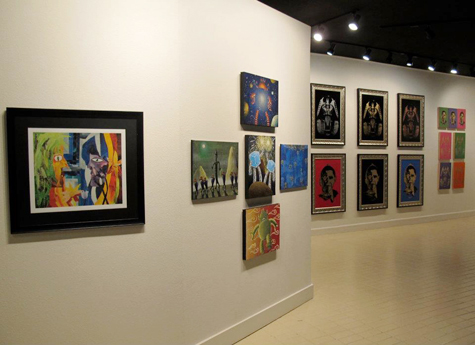
Beatnik Studios on 17th between Broadway and X Street blends harmoniously with Milton 510 Bowens’ latest solo exhibition, Echoes of the Sweetest Sounds.
The former is an urban loft-style gallery made of brick that brings photography, music and local artistry to a shared space. The latter is a well-honored fine artist’s resolve to educate about music, history and social justice through art.
Echoes… celebrates 20 years of Bowens’ work with pieces never before seen in Sacramento and gives a unique spin to this year’s local Black Music Month events (renamed African-American Music Appreciation Month by President Barack Obama).
In the last 20 years, Bowens has reshaped his philosophy as a fine artist and taken the approach of a community activist and documentarian. Since, he has achieved great recognition nationally. Starting in 2009, his art became part of the syllabus for a course study in the Harlem Renaissance at Cornell University’s Africana Studies and Research Center. He is also a spokesperson for the K—8 art immersion program Any Given Child in public schools across the country in conjunction with the Kennedy Center for the Performing Arts in Washington, D.C.
Bowens has had paintings showcased at the National Civil Rights Museum in Memphis, Tenn.; been touted by local newspapers as having the largest solo exhibition (150 large pieces) in the United States in his hometown of Oakland; received this year’s Sacramento Artistic License Award; and received a resolution from the California Legislative Black Caucus for his work on arts and education in public schools.
Undoubtedly, this unconventional exhibition has a message.
“After you’ve done something for 20 years, it’s hard to choose what to show, but instead of doing a montage of random pieces…I chose those [pertaining to] music,” Bowens says, leaning back and looking relaxed on a sofa at the gallery after grabbing lunch at Slice of Broadway. “Beatnik, jazz, counterculture…it all goes together.”
The pieces come from Bowens’ Afro-Classical collection and some from his Soul Music series. He journeys through the jazz era and its historical importance in Afro-Classical with recurring images of everything from records, piano keys and musicians’ portraits to railroad tracks, slave ownership documents and tally marks. On his pieces, he writes what he feels, quotes that he admires and pushes the viewer to take a closer look, “Don’t just hear what the work is saying, listen.”
Bowens mixes media with organic materials like cloth, doilies and prints for “richer depth and more substance.” In pieces like God Bless the Child and Straight No Chaser, the use of children’s building blocks and rope along the top of the canvas adds another three-dimensional element.
“I am trying to poetically encourage people to linger a little bit,” he says of his collages with lyricism that sometimes holds a double meaning.
Bowens says he doesn’t approach his art with a “painterly perspective,” though he has the training and knows the techniques. He attended art schools early on as a high school student in Oakland and later at the California College of the Arts and multiple schools while serving in the Army Special Forces. Two military museums collected and showed his work, and his time in the service helped shape his current philosophy.
“I was in a rapid deployment unit with special forces so I got to travel and see art I’d only ever seen in my textbooks,” he says of the experience. “Seeing it in its original environment was uniquely transforming for me. I was exposed to the fact that there is no magical pixie dust when it comes to art. I learned the definition of art–skill, emotion, spirituality, commitment–and that’s where I’m at today.”
The title Echoes of the Sweetest Sounds originally came up in 1998, Bowens says, when his philosophy and technique changed, and it has become a recurring theme.

Eye Too Am America
“When I listen to music, it’s not just for its commercial appeal,” he says, working up to a more pronounced position in his seat. “There is a poetic standpoint, an emotional response. Quality music to me is like a snapshot of history.”
Take Bowens’ piece Chain Gang for instance, named for a Sam Cooke song. It has photo images of black men in striped garb imposed onto it, as well as a white man with his dogs and gun off to the left, and a worker looking down, holding a hoe to the right.
“I love Sam Cooke’s ‘Chain Gang,’ and when you start to listen to the lyrics, that could be considered one of the first civil rights theme songs,” Bowens says.
The top corner is a bright yellow, followed by bright blue and red. The bright colors sit atop Bowens’ neutral base, like all his pieces, of brown and black to portray not only his urban environment but also to hark back to the Harlem Renaissance, and before that, to slavery.
“The only true colors are what rest on top of the surface, and below that the colors are all muted,” he says. “That’s because when I went to a California museum, or the Oakland Museum…nothing there reflected my Oakland, or my California. In my paintings, you will see the gritty undertone of Oakland, because I grew up seeing concrete buildings and basketball courts.”
Documentary filmmaker Ken Burns largely influenced Bowens’ transformation as well. The artist loved Burns’ idea of taking black and white historical photographs, putting music behind them and then putting the interviews conducted in the documentary in bold color. It was the idea of combining “time, space and history” that enveloped Bowens, so much so that it was all he could do. He even went “cold turkey,” he says, on his other techniques.
Since this change, Bowens says his message is becoming clearer, his work more calculated, his compositions tighter. But the exhibition still shows his reach, including a huge drawing done completely in pencil called Ancient Musicians, a collage of jazz masters and cultural icons that brings Bowens’ collection to a detailed, pictorial climax.
Another influence is Bowens’ family. He gives his mother the credit for helping him reach his career today. Being the youngest of 10 children, and the fifth boy (hence 510), Bowens said his mother could have had less patience with him, but instead she gave the notorious child scribbler scrap paper by having his siblings cut Safeway brown paper bags for him. Bowens incorporates brown paper into his works because of this.
Now, the younger members of Bowens’ family are his biggest influencers.
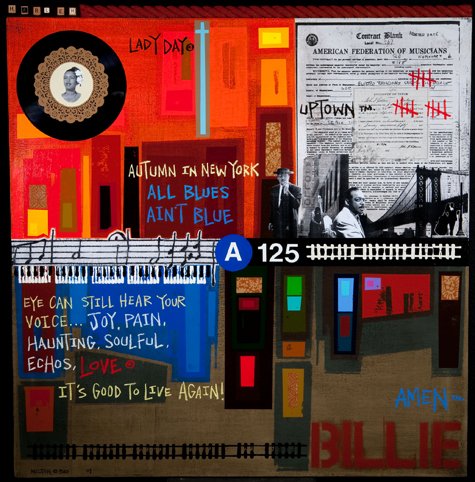
Autumn In New York
“I have two special goddaughters who help me as an artist see how art can affect young people,” he says.
Bowens works with goddaughter Mizauni, a second-grader, spending time with her as she learns to read and write. She recently won her school-wide reading competition and her family has seen “amazing success” in her educational ability since the two have been spending time together.
“I want to model what I’ve done with Mizauni to help hundreds of children in Sacramento,” Bowens says. Sacramento became the pilot city for Any Given Child, in which Bowens helped place local professional artists in schools to provide an integrated art curriculum and one-on-one interaction with students. Schools in other parts of the state, as well as in Portland, Ore., and Las Vegas, are following suit.
“We take what they are studying, like California history or ancient civilizations, and add art as a teaching mechanism,” Bowens says. “Studies have shown that students have better retention of information this way, instead of just memorization.”
Bowens says he is working toward other projects with youths, including starting a mentor diversion program in Alameda County with the juvenile court system and an art and literacy campaign in Sacramento.
“I’m getting ready to rival [my largest exhibition in Oakland] with the Art of Storytelling exhibition that will engage a program for fine art and literacy, specifically one for third grade literacy,” he says.
Bowens is basing the program off a study that upcoming correctional facilities decide on the number of beds they need by looking at the local third grade reading level.
“It’s not something terrible, it’s just if we see a problem coming, we need to prepare for it,” he says. “We need to get involved now. I’m not a minister… I’m not a counselor, I’m a painter. But I believe I have the skills to make a change and inspire young people to read.”
Some messages like this one are loud and clear in his work, while others take a little longer to see. But that’s the beauty of contemporary fine art, and though Bowens says his art “isn’t to decorate, but to educate,” he adds that he does enjoy seeing it hanging on the walls.
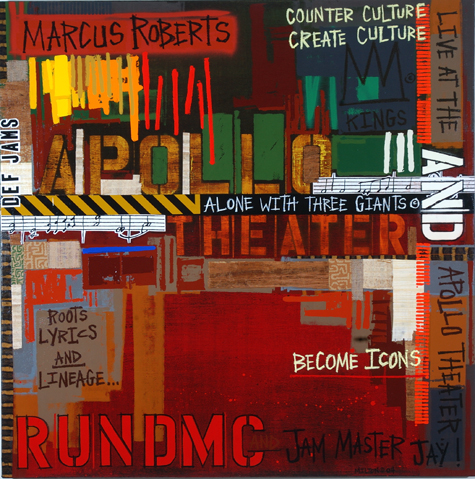
Alone With Three Giants
To catch Echoes of the Sweetest Sounds, visit Beatnik Studios at 2421 17th Street by June 26, 2012.
Thursday, Nov. 3, 2011 is a great day to be hanging out on the campus of Sacramento State, whether you’re a student or not. First, check out the closing reception for the art show CTRL/DELETE: Paintings by Digital Natives, featuring recent work by James Angello, David Mohr and Daniel Taylor at Witt Gallery (located in Kadema Hall) from 6 to 8 p.m. Mohr, who is in the local band FAVORS, recently told Submerge that he and Angello thought up the idea for the show. “We are both interested in what it means to paint and draw in a world dominated by computer technology, so we decided to put together a show that would discuss that concept,” he said. They were familiar with Taylor’s work (“We have all had art classes together,” Mohr said–the three are now seniors at Sacramento State), so they reached out to him and it became a three-person show. “All of our work is very different,” Mohr elaborated. “My work mostly focuses on abstract geometric forms, but I try to use familihttps://submergemag.com/wp-admin/media-upload.php?post_id=4726&type=image&TB_iframe=1ar shapes to reflect on the experiences and methods of interaction shared between humans and evolving electronic technologies.” If you miss the reception on Nov. 3 you’ll have to rush to see the work, as it is only viewable until Friday, Nov. 4, 2011.
After you check out the art show on campus, head over the Union Ballroom and check out one of the hottest hip-hop shows all year, featuring Aesop Rock, Rob Sonic and DJ Big Wiz. The concert also features special opening guests Jel and Who Cares. Show starts at 7:30 p.m., is $15 for students and $20 for general public.
Screen printer Laura Edmisten and the unassuming growth of her Asbestos Press
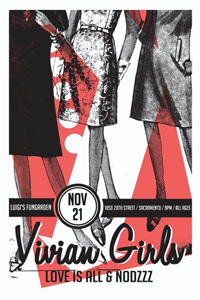 Five years and roughly 100 poster designs ago, Asbestos Press was a nameless curiosity sparked by the purchase of a screen-printing starter kit from an art store. But it only took Laura Edmisten five months of toying with the kit to toss the starter and turn her bedrooms and kitchens into workspaces–any place better than the deadly basement where it began.
Edmisten initially bought the speedball kit to screen print greeting cards, but when a musician friend inquired about a show flyer, she forgot about giving Hallmark competition. Her first poster was The Noise Geniuses. By her third poster she was hooked, trying out five colors on a poster, which takes a firsthand acquaintance with the process to truly understand the grueling nature of going beyond three colors.
“In my old apartment I’d do screen printing in the kitchen and my roommate would be in the living room watching TV,” Laura said. “I would put posters to dry all over the floor around him, leaving little paths for him to walk around. That’s how these things start: small, doing things for friends and it just grew.”
Her first workspace was supposed to be the basement in a friend’s house. But the house was 100 years old and even after a proper cleaning, she still would have to deal with the asbestos issue. The operation moved to her kitchen, but growth combined with a cooking space that looked like Jackson Pollock’s workshop forced Laura to move the operation once more. She now lives in Oak Park with an upstairs office all to herself. No matter where she moved, though, that first workspace stuck with her. “So I was trying to think of a name for all this,” she said. “As a joke someone threw out Asbestos Press. We all laughed and it stuck. There was a running joke that I mixed asbestos in the ink, like how Kiss put their blood in the ink.”
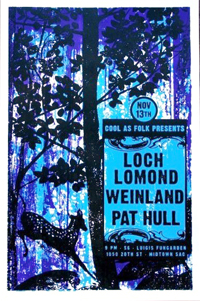 Despite limited-run posters being labor intensive, Edmisten appreciated the hands-on craft that produced a unique poster with each swash of paint pressed into the paper. I visited her at home to see the process first hand, which was the day before her big move into a space at Tangent Gallery at 2900 Franklin Boulevard. As she put on her trusty yellow apron, speckled in every possible color of paint conceived, Laura noticed me take an uneasy step back from her work board. “I’ve had this for five years,” she said looking down at the messy apron. “Every poster is on here–which is weird to think about.”
Laura spoke of her poster hobby turned side business as a saving grace to an otherwise creatively unfulfilled life. Around the time she bought the kit, she was a struggling graphic design student at Sacramento State. Screen printing was her shot in the arm, although it still didn’t guide her through a degree. “I wanted to start doing my school projects screen printed and my professors wouldn’t let me,” she said. “They were like no you have to abide by this rule, otherwise you can’t do proofs. But, I was like no I want this typography, with this distress on it. They’d be, like, no. It just made me want to do it more.”
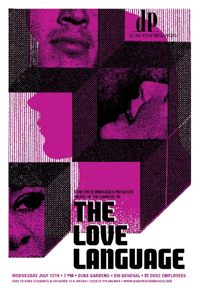 he spends her weekdays keeping the bills paid as a graphic design artist, but once she’s home, a homemade office awaits. She and her uncle built her current setup by nailing plywood to a couple of wooden horses. They built an exposure light box made from a sink cabinet and Home Depot supplies. Surrounding her tools is a seemingly endless supply of source inspiration she acquired from scrounging through garage sales, estate sales and secondhand shops.
She dug around a display of items, picking up a striped battery from the ‘50s because she admired the typography, an old inkbottle from the ‘40s with a pirate ship, vintage boxes for vacuum tubes and flash bulbs. Junk records and even discarded records from the Davis library, for which she has a project in mind; she picked through a box of old cards and admired the bird images. “I love old stuff,” she said. “I collect vintage packaging and old magazines. Things just have a way of coming to me. Before I designed posters, I’d just collect this stuff.”
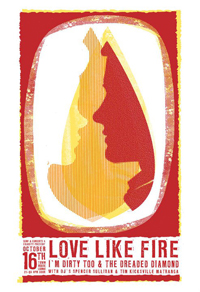 Her garage was no different. Her pack-rat tendencies were hidden out there with a collection of old bikes and her roommate’s Burning Man rickshaw. She owns a press for fabric, because she is trying to learn how to do T-shirts and tote bags, but for now it’s buried in the garage. “I really do like paper. Fabric is totally different. It moves and it’s flexible. I tried a couple things but it hasn’t panned out like I thought it would.”
Back in the office we moved to a stack of posters that included a Doom Bird release show, John Vanderslice show at The Townhouse, a Japandroids show at the Blue Lamp and a recent Jandek show sponsored by KDVS. She pointed to the Doom Bird poster: “This tree came out of a magazine of the ‘70s,” then the Japandroids poster: “This was an air conditioner unit illustration from the 70s.” She held up the Jandek poster. “The hand came out of a magazine from 1932, which was my grandmother’s, it’s an Art Deco hand. The eye came off of an album from the ‘50s, this head image came off a health book from the ‘30s and the chair and the window came off a ‘40s home improvement magazine. All of these have a different story.”
Among the scattered creations, her workspace walls were lined with framed show posters that she didn’t create, but came from shows she attended. We shared a brief commonality when we discovered we were at the same Les Savy Fav show in San Francisco, from which she had a poster. “I listen to the music,” she said regarding her creative process. “I try to see what their style is, what kind of mood that evokes in me and how I can translate that into a design that will get people to the show.”
 Laura creates by one simple rule: “If you take it, you have to make it your own.” She didn’t hesitate to admit to novice drawing skills. She relies on bits and pieces of things, collected and perused until she feels inspired; an acquired knowledge of the best paper stock, what color inks work and what don’t, what you can get away with. She even keeps mess-ups and test prints; everything is recycled. “It’s funny because I can track my style,” she said. “I’ve made some clunkers. It happens. It took me a long time to get to this point.”
Without a happenstance request, Laura may have never found her artistic calling, but since discovering it her perspective is forever altered. “I had no knowledge of any of this, of poster, of the community, none of it,” she said. “I knew Frank Kozik, but that was about it.” Edmisten is displayed in the Rock and Radio Museum and predominately at Luigi’s Slice in Midtown, in addition to an upcoming display at Phono Select in December [2010].
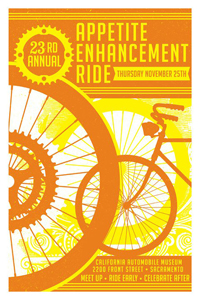 Her biggest run was 200 posters for a Love Language show at Duke University. She did the cover art for an issue of Tape-Op and contributed a piece to the Of Great and Mortal Men: 43 Songs For 43 U.S. Presidents compilation. She’s part of a community, working on shows with Concert 4 Charity at the Townhouse, with bands and with other poster artists on the scene. “I’m friends with everybody and it’s kind of a little scene,” she said. “We’re all supportive of each other.”
She’s filled requests to make wedding invitations, design album art and toyed with making tote bags. The “About” section of her website boldly states she strictly prints her designs and is not a commercial print shop. “I get weird requests online. Like, ‘Can you make a fake band poster for my boyfriend’s birthday?’” she said. “‘I only want one and I live in Canada.’ I’m really not interested in that stuff.”
I asked if she denied the request because the person was Canadian.
“No.
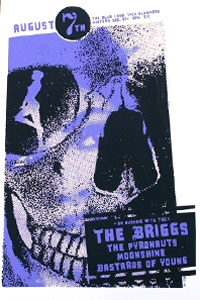 “People think I have a workshop with machines,” Laura said. “I’ve had people want to be my intern. It’s funny because a lot of people don’t realize this is a small operation. It’s growing, but I’m kind of quiet about it. I do art shows. I sell posters online, but I’m a pretty unassuming person.”
Asbestos Press’ poster show is on Second Saturday in December (2010) at Phono Select records on K Street, Sacramento. There will be posters, DJs and possibly live music.