Wet Hot American Summer: First Day of Camp
Rated TV-MA {4 out of 5 stars}
My parents never sent me away to camp when I was a kid, and I’m grateful to them for that. I don’t deal well with sleeping in bunks or bugs, and I assume every vine I see is poison oak, ivy or sumac. But if I had gone to camp when I was a kid, which was way back in the ‘80s, would my experience have been anything like what is portrayed in David Wain and Michael Showalter’s Wet Hot American Summer: First Day of Camp? These are questions journalists must ask themselves.
The answer is most likely a resounding no, because the events depicted on this brand new Netflix Original series are completely bonkers.
The series is a prequel to the film Wet Hot American Summer, which was something of a cult hit, though poorly received. Released back in 2001, Wet Hot American Summer featured many young actors who went on to become stars, such as Bradley Cooper, Paul Rudd, Amy Poehler and Elizabeth Banks, all of whom return for First Day of Camp.
The series, like the film, boasts a huge ensemble cast with numerous ridiculous plotlines, and Wain and Showalter are adept at handling them all. The duo first received recognition back in the ‘90s as part of MTV’s groundbreaking sketch comedy show The State, which featured irreverent humor with a surrealist twist. All these years later, Wain and Showalter’s absurd sensibilities seem as fresh and wickedly sharp as ever, as First Day of Camp would attest.
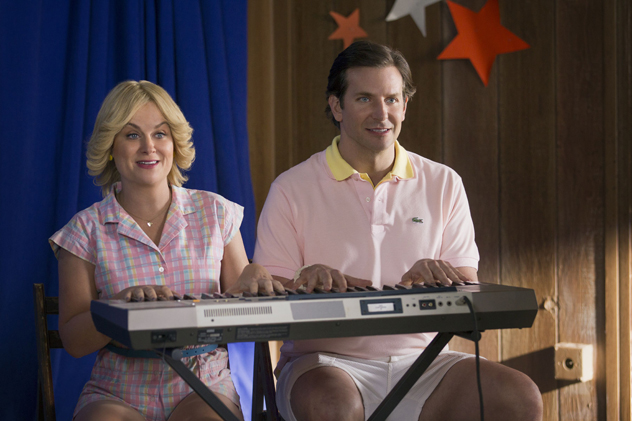
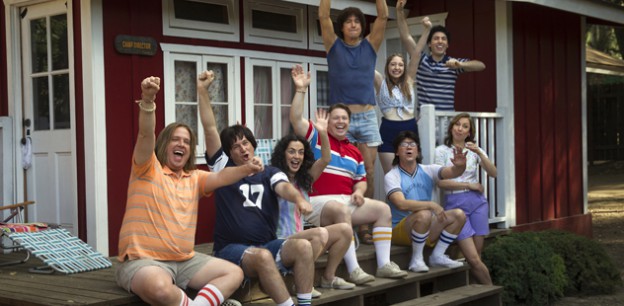
Having seen the original film isn’t a prerequisite to enjoying the series, but it would help, seeing as all of the adult actors, though they are 15 years older, reprise their original roles of teenage camp counselors at Camp Firewood in rural Maine. The year is still 1981, and there’s a lot of crazy shit going on in this patch of New England forest. Everyone asks the questions: Will Andy (Rudd) ever hook up with Firewood’s most babelicious counselor Katie (Marguerite Moreau), even though she’s dating that preppy douchebag Blake (Josh Charles) from rival Camp Tigerclaw? Are doofy but lovable Coop (Showalter) and mega-fox Donna (Lake Bell) really boyfriend and girlfriend? Why have Ben (Cooper) and McKinley (fellow State alum Michael Ian Black) been spending so much time together?
But Camp Firewood faces threats far greater than raging teenage hormones. The camp has fell upon hard financial times and is in danger of closing. To save it, camp director Mitch (H. Jon Benjamin) has has to strike a deal with Xenstar, an evil super conglomerate that is now dumping toxic waste in the woods. Only head counselors Greg (Jason Schwartzman) and Beth (Janeane Garofalo) can do anything to stop it. They have their work cut out for them, though, as the Xenstar conspiracy goes deeper than anyone could have ever dreamed, reaching all the way to the president himself, Ronald Reagan (wonderfully lampooned by Showalter).
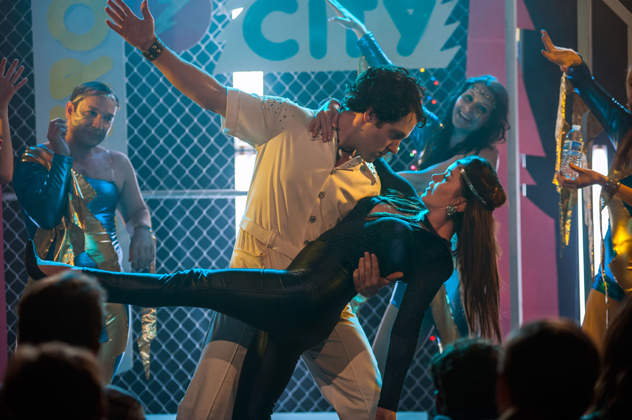
There’s also a camp musical that has to be cast, rehearsed and performed before day’s end. Ben and his “girlfriend” Susie (Poehler) have enlisted renowned Broadway actor/director Claude Dumet (Mad Men’s John Slattery) to find two diamonds in the rough to assume the starring roles. In the process, a love triangle forms (actually a love quadrangle once McKinley enters the mix).
Elsewhere, mysterious-yet-alluring new counselor Lindsay (Banks, who doesn’t get enough credit for her comedic abilities) has been snooping around and asking questions about the haunted shack that just so happens to be in the middle of the campgrounds. She’s been asking questions about the reclusive rock star who’s said to inhabit the ramshackle dwelling. Just what is she after? Why won’t she leave well enough alone?!
If it sounds like there’s a lot going on, that’s because there is. Showalter and Wain have a lot of story to tell in just eight half-hour episodes and a lot of characters at their disposal. Through the first two installments of First Day of Camp, the series feels a little directionless, and it seems as if plot is going to take a backseat to bizarre hijinks, but by the third episode, after Mitch’s shocking transformation is revealed, the series becomes delightfully plot driven (without sacrificing the hijinks).
First Day of Camp is a series that will probably benefit from multiple viewings, after your initial binge-watching, as the comedy is so deadpan and fast-paced, that you’ll probably miss something the first time around. Though it was slow to get going (which is a bit of a drawback considering its short length as TV series go), once it does, it packs quite a punch, and the extremely talented cast (which also includes Jon Hamm as Reagan’s top assassin and Christopher Meloni as the camp chef with a shady past) seems to be having a blast. You most likely will, too. Now I wish my parents had sent me to camp as a kid. Maybe it’s not too late … MOM!
American Sniper
Rated R {3 out of 5 stars}
Movies about war are polarizing. Movies about war are especially polarizing during Oscar season. American Sniper is no exception.
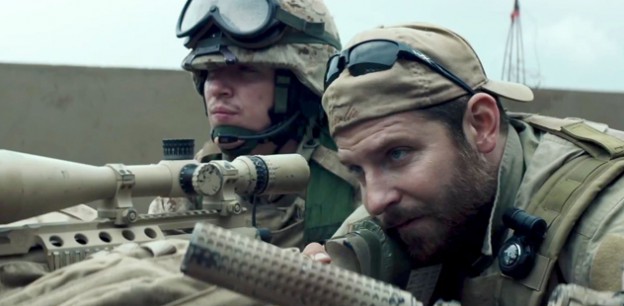
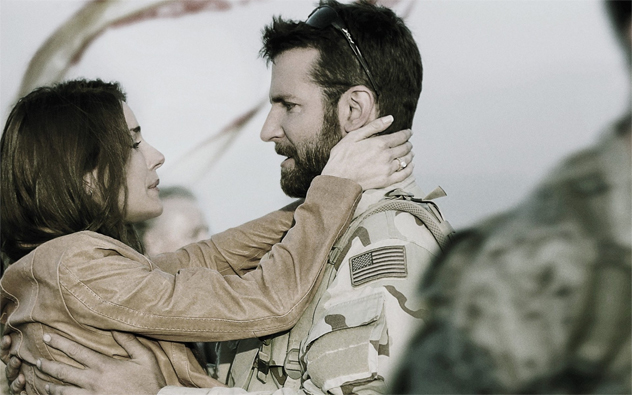
Directed by Clint Eastwood, who in five years will be a nonagenarian, American Sniper is based on the life of Navy Seal Chris Kyle, “the most lethal sniper in U.S. military history.” Released in 2013 as an autobiographical account, Sniper the film strives to recreate his wartime trials and tribulations, both at home and abroad. Hollywood heartthrob Bradley Cooper was tapped on the shoulder to portray Kyle, and over the course of 134 minutes, Eastwood takes us from Kyle’s Texas roots as the son of a patriarch, through his four tours of duty in Iraq, whereupon he tallied 160 confirmed kills and the endless respect and admiration of his combat brethren. But for all the “Legend” (his nickname), Kyle’s life back in the States between tours is far from ideal, as the continued killing and horror leaves him a distant father and husband.
If all that seems familiar, well, that’s because it’s basically The Hurt Locker. Trade one field of life-and-death military expertise for another, and you’ve got the exact same story. Which isn’t to make light of Chris Kyle, soldiers with PTSD or the sacrifices anyone makes in the name of whatever aspect of life they deem most important…it just is what it is as far as original film goes. American Sniper simply adds very little to the war genre as far as newness. In fact, the family angle feels not only tired, but pretty much flops throughout. Sienna Miller does her best to summon up the angst, fear and confusion of a wife/mother left in the lurch, but with little commitment to the thread in general, there just isn’t much of anything to work with.
The tick-tock of American Sniper is its gritty war violence, which is precise, abundant and unflinching. You could certainly make the case that this as well is nothing new, but attention to detail and realism can go an awful long way in a war drama. There are scenes in this movie that take your breath away; and Cooper is absolutely believable as a soldier, which is easier said than done. I recently re-watched Blackhawk Down, for example, and was mortified by how truly awful Ewan McGregor is. With a rifle in-hand he resembled something akin to a naked Roseanne Barr on roller skates. And when was the last time you watched Platoon? Charlie Sheen gives a performance worthy of 10,000 laughs, and that thing won Best Picture. And don’t even get me started on Lone Survivor.
You may hear the critique that Cooper’s dialogue is simplistic and clichéd, hickish even, as it frequently references God, country, brotherhood and the like, but let’s be real here. Most great war films present soldiers to be eloquent wordsmiths, poets in the face of death with just the right speech for just the right moment. But for every Hemingway, there are countless G.I. Joes. That’s not meant to be insulting, it’s just that films like The Thin Red Line, fabulous as they may be, are not especially accurate representations of the average soldier’s vernacular. And while it may be insensitive for Kyle to refer to the eastern part of the world as “evil,” or its people as “savages,” it’s worth remembering that 44 percent of the American military is from the South, with Kyle a Bush-loving Texan. This is how lots of people think, so why not portray as such if that’s the truth behind the character? Whether you feel Eastwood is presenting this story for the sake of pushing his own agenda, or just wants to paint a semi-accurate picture is up to you.
But even the battle-centric aspect of the film isn’t without its flaws. There’s a clunky thread that attempts to follow and link the exploits of a fellow Iraqi sniper, as well as a rather preposterous finale. And at times it feels as if Chris Kyle’s story isn’t being told so much as it is being showcased, the body count racking up more like a video game than a film. All told I was surprised to see American Sniper receive as many nominations as it did, especially that of Best Picture. But then again the Academy seems to have a never-ending soft spot for films of this ilk, be they exceptional or just worth seeing.
The Hangover Part III
Rated R
If it only seems like it was just yesterday we were introduced to The Wolfpack (Alan, Stu, Phil and Doug), it’s because it almost was yesterday. The Hangover only just came out in 2009, it’s sequel soon followed two years later and now in 2013, like clockwork, we have the final installment of “The Wolfpack Trilogy,” because nowadays everything is a trilogy. The Hangover Part III features all the characters you know and love (for lack of a better term) and even brings back those you’ve probably forgotten about, but the culmination of this little comedic saga is something far less familiar.
We open in a Thai prison where series trickster, the mischievous Leslie Chow (Ken Jeong) has just escaped. The scene is like something out of a cheesy ‘90s action film.
We then quickly cut to Alan (Zach Galifianakis) drinking a beer as he speeds down the freeway. Attached to his car is a trailer, which is transporting a giraffe (well, a computer generated giraffe). A low overpass beheads the giraffe causing a massive mult-car pileup in its wake. Alan seems miffed, but otherwise unaffected.
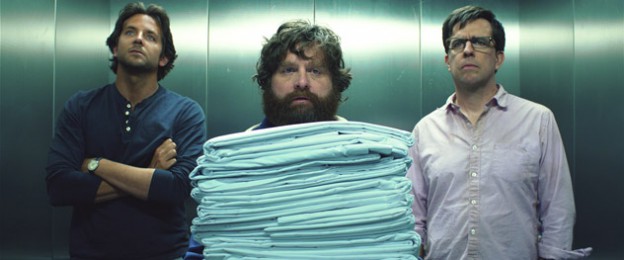
The rest of The Hangover Part III follows suit, juxtaposing weirdly dark comedy with elements of action, but it’s not a clean mesh of genres. Alan’s erratic behavior and refusal to take his medication leads his friends and family to call an intervention. The outcome of which is that Phil (Bradley Cooper), Stu (Ed Helms) and Doug (Justin Bartha) must make a two-day drive across the desert to transport Alan to a facility where he can receive the help he needs. But trouble follows The Wolfpack wherever they go, and along the way they’re abducted by Marshall (John Goodman), who’s involved in all kinds of nebulous criminal activity and is after Mr. Chow for stealing $21 million in gold that Marshall stole from a foreign royal. Marshall believes The Wolfpack is his only hope in finding Mr. Chow, so he holds Doug hostage and forces Stu, Phil and Alan to find the Chinese sociopath. The trail leads The Wolfpack to where else but Las Vegas. Along the way, there is a good deal of action, but the laughs are strangely absent.

The Hangover trilogy doesn’t stick to formula, which usually dictates that the second film in the series is the darkest. The Hangover Part III is quite dark. Though much like the previous two installments, our three heroes must band together to help a colleague, the consequences here are a bit more severe. Doug’s life is on the line whereas in the other films the guys might not have made it to a wedding in time. Marshall is not a man to be trifled with. There’ll be hell to pay if he doesn’t get his hands on Mr. Chow. Even Mr. Chow seems extra dangerous here. He’s not just a goofy villain, but a calculating, malicious force of chaos. At one point,
Marshall goes as far as to equate Mr. Chow to madness itself.
There are laughs, sure. Galifianakis has a great moment in a Las Vegas pawn store with the brilliant Melissa McCarthy, but this is one of the few light scenes in the film. This is a caper with more in common with True Romance than the past two Hangover movies. In one scene, Phil and Alan infiltrate Mr. Chow’s penthouse suite at Caesar’s Palace. Strobe lights flash as the two try to work their way through the room after room of debauchery as Black Sabbath plays ominously behind them (side note: the soundtrack for this movie is definitely worth a listen). It’s a trippy, dizzying and very exciting scene for the senses, but, like, where’s all that lowbrow humor, bro?
That’s the thing that bothers me the most about The Hangover Part III. I’ve seen each film in the series, but until this one, I didn’t realize I was supposed to actually care about these characters. Sure they’re lovable, but they’re all kind of jerks, right? That’s what makes them funny. Toward the film’s climax, Phil says to the rest of the trio, “This all ends tonight,” with such gravitas I couldn’t tell if it was meant to be ironic or not. Weren’t we all hanging out with Mike Tyson, getting face tattoos and taking incriminating photos while we were way too fucked up over the past four years? Suddenly it’s Frodo’s journey into Mordor or something. Dudes, this is way too intense for me. We’ll always be bros and all, but I’m kind of glad it’s time to say goodbye.
The Words
Rated PG-13
Writing can be a selfish practice. Writing about writing is probably even more so. In The Words, actor-turned-writer/director Brian Klugman and co-writer/director Lee Sternthal, both in their debuts as feature filmmakers, delve deep into what makes a writer tick. It’s a story within a story within a story–sort of the nesting doll equivalent of storytelling. But unlike those placid-faced novelties, The Words bears a much more troubled countenance.
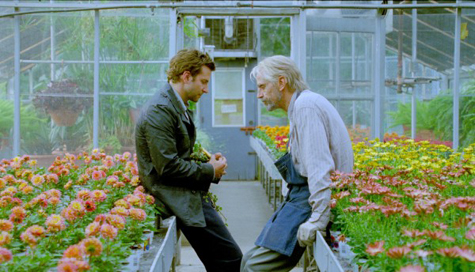
The film opens with writer Clay Hammond (Dennis Quaid) reading from his latest novel, which bears the same name as the movie, in front of a packed auditorium. This could be wishful thinking on the parts of Klugman and Sternthal, perhaps imagining that The Words would be similarly well received by real life audiences. Hammond’s story introduces us to Rory and Dora Jansen (Bradley Cooper and Zoe Saldana, respectively). Rory is a writer, too, and he’s on his way to pick up an award for his first novel, The Window Tears. However, as he and his wife pile into a limo on their way to the reception, there’s an old man (Jeremy Irons) lurking in the rain.
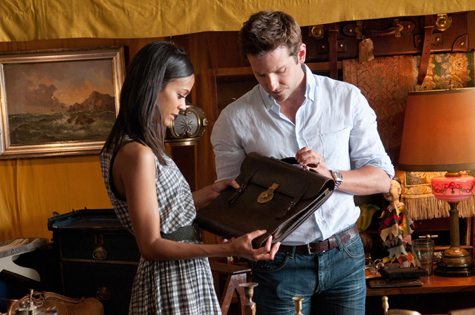
The Window Tears is a critical and commercial smash hit. The big break Rory, a struggling yet not-quite-starving artist, has always dreamed of. Unfortunately, he has a secret. While on vacation in Paris, Rory and Dora find a brief case in an antique store. Once they’re home, Rory discovers that it contains a tattered, old manuscript of a long-lost novel by an anonymous writer that was never published. Rory ends up getting the book published as his own, and the old man, whose name we never learn, reveals himself to Rory as The Window Tears’ author.
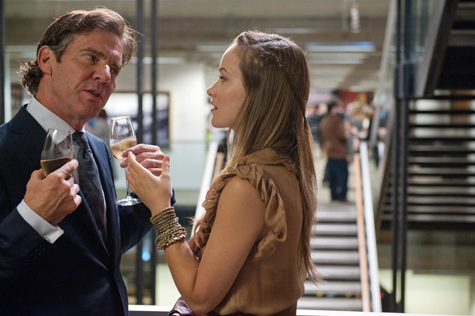
Meanwhile in Hammond’s world, he encounters a beautiful graduate student, Daniella (Olivia Wilde), during an intermission between chapters. He’s as taken with her as she is with his writing, but there’s something undeniably mysterious about her and her connection to what’s going on.
Back in the world of Hammond’s novel, the old man recounts to Rory the story behind The Window Tears, which is the kind of sprawling, tragic romance that novels are literally made of, and we are introduced to another set of characters, the old man as a young man (Ben Barnes) and his wife Celia (Nora Arnezeder).
To Klugman’s and Sternthal’s credits, the three layers of the story are clearly defined. The Words never falls into chaos, but the connection between the three couples isn’t drawn in an obvious way. In each case, we have a writer at different stages: the young man, just discovering his talents; Rory at the beginning of his career; and Hammond, middle-aged, confident and established. Irons as the old man, looking worn and grizzled, perhaps serves as the specter of death both in terms of being toward the end of his life, and also in literary terms since after he penned the novel Rory eventually stole, the old man never wrote again.
Though the male characters could be seen as archetypal forms, the female roles feel shallow. Saldana and Arnezeder are strong, painting endearing and sympathetic portraits of supportive wives, but they really don’t have much to work with. Wilde’s Daniella is presented as the most interesting. She’s guileful and captivating, shown off beautifully in expressive and intimate close-ups. But in the end, Daniella comes off written in as little more than a plot device.
Unlike nesting dolls, the storylines contained within The Words don’t fit together very neatly. As Hammonds tells Daniella, the worlds of reality and fiction may get very close to one another, but they never touch. And so, the frayed threads of these three stories are never tied together in a neat bow. However, The Words is still a literate, neatly executed and at times thought-provoking romance worthy of over-intellectualized discussion over coffee after it’s ended.