Mad Max: Fury Road
Rated R | 3.5 stars out of 5
I wonder if Mel Gibson was upset that he didn’t get asked to cameo in the Mad Max relaunch. He may be a homophobe, a racist, an anti-semite, a misogynist, a Scientologist, an arsonist, an arborist, a member of ISIS, the Grand Wizard of the Ku Klux KIan and a Lakers’ fan, but really, when you get right down to it, not a bad guy.
Fuck Mel Gibson. But god bless Mad Max.
It would be so easy for George Miller’s reboot to suck. Everything that made the originals so wonderful (specifically the first two installments) is largely antithetical to box office success. Lo-fi production, sparse dialogue, unfamiliar faces and overt weirdness are the stuff of cult classics; so what formula would allow Fury Road a chance at being a 2015 blockbuster?
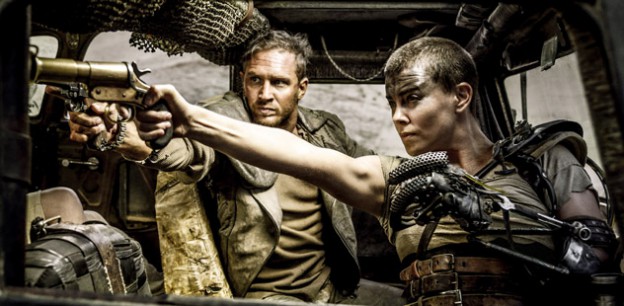
With a simplistic, post-apocalyptic storyline faithful to the gasoline-starved past, drifter Max (Tom Hardy) finds himself aiding Imperator Furiosa (Charlize Theron), a disillusioned pupil of grotesque wasteland warlord Immortan Joe. When Furiosa steals away Immortan’s captive breeding beauties in the hull of a tanker in hopes of escaping to her native “green place,” a frenetic road rage ensues, and basically never relents. In fact, it would be fair to say that three-quarters of this two-hour film are balls-to-the-wall chase scenes—ones that would make The French Connection proud at that. Whereas most effects-driven flicks of modern day rely upon green screen razzle dazzle, Fury Road kicks it refreshingly old school with actual wrecks, explosions and stunts; it’s closer to Commando than it is Furious 7.
The casting is admirable as well, with Hardy and Theron legitimate stars, and quality ones at that. Which is to say they can act. And while neither role calls for Shakespearean eloquence, selecting the likes of Vin Diesel and Megan Fox as co-leads could have doomed Fury Road from the start. Even with heavy action and decidedly minimal discourse, there’s plenty of room for non-verbal acting, which Hardy especially showcases. He discreetly manages not to ruin scenes that could otherwise have been ripe for needless macho posturing and bravado. And perhaps most surprising is that Fury Road, watered-down as it could have been, still manages to be genuinely odd. The generic bad guys are slathered in ghoul makeup and black leather; Immortan Joe is a disgustingly clownish barbarian; and the army of demonic motorbikes, big rigs and worn-out muscle cars still manages to ring freaky and true after all these years.

To my chagrin, however, is a hefty dose of Beyond Thunderdome. There’s a reason Warner Brothers backed that film in 1985, and it’s because Miller was willing to tune down the weirdo knob in order to allow for a broader, Spielberg-ian appeal, hence Tina Turner. Fury Road, in many instances, makes the same concession. The character threads, for example, simple as they may be, are fed frequent and unnecessary bits of sentimentality in the film’s second half and are only embellished by an overly dramatic score that could at times have been lost altogether. To this same point is the undeveloped and meaningless inclusion of the downtrodden community under the thumb of Immortan Joe, who desperately beg for the dam-like release of water from The Citadel. None of the above serve Fury Road any benefit whatsoever other than the prospect of mass appeal (which I suppose is inescapable), and in the end rob the film of its chance to be great, as opposed to merely good.
But that’s neither here nor there when you consider, as mentioned prior, how bad this movie could have been. The overwhelming majority of reboots and re-creations are abjectly horrible, as the newest Poltergeist will serve as reminder in a week’s time, in case you’d forgotten (which I’m sure you hadn’t). For Mad Max: Fury Road to come out right side up 30 years after the nearest release, and with a septuagenarian director no less, is a miracle greater than that time the Pope won a round of three-card monte. Whether or not the subsequent sequels will be worth a damn is anyone’s guess. But for now, at the absolute minimum, we have an entertaining freakshow worthy of your $9.50.
A Million Ways to Die in the West
Rated R {2.5 stars out of 5}
If you’re a Family Guy, American Dad or The Cleveland Show fan, then the A Million Ways to Die in the West trailer has probably caught your eye. I mean, almost everything Seth MacFarlane touches turns to gold, right? Almost everything.
Pan to Arizona 1882. We are in the West, where everything sucks. People die from any and everything: diseases, bar fights, snake bites, freak accidents. It’s an every-man-for-himself kind of world—the kind of world where you have to fight for your life. Literally, you have to fight for your life. Enter Albert Stark (Seth MacFarlane), a hopeless nobody who makes his living as an unsuccessful shepherd (like, really unsuccessful…his sheep end up on the roof. Don’t ask how that’s possible). He is challenged to a duel to settle a debt he owes; but because he is such a coward, he backs out and loses his girlfriend, Louise (Amanda Seyfried), in the process.
The movie basically follows him as he tries to mend a broken heart (broken hearts are terrible, even in 1882) and make meaning of his sad and pathetic life, all while showing that there are a million ways to die in the West. Surprisingly, there were a lot of graphic death jokes (well, maybe not surprising, since Family Guy and American Dad can get pretty gruesome…still, I wasn’t expecting it); of course there were lots of poop jokes, as well as your basic slapstick comedy.
There’s a star-studded cast in this one (imagine the entire cast of Ted with extra people), complete with Charlize Theron as the local bandit’s wife, Anna (the local bandit is Liam Neeson); Sarah Silverman as the town whore, Ruth; Giovanni Ribisi as Ruth’s boyfriend, Edward (think weird dancing guy from Ted); and Neil Patrick Harris as Albert’s nemesis, Foy. There are also special guest appearances by Gilbert Gottfried, Ryan Reynolds (duh), Christopher Lloyd and Jamie Foxx.
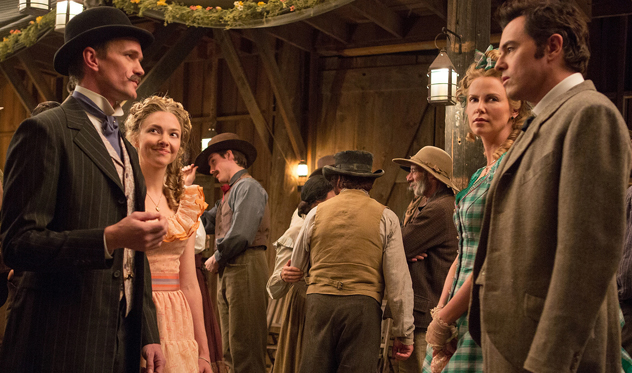
I was really rooting for this movie. I mean, I love Seth MacFarlane and I thought Ted was amazing. Also, there was a great cast in this movie. Sarah Silverman was in it! Let’s just let that sink into your brains. Yet, despite the great cast, the movie was just lackluster. There were funny parts; I did chuckle a bit. But the jokes seemed forced and it was pretty much the same joke over and over again: people die in the West because it’s 1882, here are all the different ways people can die, and for good measure, here are some poop jokes and drug references. I guess it was pretty much just one long Family Guy episode except that it wasn’t that funny. It wasn’t terrible; it just wasn’t the greatest. It was all right.
And in the end (in classic love story fashion), you learn that love conquers all and you have to fight for the dream that’s a wish your heart makes. I haven’t completely given up on Seth MacFarlane; I’m still (not so) patiently waiting for a second Ted movie and a Family Guy movie and I will still watch all of his shows religiously. He just kind of missed the mark with this one. But, that’s OK because you can’t win ‘em all, right? All in all, I probably wouldn’t recommend this movie but, if you’re a Seth MacFarlane fan like me then you’ll probably end up seeing it anyway.
And let me just note (especially to the movie patrons who were sitting behind me): DO NOT BRING YOUR CHILDREN TO THIS MOVIE. If you have a child and you are planning on seeing this movie, then hire a babysitter and have yourself an adults night out. This movie is graphic (like, a surprising-amount-of-blood type graphic), is literally full of cussing, contains some vagina jokes and has some drug references. I repeat, it is not kid friendly (also, it’s kind of really annoying when a 5-year-old talks through a whole movie), and all of the jokes are just going to go over your child’s head anyway. Plus, they probably shouldn’t be seeing (and hearing) all of the graphicness of the movie. Their minds are impressionable, or whatever.
Prometheus
Rated R
Ridley Scott’s Alien came out in 1979, perhaps before a lot of you were born. The sci-fi/horror hybrid was a truly frightening and groundbreaking film that propelled Sigourney Weaver to superstardom and birthed countless comic book crossovers and a long-lived film franchise, of which only the first two films (including James Cameron’s action-fueled 1986 sequel, Aliens) are really worth seeing. Prometheus takes us back before the beginning. It’s a prequel, a word that may have left a bad taste in your mouths after the debacle that was the prequels to the Star Wars saga. In Prometheus’ case, a look back proves to be more enlightening (and opens up even more questions) to the events portrayed in the Alien series as opposed to damaging their legacy.
The year is 2089. Two researchers, Elizabeth Shaw (Noomi Rapace, Lisbeth Salander of the Swedish-language The Girl with the Dragon Tattoo) and Charlie Holloway (Logan Marshall-Green), have patched together clues from ancient cave paintings, left by civilizations from all corners of Earth to create a map to a moon in a far-off solar system capable of supporting life. While that discovery may be monumental enough, it’s even more so because Shaw and Holloway hypothesize that this moon may have been the origin of the human race–as well as the beings known as Engineers who created it.
Peter Weyland (Guy Pierce) assembles a rag-tag exploring party to accompany Shaw and Holloway on their journey. Weyland is convinced that the Engineer theory is correct and that contact with this mysterious race of beings could answer humanity’s greatest question, “Why are we here?” Led by the icy Meredith Vickers (Charlize Theron), the party aboard the Prometheus find what they’re looking for, much to their chagrin.
Story aside, Prometheus is awe-inspiring to behold. Audiences will no doubt be left slack-jawed by the film’s bold look and stunning scenery. In most cases, 3-D seems little more than an easy way for big-ticket Hollywood films to pad their box office numbers, but much like Avatar, which really ignited the 3-D frenzy, it would be to your detriment to view Prometheus in its flat transfer. Sweeping panoramas of alien landscapes, wonderfully rendered computer effects and trippy digital-static overlays are wonderful fodder for eye-popping visuals, and Scott seems to use them to wonderful effect. Do yourself a favor and spring for the extra few bucks.
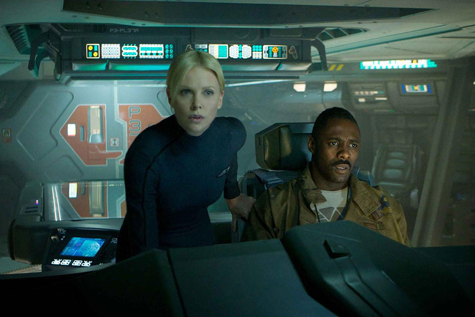
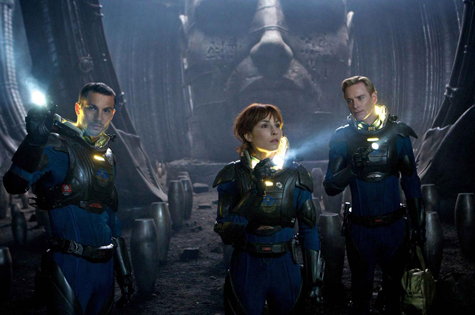
More traditional elements also enhance this feast for the eyes. H.R. Giger’s twisted cyberotica, which has been an Alien series hallmark since 1979, flavor Prometheus with terrifying notes, touching upon fears that are exotic and familiar. From the macabre marriage of the technological and organic of the Engineers’ fortress and control rooms to the freakishly vulgar creature creations, the uneasiness of the characters seems mirrored in their otherworldly surroundings.
It’s good that the visuals are so stupendous, because the film’s plot is surprisingly basic. Co-written by Lost co-creator Damon Lindelof (with John Spaihts), one might expect a dizzying story with a lot of twists and turns, but there aren’t many to be had. There are instances where we see flashes of the philosophical/spiritual mindbenders that were Lost’s trademark, but in the end, Prometheus stays true to the Alien franchise formula: humans trying to manipulate forces they don’t fully understand to their own greedy ends. There is the rich man, Weyland, who knows more than he lets on (a sort of Charles Widmore, perhaps?) and the android who seems helpful but may have its own nefarious agenda–devices that anyone familiar with these movies has probably come to expect. Unfortunately, other than a tense scene in a robotic surgery chamber, there isn’t much in the way of suspense that made Alien such a classic.
There are a couple of noteworthy performances, though. Rapace, who really gets run through the wringer in Prometheus, is the prototypical Scott heroin. Amazingly fit, she’s also tough, persistent and perhaps a bit bitchy, but she certainly upholds the high standard set by Weaver in previous films as the central character. Michael Fassbender is a wonderful antithesis to Rapace as the outwardly charming robot David, who models his appearance after Peter O’Toole in Lawrence of Arabia. Underneath his classic screen star looks is a personality more akin to 2001’s HAL9000, however.
In true Lindelof fashion, Prometheus answers as many questions about the Aliens’ origins as it poses new ones, which may be answered in another film. As beginnings go, it at the very least opens the door to a promising future.