Tag Archives: Cinder

The Man Behind the Metal

C!nder’s maniacal machines are creations of pure joy

Not many people can find joy in stepping on a fresh piece of gum. The moment it hits your shoe it suddenly turns into an endless string that seemingly can wrap around your entire body. And no matter how much you wipe the pink bundle of teeth marks on the curb, it lingers on the bottom of your heel. But there might be one person who can find some joy in a gum catastrophe.

“Look at the way that thing pulls apart, it’s awesome. Who would have thought that only one cubic centimeter of chewing gum could stretch about three feet long?” Christian Cinder asked with excitement, while sitting inside Broadacre Coffee.

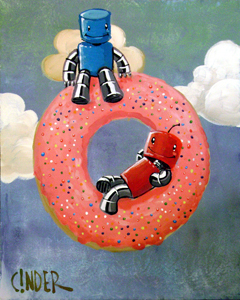
Finding the simple joys in life has led Cinder to become a professional cartoon surrealist but with a fun twist. He makes you question the stereotypical sci-fi robots that are out to destroy human life and replaces them with fun-loving robots that seem huggable.

“The work is happy because there is happiness,” Cinder said. “Maybe like a Men in Black kind of scenario; the world might be collapsing all around them, but they are going to have the best time they can.”

His current exhibit at the MAIYA gallery in downtown Sacramento, March of the Robots, displays some of Cinder’s (who signs his name C!nder) most recent collections of art pieces that are ready to be admired. He credits his creative inspiration to growing up in the ‘70s, watching Star Trek, reading Mad Magazine and comic books, and the popular ‘60s artist Ed Roth (known for creating the Rat Fink icon).

Whether you are a science fiction nerd, art fanatic or love cartoons, Cinder creates pieces that everyone can enjoy. His art work is bright, imaginative and fun. Cinder likes to portray robots having fun in their environments, smiling and exploring their world with curiosity. One of his pieces shows a red robot sitting and looking very content in a flowery meadow. But not all of this work is happy and easygoing. One piece called Night of the Tinkerbot shows a scared robot running away from other rusty robots who are trying to take his parts.

“The robots can be destructive but so can 5-year-olds,” he admitted.

From destructive robots to robots picking flowers, Cinder uses an art technique called color theory to make the picture on the canvas look dimensional through 3-D glasses.

“When I pick the colors for my subjects, I tint and tone everything according to where they are on the background and the foreground,” he said. “So that’s just the basic concept of color theory. That cool colors will recede and warmer colors will come forward.”

While visiting the MAIYA Gallery, Cinder would walk around with 3-D glasses trying to see if the other artwork on display had the same effect, which made onlookers take a second glance, said Kelly Truscott, owner of MAIYA Gallery. Truscott said that everyone has taken an interest in Cinder’s art, from 10-year-olds to serious art collectors. But Cinder likes to call his fan base the “12-year-old adult.”

“The person who has the energy and interest of a pre-teen and can enjoy life that way but at the same time has the education and experience to appreciate the nuances,” he said. “So anybody who likes a Disney film or Don Bluth animation, I would hope would like my work as well.”

The ideas behind the animation all start with pencil sketches in his worn-out sketchbook. The sticker collage on the front cover of this sketchbook, which includes, In-N-Out Burger, San Diego Comic-Con, Santa Cruz Beach Boardwalk and Space Invaders, can easily give away what he loves most. But once the sketchbook is opened, a new world comes to life with Intergalactic Police, Alien Internet and frolicking robots. Cinder can find robots everywhere. One of his drawings is based on a man who was picking up cans on the Santa Cruz Beach and wearing a medical mask with thick gloves. After Cinder saw him, he drew him as a robot on the beach.
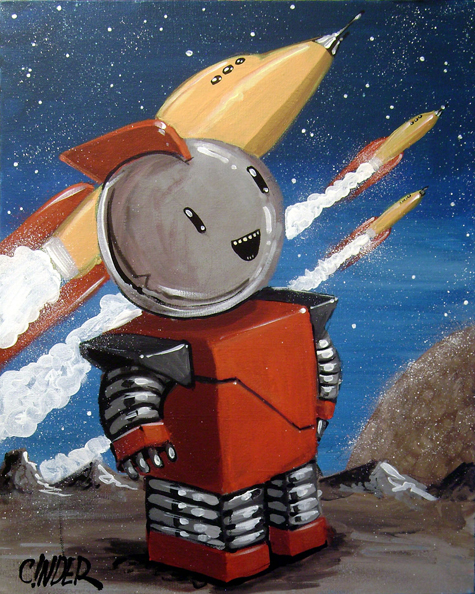
His sketch work shows all the technicalities of creating a robot and he does not allow himself to make any edits in his sketchbook. The process of developing a new robot style, which he calls Cinderbots, is a serious task. He takes multiple styles of robots and gives them a name and purpose in each painting, including the Alpha (single box or geometric shape), the Cinderbots (a more formed robot) and the Hakos (cardboard structure characters).

“I think I get the most fun out of the Alphas, he’s been my longest standing character, he gets into the most mischief,” Cinder said. “In the paintings he discovers the most about his world and the Cinderbots act like a supporting crew. I think the Alphabot is pretty cool, Alpha 1 is his name. He just goes by Al.”

And Al can come at an affordable price. Cinder likes to keep this work within reach for everyone. In the past he was known for making “insane cinder prices” where he would only charge $40 to $60 for a large painting. A former art buyer once asked him if they could pay half in cash and the other half would be a trade in CDs, and of course Cinder agreed. Those days it was easy to mark a big painting for cheap because he earned other income but now he has to be more careful with pricing.

“Affordable pricing is important, but at the same time you’ve got to be able to survive. So, I’m trying to find that middle ground. I’m trying to find that point of compromise,” he explained.

Cinder has been making his art accessible for everyone for the past seven years and has created more than 500 paintings. He learned art education through community college courses, spending many hours in a library and through other artists that he knew in the community. Cinder started to take art more seriously when he would sketch portraits of his co-workers’ pets and babies. Now he somehow finds the time to balance multiple art projects at once and spend time with his wife and three children, who often take part in titling his art.
“The paintings on the wall complement my family life,” he said. “I am a father, a husband and a best friend to all of them.”

One of his biggest inspirations came from his daughter, and while they were eating donuts she said, “Mini donut, mini donut, for a mini robot!” This idea sparked Cinder to paint doughnut-hole squids, robots chasing doughnuts and create tiny sculptures perfectly matched for Doughbot, the delicious doughnut café. Cinder’s art can be seen at Doughbot, MAIYA Gallery, and on “anything else that can hold paint,” including custom end tables, bicycle helmets, ukuleles, bongo drums, guitar cases, skateboards, cars (interiors and exteriors), pinstriping, leather jackets and denim jeans. He also does modeling for the war miniature gaming community and table top battles. He creates the scenery and terrain for tiny armies to battle on with mountains, forests, valleys and houses.

This artist, sculptor, creator, Sacramento native and all-around happy guy is excited to share his thoughts and stories with everyone in the city. “Being in the physical presence of all the work you’ve already done, you can see what you were thinking. It’s like reading back through your journal but on a visual level, because every piece that I make is in its own moment, its own story,” he said.

See Cinder’s work at Maiya Gallery. His exhibit, March of the Robots, also features the works of Marissa “Nurse Squeeky” Goldberg, Dwight Head, Mark Lifvendahl and Mark Harm Niemeyer. Maiya Gallery is located at 2220 J Street, Suite I, and is open Wednesday through Saturday from 11 a.m. to 7 p.m.
Art Anarchy

The Scary Art Collective Brings Their Art to the People

A fault of artists is their inability to comprehend a recession. Despite being conditioned for poverty, artists on the Second Saturday circuit continue to tag their work with lofty prices, turning a cold and dented shoulder to the slimmed pockets that stroll through the galleries.

dscf3980beegweb.jpg

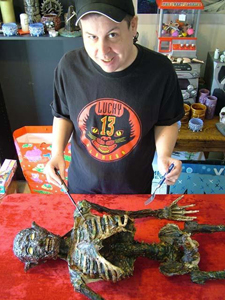
Nicolas Caesar does not have the privilege of letting his art remain in his possession. He’s got bills to pay. Call it low brow, call it tawdry, call it plebeian, but you can’t call it depreciated, as Caesar and his Scary Art Collective are selling their art before they can get it out of the boxes.
Chip Conrad, owner of Bodytribe Fitness, was the first to coin the collective. Four years ago, Conrad opened his fitness center to Caesar and his friends to use as an art gallery one Halloween, the only holiday that complements Caesar’s macabre style. “I remember getting this Myspace message asking if I wanted to show my art in a gym,” he said. “I totally thought I was walking into [a situation] of getting raped, but I’m like the girl who can’t say no.” Caesar did not get harmed, physically or emotionally; instead he formed a friendship that led to a love for the Sacramento art scene. It was a love that he described as a refreshing escape from the Bay Area scene.

From there, it became a repetition of faces. At galleries in Midtown or San Francisco, Caesar was showing his work and cheering beers next to the same few people. In this overlapping, Mark Fox, Temple Terkildsen, Cinder, Krissi Sandvik and Caesar began seeking each other out and sharing galleries. The loose organization has an unrecorded number of members, with an East Coast and West Coast branch. “Since we share the same territory, it’s a cross between Thanksgiving and AA,” he said. “We all share our tragic stories and our successes. Every Second Saturday is like meeting up with our second family.”

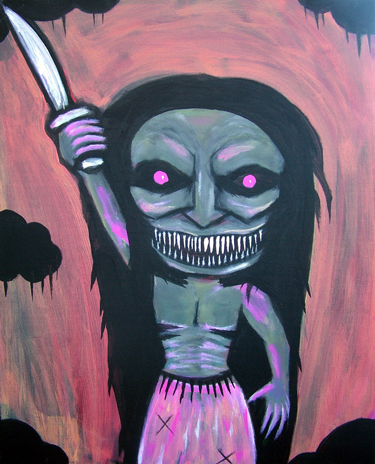
The art is mostly Gothic and dark, pulling inspiration from horror movies and the morbid subconscious. The artists share a magnetic desire to express their darkest thoughts, creating an organization comprised of your garden-variety goths to the criminally insane. Caesar is a pen pal with convicted serial killer Wayne “Skid” Lo, who is not a member. “Wayne is not officially a member of the Scary Art Collective,” Terkildsen said. “But, he does trade art with Nick.”

nikeatsweb.jpg

“My whole feeling about it is, the guy’s in prison,” Caesar said regarding his lack of concern. Caesar bought a piece of Lo’s art called Flushy the Toilet Monster. All of the proceeds from Lo’s art go to the victims’ families. “I’m gaining the Gilligan’s Island of strange and weird people [in my life],” Caesar said. “Weirdness is attracted to us.”

Living among the proletariat, Caesar is a self-proclaimed artistic anarchist who disregards the traditional rules of gallery art. He markets his work to the collectors and appreciators that keep a 30 pack of Pabst Blue Ribbon in their refrigerators and eat Top Ramen to get by. “I sell to my own demographic,” he said. “[Artists] don’t really understand who collects their art”¦ Artists have to go back to catering to the people.”

dscf3983beegweb.jpg

Terkildsen said the members of the collective are firm believers in the bartering system. On a slow night, she’ll trade two cases of beer for her art. “I’ve traded a painting for a haircut,” Terkildsen said. Essentially, they sacrifice the pompous satisfaction of selling one great piece at top value for the opportunity to put hundreds of pieces in as many living rooms as possible. Caesar and Terkildsen do not hesitate to call themselves art gypsies.

For Caesar and Terkildsen, the collective is an extension of their daily routines. Terkildsen said she works her shitty part-time job, works on art for four hours at home and then spends the remainder of the night at Caesar’s home drinking the Blue Ribbon and watching campy horror films. With work habits like that, the duo produce more art than they can store in their homes, making the bartering system all the more necessary.

“I’ve actually timed this,” Caesar said. “I can make three pieces to the movie Escape from New York.”

They are unapologetic in their merits. Both artists recognize the critiques that can be made of their leftist perspective, but they seem to revel in the judgment. Caesar said the collective’s strongest attribute is a lack of competitiveness in a cutthroat profession. Before founding Scary Art, he was frustrated with the unwillingness of his contemporaries to share galleries and the snootiness that comes with a saturation of artists. The Scary Art Collective aims to redefine the relationship between artists and galleries by operating outside traditional spaces. The collective has had shows in adult boutiques, tattoo studios, S&M clubs, gyms, coffee shops, bars, horror and comic conventions, warehouses and churches. Caesar likes Sacramento because of its bounty of unique spaces run by down-to-earth people.

4005944572_2cc9420a36web.jpg

Terkildsen described the horror of galleries outside of Midtown, expressing a loathing for curators who proclaimed they could not show her art due to its pricing. “You’re in a fine art gallery with a bunch of fuckheads you’d never talk to and you think, ‘Wow I really can’t stand this,'” she said. “Immediately, I want out and to be doing a show with Nick. I prefer the open flea market of Midtown.”

Ritually our conversation came back to PBR and living a life without the knowledge of which fork is for salads. To the affluent, this might seem like a life devoid of taste, but Caesar and Terklidsen’s art reflects a deep-seated passion for beer and cheap horror films. Read any of his comics and you’ll find black humor applied to boozed-up zombies. They share a distaste for the art critic, or in Caesar’s mind, the pastime of gremlins suffering from insomnia. “It’s a useless occupation,” he said. “For as many pages as an art critic can write, there’s going to be that person that goes into an art gallery and says, ‘You know what? I like skulls’ and buys our art.”

amdusciasweb.jpg

Terkildsen sees no glamour in an artist living off corn tortillas from the dollar store, nor does she have kind words for art critics. She keeps doing art for the feeling that comes from hearing the excitement in a few little girls’ voices at a recycling show. “I was fixing this skeleton inside this sculpture only to hear two little girls [exclaim], ‘Wow, that’s awesome,'” she said imitating their childish wonder. “How do you put a price tag on that reaction?”

Making Caesar and his friends into scapegoats for lowbrow art would only validate their convictions as monsters of the art form. Growing up, Caesar sympathized with the plight of the monsters in movies—Dracula’s eternal life, the Wolf Man’s inability to control his animalistic hunger. He sees the humanity in these pariahs. It brings to mind Caesar’s drawing of a zombie ghost feasting on a person’s head with the caption “What?! It’s what I do.”
“I was the oddball,” he said. “I was the weirdo and the freak. As an artist you’re perpetually shit on. It’s right back to the peasants and the pitchforks.” He takes comfort in being the artist who stands out from the landscape paintings, by being the guy next to the canvas bearing a bloody headless image.

On Saturday Oct. 24, 2009, Terkildsen and Caesar had a gallery showing and costume party at Side Show Studios at 5635 Freeport Blvd. Ste. 6.