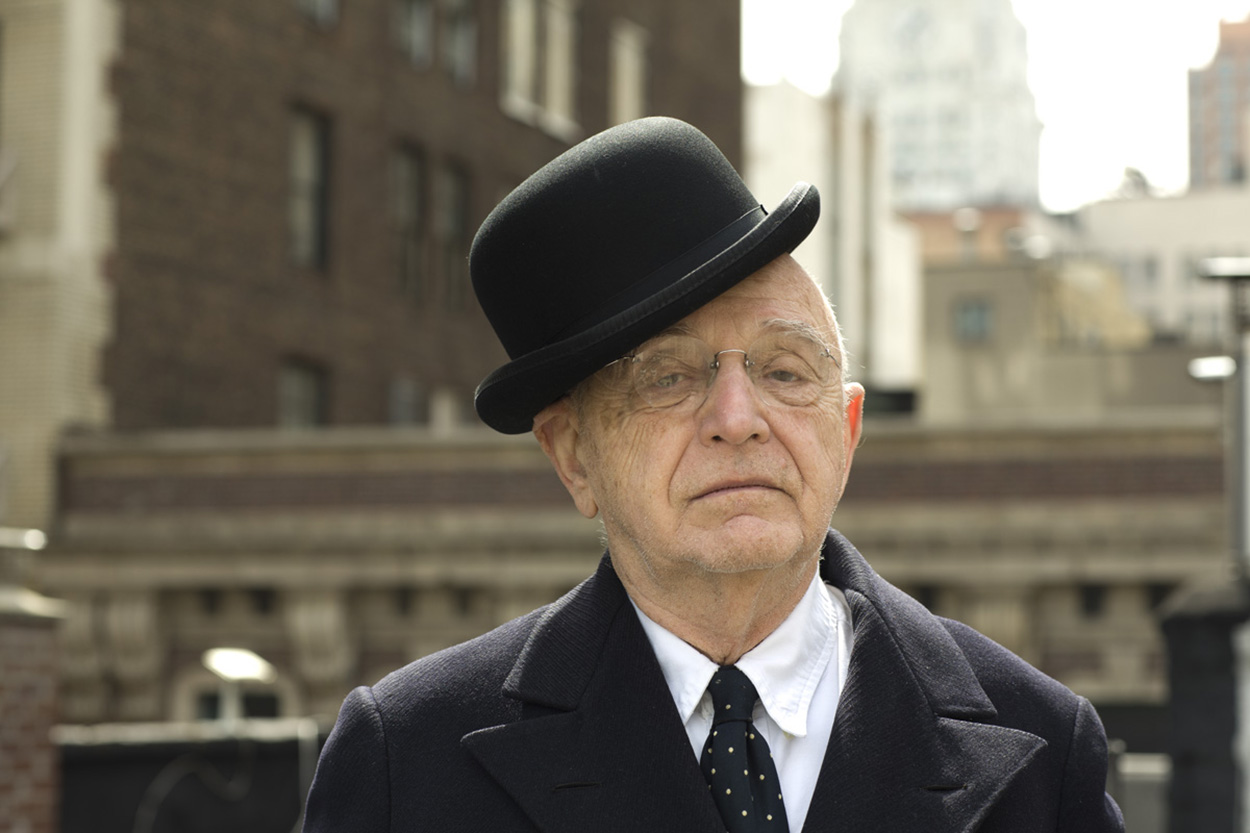
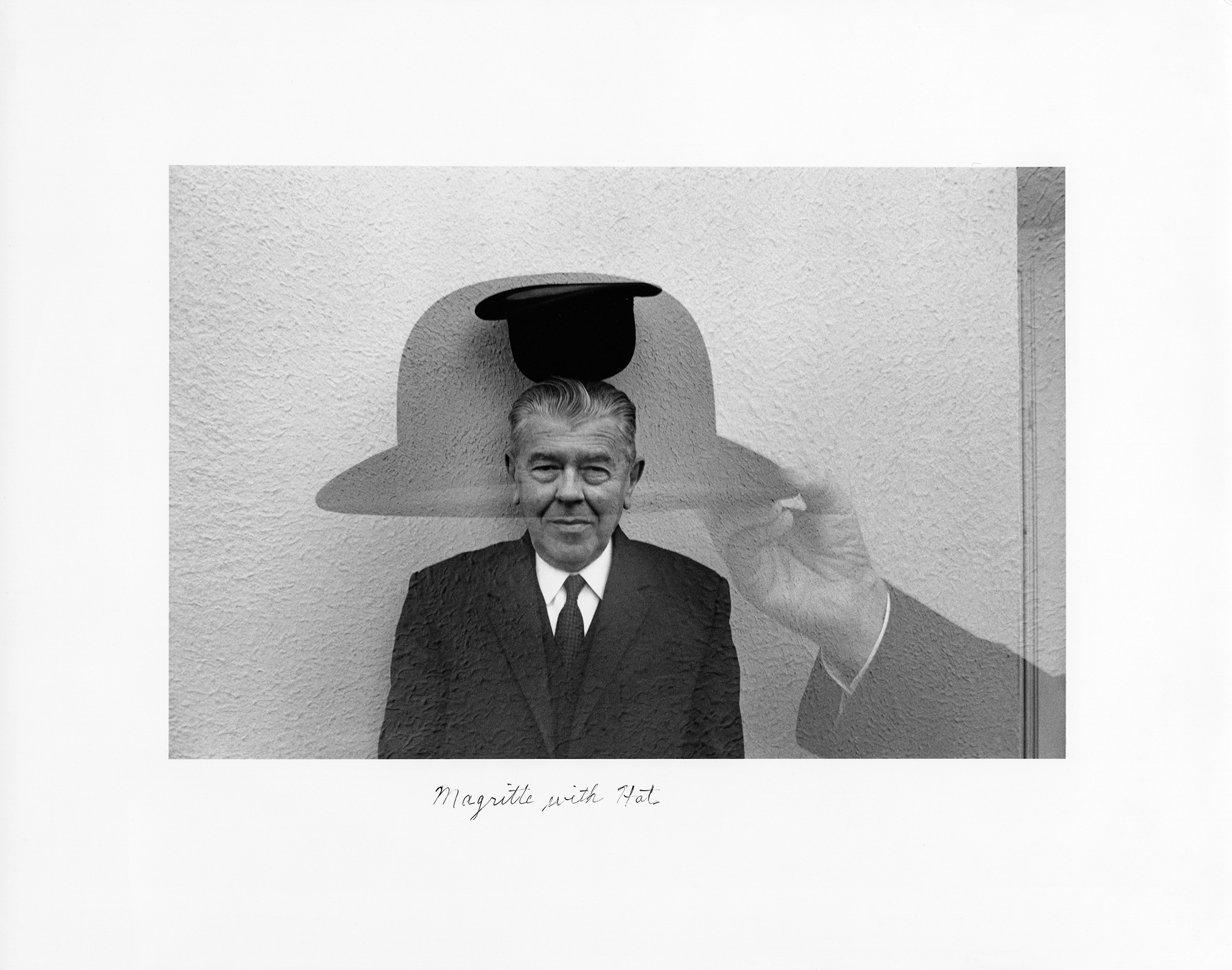
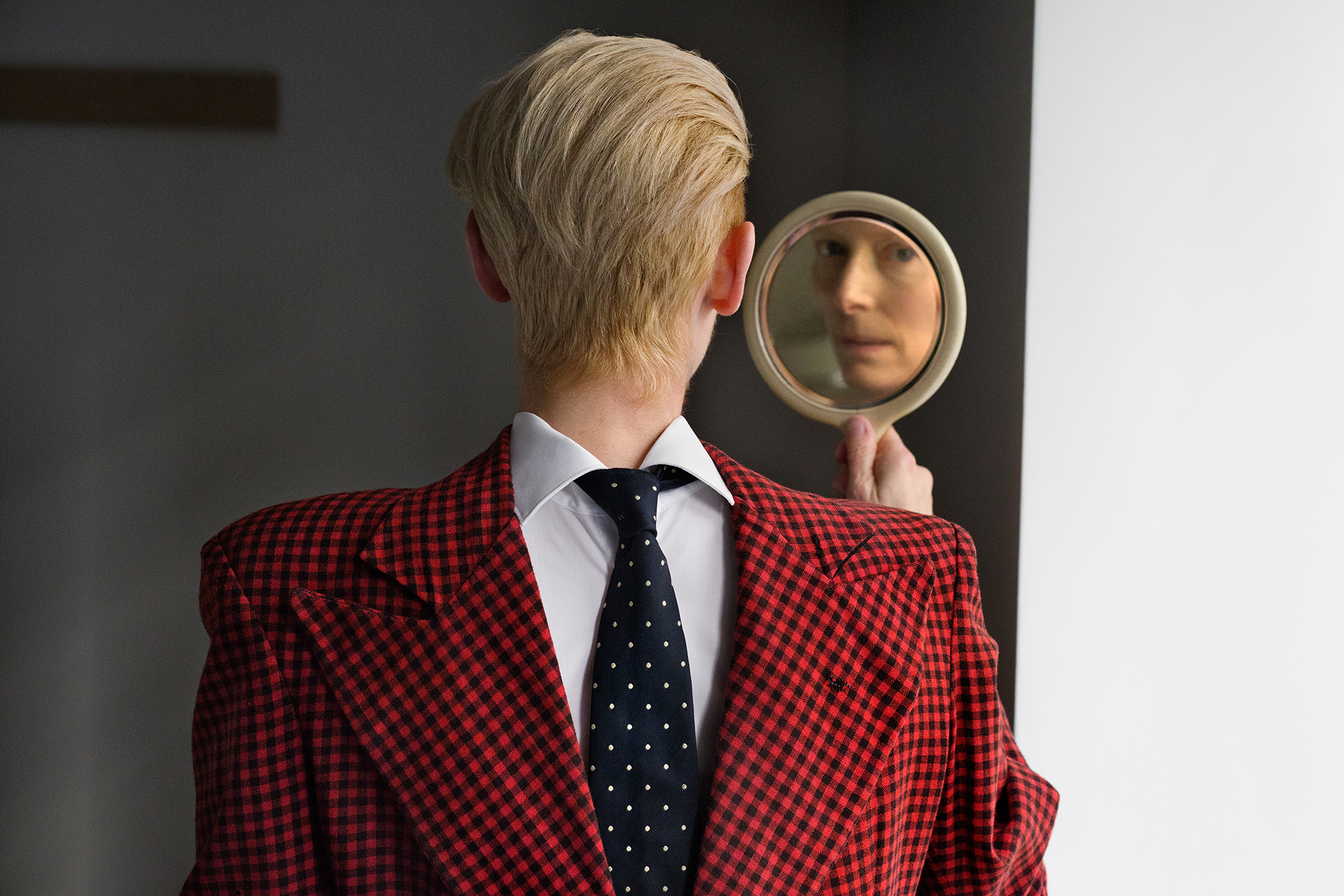
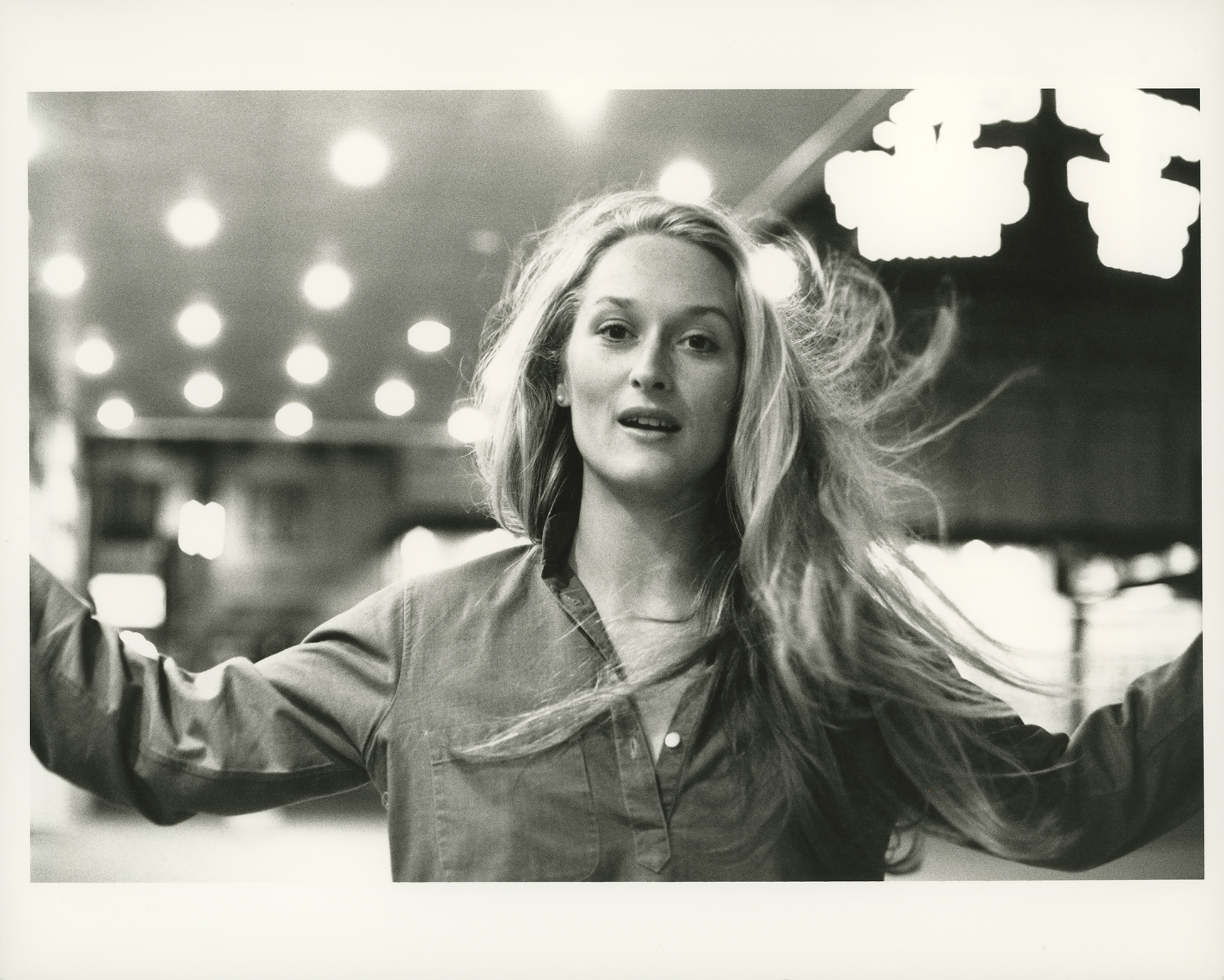
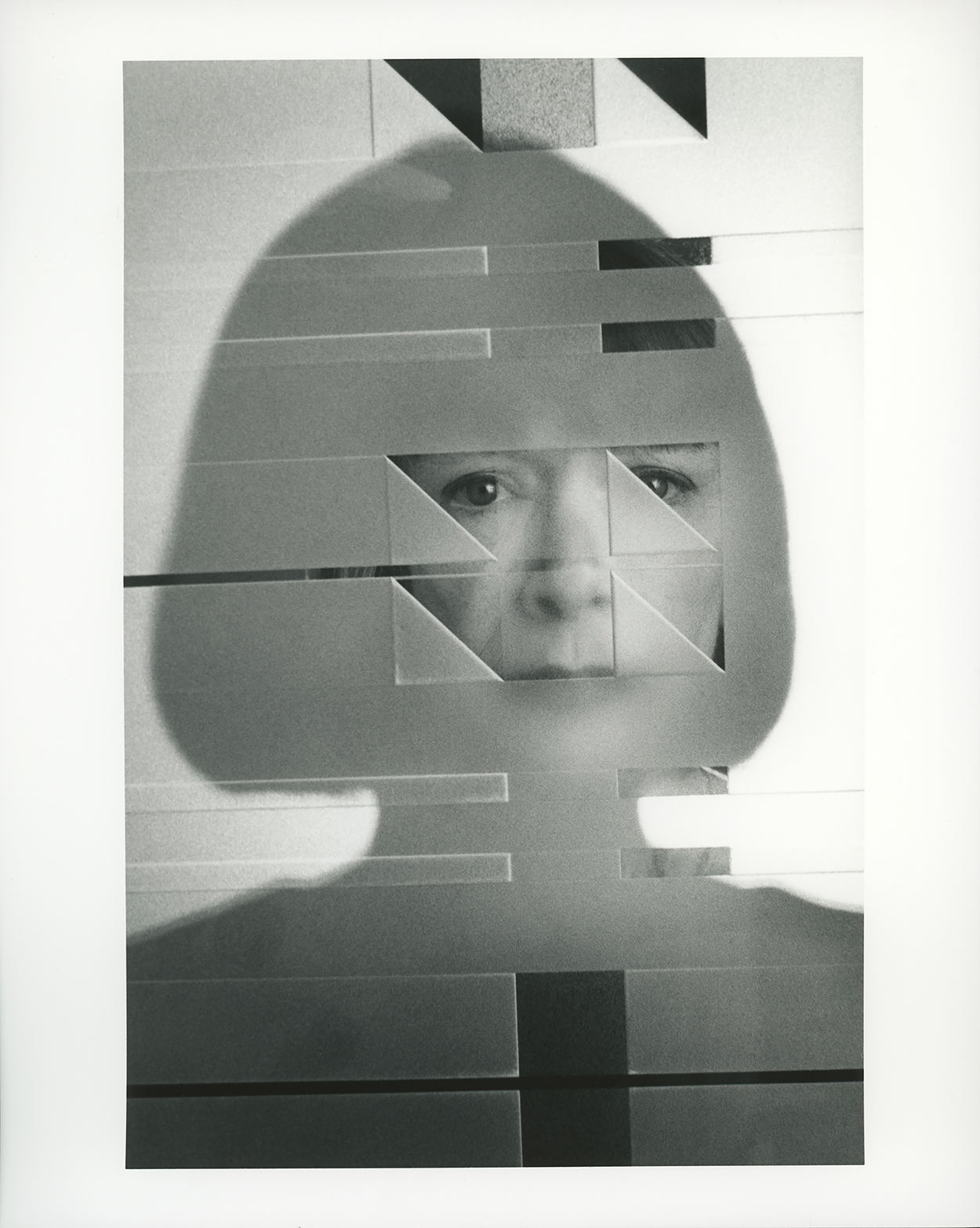
Duane Michals’ work is so incredibly full of life. There’s the playful portrait of Joan Didion, for one, looking through a smoked glass pattern on what must be an airport security door in such a way that it seems her eyes are playing peek-a-boo with the rest of her face. There is also the portrait of Johnny Cash, slouched solemn-like in a chair, with Michals’ own reflection, camera in hand, superimposed, blocking out the light from outside of what must be a glass door. Michals’ work is incredibly complex in its simplicity; creep-master Stephen King behind a spider web, ever-androgynous Tilda Swinton admiring her reflection as she’d dressed—backward, as a 19th-century English gentleman. Michals is always at play and doesn’t take himself seriously, but what he lacks in pretense, he makes up for in passion.
“Whoever said a picture is worth a thousand words is the biggest bullshitter ever,” Michals said. “A picture is such a small part of it.”
He often takes the time to write on his photos, to, as he puts it, “enhance the story” with witty quips like, “Johnny Cash was hotter than a pepper sprout,” or opaquely poetic musings like, “In Germany I named my tank ‘c’est si bon’” on a portrait of Eartha Kitt.
I didn’t know Michals before this interview, but his is the name I’ll say next time someone asks me what living person I’d most wanna invite for dinner. He’s jovial, funny as hell and he has stories about all of your favorite people—and at 86, he’s hung out with a lot of the people we never will, so in that way, wishing for Michals is like wishing for more wishes, and talking to him was a dream come true.
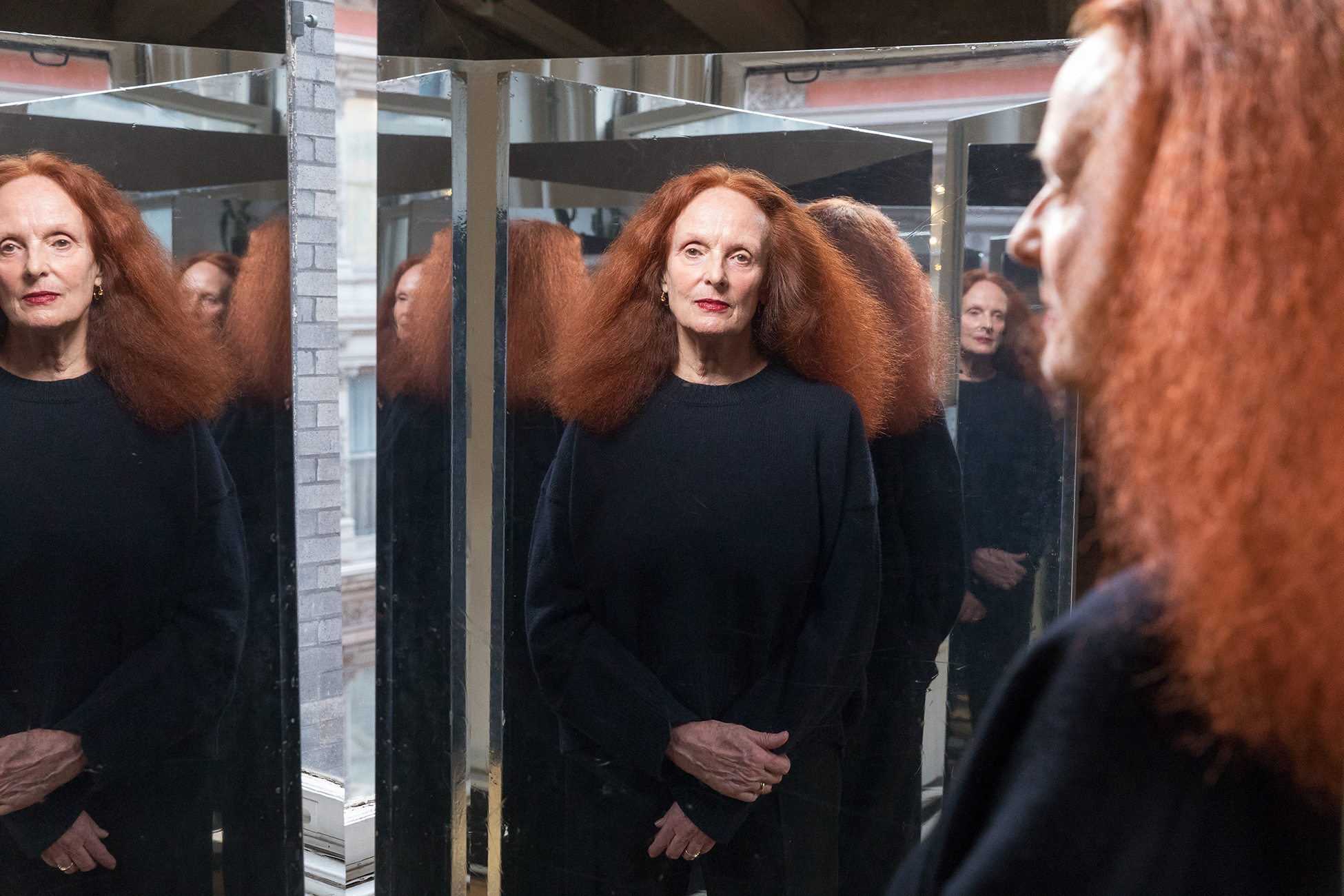
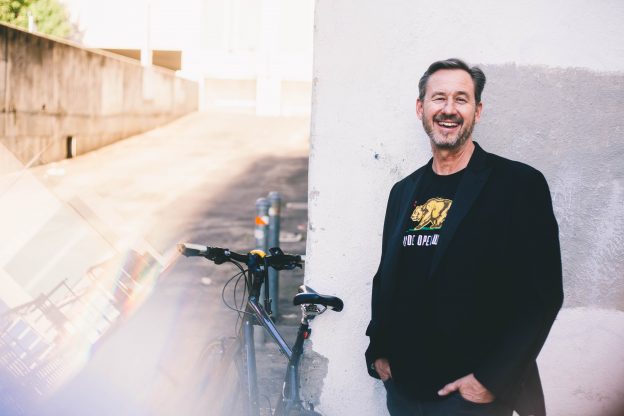
Portrait of Duane Michals by Raymond Adam | Courtesy of DC Moore Gallery, NY
So how spontaneous are these photos? In talking to you, it seems like you’re kind of playing with the moment all the time.
It’s true, I am.
I read that you never had a studio, is that right?
I never did. I didn’t like studios. If you like milk, buy the cow. So we needed a studio, but I never wanted to be a business. I never wanted to have a staff of 10 and that stuff. I always saw myself as working on a small scale. I still do. I don’t see myself in any way being a big time, big shot.
Is it a way of just being humble?
No, it’s just the way I am. I guess I’m humblish … I just want to do the work and don’t owe anybody money and just have a lot of sex.
Those are great goals!
Yeah, and make the sex first on the list.
So I read that you’re completely self-taught. How could that be possible?
No, I went to Russia when I was 26 in 1958—don’t do the math! I borrowed a camera because I didn’t have one. I’d taken a little photography course once, but it didn’t amount to anything and I didn’t think of photography as a destination. So I borrowed a camera and figured it out. That’s why I’m so angry about photo schools. I gave a talk at the graduation of the New School, and I asked the kids what they spent—something like $200,000 on photography school? Are you nuts? Give me that! That trip was literally my photo education. You put the thing in the camera. Click the other thing, put the dial on 16 when you’re outside and you put the other thing on 500. That’s what I did. It’s so simple. The trip changed my life and my exposures were amazingly good!
But your work is so great. If it’s simple as that, what differentiates you—is it your taste?
First of all, I didn’t go to photo school so I didn’t learn the photo rules. When you go to school they have to teach you something, and the teachers teach you what they do and the rules and you learn to worship the photo gods. I never learned any of that, so I didn’t worship at the altar. One day, I just decided I was a photographer and that was it.
With Instagram, everybody kind of fancies themselves as a photographer. Do you see that changing photography at all?
Yeah and actually everybody is a photographer—it doesn’t mean they’re good. And listen, I love digital—fuck film! Digital is so great. It just makes taking pictures so much easier. I’m not interested in what something looks like, more like what it feels like. If I see an old lady crying, I want to know what her grief feels like.
Do you have to develop a relationship with these people before you photograph them?
Never! That’s the greatest bullshit I ever heard! It’s total nonsense.
So then they reveal themselves to you as you take pictures?
No, nobody reveals themselves to me. Why would they reveal themselves to a stranger? No, that’s bullshit, too! It’s photo lore bullshit. It really is!
Then where’s the romance and playfulness come from? Your photos seem so intimate.
I don’t know, it comes from … I have a quotient of childishness, I think. I’m happiest if I’m saying something totally ridiculous! I can’t stand photographers who are serious. Essentially I’m just a big bullshitter, as you can see. But I never look down on jobs—any job. I did all kinds of jobs, you would be surprised. These celebrity portraits, travel photos, I’ve done Life Magazine covers, political campaigns, I did that album with the Police.
I saw that! Could you tell the story behind that album cover?
I know nothing about rock music. I was showing something, and I had an opening and this guy called—whoever the contact was—and he brought Sting to the opening. I never heard of Sting and he seemed nice and so they asked me to do the album cover. I didn’t know who they were, and as I was driving to meet them in the studio, I heard what I thought was the Police on the radio. So when I got there, Sting asked me if I knew their music, and I said I think I heard a song of theirs which sounded very nice. He asked which song it was and [I] started singing “Do You Really Wanna Hurt Me?” That was Boy George. He was nice and said, “No, we didn’t write that one.” That was very embarrassing, but we got along really well. It was one of my best assignments. I got paid a lot of money, they were nice and up for doing anything. It was great.
Can you contrast this show at the Crocker with your first show—that was the Russia show, right?
Yeah, what happened was I came to New York when I was in the army. I was a second lieutenant in Germany. I did a book called The Lieutenant Who Loved His Platoon. It was about, well, it’s a long story, but being gay in the military wasn’t easy. Anyway, you should read it; it’s a good book! Anyway, I went to New York because I wanted to—I love books. You know, I only spend money on books and magazines. And so I didn’t know where to go and I had a degree from the University of Denver. I could teach art in Denver high school. When I got there [New York], I went to Parsons for a year and dropped out. It was a disaster, and I got a job working on a small dance magazine, $50 bucks a week—can you imagine that? I found out you could go to Russia at the time—and that’s at the height of the cold war. Nobody was talking to the Russians. No one was going there. So, it cost $1,000 to go on this trip, and I was making $50 a week, so $1,000 was a big deal. So I borrowed $500 from my mother and father and I saved up for six months, saved up $500, borrowed a camera from someone, and I said to my friends I’m going to Moscow. They said, “Fuck you, you’re not gonna go.” and I said, “No, fuck you,
I am going!” and the trip changed my life, because if I had never gone, you know, I never would have been a photographer.
Do you really think that?
No, I know it. I was never an amateur; I didn’t even have a camera, I didn’t take snapshots and when I got to Russia, they taught me to say something which I think means “May I take a picture?” and I just stopped these people and took pictures. I had no pretensions about being a photographer, but it’s all I’ve done ever since, and I may be dead any minute now, but I’ll keep going.
You timed it right. I’m recording this, in case you want your last words to be poetic.
I’m the last of the great Manhattan drinkers. My last words would have to be, “One more for the road, please!” I’m not a professional.
The beauty of that is that your photos speak louder than people who consider themselves professionals.
Yeah, well, I certainly know enough. I wasn’t a total fool, but you know, I was panicked when I couldn’t find my light. The light was the big deal, and I always would suffer over everything, especially back then, but even now. Not having a studio makes you dependent on a lot of other factors.
Can you tell me more about the portrait book?
Yeah, one of my favorite ones is the one of my mother. It’s a picture of my mother, sitting and looking out the window and the sunlight is coming in and you see a reflection. There’s moisture out there and it’s very still. I wrote a caption on it and it says, “Mother after father died.” And she’s sitting there and you only see her reflection and she looks very sad, and she looks like she’s tapping her fingers. Like she’s counting the time, watching time go by and to me, that’s the most profound out of the portraits because it suggests, and any good thing can only be suggested. You can’t put everything in there. You can reproduce someone’s lips or wrinkles or their nose, or whatever, but important things can only be hinted at. Grief is something that you can’t photograph. I can tell you what it looks like—tears tell you what grief looks like. Lighting or whatever, but these are all formal elements, they’re not grief.
Do you have anything important you want to say that I’m missing?
Not at all. You’re very nice. Thanks for talking to me for this long.
You’re a bad judge of character, sir. I’m rotten.
I didn’t mean it anyway.
Duane Michals’ exhibit, The Portraitist, is currently on view at the Crocker Art Museum (216 O St., Sacramento) through Jan. 6, 2019. For more info, go to Crockerart.org.
**This piece first appeared in print on pages 18 – 19 of issue #275 (Sept. 26 – Oct. 10, 2018)**
This summer is already shaping up to be a great one in Sacramento, and to kick things off, the month of June is stacked with rad events, outdoor concerts, night markets and block parties galore. Besides all the other great stuff featured throughout this issue, we wanted to be sure to highlight these 10 fun events happening this month around Sacramento to help jump start your kick-ass summer.
Local indie mainstays Sun Valley Gun Club are throwing an album release party at the Red Museum (212 15th St.) on Friday, June 8, celebrating the release of their third album, the water, the stars. Also on the bill is Bastards of Young and Ani Maul. This will be a banger, folks. All ages, 8 p.m., $8.
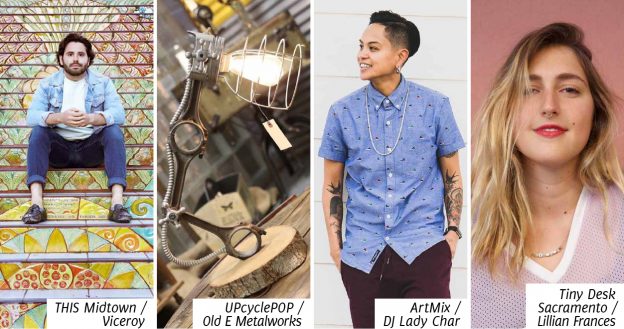
The popular THIS Midtown Second Saturday block party series returns June 9 with live music from Viceroy, Pink Skies, DJ Greg J and others. The party goes down on 20th Street between K and J streets from 4:30 to 11 p.m. and features local artists, vendors, beer garden, cocktails and tons of fun. Visit Facebook.com/this916 for more. Free, all ages welcome.
UPcyclePOP’s upcoming Fathers Summer event is a market and art lab happening at 7300 Folsom Blvd. on Saturday, June 9, where you can watch artists upcycle discarded items into works of art, fashion, furniture and other creative inventions. Sip on a drink, check out the live music jam, and pick up a unique Father’s Day gift. Noon to 6 p.m., no cover, family friendly event. Upcyclepop.com for more info.
June is pride month! Celebrate the LGBTQ community at the massive Sacramento Pride Parade March and Festival on Sunday, June 10. The free, all-ages parade march kicks off at 11 a.m. at 3rd and N street, and ends at 10th and N street. The festival is $10 (kids 10-and-under are free) and takes place on Capitol Mall between 3rd and 7th streets from 11 a.m. to 5 p.m. Visit Sacramentopride.org for more.
Keeping with the pride theme, don’t miss the next installment of the always awesome ArtMix series at Crocker Art Museum (216 O St.) on Thursday, June 14 from 6 to 9:30 p.m. Pride the Musical is the theme, and the 21-and-over event will feature performances from Britney Spares and Friends, Underground Theatre Company, Green Valley Theatre Company, DJ Lady Char, Sacramento Gay Men’s Chorus and many others. Free for Crocker members, or just $10 otherwise. Crockerart.org for tickets.
The inaugural Front Street Brewfest is Saturday, June 16 from noon to 5 p.m. and all proceeds benefit Friends of Front Street Animal Shelter. Expect 30-plus breweries, unlimited beer tastings, SactoMoFo food trucks, live entertainment and games, all in a block party environment. The fest takes place at 2127 Front St. Visit Frontstreetbrewfest.com for more info and to purchase tickets, which are $40, or $10 for non-drinkers.
Check out some high-energy, hard-hitting roller derby action at the Sacramento Roller Derby’s upcoming Double Header on Saturday, June 16 at The Rink (2900 Bradshaw Road). Doors open at 6 p.m., snag tickets in advance through Brownpapertickets.com.
Capital Public Radio is throwing a cool Tiny Desk Sacramento concert in the CapRadio Garden (7055 Folsom Blvd.) on Saturday, June 16 from 6 to 8 p.m. featuring performances from some of the station’s music guru Nick Brunner’s favorite regional Tiny Desk contest entries, like Lillian Frances from Davis, Stop Motion Poetry from Modesto, and Bobby Waller from Sacramento. Free event! Facebook.com/capradio for more.
Hometown heroes Dance Gavin Dance return to rock the Concerts in the Park stage on Friday, June 22 at Cesar Chavez Plaza (9th and J streets). Also performing is Nerv, VERNO and DJs from Emo Night Sacramento. CIP is always free, and always a good time. Runs from 5 to 9 p.m. Hit up Godowntownsac.com or Facebook.com/cipsacramento for more.
Check out the first-ever Our Street Night Market on Saturday, June 23 on R Street between 11th and 12th streets. This open-air party runs from 7 p.m. until late night (1 a.m.) and will feature a ton of vendors, street food, a beer garden, two bars, arcade games, a silent disco, salsa dancing and more. Free event, all ages welcome.
**This piece first appeared in print on page 8 of issue #267 (June 4 – 18, 2018)**
Thunderpussy is not just an all-girl band; they’re a skull-crushing, kick-ass rock juggernaut. But even skull-crushers have feelings. As evidence, drummer Ruby Dunphy was getting wrapped up from a fresh tattoo when we connected to discuss her band and their upcoming performance at the Crocker Art Museum ArtMix event, FIERCE, in March. Dunphy took a seat to chat while watching her friend get a matching tattoo—Russian symbology that means there is no revolution without evolution.
“I’m such a bitch getting tattoos,” jokes Dunphy. “I’m just crying the whole time. I wish I wasn’t like this.”
Dunphy, Thunderpussy’s newest member, moved to Seattle to attend Cornish College to study art. She vowed she wouldn’t start a band until she graduated—she was going to focus solely on her studies. During her first week at college, her trombonist friend grabbed her arm and said, “I’m going to introduce you to your new band,” to which Dunphy sharply replied, “Go away, I don’t want a band.”
But this was meant to be. Dunphy was promptly dragged to Joe Bar across the street from her school, where Molly Sides, Thunderpussy’s lead singer and a barista at the time, was introduced to her new drummer.
“Molly wouldn’t let me go,” laughs Dunphy, who reports she was courted by borderline harassing texts until she finally caved. She agreed to help the band out “until they found their real drummer.” Famous last words.
“Thank God Molly was so persistent,” says Dunphy. “I was so lucky.”
Wrapping up her last semester of her fourth year of art school, Dunphy is slated to graduate in May, and simultaneously has managed to be in a band that is skyrocketing to stardom. Recently signed to Universal Records under their subsidiary Stardog Records (which is a subsidiary of Republic Records), Thunderpussy is releasing their long-anticipated debut album in late May. When I say long-anticipated, I mean I’m panting like a dog waiting for this LP to drop.
With multiple offers on the table from labels thirsting for Thunderpussy, Stardog Records felt like the right fit because of their family vibe, affiliation with their Pearl Jam friend Mike McCready and Thunderpussy’s deal-sealing whirlwind trip to New York when they visited Universal Records’ headquarters.
“It was the craziest experience I’ve ever had,” remembers Dunphy. “The things they were offering seemed so attainable because of the artists they have, like Drake and Amy Winehouse. It was like, well, you did it for these people …”
After years of saving every penny the band made to reinvest back into the band, and hustling independently, the ladies of Thunderpussy are all now living the rock ‘n’ roll dream that for so many bands never comes true. They’ve all quit their day jobs, yet it’s impressive that Dunphy has stuck with her education in spite of her band’s success.
“My days are really filled,” says Dunphy when I asked her how she manages the workload. “I’m getting a tattoo right now only because I’m blowing off my homework. In the end it all gets done. When we’re on the road, I’ll be in the green room doing my homework, or in the van studying and shit. My teachers are super cool and for the most part understand everything, and luckily I have the other three members to help respond to emails and get me to where I need to be sometimes.”
Every member of Thunderpussy has been a lifelong musician, and it’s evident in the skillful execution of every live set. Sides was born a performer incapable of not dancing, and graduated from Cornish College as a dance major. She has been a singer all her life, too, and was in a couple bands prior to forming Thunderpussy. Leah Julius, the bassist, was a drummer all her life and has been in countless bands before learning to play bass. She also currently plays in the band Sundries “who fucking rip,” explains Dunphy. Whitney Petty, Sides’ lover and partner for the past six years and Thunderpussy’s sick guitarist, was also a long-time drummer in many bands before finally teaching herself guitar. Dunphy is a classically-trained jazz drummer.
“It’s the one thing I know how to do. The only skill I have in my whole life,” jokes Dunphy. Her jazz influence shines through in Thunderpussy’s sophisticated time changes.
Their sleazy rock ‘n’ roll sound is gigantic, dwarfed only by Sides’ and Petty’s palpable sensuality and onstage romance, and Sides’ melodramatic, convulsing, writhing, hair-flipping command of the audience. Her powerful vibrato is akin to Grace Slick’s knifing vocals, and the band’s mastery of their craft conjures the gods of rock.
Inspired by one another, songwriting generally begins with Petty and Sides at home, and song starts are brought to practice and arranged by the group.
“The ‘Speed Queen’ is this mythic and magical woman who rides a motorcycle and travels around the country,” shares Petty in the band’s bio. “Nobody knows too much about where she came from or where she’s going, but she changes everyone she meets because she’s that powerful. I was thinking of Molly when I wrote it… People talk about that magic. There’s some voodoo happening between Molly and I, which is like a cosmic connection. She has this power. Somehow, I’m under her spell when we’re performing—we all are.”
It was the magic of their live performances that has catapulted them to notoriety, making them such a hot commodity before they even put out a record. In fact, a focus on performing live has always trumped recording for the aptly-named Thunderpussy. In addition to their tour, Thunderpussy is playing Sasquatch Music Festival and SXSW this year.
“So much of Thunderpussy is performance. I prefer smaller clubs and audiences because I like to look out and make eye contact with people, and joke around with people and smile. And after the show, I love having women come up to me. My favorite fans are older women and young girls, who come up to us after the show and are like, ‘I’m going to play drums now.’ I want to cry every time. Recordings can do that, but I’m selfish—I like to be in the moment and experiencing it live,” beams Dunphy. “I go bucket drumming every weekend on Capitol Hill in Seattle just for that reason, just to make people dance and have a good time.”
And when Dunphy plays music, it transforms her emotions, too.
“Last year we played a show where I was insanely angry because I had just got off the phone with somebody who had just had something tragic happen to them,” recalls Dunphy. “I hit the drums harder than I ever had. And midway through the set, I look up, and Molly, Whitney and Leah could tell, and they responded to how I was playing. Everything shifted in that moment to pure happiness, and pure family. I love them.”
See Thunderpussy live as part of the Crocker Art Museum’s ArtMix event, FIERCE, on March 8, 2018. Rituals of Mine will also be performing a special DJ set. For more info and to register for tickets, go to Crockerart.org. This is a 21-and-over event. Crocker Art Museum is located at 216 O St., Sacramento, and the event will start at 6 p.m.
**This article first appeared in print on pages 24 – 25 of issue #260 (Feb. 26 – Mar. 12, 2018)**
Poet Donté Clark saw his hometown of Richmond, California, as a city at war. Richmond was split in a turf battle between rivaling gangs, and shootings were a nightly occurrence. However, Clark thought he’d be able to at least open up a dialog between his city’s warring factions, and found the inspiration to do so in William Shakespeare’s Romeo and Juliet. Filmmaker Jason Zeldes followed Clark on his quest to adapt The Bard’s centuries old play in hopes that it would help heal some of Richmond’s wounds. Romeo is Bleeding debuted at the San Francisco International Film Festival in 2015 where it won an audience award for best documentary feature. This screening is part of the California Fresh Film Series, which will continue on the first Thursday of the month through April 5, 2018, at the Crocker Art Museum (216 O St., Sacramento). For more info and to register for admission, go to Crockerart.org.
**This write-up first appeared in print on page 11 of issue #257 (Jan. 15 – 29, 2018)**
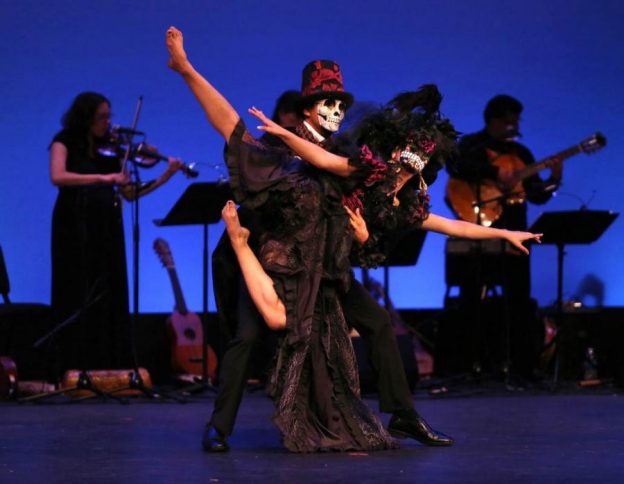
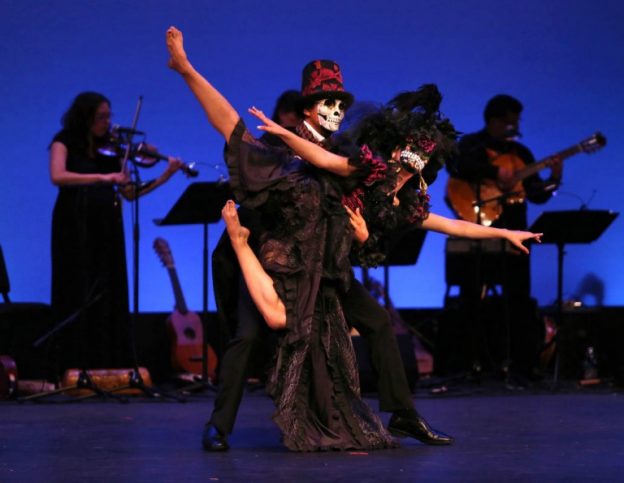
Looking for a family-friendly Day of the Dead celebration like no other? Leave it to Sacramento’s first professional Mexican folk dance company, Calidanza. On Thursday, Oct. 19, this 18-member dance troupe will bring high-energy performances to Crocker Art Museum’s outdoor courtyard for Noche de Muertos! Organizers promise a “complete, immersive experience” with not only jaw-dropping dance routines, but also “fantastical costumes” on display by designer Rory Castillo and his Catrina Catwalk Fashion Show. Plus, enjoy a light show by George Holden (who has worked with everyone from Santana, to Jefferson Airplane, to Van Morrison, no big deal!) and live music from San Francisco’s Vinic-Kay, an experimental group of Folkloric musicians. For more information and to snag tickets ahead of time (which we strongly suggest), visit Crockerart.org or Calidanza.org. Students and youth are just $14, Crocker members are $16, and general admission tickets are $20.
**This write-up first appeared on page 11 of issue #250 (Oct. 9 – 23, 2017)**
Turn the Page: The First 10 Years of Hi-Fructose is likely one of the best contemporary art exhibits the Crocker Art Museum has ever displayed. It’s evocative, delightful and sometimes surprising.
But mostly, it’s accessible, which was a goal for both its curators at the Virginia Museum of Contemporary Art, and for Hi-Fructose magazine founders and editors in chief, Annie Owens-Seifert and Daniel “Attaboy” Seifert.
Accessibility to contemporary art has been part of the mission for Annie and Attaboy, who started self-publishing and sustaining Hi-Fructose 10 years ago. They brought what some considered “lowbrow” art to the mainstream and onto magazine shelves, affirming that this form of expression by living, local artists deserves just as much attention as “the greats” hanging in the homes of the elite and on loan to museums.
Turn the Page takes this mission one step further, by bringing the art from the magazine pages to the people.
“For a long time, I found many modern museum showings to be ‘one note’ compositions or presented as a wealthy family showing off their [investments] collection,” says Attaboy. “Honestly, I often enjoy many of the gift shops more. All the artists shown in Turn the Page are living, working artists and complement each other. They aren’t afraid to tell a story, or show you what their interests are.”
Those stories can range from political to personal—the struggles and triumphs of life experiences, emotions of family and children, divorce, assault, natural disasters and the impact of war on humanity.
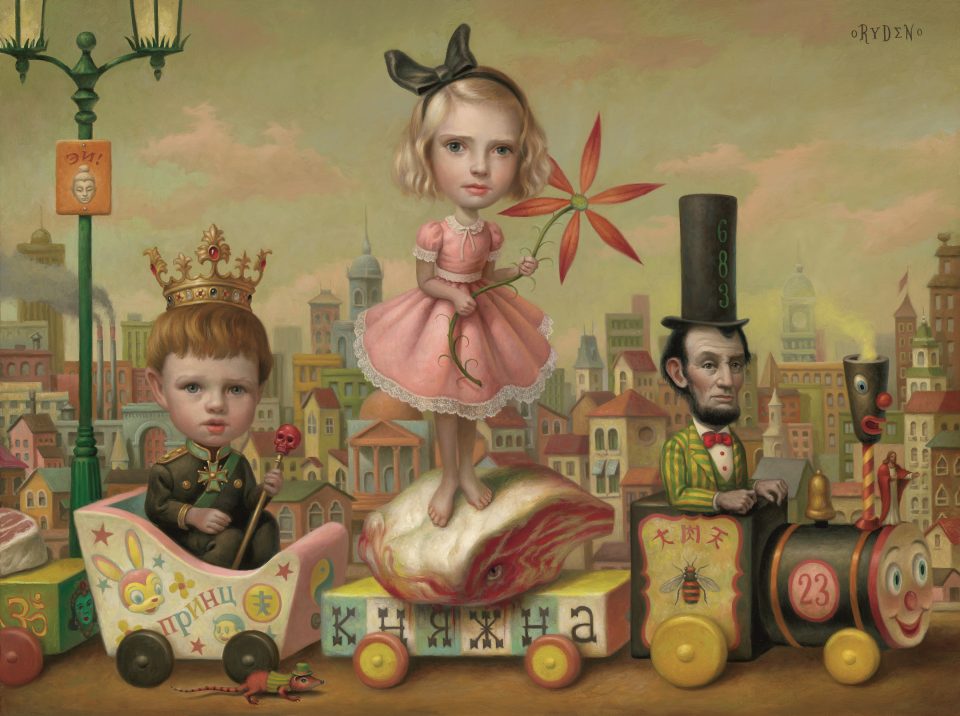
Pieces from Marion Peck, Mark Ryden, James Jean, Yoshitomo Nara and 47 other renowned contemporary artists from across the world who have been featured in the pages of Hi-Fructose over the last 10 years were carefully chosen to expose a broad audience to artists who use their media as tools to visualize what is happening in contemporary society.
“The pieces are all so different but I think the one characteristic shared throughout the show is accessibility,” says Annie. “And I mean accessible in terms of connecting with the viewer. Art can be thoughtful, intelligent and provocative and still not require a master’s degree in order to discuss or understand it in the way a lot of high concept work does—that to me is exclusionary. This work is with the viewer, not above them.”
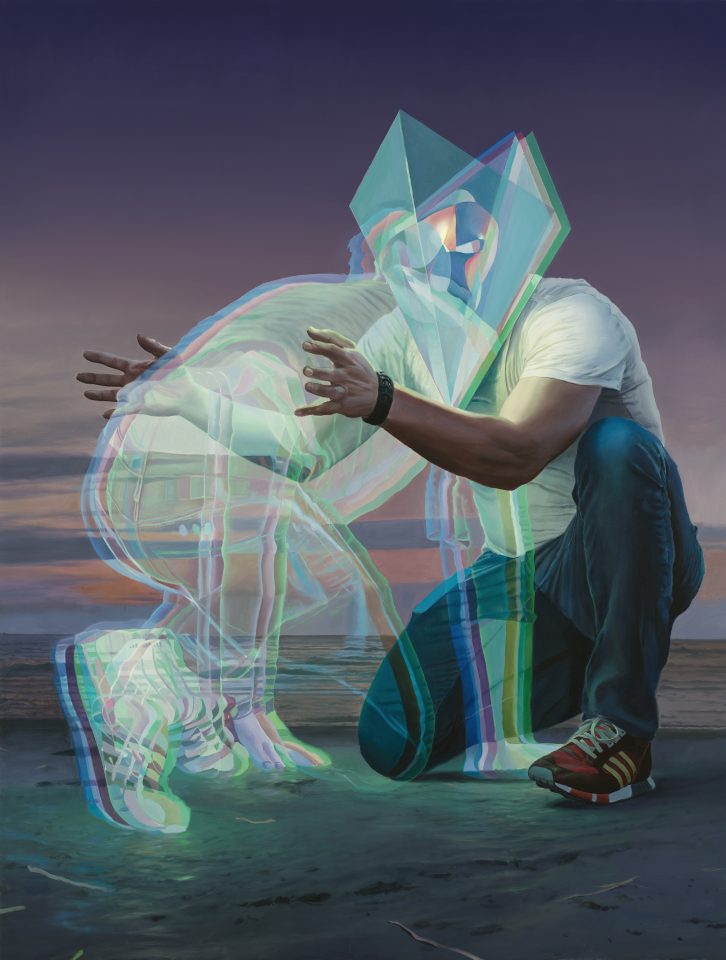
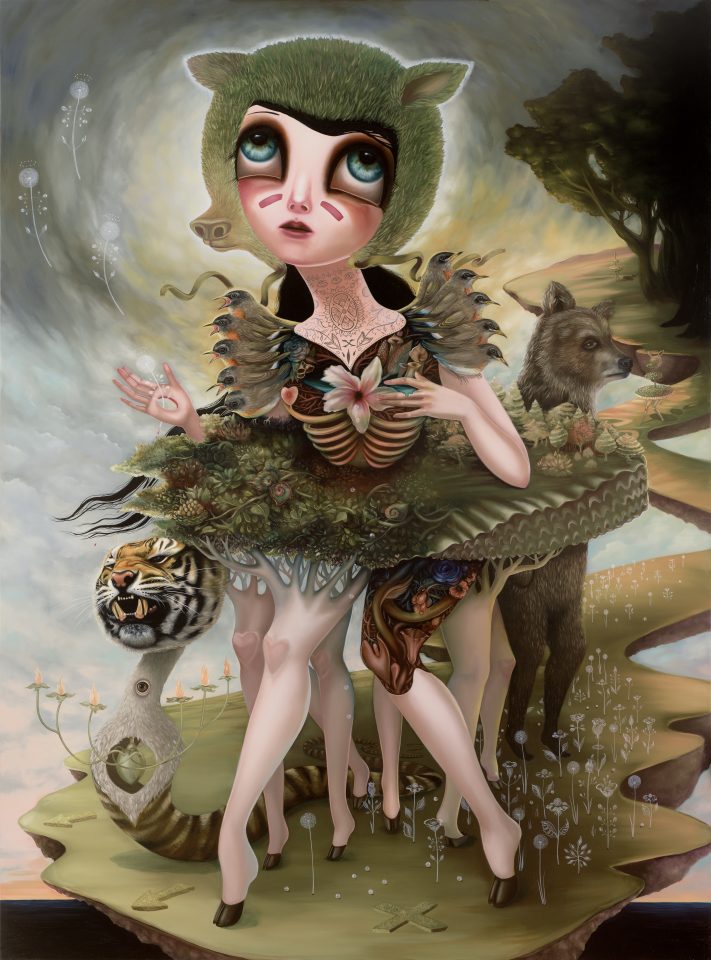
Jean-Pierre Roy, The Incunabulist, 2015. Oil on linen, 50 x 38 in. Courtesy of The Grauslund Collection.
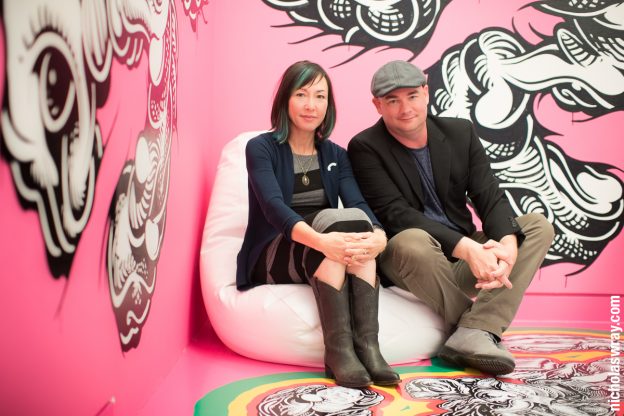
The entrance into the exhibit is a clear indication of this. Both the entrance from the staircase and from the elevators open up into an immersive two-room installation by American artist Mark Dean Veca that splashes across nearly every inch of white space.
Veca fabricates these temporary, spatial pieces first in vinyl, then goes back in and hand paints improvised line work, reflecting his parents’ jazz musician background. The resulting impact is loud, meaningful and mesmerizing; a perfect entrance to the rest of the exhibit.
Turn the corner, for example, and visitors are greeted by Shepard Fairey’s Rise Above. Fairey has been creating his politically charged movement art for more than a decade. His latest work has been displayed on skyscrapers from Las Vegas to Sydney, Australia to Berlin, Germany. The immediate gratification of seeing one of his pieces live in Sacramento right after the Amplifier Foundation’s “We the People” campaign against the Trump inauguration leaves an impression.
The globalized element of the exhibit, especially in terms of shared social issues, stands out throughout the exhibit. Walking toward the sculpture Black Hoody by Erwin Wurm of Austria, one can assume in America what the sculpture of a youngish, short, dark, hooded figure could mean.
The artist’s actual description—that the statue is a British soccer hooligan—is surprising at first but does lead to a deeper conversation of our perceived notions and our stereotypes, and how they compare to stereotypes in other cultures.
For Annie, Marion Peck’s work stands out as a favorite. The exhibit includes a cute, and on closer inspection, chuckle-worthy, Peck painting of rabbits having sex in a forest.
“Her work is elegant and graceful yet not pretentious,” Annie says. “The sense of humor and intelligent anarchy in her work is an element that permeated the underground art world back when I first became aware of it. I’m happy to be seeing it now, her underlying attitude unchanged, in a museum where people bring their children. This of course is not the first time her work has been shown in a museum but that it’s part of the Hi-Fructose show makes me very happy.”
Annie and Attaboy both must share a rabbit fetish, because Attaboy’s favorite piece, by Beth Cavener, also showcases the animal in an exposed way.
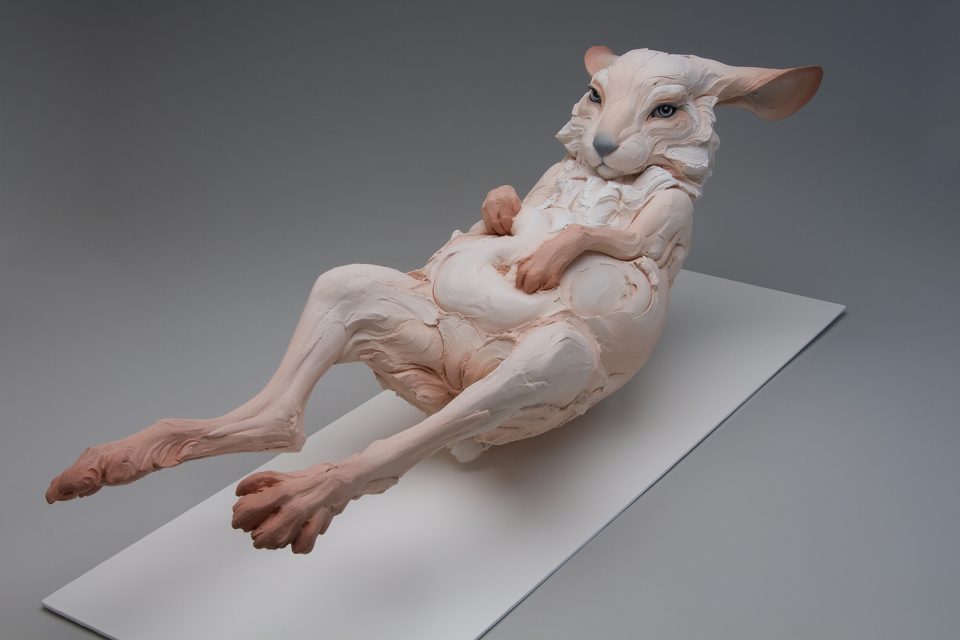
Beth Cavener, Unrequited (Variation in Pink), 2015. Resin infused refractory material, paint, 14.5 x 15 x. 43 in. Courtesy of the Artist and Corey Helford Gallery, Los Angeles, CA.
“Her sculptures are dynamic, fluid and have a narrative that shines through,” Attaboy says. “I like that people’s first response is ‘Oh, bunny!’ then a few moments later, the theme of the same work has a way of creeping up the spine as the viewer anthropomorphizes the art with the weight of their own baggage.”
Individual pieces were picked based on a number of factors, including art piece availability, logistics and visual and narrative balance, Annie says, not on who was “best” or “most deserving.” As for location, the cities of Sacramento, Akron and Virginia City are the only ones to see the exhibit, for which the editors are grateful.
“Why should big cities have all the fun?” Attaboy says. Annie notes that a bigger audience was reached as well, as opposed to if they had shown in larger cities.
“Still can’t believe the thing came together and is real,” Attaboy adds. “I’m amazed to see children and older folks stare and enjoy and investigate the art. That took me by surprise. It’s been weird for us to see this thing realized. The Virginia MOCA did a great job doing all the leg work, but it wasn’t easy to select only 51 artists. But it became its own great thing. Kinda like a movie based on a book. I’m pretty sure there will be a more straight-up gallery show in the future.”
Annie notes that this is too diverse of a show to throw any kind of blanket statement on it, but she makes one thing clear: each artist in the show had begun cultivating their own career long before social media was a thing.
“In the ‘90s and early 2000s before we began publishing Hi-Fructose, Daniel and I as artists had been milling around an already vibrant art scene humming below the radar before we started publishing … An arena that was not dependent on social media,” she says. “Many of the artists in the show had made names for themselves before we came along. We were just covering what wasn’t getting coverage at the time and there was so much. That was our job. Years later, social media exploded and helped to push this art scene out above the glass ceiling, but it didn’t make these artists.”
Many of these artists, she says, showed in galleries that didn’t follow the status quo, worked as illustrators, published indie zines, did poster art, made comic books, band art and street art that was actually on the street (sans PR reps).
“We’re fortunate that each one of them said yes when we asked if we could do a feature on them,” she says. “If not for artists that keep pushing boundaries there wouldn’t be a reason for us to keep going.”
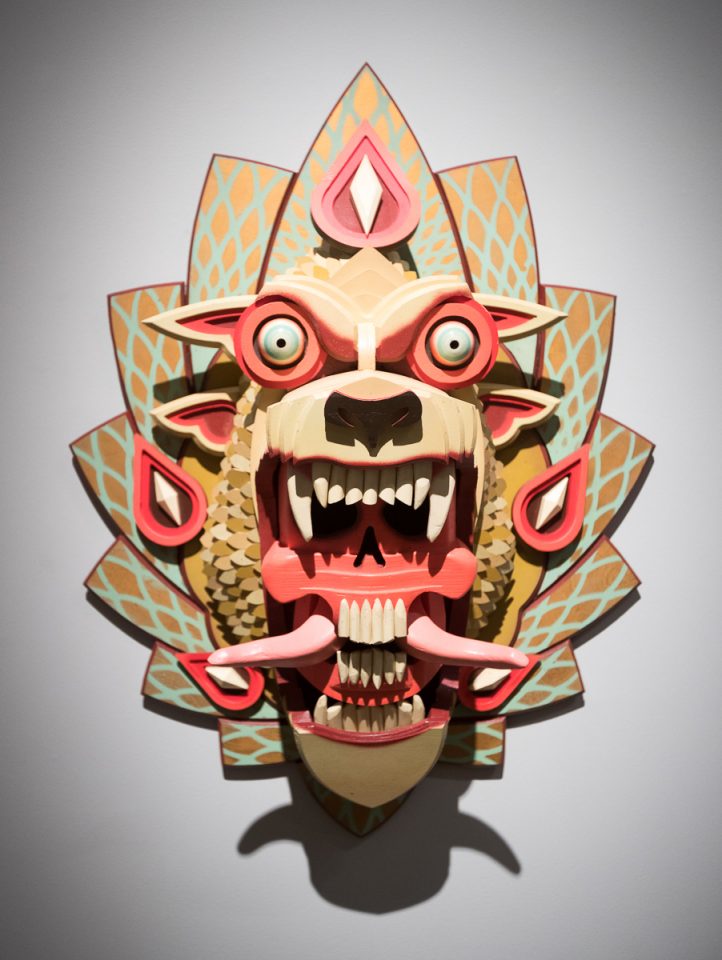
J Fosik, The Abyss Stares Back, 2011. Wood, paint and nails, 39 x 27 x 14 in. Collection of Ken and Lauren Golden. Photograph by Nicholas Wray.
Turn the Page: The First 10 Years of Hi-Fructose will be on display from June 11–Sept. 17 at the Crocker Art Museum, located at 216 O St. in Sacramento. The Museum is open Tuesday–Sunday from 10 a.m.–5 p.m. (open till 9 p.m. on Thursdays) with general admission $10 for adults, $8 for seniors/military/college students, $5 for kids 7–18 and free for kids under 7 and members.
**This article first appeared in print on pages 18 – 20 of issue #243 (July 3 – 17, 2017)**
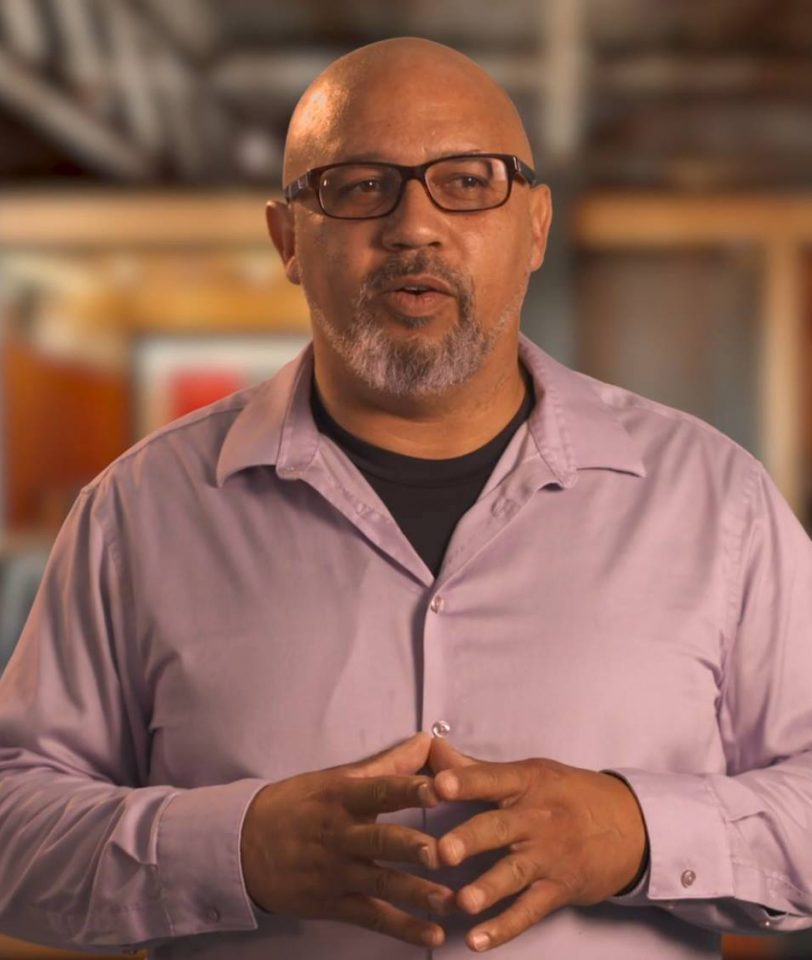
Standing in front of a blank wall bigger than a basketball court with 800 cans of spray paint and a surgical mask at the ready sounds like a scary adrenaline rush. But it’s a small piece of heaven for Michael McDaniel—an opportunity for the heart, mind and spirit to relax and create.
After living a childhood with uncontrolled psychosis that led to drug abuse and long stints in psychiatric hospitals, McDaniel’s spirituality helped him find a path to reality, and it included painting and helping others with their mental illness to be independent and creative.
McDaniel, 48, has been painting in Sacramento for nearly a decade. He has also been a case manager since 2005 at Transforming Lives, Cultivating Success (TLCS), a nonprofit that works to empower people who have mental illnesses and to prevent homelessness.
At TLCS, McDaniel has facilitated an art class for several years and has worked with more than 80 clients who struggle every day with psychotic symptoms, using art to provide them with a source of comfort and a way to express themselves.
“Art is in everything, and the greatest work of art is the human being,” McDaniel says. “I want to be able to share my artwork and use it to create community.”
McDaniel says he pictures these murals alongside community gardens, where students can learn about the importance of their environment in multiple ways.
Founder and producer of Wide Open Walls, David Sobon, has a similar goal. For Sobon, an international mural festival in Sacramento is the perfect way to build community, provide for underfunded art education, create landmarks, spur the economic engine and, ultimately, provide free, beautiful, art to all people.
Wide Open Walls (WOW), formerly the Sacramento Mural Festival, will feature McDaniel and 39 other artists—local, national and international—to transforming walls and neighborhoods across the city. He and 2 Hermano, of Sol Collective, are the two individual artists chosen through WOW’s commitment to supporting local nonprofits at the event.
Transformation is a key theme for this year’s WOW festival, which runs Aug. 10–20, 2017. Sobon has taken over last year’s inaugural Sacramento Mural Festival, run by Friends of the Arts Commission, and turned it into the largest event of its kind. No other mural festival has had 40 artists—many of them world renowned—create 40 murals in less than two weeks in one city, Sobon says.
The aim is to build upon the rich art culture of Sacramento that already permeates city walls, Sobon adds.
“I love going to museums—the Crocker is one of the best museums on the West Coast—and I love going to all the galleries around town, but I want to bring art to everyone, and bring art to everyone for free,” Sobon says about his vision. “Bringing art to everyone is not a new concept at all, I just want to bring it to the next level.”
For him, the next level means continuously adding new murals to the list of nearly 700 that already exist in the Sacramento area (check out Nathaniel Miller’s interactive mural map, to which Miller will be adding each WOW piece: Journalistnate.com/sacramento-mural-map/) and putting Sacramento on the international stage.
WOW seems a perfect companion to the Crocker’s current special exhibit, The First 10 Years of Hi-Fructose, which showcases many contemporary artists who are, or started out as, street artists.
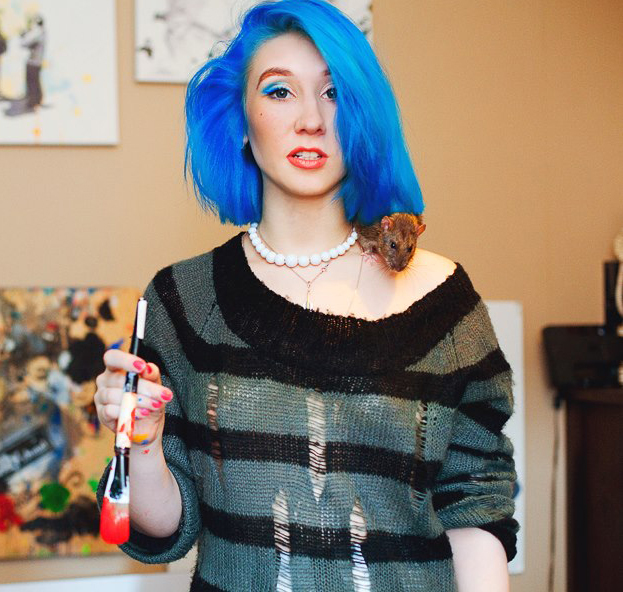
Excitement is already building for artists like Lora Zombie—frequently featured in Hi-Fructose magazine—a self-taught, self-described grunge artist, who has gained a massive online following across the world with her pop culture and cartoon-inspired watercolor paintings and wall murals.
Through her art, she shares her mind and colors, which are influenced by her path, Zombie writes from her home in Russia.
“Sharing inspiration with as many people as possible,” Zombie says, is part of the importance of art accessibility. Inspiration—from American cartoons, comic books and the Gorillaz—is what led the down her to becoming an artist, she notes in her explanation of her latest project, a clothing line called HEROTIME.
Wanting to join Zombie Flesh Eaters, the studio behind the Gorillaz, she changed her name and flew to London at 16.
“I looked up the address for the Zombie Flesh Eaters studio and rang the doorbell with my portfolio in hand, and a lady opened the door, looked at me and unsure of what to make of me, promptly closed it again,” Zombie writes. “I learned an important lesson at the time about the discrepancy between the desired and the actual, and the need to have a flexible mind that is ready for introspection and change.”
For the next decade, Zombie chose to create her own work. The emergence of street art from those like Banksy, and online forums that followed, catapulted her to star status.
Her mural on R Street for WOW, she says, will be about a feeling of gratitude to the universe.
“I warned R Street, Lora just did a West Coast tour … she had thousands and thousands of people waiting in line to get her autograph, and meet her, and take selfies with her,” Sobon says. “They’re going to have a lot of people on R Street coming to watch her paint. Or coming to watch Molly Devlin and S.V. Williams paint on the side of the Foundry. And Micah Crandall-Bear is going to be painting behind the SMUD station next to Beatnik [Studios].”
Sobon continues, “When our artists are painting in the same venue, the same event, the same festival, we get the attention of not just sponsors worldwide but organizations like Visit Sacramento—I mean, Visit Sacramento is our presenting sponsor and I could not be more thrilled,” Sobon says, eyes wide, punctuating each word for emphasis. “When we have the agency that is in charge of marketing Sacramento globally, thinking that this is the biggest event in town, that it could add more beauty, more long-term benefits than anything else we’re doing, it gets me pretty excited.”
Sobon notes that the murals will go up not just on the grid, but also in outlying areas like the River District, where an increasing number of Sacramentans experiencing homelessness are struggling to find help.
“Art is for everyone, and they deserve beautiful art like everyone else,” Sobon notes.
Power Inn Alliance, the business alliance for the vast commercial/industrial area around Power Inn Road, is also a partner, wanting to bring beauty among the rows of warehouses. Particular attention has been given to Sacramento’s Promise Zone, which encompasses 22 square miles of the economically hardest-hit neighborhoods in the city—from Del Paso Heights in the North Area to The Avenues in the South County. Sobon says the art is a catalyst to spur more activity, tourism and interest beyond downtown and Midtown.
He adds that WOW will only get bigger, and he’s already received calls from Citrus Heights, Roseville and other communities.
“Our supporters include the California Endowment, SMUD and Bank of America, but the support of private citizens has been important,” he says. “It has to be art for everyone and everyone has to be able to apply, and it has to include all cultures, be inclusive and expanded to other neighborhoods.”
Sponsors assist in paying for materials and to get the artists to Sacramento, and businesses and landlords pay for the opportunity to have a mural, with additional revenue going toward art education.
“I’d love to inspire art education and teach kids how to do this art form correctly,” Sobon says. “Teach them the rules and do murals in their schools in their neighborhoods.”
The purpose is similar to why murals started going up in Sacramento in the first place, 40 years ago.
The Royal Chicano Air Force (RCAF), a Sacramento-based art collective that started with the name Rebel Chicano Art Front in 1970, led much of the public art scene in Sacramento to promote political awareness, educate and feed youth, and foster support for Cesar Chavez and the United Farm Workers.
The impact of founders Jose Montoya and Esteban Villa is still widely felt in the region, and continues to be integral to the Chicano Art Movement in the western United States.
That tradition of accessibility and social responsibility is what Sobon hopes to continue. WOW will include opportunities for the public to engage with the artists at gallery openings, public mural tours, artists’ receptions and panels, First Friday and Second Saturday celebrations, the Wall Ball—an art-themed fundraiser for arts education—and while the artists are actually creating their large-scale works.
Sobon and curator Warren Brand gathered artists by both invitation and with a public call for artists. The final 40 will create works diverse as Sacramento and each bring a different perspective to mural art and participation in some of the most ignored alleys and streets.
McDaniel’s mural is set to go up at 917 Seventh St. in Improv Alley, just one of many alleys downtown sprinkled with art but that leave much to be desired.
His mural of the American River will show the greater universe above and below it.
“Light and water and matter create this incredible reality we get to experience,” McDaniel says of his concept, as he shares childhood memories of growing up with the American River in his backyard, and of fishing, hiking and biking. His paintings often include a bearded iris in memory of his mother, who suggested he start painting as a way to help him through his mental illness.
He includes the flower for a second reason.
“One day I was riding my bike with my camera and I stopped outside Sacramento State where I first saw this bearded iris, and started crying, ‘Dang Lord, I’m almost 30 years old and I’ve never seen a flower like this?’ It humbled me and reminded me that life can be beautiful but can also be like a vapor.”
The thought matches the reality of street art—that it is, ultimately, temporary.
Sobon hopes that the murals created as part of WOW gain the same respect and recognition of those historic pieces around town that have been preserved over decades.
But even he’s not worried about losing this form of art.
“Last year, we only did one mural in Jazz Alley as part of the festival, but five more have gone up since then because artists got permission from landlords to do more,” he says. “A lot of artists are just looking for canvases to paint on. And festivals like this bring legitimacy to street art.”
You’ll have several opportunities before, during and after Wide Open Walls to experience the art of more than 40 muralists descending on Sacramento during the month of August. For a chance to purchase art and swag, visit Beatnik Studios Aug. 4–25, 2017, for the WOW gallery show, which will have more than 50 pieces on display for sale. The reception is Aug. 4. To check out the full list of WOW events, learn more about the artists, and donate to the cause, visit Wow916.com and follow WOW on Instagram, Facebook and Twitter.
**This article first appeared in print on pages 20 – 21 of issue #245 (July 31 – Aug. 14, 2017)**
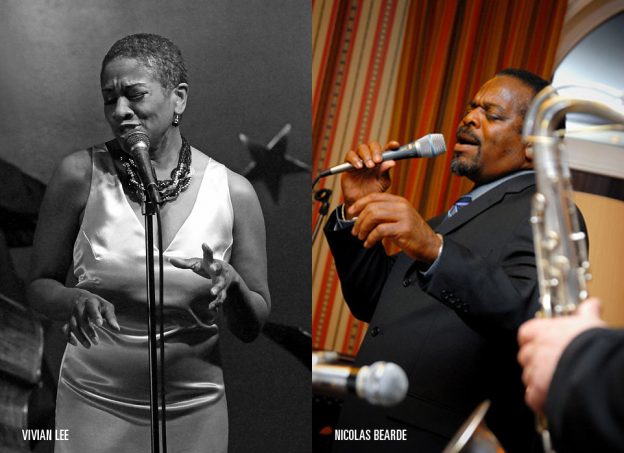
The Crocker Art Museum’s Summer Jazz Series is starting up again this month, and you can expect to find soulful live jazz performances at the museum every third Thursday between now and the end of September. Jazz Night at the Crocker is Sacramento’s longest-running summer jazz series, and this year, the series will feature performances by a lineup of musicians based on recommendations by Capital Public Radio’s jazz music director, Gary Vercelli. The first evening of jazz will be on June 15, with Nashville-raised artist Nicolas Bearde. On July 20, Sandy Cressman will entertain museum-goers with Brazilian-inspired jazz music and rhythms. On Aug. 17, California’s Ray Obiedo will enchant the audience with his smooth Latin-influenced compositions. Jazz musician Vivian Lee will bring the series to a close on Sept. 21, so you won’t want to miss the opportunity to catch this Sacramento artist’s captivating and unique stage performance. Before the show and during intermission, food, wine and picnics will be available for purchase at the Crocker Café (by Supper Club). The concerts start at 6:30 p.m. All ages are welcome. Tickets are available at Crockerart.org.
**This write-up first appeared in print on page 10 of issue #241 (June 5 – 19, 2017)**
Election day will have passed, and it’s a sure bet that we will all have something to rant, rave or even howl about at the next installment of Crocker Art Museum’s monthly ArtMix series. On Thursday, Nov. 10, 2016, join local poets, MCs, DJs, activists and artists at ArtMix: Howl, from 5–9 p.m. The Sol Collective crew will be in the house for art-making that’ll get us all thinking, and be sure to check out Activism Articulated’s Altars for Justice, a community-based art project that hopes to bring awareness to social justice issues, especially police brutality. Get down to some beats and rhymes from DJ Novela, RASAR, Paul Willis and CatchaKoala, and listen up as spoken word artists like Coon the Poet, members of the ZFG crew and HK Poet do their thing. If you’ve got something to say, you’re in luck: there will be an open mic at ArtMix: Howl as well, so be sure to bring your notepad with all your deep thoughts and sign up for your five-minute slot. “ArtMix: Howl is designed to help us move onward and upward,” states Crocker’s website. “It is all about having a voice, so let’s howl together.” ArtMix is always free for Crocker members and just $10 for non-members. 21 and over only. Food and drinks will be available for purchase as well. Visit Crockerartmuseum.org or call (916) 808-1182 for more information.
Looking for a scary good time for the whole family? Of course you are … It’s almost Halloween! Crocker Art Museum once again has you covered as Calidanza’s Noche de Muertos returns to delight audiences of all ages on Oct. 27, 2016, so your little ghoulies won’t even have to miss out on trick-or-treating. Calidanza’s mission is “to promote artistic excellence in Mexican folk and contemporary dance. Calidanza intends to make dance accessible to both audiences and participants,” according to the dance company’s website, and their tribute to Mexico’s Dia de los Muertos will be a truly multi-faceted event, featuring live music from Orgullo Regional, a fashion show by Rory Castillo, a liquid light show by George Holden (whose work has been featured onstage with The Grateful Dead) and, of course, plenty of dancing. “The evening will include the 2013 Noche de Muertos, a modernistic piece commissioned by the San Francisco Symphony; as well a new choreography of a traditional dance entitled “La Viejada;” the famous Deer dance; and more,” the Crocker website promises. So what are you waiting for? Space is limited, so head over to Crockerartmuseum.org to make reservations. Tickets start at $12 for members. For more on Calidanza, check out Calidanza.org.