Thursday, Nov. 3, 2011 is a great day to be hanging out on the campus of Sacramento State, whether you’re a student or not. First, check out the closing reception for the art show CTRL/DELETE: Paintings by Digital Natives, featuring recent work by James Angello, David Mohr and Daniel Taylor at Witt Gallery (located in Kadema Hall) from 6 to 8 p.m. Mohr, who is in the local band FAVORS, recently told Submerge that he and Angello thought up the idea for the show. “We are both interested in what it means to paint and draw in a world dominated by computer technology, so we decided to put together a show that would discuss that concept,” he said. They were familiar with Taylor’s work (“We have all had art classes together,” Mohr said–the three are now seniors at Sacramento State), so they reached out to him and it became a three-person show. “All of our work is very different,” Mohr elaborated. “My work mostly focuses on abstract geometric forms, but I try to use familihttps://submergemag.com/wp-admin/media-upload.php?post_id=4726&type=image&TB_iframe=1ar shapes to reflect on the experiences and methods of interaction shared between humans and evolving electronic technologies.” If you miss the reception on Nov. 3 you’ll have to rush to see the work, as it is only viewable until Friday, Nov. 4, 2011.
After you check out the art show on campus, head over the Union Ballroom and check out one of the hottest hip-hop shows all year, featuring Aesop Rock, Rob Sonic and DJ Big Wiz. The concert also features special opening guests Jel and Who Cares. Show starts at 7:30 p.m., is $15 for students and $20 for general public.
David Mohr expands his musical horizons with Favors
The breakup of Sacramento’s 20,000 was a complicated one. The group had an electro-Sonny and Cher thing going on, until it imploded at a fateful summer night’s show. David Mohr, one half of 20,000, was Cher in this scenario, in that it led to songs in the vein of “Bang Bang (My Baby Shot Me Down).” Assuming the moniker of Favors, Mohr’s series of fractured digital EPs sought comfort in the familiar synthesizer framework, a kinship with Lou Reed’s “Hangin’ Round” chorus and anti-anthems that put weekends and summers in their crosshairs.
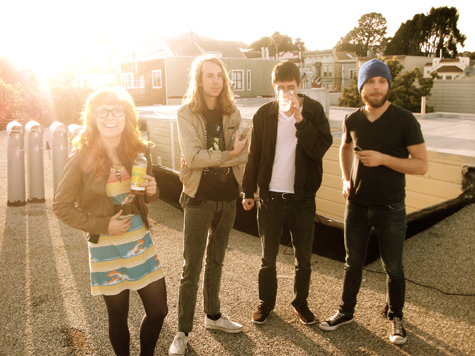
With the heart pain now out of his system, Mohr is exploring the futuristic vision his friends have always associated with the bedroom project before he was able to see it. “I started writing these songs when I was living with the rest of the band, so that is over a year’s worth of songs that I picked from to form this album,” Mohr said. “So in that time, I basically started feeling like there were a lot of different subjects I hadn’t approached yet with Favors, and I wanted to open it up so that the future of the band could go in any direction.”
The band he lived with was once called Impotent Ninja, which consisted of Ben Lewis, Chris Metcalf and Crystal McCarthy. The house mates have since gone their separate ways, but their time together allowed Mohr to get in a better place that led to the completion of Five Million Years, a record which is somewhere between sugary synth-pop and music that can help break a healthy sweat. “The songs I write will always have a pop element to them, I think,” he said. “Unless I become so involved in it that I lose focus of what it means to be pop. But I don’t know. I like fun songs. I like dance music and I like electronic music. My friend’s little sister said that Favors sounded like ‘workout music’ when she heard it. That’s perfect.”
When I last talked with you, Favors was a bedroom project of EP releases with a lot of post-breakup songs. Listening to the new record, it seems as though Favors is exploring abstract territory, with songs of starships, cash-machines and caves. What brought this change in songwriting?
A friend of mine said that Favors sounded “futuristic” to him, and I thought that was funny. I had never thought of it like that, so I thought I would push the science fiction element in some of the songs. I was hesitant to do that at first, because I didn’t want the songs to feel too distant or detached from reality, but I kept reminding myself that David Bowie wrote tons of futuristic space age songs, but it took me years of listening to ever realize that. They always just sounded like awesome songs from the ‘70s. Maybe I don’t pay attention to lyrics.
Now that you mention Bowie, I feel like the album title Five Million Years is just an extension of Bowie’s “Five Years.”
The album title Five Million Years comes from my desire to create a larger time frame and a more expansive imaginary space for the listener to step into. I’m interested in the way that time can be distorted by music, like how fast songs can make the listener feel as if time is moving quicker. It’s strange; music is very connected to our concept of time.
Favors is a full band now, but what’s the recording process like? Is it done as a band or do your band mates learn the songs after you’ve created them?
In terms of songwriting and recording, Favors is still a bedroom project. I write and record the songs on a laptop at home. The live band was formed at the very beginning; it was always Chris, Ben and Crystal, but it just took some time to get things going with that part of the project. Usually I’m working on music alone, but I always wanted the live band to exist as well. It’s nice to have a group to share it with, and it makes practicing and playing live way more fun. During practice of course, everybody contributes their own touches, and of course Ben is a wizard on guitar, so we have to incorporate that. Everyone is amazing at their instruments and is way beyond me in musical ability. I’m very lucky to have friends who want to play the songs.
You don’t see many indie bands with a frontman. Was it weird at first to have no instrument responsibilities on stage?
I’m really not a very good musician, so playing keyboard on stage is difficult for me. I thought it would be best if I just focused on the singing, that way I can express something that the music isn’t expressing live. I still feel uncomfortable performing live, though; it definitely feels like the fakest part of the whole thing for me. But that doesn’t mean I’m not trying to do my best.
From what I’ve seen, you’ve taken to the art of being a frontman. Were there any famous lead singers you took cues from?
David Byrne became a huge inspiration early on. He added so much to the music just with his movements and appearance on stage. Of course he was a great guitar player and a great musician, but I was most intrigued by his gestures. It seemed like he was really thinking on stage, and channeling that into the songs.
Have you gone for the cord windmill and catch the mic maneuver yet?
I used to do the windmill cord spin in my first band. I was really good at it, but I had to duct tape the mic to the cord so it wouldn’t fly off. I’m too old for that now. My favorite part about live shows is when things start going wrong, though. It’s fun to try and make the best of it and keep the show going. During our last show, Crystal’s electronic drum set kept falling apart because I had broken it in half while loading gear on stage. Chris had taped it together before we started, but I had to keep lifting it up for Crystal while she played. I love those moments. Things start falling apart so quickly that trying to fix them becomes ridiculous.
The cassette culture is on the rise, but has not quite hit Sacramento yet. Why did you choose this format?
I’ve always wanted Favors music to be available for free. I think that anyone who wants it should be able to have it. Also, I don’t know too many people who pay for music anymore, and I especially don’t know very many people who buy CDs, so I thought I might as well do a cassette.
It’s still nice to hold something in your hands that represents the music. I think the same reasoning goes into vinyl production, but personally I have more of a nostalgic connection to tapes. The first music I owned was They Might Be Giants’ Flood on a cassette that I bought from my brother. I listened to records as a kid, but I had a more personal connection to tapes. I used to make cover art for cassette tapes of made-up bands years before I ever started writing music. Despite all the nostalgia and my love of cassettes, there is also something funny about releasing tapes now in 2011. I like the fact that I recorded the music on a computer but I’m putting it out in a medium that degrades the quality and its near obsoleteness. It’s a wink backwards.
The bonuses are that it is really cheap to do and they look cool. I had fun designing them and putting them all together. It’s also funny to see people’s reactions. At least one member of Favors thinks releasing a cassette is a terrible idea.
Terrible idea or not, Favors’ new album Five Million Years will be available on cassette around Aug. 1. You can order a copy and get a free full digital download at Favors.bandcamp.com. Check out the band live to celebrate the release of the album at The Press Club in Sacramento with Evan Bailey and The Happy Medium on Aug. 4.
A look at the Sacramento scene shake-up in 2009
It was a difficult year for the local musician as at least eight bands met their demise. Swansong shows were played, vans were crashed and relationships collapsed in bittersweet endings. The silver lining in the shambles of bands lost? As we transition into a new decade, we’ll be greeted by fresh and lovely new bands.
That’s how this thing works. Take last year’s demise of The Evening Episode. Had they not called it quits, Terra Lopez would not have gone on to create our beloved Sister Crayon and fill that indie-pop gap in our lives. For now, it’s the breakup that is fresh for these fallen bands. Only last month, Buildings Breeding unplugged from the scene, citing a lapse in dedication as its reason for departure. Vocalist and guitarist Chris Larsen said Buildings Breeding hit a rut after founding guitarist Evan Hart moved to Oakland.
“I can’t really pinpoint what it was that made the decision,” he said. “It seemed the better we’d get, the less people would care.”
Fresh off a May tour, the band experienced a transformation from its lo-fi roots into a polished songwriting style that would become its Kite Fire EP. A man down, the group brought in Kevin Dockter on guitar and Justin Titsworth on drums. “It made the band feel brand new; finally it felt like we had something,” he said. “Even our oldest songs were fresh again. It definitely gave us a second wind.”
Buildings Breeding booked an extensive tour for November to promote the EP, only to learn that three of its six members weren’t available to travel. The band attempted to have friends fill in as best it could, but Larsen said it was apparent from those reluctant moments the band was kaput. “Chris [Vogel] and I would speak every night,” Larsen said. “When we kept coming to the same decision, we knew we had to end it. We decided to honor what local shows we had and add two farewell shows.”
The farewell show happened so frequently this year it could have been considered a fad. Bright Light Fever played its final show at Harlow’s on Sept. 10. The group had a six-year run eulogized by a can of soda.
“We bought a six pack of Sunkist orange soda before we started pre-production on our first record,” Matt Ferro, Bright Light Fever’s guitarist, said. “We drank them all but one can and kept that can in our practice room as sort of a good luck charm for the whole time we were together. When we were loading up for our last show, we looked at it and—no joke—the expiration date was Sept. 10, 2009. Same day as our last show. Poured it out in the back parking lot of Harlow’s.”
It was to Bright Light Fever’s benefit they did not share the newly expired soda. The band’s lifespan was marred by unfortunate events the members wore like an honor badge sash. Within a month of its debut’s release in Oct. 2006 on Stolen Transmission (an offspring label of Island/Def Jam), Bright Light Fever lost its distribution. By July 2007, Bright Light Fever was dropped from Stolen Transmission. The group wrecked two vans in Wyoming on two separate tours. BLF self-recorded and self-released its second record, eventually putting it on the Internet for free download due to “months wasted on empty promises and overall snakery by outside parties.”
The band finally toured without losing money last November. Alas, its follow-up summer tour led to law enforcement issues in Arizona, hitting a deer in Omaha, eight of 12 shows paying nothing and its newest member quitting. “We all genuinely loved the band, so we did it for as long as we could keep our sanity,” Ferro said. “Honestly, all the bad luck inspired us to work harder at what we were doing.”
Punk band Blame Betty attempted to bear the brunt for four years. Lead singer Brooke Sobol said being in a band exposed her to a potential she never understood, but when your band is in a constant shuffle of members, the lack of dedication wanes the drive. The band burned through four drummers, four bassists and two lead guitarists. “The more we accomplished, the more I wanted to accomplish,” she said. “When the dust settled, we had a good, solid group for a long time.”
Blame Betty broke up in September. Sobol said she was exploring a business opportunity that monopolized her time. The stability of Blame Betty suffered. “I just couldn’t do both,” she said. “The pressure of being the front person got to be more than I wanted. I actually have stage fright. There’s a lot of pressure on the front person.” Sobol said she wants to be the girl standing next to the lead now—drinking a beer and playing her guitar like a crazy woman.
Buildings Breeding split without its inner-band relationship suffering. Larsen and drummer Melanie Glover are still together. “Being able to share music with my true love Melanie, it was at times difficult, but so incredible to see her grow as a musician,” Larsen said. This is the exception.
David Mohr found out the hard way when he split with Meg Larkin just before the summer, leaving Sacramento without its premiere dance duo, 20,000. “I tell people now not to be in a band with your significant other,” Mohr said. “People warned me. I should have taken their advice.”
When Mohr ended his six-year run with previous band Didley Squat, he said it felt like an actual breakup, the intimate kind; but losing his band and girlfriend in a breakup was a crushing blow to his psyche. To make matters worse, the laptop they used to make their music was Meg’s computer. Mohr tried to record on his old four-track, but found the process frustrating.
20,000 never had an official last show. The breakup happened amidst scheduled dates around Midtown, each of which drove the nail deeper into the coffin. Mohr remembers one show in particular at Luigi’s Fungarden. “I was dreading that show,” he said. “It was right after we broke up and the plan was to keep the band going. It was just too weird to get on stage with your ex-girlfriend and pretend to have a good time, pretend to be into the songs when really you’re done with it.”
So why is this happening? Mohr said he is concerned by an influx of negative energy. In Bright Light Fever’s bassist Don Suave, he astutely wrote in the band’s obituary, “it has been frustrating to see our fan base consistently waning while, from my point of view, the quality of our work has been consistently waxing. What I’m saying is, ‘It’s all your fault.'” Similarly, Larsen expressed a frustration with the abandonment that came with his band exploring hi-fi aesthetics.
“I think [the band] was let down by that fact because we were all extremely proud of the stuff we were creating together. Add the hopes of being signed to a new label and having them leaving you dead in the dirt, that is sure to shake any band up.”
Blame Betty spent two years convincing a club to let them play and brought 75 paying attendees out on a Thursday night, only to have the rest of the bill spot four people and split the door money. “[The club] didn’t return any of my calls to get another show booked there,” Sobol said. “But, the other band still does shows there.”
Let’s not forget the silver lining. With the dissolution of such great bands, an absence is left within the artist. As Ferro put it, “playing in a rock ‘n’ roll band makes you cool. Like smoking cigarettes. So right now, I’m lacking cool.”
He and his brother Evan immediately continued writing music under the moniker Roman Funeral. The duo hopes to record an album by the spring and tour in 2010. Larsen is doing a “solo-y thing,” while his ex- bandmates have taken to other local acts like bands with ex-The Matches members and playing with Chelsea Wolfe.
Mohr obtained a laptop and has released two free digital records as Favors. His new venture retains the 20,000 sound, but with a lot more heartbreak. He is currently practicing with Ben and Chris of Impotent Ninja, as well as Chris’s girlfriend, which made Mohr wary at first. “I definitely spoke to Chris about it, but I think they might be stronger than Meg and I,” he said. He hopes to do Favors shows by the summer.
Through all the bullshit, each band had no problem expressing its gratitude for the little moments shared among bandmates and fans. For Ferro of Bright Light Fever, it was traveling in a van across the country with brothers and close friends and taking a piss while your bandmates all meet Iggy Pop on a street in Texas. Larsen recalls the feeling after Buildings Breeding’s last show as he thought, “If this many people came to our shows all the time, I would never quit. I could just play Sacramento and Davis the rest of my life.” Sobol recently caught a show with her bandmates. They still flirt with the idea of reforming again, pending a lead singer shows up. Mohr is doing his best to remain friends with Larkin. As of this week, he hopes he can give his friends one last 20,000 record. The two finished, but never released, an album before the breakup. “Up until about a week ago, I didn’t want to get it out,” he said.
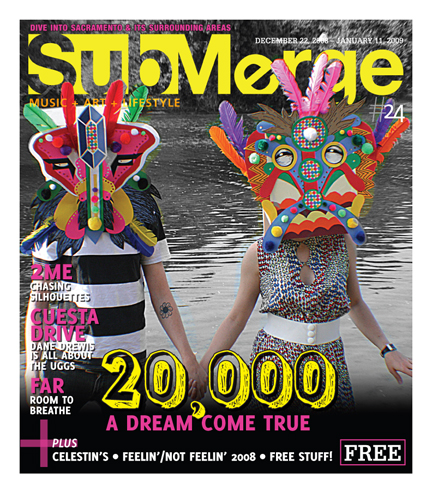
20,000 Breaks into the Sacramento Music Scene
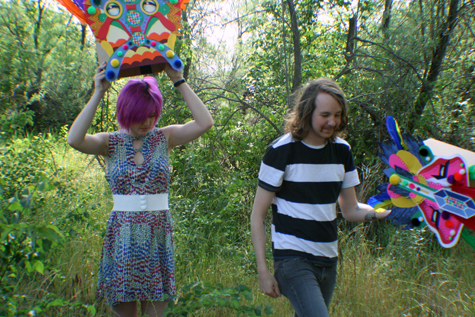
Comprised of locals David Mohr and girlfriend Meg Larkin, the band 20,000 is relatively new to the Sacramento music scene—but with their youthful energy and down to earth attitudes, it’s no wonder that fans are quickly tuning in. “By default, I usually just say it’s dance music with guy/girl vocals and synthesizers,” Larkin says about their style. Even if you’re not typically a fan of dance music, there is no doubt that the upbeat tempo and catchy lyrics of 20,000 will have you up and out of your seat in no time.
It started as a dream—literally. Mohr says, “I had a dream a while ago that we had a band and we named it 20,000.” Both Mohr and Larkin are adamant that if you dream it, you must do it, and thus 20,000 was born. “If you do what you do in your dreams in real life, then it’s almost like you’re predicting the future,” Mohr says.
“Yeah, it’s true,” Larkin adds. “If you dream that you’re wearing red socks, you have to buy a pair of red socks and wear them.”
About two years ago, sparks started flying, musically, that is. Mohr began writing music on his computer, and then he and Larkin started adding vocals. Mohr says, “When I was writing the songs for the album, I was listening to music that has a lot of synths in it, but not necessarily electronic music.” They cite musicians such as Prince, Talking Heads and Hot Chip as being very influential during that time period. Larkin says, “Up until a couple of years ago I never really listened to dance music, but it’s some of my favorite music now.”
The goal for their music is simple: create songs with a good beat that people will want to party and dance to. Mohr says, “While we were recording the album, I was thinking it would be cool to just have a good CD for people to listen to in their houses at parties.” He writes all of their songs, and is no stranger to the music world. He played with some of his high school buddies in a band called Didley Squat for about six years, and when that gig dissolved, he naturally transitioned into forming 20,000.
While they had been diligently practicing and recording songs at home for many months, their first live performance happened this past August, at Old Ironsides. “We were apparently really visibly nervous,” Larkin remembers. “I was wearing short shorts and this crop top, just trying to be funny, but it was the most intimidating outfit to wear in front of people as a joke.” While their first show was definitely nerve-wracking, a lot of their friends came out to show support and it was a fun experience that paved the way for future shows. Other than Old Ironsides, they’ve played at Javalounge, Luigi’s Fun Garden and Blue Lamp.
When transitioning to live performances, Mohr says that one of the biggest challenges is figuring out how to make everything sound right in such a drastically different environment. After spending two years perfecting their songs in their apartment with only a tiny set of computer speakers—and trying to keep the noise level down so as not to disturb the neighbors—they now had to create a seamless performance in a real venue.
For Larkin, there was the added challenge of being brand-new to the music scene. She had been involved with musicals during high school but had no prior experience with playing an instrument. “When we decided to start playing live shows, I learned how to play rudimentary keyboard,” she says. This was completely terrifying at first, and she remembers being nervous for six or seven hours before a show, to the point where she could barely eat or drink. But as time went on and performing became more commonplace, her nervous energy eventually went away, and now she loves the thrill of shows. “When we have a show and there’s people responding to it and everyone is nice it’s like, yes! We’re the best band ever! Let’s do this every night!”
Both members play keyboards and sing, and their drumbeats are on an iPod. This means that they can carry all of their instruments to a show and set everything up on their own—no roadies required. “It’s super easy for us to set up,” Larkin explains, adding that it literally takes about four minutes. “Just put the keyboards on the stand, plug it in, turn the iPod on and we’re set.”
Although perhaps they hadn’t planned to “make it big” in the music business, the Sacramento music scene has been good to 20,000. Larkin is surprised at how easy it has been to get shows that they really enjoy. Their friends have also been extremely encouraging in this new venture. Larkin says, “It’s definitely been cool to see how supportive our friends have been, getting them to come out and pay for shows over and over and over again.”
20,000 will likely become a common name in the Sacramento area as time progresses. The couple is ecstatic about their 2009 New Year’s Eve show at Blue Lamp, which has been the biggest show they’ve played so far.
You can check them out on Myspace: www.myspace.com/20000music.