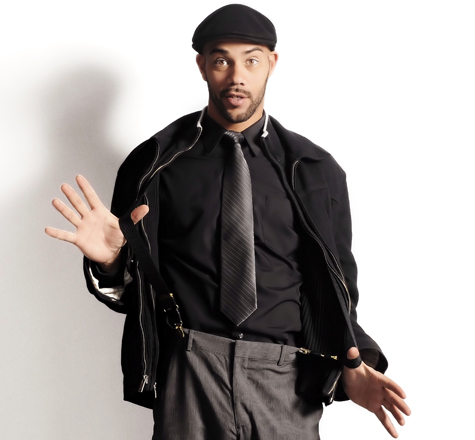
Comedian Glory Magaña (pronounced like lasagna) used to live a double life. A couple of times a week, she would leave her hometown of Modesto and drive to San Francisco. Her family always wondered where she would take off to, and Magaña would tell them, “I’m off to see this guy. I have a boyfriend.” That was a lie. Magaña would commute to the city to take comedy classes, something that she knew her super traditional Mexican family would be opposed to. Her mom would say “Comic?! You mean like a clown?” when she would try to entertain the idea of following her comedic dreams.
Upon completion of her comedy classes, Magaña was to perform in a concluding showcase. As the show approached, she grew nervous and couldn’t stand not having the support of her family in the audience. She came clean to her mother with what she had really been commuting to San Francisco for. Magaña remembers her mom being very upset and having no choice but to go to her big show solo.
She recalls arriving at the venue that day and the ticket-taker telling her, “You packed out the house!” Confused, Magaña told him, “That can’t be right. I have no one coming.”
When she looked out from the stage, Magaña saw the face of her mother in the crowd. She held back tears of joy and went out there and gave one of her best performances.
“My mom came up to me after and was like ‘You are funny! You are good at this. You can’t quit. Pursue your calling,” Magaña warmly remembers.
Since then, she has had some really great shows and some really not-so-good shows. Magaña said her worst was at a show in San Francisco where she opened for comedian Adam Ray. She will never forget how horribly she bombed. Her best show was in Stockton, where she was initially very afraid to perform. The day had started off incredibly, because her mom, who had been battling cancer, had learned she was in remission. With her mom and brother in the audience to support her, Magaña said she brought the house down that night and left her mom and brother in awe. The crowd was totally feeling it, and it was one of the first times she truly felt like a comedian.
A few years ago, Magaña’s mom passed away from cancer. Whenever she is faced with challenges she thinks she is not strong enough to overcome, the voice of her mother resonates within her. In a sweet twist of irony, her mother is the number one force that continuously propels her to pursue her comedic dreams.
Magaña is known for her clean-ish jokes that involve ethnicity, love, family and chubby boys. Magaña loves chubby boys. Growing up, she would watch a Spanish soap opera called Carrusel de Niños and be totally captivated by the romance between two of the portly kids on the show.
“The chubby little girl was a hopeless romantic … just like me!” says Magaña. “And I also though the little chubby boy was soooo cute. After that, the rest was history. Not to mention I feel like a skinny little thing when I’m around bigger men. Beats going on a diet!”
In her routine, she can be heard talking about her type of guy like they are the finest wine made of the juiciest grapes.
Magaña herself towers nearly six-feet tall, and played basketball and volleyball in college on scholarship in Iowa.
“Everyone in Iowa thought I was Samoan. There aren’t many Mexican girls who are almost six-feet tall. I was tight with all the Samoan athletes, too, so that probably fed into it,” she says. People always confuse her for different ethnicities, but Magaña says she rolls with it.
“My Samoan girlfriends would urge me to use my ethnicity mix-ups as a part of my routine,” she says. “They cry laughing when I act like I am one of them.”
She often uses the enigma of her ethnicity as a core part of her routine.
“No one ever knows what I am,” she says. “I make fun of the stuff people come up with.”
As a Mexican-American woman in the world of comedy, Magaña says that people have welcomed her and that she has learned there are a lot of hilarious women of color out there.
“Every time I perform, I meet all of these fellow woman comics and damn they are so funny,” she says. “I sometimes feel a little insecure they are so funny. A lot of ethnic women [are] holding it down and showing true talent.”
For some comedy showcases, you have to pay to apply to perform, sort of like applying to college. Magaña thought about applying to compete in the Women in Comedy festival in Boston, but was always told that it was extremely difficult by comedians she looked up to.
“Women I thought were absolutely hilarious, maybe even funnier than me, were constantly rejected, so I questioned if I had a chance,” she says, “but I applied anyway and got accepted!”
Performing in that festival and mingling with other powerfully funny women has been one of the highlights of Magaña’s career thus far.
A few months ago, Magaña was asked to perform at the Crest Theatre for the upcoming Cap City Comedy Slam. In addition to Magaña, the lineup includes headliner Kirby Shabazz and performers Kabir “Kabeezy” Singh and Ellis Rodriguez. Singh was named “The next big Indian comedian by India West newspaper and has opened up for Dave Chappelle and Dane Cook to name a few. Shabazz is known for his relentless attempt to kill health food stores via jokes and poking at the racist connotations of the Home Alone franchise as well as winning last year’s StandUp NBC comedy competition. The Cap City Comedy Slam is meant to showcase the unique perspectives and diversity of the region’s up-and-coming comedians. This showcase will offer perspectives in how really hilarious minority comics see the world around them.
Magaña is excited to grace the historic Crest Theatre stage for her first time, and to be joined by such great company. The self-proclaimed “tall drink of horchata” is gonna make you laugh, make you love the chub and make you feel susceptible to being dunked on at any moment.
Don’t miss Glory Magaña at the Cap City Comedy Slam on Friday, Mar. 2, 2018, at the Crest Theatre (1013 K St.). Doors at 7 p.m. and show at 8. Tickets are $25. Check out Crestsacramento.com for more info on the show.
**This piece first appeared in print on pages 18 – 19 of issue #260 (Feb. 26 – Mar. 12, 2018)**
Comedian Ellis Rodriguez takes a yeoman’s approach to standup
It’s 10 p.m. on a Sunday and I’m in a bowling alley bar with the hottest girl in Elk Grove (her claim) and local comedian Ellis Rodriguez. The topic of discussion: who has the best life ever? The 22-year old Elk Grove girl swears up and down it’s her, since she coined the phrase “best life ever,” but her mom has to drive her home for political reasons. I feel as though I’m disqualified from the competition because I’m drinking in a bowling alley bar in South Sacramento. But Rodriguez is the closest to actually living it because, as he puts it, “I draw comic books and I tell dick jokes. That is the best life ever.”
I meet up with Rodriguez the next day at the Stoney Inn a couple hours prior to its open mic night, which is complemented by country karaoke night in the adjacent room. What type of crowd attends this open mic, I ask? “Random assortment of mostly urban comedy goers,” is his reply. This is the trenches for a comedian. In a night’s time I receive a crash course in one comedian’s regimen for sharpening his jokes just to squeeze one funny minute out of the week.
His first night up was an open mic at Old Ironsides. He says with conviction that he became a full-time comic the day he got on stage, but at the time he did not have a job standing in the way. Rodriguez was living out of his car, working comedy at night for three months before a friend got him a job as a branch manager selling wholesale toilets.
“I was branch manager/trainer/operations recruiter for the number one wholesaling plumbing company in the world,” he says. “Great company. Great people. Couldn’t fucking stand it.”
He gave his days to toilets, but the nights were long drives to San Francisco to wait around at open mics for opportunities to do five minutes on stage. Keep in mind it is comedy courtesy to stay until the end.
“Once I drove to Pleasanton for an open mic,” Rodriguez says. “Another comedian told me about it, and I looked forward to it all 12 hours of my shift that day. I got into work at 4:30 [a.m.] that day. At 5 [p.m.] I headed straight there after work only to arrive to an empty bar that wasn’t even open. I heard there was some stage time in San Francisco so I went to get some time only to arrive and be told that I ‘might be able’ to get some stage time. I stayed until the end that night, desperate for time. I was the last one called up at 11:14 p.m. I got home at 1 a.m. and it was inventory week. I had to pull a 12-hour shift again the next day. Par for the course.”
Now a full-time comic, Rodriguez employs a strict regimen that includes open mics Mondays through Wednesdays and paid gigs at clubs on the weekends. The drive I ride along for begins on Del Paso Boulevard, treks up to Folsom and then over to Roseville. He’s never alone, though. His 2-year old Italian Greyhound named Muñeca rides along. “Tonight I’ll do three [open mics], tomorrow I’ll do two, Wednesday I’ll do four or five and then work the weekend,” he says. “It’s one of the few things I’m actually regimented about. There’s no excuse. None of the mics start before 8 [p.m.]… you can get up by 8.”
Rodriguez goes up around 8:30 p.m. at Stoney Inn to the crowd he predicted. Minutes before he goes up, he’s in my ear scrolling through his cell phone notes, running jokes by me that he might try out. It’s a fleeting moment of meekness. The related fragments have potential, but it’s when he takes the stage, assuming a confident persona, that Rodriguez discovers exactly what it is about “testing out white slavery for a month” that makes people laugh. Rodriguez just secured another minute toward his full hour set.
“I write around five to 10 minutes every week,” he says. “If you write 10 minutes, then one minute is going to be good. You keep that minute. At the end of the year I’ve got another 52 minutes.”
Rodriguez is in his fifth year of standup, tirelessly logging hours and pages of notes. He records all his sets, reviewing the tape like a scouting coach hoping to find flaws and room for improvement. “I do black rooms, white rooms, alternative rooms,” he says. “I do every room I possibly can to get as good as I can be in that room. You have to be able to read an audience and know how to react to it, but not necessarily think that once you crush it for 10 minutes that you’ve conquered that room. Can you do it again with different material?”
An hour later we’re at Po Boyz Sports Bar & Grill in Folsom and, save for three 20-somethings having a night out and the owner’s friends, the room is littered with comedians waiting to get up. Cheryl the Soccer Mom from the Real Funny Housewives of Rio Linda is hosting, and a young comedian is on stage venting about being excluded from the News & Review’s comedian feature. It’s a hostage situation.
Unfortunately it creates discomfort in the room that seems impenetrable as several comedians to follow struggle with the sound of silence. Rodriguez embraces the awkwardness and begins riffing hard on his friend Samm Hickey, who’s in the room. He tries out an AIDS joke we’ve discussed a few times that has yet to reach its full potential. We step outside to smoke a cigarette after his set and casually discuss the dos and don’ts of STD jokes. To him there’s something undeniably funny about saying his friend, who was recently diagnosed with AIDS, having “double AIDS,” even if it didn’t go over well the previous night in Elk Grove.
“I think I did all the herpes things,” he says. “I did most of the crabs thing, but they were really uncomfortable. I think there were a couple people that had that shit. I wanted to write another STD joke, but I’ve found that nobody knows enough about gonorrhea or syphilis for it to be funny. It’s just gross.”
Throughout the night I gather insider knowledge about the ideal crowd from Rodriguez and overhearing other comedians relate stories. Rodriguez tells me it was not the crowd itself, and never should be blamed, that made his Elk Grove show difficult, nor is it the presence of a bowling alley in the next room. An ideal room is dark, slightly chilly and compact. One comedian stressed the importance of seating the audience in order to prevent a scattered crowd.
“The crowd was too spread out so they are able to form a consensus of what’s funny within their little groups,” Rodriguez says of the Elk Grove gig. “They didn’t have to worry about what the people around them were feeling. That contagiousness of laughter is what makes it easy. But, if you can kill that crowd, then you’re going to destroy whatever show is set up properly.”

It is nearing midnight and we’ve arrived at the Boxing Donkey, a narrow Irish Pub in Roseville, for our final open mic. The bouncer asks that Rodriguez, a former Marine, tuck in his tags and Jesus piece–apparently they’ve had chain issues previously.
I ask Rodriguez about his time in the military, considering he was always a jokester growing up. “I was not a good Marine, at first,” he says. He was 19 and distracted with partying instead of attending his college courses when he decided to join the military.
“I’ll join the Marine Corps because they’ll make a man out of me,” he says. “I realized very quickly that Marine Corps does not make a man out of you. It gives you the opportunity to be a man. It puts you in situations where you’re pushed and strained. You’re constantly being tested and the choices you make, make you a man or a Marine.”
The Marine Corps wasn’t all precision posture, firm salutes and combat training, though. Rodriguez says there was still room for humor. “One of the things we did was send a person to retrieve an ID10Tango form on the other side of the base. They’d show up and the people there would say, ‘what are you doing here, you get that from ADMIN first, then ADMIN would say, ‘you need an ID10Tango release from your unit.’ They would come back and someone would finally tell them to write down ID10Tango. I. D. 10. T.”
It is nearing 1 a.m. when Rodriguez seizes the mic at Boxing Donkey. The room is brightly lit, less than ideal, but it gives him a visual on the room’s reaction. By now he’s told the bit about being so drunk at a Halloween party that he actually thought he was Superman for the third time in the night, but he is orating with the proper emphasis and pauses to make absurd glances to pull the most laughter. He takes notice of a group of black men not laughing much by the bar. “I’ve got one for you guys,” he says and launches into the white slavery bit, winning over the doubters with a blindside punch line.
I don’t get back to my Malibu parked on Del Paso Boulevard until 1:40 a.m. The Stoney Inn is long closed, I’ve got a burger in my hand from Jack in the Box and a guy on a bicycle is circling Rodriguez’s car giving us weird looks before pedaling off. He tells me he’ll wait until I get in my car before he drives off. It’s par for the course for Rodriguez, but for me it’s damn exhausting.
“I’ve got hours to log,” he says. “You keep coming back until you get a nice easy room at The Improv opening for Bruce Bruce and you’ve only got to do 25 minutes, but you’re going to kill because you did all these gigs at crappy open mics working out new material in bars and bowling alleys.”
Ellis Rodriguez will perform at Tommy T’s in Rancho Cordova on April 28, 2011. This will be a live DVD taping. Also performing are Dennis Martinez and Hunter Hill. This 17-and-over show starts at 8 p.m.