We finally got some good news in regards to climate change this week: North Korea once again launched an intercontinental ballistic missile that reached a height of 2,314 miles and traveled 620 miles before landing in the Sea of Japan. According to North Korea’s Korean Central News Agency, the missile was capable of carrying a “large-sized, heavy nuclear warhead.” Considering their tendency to boast, I wouldn’t be surprised if the ICBM could also haul a blessing of unicorns, banished dwarf planet Pluto and a year’s supply of Cap’n Crunch. In response, the United States flew two B-1 bombers over South Korea’s airspace as a show of our country’s military might, and also tested a missile defense system in Alaska by launching its own ballistic missile into the Pacific Ocean. (I guess that garbage island that’s floating out there somewhere is stoked.) This is wonderful news for climate change, because after Ragnarok occurs, our pollutants will be wiped out with us, and after a few hundred million years, the planet will get back to its normal business of orbiting the sun and producing life, and hopefully whatever comes next will be much better caretakers of this big blue ball than we’ve been.
As if that wasn’t enough to worry about, closer to home, you may have a Judas in your midst. I have to admit, I was totally enamored with this little critter as soon as I laid eyes on it. Roomba, a robotic vacuum cleaner sweeper thing produced by iRobot, is just about the most adorable thing ever, and it’s so helpful. It just glides around your floor, picking up whatever dirt you dragged in from outside, or whichever particles of food didn’t make it into your mouth. It eliminates your need to waste precious minutes of your day sweeping or Swiffering or whatever and allows you to spend more time watching Netflix or tweeting about whatever bizarre bullshit the president just tweeted. Roomba is your friend, right? These are the kind of things that define a true bro.
But Roomba may not be as innocent as it seems … but even if it isn’t, it’s still so fucking cute!!! Have you ever seen videos of pets freaked out by Roomba? Priceless! Pets don’t know what to make of the thing. They’re just all, WHAT IS THAT, and they can’t even. Man, you can spend all day watching those videos … more so now that Roomba is keeping your apartment clean.
But is that all Roomba is doing? Apparently not. Apparently, like everything else in our houses and on our phones and in our computers, it’s collecting data. Now before you freak out like I did (and I don’t even own a Roomba), your ro-bro isn’t just transmitting the info it collects to whomever may be interested. Sure, Roomba is mapping your home—identifying where your couch and other furniture is, etc.—as it buzzes around your floor, but it does this in order to do its job better, because it’s just a delightful little scamp. I just want to pinch its cheeks!
Roomba, clearly, wouldn’t stab you in the back, but what about its creator iRobot? Are they going to corrupt your adorable buddy? Colin Angle, iRobot CEO, intimated to Reuters that his company was looking to reach a deal in the next couple years to share the data collected by Roomba with Amazon, Google and Apple, with the consumer’s consent, of course.
“There’s an entire ecosystem of things and services that the smart home can deliver once you have a rich map of the home that the user has allowed to be shared,” Angle told Reuters. However, iRobot quickly made an about-face after Angle’s comments were met with ire from homeowners concerned about their privacy. “First things first, iRobot will never [sic] sell your data. Our mission is to help you keep a cleaner home and, in time, to help the smart home and the devices in it work better,” iRobot wrote in response to ZDNet.com. The company added that it believed that the “trusted relationship between you, your robot and iRobot” as “critical.”
I really want to trust Roomba … I need to trust Roomba. It reminds me of Wall-E, and I fucking love Wall-E. (In fact, I often wondered why they didn’t design the Roomba to look more like the famous Pixar bot, with big googly eyes and all … not that Roomba could be any cuter.) That little guy was able to navigate a post-apocalyptic world and help create a more beautiful future. We may be needing Roomba to help us do the same very soon.
**This column first appeared in print on page 26 of issue #245 (July 31 – Aug. 14, 2017)**
I keep seeing in the news that North Korea is testing missiles and that the U.S. is deploying aircraft carriers toward the rogue nation, and a weird thought popped in my head: If World War III started tomorrow, would we know that we were living through World War III? It got me wondering if, when World War II happened, that someone got on the radio or whatever and let everyone know, hey, this is World War II now. Luckily, the internet is sometimes good for something, so I typed in the question, “When was the term ‘World War II’ coined?” I was a little surprised by the answer.
I apologize if this is common knowledge. It’s been a long time since I’ve had a history class, but I don’t remember any one of my professors who covered the subject mentioning when World War II became “World War II.” If you know this already, just kick back and smile and enjoy the fact that you, as is the case with so many people in the world, are far more well-informed than I am. Congratulations. As it turns out, according to the Oxford English Dictionary, the term was first used in the Manchester Guardian of Feb. 18, 1919, “with reference to an imagined future war arising out of the social upheaval consequent upon the First World War (1914-18).” It wasn’t until more than 20 years later, eerily enough on Sept. 11, 1939 in Time Magazine, that “World War II” was first used to describe the event that changed the course of human history forever—or at least until we blow ourselves up completely.
I lived most of my childhood under the fear that World War III, with all its nuclear explosions, may have broken out at any moment. The United States and the Soviet Union just kept stockpiling atomic weapons, enough to wipe out the entire planet many times over, but it seemed like it didn’t really matter. All anyone did about it was wear clothes with huge shoulder pads and bury themselves in mounds of cocaine and listen to weird synth-pop music and sculpt their hair as high as possible. It’s not as if people were blissfully unaware that they were in possible peril, they just kind of processed it in strange ways. Just look at the pop culture of the time: Genesis’ awesome video for “Land of Confusion” highlighted the fears of those of us who felt like we were on the edge of Armageddon—with puppets! But even jankier songs like “The Future’s So Bright, I Gotta Wear Shades” by Timbuk3 was a tongue-in-cheek look at an impending nuclear holocaust. And then there was what was probably the dumbest and catchiest song ever written, “Everybody Have Fun Tonight,” by Wang Chung. It contains lyrics you’d expect from any vapid pop song when in the middle, the group suddenly busts out, “On the edge of oblivion / All the world is Babylon / And all the love and ev’ryone / A ship of fools sailing on.” Even Wang Chung felt the squeeze, bro, but I guess having nostrils full of nose candy makes these feelings a lot easier to deal with. Cocaine, as I’ve heard it said, is one hell of a drug.
Life went on like this until the Berlin Wall came tumbling down and Nirvana burst onto the music scene, and the Cold War ended up being just one big Apocalyptic cock tease. Was it because the Soviet Union bankrupted itself trying to keep pace with the U.S. military complex, or did cooler heads prevail. Did someone step forward and say, you know, if we blow up everyone and everything, what have we really proven? Maybe the people who own everything realized that there was no money to be made in our complete and total annihilation and figured it was best to make sure their buddies in power put a stop to all the nonsense. Whichever was the case, I’m grateful that it didn’t happen. If it had, I might never have lived long enough to eat my first burrito, or get married or gotten paid to write articles and stuff. All these things are pretty awesome and would have been impossible if I was forced to live underground, beneath the surface of a dead, irradiated planet.
The problem is, where are all these cool heads now? Everywhere you look there are extremists on every side of the equation. If or when the time comes, when everyone’s done blustering and blubbering and posturing and there will be nothing left to do but to take action or back down, who’s going to be the responsible one to be an adult and walk away? Who’s going to realize that we’re better off wang-chunging tonight, and every night, until our sun eventually dies out and engulfs our solar system?
I think I’m starting to develop a new kind of stress syndrome. Every time I’m watching local television and a news alert pops up, I jump, like I’m watching a scary movie. My phone buzzes with an update from the New York Times, and I want to toss it across the room and scream. (I could turn off these notifications, but I don’t know how … In fact, I don’t remember ever turning on these notifications in the first place. One day, they were there. Sort of like that creepy phone call from The Ring that just says “seven daaaaays.” Who is this?! Leave me alone! THERE’S JUST NO STOPPING IT.) I don’t think I’m the only one. The other day I was sitting in a break room with some coworkers and a special news alert popped up on the television. In the same instant, one of the guys croaked, “Oh no. What did Trump do now?”
But whatever big authoritarian dreams the Trump administration may have had have fallen on tough times. It’s a good sign that our democracy—with its checks and balances—actually works. Sure, there have been executive orders and whatnot, but those have faced opposition in the courts. Even the much ballyhooed repeal of the Affordable Care Act got derailed—by Republicans, of all people—and even though this administration has been non-stop bluster about how they were going to drain this or change that or terrific-ify the other thing, we’ve basically seen that there’s no one who can dig through the Kafkaesque, labyrinthine layers of overwhelming bureaucracy that define our political system. And we’re finally seeing why that’s a very good thing.
And you’re to thank, too, if you’ve been writing your congressmen and women, organizing and making your voices heard. Good job everyone. No matter which side of the political argument you stand on, democracy only works when the public is actively engaged in their government. Maybe this tumultuous first couple of months (that have produced three years worth of headlines) will humble our new president, as the office has done to all those who came before, and we can start a dialog and move forward amicably … OK, maybe that won’t happen right away, but it might not matter because we’re probably going to end up engaging in nuclear war with North Korea soon.
Even amid all the revelations from FBI Director James Comey’s testimony about Russian meddling in the last presidential election and the tragic terrorist attack in London, my keen anxiety receptors have been fully honed in on North Korea’s missile testing. On March 22, The Great and Awesome Republic of Awesomeness (I think that’s what it’s called) test-fired yet another missile, once again defying United Nations sanctions. The test was a failure as the rocket exploded just seconds after launch, but this has been the third such test just since President Trump has taken office, proving that North Korean leader Kim Jong Un means business as far as ensuring he maintains his position as the world’s most bat-shit crazy head of state.
“Our military declares our stand to mercilessly smash all of our enemy’s moves with our own preemptive special operation and attack, as the wicked plan for the U.S. and South Korean war maniacs’ special operations aiming at our supreme leader is becoming apparent,” read a statement broadcast on North Korea’s state-run KRT network, according to NBCNews.com.
Meanwhile, on a recent trip to Asia, Secretary of State Rex Tillerson stated that, “The policy of strategic patience has ended,” in regards to North Korea’s escalating nuclear weapons program.
So maybe it’s going to come down to who preempts who first. As of right now, North Korea doesn’t seem to have the capabilities to launch a missile that could reach the United States, and their failed test-fire may have been thwarted by U.S. cyber meddling, but who knows? Maybe they have a billion missiles. Maybe every house in Pyongyang doubles as an ICBM silo. Maybe they’re planning on strapping the weapons to a pegasus loyal only to Kim Jong Un. I mean, at this point, I’ll believe anything.
Or, I’m just as likely not to believe anything. Like, if Trump came on television tomorrow from The Oval Office and put on his best serious face and even toned down the bronzer just a bit to look more person-ish, and said in his best serious voice, like he did during his first address to Congress, that we were all in terrible danger, and we actually were, I’m not sure how I’d react. I mean, I’m not even on Twitter any more, so I might not even get the news of an impending nuclear attack until it was too late. But I’m so terrified of “Breaking News” now that when it does come on, I just leave the room, change the channel or dick around with my Magic: the Gathering collection and rock back and forth and tell myself everything is going to be OK. Look, if the shit really does go down, text me or something. Please.
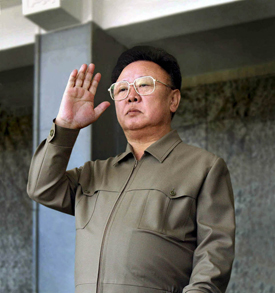
As if 2011 didn’t have enough notable deaths, Kim Jong Il kicked the proverbial bucket on Dec. 17, 2011. The enigmatic and charismatically bonkers world leader ruled North Korea for 17 years before dying of a heart attack at age 69. He took over the reins of the reclusive Asian country in 1994 from the country’s previous leader and Jong Il’s father, Kim Il Sung, who coincidentally also died of a heart attack (the elder Kim made it into his eighties, though).
Around the table on Christmas Eve, after a couple of glasses of wine, a relative showed me a YouTube video of North Koreans mourning the loss of their great leader. I’m painfully cordial at dinner tables, especially during the holidays. Death is not something that I find polite to discuss. The only thing less polite would be to converse about politics. But the video sure was striking. One image from the video particularly struck me. It was of a man crying–just bawling–on the steps of what I assumed was a government building.
“Can you believe it?” my relative asked.
Given the press Kim Jong Il has gotten on this side of the Pacific, it’d be difficult to believe that anyone would shed a tear over his passing. Yet, here this man was, sobbing so openly you’d think it was his wife or mother. It made me think about how relative everything is. Who knows? Perhaps this reaction was a calculated piece of propaganda to either show that Jong Il was beloved by his people; or, maybe it was a device wielded by those to prove the opposite–that the people of North Korea are so brainwashed that they thought the fruit bat who led them was someone likened to a god.
Even gods die, though. Just ask Zeus. The world wondered if the death of the country’s supreme leader would leave a power vacuum in North Korea. These thoughts were laid to rest on Dec. 29, 2011 as Kim Jong Un, Jong Il’s son, was named as his father’s successor. In fact, he was even dubbed “The Great Successor,” which may very well be the coolest title a world leader can have.
According to an article on SFGate.com, Kim Yong Nam, North Korean Chairman of the Presidium of the Supreme People’s Assembly (I’ll take it back, that is the coolest title a world leader can have) said of Jong Un, “Respected Comrade Kim Jong Un is our party, military and country’s supreme leader who inherits great comrade Kim Jong Il’s ideology, leadership, character, virtues, grit and courage.”
So Yong Nam not only has a cool title, but he’s also not shy with the adjectives. I’ve always been fascinated by the North Korean supreme leader, simply because the stories you hear about the country seem so deliciously fictitious. It’s like something out of a surrealist novel, or maybe even an epic poem. When I first heard the news of his death, my knee-jerk reaction was that it was some kind of hoax. Really, I sort of hoped it was, because as crazy as he might have been, his image–the Elvis hair, stoic face and outlandish clothing–made the world more interesting. I wasn’t the only one who thought so. Even as Jong Un was being named the new supreme leader, Kim Jong Il souvenir sales surged just across the North Korean border into China, according to an article published by the Agency France-Presse. One such vendor of these trinkets stated that she had sold “50 to 60 lapel pins every day during the 13-day mourning period” after Jong Il’s death. Any way you slice it, he certainly had an effect on people.
Who knows what legends will surround the new guy, but he certainly got his career off to a memorable start, one already clouded by conjecture. The Great Successor was unveiled at a massive memorial service for his father that saw hundreds of thousands of people converge upon Kim Il Sung Square in Pyongyang to pledge their fealty and support to the country’s new leader, according to SFGate.com. Strangely enough, CBS News reported that “Tens of thousands” attended the same memorial.
I guess the passing of Kim Jong Il and the tale of his successor are like many other things in life. It’s all about what you want to believe–like Santa Claus, or Balloon Boy, or that watching The Jersey Shore on a regular basis doesn’t make you a terrible person. I’d wager there’s probably a little bit of truth in everything, no matter how bizarre, vile or improbably wonderful, which is most likely why the world is such a fascinating place. Rest in peace, KJI, or some semblance thereof.
Congratulations, North Korea! On Saturday, Oct. 11, the Bush administration announced that Asia’s most mysterious communist nation is no longer on the list of states that sponsor terrorism. I, for one, am glad.
I don’t know much about Korea, or Korean culture, other than Jin and Sun from Lost are pretty sweet. I’ve also eaten at a Korean barbecue joint once and was really impressed. The table was just full of raw meats and spicy pickled things; and in the center of the table was a grill and fire pit so you could grill your meat to your liking. I got drunk on soju and didn’t even have a hangover the next day. Overall, I was pleased. However, I’m sure North Korea isn’t as bad as they’ve been made out to be—just a bit misunderstood.
Relations between the U.S. and North Korea have never been all that good. There was that war in the ’50s that never really got resolved. Back in 1994, things seemed to be lightening up in the two countries’ tumultuous relationship, as President Clinton signed a similar agreement with the North Koreans. That all went to hell in 2002, though, when the Bush administration pegged the mysterious communist Asian nation as part of the “Axis of Evil,” an announcement that ruffled the well-coiffed feathers of North Korea’s enigmatic and creepy leader Kim Jong-Il. The situation really got interesting in 2006 when North Korea detonated a nuclear device, changing the Bush administration’s “Fuck you!” attitude toward Pyongyang to “Hey, guy. How’s it going?”
An uneasy accord was met. In 2007, “six-party” talks (including Russia, Japan and South Korea) were held. Thanks to those meetings, North Korea kind of sort of agreed to halt their nuclear activities”¦probably. But in 2008, those shaky ties looked about ready to break. According to an article in the New York Times, just days before the Oct. 11 announcement, North Korea had barred international inspectors from a plutonium plant in Yongbyon. In a last ditch attempt to make it look like they have done something positive in its eight years in office, the historically stubborn Bush administration made a compromise. Imagine that.
The deal doesn’t really change the situation all that much. U.S. inspectors will now have access to the Yongbyon plant; however, whether or not inspectors will have access to sites international experts suspect may be used to make weapons grade nuclear material remains to be seen. Inspectors will now be able to gain access to such sites “based on mutual consent”—good luck with that. For its part, North Korea gains a modicum of international acceptance. They’re no longer that disturbed little child picking the wings off flies at the kiddie table; now they’re breaking bread with the big boys”¦just as long as they mind their manners and don’t ask for seconds.
The Oct. 11 announcement raised the ire of Republicans. Presidential nominee Sen. John McCain complained “that North Korea had yet to demonstrate that it was serious about adhering to its commitment to denuclearize.” Meanwhile, Democratic nominee Barack Obama was like, “Whatever, I’m going to be president soon anyway.” (I’m paraphrasing.)
Maybe we’re just making a big deal over nothing. For all his eccentricities, maybe Kim Jong-Il isn’t as insane as people think. Maybe the only way to get noticed as a player in international politics is to wave a loaded gun around. If it’s truly going to be a global community, doesn’t that mean everyone should have a voice? Perhaps it’s the only way he could ensure the safety of his government and his people—to create a sort of stalemate. Maybe if everyone had The Bomb, everyone would go forth in peace. I’d like to give the world a nuke? I suppose it has a ring to it.