Ex-Ganglians member Kyle Hoover on the first album from his new group, Tiaras
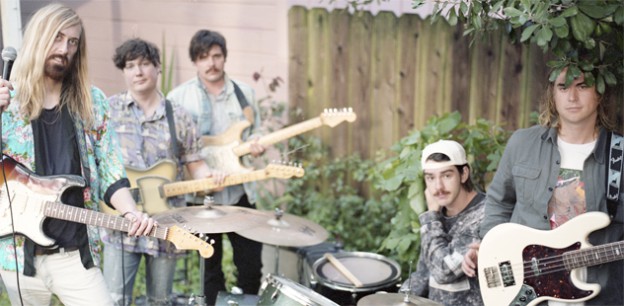
All eras are defined by the fact that, eventually, they will end. There can be no Summer of Love Without a Winter of Discontent; no Woodstock without an Altamont; no old guard without a new wave; no lo-fi renaissance without a hi-fi takeover. Tiaras, a San Francisco rock outfit forged from the remnants of other groups (Blasted Canyons, Fine Steps, Sacramento’s own Ganglians), is starting the year by releasing a full-length illustration of this principle. The self-titled debut album, out Jan. 14, 2015, is a clear step away from the modes and methods characterizing the earlier work of its musicians. Where Ganglians once stood for a wild, heat-shimmery psych pop indebted to bands of the ‘60s, Tiaras glides—not leaps—further into music history (say, about two decades), emerging into a clearer, moodier intersection of mid-‘80s jangle-pop and new wave. Whatever the eras and styles that reverberate in Tiaras’ music, a few things are clear: their melodies are strong, their production is crisp and Tiaras may be one of the first great rock albums of 2015.
To get a deeper insight into the new record and its prehistory, we dialed up guitarist Kyle Hoover, who was spending his weekend hanging out in the illustrious Haight-Ashbury neighborhood of San Francisco. When considering the changes his band has been through, I wondered beforehand: how much of a hold does the past still have on that place? Does the feverish, acid-drenched zeitgeist of yesteryear still contain a slight hold on the City by the Bay? As numerous other bands from the local scene begin to decamp for other horizons, we can tell a lot about the current landscape from the musicians who have opted to stay. The music of Tiaras, for one, seems well suited to its locale. While traversing the bittersweet highs and lows of standout track “In the Room,” you can imagine the swift changes of elevation and climate one comes across while traveling through the city: the top of a tower, the bottom of a hill; burning sunshine and bone-chilling fog crowding into a single moment.
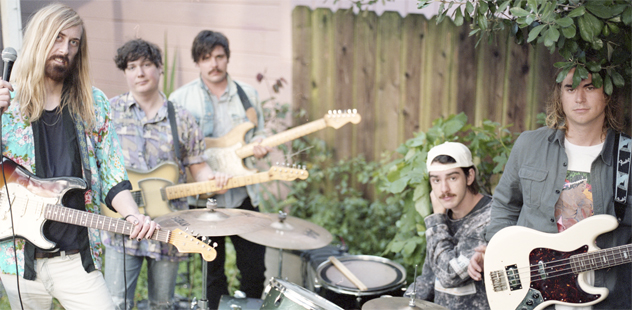
You’ve mentioned before that you’ve been living in the Excelsior area of San Francisco, how it’s fertile creative ground, but a lot of the old guard are moving south for greener pastures. What’s your point of view on these changes?
I’d say the curtains have been drawn back a little bit. I was joking around with my bandmates about the “endless summer of lo-fi ‘09.” It was this big thing—lo-fi garage, it was huge, it was everywhere. I mean, we were part of that too back in the day, but, I mean, me personally, I got over backing that stuff pretty quickly, and that’s part of the reason for the change. There’s definitely a message that we wanted to send going forward with Tiaras, like, “Alright, we live in San Francisco. We used to be kind of a garage band. Now let’s do something different.” A little more solemn, little more pop-oriented. We just wanted to do something different, and lo and behold, a year later, after the record finally comes out, there’s a bunch of other bands who are sort of shying away from that [lo-fi] scene as well.
A lot of my friends moved away—that’s just how it is. It’s super hard to live in the city. But it’s not the end of the world, there’s still cool stuff. I think if anything, it’s for the better that the garage thing has kind of faded a bit from the spotlight in San Francisco. More room to breed different genres.
The genre shift—going to the hi-fi sound, concentrating on the pop melodies—did you have anything to model yourselves on?
With this record, we definitely wanted to make it sound as good as possible. I’m a fan of using the best of both worlds—digital recording is super convenient and makes for a much less stressful recording environment; however, going analog is beneficial for different sounds. You can have the best of both worlds and get really experimental. With Ganglians, we were always trying to be hi-fi; it just always sounded lo-fi because we didn’t know what the fuck we were doing. But the idea was always to try and sound as good as possible. Genre-wise, the shifts…we just started listening to different stuff. I knew Ryan [frontman for Ganglians, Tiaras] in ‘08, and we were like, “Dude! Pet Sounds!” And the influence of that album is super evident in Ganglians. For the new record, Ryan and I were getting into a lot of weird, obscure ‘80s music, along with the rest of the world, apparently—but I guess that’s just how it goes. We just wanted to disassociate ourselves from our previous sound, which is hard because I still sound like me, and Ryan still sounds like himself. Now we have three other awesome dudes with their own take on things, and I think it works. People aren’t saying we sound like the Beach Boys anymore, so that’s fine.
When you say you all started listening to different stuff, was there anything in particular that you got excited about?
Ryan and I got really into Chrome, which was like this super weird, kind of avant-garde ‘80s rock thing. I don’t even know how to describe it. We’d heard about them from back in the day, but we started listening to them all the time. I personally started listening to a lot of Echo and the Bunnymen…just a lot of weird ‘80s stuff that I knew was good but that I’d never really taken the time to listen to. When the Cleaners from Venus record was reissued a few years ago, that was being played around our house 24/7. That was definitely a record I was super stoked about.
Was there a good deal of downtime between the dissolution of Ganglians and the recording for Tiaras?
Oh yeah, definitely. I think we stopped playing together after our last SXSW, which must have been the spring of 2011. Ryan moved to San Francisco, our drummer moved to Brooklyn, our bassist moved to Oakland and I was stuck in Elk Grove. I was living at my dad’s house for a good eight months until I finally saved up enough money to move in with Ryan in SF.
Did a lot of the ideas for the new group and album come out of that eight-month period?
That would be nice, but definitely not. That was more of like a—I don’t know, we were so worn out. I think at that point, we’d been on the road almost constantly for like a year and a half. We were starting to argue a lot, and it was kinda gnarly. So I was mostly just being miserable in Elk Grove, commuting to Davis with Alex’s [Ganglians drummer] mom every morning. That’s basically what I did. If anything was going on idea-wise during that period of time, it was with Ryan and Antonio in San Francisco while they were jamming together.
It seems collectively like you have decades of band experience—you’ve been in a lot of bands, you kind of know the drill. At this point, is it easier for you to tell when the chemistry is right, or when you’re ready to call it a day?
Yeah, I’d say so. This is probably only my third band, but this time, the songs came together easier. Ganglians was like a shitload of trial and error. That was kind of a turning period, because we were all new to what we were doing. With Tiaras, it was super easy to make things work. I’d say there was a year’s worth of time where we were learning to play with each other. And it wasn’t super natural at first, but now we all understand what we’re trying to do.
Playing TBD this past October was sort of a mini-Sacramento homecoming for you guys. How was the experience?
It was fun! It kind of felt like a Sacramento Burning Man or something. Everyone was walking around with scarves on their face and dust was everywhere. I definitely partied too hard, because I stayed there for the whole weekend. I think we were all hungover for like a week after that.
Finally, how do you feel about Tiaras as a group at this point?
When Tiaras first started, I had known Ryan pretty well from being in Ganglians. I’d known Antonio pretty darn well—I think I’ve known that guy since he was like 16—and I had just met Adam and our bassist Ryan Hansen, so I was getting to know them, and we were figuring out how to play together and what our sound should be like. Needless to say, we’re still fucking with our tone settings and our amps to figure out what sounds we have and stuff like that. But I feel like the songs are getting better, and we’re getting better at writing them.
See Tiaras live at Harlow’s in Sacramento on Feb. 10, 2015. Tiaras will be playing in support of The Dodos. Tickets are $15 and can be purchased through Harlows.com. Doors open at 7 p.m.
San Francisco’s Con Brio Brings the Funk to Third Annual Torch Fest
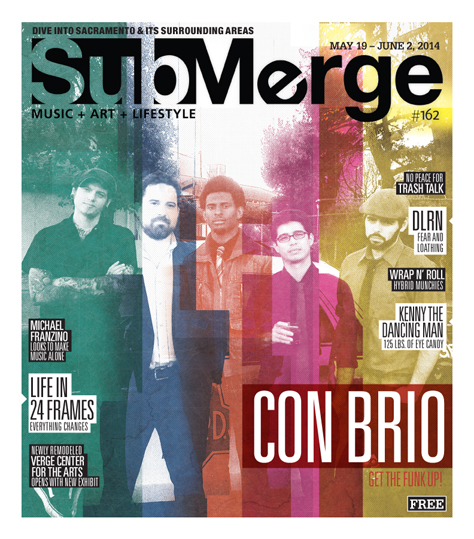
San Francisco soul brothers Con Brio reignite the classic sounds of the ’50s and ’60s with two new singles, “Temptations Talkin’” and “California Cowboy,” set for release this fall on a yet-to-be titled EP through Burning House records. Both tracks respectively tip hats to the R&B, gospel and funk genres. Fitting, as the guys admit they’re heavily influenced by the charisma and energy of entertainers like James Brown and Jackie Wilson, with a deep admiration for funk purveyors Sly and the Family Stone and Billy Preston.
Formed in 2009, Con Brio (“with vigor” or “spirit”) quickly gained momentum in the San Francisco music scene performing at high-capacity venues like the Great American Music Hall, the Fillmore and the Regency Ballroom. A year later, the band recorded and released its debut album, From the Hip, followed by its live album titled The Bay is Burning in 2012. They continued the momentum with their first national tour that year.
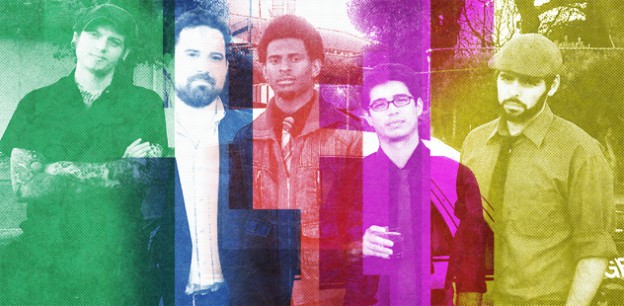
Although this five-piece (which includes a two to three-piece horn section and full organ) originates from the Bay Area, Con Brio is no stranger to Sacramento, especially when it comes to multiple performances at the historic Torch Club. What’s more, new vocalist and dance machine Ziek McCarter, and organist and founding member Micah Dubreuil, are both masters of the long-distance phone interview—even if the two aren’t in the same city. Other up-and-coming bands take note: for our phone interview, McCarter was on a bus to Big Sur to perform with another band; while Dubreuil, who started at his apartment in San Francisco, found his way onto a bus heading to Los Angeles. Submerge caught up with the duo ahead of Con Brio’s scheduled performance at Torch Club’s third-annual Torch Fest, beginning May 24, 2014.
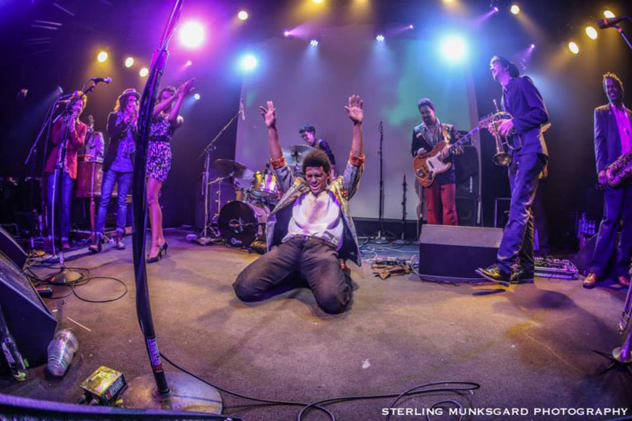
The latest music video for “Temptations Talkin’” off your new EP exudes a great deal of energy from everyone involved. Can you fill me in on some influences?
Ziek McCarter: Vocally, Stevie Wonder, Donny Hathaway [and] D’Angelo. Dance moves-wise, as an entertainer, I look up to cats like Prince, James Brown or Michael Jackson, or really anyone who is a charismatic performer, like Jackie Wilson.
Who influences you behind the organ, Micah? I hear Booker T., is that someone you’re fond of?
Micah Dubreuil: I haven’t listened to Booker as much as I should’ve. I know about “Green Onions” and so forth, but for me, it’s a lot more of the jazz guys, like Dr. Lonnie Smith. [He] is my biggest influence and hero on the organ. … Some of the younger guys as well like, Billy Preston and even some gospel players like Cory Henry, who plays in a band called Snarky Puppy.
What inspired you to play the organ?
MD: It’s just a beautiful sound, an incredible feeling. An organ is a 400-pound machine and there’s buttons and levers and it feels like you’re driving a big truck. I’ve been told I play it in a pretty heavy-handed way, I think it definitely helps push the sound and really elevates the music when the time is right.
The mixture of genres within Con Brio’s music seems to be a perfect fit for the Torch Club. How did you stumble upon that venue?
MD: We were recommended the Torch Club by our friends in a touring blues band. Since then, we’re happy to play there, always.
Which song relates to you the most off the new EP?
ZM: Oh man, that’s a hard one. That’s like asking me, do I have a favorite genre? I’ve been listening to one song all day called “Give it all,” which is a song that Micah and myself wrote. I’m really excited about it and I want it to make me cry and it’s almost there. Its story has so much emotion, especially for me. I’m making sure to push the song to the highest level and make sure that it penetrates myself first and foremost. I’m speaking in the context that I’m talking to a woman, but a lot of it is inspired by my father, who has passed. He gave me all that he had and I am what I am because [of him].
Why did you two want to join a funk or soul band?
MD: It’s so good, man. It’s the music I love. It makes me feel something inside of me whether as a listener or performer.
ZM: It’s something I always wanted to do since I was a kid, be an entertainer. It just happened to come through the vein of funk and soul, as a band. I used to play blues with my pops. So, I guess it kind of prepared me for what was to come.
What are you looking forward to over the next couple of years as a band?
MD: We’ve been lucky enough to play some great venues in San Francisco like the Independent, the Great American Music Hall or the Fillmore, but we’d like to perform at those kind of rooms around the country.
ZM: Hit all the major festivals and get on that festival circuit, like the one in Sacramento!
If you could perform alongside any one person from the past, who would it be?
ZM: It would have to be James Brown or Prince. The way they deliver in the moment and just their high energy and the momentum that they have. I feel like I operate on that same level, and so I would like to see first-hand how it’s done instead of watching videos.
MD: It’s funny, I might’ve been thinking James Brown, too. I get the most out of working with singers and drummers on stage. The singer is directing the traffic from the front with the audience and the drummer is working from the back. But, James Brown had so much energy and such an ability to capture a moment, I think it would be really incredible and amazing to have that experience.
Con Brio will perform the second day of Torch Club’s (904 15th Street) third-annual Torch Fest. The two-day fest kicks off on Saturday, May 24, at 6 p.m. and continues on Sunday at 4 p.m. Tickets for this 21-and-over event cost $12 the first day, followed by $15 on day two.
Church Underwater
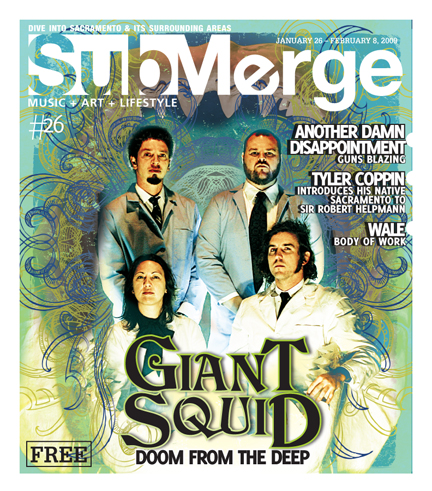
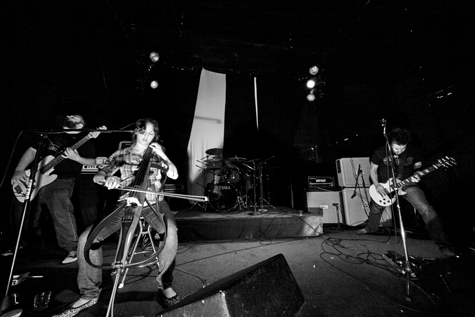
The ocean is home to the world’s largest creatures. One of the most fascinating of these mammoth beasts is the giant squid. Rarely photographed, its elusiveness belies its ponderous size. As a result, the mysterious creature has inspired folklore, myth and art worldwide. It is fitting that such a beast would serve as the moniker for San Francisco-/Sacramento-based metal band Giant Squid. Titanic in sound, Giant Squid is difficult to categorize. Though the band leans heavily on the tenets of doom/stoner metal popularized by groups such as Isis—riffs are heavy, thick, slow and hypnotic and paired with wailing vocals laden with despair—Giant Squid pushes the avant-garde metal envelope even further, tossing in atmospheric keys, horns and strings into the mix. This strange sonic brew made the group’s debut full-length, 2006’s Metridium Fields, a noteworthy release for underground metal fans. On Feb. 3, Giant Squid may extend its reach even further with the unveiling of their latest album, The Ichthyologist.
Weirder, heavier and deeper than the group’s previous efforts, The Ichthyologist is a sort of heavy music kaleidoscope. Considered separately, the songs seem to share little in common with one another: The jazz-y “Sutterville” sways like a drunken zombie lounge singer; while the opener “Panthalassa” starts with a sinewy, serpentine guitar line that snakes into a wall-squalling metal noise. Yet, when listened to as a whole, these disparaging colors form a mesmerizing picture.
A portion of the album’s success should be credited to the man turning the knobs. In-demand heavy music producer Matt Bayles, who has worked with the aforementioned Isis as well as Mastodon in the past, served as producer for The Ichthyologist. According to Giant Squid singer/guitarist Aaron Gregory, the band, without the backing of a label, pooled its resources to pay Bayles’s considerable price tag.
“Everyone in the band chipped in their savings and then some,” Gregory says. “We sold some gear, and we finally got around to putting the rest of our Monsoon EPs online, and made some money off of those real quick. We managed to do it somehow. We put together a really large sum of money and hired him.”
It was money well spent. During our interview, Gregory refers to Bayles as a “taskmaster,” but says he appreciated the producer’s strictness.
“He really whipped us into shape, and made us make sure we play every note to the best of our ability, or he wouldn’t let it go,” Gregory recalls. “It’s one of the first records I’ve walked away from and said, ‘I’m pretty much OK with every single thing I did on that record.'”
The Ichthyologist‘s cohesiveness may also be attributed to its concept. The album coincides with Gregory’s first, yet-to-be-completed graphic novel by the same name. Gregory says that the comic book version of The Ichthyologist is, in part, inspired by The Swamp Thing. “I love the idea of a man becoming something so much more than a man, and yet kind of less than a man, and the spiritual heaviness of Swamp Thing, especially when Alan Moore started writing it,” Gregory says of the classic DC Comics character.
Gregory, a professional SCUBA diver working at San Francisco’s Aquarium of the Bay, discussed the audio, visual and philosophical aspects of The Ichthyologist in a recent interview.
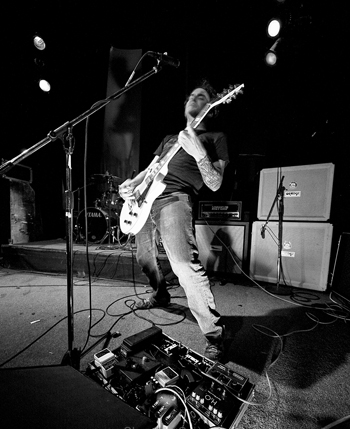
You’re self-releasing The Ichthyologist in a limited run of 1,000 copies. What made you decide to take that route with the album?
We spent an incredible amount of money to work with Matt Bayles, and we’re maybe not the caliber of band yet that could get a label to pay us right upfront enough money to hire Matt Bayles. Honestly, I doubt most labels would be able to give us half of the advance we would need to work with Matt. Because we did it for ourselves, we wanted to make sure that we didn’t give this album away to a label for nothing and we all kind of lose our ass. In all reality, you don’t see hardly any money back from small labels. That’s just part of it. That’s fine too, because they work their ass off and they have bills to pay too. In this way, if we sell a thousand of them at 12 bucks a pop, we get all of our money back. We get to break even. We’re at the level that we can do that on our own, for sure. The pre-sales are already exploding. We sell a shit-ton of them every day. Hopefully when all is said and done, we would have signed a new label deal or two, six months after the release, it’s our goal to find someone to put it out on vinyl and put it out on CD.
I’ve read that The Ichthyologist is based on a graphic novel that you’re working on. Would you like to talk about that?
Yes, the album is based on a graphic novel I’m writing that goes by the same name. The protagonist has lost it all in haphazard ways and takes on the abilities of a sea star to survive it, and thus begins this huge journey, that no matter what happens he ends up healing, because sea stars have this regenerative ability. The album is basically the poetic description of my character’s origin. It’s the poetic downfall from the beginning to the end of his origin. The graphic novel goes much, much more past that.
Did you know that you wanted to tell this story both musically and as a graphic novel, or were you not sure?
I came up with the album title first. I thought that would just be a great album name, The Ichthyologist. It’s perfect for me—perfect for Giant Squid. Then I was talking to someone in the comic book industry, a good friend of mine, about some ideas to pitch for the company he works for, which led me to this concept, under the same name. The songs had already been written, and I worked the general themes of those into the story. There’s a song on there called “Mormon Island,” which is a very old gold mining town in the Sacramento area that’s long since gone and is now actually sitting at the bottom of Folsom Lake. We were writing this very creepy song, and someone said that it sounded like a church underwater, and I was like, “Shit, I know where there’s a church underwater. There’s a church at the bottom of Folsom Lake, a town called Mormon Island. We’ve got to call this song ‘Mormon Island.'” Then I was like, “How can I work Mormon Island into the story?” And by doing so, it opened up all these different angles into my story. So, as I’m writing the graphic novel, writing the album helped inspire a lot of different things, and vice versa. There would be ideas, right from the get-go, like, “I have to write a song about this moment in the dude’s creation, this moment in the guy’s downfall,” and so on.

Looking at the other titles on the album, there’s one that mentions the Donner Party; and Ernst Haeckel, whose image you used on the cover, has a peak named after him in the Sierra Nevadas. There’s also a mention of the La Brea Tar Pits. I don’t know if it was intentional, but the album seems to have a very firm sense of place. It’s very Californian.
Absolutely. I’ve always been obsessed with California history, and have incorporated it in a lot of ways, sometimes more subtle than others, in all our albums. We also had a 7-inch called “Sutter’s Fort,” and there’s a sequel to “Sutter’s Fort” on The Ichthyologist called “Sutterville,” which is more or less about Sacramento refusing to give up its capitol-ship. Sacramento kept flooding in the 1800s, and people kept saying, “You need to move your capitol. This is a pretty shitty fucking place to have a capitol.” And Sacramento refused to give it up, and after huge bouts of cholera and death and that kind of shit, they just raised all the streets 10 feet in the air. The actual story of The Ichthyologist is time-hopping as well.
There’s a mix between the human history of California and the natural history as well. Does working in marine biology allow you to see the scope of both? I would imagine being underwater, you can see how the Earth grew up out of it.
You know, not to get too heady, but when you’re 40 feet down at the bottom of the ocean in Monterey and you’re surrounded by kelp and a rocky reef and tens of thousands of fish swimming around”¦you are basically staring right at the godhead. You’re staring at the spiritual center of it all. As far as our planet goes, it all came from right there. You also never have felt like you belong as much as you do when you’re down there. It’s a very strange and surreal sense. It opens up a lot of spiritual thought and philosophy, and who we are in the grand scheme of things. The album is a little heady in some ways, because it does touch on stuff like that. The grand result of the graphic novel kind of deals with that—God being underwater. People go into the seas to talk with God.