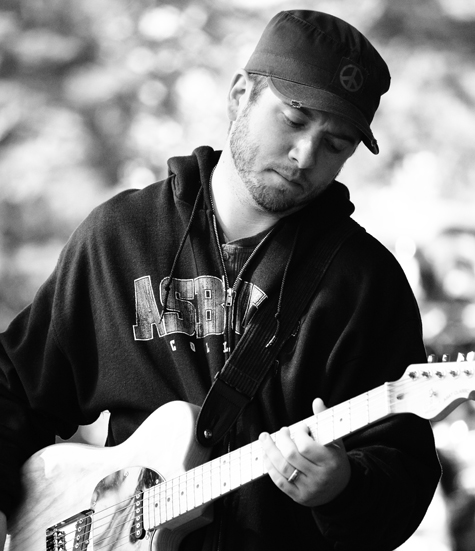
Ross Hammond and the Tao of Improvisation
At this year’s SXSW, Ross Hammond, performing with Teakayo Mission, put his rockist touch on the traditional hymn, “Let Us Go Into the House of the Lord,” leading a 14-minute tour of the heavenly kingdom. The live recording sounds as though he and his band mates reached nirvana; but for Hammond, this was just another night of performing in one of his many side projects.
It is tough to say why I feel this way, but the guitar has always been a spiritual instrument in my mind. Perhaps it is images of Jimi Hendrix kneeling in a prayer position, conjuring flames from a burning broken instrument, or the intoxicating feelings that come from Eddie Hazel’s 10-minute guitar soliloquy on Funkadelic’s “Maggot Brain.” A guitar is especially powerful when improvisation is introduced, allowing a guitarist to operate on instinct and inspiration—it is in these delicate moments that musicians seem touched by a divine muse.
Pulling the pomp from these circumstances, such musings can be reduced to just another good night for improvisational jazz—a scene that is garnering some attention in Sacramento. Ross Hammond has been operating within the limitless art form for over a decade, dividing time between improvisational groups, working as a sideman for singers and songwriters, teaching private lessons and curating local jazz shows. Some of his current projects, whether as a leader or session player, include RACE!!!, Teakayo Mission, V-Neck, Lovely Builders and Joaquin’s Night Train. Even with such a prolific resume, he’s reluctant to be dubbed torchbearer for the scene. “A lot of these projects that I’m playing in aren’t mine,” Hammond said. “There’s a lot of passing the leader title around in different projects. Usually a new project is from meeting someone new that’s into a similar idea or finding a new concept about how to present your music.”
Even in the most possessed thralls of improvisation, an artist cannot reach this higher ground without an intense dedication to the craft and community—one monk can’t run a monastery. Hammond views his eagerness to continually invite new musicians into his circle part of this ideal. “Playing with all kinds of different musicians and styles keeps you sharp,” he said. “That’s really the whole idea, in being able to play as much as I can in as many styles as I can.”
Hammond’s predilection for an unabashed marriage of style and technique are the principles for his latest solo record, An Effective Use of Space, a title penned by his wife. “It’s a phrase [she] likes to use when we talk about how things should be arranged in our house,” he said. “I’m sure someone could make a good musical meaning for it too. But it was more of a title that was given after the fact.”
Essentially, his wife has unwittingly helped this writer do just that, as his album suggests jazz feng shui. In a traditional sense, feng shui is an ancient Chinese system of aesthetics for improving ones life through placements of positive energy, but Hammond’s feng shui comes from his guitar-plucking intuition. The record also features several stylistic choices that require delicate placement.
[audio:Heaven Was Getting Crowded.mp3]
Hammond occasionally deviates from his signature sound to pose dedications to friends and family. One of his favorite songs is “Heaven Was Getting Crowded,” which features his recently departed grandmother—Hammond recorded her delivering this joke during her final stay in the hospital. “I wanted to get a recording of her telling her favorite joke, so that’s pretty much how it came out,” he said. “She was a very loving and supportive lady, and she loved to make people laugh. She would tell us and the doctors and medical staff jokes up to her final days.” Without overshadowing the recording, he supports his grandmother’s joke with a bittersweet mood created from solo electric and lap steel guitar loops. “The song is meant as a way to remember her jovial side,” he said.
Once again, I recall Hammond’s SXSW recording. It is as though his guitar is in deep meditation, yet there’s an unspoken connection with his band mates. The spiritual is the constant, while the exploration of a deeper understanding is ritually being sought throughout the performance. “I try to communicate whatever I’m feeling in the moment,” Hammond said. “That obviously has some day to day changes, but there are some parts of my personality that are pretty much constant.” Originally from Lexington, Ky. and raised in the church, Hammond’s spirituality is connected to his guitar playing. “I think most improvisers are that way,” he said. “You should be able to get an idea of what a person is feeling by listening to them play. I think that’s what keeps improvised music honest. But there’s also the factor of what your other band mates are doing. So, it is definitely a balance of trying to get across what you feel while still listening to what’s going on around you.”
The practice of meditation in Eastern religions holds relevance to the improvised jazz performer. Obtaining Zen through meditation involves intense mental stamina as a person directs awareness toward breathing or counting until he or she establishes a trance state. Improvised music shares principles with meditation, as the beat is the groundwork for the journey that comes from reacting to your group and the impulses you feel in the moment. “It’s like you are an antenna that is channeling the music from somewhere else,” he said. “When I play, I’m definitely not thinking about scales or keys. There’s an old adage that says if you are thinking when you play, then you’re gonna muck it up.” Once again, Hammond likened it to his personal experience of participating communally in church, “I think that is a very spiritual thing, because in that sense the music is something that is bigger than just me and whoever I’m playing with. It’s definitely greater than the sum of its parts. I think it’s a similar feeling as being in church, or meditating or whatever else people do to escape. When you are improvising it’s a timeless feeling in that it’s hard to tell if the song you just played was five minutes or 45 minutes.”
Hammond stresses that, though time loses its relevance while performing and the transcendental progression is intoxicating, it is important to hold dear to your purpose. For Hammond, creating is far beyond notes on staff paper, matching scales to chords and counting beats. He spoke with restraint, worried he’d sound too “new age-y,” relating that he created “to convey a sense of unity and harmony in the world we live in.”
Finally, I asked Hammond if he thought his style of improv-jazz was less intimidating than most jazz because of its focus on the guitar and crafting soliloquies. He resisted my hypothesis stating, “I don’t see jazz artists like John Coltrane or Pharoah Sanders being that much different than Pete Seeger or Bob Dylan,” he said. “They are all trying to convey a message through their music. That’s the important part. I think at this point jazz just means ‘not pop.’ Just play what you are feeling. That’s where the real music lies.”

The deluge of e-mails continues.
Tee Pee Records will be all over SXSW this year, and if you’re going, you should make a point to catch some of them. If you’re not going, or just need more convincing, the label has posted a FREE sampler of their bands for download online. Bands featured include J. Mascis’s metal band Witch, Earthless and Graveyard (their “Evil Ways” track is my favorite so far).
Fans of Sabbath-/Pentagram-inspired doom and psych-rock should take note. Also, anyone still rocking black light posters will probably want to download this, if they even have computers.
Check out Tee Pee bands at SXSW at the following times/locations:
Wednesday 3/18:
Tee Pee Records/MadeLoud.com Day Party at The Scoot Inn
Scoot Inn – 113 E 11th St
5pm Hopewell
4:30 Willem Maker (inside)
4pm Night Horse
3:30 Larkin Grimm (inside)
3pm Sleepy Sun
2:30 Silverghost (inside)
2pm Krista Muir
Thursday 3/19:
Gibson Guitars/Affliction Day Party at Maggie Mae’s:
Maggie Mae’s – 512 Trinity Street
1:25-1:55 Earthless
Roky Erikson Psychedelic Ice Cream Social at Threadgills World Headquarters:
Threadgills World Headquarters – 301 Riverside Drive
4PM The Warlocks
Full Metal Texas @ Emo’s Annex Noon – 6PM:
Emo’s – 600 Red River Street
RSVP AT:
www.FullMetalTexas.com
12:15PM Memphis May Fire
1:05PM Night Horse
1:55PM Black Math Horseman
2:45PM Kylesa
3:35PM Skeletonwitch
4:35PM Fact
5:15PM Greeley Estates
Tee Pee Records Official SXSW Showcase at Room 710:
Room 710 – 710 Red River Street
8PM Kreisor
9PM Black Math Horseman
10PM Night Horse
11PM Ancestors
12AM Annihilation Time
1AM Earthless
Friday 3/20:
Gibson Guitars Day Party at Maggie Mae’s:
Maggie Mae’s – Maggie Mae’s – 512 Trinity Street
1:30 PM The Warlocks
Action PR / Tee Pee / Scoot Inn Presents day party
Scoot Inn – 113 E 11th St
Outside-
5pm Peelander-Z
4pm Zoroaster
3pm Ancestors
2pm Easy Action
1pm Dixie Witch
The Smell Day Party at 501 Studios:
501 Studios – 501 North IH-35
5:15 PM Ancestors
AAM Day Party at Habana Calle 6:
709 – E 6th Street
4:45PM Earthless & J Mascis exclusive performance
Psychotropic Day Party at Spiderhouse:
Spiderhouse – 2908 Fruth Street
3:20PM Hopewell
6:40PM Earthless
7:30PM Black Math Horseman
Day Party at Guero’s:
Guero’s – 1412 S Congress Ave
6:45 Hopewell
Saturday 3/21:
Tee Pee Records/LA Record/Converse Day Party at Club 1808:
Club 1808 – 1808 E 12th Street
6:10PM Annihilation Time
5:20PM Year Long Disaster
4:30PM The Warlocks
3:40PM Night Horse
2:50PM Tweak Bird
2PM Black Math Horseman
High Times 2009 Doobie Awards at Red 7:
Red 7 – 611 E 7th Street
Earthless (set time TBA)
Live Music Capitol Day Party:
1PM Hopewell
SXSW Showcase at Beauty Bar:
Beauty Bar – 617 E 7th Street
10PM Hopewell
Viva Radio/American Apparell Showcase at Club Deville:
Club Deville – 900 Red River St
9PM – The Warlocks

With SXSW on the horizon, my inbox is filling up with e-mails about who will be playing there. It’s a double-edged sword: I’ve checked out a lot of stuff I wouldn’t have heard normally, but since I won’t be attending the festival this year, I won’t have the opportunity to be so wasted that I’ll forget whether or not I’ve seen them perform. It’s upsetting.
That being said, if I were going, Madi Diaz is one of those acts I would do my best to sober up for. She’s from Lancaster, which is in the butter-churning heart of Pennsylvania Amish country. Now, the fresh-faced 22-year-old (pictured above with partner in crime Kyle Ryan) is based out of Nashville, and her songs veer toward the sunnier indie rock, country and folk. Maybe it will remind you that there are warmer days ahead. Her new EP, Ten Gun Salute, has been self-released and can be purchased digitally on her Myspace page (“Heavy Heart” and the title track are especially nice).
If you’ll be in Austin this year, here’s where you can find her:
Wed, March 18
6 p.m. @ Sheraton Hotel (701 E. 11th)
Thurs, March 19
11 p.m. @ Hi-Lo (301 W. 6th)
Fri, March 20
12:30 – 12:45 p.m. @ Four Seasons / BMI Breakfast
2:00 – 2:20 p.m. @ Tap Room at Six Lounge (117 W. 4th)
9:15 p.m. @ Driskill Hotel, Victorian Room (the main gig)
If you’re considering a vacation to Amish country, I suggest eating at Good ‘N Plenty, a family style restaurant where you can quite literally eat yourself to death. Just save room for the shoo fly pie.
All That They Can See
Don’t mistake San Francisco (by way of Davis) trio Sholi for a wholly identifiable musical collective. Their creative influences weave through minimalist shoegaze, Qawwali and the drone-y spiral of standing on a precipice, not knowing whether or not it’s time to leap. Their self-titled debut full-length, produced by Greg Saunier of Deerhoof, is an endurance test of the best kind; a sort of hopscotch through sidewalk chalk squares, hopping backwards with no knowledge of where the stone lies—guess wrong about a particular movement and you’ll trip and lose. Only according to vocalist/guitarist Payam Bavafa, Sholi isn’t interested in elaborating on the brainier elements of his band; but just hopes that listeners will create or find their own spaces with which to understand the band’s sound.
Established fans and newcomers will get their respective chances, as the band will celebrate the release of their debut on Feb. 14 at Delta of Venus in Davis. The album will be released nationally via Touch and Go/Quarterstick Records on Feb. 17, just two weeks before the band hits the music conference circuit with Noise Pop and SXSW. With so much going on, it’s a wonder Bavafa even had the time to carve out an interview with Submerge. He almost didn’t; but as with the stunning collection of angular neuro-rock his band has put out thus far, it’s definitely better to wait it out.
Sholi is a relatively new band, and you relocated during its formative months. How did the distance affect the band in the beginning?
Jon [Bafus, drums] and I started Sholi in Davis, and then I moved out to San Francisco for work. With the distance, things took a little longer to develop, but it was nice to be able to explore some ideas on our own before collaborating.
I’ve read that your relocation to San Francisco landed you a job as an electrical engineer for a sort of mad scientist. Can you explain what type of work you did, and how/if that work found its way into lyrical themes of your music?
I worked for a neuroscience research company. Most of the work we did had to do with capturing and analyzing EEG—brain waves. We studied sleep and memory among other things. I guess just working in this environment all day inspired some lyrical and musical ideas that explored the line between nostalgia and the “science” of how we actually process memories.
What kinds of theories of memory and the inner-workings of the mind interest you the most or are the most fascinating to you?
There’s a book by Pentti Kanerva called Sparse Distributed Memory that my research director gave me. It explores how memories are physically activated by means of association and attempts to construct a computational model of this idea. Pretty interesting stuff if you’re into technical reading.
Your 7-inch released on Holocene Music included a reinterpretation of Iranian ’70s pop musician Googoosh, as well as a cover of Joanna Newsom’s “The Sprout and the Bean.” Is displacement a central theme of your work as well? In what ways do you hope to invoke messages or insight to the plights of not only Iranians, but of all displaced peoples of the world?”¯
The Hejrat 7-inch was a separate project. I don’t know if our music attempts to do that necessarily, but it could be said that displacement is a theme explored in our music to some degree. Not so much in a “cultural” sense, as with Hejrat, but in notions pertaining to the development of one’s identity or a shift in one’s perspective.
Your new album will be released in just over a week, having been produced by Deerhoof’s Greg Saunier. What was it like working with him as a producer? What sorts of suggestions did he give you in terms of arrangements stemming from those initial production notes from your demos? Was it difficult to sometimes submit to ideas you didn’t come up with on your own?
Working with Greg was amazing. Production began while he was on tour in Europe. He sent us notes via e-mail about the demos he was listening to on his iPod. A lot of his feedback focused on concision, which is funny because we ended up with some pretty long songs. He helped us highlight certain elements of the music, balancing expressiveness of instruments and vocals, which is something that I think Deerhoof does very well. We wanted a producer who would be able to mold Jon’s intricate, complex drumming style with these melodic songs without making them sound too dense or overwhelming. Greg was very helpful in that regard. There were occasional creative differences, but in general, he would leave us with a bunch of suggestions, let us work on the songs ourselves for a while, and then come back to help finalize things.
Your music contains a lot of different movements in energy, it seems; are these movements intended to thrust the songs’ lyrical arcs through to the listener in a more cerebral way, or is being a sort of progressive indie rock trio kind of something you’re just drawn to musically? How might the rest of the band respond to that question?
We definitely put our own thought into structures and themes, etc., but none of them are intended to engage the listener in a more cerebral way, necessarily. If anything, I think we’d be happiest if people could listen to the album in a variety of environments and find whatever way they can to enjoy it.