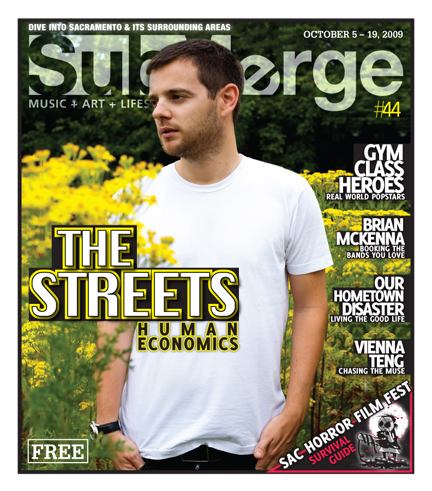

Mike Skinner Readies the Final Streets Album
Mike Skinner (aka The Streets) was apologetic when he called in a half-hour late for our interview. However, it wasn’t the vast time difference between us and the United Kingdom or a simple disregard for scheduling that contributed to his tardiness. Skinner was busy putting the finishing touches on his fifth and final Streets album, Computers and Blues, which will hit stores early 2010.
The new album may be pretty familiar to Streets fans by the time it’s released. Skinner had been releasing a majority of the songs via his Twitter account over the past year or so. But those songs were far from finished.
“They’re kind of works in progress,” Skinner explains. “I don’t want to say demos, but the way that I work, I’m constantly refining stuff. When the album comes out, there’s probably about two or three tracks that are the pretty much the same as the ones that I gave away. Most of the tracks are either completely new or heavily rewritten. In all cases, they sound a lot more polished.”
Skinner calls releasing the tracks in their formative stages to his fans “one of the most exciting things I’ve ever done as far as the recording side of my career.” He adds that the feedback he received on his songs influenced the course of Computers and Blues.
“In the past, when I used to make an album, [I’d] spend two years sitting in the studio—things going backward and forward and wondering if the stuff is finished or not,” Skinner says. “And then you feel like you’ve ironed everything out and you release it, and it’s not a shock, but it’s all new for the fans. You kind of have to get to know the fans again, in a way. Particularly with what I do, because every album is do different. But this time around”¦I’d work in the studio, and finish off the track, then come pub time, I get to 7 o’clock, and I just put the track on the Internet, and then go to the pub and have a drink and you can read all these comments from thousands and thousands of people.
“Sometimes, you don’t get so many comments and you realize it’s not the best thing you’ve done; and sometimes, you get this influx,” he says. “You can just tell when it works. It’s been like performing in front of an audience, to be honest; it’s like recording in front of an audience. I don’t think there’s many people who’ve really experienced that. It’s a new thing.”
The Streets may not have much more time in front of audiences, but fans in the United States should be happy to hear that Skinner’s upcoming tour, which hits the Boardwalk in Orangevale on Oct. 16, should be an intimate affair. Skinner says that he’s looking forward to playing smaller venues on this, perhaps The Streets’ penultimate tour of the States, and he’s hoping to give those in attendance a little extra.
“There’s a select few real sweet fans in America, and I think those people who really want to see The Streets who haven’t had the chance for years are really going to have a good time, because we’re going to try to hang out and get to know them and to do the whole Twitter thing,” he says. “Aside from the gigs, I think we’re going to try to have a lot of fun with the fans.”
Skinner’s brand of fun may cause havoc with traffic patterns, however.
“We’re going to try to get a road block going, our own tour bus road block—actually physically drive it into the road.”
I’d been reading your Twitter account, and you’re really active on there. That’s where you at least announced a lot of the tracks you were giving away. Did you have the idea to do this before you got active on Twitter?
No, it all just happened really fast, to be honest. What I was doing was kind of illegal really, because I’m signed to Warner, and I was kind of giving their music away, really, but they’ve been really great about it. There was definitely a gray area in the beginning of it, where it was like they could possibly fight this. I think if I’d done it in a different way, I think they wouldn’t have liked it; but I’ve caught the moment a little bit, and from their point of view, I got some great press out of it and created a bit of a buzz. I think no one would really say it wasn’t a good thing for the label.
Do you think it’s one of those things where they realized they had to do business in a different way in order to survive?
I think if it had been a different artist, they might have taken—like if it was Madonna or something like that—they would have been really worried. But because of the way I’ve always worked anyway, it just kind of fit. I do everything myself. It’s weird. When I first did it, it didn’t really feel that revolutionary, because I send tracks to the team, so physically it’s just same process, but all it really is you just send it to the fans as well.
It did cause a bit of a stir. I have to say I was quite surprised how big the story became in the media, but I’ve been using MP3s since I made the first album. I was using MP3s 10 years ago. So it’s not really revolutionary, is it?
If you’re looking at the blogosphere or whatever, and you’re looking at these remix-type artists who post music to Hype Machine, that’s a really cheaply made form of music. When you’re getting into like proper bands and proper big releases, everything starts costing a lot of money. Recording the band, mixing the band—mixing engineers start at two grand a day—making a song costs a hell of a lot of money. It doesn’t cost me money, because I do everything myself, and I’ve got all the gear, because I’ve spent hundreds of thousands over the years on a studio. Most other labels aren’t willing to do what I’ve done, mainly because it costs them so much”¦
When you came to the United States, you were billed as part of the U.K. garage scene. The thing that always interested me about it was that it seemed very DIY and very punk. Is that the mentality that the scene grew out of?
At the time, I wouldn’t have considered myself as a part of U.K. garage. But now, looking back on it, I know all those guys, and they all know me. My music was never played in the clubs. It was an album thing, really. It was a weird thing that happened: A lot of the DJs really liked it, but a lot of the kids just didn’t get into it. There was also this indie thing that was happening around the same time, so you wouldn’t really call me U.K. garage, really, but in the sense that it was made in the same way”¦
All U.K. dance music is essentially made by one or two people in a spare room in their house. You get to American rap music, and it all gets really organized, doesn’t it? There’s a lot that goes into it”¦ But if you look at something like Daft Punk, Daft Punk is Thomas Bangalter and Guy-Manuel in a room making some tunes. In that sense, I just came from that—dance music.
Playing off of what you just said, do you identify more with a hip-hop scene or an indie rock scene?
On the live side, I’m definitely part of the circuit of bands that go around touring. The bands we always run into are guitar bands, really. But when I get home, it’s more kind of grime, really. Grime is probably, if there’s a scene or a group of people that I’m on the level with, it’s grime, like Dizzee Rascal. Those are the people I tend to work with.
One of the newer tracks from you that I’ve heard is “Slow Songs,” which you did with the U.K. rapper Giggs. How did you come about working with him?
British rap music is very”¦black. We don’t have that sort of thing where you have Jay-Z and 50 Cent, where these guys are pop stars, because it’s not as well organized, because they haven’t been able to make the money. When you’re talking about Giggs, in terms of black music in the United Kingdom, Giggs is very famous in a very slim world. He’s perceived—and well, I can’t really comment—but he’s perceived to be a very serious gangster, and to be fair, he kind of is, to be honest. But I’ve spent quite a lot of time with him, and he’s really good fun. I worked up a song with him, and he’s signing to XL now.
One of the songs you released off the upcoming album, “He’s Behind You, He’s got Swine Flu,” I loved the video for it. I’m a big fan of zombie movies. I was wondering if you could talk a little about the song and video and what went into that.
We did that very quickly. The whole thing took about two or three days. We do a TV show called Big Stevie; the guy who edits that, I told him, “I want you to make this video.” I didn’t give him the song. I gave him the song two days later. He’d already done the interview and slotted them together. That was right in the middle of the swine flu stuff. It just felt like we had to do it very quickly if we were going to do it at all.
The song’s about paranoia over the swine flu”¦
Yeah, it’s a take on the panic and taking it to its nth degree. I’m really into economics and that point where human decision-making”¦you extrapolate deductions about human decision-making. If you look at economics, you realize how computer-like our thought processes are. We make decisions based on, “Is my friend likely to kill me? Therefore, I’ll kill him before he kills me.” If you put that in a song, it sounds harsh, but if you look at economics and the way people act, they do act in those logical ways.
Is that why you chose to use the word “computers” in the title of the new album?
The last album I did, Everything is Borrowed, the restriction I put on myself was not to reference modern life in any way. It ended up feeling quite spiritual, and I think people thought I’d discovered some sort of Darwinian god. But those were just the songs that had the power. If you remove day-to-day life, these objects, technology and things like that, you end up with fishes and water and the sea and the sky, and you end up sounding like The Bible. With this album, the idea was to go in the opposite direction of that and say, “OK, now I want to see into the future.” But the songs ended up sounding more like my first album, in a way. There are elements of the futuristic stuff, but those ended up being noncommittal.
You said you wanted the album to sound like the city of Berlin. What was it about Berlin that made you go in that direction?
I was thinking about how Germany pioneered electronic music, really—that kind of Bauhuas thing and that functional design. It was like the Joy Division, you know? Joy Division weren’t German, but those guys felt quite German in a way.
I’d read that this is going to be your final Streets album. Are you going to hold true to that?
Yeah, fully, yeah. Every album I’ve done has been a big sharp turn. Genuinely feeling like you’re doing something you’ve never done before, I think you have to try to have that in music. It shocks me how much music is made and music is performed to a business model, really. I think live music is pretty—a lot of it is about money, really. I like money, too, but I think it’s more exciting, it attracts people more if you’re doing something that hopefully no one, but at least you’ve never done before.
Are you looking to stay in music once the Streets is over?
I don’t really know. I’ve been doing quite a lot of production stuff that I really enjoy, and I also want to write a film. Whatever I do, you’ll know about it, because I’ll be trying to promote it in some way.
You talked about Big Stevie before, and your Myspace page said you were working on a short film version of that”¦
Yeah, that’s what I was talking about, really. We were going to do a short film, but we’ve done so much Big Stevie stuff, and you’d be surprised how much we put into the structure of it. To do a short film, it feels like we’ve already done—I know this would be more fictional—but we’ve already been doing short films for years.