We can’t get enough of Andy Warhol. The artist has been dead for 30 years, yet he transcends genres and generations.
Warhol was ahead of his time in recording, collecting and marketing his work and stories of himself. He photographed everything and audio-recorded thousands of hours of himself speaking. Some of Warhol’s most famous pieces of art are traveling worldwide alongside the art of Chinese artist and political activist Ai Weiwei. At the same time, Sacramento residents are filming selfie screen tests just like Warhol did in the ‘60s at the Crocker Art Museum.
The Warhol brand is like an international fashion house—it remains relevant through movies, books, clothes and even greeting cards and perfumes.
“He is one of the most fascinating public and creative figures of the latter half of the 20th century,” says Crocker curator Diana Daniels. “People are intrigued because his influence was so wide-ranging. For more than 30 years, Warhol was connected to the most creative individuals in America and from abroad, who wanted to be connected to him. This means that his influence is felt not only in visual art but in design, fashion and music, particularly New York’s rock scene, from The Velvet Underground to David Bowie.”
In the last eight years, predictions Warhol made decades ago about our society have also become more prominent, as we spend our days publicly living and creating on social media.
“He predicted things like Instagram and Twitter,” says public relations associate Elena Macaluso on a bright Friday afternoon at the Crocker, walking into the Andy Warhol: Portraits exhibition.
Portraits offers a biographical Warhol experience and smartly weaves in social and political commentary that was as relevant to Warhol’s study of celebrities, politicians and the rich in the ‘60s–80s as it is today.
One of the coolest aspects of the exhibit is Warhol’s Silver Factory, which has come back to life from east 47th Street in Midtown Manhattan to the third floor of the Crocker. The Silver Factory is where, from 1962-‘68 (and in later years at other locations), Warhol welcomed celebrities, drag queens, musicians, transsexuals and artists to partake in his creations, leave behind any judgment and sleep off methamphetamine, a popular drug during that period.
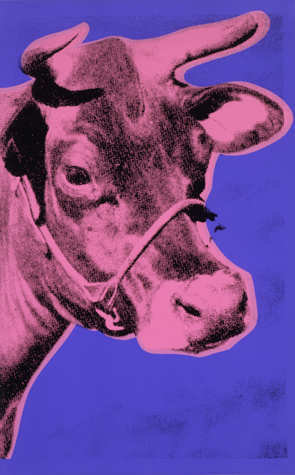 {Andy Warhol, Cow, 1976. Screen print on wallpaper. 45 1/8 X 29 1/2 in. Collection of The Andy Warhol Museum, Pittsburgh. © 2016 The Andy Warhol Foundation for the Visual Arts, Inc. / Artists Rights Society (ARS), New York.}
Warhol used the Factory, which was covered in aluminum and silver paint, to create his famous silkscreen portraits, movies and other works. He’s been quoted as saying that those who hung out in the Factory were not there to hang around him, but that he was there to “hang around with all of them.”
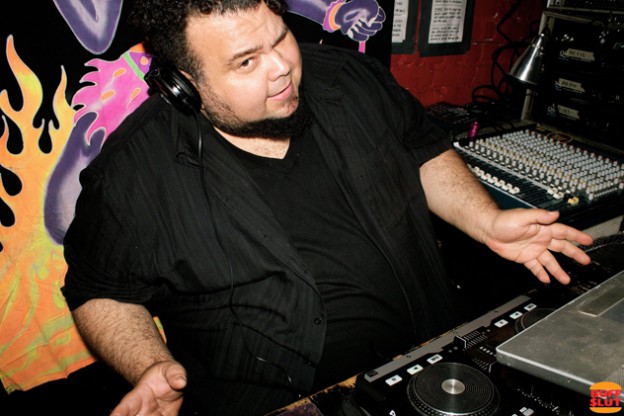
To recreate the Silver Factory, Crocker Manager of Museum Learning Melissa Sais began researching and conceptualizing more than a year ago. Late last year, she hired set designer Jarrod Bodensteiner of the Sacramento Theatre Company to construct the space, and DJ Larry Rodriguez, who spins Saturdays and Sundays at The Press Club, to create the soundtrack.
“We based the design on historic images but had to work within the constraints of the museum room,” Sais says, pointing out the faux walls that cover up the otherwise floor-to-ceiling windows on the third floor, and the fabricated pipes and window fans.
With 20 cans of spray paint, four rolls of industrial aluminum foil and one red sofa, Sais and her team had a complementary interactive exhibit to the portraits of Warhol’s friends who once hung out in the Silver Factory.
“The Crocker’s interactives are meant to add a dimension of educational play and other sensory experience to the history of art,” Daniels adds. “For this exhibition, Warhol’s Silver Factory was the most inspiring aspect for this type of exploration because this is exactly what Warhol did—he invented a space where the usual rules didn’t apply, removing conventions that were obstacles to the play creative types require.”
Daniels says that for young people, Warhol is history and the cultural references to him are new terrain, so “to see that someone covered an entire space in aluminum foil as a form of expression and a changing of ‘the rules’ is something to be experienced.”
For those who lived to see Warhol’s impact on the world in real time and those who studied him after, the Polaroids and funky portraits in life size—often 40 x 40 or larger—are mesmerizing.
Sais’ favorite is the Dolly Parton photo, “because I always thought she was so pretty.”
For Daniels, it’s the three Jackies from 1964, “art historically important and tremendously profound regarding the change in American culture that President Kennedy’s assassination catalyzed.”
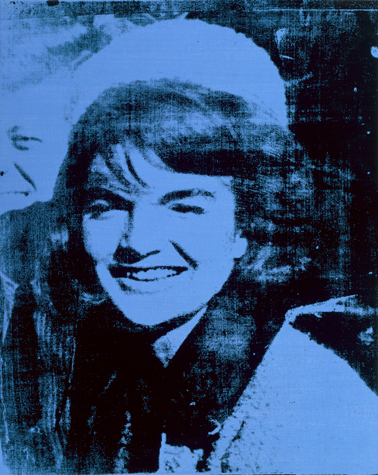 {Andy Warhol, Jackie, 1964. Acrylic and silkscreen ink on linen, 20 x 16 in. Collection of The Andy Warhol Museum, Pittsburgh. © 2016 The Andy Warhol Foundation for the Visual Arts, Inc. / Artists Rights Society (ARS), New York.}
She also loves Nine Heads of Japanese Corporations as clever, yet understated social observation and commentary, and Warhol’s enormous Self-Portrait in Blue, which he painted nine months before his death.
“For intellectual and personal reasons, this for me, is such a vivid encounter with the art, myth and legacy of Andy Warhol,” Daniels says.
Pieces like the self-portrait, which is used in the marketing for the current exhibition, commonly pop up in Warhol Google searches, but standing in front of a two-story face doesn’t compare.
“High quality electronic displays do a tremendous job of providing information about a work of art,” Daniels says. “The introduction to a work can enhance the encounter with the real object by making it more familiar—the mere-exposure effect in psychology. But all photographs and electronic displays have a flattening effect in what they convey about an art object. Also, just like people, art can or cannot be photogenic. Often times my gut reaction to art viewed on the computer screen fails in comparison to the actual object.”
Another standout piece in the exhibition is one of Warhol’s nearly 100 variations of Leonardo da Vinci’s The Last Supper, in which a gym advertisement with a generic bodybuilder and the line, “Be a Somebody with a Body,” is followed by giant repetitive images of Jesus’ face from The Last Supper.
Finally, a fun claim for California to the Warhol party is the tiny signed photo of a young Arnold Schwarzenegger.
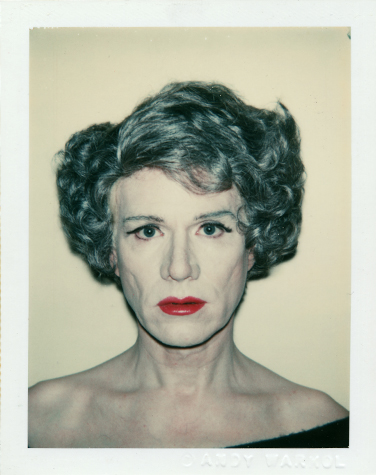 {Andy Warhol, Self-Portrait in Drag, 1980. Facsimile of original Polaroid™ Polacolor 2, 4 1/4 x 3 3/8 in. Collection of The Andy Warhol Museum, Pittsburgh. © 2016 The Andy Warhol Foundation for the Visual Arts, Inc. / Artists Rights Society (ARS), New York.}
“In August 1977, Schwarzenegger was not yet a movie star and in no way a political prospect,” Daniels says about the photo. “But, he wanted to be someone and chose body building as his way to the perfect body, which was his means to becoming someone special, i.e., famous. Regarding having the best body in the world, he actually stated in an interview: ‘It means that I’m somebody special.’ This makes him exactly the type of aspirational personality that wanted a Warhol portrait because a Warhol portrait shouted to the world, ‘I’m somebody special.’”
Were Warhol alive today, he would likely have a never-ending list of clients, and undoubtedly would have found a way to miniaturize his portraits perfectly for that square space on our Instagram feeds.
Create your own Warhol-style portrait or screen test while experiencing the artist’s life and work through Andy Warhol: Portraits at the Crocker through June 19, 2016.
The Crocker Art Museum is located at 216 O Street in Sacramento. Museum hours are 10 a.m.–5 p.m., Tuesday–Sunday (open till 9 p.m. on Thursdays). General admission tickets are $10 for adults, $8 for seniors, college students and military, $5 for youth (aged 7–17) and free for children 6 and under. For more info or to purchase tickets go to Crockerartmuseum.org.
It’s time to say goodbye to 2015. From rock concerts, to dance parties, to comedy shows and everything in between, here is your ultimate guide to Sacramento-area New Year’s Eve parties! Have fun, be safe and please don’t drink and drive.
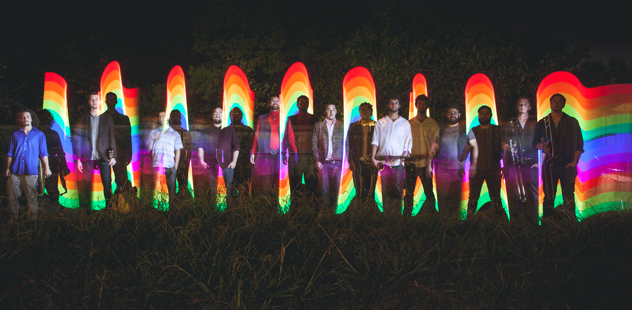
1) If you’re looking for a funky dance party head to Torch Club and get down with two fantastic local bands: IdeaTeam (featuring Aquifer) and Black Star Safari. Cover charge is $25, 9 p.m., 21-plus. Torchclub.net for more info.
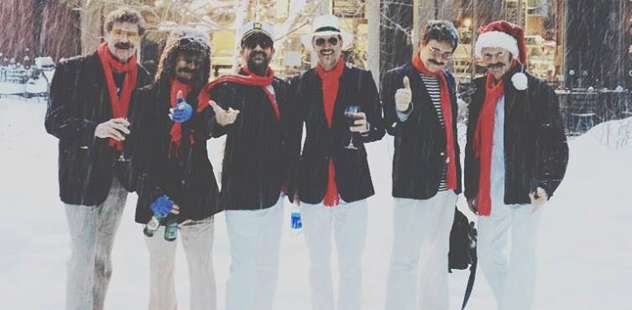
2) Enjoy a soft rock explosion at Harlow’s with Mustache Harbor. Tickets are $30 in advance, doors open at 9 p.m., 21-plus. Hit up Harlows.com for a link to buy tickets.
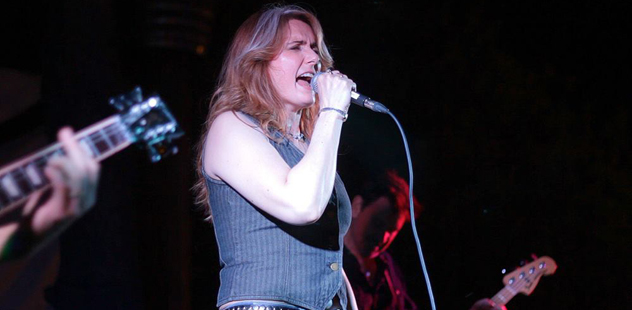
3) Sing along to your favorite hard rock hits with Radio Heavy at our favorite downtown Roseville watering hole, Bar 101. This party is free and 21-and-over, with a 9:30 p.m. start time. Bar101roseville.com for more info.
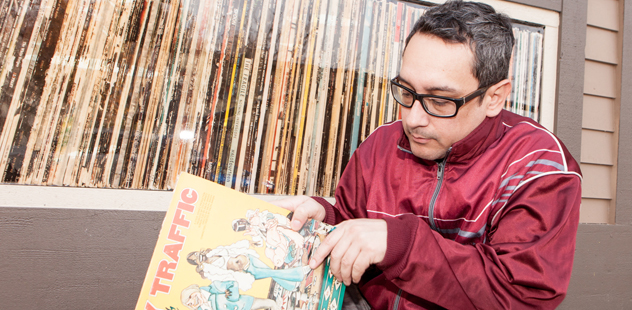
4) Groove to late ‘80s and early ‘90s hip-hop, hip-house, and R&B at “New Jack Fling” at Press Club, brought to you by DJs Crook (featured in our current issue), BenJohnson and Satapana. $7 cover, 21-plus, 9 p.m.
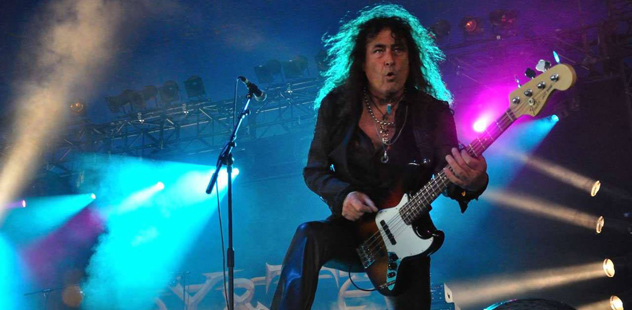
5) Ace of Spades wants to party hard with you on NYE when they host legendary heavy metal band Y&T, with opening sets by locals Skin of Saints, ONOFF and Roswell. Tickets are $35 in advance, available at Aceofspadessac.com. 7 p.m. doors. This show is all-ages!

6) The newest dive bar on the grid B-Side invites you to check out their digs and get down to sounds by DJ Whores and friends. No cover, 21-plus. Search for “B-Side” on Facebook for more info.
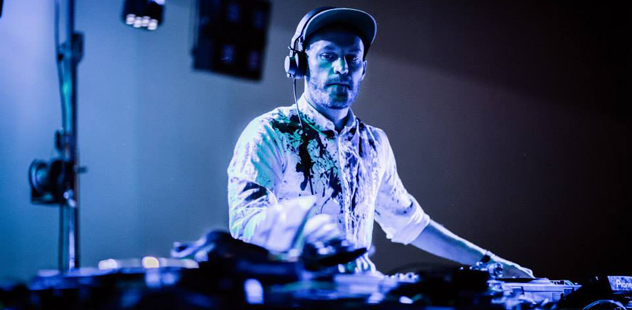
7) We here at Submerge are teaming up with the Lipstick crew for an epic NYE dance party at Old Ironsides featuring live music from local dreamy/synth-y pop group The Good Fortune, as well as DJ sets by Shaun Slaughter, Roger Carpio and Adam Jay. 9 p.m., 21-plus. $8 advance tickets available at Cuffs.
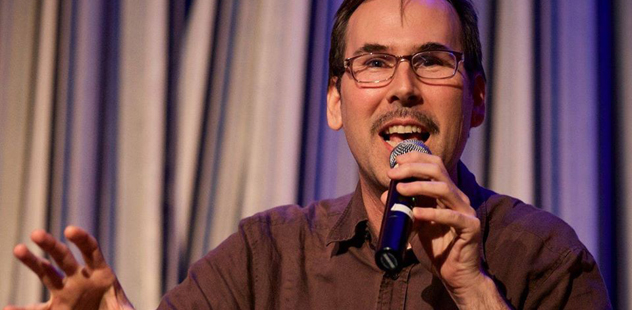
8) Laugh away the new year at Punchline Sacramento during “2015’s Last Laughs” featuring sets by Ngaio Bealum, Keith Lowell Jensen and many other local faves. Two shows: 7:30 p.m. ($20) and 10 p.m. ($25). 18-and-over. Punchlinesac.com for more info.
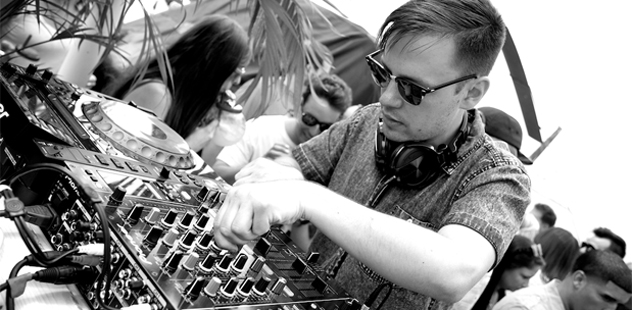
9) Blackbird recently re-opened and they’re throwing a party this NYE co-presented by Rue 27, THIS Midtown and 1810 Gallery featuring live tunes by nu-disco act Figgy, and a DJ set from Sacto faves Sister Crayon. 7:30 p.m., $40 per person, $75 for VIP upgrade. Studio53.eventbrite.com for more.
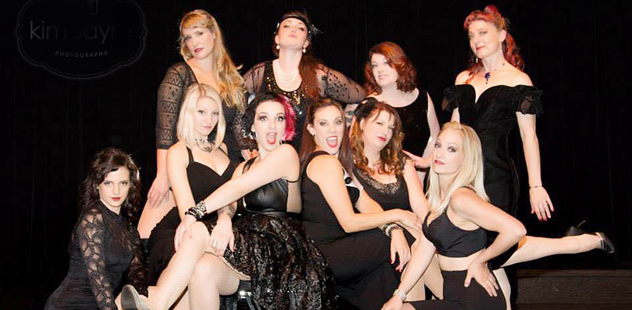
10) Visit historic Grass Valley for Center for the Arts’ “Laughs, Lolo and Legs” party featuring comedy from Katie Rubin, neo vintage jazz pop music of Lolo Gervais, burlesque from the Bow-Tie Beauties, DJ dance party hosted by Jamal Walker and more! 8 p.m. doors, tickets start at $22. Hit up Thecenterforthearts.org for advanced tickets.
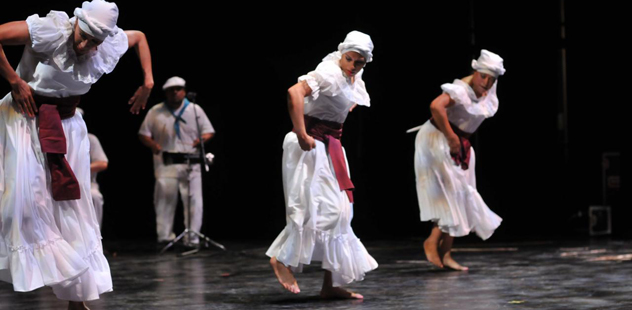
11) For a family-friendly daytime celebration that everyone can stay awake for, head to Crocker Art Museum’s “Noon Year’s Eve” event, which is free for all ages and runs from 10 a.m.–5 p.m. Performances from Germar the Magician, Ebo Okokan, Ohana Dance Group and many more.

12) Enjoy some amazing homegrown talent at Crest Theatre when Jackie Greene and his band perform a special NYE concert! Doors open at 8:30 p.m. and tickets start at $35 in advance.
13) The kind folks over at Blue Lamp are throwing a free NYE bash featuring great music, plenty of booze, good company and a champagne toast at midnight. 9 p.m. start time, 21-plus, no cover.
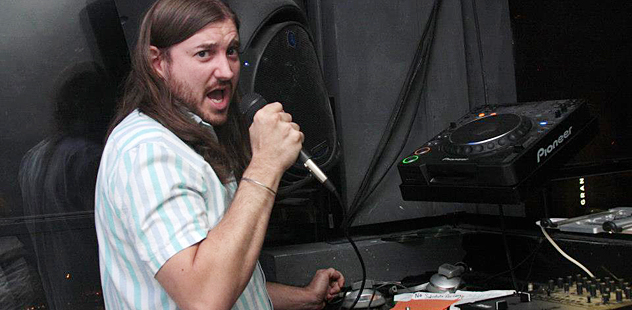
14) Groove to some soul, funk, disco, reggae, latin and more from a few of Sacto’s best selectors at Fox & Goose. DJs Larry Rodriguez, MC Ham and Wokstar will be spinning all night! $10 cover, 21-and-up, 9 p.m.

15) Bundle up and head up the hill for three days of SnowGlobe (Dec. 29–31) in South Lake Tahoe featuring headliners like Jack Ü (aka Skrillex and Diplo), Kaskade, Dillon Francis, Run the Jewels, E-40 and many more. All-ages event. Check out Snowglobemusicfestival.com for details.
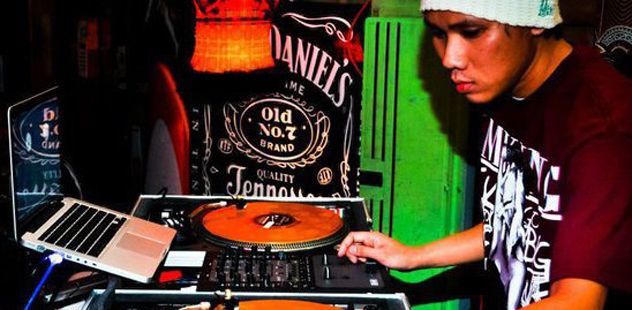
16) NOW 100.5 FM and MIX 96 are throwing a masquerade party for the ages at the Hyatt Regency Sacramento featuring cover band and headliner Apple Z, plus DJ Rated R, Quinn Hedges and Ryan Hernandez. $75 in advance for general admission, 9 p.m. start time, 21-plus.
If you’ve yet to attend one of Crocker Art Museum’s infamous Art Mix events, this Thursday, Dec. 10, 2015, would be a great place to start. The lineup is absolutely stacked, and we’re predicting it’ll be one of the best ones yet. In true Art Mix fashion, “Revolution” will smash together the worlds of music, art, comedy, film, performance, food, drink and more! Crocker wants you to, “Overthrow 2015 with a bash, a bang and a blast.” Expect great tunes from Lonely Bulls and DJ Larry Rodriguez (aka Flower Vato). Stand-up comedy will be provided by Keith Lowell Jensen and Johnny Taylor. Other community groups involved include American River College Electronics Program, Bobby Edwards’ Transnational Art Project, Isabella Corsetry, Sacramento Young Feminist Alliance, Boomcase, Sacramento Natural Food Co-op, Burly Beverages and many others. Don’t forget to check out the incredible exhibit Divine Ammunition: The Sculpture of Al Farrow, which you might have read about in our last issue. Art Mix runs from 5 p.m. to 9 p.m. and has been designed for adults. Crocker members get in free, general admission is $10 for adults and $8 for college students. Learn more at Crockerartmuseum.org or Facebook.com/crockerart
Weapons of Mass Instruction
Due to the subject matter of this story, during my research I couldn’t help but Google places that have recently endured mass violence.
After three obvious locations—Douma, Syria (at least 250 reported killed Nov. 4); Beirut (43 reported killed Nov. 12); and Paris (129 reported killed Nov. 13)—I nearly stopped.
I also checked local news, though nothing at such scale happened on this particular day. The daily violence involving weapons that did occur, as far as I could tell, was upsetting but unrelated to religious extremism.
This last factor is important in the context of my interview with artist Al Farrow, whose collection, Divine Ammunition: The Sculpture of Al Farrow, graces the Crocker Art Museum through Jan. 3, 2016.
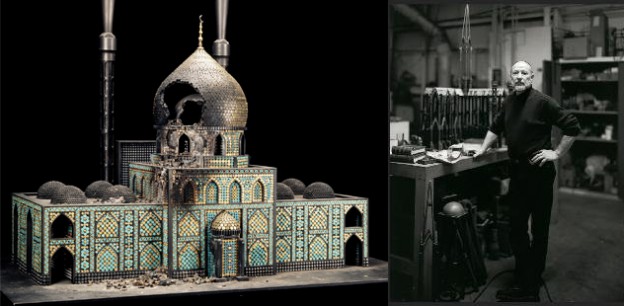
Farrow uses guns and ammunition to create miniature cathedrals, mausoleums, mosques, reliquaries and synagogues. Colorful copper, brass and steel bullets line entrances to sacred spaces, shape domes and create buttresses and minarets in a beautiful but disturbing way. Farrow is a social commentator, and through these pieces, he expresses what he sees as the hypocrisy and dissolution of true religion.
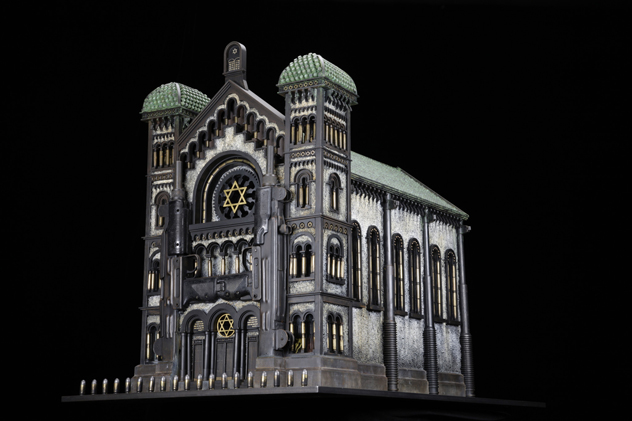
{Synagogue V | 31.5 h x 26 w x 42.5 d inches | 2012 | Guns, gun parts, steel, bullets, shell casings, lead shot, glass}
“Everyone sends out their soldiers with blessings, and says God is on their side,” he says. “They give the last rites to their dying. But they don’t prevent them from going out and killing or getting killed. Religion is not preventing what it’s supposed to.”
Farrow grew up in a secular, nonpracticing Jewish household. He says he has noticed the United States has changed from his childhood to today, but his commentary through his art since he began this body of work 15 years ago, has not changed.
“It hasn’t changed at all, since the problems that existed then are still here now, even if they may manifest in Paris instead of New York,” he says. “The idea of war and religion hasn’t shifted at all. When I was a young person, religion wasn’t playing as much of a role in American life, it was more secular.”
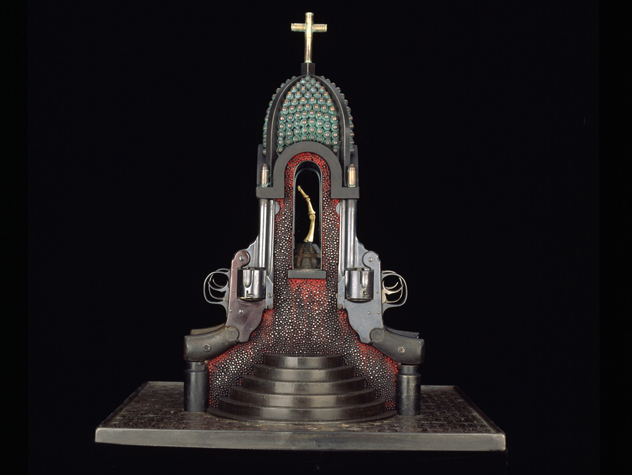
{Trigger Finger of Santo Guerro (VIII) | 19 h x 16 w x 16 d inches | 2007 | Guns gun parts, bullets, Shell casings, steel, glass, bone, crucifix}
“There has been a real expansion of fundamentalism in all major religions,” he says. “Evangelicals, Jews, Catholics, Muslims—it’s only a handful [from all religions] who are messing it up for the many.”
The 72-year-old architecture-trained artist says he doesn’t have a goal for his art, but a point of view that there “is a relationship to think about” between violence and religion.
“Would people fight over economics and kill each other?” he says. “Somehow religion goes so deep into the human psyche. My hope is that those who see my art will think about this and think, ‘I don’t have to listen to this.’ I hope I can lead them to finding those hypocrisies.”
Farrow started this body of work 15 years ago based off his first experience seeing reliquaries, some containing human bones, in the crypt of the basilica of San Lorenzo in Florence, Italy. He invented his own saint, Santo Guerro, the Saint of War, and chose bones and weaponry as the ironic materials for his social critique.
Farrow explained that “guerro” is not a real word, but a play on the word for war. He noticed in romance languages that “war” is a feminine word, so he masculinized it.
“I didn’t want to insult anyone else so I needed to make up my own saint and it had to be meaningful,” he says of the creation, whose relics lie within Farrow’s Catholic sculptures.
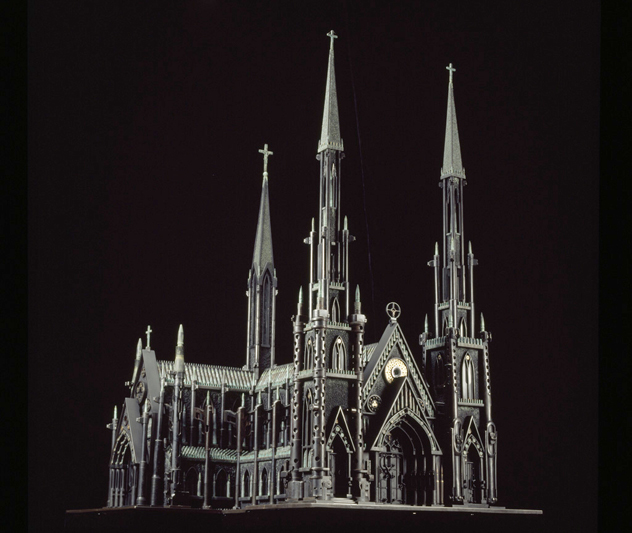
{Cathedral: The Spine and Tooth of Santo Guerro | 64 h x 50.5 w x 74 d inches | 2007 |
Bullets, guns, glass, shot, steel, bone, antique textile}
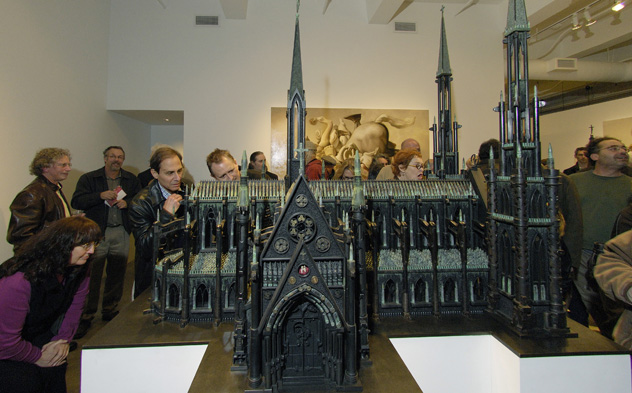
A gothic cathedral at the back of the exhibit, for example, steals the show. Known as The Spine and Tooth of Santa Guerro, Farrow used more than 200 guns and thousands of bullets to build the 1,200-pound sculpture. Its finishing touch is Santo Guerro’s gold tooth.
Farrow later evolved to include other major religions (he said he will eventually incorporate Buddhism), but because they do not have a history of relics, he found other equally meaningful objects.
Inside his synagogues he places Torah covers with the Ten Commandments, making sure the first Commandment, thou shalt not kill, is clearly visible. His synagogues always include Uzi parts, because, he says, “It’s an Israeli gun and I want to make that hypocrisy obvious.”
Farrow notes he has chosen not to place symbolic objects inside his mosque sculptures.
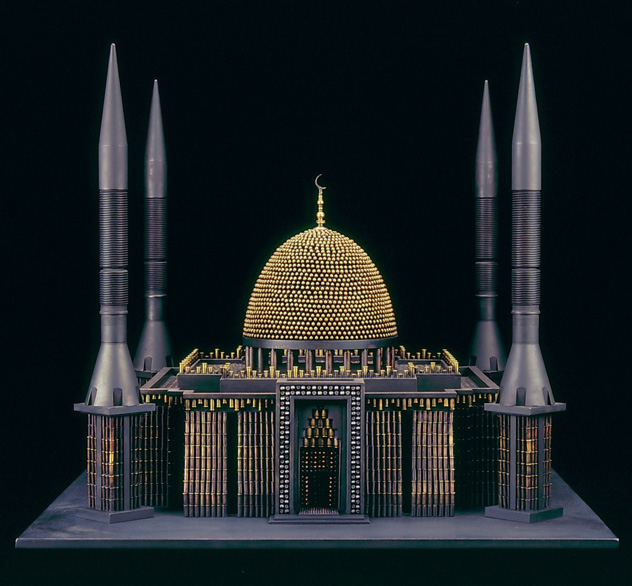
{Mosque III (after National Mosque of Nigeria) | 25 h x 29 w x 31 d inches | 2010 | Tank killer missiles, bullets, brass, steel, trigger}
“It’s not that I am afraid, but what I consider approaching with respect,” he says. “It’s in the eye of the beholder and I trust that.”
The changes Farrow has noticed after years of buying, dismantling and reimagining weapons of destruction, are in himself.
“Because I was not a shooter and raised around guns, it had no presence in my life,” he says of first starting out with his concept. “I was at a complete loss as a way to communicate.”
Farrow started attending gun shows and admits to having preconceived notions when first approaching.
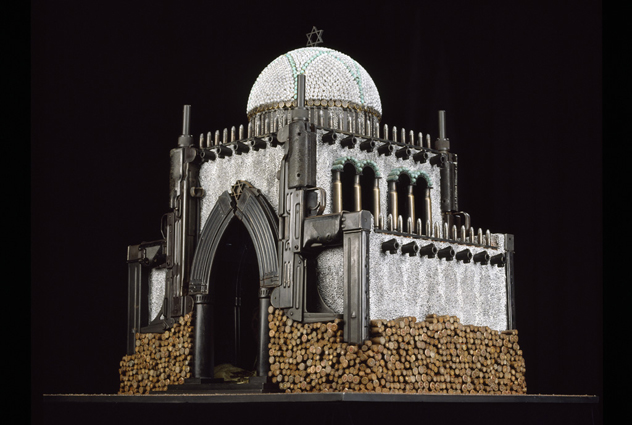
{Synagogue (I) | 32 h x 36.5 w x 27.5 d inches | 2005 | Guns, bullets, shot, steel, antique torah cover, glass}
“I am a social commentary artist and anti-war,” he says. “I entered that world with prejudices. I have learned a lot and evolved around the world of guns. I have since learned that the gun world is not just a bunch of violent yahoos. For example, there are collectors and the world of gun collecting is no different than the world of art collecting. They use the same criteria, for example—quality, rarity and prominence.”
Farrow also learned more about the culture around hunting, and the use of guns for law enforcement and protection in a business setting. Despite these more realistic uses, Farrow says he is still adamantly against civilians having assault weapons, and in his ideal world, guns would not be needed.
“I keep telling my wife, I wish they would put me out of business,” he laughs. “That would be the best thing that ever came out of this.”
For now, second best is the conversations he has been able to start through these sculptures.
“It’s intended to disturb to a degree and in that sense, it’s been successful,” he says of the collection. “It gets people into a place where they feel the need to communicate with each other. You can see masterpieces in places all over the world and people will see them in silence and just look for a few seconds.”
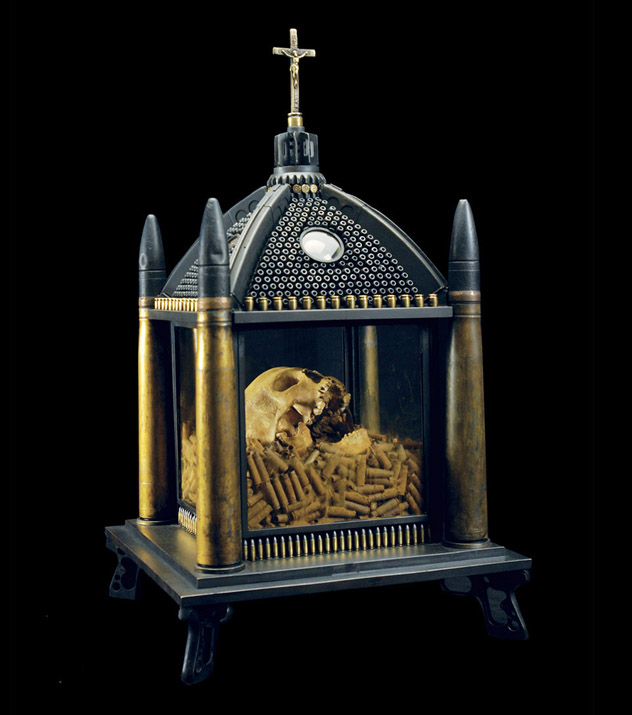
{Skull of Santo Guerro (II) | 32 h x 18 w x 18 d inches | 2011 | Artillery shells, bullets, shell casings, gun parts, steel, glass, crucifix, skull, glass lenses}
Divine Ammunition: The Sculpture of Al Farrow is on display through Jan. 3, 2016 at the Crocker Art Museum, located at 216 O Street. For more information, go to Crockerartmuseum.org. For more information on Al Farrow and to see his full Reliquaries collection, visit Alfarrow.com.
Visceral Sound Creation
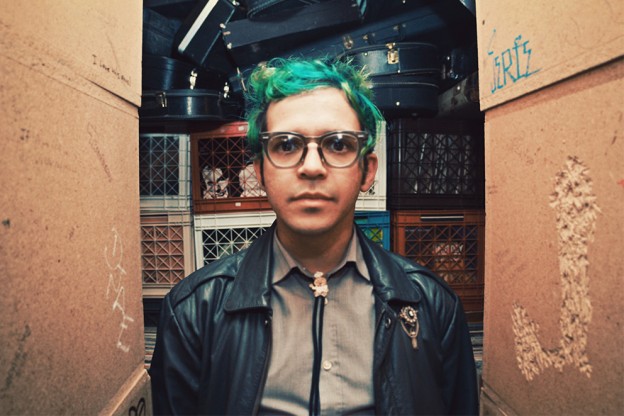
While most teenagers in the ’90s were navigating their way through the precarious world of acne, young love and algebra, Andrew Southard—also known as Young Aundee—was honing his skills as a musician and launching his career as an electronic, hip-hop and trip-hop beat maker while learning to master the melodica, a harmonica with a blow tube, but more on that later.
With a calendar full of DJing gigs, including a slot at Submerge’s upcoming 200th issue party, and a new four-song EP release titled Caveat Emptor that features two vocal tracks and two heavily layered instrumental cuts, Young Aundee is hitting the local music scene hard this year.
“The first song ‘Amazing Grace’ is a beat that Dusty Brown had since 2007. We made some modifications to it,” he explains. “There’s no [specific] concept to it, but the name caveat emptor is a sales term that means let the buyer beware, so I thought it would be kind of applicable, like when you apply yourself to art and music you kind of have to take whatever discomforts come with the bad and the good.”
As he approaches his second decade of making music, the performer has amassed a catalog of music that ranges from punk rock to hip-hop, but says his journey as a singer and performer is still ongoing as he continues to cultivate his talents.
“In the more live, songwriting atmosphere, I’m still coming into my own,” he admits. “Self-consciousness is still a problem for me, so when I do feel like I connect [to the audience] it means a lot to me. I guess ultimately that’s what I’m trying to do is connect.”
Making connections is a language that Young Aundee speaks fluently—he’s played with local and national acts ranging from Sister Crayon to witch house maestro oOoOO, and maintains a long-running musical partnership with Sacramento electronic impresario Dusty Brown. As he gears up to bring his latest project to life, Halftone Society Rhythm Section—a musical alliance he formed with producer Benji Illgen who performs under the name Mophono—Young Aundee says that the act will be a clandestine event shrouded in ambiguity.
“It’s a collaboration between a bunch of different musicians in the San Francisco jazz scene and also a couple in the beat music scene,” he explains. “Mophono [is] trying to keep it as elusive as possible, you’ll never know what it’s actually [all about] until you go to the show.”
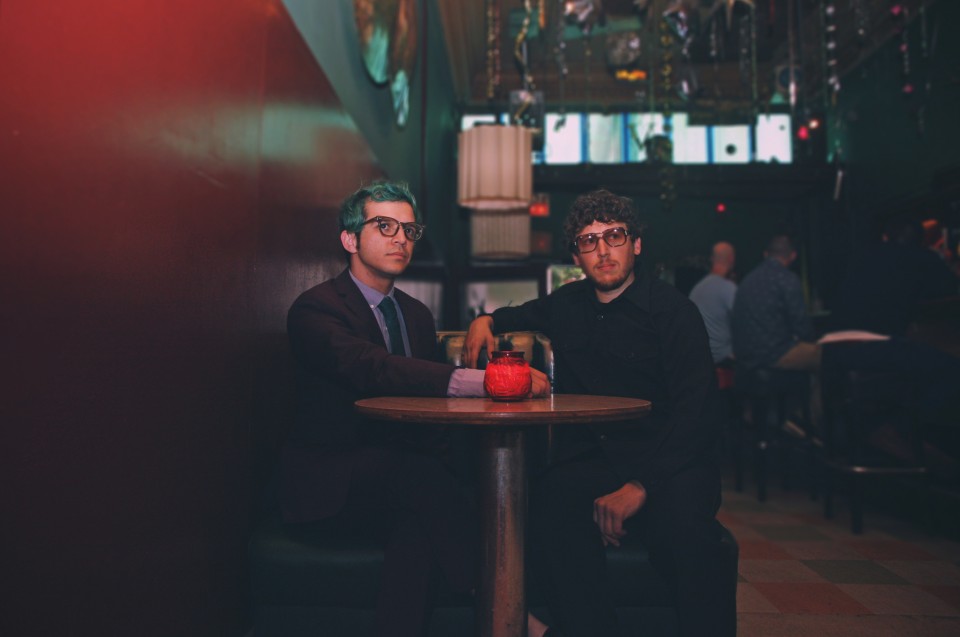
{Young Aundee with Mophono / Photo by Jen Wong}
A Young Aundee performance is both heterogeneous and unpredictable—drawing from his eclectic range of musical interests, his mood-drenched lyrical style combines genuine openness with raw, unapologetic observations of the world around us. Layered over a menagerie of twittering synths and methodical beats, his music is a reflection of the diversity that directs his musical compass, coalescing in a sonic wave that is both hauntingly beautiful and straight-up ear candy.
“The first band I ever played in, I was a keyboard player and it was kind of a Cure, pop thing,” he recalls. “I loved the feeling that we were creating something that was our own, as simple as that sounds, it’s true.”
When he isn’t constructing beats with Brown or tackling the logistics for the Halftone Society Rhythm Section album release party set for the end of the year, Young Aundee also throws down with the hip-hop group Who Cares. In fact, it was through his association with this act that Young Aundee established one of his favorite collaborations, with the ’80s Los Angeles dance scene legend Egyptian Lover.
“My very first show with Who Cares was in 2005 at the Mezzanine in San Francisco. It was the first time we ever performed a song called ‘Space Love,’ which is kind of on that freestyle, Debbie Deb, Shannon kind of shit, and the chorus in that song is straight-up like an ’80s radio song,” he recalls. “So he heard that, and ever since then we’ve kind of been on his radar. We approached him to collaborate on a track and he was available and was actually excited about the idea. To say that I worked with a dude that created a sound, especially on the West Coast, is a big deal to me.”
Creating sounds is Young Aundee’s jam—the soundscapes he constructs, whether performing live with Who Cares or standing behind his laptop churning out beat-drenched grooves at events like this week’s ArtMix at the Crocker Art Museum, draw from his wide-ranging musical pursuits, including the melodica.
“I started playing the melodica because of my connection to dub reggae music; it was made famous by a guy called Augustus Pablo in the ’70s,” he says. “I started playing it in my first band called Secret Six. We were like Bad Brains and Operation Ivy, that punk-reggae, but not the Sublime kind. Yeah, I call that Beach Hut Deli shit, they always have the Pandora station on Slightly Stoopid and Pepper, and all that horrible shit. I can’t stand it. You have to smoke dabs to feel that shit, the highly concentrated shit.”
And while he’s been making music since the days when he recorded original tunes on his four-track recorder at 14, Young Aundee says that his sound has evolved organically through the use of technology, but also as a result of his close relationships with his trusted production team.
“The dudes I work with predominantly are Dusty Brown and Benji, who are like two of the most underrated electronic music producers in Northern California,” he says. “I’m super lucky and blessed to be able to work with them on a regular basis.”
“I usually work with a lyricist, but I also write my own stuff out of necessity,” he continues. “I’m more of a singer and a part maker before I am a lyricist. I’ve worked with one of my best friends since I was in high school, his name is Jeremy Dawson and he collaborates with me on probably 70 percent of the lyrical content.”
The word visceral gets thrown around a lot around these days, but from Young Aundee’s purgative debut album, 2013’s Fear in the Fold, to his latest exploits with Halftone Society Rhythm Section, the singer-lyricist-beat maker says that it is because of those guttural, agonizing experiences that creativity emerges from the dark recesses of the spirit, both in and out of the studio.
“That’s what David Sedaris’ books are like for me, they make you laugh [but] they also kind of make your heart drop,” he explains “A lot of comedy does that for me; a lot of comedians are deeply disturbed, depressed individuals, that’s why that shit comes naturally to them.”
With Caveat Emptor hitting the streets and a full-length album he hopes to release in 2016, Young Aundee is hitting his musical stride. But it is his dedication to the exuberant exploration of the sonic world through bold experimentations and by taking risks that belie his quiet demeanor and allows him to draw in and connect with the crowd.
“Music is pretty transient, so it’s super rewarding to connect with an audience,” he says. “I don’t call myself a DJ but I think that’s the language people can adapt to more than the original music thing, so I’ll take it as it comes.”
Catch a Young Aundee DJ set for free Sunday, Nov. 15, 2015, as part of the Submerge 200th Issue Party at LowBrau, located at 1050 20th Street. The event will also feature live performances by Contra, Sunmonks, DLRN and Joseph In the Well. The party is free, 21-and-over, and begins at 5 p.m.
California Classics
Visitors who want to get as much out of the David Ligare exhibit at the Crocker Art Museum as possible may want to approach the artist’s pieces with a notebook and possibly a Greco-Roman history book in hand.
It’s easy to float through the exhibit mesmerized by the 70-year-old Classicist’s beautiful symmetry, seascapes and elegance. His home on California’s Central Coast and his travels of the Mediterranean have inspired some of the most beautiful watercolors and oil paintings of the balance of water and land to depict life and death, chaos and calm, shadows and light, that you leave feeling serene. But that’s not all that Ligare wishes—of art lovers or of humans in general.
He sees his work as a “social project,” a push for the viewer to dig deeper into the Greco-Roman stories, landscapes, architecture and mythology from which he finds inspiration, and see how to apply this knowledge to modern life the way he offers modern narratives and twists.
Those serene images of white drapes flying above the Pacific? They are inspired by the alabaster Greek statues that have long lost their limbs and heads and of which only draped clothing remains.
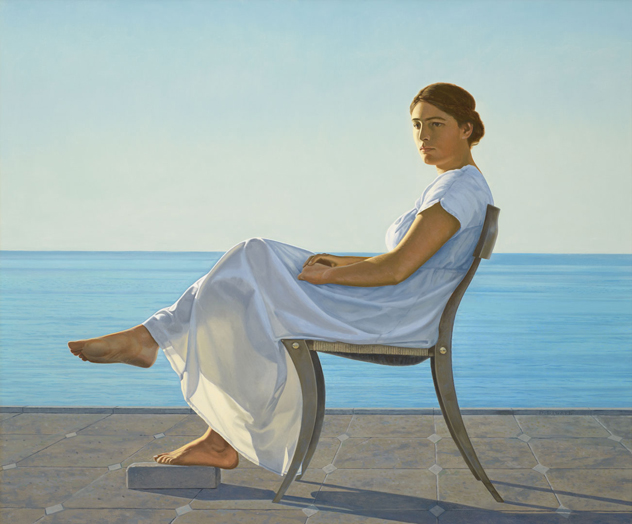
{Penelope, 1980 | oil on canvas, 40 x 48 in.}
“It is often said that art should reflect our time, but it can reflect other times, and we can learn from history,” he explains. “When I began making narrative paintings I didn’t know anything about Classicism at all. I didn’t know these stories or myths, so I just started reading. It was just wonderful to do. It was so incredible to be completely submersed in these ideas that are so rich and so surprising.”
Ligare read the great philosophers of that ancient time and was amazed with the depth of knowledge they and others discovered, whether it was being able to measure the distance to places in the solar system or setting up a democracy.
“It’s the fact that somebody like Lucretius could understand that we are made up of atoms, and we’re talking about first century B.C. there,” he exclaims. “It’s just a crazy idea somebody would have without all the microscopes and modern technology. They were measuring the distance to the moon and the circumference of the Earth. And it wasn’t just ancient Greeks and Romans but other ancient societies like the Egyptians. They were inspired to think, and maybe that’s the key right there—inspiration. Any group of people, no matter what ethnicity or location, has the potential for doing really extraordinary things. It could be fifth century Athens or 15th century Florence,” but he notes that there was leadership that inspired thinking.
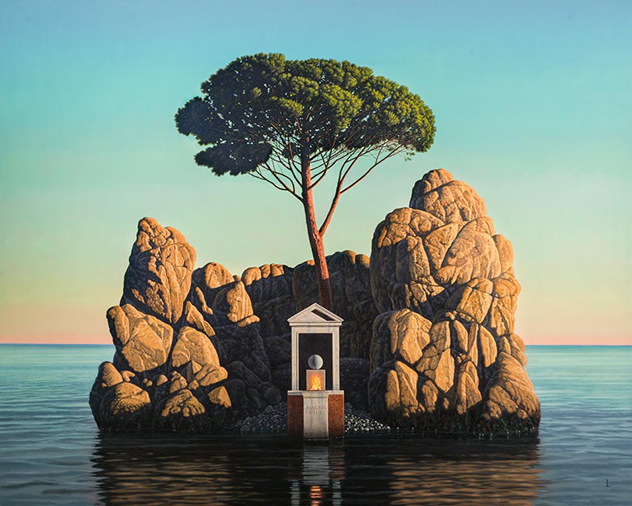
{Magna Fide, (The-Great-Belief), 2014 | oil on canvas, 60 x 80 in.}
Ligare doesn’t necessarily call himself a leader, but his belief that the central purpose of art is to inspire does then call on artists to lead in some way. He also specifically believes that the function of art and culture is to fulfill a social need, and viewers will realize that his art fulfills that need by depicting equality, the struggles of the homeless and the sick and the ideal that all things and beings can live harmoniously together.
“There’s a passion for knowledge we don’t really have right now and I would like to see that, to inspire people to want to learn, about everything,” Ligare says.
Education is how Ligare became an artist in Classicism in the first place.
“I thought it was important to begin exploring the origins of some of the ideas we were dealing with,” he says. “For instance, with homelessness, [it was important to me] to learn about what the Greeks felt about hospitality, or Romans, and what some of the underlying concepts were there and one of the concepts I’ve used most is ‘symmetria’—the idea of symmetry.”
Some of Ligare’s paintings at the exhibit depict this concept, which came from his research of Polykleitos and the harmonious integration of the disparate parts of the human body.
These paintings show the diversity of society and things in nature and how they fit together in a harmonious way.
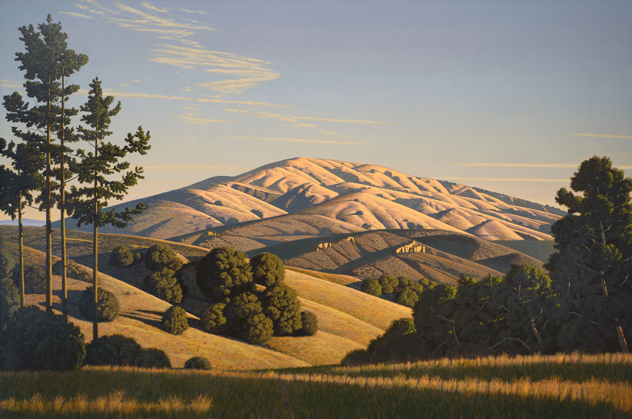
{Mountain, 2013, oil on canvas, 60 x 90 in.}
“That is such an important ideal in modern society that I think it’s important to date back historically,” he says.
To discuss modern issues that society has seen over the last few decades, Ligare painted his perfectly symmetrical Vitruvian Man black, to coax people to talk about integrated as opposed to segregated society. The male body is harmoniously in proportion to the architectural structure behind it, which is harmoniously in proportion to the environment behind that.
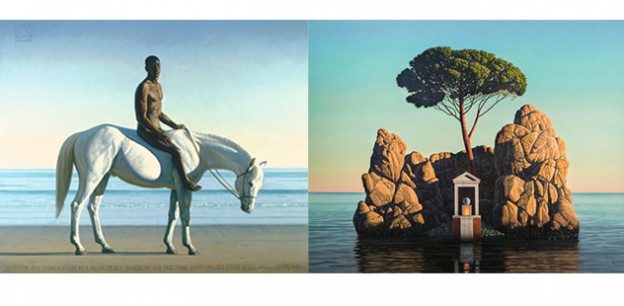
Ligare says his concepts sometimes become very esoteric, but that’s where the fun is for him. His massive, attention-stealing painting Arete, for example, is a naked black man on a white horse, and caused many museum visitors to pause and stare.
The layers behind the painting bring much perspective. Arete in Greek has to do with the idea of excellence of the human spirit. The quote scrawled below the horse comes from a fifth century B.C. poem written about an athletic event, and Ligare wanted that athletic excellence idea to carry over to excellence in knowledge. His reason for using a black man also has to do with the two kinds of ceramic pots used in Ancient Greece, in which earlier pots were black figure vases, and the poet he references in the painting came from that period.
“For me, all of these paintings are so wrapped up in ideas and it’s difficult to boil them down to just a few words. But in that case I wanted it to be a man who had a great amount of integrity about him and carried himself as an excellent human,” he says.
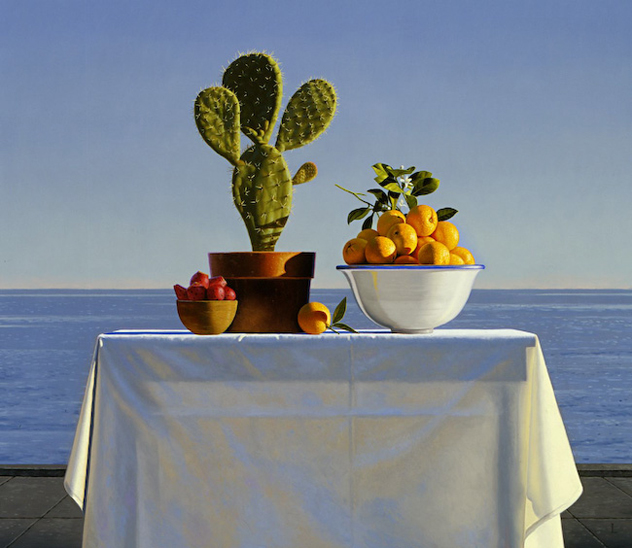
{Still Life with Cactus and Oranges, 2001 | oil on canvas, 40 x 48 in.}
Ligare’s latest pieces hang at the very beginning of the exhibit before entering the room, and focus on architecture. The artist—who used to teach drawing at architecture schools in Wales and at Notre Dame—also finds great inspiration from past and current architects, especially the New Urbanists.
“I use history to recreate a narrative into art that way they [New Urbanists] were trying to create a narrative into cities to bring back a sense of character that would make them more livable,” he says.
Ligare doesn’t limit himself within a painting to a certain time period or place, which adds yet another dimension to each piece.
“One of the things I really like doing with all this stuff is being flexible and fluid in time; being comfortable with moving from 18th century to 17th through the Renaissance to even beyond to cave paintings in the neolithic era, and not be fixed to contemporary ideas or contemporary culture,” he notes.
That fixation to what might be acceptable in a specific place or time frame is something Ligare continues to rebel. It’s almost epitomized in one of his pieces—Ligare painted a male diving into a sea to show the balance of opposing forces of order and chaos, something he says he’s put into his work for the last 35 years. The painting of the diver was influenced by a tomb in southern Italy, which he says was likely not belonging to a diver, but was a representation of a person moving from air to water and from life into death. The painting is based off a photograph of Ligare as well, diving into the Aegean Sea.
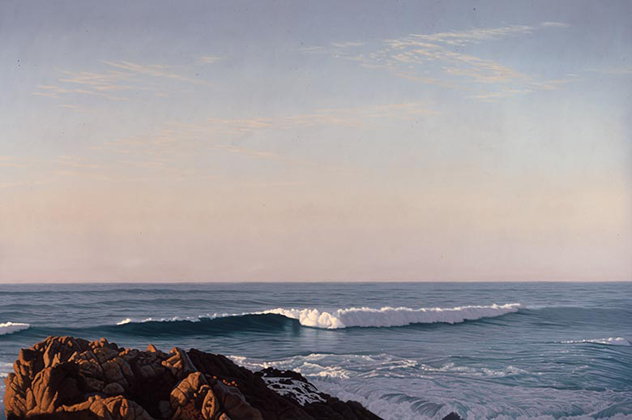
{Seascape, 2003 | oil on canvas, 60 x 90 in.}
Ligare said he couldn’t help but laugh and include a new angle to the diver story when he found out that the main painting on large billboards advertising his exhibit in Gdansk, Poland, was the nude male diver. However, when he mentioned this to the Crocker, they didn’t seem to agree with the use of the painting for public advertisement.
You can see the infamous diver and dozens of other equally intriguing, educational works from Ligare at the Crocker Art Museum through Sept. 20.
David Ligare, California Classicist is on display now through Sept. 20 at the Crocker Art museum, located at 216 O Street in Sacramento. You can find hours of operation, as well as purchase admission tickets, through Crockerartmuseum.org.
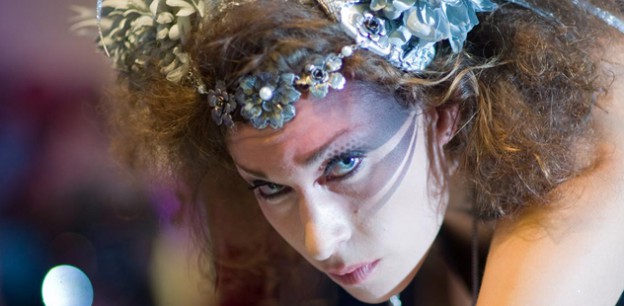
With Halloween being pretty much the best holiday all year, the next installment of Crocker Art Museum’s always creative ArtMix event is one we’ve been looking forward to ever since we caught wind of what was brewing behind the scenes months ago. Thursday, Oct. 9, 2014 it all comes together at ArtMix: Monsters’ Ball, featuring tons of people dressed ridiculously for costume contests, a scream competition by Sacramento Horror Film Fest, live music from Grass Valley fuzz-rockers Mount Whateverest, spooky dance tunes from DJ Shaun Slaughter, 10-minute flashlight art tours, ghostly dance performances, local psychics and a freaky photo booth from Giggle and Riot Funbooths. Also check out the four-on-four “creature feature soccer matches” in the Living Dead Cup presented by the Sacramento Lady Salamanders, a Street Soccer USA program using soccer to help women and youth break the cycles of homelessness, addiction and domestic violence. So if super-fun themed events are your thing, and you like hanging out with zombies and other creepy crawlers, head to Crocker this Thursday from 5 to 9 p.m. Admission is just $10 for non-Crocker-members (free to members), and college students get a couple bucks off. There will be $5 drink specials all night too. Visit Crockerartmuseum.org or call (916) 808-1182 for more information and to purchase your tickets ahead of time. Remember, ArtMix happens the second Thursday of every month with fresh new themes. Get out and experience the arts from a different perspective.
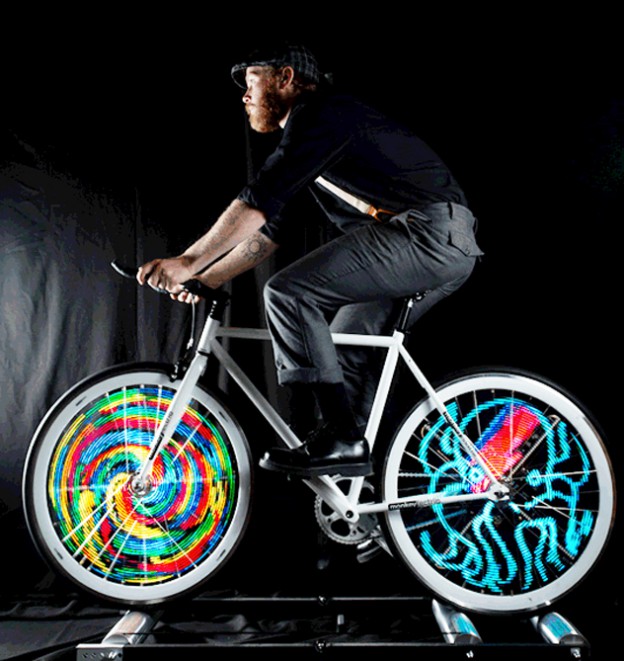
Biker newbies, enthusiasts, socialites and experts alike, it’s time to celebrate that super-small carbon footprint of yours. In honor of Bike Month, Art Mix will be hosting Spoke-tacular at the Crocker Art Museum on Thursday, May 8, 2014, from 5 to 9 p.m. Park your bike at the free bike valet before immersing yourself into the sound of local bands and DJs complemented with Kevin Greenberg’s hand-built bike art and MonkeyLectric’s interactive digital wheel art. Sacramento Bicycle Kitchen will be there to assist with questions and provide suggestions for all the DIY bike builders and Juniper James will be presenting a bicycle fashion show for the boldly expressive and highly fashionable cyclists of Sacramento. The event is 21-and-over, and will be offering $5 drinks all night. Check out Crockerartmuseum.org for more details and ticket purchasing (free for members, $10 for nonmembers, $8 for college students).
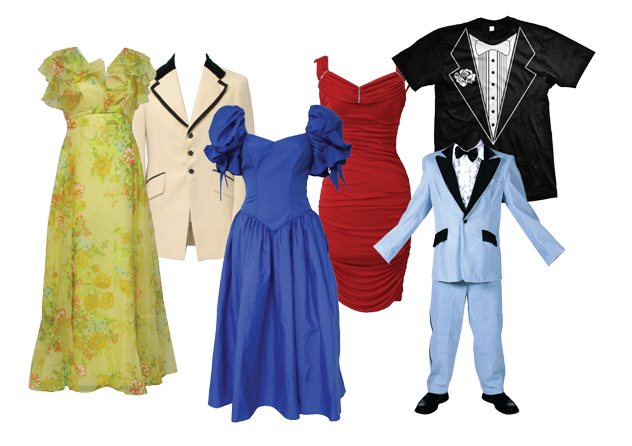
It’s back, everyone. The pinnacle of our high school careers, the topic of every ‘90s teen movie, the “Olympics of High School” and probably some of the most awkward phases of our lives… that’s right, prom. Art Mix and Unseen Heroes are catering to all our nostalgic needs to bring us Prom 2.0 at the Crocker Art Museum. It’s going to be everything you ever thought it to be, except you’ll actually be allowed to drink this time. Cancel any plans you might already have for Thursday, Feb. 13, 2014, and get ready to dance the night away from 5 to 9 p.m. Start off the night with a corsage and boutonniere crafting station and a prom photo booth, then make way to the Andy’s Candy Apothecary candy bar and DEEDA Salon makeup refresher station. From 6 to 7 p.m., DJ Bryan Hawk will be spinning ‘70s classics so you can show off all your Saturday Night Fever-esque dance moves. At 7 p.m., get your second chance at becoming Prom King or Queen in the ‘70s, ‘80s and ‘90s costume contest. Transition into the Footloose zone thereafter, as DJ Eddie Edul brings the best of the ‘80s. Finish the night with a modest mosh and slow dance session as The Best Ever Summer Band covers ‘90s classics. Find this event at Crockerartmuseum.org for tickets and more information, because we haven’t even covered all that this event will offer. Tickets are free for Crocker Members, $10 to non-members with a $2 reduction in prices to college students. Grab your poofy dresses, baby blue tuxedos and gallons of hair spray: it’s prom, people! —BD
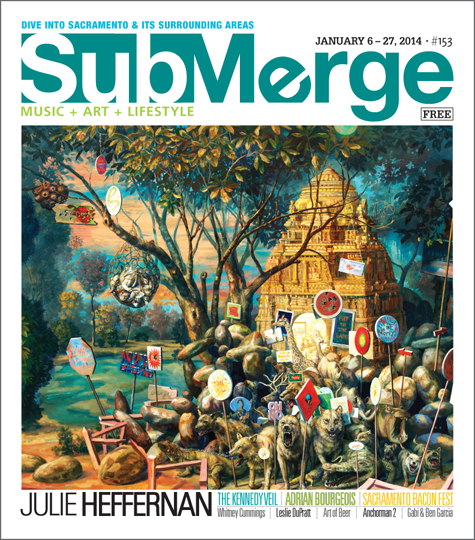
Julie Heffernan on her process, self-portraits and the reclining nude
1814—Jean-Auguste-Dominique Ingres finishes La Grande Odalisque, a work that becomes iconic for multiple reasons from various critical perspectives. It’s Orientalism at its finest or worst, an example of neoclassicism betraying reality, an introduction to the gendered gaze and a document of patriarchy’s ridiculous ideas about female bodies as objects and their lack of agency. These ideas might seem current, because they are; but the work, the painting itself, is now two centuries old.
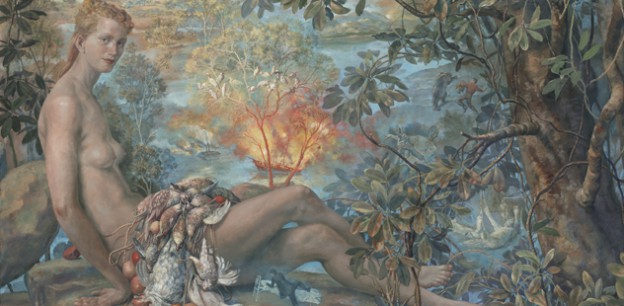
And yet, one of the first paintings one is likely to see at Julie Heffernan’s current exhibit at the Crocker Art Museum is her work Self-Portrait with Talking Stones, and immediately it’s impossible not to see the intertextual play between the Ingres work and Heffernan’s central figure.
In both works we encounter the female nude in an elaborate framework, one lush in figurative wealth, the other a wealth of figurative detail. While the Ingres work is a perfect distillation of patriarchy, Heffernan’s Talking Stones is a critique of not only the elements of Ingres but also the dominant forms and aesthetics that have been derivative of and since Odalisque.
“She is the closest to a reclining nude that I’ve ever done,” says Heffernan. “As I’ve said before, I’ve got a real problem with the reclining nude. How do you give the female agency when you take the vertical stance from her and have her sit or recline. I wanted to have her body speak.”
In Heffernan’s framework, the nude is challenging her placement in the work. She’s placed upon a series of stones that serve as historical reminders Greco-Roman, spiritual or otherwise. These stones become the divan upon which the nude rests. The “exotic” peacock feathers of the duster in Odalisque become a maternal mound of dead birds and fruits heaped upon or emerging from the nude’s genital region. It’s not ripe, as we might think of the precision, delicacy of the still life form, its various bowls overflowing with fruit and remnants of rural continental labor. Rather, this is both abundance and loss, a bounty of sweet over-ripe stone fruits and the end of a sexuality rooted in reproduction—specifically for Heffernan, hers.

{Jean-Auguste-Dominique Ingres’ La Grande Odalisque}
These adornments are important to Heffernan. They—these dead birds, wasted fruit—are anything but arbitrary, as they repeatedly appear in various ways throughout her work. Yet, the unique thing about Heffernan’s paintings is that the macro, which seems so important at first, isn’t exactly the takeaway. Instead it’s the little things that give her works weight.
The minute details, the micro of Heffernan’s works, often become the most rewarding parts of her paintings. In person, it’s not the nude figure that weighs on the viewer. Instead, it’s the man fighting a grizzly bear in the right distance; the evangelical, ghostly figures praising what appears to be a wine bottle just below the fight but in the foreground of the large tree that anchors the right side of the frame; the person in a full-body cast and hospital bed further to the right; the miniature man about the size of one of the dead game-birds mentioned above, climbing into, or mounting perhaps, the iron-railed bed next to the pelvis of the nude, birds, fruits and all; the ship ablaze just left of center of the canvas, floating down a river that has also inundated a series of buildings from which no living people emerge; or lastly the peaceful serene sky that floats behind the nude’s head, a stark contrast to all the death, danger, tension, violence and history visible at every other point of this painting.
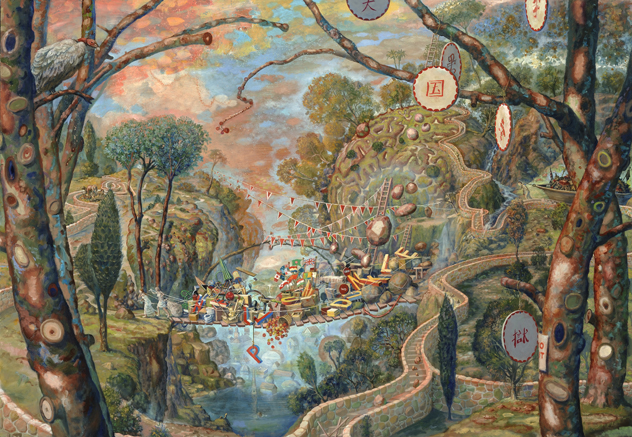
{Self-Portrait Moving Out | Year: 2010 | Medium: Oil on canvas | Dimensions: 54 x 78 inches}
Despite all this, the nude, the figure, the face of what can only be understood as a projection of Heffernan herself, gazes back at us, the viewers. She’s calm, confident, powerful—despite her placement, slightly reclined, in the work. This look too asks us to confront, as viewers, our desire to see, voyeuristically, trauma and tragedy in the artwork itself, in Heffernan as an artist, in her self-portrait.
“The title ‘Self-Portrait’ started when I kind of rejected any human figure in my work,” explains Heffernan. “This was way back in the ‘80s. There was the whole discourse about the male gaze and the objectified female nude, all those problematics were clear to me. The feminist writings, like Laura Mulvey’s “Visual Pleasure and Narrative Cinema,” they really hit me, they opened my eyes. It was clear for a while that the nude, the female nude, had to rest. But I still wanted to paint about my own female experience. That was when I moved to these large-scale still-lifes, and I used them as backdrops for the image streaming process that I had been experiencing, where pictures would flood into my head.”
Heffernan describes her artistic process as a sort of prayer, though she denies any particular religious affiliations even if they do appear from time to time in her paintings. When beginning a new work, she sits and waits, for days on occasion, until she finds an aperture which allows her to begin a work. Often this initial impulse is discarded, but it inevitably leads to the actual subject or content she will spend the next two months bringing to life. Sometimes this process takes years, and the negotiation between the large central figures and the minute background details are the delicate elements that Heffernan has to balance.
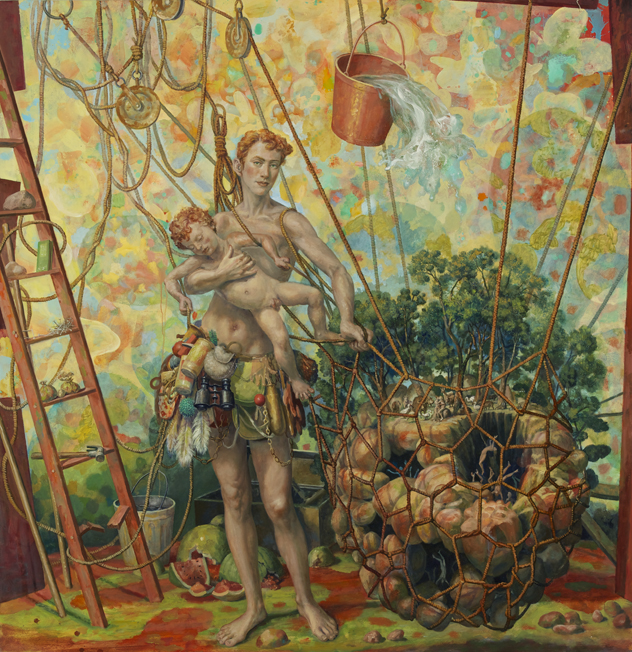
{Self-Portrait Holding Up | Year: 2010 | Medium: Oil on canvas | Dimension: 68 x 66 inches}
Once she’s comfortable with the larger setup, she begins to develop the smaller aspects of the works. This she calls the “culture” of the painting.
“At a later stage,” she explains, “I know the world and now I want to give it culture. I’ve built the buildings, I’ve laid out the thoroughfares, and then I want to start to parse the fine points of this world, the culture of this world. That’s the point where the intellect gets engaged. It has to do with scanning broadly. I’ll leaf through tons of books and wait for things to pop out as relevant to the world. Sometimes they’re in textual form, and sometimes they’re in image form.”
This act of discovery, of reference, Heffernan describes repeatedly as a journey of sorts. As an artist she attempts to enter the canvas through the paradoxical application of layered paints:
“I’m always trying to go into a hole; the canvas proper, the canvas parameter is the initial hole, a white hole. You enter that, and I’m always adding, trying to cut into deep space, cut into it even deeper.
“I deal with everything from the experience of being a maker. The joy of losing yourself in the tiny muscle movement of hands of creating something is really the best, the only escape we have from our horrors.”
These horrors are both real and imagined, as one can see in her works, actual tensions and fantastic circumstances. Because the works are so large, the details so overwhelming, they feel like paintings of Hieronymus Bosch with a slightly less surreal accumulation of minutiae. These immense tensions are what make Heffernan’s works so current. These are projections of herself, as citizen of our century, America on the sharp edge of financial and militaristic empire, a globe on the verge of environmental collapse. In short, the readings of environmental concerns and allusions to the contradictions of globalization seem entirely apt.

{Millenium Burial Mound | 2012
Oil on canvas | 68x 80 inches}
As an example, in Millennium Burial Mound, wolves and other predators break forward into the painting and the foreground over a shoddy fence that limits their movement through space, as we increasingly see with diasporic communities and the fenced borders around the globe. And though Heffernan is conscious, both in her works and in our interview, to distance herself from a critique of consumerism, she’s perfectly fine discussing the other two large issues of environmental degradation and globalized society.
She emphasizes, “We can’t support it. We are so clearly on a cusp, and I feel it viscerally in a way I would never have anticipated. It’s a factor of your sensitivity extending out beyond your own bloodlines, through your kids, out into your community and even further out into the world. It’s clear to me, even though it’s a bit of a sky-is-falling, Chicken Little trope, an end-times kind of cliché, that any talents I had to say something, I had to use.
“This is the largest conversation of our time. I’m constantly flummoxed—as artists are the nerve center of a culture—and I’m just wondering why everyone isn’t on this, like we were in the ‘60s to end the war. It seems so urgent.”
“It” for Heffernan is both our environmental condition and the logic that predicates this condition, the uneasy acknowledgement and urgent silence of the media sphere. Within the world of her paintings, her subjectivity, Heffernan is an everywoman of sorts. Her inner thoughts and ideas become projections and gestures that seek to move beyond her singular experience. However, Heffernan is also, quite simply, an artist attempting to represent her socially conditioned mindscape.
“I simply paint what appears to me,” she says, “and I realize later the communion between what I’m doing intuitively and then what turns out to have been happening in my body that I wasn’t even thinking I was addressing.
“The thing I love about painting is that it’s an encounter with another being, via their touch. They’re gone from the room, their painting is left on the wall, and you can feel their touch in it.”
If this is Heffernan’s version of success, then she’s accomplished it. There’s no doubt that in her exhibit, Sky Is Falling, there’s a sensual encounter with the qualities of Julie Heffernan, and therefore the greater world around us, rooted in experience, bodies and touch.
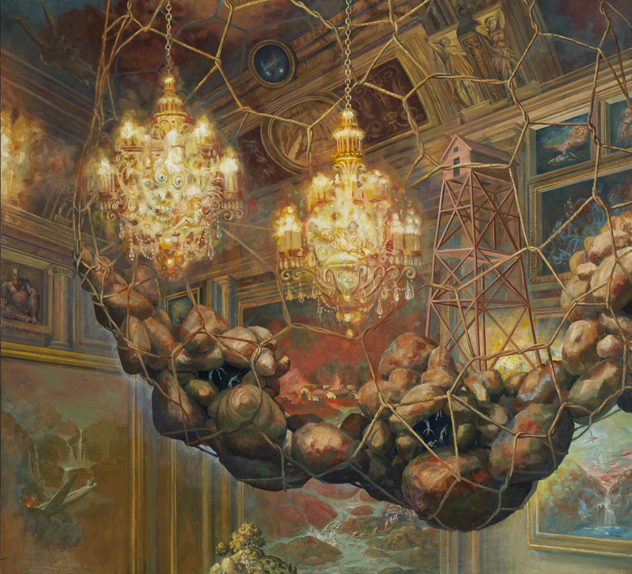
{Self-Portrait as Explosive | Year: 2011 | Medium: Oil on canvas | Dimensions: 62 x 68 inches}
Sky is Falling: Paintings by Julie Heffernan is on view at the Crocker Art Museum (216 O St.) until Jan. 26, 2014. Visit Crockerartmuseum.org for more info. Drop by on Jan. 26 from 1 p.m. to 3 p.m. to meet Heffernan and hear about her works directly from the artist.