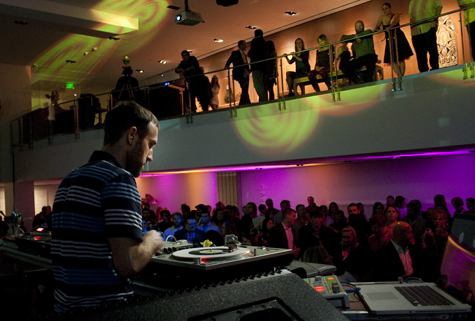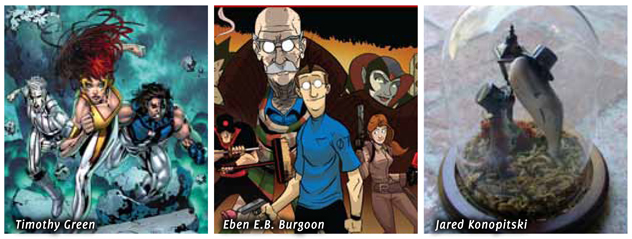
Crocker Art Museum’s creative monthly event Art Mix is going all Comic-Con on Thursday, Nov. 14, 2013, where from 5 to 9 p.m. guest artists like John Cottrell (from Dark Horse) and Timothy Green (from Marvel, DC and Dark Horse) will be on-hand along with Eben E.B. Burgoon from Eben07 and B-Squad and local artist Jared Konopitski. Listen to a nerded-out DJ set by Kwes the Bess (of Sleeprockers) and witness a lyrical battle between good and evil at a live hip hop performance by local MC extraordinaire TASK1ne. Plus tons of comic book stores will have pop-up shops set up like A-1 Comics, Empire’s Comics Vault, River City Comics and Games, Metropolis Comix, and more. Admission to Art Mix is included with your general admission ticket to the museum, which is $10 for adults. Of course, cosplayers get in free. Visit Crockerartmuseum.org for more information. Now, let’s nerd out!
Exquisite Corps hopes debut album will resonate with the band’s growing fan base
It is exactly 4 p.m. on a Wednesday afternoon when Exquisite Corps’ frontman answers his cell phone.
“Dude, right on time,” Bryan Valenzuela says with a laugh, seemingly impressed.
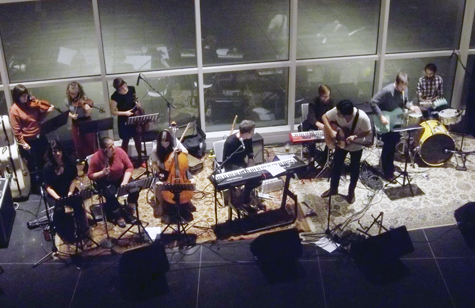
Observing the magnetic character on stage lead a six-piece chamber rock band during a sold-out show at the Crocker Art Museum, one might imagine that the singer/guitarist of local band Exquisite Corps is unapproachable.
It quickly becomes apparent, however, that this musician is in fact more approachable than most.
After a morning spent painting, and playing a late show for a full house in Nevada City, Calif., the night before, Valenzuela is in great spirits. Exquisite Corps played at the Haven Underground, where they shared the stage with The Still Sea from Nevada City and Pillars and Tongues from Chicago. Apparently people were stacked on each other to watch the show, and Valenzuela had nothing but good things to say about the experience.
“I always love playing in Nevada City,” Valenzuela says. “It’s super cool there, everyone is really chill and interested in music.
“It was kind of crazy to have a show on a Sunday. There was a lot of people staying until one in the morning,” he adds.
Valenzuela has plenty to be excited about. After a few hiccups and lulls in the recording process, which began last summer, the band is now preparing to release its debut self-titled album at this year’s Launch Festival, which Exquisite Corps will be playing for the third year in a row.
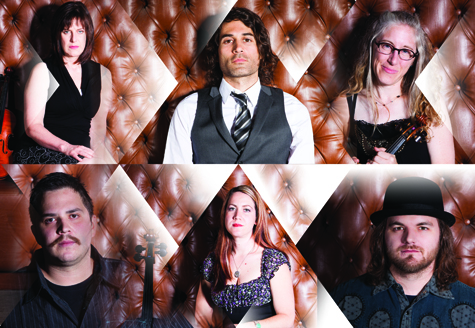
For those who ever fell for cellist Gretta Cohn on Cursive’s Ugly Organ, this album is worth a listen. Since the spring of 2010, Exquisite Corps sprung from a cello and guitar duo, with Valenzuela on the guitar and Krystyna Taylor on the cello, to a full band. The current ensemble includes violinists Reylynn Goessling and Kristin Arnold, drummer Robby Dean and bassist Nathan Webb, in addition to Taylor and Valenzuela.
On headphones, the seven-song album allures the listener from the start, enchanting and ominous. Track one, “Tone Poem,” begins with Valenzuela’s voice oozing over the airy, ethereal resonance of an organ, soon joined by the warm hum of the cello. Then violins come in, high pitched and full-bodied, moving the song forward as Valenzuela’s voice reaches fervent, wailing heights.
The subsequent tracks progress in the same vein, commencing with soft, mysterious beginnings, and erupting into opulent, racing symphonies conjoined with Valenzuela’s vocals, impassioned and raging as he sings about subject matter varying from the followers of Dionysus to winter landscapes. Following “Tone Poem” is “Light As a Feather,” which appeared on local music blog Live in the City of Trees.
Now the band is releasing previews of the album, song by song, leading up to the release show.
To record the album, the band of six spent a considerable amount of time at Hangar Studios with music engineer Scott McChane, who has worked with the likes of local acts Sister Crayon, Agent Ribbons, Chelsea Wolfe and Ellie Fortune.
Valenzuela had his hands in both the recording and mixing processes, ensuring that he could guide the direction of the final product.
“I was there for every single aspect of it,” he says. “It’s expensive to record, and we wanted to record as professionally as possible and make it sound as good as we could with what we had.”
Exquisite Corps’ songs begin with Valenzuela, who writes the music, working through the melodies in his head. Then he approaches the others to arrange the songs. Each member brings something to the table, coming up with pieces to add or ways to solidify the songs.
The progression is not unlike how Exquisite Corps originated, with some string compositions Valenzuela wrote a while back and wanted to put into action.
Valenzuela grew up in Orange County, relocating with his parents to Placerville when he began high school. Around the same time he took up the violin at school, and was drawn to chamber music ever since. He studied music theory in college. When he was the singer/guitarist of former local band Call Me Ishmael, he wrote string accompaniments for the band’s CD release show.
It went over well, but for some reason the band never used strings again after that performance. He wanted to do it again ever since.
“I guess I was just in love with the sound,” he professes. “The string instruments can be, in my opinion, super versatile. They can be really sweet and beautiful, and then they can be really gritty and dirty. There’s so much range there that is great to utilize in music.”
Upon running into the right people at the right time, likeminded people like Taylor, Valenzuela fell upon an opportunity to start a chamber rock band, and thus Exquisite Corps was born.
They eventually recruited Dean and Webb, who played with Valenzuela in Call Me Ishmael.
“[The band] kind of took on a life of its own, in some ways, just by having the thought a long time ago,” Valenzuela says. “Sometimes things just fall into place, I guess.”
Though Exquisite Corps has come a long way since its beginnings, gaining a loyal following in Sacramento and playing sold out shows at venues around town, Valenzuela remains modest about his musical capabilities. The following is an excerpt from the phone conversation between Valenzuela and Submerge.
It sounds like you had played in a lot of other bands prior to Exquisite Corps as well?
Yeah, some bands here and there. Nothing really that notable, not that I’d like to talk about [laughs].
OK, that’s fair.
Because…when you are younger you are in all these different bands, and later in life it’s a little embarrassing.
But what would you say your thoughts are on your progression, anyway, musically, from Call Me Ishmael to Exquisite Corps?
I don’t know, just more experience as far as songwriting and how to arrange music [goes]. Since that band I’ve been studying how to arrange for string instruments, and I’m not a classically trained musician. But [I’m] learning, maturing, trying to ensure that the content of the music is all together. When you are younger, you’re just super excited, and you’re throwing everything out there.
Some of your songs sound almost soundtrack-like on the album. I was particularly thinking that [about] “Windswept” and “I Want What I Want.” Do you ever visualize storylines as you’re writing the songs or writing the lyrics?
Yeah, totally. Either there’s a specific story or it’s like a loose story and images, you know? Maybe it’s a non-linear narrative or something. It may not always come through in a lyric but it’s something you think about when you’re writing or even when you’re playing it. You know who I thought is really good is Neko Case.
Yeah, I love her music.
Dude, she’s so rad. But she tells these stories, and I don’t really know what the story is. The story is totally a non-linear narrative. I know there’s a story in there, and it kind of draws you along.
Would you say that’s the same with some of your songs as well?
I’m always inspired to do that. I’m always inspired by that kind of thing.
Did you ever receive vocal training? You really belt it out during some of your songs, and I was wondering if you’re voice ever gets strained.
In college I took choir [laughs]. I wouldn’t say I ever had vocal training, though. It’s just listening to other singers and watching other singers. I have no formal training in singing. And actually, this wasn’t even something I aspired to do at first. I was mostly a musician, a guitar player most of the time. I was in band in high school, and I was never a singer. But you start playing with people, and no one wants to sing [laughs], that’s pretty much how I started singing. You just try to get better, you just work on it every day and keep working on it. I’m sure I was really bad, I know I was really bad when I started singing… As far as vocal straining, I’ll just drink more water the next day and everything’s fine.
What kind of music are you listening to these days?
Shit, I’ve been listening to PJ Harvey. I kind of got obsessed with the last PJ Harvey record [Let England Shake]. And then I’ve totally been listening to tUnE-yArDs, even though we’re not even close to that kind of music, it is pretty awesome. I mean, we’re not that type of music but I do love it. Beforehand I was listening to Elliott Smith. I always listen to a lot of different stuff, like old stuff and new stuff. The Beatles to Blonde Redhead. I love David Bowie. I was listening to David Bowie coming back from Nevada City the whole time. It kind of keeps you going. It’s a long drive and it was late.

Exquisite Corps will celebrate the release of its self-titled album as part of the Launch Festival on July 25, 2012. The show will take place in front of the MARRS Building in Midtown. Doom Bird, The Honey Trees and I’m Dirty Too will also perform. This is a free, all-ages event and starts at 5 p.m.
Baroque Bash featuring Doom Bird
Crocker Art Museum, Sacramento – Friday, Jan. 13, 2012
On a normal afternoon the Crocker Art Museum is usually filled with art enthusiasts who quietly soak in the historic and modern art pieces as they roam the halls. But last week on a chilly January night, the art museum was humming. Upon entering the museum lobby, there was a different vibe in the atmosphere. It was filled with excited guests who were patiently waiting for the “Baroque Bash,” a music and art celebration to honor one of the Crockers current exhibitions called Florence and the Baroque: Paintings from the Haukohl Family Collection, to start. People were busy talking in small groups or sipping on glasses of wine and beer. After all, there might not be a better way to properly appreciate 16th century artwork than with a glass of classy wine in hand.
As the room waited patiently for the musical performance by Doom Bird to start, most eyes wandered to the left side of the lobby where museum goers could participate in art demonstrations. A few aspiring artists were caught sketching costume drawings from the Baroque period, along with the help of artist Arturo Balderama. A woman dressed in an elegant dress from the 17th century was modeling for the artists and wandering the lobby so people could appreciate her wardrobe.
The musical portion of the show began with relaxing melodies from three instrumentalists who gracefully took strums at a cello and two violins. During their performance, the majority of the audience members seemed to appreciate the music, but were also a little distracted by their surroundings.
After the classical performance ended, Doom Bird was ready to take the stage (which consisted of two rugs on the floor). Band members Kris Anaya and Joseph Davancens were accompanied by many local musical guests for the night including Krystyna Taylor (cellist from Exquisite Crops), Arjun Singh (drummer from Wallpaper) and Adam Wade (singer from Golden Cadillacs). Depending on the night, Doom Bird enjoys to be backed up by great musical talent to keep their shows lively and entertaining. “Joe and I usually play with a large group of people for shows,” Anaya described in an e-mail the day after show. “It usually keeps the audience excited about what we are trying to present in our music.” Although the band admitted that they had not performed in nine months, the performance from the musical group was peaceful and flawless. Each song provided the audience with calming but powerful music notes, making the perfect blend of classical and alternative tunes.
For most of the set, frontman Anaya didn’t have much to say to the audience except for the occasional thank you. But during the middle of their set, Anaya noted that the lobby of the museum resembled a mini airport. “Welcome to the International Crocker Airport,” he joked over the microphone. Taking a bird’s eye view of the museum, it did resemble a map from a stereotypical “airport.” Starting at the left of the lobby was a bar serving cocktails to guests, then families enjoying their dinners on square tables; the middle of the room was filled with rows of silver chairs facing the stage (resembling a waiting room). It provided an atmosphere that made the museum appear busy and full of life. Throughout the entire set, audience members could take in the “artistic extravagance” of art and music that the Crocker Art Museum had hoped for.
Nathan Cordero carves a path from gallery janitor to full-fledged artist
Nine years ago, Nathan Cordero used to walk through the Crocker Art Museum every day. But unlike the other gallery visitors who would slowly roam the hallways and take their turn to enjoy each piece of art, Cordero “wasn’t inspired by any of it.” He would walk into the museum, clock in as the custodian, clean the building and head home without feeling the slightest inspiration from the artwork. “After a while you get sick of seeing the same thing. I always noticed flaws in the art and saw something that I didn’t like about it,” said Cordero over the phone. “After seeing everything for so long you usually find one little thing, sometimes the whole piece that’s just…wrong.” But these days Nathan is taking on a new role of being the artist behind the gallery. Until Aug. 20, 2011, art lovers can take a quick peek into Cordero’s mind by visiting the Nelson Gallery at U.C. Davis.
The 36-year-old Sacramento native has found a way to take everyday objects and turn them into unique handmade carvings on pieces of wood and leaves. The art pieces show images of objects, people and quotes.
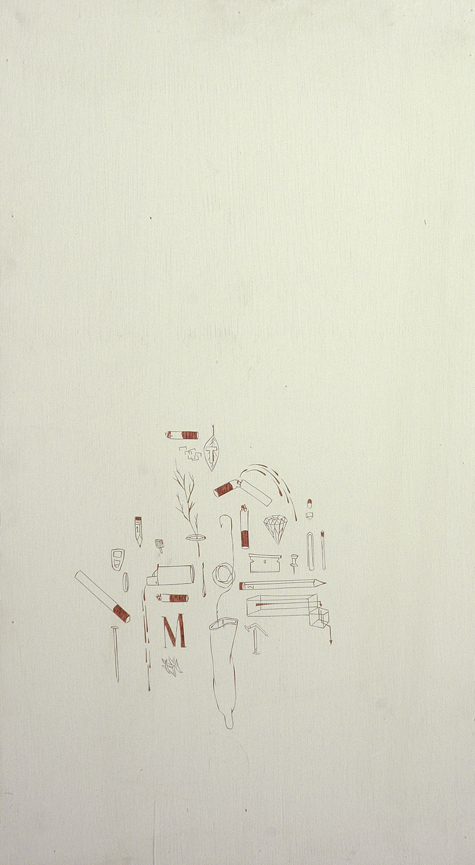
Although the common objects shown in the carvings (such as flowers, razor blades, fishing hooks, safety pins and pencils) have no particular meaning, they all share one thing in common. “All of those are really easy to carve on a particular surface of wood. So I was able to do more detailed things on that carving,” Cordero said. “When you are able to cut details, it’s really cool to take small images or small subjects and pile them together.”
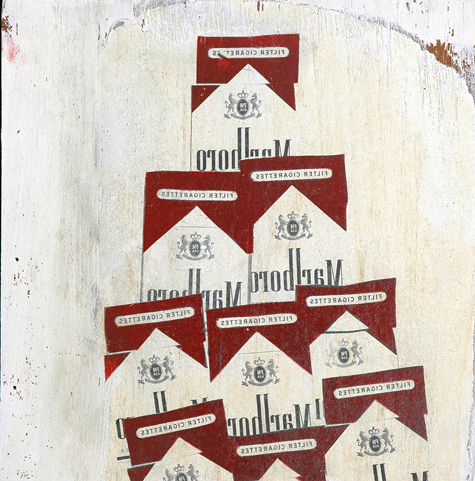
One of the “small subjects” that he chose to carve repetitively were cigarettes and pictures of Marlboro cartons. “There’s no political message at all. It has nothing to do with tobacco prohibition. It has nothing to do with promoting cigarette smoking. It’s both controversial and satisfying,” Cordero added. “I enjoy smoking cigarettes. I’ve quit many times, then restarted, quit and restarted. It’s just something that is part of my life, a part of growing up and growing old.”
Cordero also chose to make repeated creations of masked men and women, which were inspired after he discovered a box of photos.
“I found a box of head shots from a theater production in Sacramento; they are all people from the Sacramento Valley. I don’t know any of them,” said Cordero. “My original idea was to conceal their identities and then put them up all over Sacramento.”
Nearly all of the wood pieces that are hanging in the gallery were found “everywhere” outside, many of them coming from construction sites. “I find a piece and know exactly what I’m going to do with it right away,” Cordero said. “And once it’s prepared, it’s ready to go.”
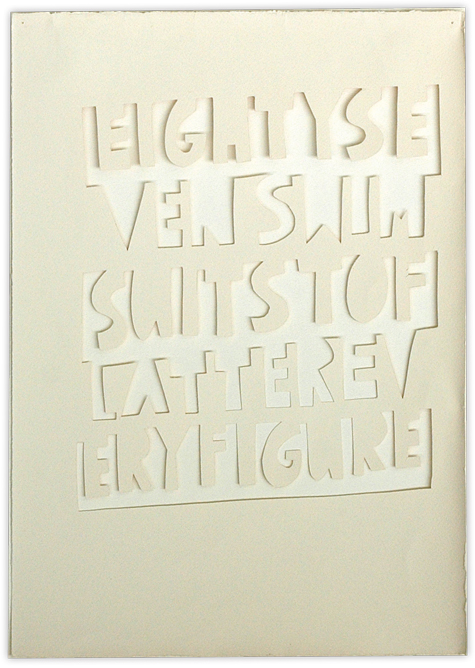
At first glance some of the carvings seem as if they are filled with random letters that are aligned with no spaces in between, but after taking the time to read them, quotes and phrases begin to form. He lifts these quotes from headlines in fashion magazines, such as Vogue or Elle, including “Eighty-Seven Swim Suits to Flatter Every Figure,” “Imagine Christina Aguilera Coming Over to Your Place Every Night,” or “Treat Your Body Like Your Face.” The name of his exhibit, Are You Destined to Become Your Mother?, was chosen from a headline he read on the cover of Real Simple Magazine. But the same headline was also found on a cover of Vogue from the late 1960s. “I thought that was kind of interesting, that decades later the same headline would pop up in a completely different manner,” Cordero said.
The majority of the pieces held in the gallery were created this year during the span of only six months, which is very little time considering some pieces took Nathan more than 20 hours to complete. During those months of hand carving every piece with razor blades, Nathan would experience minor accidental cuts on his hands about three times a day. All 1,600 razor blades that were used and collected during the hard work almost fill up an entire wall in the gallery. The blades are formed in an X and aligned to create a dramatic 3-D image.
“It’s a tool that I use to do most of my work. I originally just started collecting them,” Cordero explained. “After noticing the amount of shadows from the different directions of light, I thought a whole wall of those would be great. I finally had the chance to do it.”
Although Cordero did not attend art school, he has an eye for recognizing everyday objects people normally pass up and transforming them into a unique art piece. His wood carvings started after he took notice of a piece of wood in his room and “put a hole through it and peeled away at it.”
“I’ve always been interested in art. In my early 20s I actually started to consider art as a career,” said Cordero.
The Nelson is not the only gallery that he has on his resume. His art has been shown at the Verge Gallery and Axis Gallery in Sacramento, The Warehouse Gallery in Syracuse, N.Y., and Ritual Roasters Gallery in San Francisco. Cordero was born in Woodland, “does a lot of fishing” during his spare time and paints houses during the day. But even after his job during the day is over, his art isn’t finished yet. “Whatever time I have available, I’ll work,” Cordero said. “Like today after work, I’ll probably go to my studio and finish up what I’ve been working on.”
Nathan Cordero’s Are You Destined to Become Your Mother is open now through Aug. 20, 2011 at the Nelson Gallery on the campus of U.C. Davis. The gallery will host a special discussion about the exhibit on Aug. 12, 2011 from 5—8 p.m. For more information, check out Nelsongallery.ucdavis.edu.

May is Bike Month and with it comes the return of the Bicycle Film Festival from May 12—14, 2011 at various venues throughout town. One flick I’m particularly drawn to see is called Riding the Long White Cloud, which will screen on Thursday, May 12 at 7 p.m. at Crocker Art Museum just after the BFF Opening Party, which starts at 5 p.m. Riding the Long White Cloud is a stunning documentary from director Alex Craig that follows seven professional skateboarders (Rick McCrank, Silas Baxter Neal, Cairo Foster, John Rattray, Keegan Sauder, Chris Haslam and Kenny Anderson) as they attempt to cycle New Zealand’s North Island. “Twelve days of cycling across mountain and valley, through rain and shine, trying to skateboard along the way,” are the first words that scroll across the screen of the film’s trailer. Cycling, skating and incredible scenery–sounds like a recipe for cinematography greatness. Other BFF highlights include a Trick Competition powered by PedalHard on Saturday, May 14 from 4 p.m. to 7 p.m. at Fremont Park (16th and Q streets); the BFF Classics screening on Friday, May 14 at 9 p.m. at Fremont Park; and the Friday night BFF After Party at Sol Collective (2574 21st Street) featuring DJ Riff Raff from the Red Bull Music Academy. That party kicks off at 10 p.m. and will feature custom bikes on display and Sierra Nevada on tap all night long. Learn all about the Bicycle Film Festival’s offerings at Bicyclefilmfestival.com/sacramento.
-J. Carabba
Our Region’s Top Breweries Make Beers Exclusively for Sacramento Beer Week
Words by Adam Saake
Since I covered the inaugural Sacramento Beer Week last year, our area’s thirst for quality suds (and ciders) has grown exponentially. Last year, the focus was on all the local breweries that had shut down and how our beer scene was changing as a result. Well, boy has it changed and damn is it good. Many new faces have arrived on the scene and the old faces are still making and selling great beer. Alley Katz on 21st and O streets opened early this year and immediately caught the attention of serious beer drinkers when they heard the bar boasts close to 200 beers between bottles and draft. Owner Geronimo Avelar‘s neighborhood bar atmosphere isn’t a novelty shop for spendy beer drinkers. Affordable selections like $3.50 Anchor Steam bottles or 32 oz. mugs filled with draft selections for around $7 are going to keep this place alive with business.
Our beer scene is thriving and the events planned for this year’s Sacramento Beer Week is evidence alone. Feb. 25 through March 6, this celebration of “Sacramento beer culture” features over 200 events that include special dinners with food and beer pairings, meet and greets with brewers, pint nights galore and even demonstrations of how to make your own beer. New this year are two anchor events: the Capital Beerfest at Cal Expo and the Sacramento Brewers Showcase at the Crocker Art Museum. The latter will feature all the local breweries as well as “sneak previews of breweries opening soon.” This event also features tastings of specially brewed beers by Sierra Nevada, Lagunitas and Sudwerk that were created just for Sacramento Beer Week. Lucky for you, we’ve got the skinny on these tasty suds.
Lagunitas
Paradime Sac
There’s an episode of The Simpsons in which Homer meets his half-brother Herb whose existence he had no knowledge of. Turns out the guy owns a successful car company and subsequently, Homer is given the opportunity to design his very own car for the company. Problem is Homer’s an idiot, not a designer, and really only good at drinking Duff. The car ends up being a monstrosity that sinks Herb’s company, and he never speaks to the family again. Classic television of our childhoods becomes the perfect anecdote for Lagunitas’ limited-run Sacramento beer that they are brewing for our upcoming Beer Week.
Now imagine for a second that Lagunitas is Herb’s car company–successful and pumping out great product. Easy, right? But instead of Homer’s Duff palate and moronic sensibility, you have a lineup of Sacramento-area beer aficionados that include Kimio Bazett and Jon Modrow, owners of the Golden Bear; Michael Ng, general manager of One Speed; Gary Sleppy, owner of The Shack; Dylan Mauro, owner of Samuel Horne’s in Folsom; Rick Sellers of Pacific Brew News; and others whose names were drawn from a hat (seriously). The amount of Lagunitas accounts around Sacramento that have so loyally supported the company over the years were too high in number, and so a democratic process was necessary to select the intimate group that would travel to the brewery and participate in the process of brewing one very limited edition Lagunitas beer just for Sacramento. A 10-person van full of Freeport Bakery pastries and the Sacramento bunch arrived at the brewery in Petaluma, Calif., where a day of beer tasting and brewing, most importantly, was ahead of them.
“Say: LAH-GOO-KNEE-TUSS” is written on the label of the Hop Stoopid Ale in front of me while I write (research). A picture of the owner’s dog is on the cap of every bottle, along with a frantic story on the label that attempts to explain the beer you will be enjoying. With playful names like the aforementioned and others like Brown Shugga’, Little Sumpin’ Wild and Gnarly Wine, it’s clear that Lagunitas, the brewery with a tumultuous past of a shut-down and humorous run-ins with the ABC, doesn’t take certain aspects of their business too seriously.
“It was cool how casual, yet precise the brew master was,” recalled Bazett.
If what’s inside the bottle is carefully crafted and has years of trial and error to back up its progress, the rest is about having fun and enjoying making the beer. The guys at Lagunitas are very good at making beer and making fun. Part of that process is experimenting with different concoctions and seeing what kind of beers they can come up with. Often these are very limited runs and may not even see a life outside of the tap house at the brewery. You’re lucky if you get your lips on one of them because you may never drink it again as they may never make it again. That’s why when Lagunitas proposed the idea of a limited run beer specially brewed for Sacramento Beer Week, many were excited at the idea.
“Justin Seybold, our regional Lagunitas rep, had approached me a while back about having a bunch of us out to develop a beer for Sacramento Beer Week,” recalls Modrow. “I was freaking out over it.”
Although everyone at the brewery that day agreed on crafting a beer that was unique for Sacramento, naturally, opinions varied on what exactly the beer should taste like.
“We really tried to think of what the Sacramento customer base would like,” says Mauro.
Each had their say by filling out a survey that was given to them in advance. Questions about the flavor profile were on the survey, asking about hops and malts and light and dark and all the elements that make up the DNA of beer. This would help Lagunitas interpret the flavor profile that was collectively on all of their minds.
“Although I love a big hop-y beer, which is what a lot of beer snobs are into, we can’t forget what Sacramento is into,” Modrow told Submerge. “Blue Moon is one of the biggest selling brands in Sacramento and we’re the fifth biggest [Miller] Highlife account in the country. So, something that’s lighter and more on the malt end and a little less hop-y probably suits Sacramento a little bit more.”
Bazett’s opinion leaned more toward something that was “kind of hop-y and malty and bittery.” He feels that the winter seasonal beers come and go too quickly and likened his ideal profile to something more like Sierra Nevada Celebration Ale.
Both Bazett and Modrow ended up getting a little of what they wanted and it seems that according to the surveys, the varying opinions all came together in a very harmonious compromise as well. Seven different malts were chosen for the beer and the head brewer brought out six different kinds of hops for everyone to try.
“We all tasted the hops and discussed them and decided to do a real malt-based light beer,” said Seybold.
The day was a real hands-on experience for all those involved. The brew master brought out 10 oz. cups with not only the hops but all kinds of malts and ryes and grains and they snacked on the ingredients and got a taste for some of the flavors that could potentially go into their beer. One of the more unique grains used for the beer was the inclusion of rye. Although rye isn’t a new ingredient, Mauro explained from his alehouse in Folsom, it’s still “not widely used.” In fact, Seybold says that this is the first batch of beer with rye in it that Lagunitas has produced on their new brewing system and they haven’t made a beer with rye, period, in over 13 years. The rye will give the beer a little spice and play well off all the different malts.
“The style is an imperial rye ale, and it’s going be super dark and super dry and have about 77 IBUs,” said Seybold.
IBU stands for International Bittering Unit and is basically a scale for how bitter a beer is. Typically the more malt that is used in a beer (usually darker beers like porters or stouts) the more IBUs as this helps balance out the beer.
“We talked about it and we ended up with seven different malts and we didn’t want it to be super hop-y since it was going to be so malty. We just wanted a lingering bitterness,” said Seybold.
And in case you’re wondering, the alcohol will come out to about 7 percent, making that all sevens, something that was not planned. Lagunitas decided to call the beer Paradime Sac and about 80 kegs will be made and distributed to the various proprietors’ locations who participated as well as those that were not selected to participate in the brewing process. Lagunitas has planned a synchronized tapping of all the kegs at 4:20 p.m. on Tuesday, March 1. This idea, originally done for Chicago’s beer week (where Lagunitas first brewed a special batch), was a huge success. Seybold anticipates that Sacramento’s Beer Week will enjoy the same success.
Look out for information regarding the location of these limited edition kegs during Beer Week so you too can try a pint or two of Lagunitas’ Paradigm Sac. Who knows, maybe we’ll see it on shelves.

Sierra Nevada
Sierra Nevada
Sloughhouse Pale Ale
At the end of 2010, the EPA awarded Sierra Nevada Brewing Company with “Green Business of the Year,” a huge achievement that put the brewery back in the spotlight as one of the leaders in micro-brewing. From renewable energy to water conservation, to a zero-waste program, it’s good to feel good about drinking their beer. And, well, it’s really good beer. I can’t recall meeting a Sierra Nevada I didn’t enjoy, and that’s why I’m most excited to taste their Sacramento beer they are making special for Beer Week. That’s right, not one but two of California’s leading micro-breweries are busy concocting something just for us. This time, instead of the usual cast of characters behind the helm of the flavor profile, there’s just one very involved Rick Sellers. He’s the founder of Pacific Brew News, a WordPress site with all things beer, the former editor for Draft magazine, co-founder of Odonata Beer Company with Peter Hoey and an avid home brewer himself and most recently one of the faces behind Sacramento Beer Week. The guy knows beer, to say the least. He also got to know the brewers at Sierra Nevada well enough to pitch them an idea for a beer.
“Sierra Nevada does something called beer camp where they invite restaurant owners or people of the industry to come to brewery for a few days and make a beer of their own,” explained Sellers. “I did a little beer camp of my own where I did a black IPA and so I knew the process and I knew their brewery and the brewers.”
And as simple as that, Sellers approached the brewing company a few months back about them brewing the Sacramento Beer Week beer and they were excited at the idea.
“When I approached Sierra Nevada, they didn’t blink,” says Sellers. “Their mentality was Sacramento has been so good to us for so many years. There was no negotiating; I asked them and they immediately said yes.”
The concept of the beer was to have a low alcohol, very hop-y beer with complex flavors; something light but with body. It’s sort of like a guilty pleasure with a conscious.
“It’s something that people can enjoy more than a pint of without being in danger of DUI.”
This is a departure from what most beer drinkers geek out on and what a lot of pubs and bars are serving. The popularity right now lies in the high alcohol Belgian beers that carry intense flavors and aromas. Two of those and you’re lit. Sellers says that making a beer that is low in alcohol yet very tasty is something a “little uncommon in these parts.” The way to achieve the hoppiness and aroma, Sellers explained, was by adding a lot of hops late in the brewing process. So with this idea in mind he headed to the brewery and while there, he was able to play around with the hops that he wanted to use for the beer as well as the IBUs (Remember those? Think bitterness).
“We used a hop called Citra, which is what they use in their beer called Torpedo,” explains Sellers. “And we also used a hop called Strissel Spelt, which to be honest with you I’ve never heard of. It’s a nice European hop that has some peppery, sort of floral notes to it.”
There are many different kinds of hops to choose from like Cascade, Centennial, Willamette; the list goes on. Choosing the hops for your beer is like spices in your cooking; they determine a lot of the flavor, coupled with the malts and grains. And one ingredient that the Sierra Nevada beer will have in common with the Lagunitas is that coincidentally, they both will have rye.
“They added some rye to it to round out the edges with a little peppery, almost chewy texture to it,” says Sellers. “It’s going to play with people’s palates a little bit.”
The beer, which Sellers suggested be called Highway 16, is in reference to the highway that runs through Sloughhouse, Calif. Ultimately, the beer was named Sloughhouse Pale Ale.
“At one point, Sloughhouse was one of the biggest hop growing areas in the country,” says Sellers. “I wanted to pay tribute to Sacramento’s history of hop growing.”
Sellers spoke fondly of Sacramento’s beer history, citing letters written by Mark Twain who stepped off the train to a town full of saloons. His beer collaboration with Sierra Nevada will help those memories live on and hopefully inspire new generations of beer makers to keep pushing the envelope of fermentation sciences with nods to the past.
Here’s to Sloughhouse Pale Ale, and I’ll see you at Beer Week!
Sudwerk
Sacpiper Wee Heavy
Sudwerk is in on the Beer Week brews too with a specially crafted ale that’s done in a Scottish-style. What’s extra cool about this darker, high alcohol beer is that the hops used were sourced locally from Penryn, Calif. at Jordan Family Farms, which is also known for growing mandarin oranges and wine grapes. Appropriately named Sacpiper Wee Heavy, this Scotch ale goes through a long boil process, which produces a sweet carmelization. This will be a big boy, so save room for dessert. You can try Sudwerk’s Sacpiper along with the other specialty brews at the Sacramento Brewers Showcase at the new Crocker Art Museum.
Put down the PBR for a few days and enjoy Sacramento Beer Week Feb. 25 – March 6. Go to Sacramentobeerweek.com for schedule and info.
RJD2 Doing What He Wants to Do
After releasing his debut, Deadringer, in 2002, it was clear that RJD2 was embarking upon a fruitful career of longevity and innovation. The DJ/producer, and later vocalist, had an undeniable vibe and an eclectic palette of sounds at his disposal. With an understanding of music theory and chord progressions, his instrumentals played out more like a score than the average programmed beats, and while it was natural to lump him into the hip-hop gene pool at first, you knew he would eventually go on and grow into his own.
His preceding solo albums showed a quick evolution. As he began shifting further away from his hip-hop base with Since We Last Spoke and The Third Hand, he had group projects with MCs like Blueprint and later Aceyalone that were catered more toward his core. RJ’s output, whether it was his own albums, lending his production to other projects or through a series of mixtapes, remained consistent and always pushed the creative boundaries he had cast on his last.
Complacency is a word that doesn’t exist in RJ’s vocabulary. He is always recording and creating, always touring, and now that he started his own label to back it up he is always working. It’s a job he enjoys though, and one that he is quite good at.
In support of an upcoming stop at the Crocker Art Museum on Oct. 16, 2010 Submerge reached out to the Oregon-born renaissance man. Excited to bring his four turntable and two sampler setup, he talked about the past and present and what to expect in the near future.
I want to talk about the progression of your career. From your early days with MHz on the underground rap tip, to creating what some dubbed as an “indie rock” album, to your last album The Colossus which was a collage of all kinds of genres, you have shown you can do it all. Was it always the plan to be this all-encompassing artist?
No, I never had any kind of any master plan of this is where I want to be in five or 10 years. I’ve just been kind of looking at what’s immediately in front of me, and behind me too, and sort of responding and reacting to those things. One thing that I feel compelled to mention is you brought up the “indie rock” record. I haven’t been working on that in any master plan, but there have been some constants in my career; some common threads that have ran through almost everything that I’ve done. From the beginning of my career to now the most driving influence in everything I do still is soul and R&B music. It has permeated in every record and decision. It’s not conscious or anything, it’s just how it comes out. I know people refer to The Third Hand as more of an indie rock record, and I assume that is because of the singing, but from my perspective if you look at the production and sound of that record, it’s very much drawn from soul, funk and psychedelic rock influences.
Going off what you just said, and I hope this doesn’t come off offensive, but do you think it was labeled that because you are white?
[Laughs] Well, I’ll put it this way… For one, I don’t take that as offensive. I’ll pose a statement to you: A band like TV on the Radio can make a certain type of record, and for better of for worse they are going to get lumped into the category of “black rock.” I don’t know how they feel about it, but I assume a group like that doesn’t really care for that classification. I don’t know, we could play the game of hypothetically speaking thing all day, but to answer the question, it’s entirely possible [laughs]. One thing I will say to play devil’s advocate, I wouldn’t rule out the opinion of it’s how I sang on that record made it feel more like an indie rock singer than, say, a Curtis Mayfield soul record. And you know, to this day I don’t particularly fancy myself as the most accomplished vocalist. On that record, though, it’s not a bravado-heavy style of singing, it’s harmony-dependent. Singing-wise, I can see how people would say it was an indie rock style of vocalization, but to me there is so much more that goes into all music than just who’s singing; it’s the sound of the drums, the production techniques and all that other stuff make up the cumulative effect.
Is it bothersome for someone like yourself who works without boundaries that ultimately it’s the journalists and such who say what each album is? Do you read that stuff and just get a headache?
I learned it doesn’t put me in a healthy place to read reviews of my records. I do everything possible to avoid them actually. Right around the time of The Third Hand is when I learned to disassociate myself from reviews. I vividly remember reading the first two reviews, and they were so wildly disparate it just made me realize it wasn’t making me more effective as a producer, or better yet as a person. The only thing I lament about with the current climate is that it seems we have entered into an arena where the reigns over and the rest follow. It’s funny because I’ve had journalists tell me that other journalists, or magazines and blogs or whatever, wait for the larger source in their field to sort of say what’s good and what’s not, and then everyone else follows suit. As a listener, I don’t think that serves anyone well.
Have you found in the interviews that you do that the level of journalism has dropped?
Yeah, I have found that people are less prepared. A lot of times it seems like I’m answering questions that are straight out of my bio. It doesn’t bother me, but it annoys my publicist the most [laughs]. I’ve gotten used to answering the same questions over and over. But yeah, I have noticed people not doing any research. Again, I’m not reading them, so I don’t see the final product, but the preparation seems to have dropped. There are still a lot of folks writing about stuff that they are interested in, which to me makes the most sense. It seems natural that you would write about the stuff you like opposed to the things you don’t.
OK, fair enough. To switch gears completely, I want to talk about your new label that you created, Electrical Connections, and get your perspective on being an artist/label owner. Was it more work than you expected?
It has been more work than I expected, but not a huge amount. At first it was tough, and I was taking on a lot of things–I reissued three records, put out a box set and released a new album in the course of four months. That period, of what was essentially putting out four records in as many months, was really rough. In hindsight though it’s only about 20 percent more work than what I was used to. I had a small label I was running called Bustown Pride on which I just pressed CDs and sent them straight to the distributors. Honestly, looking at the profit margins and the work that goes into everything, I’m still in awe how any record label can afford to have a staff.
Would you say it was a grueling process with a big reward, a grueling process with little reward, or say a fun process with a great reward?
I would say somewhere between grueling and a tolerable process, with a great reward. The reward for me is ownership of masters, which isn’t always immediately gratifying. It’s basically either going to pay off or not in the future, but I’m still wholeheartedly pleased with the way I’ve gone about it. My biggest concern was that I would put The Colossus out and no one would know anything about it. Love it or hate it, I feel like the visibility is about the same as it has in the past, and that is good enough for me.
With the name Electrical Connections, I have to ask about a video I saw of you where you built a wireless MIDI controller that linked up to your MPC… I gotta say, it was pretty awesome. I know you enjoy building and tweaking your equipment. I wanted to know if you have any other big projects in the works?
[Laughs] Recording-wise yes, I just moved and I set up a new studio space that is much bigger than my previous. The added new space will allow me to have several rooms that are all inter-connected in the house. The ergonomics of doing completely live music, or synth-orientated music, or sample-based music and having each in their own spaces but will all great. It’s all wired into one control room, and I have video and USB feeds going through each room. There are times you don’t want to blend it together, but one of the things I really liked about my last record was having all kinds of themed approaches to recording. I get bored doing the same thing over and over, but I like the idea of doing just sample-based music, but I like to be able to easily blend them. I have a couple records finished that I’m in the process of getting ready to be released. I’m just waiting to get the studio done.
Can you divulge on those?
Yeah, the first one… I’m pretty into horror and sci-fi soundtracks from like the mid-‘70s to like 1984. It’s all instrumental, and sort of an homage to that kind of cinematic approach to scoring music. I also did a record with a group I started with a singer named Aaron Livingston, who is featured on The Colossus. It’s all him singing and me on production, the group is called Ice Bird. Those two will be coming out in the next year for sure, hopefully before that.
And with a little foresight, how will journalists label Ice Bird?
[Laughs] I have no idea. I have proven to be a poor judge of that.
Last one. This interview is in support of your upcoming gig in Sacramento at the Crocker Art Museum. I have a feeling this may be different from a typical club gig you might get on tour, so I’m wondering if or how you change up your set depending on the setting?
I try to stay prepared. In the last year I’ve been using Serato [DJ software], but in the past I had to create dub plates so that I’d have everything for the live show. If I find myself in front of a crowd that doesn’t necessarily know my music, and they just want to hear something else, it’s like an eject button. Depending on the crowd though, I try to keep focused on doing my own thing.

RJD2 will perform as a featured guest at Neo-Crocker 2010: A Modern Culture Party at the Crocker Museum on Oct. 16. The party will run from 8 p.m.—2 a.m. and will also feature performances from DJ Shaun Slaughter, the Sacramento Ballet and much, much more. Tickets are $75 in advance and $90 at the door. For more information, go to www.neocrocker.com.
Raphael Delgado Wears his Heart on his Canvas in New Exhibition
Since opening his art studio in Midtown in August 2006, Raphael Delgado has emerged—humble and prolific—a step ahead of his contemporaries. It could be dangerous to file any explosion of expression under the lead parasol of “renaissance,” but in Delgado’s case, the tag seems more than fitting.
Having been weaned into the burgeoning Sacramento art world by way of guidance from his artist parents, Delgado enjoyed a childhood surrounded by art. Whether it was visiting La Raza Galéria Posada—where his current exhibition, What Is This Thing Called Love? Interpretations by Raphael Delgado began a six-week run on Jan. 22—touring the Crocker Art Museum or attending festivals and galleries in Sacramento, he has suffered the hitches and overcome the throes of becoming a “working artist.”
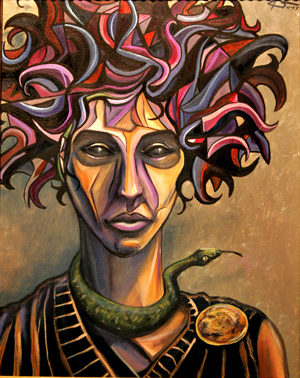
What Is This Thing Called Love? melds Delgado’s bent for muscular, cubist qualities, adventurous mosaic deconstruction and insistence on spontaneity in the creative process to the overarching theme of love in all its splendorous stages. Pieces such as Crying Couple and New Love both express different types or themes of love.
“New Love is a couple that are at the beginning of a new relationship, in love and in bliss,” explained Delgado. “Crying Couple is a married couple that are going through a hardship, but still together and leaning on each other for support. Both paintings have each couples’ heads leaning toward each other in a heart shape, representing that no matter what stage or theme of love a couple is in, love is still love.”
His exhibition at La Raza is just one more in a series of well-plotted steps—beginning at childhood, through academic study at the Academy of Art in San Francisco—in an exciting and chameleonic evolution as one of the Sacramento area’s best known, and most revered Chicano artists.
Submerge had the chance recently to chat with Delgado about his many muses, his far-reaching approach to his work and his willingness to reveal the cogs of his craft.
Considering that you have the ability to excel artistically within a variety of media, does it hinder you, limit you or change your approach to creating when you are recognized mainly for your cubist work?
I have changed my approach quite a bit, and really started to listen to my collectors’ suggestions. If people are responding to a particular style more than others, then I make an effort to re-create similar paintings and prints in all of the mediums that I am capable. I basically copy myself in other mediums. For example, my angular and distorted cubist portraits are turning up in acrylic, oil, watercolor, gouache, pastel, linocut and woodcut. I would like to say that my clients and viewers are taken seriously when they recommend, “You should make more like that.” Of course, I am still being expressive and artistic, but I am just putting all other ideas on hold, and bringing to life something for which there is real demand. I thoroughly explore and present my popular styles in the front room, but also continue to experiment and be radical in the back.
How big of a role does spontaneity play in your art now compared to when it did, say, when you were in school, or before you attended art school?
In art school, creative spontaneity was a necessity to break up the monotony and strict regimen, and sometimes it even led to an artistic breakthrough. But most of the time my aimless experiments led to improvisation, which led to uncertainty, which oftentimes led to a mess. Looking back, I see the art of young man wanting to be a painter, but not wanting to paint. As a young artist, I rejected the idea of setting out on a painting with a preconceived notion of what I was going to paint.
As I matured and became more grounded in what I was trying to say, I felt that the spontaneity in my drawing was still a useful ally in creating an image that is purely derived from my intuition and my artistic instinct. Also, the distortion and intensity tended to be more passionate and truthful. More recently, armed with a concept and style in mind, I find myself going up to the blank canvas and drawing a purely automatic explosion of quick, bold, decisive outlines. Then, over the course of weeks or months, bringing to life and resurrecting my original idea. My most current work is a delicate balance between pure chaos and careful analysis while still being personally relative. The radiating and intersecting networks of lines can be identified and retraced in almost every painting.

How did the constant inundation of expression while attending the Academy of Art University in San Francisco help to hone your art? Your short film suggests that there was a higher level of competitiveness. Do you feel or react to competition with regard to the creation of your pieces in any medium?
I feel that it is healthy for there to be a competitive nature among artists and teachers. I feel it humbles you and makes you more driven to succeed. Jealousy, self-doubt, rivalry, anxiety and resentment are all feelings that rush over every young artist as they look at other artists’ work. In art school, if I was looking at a painting that I really liked, then chances were very good that I didn’t paint it.
It seemed at the end of every drawing session the crowd collectively chose the best artist by simultaneously circling the easel of the person who made the best work for that day. Surprisingly, the best art is not always the most realistic or fine”¦but sometimes just the most interesting or radical. People wanted to see what you could do differently than the rest of the class.
I have set and maintained a competitive nature in my work ethic, my principles and my business practices to this day. Not that I am the best artist by any means, but you better earn that title. I know I am.
Of what importance is it to you to make sure people who see your work understand it? At what point do you (or do you not) toe the dichotomous line of making art for others and making art for yourself?
I want people to understand my art if they are willing, but more importantly I want people to have a reaction to it. They can love my art or hate it, thinks it’s the best, craziest, or ugliest art they’ve ever seen. If they have an opinion and an emotional response, then I feel I did my job. I want people to understand it, so I try to make myself available for questions. At the same time, I don’t tell them what to think.
What Is This Thing Called Love? Interpretations by Raphael Delgado runs through Feb. 27 at La Raza Galeria Posada (1022 22nd Street). Wednesday, Feb. 3 will feature an Artist Talk with Raphael Delgado, interviewed by Michelle Alexander, Executive Director of the Sacramento Arts & Business Council at 7 p.m. For more info, visit www.larazagaleriaposada.org or artbyraphael.com.