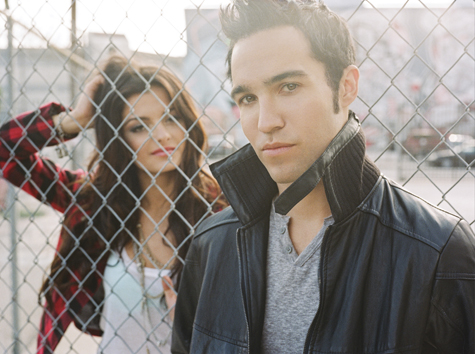
Black Cards proves Pete Wentz has many tricks still up his sleeve
Pete Wentz has become synonymous with energetic, slightly emo pop-punk–not that there’s anything wrong with that. It’s not difficult to understand why. As bassist and lyricist for Fall Out Boy, Wentz helped pen songs such as “Sugar, We’re Going Down” and “This Ain’t a Scene, It’s an Arms Race” that propelled his band’s albums into top 10 rankings on the Billboard charts and garnered the band some hard-earned Platinum. Since 2009, however, Fall Out Boy has been on an indefinite hiatus, leaving Wentz to focus on other things, such as being a label owner, entrepreneur and father. Black Cards is Wentz’s first foray back into music since Fall Out Boy took a vacation, and taking his prior output into consideration, it would logically follow that his new band’s music would be reggae-tinged British-style electro-pop music. Wait…you mean it wouldn’t? Well, I don’t know what to tell you. That’s how this shit works out sometimes.
Wentz started Black Cards out of a desire to do something different. He said in a recent interview with Alternative Press, “I’ve watched people when their bands are on hiatus or whatever it is, and they have the itch to do something, but they don’t really do anything that differently. It makes it all the more easy for people to be like, ‘Well, why doesn’t he just do his [main] band, then?’” But the desire to do something people wouldn’t expect from you and actually pull it off are two entirely different things. Wentz had to go outside himself in order to make it a reality.
The first piece of the Black Cards puzzle was Sam Hollander. A producer and songwriter, Hollander has worked with a wide array of artists from Coheed and Cambria to rap group Arrested Development (he also worked with Gym Class Heroes, who were signed to Wentz’s label Decaydance). Wentz told Submerge that it was Hollander’s encouragement that got him into the studio in the first place post-Fall Out Boy.
“After FOB went on ‘hiatus’ I wasn’t really sure what I was going to do,” Wentz shared via e-mail. “Sam hounded me to come into the studio over and over, but I thought I wasn’t ready. He just convinced me that even if nothing came out of the process I should have a place to let out my energy. As soon as we got in the studio together, it felt right and Black Cards stemmed from that. Sam’s a good friend who knows how to spark my creative side without me even realizing it.”
This new “spark” urged Wentz down a decidedly different path. Instead of penning anthemic rock choruses, he was at work creating his take on Jamaican roots reggae mashed up with the electro pop sensibilities of artists like Lily Allen. Under the guise of Black Cards, he said he’d have the freedom to express things he may have not felt comfortable doing with Fall Out Boy.
“Well after doing something for a number of years–especially with people watching–things are expected of you, and I really feel FOB fans came to expect those type of lyrics and songs from us,” Wentz said. “With Black Cards I really get to start over, be all over the place and it’s OK. I hope fans just take to that and enjoy something new.”
Lyrically, Wentz was looking to get out of his own head. Fall Out Boy’s lyrics tended to be personal. With Black Cards, Wentz is able to look outside himself, and he said that the experience so far has been liberating.
“It’s fun to escape and just be creative,” he said. “You are always the party and everyone isn’t invited: that’s been a hard concept for me to understand. Sometimes I have to learn to give myself a chance to just be me and not worry so much if everyone else is doing OK.”
With a new direction musically and lyrically in place, Wentz needed to find a new voice. Enter unknown Staten Island, N.Y., singer/songwriter Bebe Rexha, whom Wentz heard singing by chance at Hollander’s New York City studio.
“It just clicked when I heard her singing,” Wentz recalled of his first encounter with the young vocalist. “I told Sam that she’s the one we had to work with.”Â
Wentz said that Rexha is sort of like his “battery sometimes.” Her youthful energy hasn’t been bogged down by years in the spotlight. Not only is she a fresh voice for Wentz, but a fresh perspective.
“It’s impossible for her curiosity and excitement about everything not to rub off on me,” Wentz explained. “I definitely feel like the big bro teaching her the ropes and she’s a sponge.”
Writing for a female vocalist also provides Wentz with a new challenge–albeit an enjoyable one.
“Its hard to picture myself outside of my own mind in general,” He said. “It’s especially hard to think as a girl from Staten Island. It’s been a fun challenge that is different than anything I have ever done.”
As of now, no release date has been set for Black Cards’ debut album. Though the band has unveiled a few songs here and there, including “Club Called Heaven” and its accompanying Bonnie and Clyde style video. Wentz has hinted in the past that the album is done, but it seemed from our correspondence that nothing is entirely set in stone just yet.
“Every day we think we’re finally done and every day we think of a way to make a line or melody better,” he said. “We’re still getting to know each other so we’re constantly finding differently ways to execute a lyric or switch up a beat. We just want to make sure the album is 100 percent what we want it to be so I can’t make any promises on when it’ll come out.”
Even the title is up in the air as Wentz said he comes up with a new title each day. However, given the serendipitous way Black Cards was formed, you should shed any expectations of how it should turn out and just enjoy the result, whatever it may be.
Black Cards will play District 30 in Sacramento on July 3, 2011. The event will feature a live performance from the band and a special DJ set by Pete Wentz. There is no cover charge if you arrive before 11 p.m., and drinks are also half-off before then. For more info, go to District30sacramento.com.
Emo Kings or Underdogs?
Ready for more from the “Kings of Emo?” Fall Out Boy’s fifth studio album, Folie à Deux, was released Dec. 16, 2008. Translating to “A madness shared by two,” the album title may be more fitting than intended. It seems their music incites a sort of madness both among fans and critics. Critics love to throw around terms like “sell out” or “overproduced,” claiming either that Fall Out Boy has strayed too far from their characteristic sound, or that they’re simply catering to the masses and aren’t offering anything new. Others feel that Fall Out Boy’s new album demonstrates the courage to take risks and experiment with new sounds. Whatever the reason for their popularity, fans can agree on one thing: bassist Pete Wentz made “guyliner” famous.
The band isn’t worried that the public is completely divided about their music—they embrace the controversy. “I don’t care what you think just as long as it’s about me,” Fall Out Boy declares in their new single. Guitarist Joe Trohman explains, “It’s good to be polarized”¦the love on the one side and the hate on the other side. I think that’s the only way to stir up real thought-provoking conversation and real emotion.”
With roots in the Chicago punk scene, Fall Out Boy formed in 2001. They are Patrick Stump (vocals and guitar), Joe Trohman (guitar), Pete Wentz (bass) and Andy Hurley (drums). They put out their first major release, Take This to Your Grave, through a small-scale Wisconsin production company, but quickly signed with Island Records in ’03 and are now seeing astounding success. Although their music is often referred to as a “guilty pleasure,” these kings of emo are now a musical force to be reckoned with—love ’em or hate ’em.
In the typical way of indie music fans, not everyone was happy when Fall Out Boy left their independent label behind. “It’s a very juvenile way to go about things, but once we got on the major label [some people] were probably like, fuck this band. So I’m sure we lost some people to the wayside,” Trohman explains. The band had little reason to worry, as From Under the Cork Tree—their 2005 major label debut—sold well over 2 million copies.
“Although we’ve been changing musically—and in my opinion organically—from record to record, we’re still the same band,” Trohman explains. “I think most of our fans are smart enough to know that whatever label we’re on doesn’t dictate how ‘cool’ the band is.”
Fall Out Boy is enjoying the ride and all that fame brings—in their case, this includes a signature instrument for every band member. If you’re a die-hard Fall Out Boy fan, you have your choice of the Patrick Vaughn Stump Signature Series Gretsch STUMP-O-MATIC Electromatic Corvette Guitar, the Squier by Fender Pete Wentz Signature P Bass, the Vic Firth Signature Series Andy Hurley Drumsticks or the Joe Trohman Washburn Idol (which is rumored to be very difficult to smash onstage).
Trohman also has been experimenting with heavier rock and metal music on the side. “I’m more influenced by the heavier classic rock bands, like Zeppelin and Sabbath and Cream. I think I take a lot from some of their riffs and ideas,” he explains. He’s been interviewed by numerous guitar publications, such as Modern Guitars and Ultimate-Guitar. Despite rumors of an upcoming release, Trohman’s first loyalty is to the band. “One day [my music] will see the light of day, but Fall Out Boy is my main goal, 100 percent”¦ As long as there’s work to be done with Fall Out Boy, that’s where my heart is going to be. ”
As is appropriate for the unofficial Fall Out Boy spokesperson, Wentz has his own record label, Decaydance, and works with bands like Panic at the Disco, Gym Class Heroes and The Academy Is”¦ Although Decaydance is commonly thought of as a Fall Out Boy side project, Trohman explains that it’s mostly Wentz’s venture. “We support it a ton, which is why I think it comes off a lot like we all sit down and find bands for the label,” he explains. “It is kind of part of the Fall Out Boy world, but it’s more Pete’s bag.”
For those who dismissed Fall Out Boy after being bombarded with overplayed emo-pop singles like “Dance Dance” and “Sugar, We’re Goin Down,” it might be wise to give Folie à Deux a fair listen before writing the band off as just another teen icon. “It’s collectively probably our most favorite record, because it’s new and it’s our best collection of songs,” Trohman explains. “We did some experimenting.” In addition to the expected angst-y lyrics and bubblegum beats, Folie à Deux boasts new territory—R&B harmonies, jazz melodies and some heavier guitar riffs. “There are places we meet up and there are a lot of places we differ as far as musical tastes. I think that is what is able to help make Fall Out Boy have a better sound,” Trohman explains.
This album retains much of what Fall Out Boy is famous for, such as catchy tongue-in-cheek lyrics that thrive off of puns: “My head’s in heaven, my soles are in hell,” they write in “W.A.M.S.” They also still love to refer to “the scene,” making light of their own place in the fickle music kingdom.
What is missing from the new album is the ultra-long song titles characteristic of earlier albums, such as the infamous song, “This Ain’t a Scene, It’s an Arms Race.” With the exception of the song “Headfirst Slide into Cooperstown on a Bad Bet,” these newer songs feature two- or three-word titles.
Still, some fans aren’t going to embrace the new album. Fall Out Boy understands that within the music scene, you simply can’t please everybody. “I feel like sometimes people just complain to complain,” Trohman says. “Your personal art is going to look and/or sound different to you than other people. Some people may interpret it just as the same old thing because it may have that sense of you in it, but those who really pay attention may see the differences. And then there’s other people who see the differences and hate it off the bat because it’s different.”
Luckily they still don’t take themselves too seriously, and pride themselves on a kind of “underdog” approach to fame. Fall Out Boy claims loyalty to their fans and their music first and foremost, refusing to be taken in by the limelight. “It’s weird, we try to really focus on our fans and the music and not necessarily on getting to the top and saying, ‘We’re the best, we’re the most awesome, fuck all you guys,'” Trohman says. “Fans own us, the people that love us own us, basically. No matter where we go, we’re going to definitely kind of cater to our fans.”
True to their word, Fall Out Boy keeps their fans informed of their every move through multiple Web sites, where they answer questions about anything and everything—from wondering why they use the word “Pavlovian” as an adjective in their lyrics, to questions about which of the guys is the funniest when drunk. You can even get a Fall Out Boy widget, if you really want one. They love their non-fans too—make your opinion about Fall Out Boy public at Friendsorenemies.com, where both fans and critics can rant and rave about the band. Also check out Falloutboyrock.com and Myspace.com/falloutboy for the usual band info, and Decaydance.com to learn about Wentz’s production efforts.
With album sales soaring and fans eating up their every word, what do the self-proclaimed underdogs do if they actually make it to the top? Trohman laughs, “I think if we ever make it there, we’ll probably get torn down and have to work our way back up again.”