
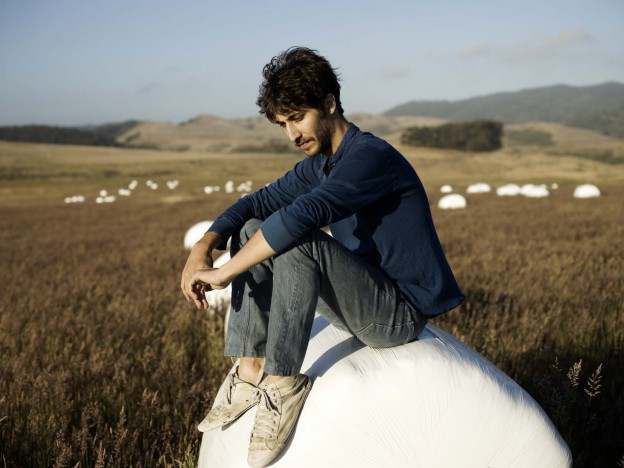
Renown Sacramento Producer Raleigh Moncrief Steps Out from Behind the Boards for His New Solo Album
A fine piece of apothegm to live by is, “you’re only as good as the company you keep.” Look at Ringo Starr. He got by with a little help from his friends, who happened to be the greatest musical minds of his time. A relevant and localized example is producer Raleigh Moncrief, who’s collaborated with Zach Hill, toured in Marnie Stern’s band and co-produced/engineered one of the most unanimously lauded albums on a national scale in the past two years.
If he lived in Brooklyn, he would get accosted by hipster vermin at every DIY show he attended. Living in Sacramento means relative anonymity, even indifference to an extent, which allows unlimited hideout time to craft a solo record while producing for the budding local bands. A hermit’s life is how creative-types get things done, and for Moncrief it means recording in his kitchen with an acoustic guitar and laptop at odd hours between sessions with Ganglians and Teddy Briggs of Appetite.
Moncrief is one of the few “behind-the-scenes” guys that has his name shouted out in press releases and in print. Contributing to Dirty Projectors’ Bitte Orca record plays a significant role in that, but this year alone he’s recorded a Ganglians record, the Appetite record and an EP with Cuckoo Chaos–those are just the ones released. Last year he sporadically released free digital beat tape EPs and remixed a few local rap artists. Without hearing Moncrief’s solo debut Watered Lawn, one might assume he’s scatterbrained or has A.D.H.D. when it comes to music, but over the phone he cleared the air with, “I like to work fast and get it out of my face or my mind.”
Listening to the advance of the Anticon debut, the many faces of Moncrief begin to blur. Even my iTunes player struggled with defining Watered Lawn, by anointing it “New Age”–the dishwater of music genres. When I shared this curiosity with Moncrief, he replied through laughter, “How the fuck did that happen?”
Defining Moncrief’s music can be quizzical; a task he sidestepped by casually stating, “That’s not my job,” but the record is not beyond comprehension. The title itself suggests a project well tended and cared for, which is properly delivered in the 38-minute duration. Written in the three-month span of December through March, Watered Lawn is the amalgamation of Moncrief’s flighty interests in mainstream hip-hop production, a bit of leftover 8-bit intrigue and his various indie collaborations whittled down into 11 songs. Last year’s Carpal Tunnels beat tape introduced Moncrief as a hip-hop producer, but as time wore on the sound began leaning toward chillwave and beat music associated with the Los Angeles scene. In our interview, he offered a slightly alternative progression.
“In my mind I owe more to mainstream hip-hop,” he said. “It’s kind of weird because I don’t really listen to that beat music so much. There are elements of it I really like. It’s really about the low end. That’s something I took away from that [scene]. But I think that T.I. was more inspiring than the beat scene.”
By March he leaked “Lament for Morning” to the blogs, which ushered in the first glimpse of a newly discovered identity. The track made sense in fluidity of past work, but the release of “I Just Saw” in late August broke his vocal silence and hinted at a friendly influence. On the track, Moncrief is twitterpated by a female vision, stretched to a joy of singing without concern to his voice’s limitations. It is a singing style often attributed to David Longstreth of Dirty Projectors.
“I can’t help but be influenced by everyone I’ve worked with,” Moncrief said. “The main thing I took away specifically from working with Dave was exploring those outer limits. Being someone who’s not afraid to go to a place that is uncomfortable for yourself. Being brave and having the courage to try something that you’re not going to be confident in is valuable.”
Tracing back to his days in instrumental post-rock bands What’s Up? and Who’s Your Favorite Son, God?, Moncrief was the silent axe man, which continued into his project with Zach Hill and playing alongside Marnie Stern. While recording his debut he described the urge to sing as something growing in his mind, a new challenge to go along with his newly discovered production style. “I’ve written things and had other people sing them,” he said. “It reached a point where it felt like doing it myself was something I needed to prove I was capable of.”
“Lament for Morning” was the first leak, but the track that was his breakthrough was “Cast Out for Days,” which achieves a balance of the organic instruments (guitar and vocals) alongside warping glitches, flickering synths and programmed drums. “To me, [“Lament for Morning”] still sticks out like a sore thumb on the record,” he said. “Originally it was a guitar piece that was instrumental, but I didn’t know if it fit. So I just changed the guitar parts to vocals. That was my vain attempt at making it fit contextually.”
With new discovery can come bothersome uncertainty, but relating back to ol’ Ringo, one gets by with help from their friends. Moncrief had his share of butterflies. He sent his music out to the hodge-podge of contacts and friends he accumulated in the industry, including label heads at Anticon who initially balked at his beats. “I’d send them out to friends and say, ‘How does this make you feel?’
“I was looking for reinforcement because when you’re isolated like that it’s hard to have perspective,” he said. “Which is something good about the isolation as well. I got a lot of good feedback that helped build confidence in pursuing the change, because it’s a pretty big departure from most everything I’ve done previous.”
Oddly enough, it took a blog post instead of a personal e-mail to get Anticon’s attention. The label head contacted Moncrief and offered him a record deal. The label even sent Watered Lawn to Los Angeles to be mastered by Daddy Kev, owner of Alpha Pup Records and founder of Low End Theory, a weekly club night featuring experimental hip-hop–ask any Low End theorist or resident and they’ll say it’s an honor to receive his visionary stamp of approval. Raleigh could only say in approval, “He made it loud. Good work, Daddy Kev.”
The record awaits an Oct. 25 release date, but Moncrief is not taking a breather from issuing personal challenges. He has a few California tour dates, mostly coastal, scheduled sooner than he’d probably prefer. It will be his first opportunity to debut his songs, as well as perform with a four-piece band, which was lacking completion at the time of our interview. “It’s short notice,” he said. “It’s coming together well, but there’s still a lot to be done before I’d feel confident performing, which is funny because I think there’s a show in two weeks? Three weeks?”
As sketchy as he said he felt, it also seemed as though the pieces would fall into place regardless. Moncrief lamented it was tough to find people to play, but perhaps he will call in a few more friendly favors.

Look for Watered Lawns from Anticon Records on Oct. 25, 2011.