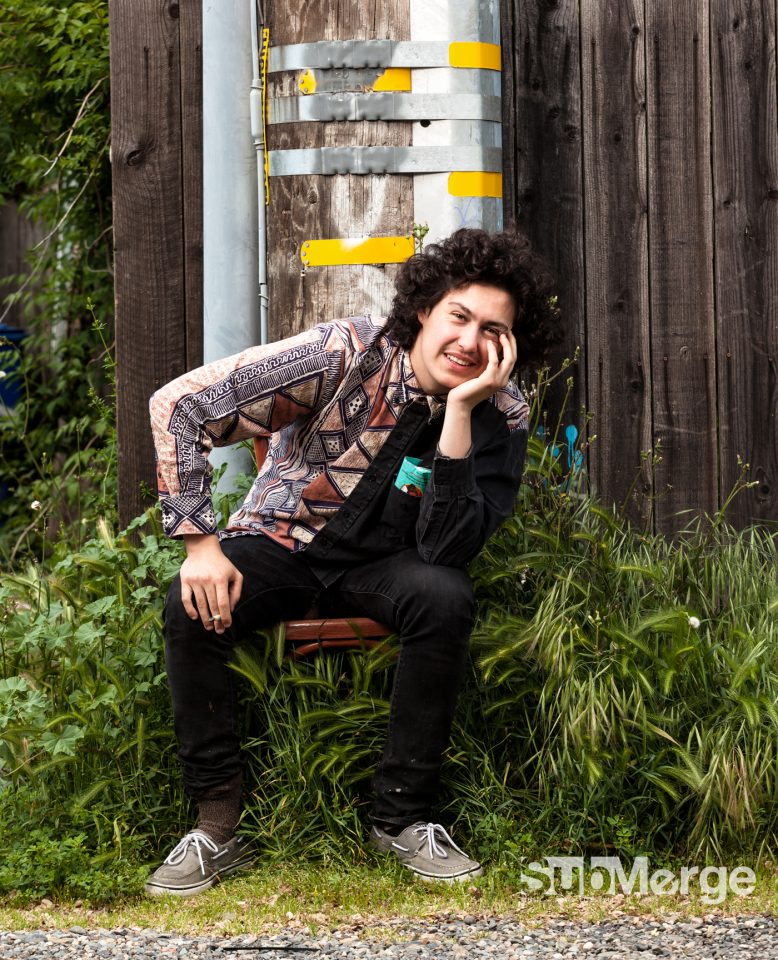
Let’s be honest here. I’m greedy. I wanted to write the first Hobo Johnson (né Frank Lopes) story. Like many others, after watching the “Live From Oak Park” series of videos on YouTube, I was hyped, instantly fascinated by the young rapper, whose stuttered, offbeat style often jumps from Conor Oberst to Sole in a matter of one breath. There’s something about his delivery—confident, yet totally unsure; joyful and angry; polite, but crass; rational and completely insane—that reveals an actual personality behind the music. Hobo Johnson’s candid style cuts through all artistic pretensions and allows the MC to actually articulate heavy (sometimes brutally funny) ideas without having to bare the weight of the label “conscious rapper,” which once could be worn as a badge of honor, but now is simply the shriveled detritus of ‘90s-era hip-hop. Well, I wanted to show the world this young artist who is surely destined for greatness, but, instead, I listened to an audiobook about extreme altruists, then caught up with the new season of Catfish, then watched a documentary about pedophiles, and a bunch of other writers beat me to it.
Bah, Macias
Enter Chris Macias, a journalist who writes for the Sacramento Bee. He always writes the first big stories. I’m sick of it. But I’m also insanely lazy and apparently not fed up enough to actually seek out new artists and interview them before he does. In fact, I’m so lazy that I called upon the award-winning journalist to help me with this story:
“How should I start it?” I wrote in a desperate email.
The kind-hearted Macias responded: “You should start by name-checking everyone who wrote about Hobo Johnson before you, and how since you became a dad you’re pretty much out of touch with all music, except what’s played on Sprout TV.”
That would require waaaaaay too much research and I’m not into that kind of shit. Plus, I don’t know what Sprout TV is, so I can add “fatherhood” to the list of things he beats me at.
Honestly, I just like listening to artists and then babbling about them and then collecting a paycheck at the end. But for this story I actually met up with Hobo Johnson at the Old Soul in Oak Park, where, unbeknownst to me, the 22-year-old MC used to work (and then quit with a bit of melodrama).
“This is where everyone asks to come,” he says. “But then we were in the Sac Bee and I came to pick up a copy real quick and I saw my old bosses and they got mad at me. My boss here was like, ‘You’re a piece of shit.’”
But, to be fair, he quit the second he signed a management deal with some big shot in Los Angeles. If I got a management deal, I would quit everything, leave my family and never wear clothes again.
“Working, to me, is the fucking worst,” he says.
Amen.
No safety net
Working is the worst. The only thing that matters in this dumb world is to live your goddamn dreams, even if there’s a 99-percent chance of them dying a horrific death right in front of your blinking eyes. Hobo Johnson is going for it. Without a backup plan, the rapper is relying solely on his music to make money.
“I just play shows and sell merch,” he says. “But with the festival season coming up, I should be good. Rent is dumbass cheap.”
I have confidence in this plan. There’s something about his oddly hilarious songwriting style that is suspenseful, wickedly smart and endearing enough to sustain a long career in the arts. Check out these lyrics: “Hey missus, will you take me to a world where nothing else exists except the contents of our soul / If I looked like Brad Pitt mixed with a bit of Jake Gyllenhaal and a bowl of David Hasselhoff I wouldn’t be here at all / I’d be in Los Angeles / Or at your mom’s house. Eating all the sandwiches.”
See? Hobo Johnson is a character, and not the gimmicky kind. He’s a larger-than-life personality. Even his diction, the way he says words, is really weird, but it’s something that sticks with the listener.
“I talk like that, too,” he says. “Like I’m kinda always about to fuck up a sentence. It’s just part of who I am, I think, just the unsureness of what the fuck I’m saying.”
That unsureness, the willingness to show vulnerability, works. Even my nemesis, Chris Macias agrees. “[H]e’s the kind of rapper who could actually do a guest slot on Yo Gabba Gabba, which is even better for old dad bros like us,” Macias writes in his email. “Listening to Death Grips now just hurts my feelings.”
Man, I wish I would have come up with that.
A visit from Jesus
Anyway, from his humble beginnings as an open mic MC who could only draw four people to a show to now, where he, along with his band, The Lovemakers, can draw a crowd of 450, it will surely be interesting to track the journey of Hobo Johnson. And believe me, it will be tracked, seeing as this is like the 90th story about the guy. But here is a story that nobody else has. It’s about the ill-fitting PT jacket he sported in all those “Live From Oak Park” videos.
Hobo Johnson recalls: “A few days before we shot the videos, I knew I needed to get a jacket and I wanted a speaker system for my turntable. I looked on Craigslist for one that morning. We go to my friend’s house and we practice and we go out to his car and right in front of his car on 44th Street is that PT jacket and a speaker system with a receiver. And I’m like, ‘This is from Jesus Christ.’”
So there you go. Jesus Christ Himself dropped down and paid a visit to Hobo Johnson. Eat it, other stories.
Anyway, I don’t know how to end this shit, but, luckily, Macias (like my own, personal Jesus), tells me what to do:
“Be sure to drop the details of his next show.”
I don’t really know when his next show is.
“[B]ut … you probably won’t be there because you’ll be teaching your son how to play catch and hopefully steer him away from the idea of being a rapper.”
Screw you, Chris Macias. Screw you.
Check out Hobo Johnson and the Lovemakers live when they perform at this year’s First Festival at Riverwalk Park in West Sacramento. This two-day festival will take place on May 6 and 7, 2017, (Hobo Johnson’s set will be on May 6). Headliners include Arden Park Roots and Oleander, with sets from Some Fear None, DLRN, The Moans and many others. For a full lineup, or to purchase tickets, go to Firstfestivalsacramento.com. Hobo Johnson and the Lovemakers will also play Concerts in the Park on June 30, 2017, at Cesar Chavez Plaza. Check out one of Hobo’s videos from the “Live From Oak Park” series below.
Sacramento Bee food and wine writer Chris Macias recently reported that Kimio Bazett and Jon Modrow, the duo behind one of Submerge’s all-time favorite Sacramento bars/eateries, Golden Bear, recently signed a lease on the space that used to be Hangar 17, which shut down in March. They expect to open their new spot (which has yet to be named) by February, so keep your eyes and ears out for updates on that. Bazett and Modrow are great guys; they are smart, hardworking and dedicated and we here at Submerge could not be more thrilled for their next endeavor!
“It kind of lit a light bulb in me, I started doing a little bit of research, back before we had access to computers, so a lot of it was going to the library,” Villegas said while sitting in the Viewpoint Photographic Art Center in downtown Sacramento. The little “light bulb” in his head would soon lead him to photographing some of the most influential blues musicians in the world. During his off time from his day job at the newspaper, he would be in contact with representatives of musicians that were coming through California and tell them about his vision.
“Little by little the doors began to open,” Villegas said. “And outside of some of the concert pictures, my real goal was to get access to photograph some of the activity that took place backstage and just try to get a little slice of what life was like for an older musician.”
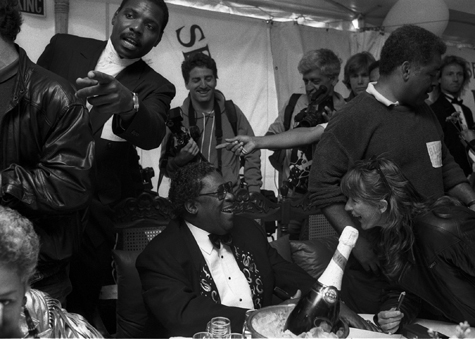
BB King - Concord, California 1991
Throughout the years, starting in 1991, Jose has captured various moments in the world of blues music that isn’t just another concert image–it’s “appreciation” of blues music. For every photo displayed throughout the gallery, there is a moment frozen in time with an experience, an encounter or a performance with legendary musicians. “Some of them were very comfortable with where they were in their lives and were more interested in just playing the music,” he said. “And were more taken by the fact that people were still interested in their music, this many years down the line.”
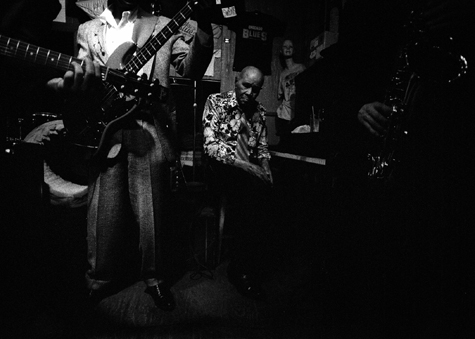
Each memory and story that Villegas has about his blues experience can be clearly seen in each of his photographs. He vividly remembers that blues legend John Lee Hooker liked to have attractive young women at his side. He remembers the type of “aura” that B.B. King had when he was in his hotel room while surrounded by reporters or at a party where King was the center of attention. He recalls talking to Sunnyland Slim, a man in his 80s who was still performing a 45-minute set and remembers the way he was “slouching a little bit in his seat” at a night club.
Sunnyland Slim - Chicago, Illinois. 1992
“The image was already there,” Villegas said. “And [the moment] happened several times during the course of the night. It was just a question of whether I recognized the moment and was able to compose it the way I wanted to.”
All of these memories are now black and white and color photographs for the Save the Music exhibit at the Viewpoint Photographic Art Center in Sacramento. The gallery of photos will give you a glimpse of the experiences of blues musicians with scenes from concerts, birthday parties and backstage chats. “I would hope that the photographs would speak for themselves,” Villegas added. “[People] get to see the artists more as people who enjoy what they’ve been doing for a long time.”
One photo in particular, of the more popular, Charles Brown–a blues singer in his 70s who was living in an elderly home then rediscovered by Bonnie Raitt–was taken in 1991 in Monterey, Calif. The photo has an up-close and personal feel; it almost feels as if you are sitting right next to Brown watching him play.
Charles Brown - Monterey, California 1991
“In journalism or in street photography, I think the idea is to try and get yourself in a position where you can document a moment in time that hopefully will translate to somebody else as if they were there,” Villegas said, standing in front of his photos. “A moment that is spontaneous, that has captured a little bit of emotion, a feeling, and if I can get someone to feel something from that imagery, then I think I’ve accomplished what I’d set out to trying to do.”
The 51 year-old man who captured these “spontaneous” moments in his photographs is no stranger to the world of art galleries. Although this is the first time Villegas will be showing at the Viewpoint, he isn’t going to sweat during the exhibit opening because of previous experience including The Oakland Museum, Museum of Modern Art in Texas, the Baseball Hall of Fame in Cooperstown, N.Y., and the Crocker Art Museum in Sacramento. All of his photographs with the Sacramento Bee and from separate projects tell a story about the moments he has experienced during his life. “It’s been a really nice ride,” he said. “If anything I get real enjoyment of being able to share some of my work with other people who have interest in the subject matter.”
Save the Music is running now through June 4, 2011 at the Viewpoint Photographic Art Center, located at 2015 J Street in Sacramento. Gallery hours are Tues. through Thurs. from 12 — 6 p.m. and Fri. and Sat. from 12 — 5 p.m.
The ongoing battle between Viacom and Google entered a cultural quagmire as a judge on July 2 ordered the latter to hand over all records of every video ever watched on YouTube. Google, which owns YouTube, will have to release a staggering 12 terabytes of data (a terabyte is equal to 1000 gigabytes, which is a whole lot of iPods). The information includes user names, IP addresses and what videos were watched and when. A little icing on the cake: Google will also have to turn over all videos that have been taken down for any reason. Even some information regarding videos that are set to private will have to be divulged.
The lawsuit—combined with a similar lawsuit filed by the English Premier League (you know, soccer) and other parties—was filed in March 2007. Viacom is seeking $1 billion in damages for YouTube allowing its users to upload onto its servers copyright-protected material.
U.S. District Judge Louis L. Stanton (give him a call: (212) 805-0252!) presided over the ruling. He dismissed Google’s argument that turning over their users’ information would infringe upon their privacy as merely speculative. To add insult to injury, Stanton used Google’s defense of retaining all that data—which is how Google is able to make so much money and rule the Internet with an iron hand—against them in his decision. According to the Sacramento Bee, “Though Google said giving the plaintiffs access to YouTube viewer data would threaten users’ privacy, Stanton referred to Google’s own blog entry in which the company argued that the IP address alone cannot identify a specific individual.” Burn!
The Electronic Frontier Foundation, a nonprofit organization that “[champions] the public interest in every critical battle affecting digital rights,” called Stanton’s ruling “erroneous” and “a set-back to privacy rights.”
I don’t agree with the ruling. As one astute commenter (imagine that!) wrote on the Wired blog, “I don’t see any real need to disclose user identities and other personal information to a third party, especially when Viacom has no claim to the video. How does my personal information help Viacom determine whether a video is or is not its copyrighted material?” My thoughts exactly. Clearly, Viacom is after more than just a billion-dollar payday. The media giant also asked for “YouTube’s source code, the code for identifying repeat copyright infringement uploads, copies of all videos marked private, and Google’s advertising database schema,” according to the Wired article posted by Ryan Singel. I wonder what they could’ve wanted that for”¦
I don’t care if they have my user information or not. I have nothing to hide. Sure, I like to watch clips of scantily clad women shake it to the pop song du jour while I’m supposed to be editing this here magazine (those girls are of age, right?), but I’m sure that doesn’t make me a criminal”¦well, reasonably sure. I’ve never seen “Two Girls, One Cup” or “Leave Britney Alone” or even “Chocolate Rain,” so I have nothing to be ashamed of either.
We all had to know this was coming. It’s been a crazy ride on the information superhighway, but I’m sure more decisions like these are coming. There’ll be more regulations, too. The days of the Internet as the new Wild West are numbered. At least you can take solace in knowing that you’re not the intern who has to pore through all that data.