
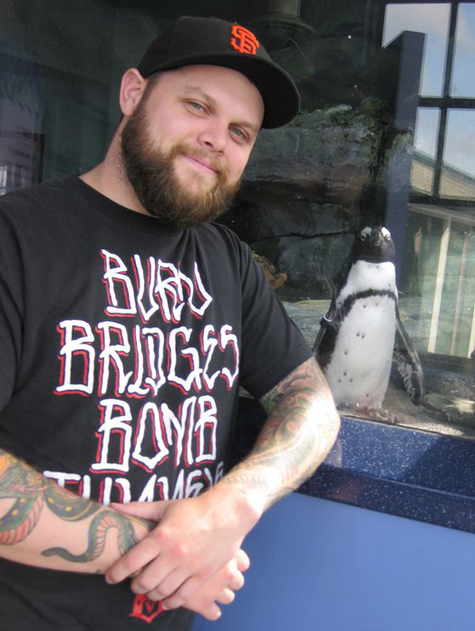
Major props to local punk-rock promoter and Bastards of Young bassist Sean Hills for putting together Punch and Pie Fest. With zero sponsor dollars the dude booked a week straight of amazing punk-rock shows from Aug. 15 through 20, 2012 (with the pre-party happening on Aug. 14). Catch touring bands like the Hot Water Music-esque Red City Radio from Oklahoma City or Continental from Granite City, Mass., which features Rick Barton from Dropkick Murphys. Also of course there will be tons of local faves like the aforementioned Bastards of Young, Kill the Precedent, The Secretions, City of Vain and others. There are more than two-dozen bands in all, and the shows go down at either Press Club or Luigi’s. Get out and support your local punk scene! To view the entire schedule, visit http://www.facebook.com/PunchAndPieProductions.
Tag Archives: Sacramento punk
PUNCH & PIE FEST 2012
Street Punk Solidarity
Madhouse Disciples proof positive that hard work, and doing what you love, always pay off
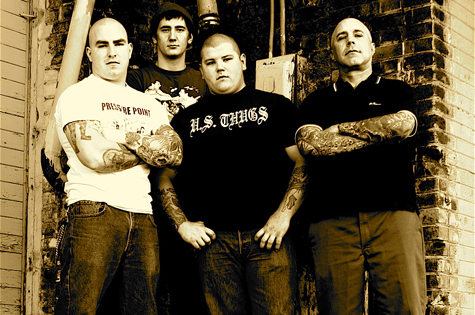
Despite what you may have learned from watching the troglodytes on The Jersey Shore, working for a living hasn’t completely gone out of style. Most of you probably do it every day, schlepping from job to job, making ends meet–you know, basically working-class life in America. The members of the Sacramento-based punk band Madhouse Disciples do it too, but unlike many of us, in their off hours, they fucking rock.
Starting as a three-piece, the street rock/Oi! band formed in 2003. In that time, members have come and gone, but as of now Madhouse Disciples stands strong as a tight-knit four-piece ready, at long last, to release their debut full-length album. Mike Montero, Madhouse Disciples’ drummer, is the sole founding member of the group. But he says no matter how many personnel shakeups there may have been, he never felt the need to stray from the band he formed or playing the music he loves.
“We play street rock ‘n’ roll, Oi!,” Montero says. “That’s what I love, that’s what I’ve grown up on. The people who have came and gone in this band were also into that same thing. That’s one thing that all of our members have shared. And the name, I wouldn’t change it because I’ve been doing it since I was 16. It’s my baby.”
When the band parted ways with its vocalist in 2007, Montero turned to his cousin Brian Rawlins to fill in, even though he wasn’t the most obvious choice. Though Montero had fostered Rawlins’ acceptance into the Traditional Skinhead (read: working class, pro-union, anti-racism) subculture, and Rawlins was an avid punk show-goer, he had never sung before, at least not in front of a crowd.
“The only times I’d sang before that was in the shower or in front of family,” Rawlins admits. “So it was something I wasn’t very comfortable with.”
Rawlins came to join Madhouse Disciples under peculiar circumstances. Around the time the band’s singer had left the band, Rawlins was out on tour with venerable Sacramento punks Pressure Point, working as a roadie. One night in Elko, Nev., Mike Erickson, Pressure Point’s frontman, blindsided Rawlins with a severe ultimatum.
“Mike and some of the other guys were telling me that I had to do karaoke,” Rawlins recalls. “I was like, no, I’m not really comfortable doing that… Mike told me, ‘If you’re not going to do it, we’re leaving you here and you’ll have to find your own way back.’”
The threat of being abandoned in the middle of Nevada was all the motivation Rawlins needed. He nervously belted out a rendition of “Fortunate Son” by Creedence Clearwater Revival. However, his performance left enough of an impression on Erickson that he phoned Montero and told him he should consider Rawlins for Madhouse Disciples’ vacated vocalist position. Strangely enough, the thought had already crossed Montero’s mind.
“I already wanted to try Brian out because I’d known him forever and just thought it’d be fun, but then I heard he actually could sing,” Montero says. “Mike told me about that, and it just kind of clicked.”
With a solid group, the band went into the studio to record its first full-length album. Fittingly, Erickson served as producer. Montero says that financial concerns kept the LP from seeing the light of day, but in January, the band plans to finally release the record. Not only was he a first-time singer, but Rawlins also wrote lyrics for just about every song on the record–also a new experience for him. He did what any good writer would and just pulled from his own experiences.
“I write about things like working-class ethics, unity and anti-racism. I also write about things on a personal level that can also touch other people,” he says. “Coming from divorced parents, who also had a heavy drug abuse background, there’s stuff that I learned from that. It’s not a path I have to follow.”
At 12 tracks, the self-titled album is long on message, but also extremely entertaining–just good, honest rock ‘n’ roll with searing lead guitar work courtesy of guitarist Tony Courtney. Who said having a conscience and having a good time had to be mutually exclusive? In separate interviews, Montero and Rawlins broke down for us their experiences working on their debut record as well as living in the punk rock subculture.
Mike Montero
Did you have an inkling that Brian would be a good vocalist, or was it just because you had a good relationship and thought it would be fun to have him in the band?
One, because we were related and I knew he was a solid dude. Two, if you’ve ever met Brian or know anyone who’s met Brian, he’s got more energy than any human being alive. I thought if nothing else, he would have great stage presence. That was the basis for me wanting to try him out.
You recorded your first full-length album coming out soon. You worked with Mike Erickson from Pressure Point to record this album. I know you did a split with Pressure Point before, but what was it like going into the studio with him to record your own album?
Mike is a great producer. He has an amazing ear for music. We spent a lot of time in pre-production. We played those songs over and over, to the point we didn’t have to think about it any more. Mike was a big part of that. He kept us motivated and going in the right direction as far as being militant about practicing and getting so good with those songs that we could play them in our sleep. As far as recording goes, Mike was producer and Eric Broyhill was the engineer. We recorded it at the Pus Cavern. Eric and Mike have been working together for years, and those two together are a deadly combination when it comes to making music. They know what it should sound like as far as tones and everything. Once we got in there, we let those two figure out the tones we were going for. We gave them a small amount of what we wanted. We wanted to sound more like an old rock ‘n’ roll record, and they knew what amps would sound good, what guitar combinations and stuff like that. It went like clockwork, really. It came together like it was meant to be.
As a drummer, have you had to adapt to each new player coming in?
Not so much. With the kind of straight-forward rock ‘n’ roll stuff we play, the drums aren’t really supposed to be super flashy. There’s not a whole lot to change. The drums are just the backbone. It’s nothing real fancy.
You’re doing the CD release at a house show. Do you prefer those over shows at venues?
The venue to me isn’t really the point so much. I prefer to play all-ages shows, where the younger kids can get into it and have a good time. It’s a good positive outlook. You play bar shows, and often times there are a lot of people sitting at the bar who don’t care about the music. They just want to get drunk, and that’s fine. Whatever, that’s cool. You want to get drunk, get drunk. Typically punk and Oi! subculture has been a youth subculture. It has a lot to do with the younger kids. All-ages venues are more preferable. Our bass player [Dirty D] owns a house that has a great big shop in the back, and it’s totally DIY. We put a stage and a PA in there, and it’s a cool thing where this is our thing.
How did you get involved in the Oi! subculture?
It was a natural transition for me. I was a punk rocker. I had crazy hair and all that stuff. It got to the point where, “I can’t find a job if I look crazy.” I didn’t change any of my values in that sense. This is what I am. This is what I believe. I’m extremely anti-racist. I can’t stand that shit, and I’m extremely working class. It comes from my lower middle-class upbringing. I was taught that you work hard for what you get. That’s one of those values that I kept with me.
Your music is a lot of fun to listen to, but there’s also the message behind it that comes through very strong. Is the enjoyment or the message more important to you?
It’s a double-edged sword. In my opinion, in punk rock and Oi! music, the message is always more important than the music. It’s not like this new fucking pop bullshit that comes out that has no message or anything to it. There are definitely things that need to be said, and I think Oi! and punk music is where that stuff is said more than in the mainstream.
Brian Rawlins
Mike said he was already thinking of asking you before he heard from Mike from Pressure Point about it. Were you aware of that at all?
A little bit, but not so much. We kind of joked about it. When their split CD with Pressure Point came out, I was like, “Dude, you should let me sing in your band,” and my cousin said, “No dude. We already have a singer. Sorry. You suck at singing.” I’ve known him my whole life, so he’s brutally honest with me, but it’s all in good fun.
How did you feel when you got off that karaoke stage? Did it make you realize that you wouldn’t mind singing for a band?
No, I was terrified, to be completely honest. I was nervous and extremely embarrassed. With my friends, we have a saying that ball-busting is a sign of endearment, and I was preparing myself to get handed a bag full of endearment, I guess you could say.
How is it for you now? You’ve been with the band for a while. Are you comfortable singing in front of people?
It’s weird. I still get nervous, but that’s one of those things, I guess. It depends on the person. I still get the jitters. I prefer not to eat before a show, but that’s the same way I was with sports growing up–playing football. I didn’t eat before games, because I knew I was going to throw up.
Sports and punk rock seem like two different worlds.
Polar opposites.
How did you move from one to the other?
Well, as far as sports went, I started playing when I was 7. I played football all the way up until I graduated. I found myself not going to parties in high school, because I just didn’t find myself getting along with the “jocks.” It wasn’t because I had a beef with them or I hated them, but I just didn’t fit in with them. They could tell I was not one of their upper middle class brethren. I was from a poor family, so it was definitely one of those class differences.
You worked with Mike from Pressure Point on this record. Was he a big influence for you heading into the band?
Going to Pressure Point shows sucked me in pretty hard. Watching those guys play was amazing. Everything he said in between songs, and reading the lyrics, spoke to me on a different level. That’s when I realized it was something that mimicked my life already. It was an easy thing to take part in.
And now you’re working with him on this record, so that must be a big thrill for you.
For Mike to produce us was really awesome. It was fun. And he’s actually someone I respect, so when he suggested something, I wasn’t like, “Uh, I know what I’m doing.” It was really nice, because I could listen to his point of view and perspective and take a different look at things. He’s been doing Pressure Point for over 15 years, and it’s like, of course I’m going to listen to him with respect and admiration. Any advice that he had, I listened to with open ears.
Mike, your cousin, was saying that you spent a lot of time practicing the songs in pre-production, and that Erickson was a big reason for that.
Huge. Before we went into production, he said that he wanted us to be able to play them forwards and backwards–know them so well that we could go and hit it the first time and then work on any little things we wanted to do. You’ve got musicians like Tony in the band, who’s an amazing guitar player. It was fun. Practicing with these guys has always been fun. It’s never been like work.
Saving Grace
Kevin Seconds finds solace in music
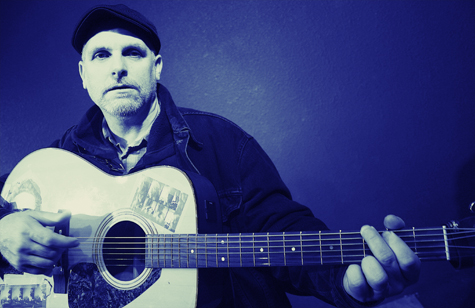
Listening to Kevin Seconds speak about his music, you’d hardly believe he’s been in the game for more than 30 years. Serving as frontman for 7 Seconds, one of California’s most seminal hardcore punk bands, you’d think the years on the road, spitting bile at the young and the restless would make him a salty individual, but that’s just not the case.
“We’re from the era of hardcore punk rock,” he says of his early days touring with 7 Seconds. “We would go out for two or three months straight, come back home for a month and then go back on the road. We thought that was the way to do it. At that time it was.”
Of course, as time marches on, things change, even for musicians. Children, marriage and the other trappings of adulthood eventually claim most of us–not that that’s a bad thing. Even the most unruly and defiant among us aren’t immune. Seconds has managed to change with the passing of time and not lose his edge, though the music he’s spending most of his time making nowadays is a far cry from the brazen punk rock of his youth. He stands as a perfect example that it’s possible to grow up gracefully in the music business and still have a good time doing it. When Submerge contacted Seconds, he was happy to report that he’d just received a text message from his label, Asian Man Records, that his latest solo CD, Good Luck Buttons, had come in.
“I was pretty excited, actually. After all these years of having different records out, it’s still pretty exciting to get word that the new CD is done,” he says. “It’s definitely one of those little thrills you get–realizing that something you’ve been working on for two years has come to fruition.”
It would seem that Seconds’ continued enthusiasm for his music has bled into his songwriting this time around. Good Luck Buttons, out May 11, 2010 bears a much sunnier disposition than its most recent predecessor, 2008’s Rise Up, Insomniacs! Seconds said a lot of Good Luck Buttons was written while he was on the road for Rise Up…, which had a big effect on the finished product.
In our interview, Seconds talks about how real-world stress got him down, and how he was able to find solace and brighter days by focusing on his music.
You did a lot of solo touring for your last record. Did those experiences have a big effect on your writing of Good Luck Buttons?
Yeah, definitely. Living in Sacramento, and I’ve been here a long time, Sacramento always inspires my writing–at least my acoustic stuff, because I got started doing the solo stuff here in Sacramento, playing open mics and coffee houses and stuff like that. This time around, I got to go to Europe a couple of times and toured around the States, and [the songs on Good Luck Buttons] definitely have a travel feel to them–at least in the way that I wrote. I would pull over, resting somewhere, and jot down ideas for a song. The last record was a tense, stressful record, because all the things leading up to that record coming out–it took me forever to put out. I had crazy back problems; I was dealing with our business going under. All this stuff was happening. It was more like, “Let’s get this thing done so I can get it out and be happy again.” This new one is a little more free-spirited. I think it’s a happier record, at least. The road influenced it quite a bit.
There’s a sunny vibe to this record, listening to it all the way through. There’s almost a pop feel to it.
That’s cool. I love melody and harmony. Good pop–I love it…unless you’re talking about Britney Spears pop. I love good melodic pop music. Even when I try to do one kind of thing so I can establish myself doing this kind of thing. I listen to gospel music, I listen to metal–if it pops up in there, I guess it’s bound to happen. It’s not an accident if it’s in there. [Good Luck Buttons] is more up-tempo and not as mopey-sounding as the last record.
You were mentioning the problems you were having with the business. Was it difficult to balance all your music projects while running the True Love coffee house?
It was. My wife Allyson and I ran the first location starting in 2001, and we were open for almost four years at that location, and I did some shows, and 7 Seconds did a couple of little road trips, but I decided it was going to be a big deal and that I should really commit to this and be a business owner. That was a big switch for me, because I’ve been pretty irresponsible for most of my adult life. I’ve just been able to get in a van and go, you know, and not worry too much about paying rent and paying bills, but I learned a lot from it. It also brought stress in my life. I was having panic attacks every other day. This was the first time in all the years I’ve been on Earth where I’ve been responsible…
We closed on a high note, we were doing the best we’d ever done, but we had a horrible relationship with our landlord, and we couldn’t renegotiate with him because he was being such a prick. We said, “Instead of dealing with this, let’s shut it down for a while, and if we want to do it again, we’ll do it at another venue.”
In that time between the first and second True Love, I purposely filled up my calendar with as many shows and tours that I could. It was great getting back to something I knew and that I’d been doing since I was 16, but as you get older, it takes a lot out of everything. When I was 20, I could get in the van for three months straight, but now it’s like, I love these guys, but come on.
But I’m still good at touring, and I love traveling. When you go to other cities and other countries, your brain and your heart change. You can’t be the same person you were when you come back. You look at people differently, you look at food differently, you look at art and music and film differently. If I don’t have that, I feel like I’m working at half-power. At the same time, it was really gratifying being a part of and running a place that meant something to Sacramento. It was a little more than just a coffee house. It was a hub for the community. It was nice to give that to Sacramento. Allyson and I talk about it like, “Are we crazy enough to do it again one of these days?” We probably both are.
The title of the album comes from the song “No Good Eggs.” Was there a reason you picked a line from that song in particular?
Titles are really hard for me. I try to stay away from the most obvious things, or what I think are the most obvious things. Whenever I sing the line, and Allyson sings that with me live a lot, and I think just because of her harmonies, it really resonates with me. I’m not really sure if it has a meaning or if it’s a good title or not, but it just stuck out, and I liked it a lot. The last record, now that I look back on it, was such a downer, and it seems like I was trying to make it a downer. A lot of stuff was going on, I lost a lot of really close friends, Allyson and I were having problems, so I had to fill it up with a lot of negative stuff to get it out of my system. Good Luck Buttons seems like a harmless, meaningless title–no huge meaning, but I guess it just came down to thinking it sounded cool.
It definitely fits the songs. One song in particular that I really liked was “Sunday Afternoon Bicycle Polo.” Where did the lyrics for that one come from?
I had this space that I turned into a studio. I did my paintings there, and I also did some recordings there. It was over near 19th and X streets. I had it for a few months. In fact, a lot of the stuff on the last record was recorded at that little studio. One day, I was not having a good day. Nothing was coming together. I was bummed at myself for wasting time and not getting anything done. I looked out the window, and across the street was an overpass for the Capitol Freeway, and there are these big concrete patches of property. There were these kids out on the concrete playing bicycle polo, and I thought it was funny because they were these young, hip kids. At first, I was really annoyed by it, like, “Look at these fucking hipsters. Who do they think they are?” Then I realized, it made this thing change in me like, “Why are you being this old, cynical prick?” It’s kind of cool that they’re out there doing it. It’s nice and warm. What I always do with songs is that I’ll have an idea for a song, and then in the middle of it, it just changes. All of a sudden it became this love song about someone I know. She’s a great person, but she’s always on the outs. She’s always trying to be a part of something, but she can’t quite fit in…
In the bio you sent us, you were sheepish about 7 Seconds’ influence on younger bands. You made a joke where you apologized if your band had had any influence on younger bands. Is the influence you’ve had on youth culture difficult for you to admit?
It’s not difficult at all. For me, it’s more of an embarrassing thing when people say it. I still haven’t embraced the idea that we might be a bigger deal in some people’s minds than we are. I love that we are. I love that when we play, a lot of great bands will come up and say that they were influenced by us. Of course it’s very nice to hear, and we love it. But I’ve never been good with big compliments–when people come up to me and start calling me legendary, it’s like, “I’m still alive!” Call me legendary after I die.
It all comes from a good place. I know that. I don’t shit on it. I don’t ever want to be somebody who comes off standoffish or who doesn’t appreciate the fact that people have been so supportive of what me and my good buddies have done for the past 30 years… I have this tendency to be a little too self-deprecating at times, and my wife will be like, “Stop that!” It’s how I handle people giving me or my band compliments.

Dead or Alive
Exene Cervenka and X still as vital as ever
“My stove was broken, and someone came to fix it,” confides Exene Cervenka after an interruption in the middle of our interview. “They said it was never broken in the first place. They made it work, and I feel like an idiot now. Life is funny.”
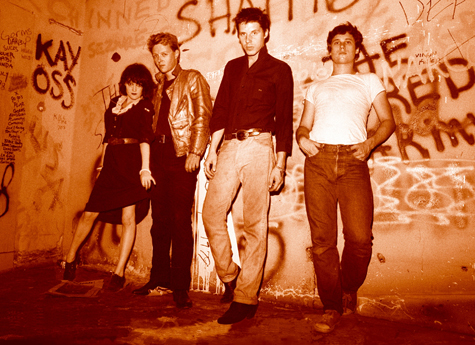
It sure can be, and life has certainly been a strange trip for Cervenka. In 1976, she moved from Florida to Los Angeles, and barely a year later, she was well on her way to becoming a punk icon. Along with Billy Zoom, DJ Bonebrake and her one-time husband John Doe, she helped shape a musical movement that was often imitated but never quite duplicated.
Cervenka’s life hit a considerable bump in the road this June when she announced that she had been diagnosed with multiple sclerosis, an incurable disease that affects the brain and nervous system. She wrote on her Web site, “After some months of not feeling 100 percent healthy, I recently had some medical tests run and the prognosis is that I am suffering from multiple sclerosis. Apparently, it has been affecting me for quite some time.” Coincidentally, back in the 1990s, she and X had worked with Sweet Relief, a charity that “provides financial assistance to all types of career musicians who are struggling to make ends meet while facing illness, disability or age-related problems,” according to the organization’s official Web site. The charity was started to help musician Victoria Williams pay her medical bills when she was diagnosed with MS in 1992.
“The irony of this is not lost on any of us,” Cervenka went on to write in her June 2 statement.
Now months after the diagnosis, Cervenka reports, “I seem to be doing fine with it. I’m still working, and I’m still touring.” True to her word, she released a solo album, Somewhere Gone, in late October and has already played some dates in California in support of it. The album, a haunting collection of sparsely arranged folk tunes, is available through Bloodshot Records. Cervenka says she has more dates through the South and Southwest planned and is looking at heading further east in the spring.
“It does cut into my ability a little bit to tour and play shows,” she says of her condition. “Just because it’s a little bit harder physically than it used to be, but that could be my age as well. I still love touring very much, and I try to do it as much as possible.”
In addition to her solo work, she’s been busy with X. This Thanksgiving, the group headed back into the studio for the first time in quite a while to record a “digital 45″ of two Christmas songs (“Santa Claus Is Coming to Town” and “Jingle Bells”). The recording has spawned a handful of holiday shows, including one at Harlow’s on Dec. 29, because, as Cervenka puts it, “Sacramento deserves a good party.”
“We’re playing two nights in San Francisco, and one night in Sacramento, so it’s going to be three nights in a row of New Year’s Eve celebrating,” she says.
Sacramento punk fans—and music fans in general—would be remiss for not circling the date. It’s a sad fact that many of the bands from punk rock’s heyday are gone. However, you’d be a fool to say, “Punk is dead”—at least not as long as X is around. Cervenka acknowledges that the band has become a flag-bearer for the movement it helped shape. Perhaps it’s a lonely place, but as Cervenka puts it, “I’d rather be alive than dead.”
I wanted to first talk about your solo album, Somewhere Gone, that came out at the end of October. It had a really spare sound. Did you have those kinds of arrangements in mind when you wrote the songs?
Yes I did. I was writing a record that was lyrics-driven, and not about a band. The Original Sinners was a band that I tried out for a few years, but that was an artistic failure as far as I’m concerned. I shouldn’t have gone that route. I have X and the Knitters if I want to do rock ‘n’ roll and country and punk rock. So what I need, instead of a band like The Original Sinners, is my own solo career, and that was great, because I got to work with some pretty great people.
Why do you call The Original Sinners a failure?
Because the lineups kept changing”¦ It was just really hard to keep it together, because the people I was working with had other projects, and it wasn’t a priority. I wasn’t happy with the way the production worked. But I’m really happy with Somewhere Gone. It’s exactly what I wanted to make—the record I wanted to make.
This was your first solo album in a while. The last one was in the ’90s, right?
Yeah, that’s right. The early ’90s.
Were these songs you’d been kicking around for a while?
No, they were fairly recent songs, and I’ve written a lot of songs since then. I moved back to California from Missouri, and I’m working with different people now and writing songs here and getting ready to make another record.
What were you doing out in Missouri?
I was living there for a while, but I decided to move back to California, because the people I wanted to work with are here. My business is all here, and my friends are all here. I got pretty burned out with living out there [in Missouri]. It was pretty isolating and not very much fun.
What caused you to move out there?
I was searching for a small town somewhere. I thought it would make me happy. But it didn’t make me happy, so I came back.
I’m glad to hear that you’re still pressing on despite being diagnosed with MS. In the statement you released on your Web site about the diagnosis, you mentioned that you and X had worked with Sweet Relief, which helped Victoria Williams, who also was diagnosed with MS. Did that give you some insight to the disease?
Well, yeah, it did. I’ve known Victoria Williams a long time, and I remember when she was diagnosed. I’ve talked to her several times, and I’ve talked to Sweet Relief several times. I’m lucky, because right now I don’t need any assistance financially, but if I ever do, I will definitely go to them. They’re a good foundation.
Are you planning to do any charitable or awareness work for multiple sclerosis research in the future?
You know, if it comes up I will, but what I like to do more than that is play a lot of benefits for friends or people who have medical bills and stuff like that, rather than organizations. We do give money to Sweet Relief—X does—every time we play, but I like to see the money to be handed over to somebody and have them put it in their checking account and pay their bills. So those are the more personal benefits that I like to play, but Sweet Relief is an organization that we’ve been helping for a long time, and I don’t expect that to change.
In that light, have you been following the debate in this country over health care reform?
No. I’m waiting until it ends. I don’t need to know all the stories and the pitfalls and the fights and the arguments and the pettiness of the people in our government right now. If it comes true that there’s health care, that’s great, but if it doesn’t come true, that’s what I expect, and that’s fine too. Nothing’s going to be any different in this country, probably. But I don’t follow the news, I don’t read magazines, I don’t watch television—I don’t even have a television—all I want to know is the end result. I don’t want to know all the bullshit.
There’s definitely a lot of it floating around right now.
Yeah. I’m sure there is. I don’t want to know.
X is getting back together for some Christmas shows, and you even recorded some Christmas covers. Whose idea was that?
Billy.
Was that something you were all stoked on doing, or did it come with some trepidation?
It was something Billy always wanted to do. He wants to make a Christmas album, and so, right now, the best we could do is put two songs together, because right now a Christmas album is too much. But, yeah, we recorded two songs, and Billy produced them, and I think they sound great. People can get them if they want on the Internet, and we’re going to be playing them live.
How did that feel to get back in the studio with X?
It felt great. It went really well, and it made me want to do more. We’re talking about—as usual—writing some songs and putting them out, but we’ll see if we get closer to that.
Is that something you guys talk about often?
We talk about it all the time. We never do anything about it.
Why not?
We’re like a pretend band on some level. You know how some people have a name for a band and an idea for a band and some songs for a band, but they don’t have a band. Sometimes I feel like that—like I’m 19 and I’m just trying to start a band, because it’s like, “Why don’t we get into the studio and record some tunes?” But we will eventually. Maybe in five years or something. We’ll see.
I saw a quote from you in one of the bios that was sent to me. I think it was from 2008. You said, “I remember one night at the Masque, saying to myself at age 22, I just paused in the middle of my drinking and thought, ‘This is an amazing thing. You’re really lucky to be here right now.’ I realized in that moment how special it was.” Has that feeling remained the same over the years?
There’s two ways of looking at it. One is the feeling you have in the moment, which can’t be kept. It passes, right? You have a realization or an amazing moment, whether it’s an event that you’re at or a band that you’re watching, or your life and then you just realize that it is going to pass some day, so you just sit there for a second and think about how great it is. And then, you try to continue on in life to have those moments. Maybe the punk scene will never be transcended by something in my life as far as a new musical movement or something like that, but certainly new songs, new experiences, new people, new art can be achieved all the time. So those moments, yeah, I have those moments.
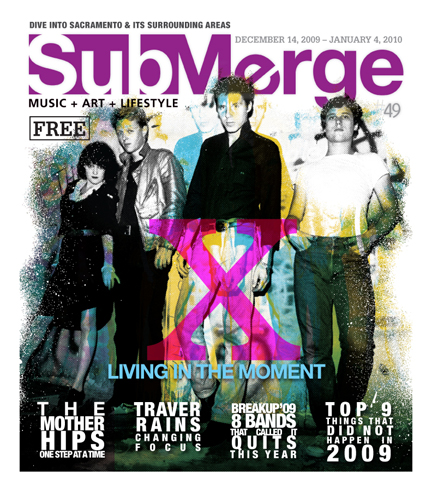
Hope you did not miss X at Harlow’s on Dec. 29. For more information on Sweet Relief, go to www.sweetrelief.org.
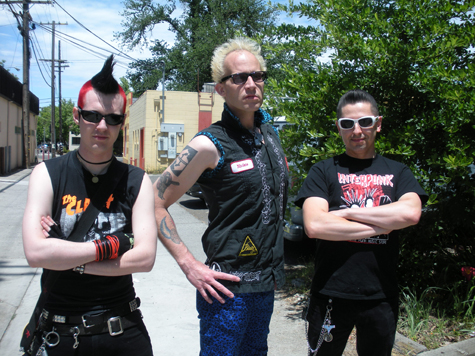
Showing No Signs of Slowing
Sacramento Punk Legends The Secretions Are Set to Release New Record
The year was 1991. The grunge movement, in all its flannel glory, had fully engulfed the country thanks to bands like Nirvana and Pearl Jam; the Governator was just the Terminator in Terminator 2: Judgment Day; Will Smith was just the Fresh Prince in The Fresh Prince of Bel-Air; and two young punk rockers attending Sacramento State, Mickie Rat and Danny Secretion, would meet and form a band. “I would have to walk through the University Union and I would get my coffee and go to class and I would always see this guy wearing all black no matter how hot it was,” Danny recalls of Mickie Rat during a recent conversation outside Benny’s Bar and Grill. “Long-sleeve black shirt, black pants and motorcycle boots with these big metal plates on the front and he had kind of a Mohawk devil-lock. It was pretty awesome.”
Mickie was aware of his intimidating appearance and even admits that he was known as the “scary punk guy” around campus. The two would see each other often, but never really spoke until their paths crossed one afternoon under dreary circumstances. “We actually started talking at a funeral,” says Mickie, who at this point had already started a band. “Our original guitarist was the program director for the student-run radio and he passed away. I had seen [Danny] in the studio; we had shows near each other. We didn’t even really start talking until then,” says Mickie.
One thing led to another, Danny was invited to jam and The Secretions were born. “We still have cassette tapes of those practices and how we started every song with, ‘One, two, three, four!'” Danny says.”
The two recall that in those first days of practice, ending the songs in sync was not as easy as starting them. “Usually we would start out the song together but the ending would always end up disintegrating,” remembers Danny. “The guitar would stop, then the bass, then the drummer would just keep playing.”
Fast-forward 18 years and the two are still making punk rock music together. “We don’t know how to do anything else,” says Danny. “I think the thing that’s really helped attribute to us not throwing in the towel is coming to grips with the fact that we’re not going to be huge and famous.”
Money and fame aside, The Secretions are a very successful band. They’ve toured the country many times and released a handful of records, but more importantly, they’re great friends who love playing music together. “My goal was to always be in a band with friends,” says Mickie. “That’s pretty much what it’s always been about for me. I’ve been lucky enough to do that. I mean, some people are like, ‘Oh I’ll hire a bunch of guys to play my music.’ That’s never worked for me.”
What has worked for The Secretions for nearly two decades now is booking smart tours: Gigging every other month as opposed to every weekend to avoid over-saturating the market; recording and releasing high energy, addictive punk rock records; and connecting with their dedicated fans, appropriately dubbed Secretins, more deeply than most groups these days. The band—which currently consists of Mickie Rat (bass, vocals), Danny Secretion (drums, vocals) and Paul Filthy (guitar, vocals)—truly has withstood the test of time. With a new record, entitled GREASYHOTMEATCHEEZY, due out in July, a slew of tour dates including two appearances at the Insubordination Fest in Baltimore, Md. in late June, two Sacramento release shows (July 3 at the Blue Lamp and July 20 at the Boardwalk) and a two-week West Coast run with The Bugs, they are not showing any signs of slowing.
Where did the name GREASYHOTMEATCHEEZY come from?
Mickie Rat: Paul’s girlfriend.
Danny Secretion: We were driving to Fresno to play a show; it was like a Friday night so we had all just gotten off work, went home, cleaned up, drove around and picked up everyone. We pulled over to get some gas and something to eat and I just asked, “What do you guys feel like eating?” And she just blurted out, “Greasy, hot, meat, cheesy!” It was just one of those things. On the inside of our van there is just Sharpie tags all over and written up there is “GREASYHOTMEATCHEEZY” and we just circled it and were like, “That’s a great album.”
MR: It’s a running joke, somebody will say something disgusting and you’ll be like, “Oh that’s what our next album is going to be called.” She also kind of did that to goof on me because I’m a vegetarian and I’m allergic to dairy so she was like, “Hm, what are all the things you can’t eat?”
DS: Yeah, Mickie can’t eat too many things that are meaty or cheesy.
MR: But I like hot things and greasy things.
What else can you tell me about the record? How does it compare to past releases musically and lyrically?
DS: Musically I think it’s on par with everything else that we’ve done, it’s nothing too complicated.
MR: I think a lot of people are shocked because I’m more singing than yelling. There’s some different songs. Usually if I write a pop-y song that sounds kind of smoother and I sing kind of pretty on it, I’ll save it and not put it on the album. I’m getting to the age where you just stop giving a shit. A lot of those songs I didn’t want on the album, but then I was like, “Eh, what the fuck do I got to lose? Let’s just put them out there.” The opening track is like three-and-a-half minutes long, which is like the longest song I’ve ever written.
Yeah, that’s like three normal Secretions songs!
MR: Usually I write stuff that’s a minute-15, that’s like my average song length. I kind of wanted to write this rockin’ Joan Jett and the Blackhearts kind of song.
DS: It’s a fun song. That was the big risk that we took was putting a song that was so different from the others at the beginning.
MR: Yeah I really didn’t want to put it first either but eventually they convinced me.
DS: We were just like, “No, this one has to start it.” It’s one of those things where it’s going to make people listen to it. The next song is just classic punk all the way through.
MR: There’s some different kind of stuff on this one.
DS: It’s just a fun album. We’ve got the songs pretty much telling off certain people. That’s always been what we do, just kind of poking fun at people.
MR: It’s what we do best: pissed off punk rock.
You’re doing a listening party at Capitol Dawg. Whose idea was that?
DS: That was Mickie’s idea.
MR: It’s one of my favorite places to eat. I always hang out and talk to the owner. My girlfriend and I actually went there for the first couple of weeks and nagged the hell out of him to get garlic fries because he didn’t have them yet.
So I have you to thank for my stinky breath after I eat those, eh?
DS: The reason why he didn’t have them was really cool. He didn’t want to do garlic fries, because Jack’s next door had garlic fries and he didn’t want to disrespect them.
MR: But Jack’s has terrible fries, the only reason they are good is if they put garlic on them. A fry must stand alone, by itself, before you put anything on it. I am a total fry aficionado. If a fry doesn’t taste good with nothing on it then I don’t want to eat it.
You guys have a widely renown connection with your fans, a listening party seems like a good way to keep that strong. Have you done anything like this before?
DS: We did it last year at the Javalounge. I think prior to that it had been much more informal, maybe just inviting friends over to our house to get drunk and play our new CD. For Faster Than the Speed of Drunk we did something a little more formal, we had an actual listening party where we told everyone to come on over to the Javalounge and we played the CD. This year we thought about doing it again and Mickie had the idea of doing it at Capitol Dawg.
MR: We’re going to have a special hot dog recipe for the evening; it’s going to be the “Greasy, hot, meat, cheesy.” I somehow convinced the owner to do the 88-cent Pabst long necks for that night. He usually only does that on Mondays, but he’s agreed to extend it to a Thursday.
DS: Oh, that could be bad news for us!
What is this Insubordination Fest all about? Are you pumped to be a part of it?
DS: It’s a big festival, I think this is the third one; it’s basically Lookout Records mid-’90s: bands like the Mr. T Experience, The Queers and The Parasites. They just have this huge festival with all these pop-punk bands back East.
MR: It’s put on by Insubordination Records.
DS: This year the surviving members of The Dead Milkmen are going to reunite and play. Lots of other huge bands will be there. We play on the Friday night just as the Secretions. Then on Saturday we’re backing Wimpy Rutherford, who is the original singer for the Queers, so we’re going to be doing like all the old Queers songs.
That seems like kind of a big deal for you guys!
MR: It’s a huge deal.
DS: It was one of those things where I was talking to Wimpy about the possibility of him playing and us backing him up. I let the guys know, and Mickie didn’t want to get his hopes up.
MR: I was like, “I’m not going to hold my breath.”
DS: Then when we finally got the OK when Wimpy was given a slot and he said, “I want you to be my backing band, learn the songs,” then I let the guys know.
You guys recently did a video shoot for the song “Back in the Day Punk.” Will it include footage from your recent Club Retro show?
DS: Yes, we worked with our friend Rob Young, aka Rob Fatal. He’s a local DJ here in town. He’s an awesome filmmaker, and he’s absolutely punk rock. He’s very fast about how he films things; he’ll have you do everything about five times until he gets what he thinks is just right and then moves on to the next thing. We filmed the first part during the day at our friend Tom from the No-Goodniks’ house and that was a good time. Then we played at Club Retro later on that night and we played the song three or four times. And he just filmed the kids and filmed us. If you want to get people to really go crazy during your set, put a camera right in their faces. Everyone wanted to be on camera for that. We had a trampoline on-stage for people to jump out into the crowd.
MR: It was for stage diving assistance. In full disclosure, we stole the idea from Sloppy Seconds. It looked like fun.
DS: The first kid to do it was this kid named Tony Silva; he’s from Woodland, Calif. Mickie wrote a song about this kid because he’s from Woodland but he takes the bus, because he doesn’t have his drivers license yet, to Sacramento to go see punk shows. So all these kids complain about, “There’s nothing to do, this scene sucks.” And you got this kid taking the bus to pay a cover to go see a punk rock show.
What’s the song called that you wrote about him?
MR: It’s called “Tony Silva Rides the Bus.” It’s on our new record. He’s a really nice guy, but he’s kind of a klutz and always ends up hurting himself, you know the bad luck stuff always happens to him.
DS: Well, he was the first one to use the trampoline. I motioned to him with my head as I was playing the drums like, “Tony, go!” So he runs offstage full force, just jumps on the trampoline, soars into the air and the crowd parts like the Red Sea. He had gotten so far out he didn’t have the time to level out so he could land feet first, so he pretty much did a big elbow drop on the ground. It was captured on video by Rob and we’ll see if it makes it in the video or not.
MR: After our set he comes up to us and was like, “Yeah it kind of hurt, but I got right back up because I didn’t want anyone to think I was a pussy!”
DS: If anyone deserves a song, it’s Tony. I don’t know if we’re going to be bringing the trampoline to the Boardwalk though, because that’s a pretty tall stage.
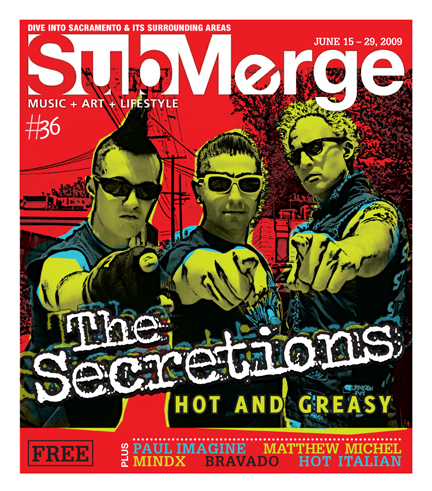
Preview The Secretions new record, GREASYHOTMEETCHEEZY, at Capitol Dawg on July 2. Catch them live at the Blue Lamp on July 3 and at the Boardwalk on July 20. For more information visit myspace.com/secretions or secretinlifeline.blogspot.com