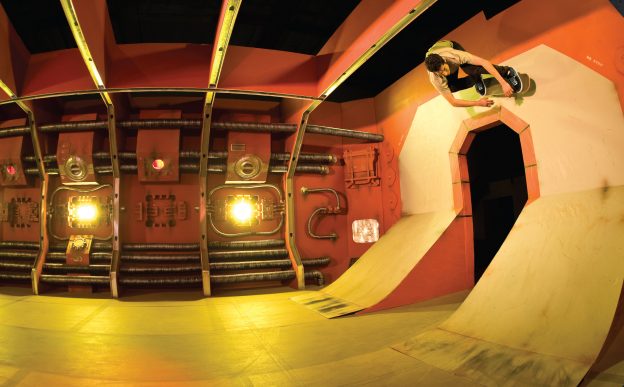
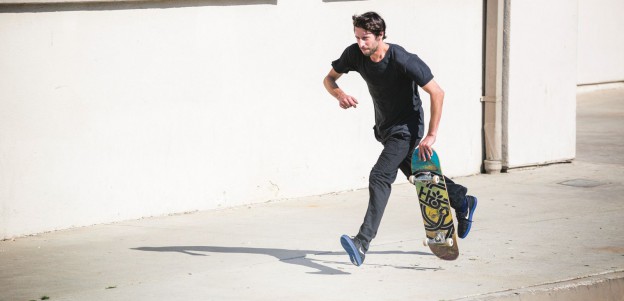
Local pro skater and longtime musician Matt Rodriguez has a style all his own
For having had such a long, successful career as a professional skateboarder, going on trips around the world to film countless videos, landing in magazine spreads left and right, co-founding a popular footwear company called iPath, all while earning what many might call “legendary status” along the way, Matt Rodriguez is a really mellow, surprisingly normal guy. In fact, when Submerge arrived at Rodriguez’s Midtown house in early January, we found him in his backyard shoveling dog poop. See, pro skaters are just like you and me.
One major difference between Rodriguez and the rest of us, though, is that the remainder of his yard, the part not covered in dog doo doo, is made up of a custom skate park with ramps built from salvaged wood.
“It was kind of like a scavenger hunt,” Rodriguez said of his lengthy search for re-usable lumber. Although extremely well built, the ramps are steep and gnarly with tight, technical lines; definitely not easy to skate. In a way, that sort of sums up Rodriguez’s style. He’s known for rolling up to spots that to the untrained eye might not even look skateable, but before long he’ll have a couple tricks bagged and will be ready for band practice (he plays drums in local band The Storytellers as well as percussion in a musical experiment called Blktop Project with fellow pro skaters Ray Barbee, Tommy Guerrero and Chuck Treece). A dirty drainage ditch here, a makeshift plywood ramp leaned up against an electrical box there, and Rodriguez can make anything and everything he approaches on his skateboard, no matter how sketchy or unusual of a spot it is, look downright stylish.
Case in point: After an interview sitting with Rodriguez amongst the ramps in his backyard, photographer Wes Davis and Rodriguez set out on one of a couple missions to snap some photos to accompany this article and Submerge decided to tag along. After loading up a couple skateboards and a case of camera equipment into one car, we headed for a bank spot in West Sacramento near Raley Field that Rodriguez wanted to session. “It’s been here for years but was always fenced in, so I couldn’t get to it,” he said of the feature. The fence recently came down so he’s taking full advantage. As we rolled up to the spot, Submerge couldn’t help but notice that the small concrete bank Rodriguez spoke of was literally smack dab in the middle of a dirt field. Not where you would typically think to go to snap a photo of a skater, like, say, somewhere with more concrete.
“This is the story of my career, fucked up spots,” Rodriguez joked.
We arranged three or four long, narrow pieces of wood as his run-up to the bank to gain speed. He’d start in the dirt with his board in hand and would sprint toward the makeshift ramp, hop on his board and then pop a trick on the lip of the bank. Davis lined up the shot from a number of angles, at times getting down and dirty laying flat on the ground to get the proper vantage point.
“Sometimes you’ll be at a spot for hours trying to get a shot,” Davis said of the tedious art that is photographing skating.
Lucky for us, Rodriguez was on this particular day and half-an-hour or so later we had a few keeper shots, some of which show the Tower Bridge directly behind Rodriguez mid-trick. We’d captured two Sacramento icons in one shot, a success indeed.
After the dirt field bank spot, we headed around the corner to an entrance near the ballpark and immediately started, pulling pieces of plywood off of nearby lumber piles, building a makeshift launch ramp and a landing with a tall obstacle in the middle for Rodriguez to olly over. You know, another typical Rodriguez style set-up consisting of randomly found wood and obstacles. Just as we were about done with the set-up and Rodriguez was getting ready to hit it, we heard someone yell at the top of their lungs, “Hey!” and we saw what looked to be like a security guard pointing at us from a distance. We thought nothing of it until we saw him start running, so we scurried back to our car and hopped in before he could give us any shit. Crisis avoided.
“Just like the old days,” Rodriguez said, smiling ear to ear as we sped off, tires chirping.
On the car ride back to his house, Rodriguez spoke of wanting to get into photography, stating that it would be a good way to keep involved in the sport as he gets older. At 35, Rodriguez is surely no young buck, but one look at his part in the recently released iPath team video The Other Ones shows he’s still at the top of his game and likely will not be dropping off the radar anytime soon. “Trust me, I’ve been a part of a lot of videos,” Rodriguez said. “Some I’m proud of and some I’m not so proud of. This one, as a team we did some missions and covered some ground and gathered some good footage. It is what it is, I think it’s good, honest skateboarding.”
In the following interview with Rodriguez, you’ll learn more about iPath and his involvement in the company, his passion for music and how it ties into his skating, his love for Sacramento and tips for growing dreadlocks. Pick up The Other Ones at local skate shops or find it online by searching “iPath The Other Ones.”

What have you been up to lately? What have you been focusing your energy on?
Skate-wise, doing a lot with iPath right now, designing some shoes and trying to scout out some possible new members for the team. We just finished a video, The Other Ones, so just doing that, keeping that fire burning. And you know, music, The Storytellers and Blktop Project. We just did a Blktop tour in Japan.
How was that?
It was awesome, we went for eight days. It was great.
You were one of the original founders of iPath back in the late ‘90s. Since then the company has gone through a couple of ownership changes and it seems like it’s been on a bit of a roller coaster. What is your role at the company now?
Just someone who they, at least the new owners, look at as a headstone basically. Being there from the dirt up, going through all the metamorphosing, to team changes and new owners. Now it’s on its third owner, and hopefully its last. Just being someone who they look to for direction, being a skater, you know, they figure, “This guy knows what he’s doing and has been here from day one.”
I’ve read that Klone Lab, the new owners, want to get the company back to its roots. It’s got to feel good knowing that everyone is on the same page when it comes to realigning the company with it’s original values and image, right?
Yeah, whereas a lot of stuff changed when Timberland bought it. They hired a general manager, he came in and just cut half the team, and the half of the team that he cut were big personalities and a big part of the company, that makes up the vibe. A lot of stuff went through change then. But Timberland came into the situation not knowing who the hell was who in skateboarding. Through the time they had it, it grew and maxed out every year and was showing increasing growth, but I just think it wasn’t enough for them and they had other stuff on their plate. They actually sold Timberland, so the good thing is that they put iPath on the market for someone to take instead of canning it. They could have been like, “We’re over it, sorry.” But they realized that it’s a collective of skaters and artists, and a lifestyle even beyond just skateboarding, and they respected that and they wanted to give it a chance for someone else to take the time and energy. So Klone Lab stepped in.
It’s a tough market out there for small shoe companies, isn’t it?
Oh yeah, you’ve got companies like Nike, even all their pros that they pay to skate for their team combined is still barely a chunk of what they pay Tiger Woods. So skating for Nike, it’s fun, they can have fun with it, but it’s not their livelihood. With something like iPath, from the original investors to the investors now, that’s all they have, they have to make it work. But, you know, we’re just wanting to take more road trips, trying to get articles, making some films, get it all out there and just keep it going. Just keep trying to show the raw side and the soul side of skating.
As a company, especially coming from a grassroots budget, let alone motive, it’s not always easy. We don’t have X amount of dollars to just blow and have fun with, we have to make every dollar count. Granted, not everything runs smooth, even when you have all the dollars to wipe your ass or sweaty forehead with. But nonetheless it’s all about keeping going, nothing is going to be perfect. It’s like a band, sometimes a member gets fed up and can’t take it, or you want to bring a new member in, or someone wants to go in a different direction, or there’s a falling out. Whatever you have left, you have to work with.

The iPath skate team has gone through changes recently and a lot of people were dropped, right? Who is officially on the team now? I read somewhere it is just you, Fred Gall, Kenny Reed and Steve Nesser. Is that true?
Yeah, for right now.
About The Other Ones, there’s a long story behind why it didn’t get “officially” released through iPath, can you touch on that please?
It’s an independent effort from the team, because at the time iPath knew people were going to have to be cut, and they didn’t want to put it out as “the iPath video” and then a month later, half the team is gone. So for now, for our individual talent and credibility, the video is out. It’s out there as opposed to out of sight, out of mind. The team got together and were like, “Fuck it.” iPath still put in some money to produce it, most of the footage in that video is from iPath tours, so iPath is still a big part of it.
The song during your part, you recorded that right?
Yeah that was me and Tommy [Guerrero], that was just on the cuff. I was like, “Yo I want to come down and throw down a rhythm.” We set up the mics and just fucking went for it. He had a bass line and we just did layers.
Is this the first time you’ve recorded a song for a video part of yours?
No, I’ve done that before, but it was all percussion. This one was percussion, Tommy on bass, a little guitar, some melodica, some shakers.
Is that something you’ll continue to do? Not a lot of skaters can say, “That’s my song during my part.”
I figure whatever I have to offer, you know? I’m going to need a song, why not throw down a little something?
How old were you when you started playing music? What instruments were you first drawn to?
In fourth grade I definitely was tearing down boxes and buckets and banging away on anything I could get my hands on. We had an extra room and I lived on Madison and Sunrise, and it was like all around me. I just had like boxes and buckets and pans. I’d play with my mom’s coat hangers, I’d snap them so I had sticks. I finally got my first drum set when I was in sixth grade.

So it was percussion that drew you in?
Yeah, basically. Drumming and time, rhythms and patterns. I like how physically demanding it is, like skating. That’s what attracted me to skating, because I used to break dance when I was young in San Jose. So when I first seen skating…
Wait a second, that didn’t come up in my research! How into break dancing were you? And how old were you?
I’d go to battles, me and my older brother.
I was like 7 to 10 years old. Then I found my first skateboard when I was 10-and-a-half.
You found the board in one of your grandparents’ closets, right?
Yeah, my grandpa’s closet. It was my older brother’s, but I’d never seen him ride it. I was like, “Sick! Something to roll on!” From then on I met skaters, and they showed me Thrasher mag and who were the dudes. I was like, “Oh sick, there’s a whole world here.” I was captivated.
You’re 35 now and still going hard in such a physically demanding sport. How do you keep your body and mind so healthy and fit? What are your secrets?
It’s just will. I don’t ever see myself just being like, “Ugh I’m too old,” or mad I’m not getting paid, or being sent around to do demonstrations. I’m going to skate, go find a ditch and have at it.
You skate with your trucks ridiculously loose. What’s that all about?
Jeff Toland and Ricky Winsor and Sam Cunningham, so many amazing guys like that, I naturally gravitated to it because I grew up seeing it. Those dudes literally schooled me, I was basically blessed to grow up with those guys. They were raw, they rode their trucks super loose, they didn’t give a shit, they were like, “Fuck you, we’re skating! Don’t talk shit or we’ll caveman the side of your car’s fender.” They were just so raw. You know, back in the day learning flip tricks and whatnot… You evolve over time, your skating may change. I definitely realized my skating was changing and wanting to do something different. I always want to do something against the grain, you know. I get sick of seeing the same redundant shit out there. As far as skating with my trucks loose, that was just more of a way to be like, “How can I make my circumstances more screwed up and still pull it off?” Back then, they weren’t doing the tricks that are around today, but nonetheless, it’s possible. So I slowly worked my way looser and looser.
And now your trucks are barely on your board…
It’s a challenge, yeah. My board’s fucked, but I’m still rollin’ away!
Have you always called Sacramento home?
Pretty much, yeah. I moved here when I was 11-and-a-half. Grew up all around skating, knowing different skaters around the perimeter, downtown and all the outskirts. I moved back to San Jose when I was 16 for two years only to realize I just loved it up here, all the trees–the people, the pace, just the vibe, you know? The seasons, you can actually see them. And just the people, the friends I met through skating here. So I moved back after high school. I’ve been here ever since. I go around the world, I’ve seen a lot of beautiful places, but when I’m coming home to Sac, I’m like, “Ah man, good old Sac.”
Lastly, how long have you been growing those dreads?
Oh, this mop? Seven years. The secret to fast-growing, long hair is to eat a lot of beans. Lentils, peas and kidneys, it’s all the calcium.
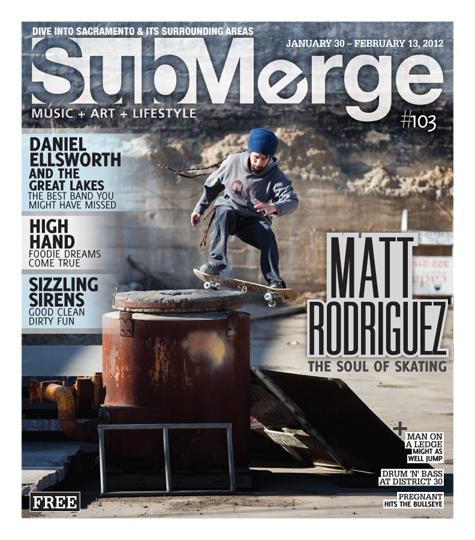
Learn more about iPath at ipath.com. Pick up The Other Ones at local skate shops or find it online by searching “iPath The Other Ones.” Learn more about Blktop Project at Galaxiarecords.com/album/blktop-project. Look for upcoming Storytellers show dates at Facebook.com/sacstorytellers and expect a new album later this year. That Rodriguez, he’s a busy dude.
Put professional skateboarder Omar Salazar on the phone for an interview, even while he’s in Australia on a Nike Skateboarding team trip, and you’ve got one of the nicest dudes you’ll ever meet; caring, witty and all around fun to talk to. Put Salazar on a skateboard, assuredly where he’d rather be than on the phone, and you’ve got a savage on wheels; a straight-up wild man that charges at his tricks with relentless speed, dedication and concentration. The 26-year-old skater from Sacramento has made quite a name for himself in the industry, especially within the last couple years with his part in Alien Workshop’s video Mind Field, making the March 2009 cover of Thrasher and the announcement from Nike that Salazar will have his own signature shoe. But all the success hasn’t come easily.
Salazar was raised by loving and supportive parents who fled to the States from their home country of Chile. Pursuing a career in skateboarding, though, was not exactly what they had in mind for their son in this so-called land of opportunity. “They were always like, ‘Hey look, you’re lucky you have opportunities here, you need to go to school and you need to work for a big company,” said Salazar of his parents outlook on his skating. I was always like, ËœYeah, but I don’t want to do that; I’m not good at that. This is what I want to do.”
Salazar remembers having to hide his skateboards and boxes of products that companies were sending him so his parents didn’t get suspicious. “I didn’t want to disappoint nobody, but I was never good in school,” he admitted. “I mean, I finished high school, but I was never good as far as book smarts goes, I’m better at street smarts.” Those early years also consisted of a lot of couch surfing, riling up change from said couches to hit up Del Taco, raiding Safeway’s sample tables and bombarding open house food platters. “Yeah, I’ve come a long way,” Salazar said with a laugh, looking back.
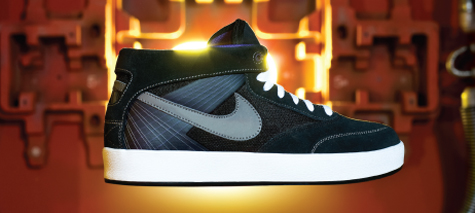
A long way is an understatement, as this month Nike will release Salazar’s first signature shoe, a career milestone for any athlete involved in any sport. Salazar will be the second Sacramento-area skater to get his own Nike shoe, as teammate and close friend Stefan Janoski did so just last year.
“In the beginning,” Salazar remembered, “Before Nike gave anyone shoes, Stefan and I, we’d had offers before in the past from other shoe companies, but I always stick with what I believe in. I believe I’m a loyal rider. That’s just the most important thing. So, I figured if I kept loyal with Nike and the people I work with, then something good was going to happen.”
Even after Nike told them years ago that Paul Rodriguez would be the only team skater to get his own signature shoe, Salazar stuck it out, all the while telling Janoski, “We’re going to get shoes, trust me.” Eventually they both got the phone call and for Salazar, it was sort of an ‘I told you so’ moment when they did.
“I don’t want to sound cliché or lame, but in a way I kind of manifested it because I knew it was going to happen,” said Salazar, not in a cocky manner, but a confident one. “Even before they offered me a shoe, I drew up a design and straight up put one in my room, one in my bathroom and one in my closet.” Salazar would be gone for months on skating trips and he’d come home having forgotten about his dream shoe designs, which re-invigorated him to skate harder, to keep going so that one day it would be a reality. “Like a year later after working hard and having fun skating and stuff, they hit me up and were like, ‘Hey, we want to give you a shoe after Stefan.'”
When it came time to actually visit Nike HQ in Portland, Ore., to meet the people who would be designing his shoe, Salazar was well prepared with his sketches, his favorite color schemes and other things that represented him and his personal style. “When I first started working on the shoes, they were like, ‘Shoot us your favorite colors, your favorite objects, your favorite things around the house, bring us photos of them.’ I didn’t know what the hell they were talking about,” said Salazar. Nike was essentially asking for pieces of Omar so that his shoe “could tell a story.” Turns out, Nike doesn’t just give signature shoes to anyone and when they do, they always have little stamps of the athlete’s personality and style on them. Take for instance Michael Jordan’s famous Air Jordan logo, jersey number, etc. found on his shoes. Salazar wanted a classic-looking silhouette, but with Nike’s new technology infused.
“I’m really into the ’50s and oldies, and I like old tin cans and old rockets and outer space and all that stuff,” said Salazar of some of his personal interests. Hence the reason his shoe features a cool little rocket ship on the sole. Salazar also pointed out that he likes to surprise people, so he told Nike he wanted to make the tongue of his shoe interchangeable. “I wanted to have fun with the shoe and I wanted it to be functional for people,” said Salazar. “Some people like to tie their shoes real tight and some people keep their shoes real loose. Some people like a thin tongue, some people like a real thick tongue,” he said. He also wanted Sacramento-area residents to connect with the color scheme, so he included purples and blacks to match our beloved Kings’ colors.
What really makes Salazar’s signature shoe stand out, though, is the inclusion of Nike’s Flywire technology, something new to the world of skateboarding shoes. Basically, shoes with Flywire are really light, yet really supportive—two attributes not normally associated with one another in the sporting shoes industry. In the past, more material meant more support, but in turn the shoe got heavier. But with Flywire, Nike took Kevlar and spun it into an embroidery-thin thread for reinforcement, and then they added Lycra in areas that needed power and stretch. According to Salazar, they feel great. “Nike’s technology enables the shoe to be lighter and support your foot more and lock it down really well,” he said of the shoe’s feel.
Sacramentans will be able to witness Salazar ripping up B Street Skatepark in his new shoes on Sunday, March 7, at the official shoe launch demo along with Nike teammates Paul Rodriguez, Stefan Janoski, Brian Anderson, Justin Brock, Grant Taylor, Daryl Angel, David Clark, Elissa Steamer and Brad Staba. Anyone who knows anything about skateboarding knows those are some heavy hitters and that this event is will not be to miss. As our conversation was coming to an end, Salazar closed with a bit of advice for the young skaters out there. “The one most influential person that told me how to get shit was John Cardiel, Sacramento’s best skateboarder ever. Whenever I was trying something, just trying for hours and hours, he’d yell out, ‘You’ve got to want it! You’ve got to want it!’ That stuck in my head forever, so if there’s any message I’d give anyone, it’s that.”
Catch Salazar and the Nike SB team on Sunday, March 7, 2010 at B Street Skatepark. Demo starts at 2 p.m.
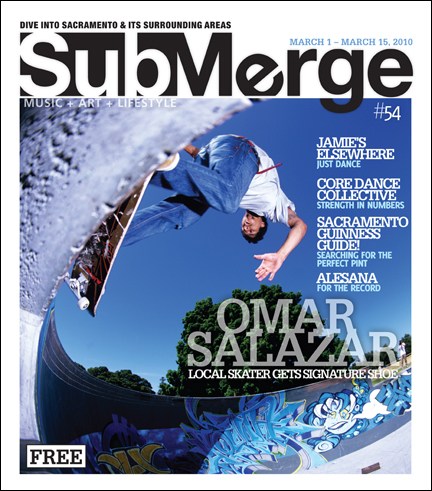
Cover photo by Jonathan Humphries
It’s Gotta Be the Shoes
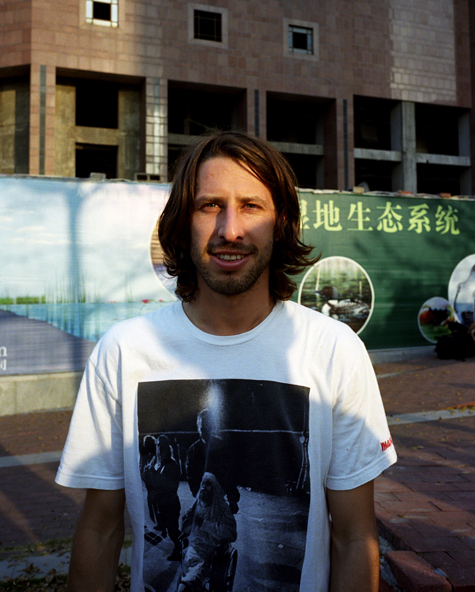
In 2005, Nike dug their fingers deep into the world of skateboarding by releasing a signature shoe by Paul Rodriguez, poster boy for the Nike SB campaign. Four years later, after compiling a team of remarkable talent—Brian Anderson and Omar Salazar to name just two—the next in line was Stefan Janoski who joined the roster in 2005. A Sacramento resident who hails from the nearby city of Vacaville, Janoski is one of the nicest guys in skateboarding and when you see him on the board it’s immediately clear why Nike has chosen him for their next signature shoe release.
Janoski’s style is fluid, always landing tricks over the bolts whether he’s destroying handrails or whipping out his signature 360 flips. His stylized version of the trick captivated youths around the world when Transworld Skateboarding released a how-to video of Janoski explaining the basics of 360 flips. In charismatic fashion, he performed the stunt on the street, in the skate shop and even at the grocery store while picking up some Cocoa Puffs. In two years time, the video has had over 2 million views and has made him into a recognizable face in the skateboard community here in the U.S. and especially abroad. Celebrity isn’t the best adjective to describe Janoski, though. Genuine might be more appropriate as it best describes his infectious personality, his passion for skateboarding and his outlook on life.
Janoski was born to ride a skateboard and at 29—his 30th birthday lands in July—he’s skating better than ever. For him, age is just a number.
“I feel like I’m 17.” He says. “Thirty-three will come around and I’ll still be doing the same thing. That’s pretty cool.”
Pretty cool indeed considering the fact that skateboarding is centered on youth culture. The average age of the Nike SB team is 31 (its senior member Lance Mountain is 45). It seems that age and experience were deciding factors in the selection process, but then there’s that Paul Rodriguez guy. At 24, he’s the youngest skater on the team, and subsequently the first to receive a signature shoe. But that was then and Janoski is now and he’s excited for the release of his shoe in early May.
You have a shoe coming out for Nike pretty soon. Is that a really important landmark in your career or does it just feel like a natural progression for you?
I guess it’s sort of a landmark just because I’ve never had a shoe, and it’s pretty common nowadays for people to have a shoe. It’s kind of taken me a long time, just because I’ve never really been set at a company where I really wanted to get that deep and involved and stick around for that long. So usually I’ll talk about having a shoe with a company, and then I get cold feet and don’t really want to stay there.
You have commitment issues?
Yeah [laughs]. It’s pretty cool, though, that I’m finally getting a shoe and also that Nike is finally open to giving people shoes. They’ve always had Paul Rodriguez, who has a shoe, and he was the only one.
Why was it like that?
I’m not sure exactly. I think they were trying to make it a really big deal or”¦I think what they realized is that they have to expand more. There’s a lot skaters out there nowadays, so to really stay in skating they have to have more than one person representing. It’s pretty cool. I’m excited because it’s a shoe I really like.
When does the shoe come out?
They come out on May 8.
How much input did you have in the design and construction of your pro shoe?
A lot of input actually, I had total input. I don’t know if they expected me to get as involved as I did. At first they had samples and prototypes of other shoes already, but it wasn’t what I was going for. So then we started, me and this guy James, from scratch. I brought in a bunch of shoes and kept telling them what I wanted.
You’d bring in examples of other shoes that you liked or what?
I’d bring in a shoe and say that I like the toe on this shoe, and I like the lace hole on this shoe and the tongue on this one—put them all together. I think I had an old Vans a Sperry Topsider and a Converse All-Star. They wanted to use a cup sole at first, which is like a Dunk or a normal sneaker, but it just wasn’t really getting the shape that I wanted. It took a really long time, because we did other stuff first and so this shoe didn’t come around for a while. But then once the prototype came about, it was the best.
That’s surprising, because it seems like Nike would be more overbearing with the product that they are putting out.
I’m a little bit of”¦ If someone’s going to give me a shoe, I’m going to get like, “It’s my shoe!”
Oh, so you’re a bit of a diva?
I don’t know. I just really care. If I’m going to have it be mine, then I want it to really be mine. I don’t have a problem not having a shoe, if it’s not going to be what I want. It sucks to have something with your signature and then hate it. At first they fought it because Nike doesn’t really have this style of shoe. They have everything else and that’s the main reason I wanted it to look like that.
How does the pro shoe thing with Nike work? It looks like from the video footage I’ve seen you’re able to skate it for a while before it comes out. Is there like some sort of test run period?
They’ve been around. I’ve had them for a year, I think. I actually wear the sample size, which is a 9.

Sample size?
Every shoe’s prototype is made in a sample first, but all samples are a size 9. So I was able to wear my shoe way before they made a sample just for me. I’ve only skated in two pairs that weren’t samples.
How do they skate?
Actually, they are 10-times better than the sample. They’re so much more comfortable. They’re quality. Not only are they a cool shoe to wear, but they’re exactly what I want to skate in.
You live in Sacramento, but I know that you are originally from Vacaville. Most people I meet talk a load of shit about that place, but you put the city on your shoe! Are you getting some serious Vacaville love for that? Have they given you the key to the city or what?
No! I don’t know if Vacaville even knows about it. I probably know three people in Vacaville. Maybe five if you count my parents, so”¦yeah.
So, there are no strong ties to Vacaville then?
It’s a joke for me because people really have hometown pride and like to represent where they’re from. People from San Jose are like, “Yo, San Jose is the best! Fuck!” I don’t know, I think it makes it even funnier that I have a shoe with Nike and it says Vacaville. Vacaville is a place that you grow up in and you’re supposed to leave. It’s a big accomplishment to not be there anymore.
But depending on who you talk to, the same thing can be said about Sacramento. Why stay in Sacramento?
For me it’s a home base type of thing. I travel so much and Sacramento is so mellow, there’s no traffic and it’s so quiet. I can come here and just hide out and go skate with Brandon Biebel and those guys. It’s just a hibernation place for me now. I’m traveling constantly and waking up in a hotel in some city somewhere and going skating everyday. So when I come home, it’s hard to wake up early and say, “I’m going to go skating and eat shit all day.”
From what I’ve read, you’re not too into the competition circuit. In fact you don’t place all that well! Is it because you just don’t care all that much? Why do some skaters love it and others like you just not get into it?
I mean, I’ll enter a contest, but it’s hard for me to really care; to really go out there and try to put a run together and work really hard! Contests are an entirely different way of thinking about skating. To me, it’s a way to make money off skateboarding. People win a lot of money in contests but I don’t think that it really has anything to do with skateboarding. It’s a way for people who are consistent and really like it to go and be competitive and win some money and all that. But it’s the smallest percentage of anything that has to do with skateboarding. Most people started skateboarding for the exact opposite reasons. They weren’t competitive, they didn’t like sports and they just wanted to go out and have fun and not stress. I enter contests and if I win a little bit of money, yay! But if I totally fucking lose, then it’s like, “Oh well.” When I started, you didn’t train or practice skateboarding for a big match, you just went skating everyday. Some days, maybe you’re just sitting around on a red curb all day just bullshitting with your friends, you know?
How is the swine flu affecting skateboarding?
I don’t know. I had bacon yesterday. I think it’s a rumor! Isn’t it just on the East Coast? Whatever, it’s population control.