
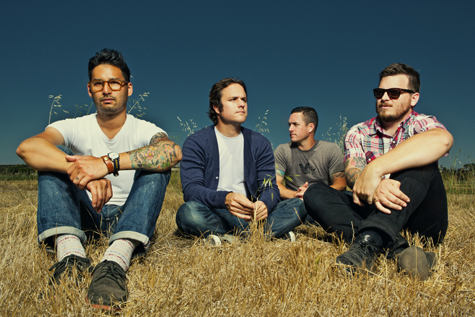
Thrice’s Ed Breckenridge talks about his band’s new album and the struggles of losing a parent
Family can take on many forms, but there is no doubting that it’s important. Thrice could be considered as strong a family unit as there is in modern rock music. The band formed in 1998 and has been together ever since, fronted by singer Dustin Kensrue with Teppei Teranishi on guitar and two brothers in the rhythm section, Riley (drums) and Eddie (bass) Breckenridge. Sure, family can be a headache. The oncoming holidays are always a reminder of that, but during the most difficult times, such as the trying period the members of Thrice endured during the making of their most recent album Major/Minor, it’s always good to know you have someone to rely on.
Submerge caught up with Eddie over the phone before a show in Grand Rapids, Mich. The group had something of a “family day” the day before in Grand Haven, about half an hour west of Grand Rapids, on the shore of Lake Michigan.
“We spent the time walking around and sightseeing,” Eddie says of the much-needed day off. The band has already been out on tour for over a month supporting the release of Major/Minor, which was released on Vagrant Records on Sept. 20, 2011. “The day before, we acquired a bunch of barbecuing stuff, so we ended up doing a little barbecue outside the bus at the hotel where we were staying. Thank God we didn’t get harassed by any police for loitering in the hotel parking lot. It ended up being pretty fun.”
These family dinners have been a tradition for Thrice almost since their inception, Eddie says.
“I think that some of the earlier bands that we toured with, we always tried to meet up and go out to dinner,” he explains. “Whether we’re in the same town as another band or not, we try to have everyone in on a family-type meal.”
These sort of gatherings have probably become even more important during the most recent tour. The Thrice family suffered serious losses during the writing process of Major/Minor. Teranishi mourned the death of his mother, and the Breckenridge brothers’ father also passed away. The pain of these losses is certainly noticeable in Major/Minor, which is a potent mixture of hope and sadness. “Treading Paper,” placed in the middle of this sequence of songs, has Kensrue wailing in a scratchy but forceful voice “Carrying on; unwitting orphans of an unyielding despair.” Later on in the same track, the words look for the light at the end of the tunnel, “If anything means anything / There must be something meant for us to be.” It’s this interplay between light and dark that works its way throughout the album. Musically, Major/Minor is rife with big, crunchy riffs, pounding rhythms and raw vocals. Eddie says the album’s songs have caught on almost immediately by fans.
“When we did a record like Vheissu, it seemed to take a full touring cycle before people seemed like they wanted to hear those songs,” he says. “It’s cool, but at the same time, I can’t help but think, ‘Are we doing something wrong?’”
The album’s producer, David Schiffman, who worked on Thrice’s 2005 album Vheissu, went as far to describe Major/Minor as a grunge record. Eddie Breckenridge doesn’t necessarily agree with that sentiment, but during our interview, he does confess his growing love for Pearl Jam and he also touches upon the loss of his father. Thrice is currently on the road with O’Brother, Moving Mountains and La Dispute.
You’ve been touring for almost a month now on the new record. How has it been going?
It’s been great. It’s been going pretty well. All the bands are a bit different, but I think they all work together really well as far as like a cool-sounding show for everyone. There’s a lot of different dynamics to the music. The people are pretty great too. It’s been really fun. I can’t believe we’ve been on it for as long as we have. It doesn’t feel like that.
You mention that the sounds are really different between the bands. Was that what you were looking for when you headed out on the road?
I think you always try to make it so there’s no band that’s like an odd ball, but I think this tour, we’ve been really fortunate in picking bands, because I think nobody is an odd ball, but nobody sounds too much like everyone else. I think it’s a cool lineup. I think O’ Brother is a bit heavy, and their songs are a bit darker. Moving Mountains is more atmospheric, but they still have some heavy stuff. La Dispute has some really cool instrumental stuff, and their energy is a little more intense than the other bands–maybe not as dark or as heavy, but intense. And then there’s us. Whatever we are.
I definitely want to talk about Major/Minor. It’s funny because when I first listened to it, my first impression was that it reminded me of an old Soundgarden record. After I started reading up on it, I saw that your producer had likened it to a grunge record. Is that something you get when you listen to it?
We weren’t going for anything specifically. When we were writing the record, we were experimenting a lot with major and minor chords in the songs, and I think that’s the thing that sounds grunge-y. I think a lot of bands in that time period were experimenting with a lot of the same kind of stuff. They might have a song that’s really heavy, but it’s in a major chord. I think that ended up stylistically being a grunge-y sound. Maybe that’s where that came from, but it wasn’t an intentional attempt to make stuff grunge-y. I can see how you can relate it, but I don’t think the album on a whole sounds like a grunge-y record.
Definitely. There are some songs that give you that impression–maybe because of Dustin’s vocal delivery–but it definitely sounds like a Thrice record. It definitely doesn’t sound like Mother Love Bone or something like that.
Did you see that documentary, by the way? Pearl Jam 20?
No, I really want to though. Have you?
Oh, it’s amazing.
Why did you like it so much?
I’ve been a fan of Pearl Jam. I didn’t really follow them as much as I would have liked to now after seeing the documentary. It’s just really awesome seeing how they came about and how they tried to deal with what was going on. It was just inspiring. I think two weeks later all I could sing in my head were Pearl Jam songs.
Well you guys have been together for 13 years now. Were you able to see any parallels between that movie and your own band’s career?
Maybe, but not really. They became a huge band pretty quick. I think there were some parts where Eddie Vedder was talking about how hard it was to be in a huge band, but still wanting to play songs that reminded him of Fugazi and people not understanding that–struggling with what people think your identity is, and you wanting them to understand your real identity, but also not wanting them to be too close because you still want to be yourself in private. On their scale, that’s insane. I couldn’t imagine dealing with that, but I can definitely see where they were coming from, on a much smaller scale.
As a band that’s not afraid to do different things, is that something that plays into what you’re saying? Dealing with what people expect of you?
I think it’s important not to give into what people expect, because then you lose your identity as a musician. You need to create. You need to be inspired by things that inspire you, not inspired by people’s assumptions of what they think you should be. That would be a really rough spot to be in, and I don’t think our band would have lasted as long as it has if we were catering to other people’s tastes. It might be selfish in a way, but it’s really important to have it come from a natural place.
You and your brother Riley lost your father during the making of this album, and Teppei lost his mother. Now that other people are hearing the music, does that make it feel less personal to see other people react to it?
It’s hard for me to really play the music with my emotions that were involved with losing my dad. I think playing the music live is a huge release as far as that. I would never want to exploit my feeling for the sake of the music, but I definitely will be playing shows and think of my dad at moments, but I know my dad would enjoy it, because he supported us a ton. I can’t help but feel that sadness turn into some sort of energy. I become, I don’t know, strangely empowered by his memory. It’s crazy. It’s so hard for me to describe because there’s so much involved in it, as far as losing somebody, but also, I don’t know. I don’t know what I’m saying. It’s just been a rough, rough year. There’s no escaping it. Not that I’d want to escape it either. It’s this struggle that I don’t want to escape, but it’s hard not to let it ruin my ability to be happy, I guess.
Thrice and company will play Sacramento on Nov. 6, 2011 when their tour takes them to Ace of Spades. Tickets are $20 and can be purchased through Aceofspadessac.com.