
Gone Girl
Rated R {3.5 out of 5 stars}
Yes, that’s really the title of this review. But hear me out.
Three weeks ago I spent $8.50 on a Friday night to see A Walk Among the Tombstones. “Hey,” said I, “it’s Liam Neeson tough-guy shit! What could go wrong?” Little did I realize that Tombstones would amount to nothing more than an embarrassing piece of misogynistic torture trash, poorly acted, directed and adapted. It was the kind of cliche, pseudo-noir rubbish that makes Nicolas Cage’s 8MM look like Citizen Kane. And all I can really do about it is sit and ponder the hows and whys of a movie whose sole purpose is showcasing ultra-violence against women. Therefore I spent the first portion of Gone Girl expecting to be upset.
I suppose that isn’t fair, though, to expect a David Fincher thriller to stoop to such ignoble levels, but conditioning is what it is. Gone Girl is not a gratuitous horror show. It’s actually a clever and detailed murder mystery, written and adapted by author Gillian Flynn, that uses unsettling themes and personalities to its tasteful advantage.
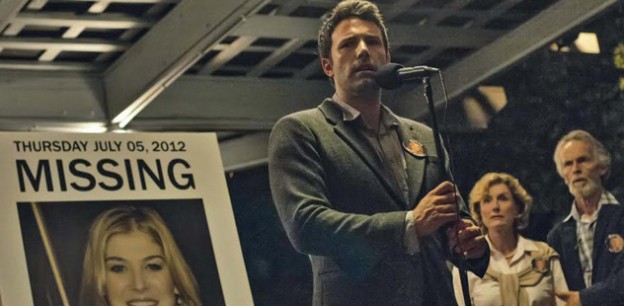
Without giving too much away, Gone Girl is the story of Nick and Amy Dunne (Ben Affleck and Rosamund Pike, respectively): an unhappily married couple detached from their once-elite Manhattan lifestyle. Having moved to Nick’s boyhood home of Missouri to care for his now-deceased mother, their marriage has since become a sham with divorce looming on the horizon. But when blonde and beautiful “Amazing” Amy mysteriously vanishes from their suburban mansion one morning, the ensuing investigation begins to point dirty fingers at Nick—all of which lead straight down an impossible rabbit hole of cold and calculating cruelty, emboldened by a national media frenzy.
The surrounding cast is a strong one. Nick’s twin and often incredulous sister, Margo, is aptly played by Carrie Coon (whom you may now recognize as Nora from The Leftovers); detective Rhonda Boney is Kim Dickens (The Zero Effect, Deadwood); bona fide weirdo Desi Collings is the lovable Neil Patrick Harris (he’ll always be Doogie Howser to me); and in perhaps the surprise performance of the film, Tyler Perry expertly plays celebrity lawyer Tanner Bolt.
While I won’t leap to compare Gone Girl to Fincher’s most brilliant directorial works like Seven, The Game or Fight Club, this is a smart film, touching a variety of nerves along the way. Much of the credit indeed belongs to author Gillian Flynn for penning both the script and book, but it takes the right vision to ultimately project page to screen, and Fincher was certainly up to the task. Themes of infidelity and jealousy are paramount, often causing a near visceral reaction as Fincher weaves the twists and turns in a manner that causes one to reevaluate character preconceptions along the way. To get that much out of Ben Affleck, for example, is noteworthy in its own right, as Affleck the actor can be so terribly uninteresting so very, very frequently. (A needless aside: During my initial perceived frustration with the film, I found myself internally cursing Affleck for once again casting himself as lead in a movie he directed, despite consciously knowing he wasn’t the director. Ben Affleck can have that effect on people, you know.)
Gone Girl’s imperfections stem from sheer plot density—there’s a lot going on pretty much all the time. You’d think that 149 minutes would be more than enough to properly attend to each thread and character, but that isn’t the case. Take Tyler Perry, for one: His portrayal of celeb attorney Tanner Bolt is arguably the best in the entire film, and yet he’s barely in it. The same can be said for Neil Patrick Harris, who deftly plays a freakish oddball you’d love to know much more about, yet we learn virtually nothing. Which doesn’t imply that most other aspects of Gone Girl are being overplayed; there are just so many characters, themes and emotions introduced, that many of them simply aren’t seen through to preferable completion.
But that’s nitpicking, at a point. Because this is a good movie, and one worth the time for anyone that enjoys an involved thriller. And that’s coming from a guy that wasn’t blown away by each and every plot ripple. What it comes down to, I guess, is that sometimes you don’t need to be blown away. Sometimes you just need to see something done right. And sometimes it takes a real horseshit flick like A Walk Among the Tombstones to put that into perspective.