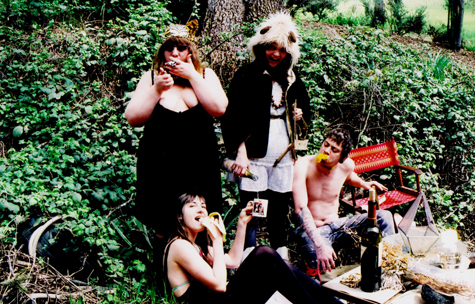
ALAK GRØUPS
(KDVS Recordings)

KDVS Recordings broke into the modern cassette fetish in May with ALAK’s GRØUPS and while, I feel regrettably late to the campfire, the album’s August digital release will hopefully breathe new life into another fine installment in the local cult of weirdo-folk music.
From Davis to Midtown, stretching on up to Placerville and Nevada City, the greater region is rife with weirdness. Folk, the genre armed with acoustic guitars and banjos, is treated quite differently in our region. Bands like Ellie Fortune, Sea of Bees, (formerly) Chelsea Wolfe and Dead Western are connoisseurs in crafting folk oddities. Is it the legalized marijuana? Is it an unseen Owsley figure with an endless supply of blotter acid? Are the surrounding woods filled with mystical spirits and owls, like in David Lynch’s Twin Peaks? Or is it the Sunday farmer’s market? I could not tell you. It is only known that the weirdo folk genre is as organic to Sacramento as the pungent smell of garlic is to Gilroy.
Place ALAK in the weirdo folk community’s highest regards. GRØUPS asks, “Are you weird enough, man?” for a two-song duration of ambient fuggery, freak-out jazz skronking and crystalline tape machinations, before settling in with a folk track fed through dub selector systems called “My Love Is the Best.” The intro to GRØUPS is deliberate in establishing a weird front. As a digital release the challenge is a non-issue, since skipping is as easy as a pushed button away or the stroke of a delete key; but in the tape format, ALAK is risking its heartstrings in the name of experimentation. With the futzing mess out of its system, ALAK harnesses its chi for an enlightening stretch of acoustic haunts (“White Stones”), instrumental transmissions to the Third Kind (“Doc’s New Super Leo”) and off-kilter sambas (“Pull Old Saint Long Chaine”).
All great albums must come to satisfying conclusions, and GRØUPS rallies for a final shot at greatness with “Child Heart” and a cover of Robert Wyatt’s “Alliance” (I excluded the field recording “Wiiind,” simply because it’s just a slapping barn door and the whistle of Mother Nature). “Child Heart” dodges the folk label entirely, by operating in the tropes of pulsating indie-rock and synth-pop flourishes. As songstress Jocelyn Noir lingers on the lyrics, “Just get it out,” the blossoming synths billow faster for a dramatic crescendo that delicately releases its grip on us, so we’re not too wound up for “Alliance.”
I would much like to hear the GRØUPS cassette, but I am grateful my introduction was the digital release. Hearing “Alliance,” a Wyatt cover that claims “Chomsky got it right,” sung in Noir’s chilling whispered croon is best enjoyed through a pair of expensive headphones. In the comfort of a headphone womb, ALAK’s version of “Alliance” is a lush swan song, willing to let the lyrics be the challenge issued, rather than a test of one’s taste for experimentation.
ALAK’s GRØUPS requires patience, beyond determining your threshold for clatter, but grit through the odder moments and it’s a record with the capacity to nurture. Possibly GRØUPS is your gateway into the weird scene without undergoing altered states? Don’t worry, it’s only folk music with an unorthodox slant.
You can stream ALAK’s GRØUPS at Alak.bandcamp.com, where you can also find links to download the songs and purchase a copy of the cassette.
Dead Western
John Natsoulas Gallery, Davis
Aug. 29, 2009
Words by Vincent Girimonte
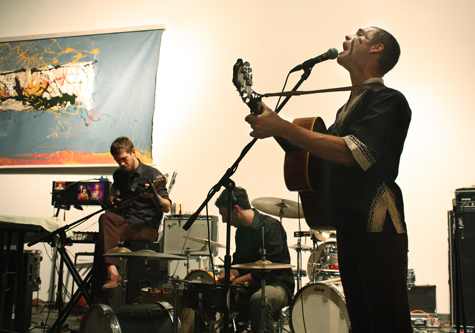
Last Saturday, the ever-embracing arms of Davis’ John Natsoulas Gallery welcomed some pysch-folkers, notably Sacramento’s Dead Western Trio, who played in support of Ben Chasny’s decade-long, discretely prodigious endeavor, Six Organs of Admittance. However, it was the local act who made the show somewhat remarkable.
The Dead Western Trio is a genuine spectacle, both visually and sonicly—each served the band well in a room four sizes too big, with other pieces of high art threatening to pry attention away from the makeshift stage. The high ceilings seemed more conducive to flying a kite than live music, but to his credit, Dead Western frontman Troy Mighty was shrewd enough to wear tights and war paint (the old one-two), perhaps to guard against wandering eyes.
Mighty approached the audience gently picking a guitar, strolling along with the bass and ambient percussion. With the addition of vocals, the music changed drastically, slumping down into an almost macabre tone. The simplicity of the acoustic guitar and bass gave room for Mighty’s calamitous baritone to let loose and emphasize each note. To be sure, an appreciation for the low and slow will help here; the pace never exceeded that of a funeral procession march.
Mighty’s voice—to some extent, Dead Western’s sound—may initially strike the listener as polarizing, engendering a queasy impulse. His clarity and the Trio’s instrumentation might be obscured by his vocal delivery, which has elicited all sorts of zany characterizations such as Big Bird lamenting on Dramamine. Crooning? Maybe Antony Hegarty with a few more Y-chromosomes.
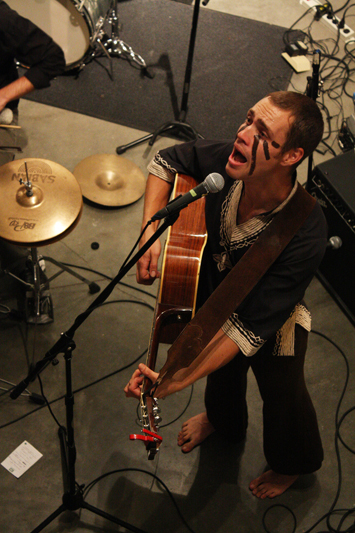
Despite this, midway through his first number, the strange gap between Mighty’s vocals and the Trio’s music had been bridged thanks in large part to his words and the manner in which he employed them. The incongruous pair turned out to be a neat fit.
“Too often, I think, the voice is not recognized as the instrument that it is,” Mighty says, answering a few e-mail questions, “and therefore feels very separate from the music, rather than being rooted in and around it.”
The instrument he speaks of mouthed clear, articulate language, often overtly pensive with lines like, “Tell me how do you write a song that makes things meaningful? How do you reach inside the hearts of those you don’t know?” These are undoubtedly broad sentiments, which fringe upon tired at times, and Mighty doesn’t necessarily stray too far from them in his other tracks. But they surface as familiar and approachable and altogether committed.
Mighty on the not knowing: “I feel very sure about many things at this point; other things, not so sure, and this comes through in the honest songs that I attempt to write. It’s an ambiguity that I am very aware of, and am not afraid to present to others.”
Completing the Trio are bassist Jesse Phillips and percussionist Kevin Corcoran, who remained the steady, honest accompaniments on Mighty’s quest through the weird. And don’t be nervous about the percussionist, as was I; percussionists do shit drummers can’t, like tap fossils against a garbage can. But fortunately there were no wild forays into scraping cymbal solos and nobody, as far as I could tell, pulled out a skull. Corcoran knew what he was doing—an utterly refreshing quality for a percussionist and indicative of Dead Western’s refined sound. They made neat work of filling such a large room.
Dead Western’s Soften Your Screams into Sings is available on LP from KDVS Recordings. Suckle at the Supple Teats of Time will be released in 2010 out of Germany on Discorporate Records.