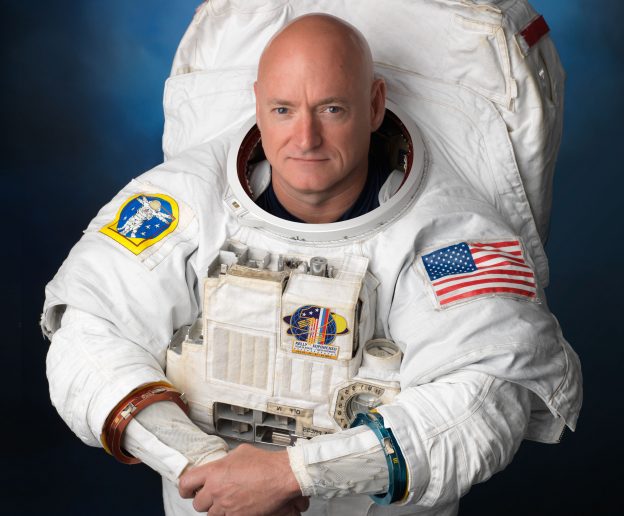
Captain Scott Joseph Kelly has spent 520 days literally off the planet, floating in space. That would be 2 percent of his 53-year life, if you’re crunching numbers at home. Fascinated by The Right Stuff as an impressionable youth, Kelly received degrees in both electrical engineering and aviation systems before joining the Navy in the 1980s, whereupon he was eventually selected by NASA as a part of Astronaut Group 16 in 1996. His resume from that point forward reads like science fiction, with the crowning achievement being a year-long mission aboard the International Space Station (ISS) alongside Russian cosmonaut Mikhail Korniyenko from March 27, 2015 to March 2, 2016. The primary objective of this lengthy stint in space was to study the long-term effects of spaceflight upon the human body, which, in the case of Kelly, also involved using his twin brother as a control back home on Earth.
The time since has seen Kelly “retire,” a relative idea for a man possessing a work ethic that most can only dream of. In the spring of this year, Kelly saw the release of his first book, Endurance: A Year in Space, a Lifetime of Discovery. Endurance is both accessible in its scientific nomenclature, while still steadfast in detail. It’s also rewardingly human and philosophical; all the more poignant from a vantage point that very few have had the chance to experience. With the Sacramento Speakers Series presenting Captain Kelly at the Community Center Theater on Jan. 17, the spaceman himself spared a few minutes of his time to speak with Submerge.
Your voice in print is pretty effortless. It almost felt like you’ve been a longtime author. Was it something you had to work at, or did you find it easy to slide into that mode?
I think at times when I write it can be really good; at other times it’s a struggle and a challenge. I think it’s more my ability to tell a story versus my ability to write it down. I think being able to tell a story in a vivid way is helpful when you then want to write a book; it makes people feel like they were there. But it’s not easy. I wanted people to be able to relate to it, to believe in it, to experience in their imagination from these words what I experienced. Right now I’m writing a young reader version.
Do you get the opportunity to speak with kids as much as you’d like given your various engagements?
Right now it kind of is what it is based on my schedule—which is not that free—but I would much rather talk to a group of kids than a group of adults [laughs]. It’s getting to see that they’re really interested in space and science. If you took a poll of all the kids on Earth and asked, “What job would you want to have when you grow up?” I bet astronaut would have more than any other.
With the pushback on science across the populist spectrum, do you feel very strongly about giving your opinions to the world right now? More so than, say, 10 or 15 years ago?
Absolutely. I think we are at a critical time in the history of our country where we have people that deny science. Especially [from] people that aren’t scientists. To say that 97 percent of scientists are wrong and you’re right because, I don’t know, you’re a lawyer? [Laughs] Makes no sense. It’s not logical. And you have a government, whether it’s congress or the administration, that fosters these conspiracy theories and anti-science ideas. The fact that I kind of have a platform now … it wasn’t my plan, [but] I do feel somewhat obligated to point things out when I think they need to be in regards to this whole science denial.
There are so many things regarding life in space that 99.999 percent of us could never even begin to consider. One of the things that jumped out at me in the book was urine, and trading it with the Russians.
So we have a system on the space station that turns our urine into water. The Russians don’t have that; they give us their urine so we can also turn their urine into water. It allows us not to have to fly so much water [into space]. It’s a pretty sophisticated piece of equipment and kind of hard to manufacture and run. The Russians have plans to fly their own, but they’ve not been successful yet. So they have to launch all their water from the ground. We on the other hand don’t. It’s that simple.
I know that you see the United States someday reaching Mars, as it was a part of what initially interested you in space travel, but how far out do you see a mission like that, realistically?
It depends on how much desire we have to do it. I think we could do it within the next few years if we made the investment. I don’t think that will happen, but it could. I’m hopeful. But skeptical.
Your story about being ordered to find out if a Russian counterpart had brought an Iranian Quran aboard the ISS struck me. Does it surprise you that politics can permeate even the furthest reaches of humanity?
I was shocked about that; that I was kinda given a mandate to go find out. I mean this is somebody’s personal property. The fact that it was a Quran from Iran was irrelevant to the point, I thought. If you can bring a Bible from your own country, why shouldn’t you be able to bring a Quran from somewhere else? It’s not logical, and I’m a pretty logic-minded person.
You noted that while looking down on Earth you were in fact viewing the chaos from above. Was that an interesting or maddening experience, to know that even in your own country strange things were happening while you were so far away? How did you process that at such a distance?
At the time, it’s just kind of hard to understand. We have this incredible planet and opportunity to do good and work together to solve our problems, and it seems impossible. Fast forward two years later and we’re in the situation we’re in now and it’s just … heartbreaking. That this is what our country has come to, just yelling at each other on TV news 24/7.
I read in the text that one of the questions you get asked most is “What did you miss most about Earth?” But I was curious, what did you miss least about Earth while you were away?
Hahaha. Never been asked that. Huh. [Long pause.] Well I know what I would say now. Back then I don’t know what I would say.
What would you say now?
I’m not telling ya.
Hear Captain Scott Kelly speak live about his year in space at the Community Center Theater (1301 L St., Sacramento) on Jan. 17, 2018. This event is part of the Sacramento Speakers Series. For more info or to order tickets, go to Sacramentospeakers.com.
**This piece first appeared in print on pages 14 – 15 of issue #255 (Dec. 18, 2017 – Jan. 1, 2018)**
In a media landscape that’s riddled with “alternative facts” and reality stars who are famous simply because we revel in how dumb/mean/awful they can be, Neil deGrasse Tyson is a breath of fresh air.
For the past two decades, he has been the director of the Hayden Planetarium in New York, but his numerous television appearances, including guest spots on The Late Show with Stephen Colbert, The Tonight Show Starring Jimmy Fallon, The Daily Show and many others have aided the charismatic astrophysicist’s elevation to household-name status. But as you’d imagine, stardom was the furthest thing from Tyson’s mind when he entered into science.
“The fame factor, I’m still in a little bit of disbelief of it,” he says in a phone interview with Submerge from his office at the Hayden Planetarium. “I want to turn around and face people and say, ‘You realize I’m an astrophysicist. Should I remind you of this? So you can still pull out, you can unfollow, you can redirect your energies.’”
However, there are positives Tyson takes from his fame, and maybe you can, too, especially if you’re of the mind that our country has been mired in a severe brain drain in recent years.
“I think the takeaway here is there’s an underserved appetite that the public has for the universe or for learning or for science, and that’s what I’m delivering to them,” he says. “I don’t twist their arm. I’m not trying to get them to create a cult. I’m just offering knowledge, wisdom, insight into the operations of nature, and people like it. That’s very powerful information, I should think. Some networks have figured this out. CBS has the No. 1 show on television, and it’s called The Big Bang Theory. Though they may be caricatures, they are Ph.D.-educated people, and you’re eavesdropping on their social and personal lives, and who would have thought you can make money on that?”
Part of Tyson’s appeal is that he’s able to communicate his knowledge without condescending. This trait will be on display in his upcoming book, Astrophysics for People in a Hurry, which is due out in early May 2017. Notably, the title is not Astrophysics for Dummies, as he’s quick to point out, because he knows you’re smarter than that.
“I’m very proud of the book, because it took a lot of my educational insights that I’ve gleaned over my lifetime to figure out what to put in there and how to present it so I could maintain your interest, not insult your intelligence,” he says. “The first sentence is a statement of the conditions of the early universe. It’s flat-out, ‘Oh my gosh, this is otherworldly. What is this place?’ Well, it’s our universe.”
Tyson will visit Sacramento on May 9, 2017, when he’ll give a sure-to-be sold out talk at the Community Center Theater. There he’ll no-doubt blow your mind with stuff about black holes and other secrets of the cosmos. In this interview, however, we delve into deeper mysteries such as Tyson’s playlist, Stonehenge and why would anyone pre-order anything.
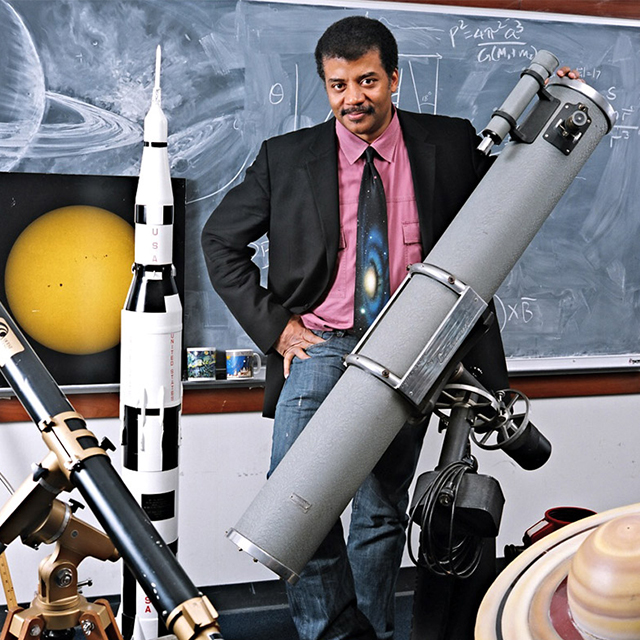
Photo by David Gamble
The publication I write for is primarily focused on music. Do you listen to music while you’re working in the office?
I love music, but who doesn’t, right? I have the ability to—or at least I’ve convinced myself that I have the ability—to be no less productive even in deep-focused work with music blasting behind me. Some people need silence when they focus, but I can thrive in the presence of music—particularly music that I like. Back in the disco era, because that’s how old I am, I would play disco while working on certain projects, because the incessant beat would force [laughs] … the beat would never end, right? So if I linked my own body rhythms going to the beat, it kept me going, kept me awake, kept me moving forward on intractable projects. If I were to pick a genre that I would live with above all others, it would be the blues. That’s my favorite genre. I would say that a third of what I listen to is the blues, and the other two-thirds is a mixture of everything else, from classical to pop, but time-tested pop … I’m very pop-ularist when it comes to pop music [laughs]. I like the songs that have survived scrutiny … They are the ones that the oldies station would play. You forget when you listen to an oldies station, you say, “Oh boy, we really made good music back then,” but I say, “No, they’re not playing all the crap.” They’re filtering all the good stuff from the bad stuff, and you think somehow that era had better music than later eras. It’s a common misconception that we all have when we listen to music from our time.
So unlike science, for you some of the older ideas in music are better than the new ones as far as you’re concerned?
No, what I’m saying there’s good music coming out at any given time, but I rely on the filter of time to select the best ones, and those are the ones that I listen to. And I generally agree that they’re better.
Do you have any songs or bands that are your go-to when you’re looking for something to listen to?
OK, so, amid all the hit songs that I may like, there are some groups and performers who rise up above all the rest for me in terms of how they satisfy me. One of those is Simon and Garfunkel, and another is Enya—yes, I admit that.
Well, I’ve got it on tape, so you can’t take it back.
I admit it [laughs]. Enya. Those may be the only two performers where I own everything that they’ve ever done. There are others where I like some stuff, but not enough to own everything they’ve ever done.
I guess Enya is kind of space-y …
Yeah, kind of new age, space-y. It’s celtic, of course, but it comes from another place. It comes from space! If the Celts were aliens from space, this is the music they would make [laughs]. Right? That’s what it is.
I’m probably way wrong on this, but didn’t the Celts build Stonehenge? And that was a space-thing right?
Yeah, I don’t know who precisely built Stonehenge. I thought it may have been the druids, but maybe the scholarship has been modified on that, but yeah, it is an observatory. It tracks the moon and eclipses and does a lot of really fun things scientifically.
[Editor’s note: If you’re keeping a scorecard at home, radiocarbon dating suggests evidence that Stonehenge’s construction dates back to Neolithic times and precedes the arrival of the Celts. Regardless of who built it, it’s safe to say that it’s still a pretty bad-ass monument.]
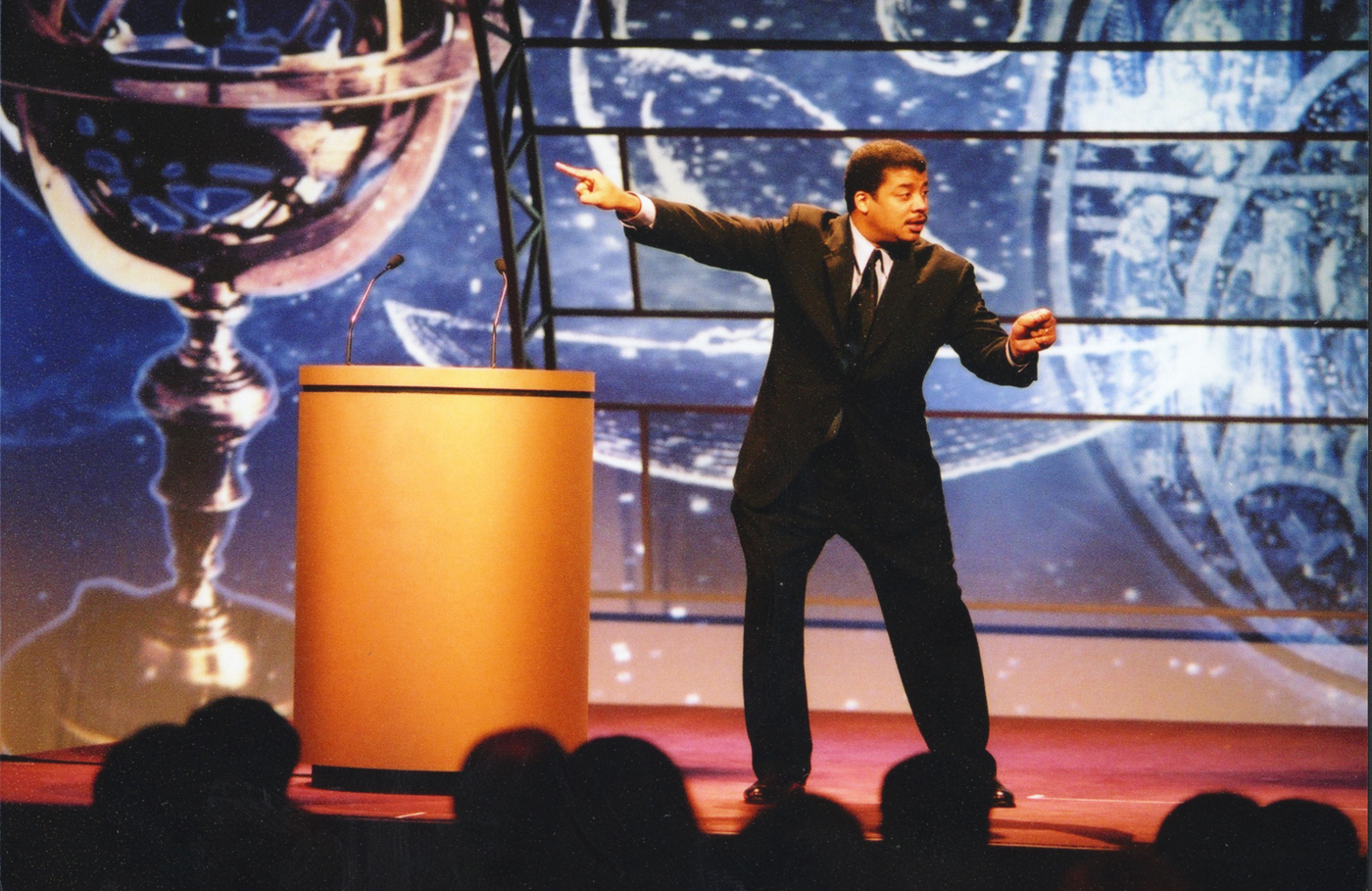
Photo by Delvinhair Productions
Science changes all the time. In your time at the Planetarium, how has it changed for you? Has it altered any of the assumptions you had?
No, we were smarter than that. We wouldn’t commit large exhibit money—heavy duty exhibit money—to something that could be different a few years later. So what we did was, the exhibitry was split into three varieties. One was we would cut into metal content that was of a very high shelf life. Earth goes around the sun … that’s cut into metal. The next would be transparencies that communicate information that has medium-length shelf life. And then we have another place that’s just video, where as the frontier changes, we swap in a new video relative to the old one. That way we stay current, but we anchor what we know about the universe and what’s not going to change going forward.
You have a new book on the way, Astrophysics for People in a Hurry. When does that come out?
Well it turns out, right now you can pre-order it, and I hadn’t fully appreciated why anyone would pre-order anything—but now I know. OK, you’re ready? Here’s why …
Why?
The publisher likes knowing how many books they have to print. They don’t want to print too many, and they don’t want to print too few. So if you pre-order it, that helps the publisher, but why would you want to help the publisher? Well, there’s also the fact that Amazon wants your money sooner than you want to give it to them, so if you pre-order, you order at this really low price. The book retails for $18, but they’re selling it right now for $12. Holy … How do they … What?! But that’s only in pre-order, and when the book comes out, who knows what will happen to the price? So I’m intrigued by this whole marketing dimension of what a pre-ordered book is. But it’s coming out in about six weeks … The first week of May, I think—May 2.
As a scientist, do you often find yourself breaking down things like this, like why would someone pre-order something?
Oh yeah! This is how you learn, right? You wonder why something is, and then you go investigate it, and then you learn it. If a day goes by when I don’t learn anything, that’s a wasted day.
Can you give us a preview of what the book is about?
Astrophysics for People in a Hurry … my goal for it is that all future headlines that come across from discoveries in the universe, you will be fluent in. So discoveries on exoplanets and black holes and Big Bang and the multiverse and the search for life and dark matter, dark energy, all of this is carefully curated so you get a maximum amount of information in a short amount of time, because you’re in a hurry … because that’s what the book says. You’re in a hurry. I found a way to ramp up all the really cool science so you can see it, read it, absorb it and take it with you wherever you go. I’d like to think of it as an occasion for you to consummate your relationship with the universe.
Recently NASA made headlines with the discovery of Earth-like planets in the Trappist-1 system. I heard about it from watching the press conference, but did you get a preview of that before the public did?
I used to chase the previews, but it turns out that it’s not necessary. I’ll read the press release like everyone else and then I’ll watch the press conference and then maybe I’ll get a phone call. But by the time I get a phone call, I’m already pre-briefed. I’m usually pre-briefed on these things.
When I heard about it, I was extremely excited. When you get a press release like that, are you like, “Yeah!” Is it like the Super Bowl or something like that?
Oh no, actually I lament that I’m going to get a zillion phone calls and my days no longer belong to me. I have to go into servant mode of the public’s curiosity, and I’d rather just stay home.
Join Neil deGrasse Tyson for a talk at the Community Center Theater in Sacramento (1301 L St.) on May 9 at 7:30 p.m. For tickets, go to Sacramentocommunitycentertheater.com or call the box office at (916) 808-5181. Editor’s note: This show is now sold-out!
**This interview first appeared in print in issue #236 (March 27 – April 10, 2017)**
Where did you spend your Fourth of July? A barbecue? That’s pretty sweet. But all the smoked ribs in the world just aren’t as cool as swinging by Jupiter. That’s where the Juno satellite ended up this Independence Day.
Assuming everything went according to plan (as of this writing on July 3), Juno began inserting itself into Jupiter’s orbit at 8:18 p.m. PDT (don’t know what that would be in Jupiter Time). The process took roughly 35 minutes, and then Juno, a solar-powered spacecraft that would fit more or less snugly into a regulation basketball court, started setting up antennas and probes and whatnots to start broadcasting back to the uber-nerds at NASA who held a press conference at 10 p.m. PDT to let us know that everything went hunky-dory. Again, I’m just going to assume this all happened, because NASA never makes mistakes.
OK, that was low. I’m just jealous that I’m not even remotely smart enough to work for NASA. I just want to go to space really bad so I can meet Yoda. No one will send me. I’m a jerk.
Anyway, Juno, named for Jupiter’s mythological wife who could see through the clouds (according to this nifty Jupiter Orbit Insertion Press Kit I’ve been having a nerdgasm over all afternoon), was launched way back in August 2011. Our world was very different in 2011. David Bowie and Prince were both still with us, Brexit hadn’t become a catchy buzzword, no one would have ever conceived that Donald Trump could be the next U.S. President and I’m not sure which iPhone we were up to, but I’d bet it was the sweetest one ever.
My guess would be that Jupiter of roughly five years ago was pretty much the same as it is now on our Independence Day 2016. I mean, it’s just this giant swirling sphere of gas and gravity with epic storms and a gajillion moons just dominating our solar system out there in the relatively not-so-far reaches of space. It doesn’t have troubling political issues or pop culture or technology posing as pop culture. So why do we want to spend $1.13 billion on getting up close and personal with it?
I honestly don’t know. Even so, I’m all for it. Sure, that money would probably be able to do a lot of good stuff here on Earth. But, well, it’s freaking Jupiter for cryin’ out loud. I mean, seriously, Jupiter.
Juno is a groundbreaking doodad as it has traveled farther than any solar-powered spacecraft has ever traveled from Earth. It will also be the first spacecraft (at least that we know of) to travel as close as 2,600 miles from Jupiter’s cloud tops. As a bonus, it will take the highest resolution photos of Jupiter in our history. The mission hopes to learn more about how Jupiter formed and its evolution over time, which scientists hope will give us more understanding about how our solar system formed. I’m not sure how some high-res JPEGs will do all this, but then again, that’s why I don’t work for NASA.
Juno will then study Jupiter over the next three months, but will not really get down to the nitty gritty of its scientific mission until October. When it’s all done, in February 2018, Juno will go out like a true gangster, plunging itself into Jupiter’s atmosphere in a blaze of glory. In so doing, hopefully sparing the potentially life-bearing moon Europa any contamination of Earthling microbes.
All this is super cool, and not just because I have a raging space boner. I’m sitting here with sweaty palms, anxiously awaiting all these awesome new images to come pouring in. Also, I can’t wait for all the grabby headlines like “Scientists Discover New Clues About Our Universe!” and such.
But other than the cool factor, maybe all that money we sunk into Juno could have some real practical applications. Like, that solar-powered engine … er … thing that was able to propel Juno so far and so fast out into space (it was capable of reaching speeds of 165,000 miles per hour, and at the point of orbital insertion, it would have traveled hundreds of million miles away from Earth). That says a lot for solar power. Like, running a TV shouldn’t be so difficult if we’re able to send a satellite so far. So maybe it can be a thing. And then in five years, we can look back at 2016 and remember when oil dependency was a thing. Or something like that.

If you were alive in the ’90s and had MTV or a stereo (remember those?), you probably had a boner for Nina Persson. As frontwoman for the Cardigan’s, her dreamy voice, elfin features, deep blue eyes, super model body…
Sorry, I forgot what I was saying.
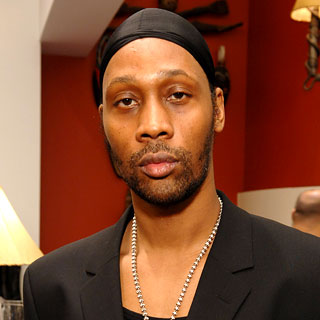
Right, I got an e-mail that she’s doing a duet with RZA for the new N.A.S.A. album, and since I’m from Shaolin born and raised, I am obligated as per the conditions of my birth certificate to report anything remotely Wu-related. Nina is just the sexy Swedish frosting on the cake.
You can check out a brief clip of RZA and Nina in the studio here. Their collaboration with N.A.S.A., “Electric Flowers” is on the album The Spirit of Apollo for Anti Records and also features appearances from Tom Waits, Fat Lip, Method Man, the Yeah Yeah Yeahs, E-40, M.I.A. and many others.
Persson is also busy on her own projects. Though “Lovefool” was The Cardigans only substantial hit in the U.S., Persson has continued to produce music. Now with husband and former Shudder to Think guitarist Nathan Larson, she is lending her talents to A Camp, which has more of a pop-country vibe. A Camp will release its U.S. debut, Colonia, for Nettwerk on April 28.
And for nostalgia’s sake, click here.
This has been a busy week for me. In addition to my normal duties, I’ve also been tending to my neighbors’ cats and garden while they’re away on vacation. It’s very rewarding and very stressful work. The cats have taken a shine to me. Now when I approach, they don’t scurry and hide, but they run up all around my legs and meow sweet nothings toward me. The plants have proven to be more difficult. The azalea bush was pink, vibrant and fluffy before it was relegated to my care, but now is shriveled, drab and droopy. On the bright side, the vegetable garden seems to be thriving. The Japanese eggplants are coming in nicely and there are zucchini and squash already coming in. It’s simple, maybe, but it’s very fulfilling work.
While I’ve been busy concerning myself with terrestrial matters, others have been setting their sights toward heavenly bodies. Mars is back in the news again. The Phoenix Mars lander, a space craft deployed by NASA, may have discovered water ice. According to an article by Kenneth Chang published in the New York Times on June 20:
“In a photograph released Thursday evening of a trench that the Phoenix Mars lander has dug into the Martian soil, some white patches that were seen earlier in the week have shrunk, and eight small chunks have disappeared. Until now, scientists were not sure if the white material was ice or some kind of salt.
“When exposed to air, water ice can change into water vapor, a process known as sublimation. Salt, on the other hand, is not capable of such a vanishing act.”
Of course, ice on Mars is nothing new. Scientists have been popping boners over the possibility for years now. Later in the article, Dr. Peter H. Smith of the University of Arizona, the principal investigator of the Phoenix’s mission, threw the scientific method out the window and gushed, “It must be ice! The whole science team thinks this. I think we feel this is definite proof that these are little chunks of icy material!”
In case you were wondering, I added the exclamation points for effect. He just seemed so darn excited. I’m sure his statements were delivered with the proper gravitas.
Water ice, of course, means water. And, as I’m finding out as the caretaker of my neighbor’s garden, water means life—unless of course you live near the banks of the Mississippi, in which case water equates financial ruin and soggy doom.
So did anything ever live on Mars? There is evidence of vast icy material beneath the planet’s surface. There is also a chance that Mars’s environment may have been habitable in the past 10 million years or so. It’s possible, sure, but it’s probably nothing as interesting as the critters from Mars Attacks.
If it turns out Mars is, was or could be inhabitable, we should take it at as a blessing. Shit keeps getting worse here on ol’ Earth. A report issued by the U.S. Climate Change Science Program (got to work on that name, guys) on Thursday, June 19 stated that catastrophes like the aforementioned Midwest flooding—and even the fires that have been raging around us in northern California may become more prevalent and more extreme in the years ahead. Apparently, what was contained in the 162-page report was so gnarly that the vice president and managing director for climate change of the World Wildlife Fund, Richard Moss, called it “really frightening!”
That exclamation point was mine, too. But you should probably grow those gardens while you can.