Dog Party
Concerts in the Park
Friday, May 7, 2010 – Cesar Chavez Park – Sacramento
Words & Photos by Vincent Girimonte
Two things to take away from last Friday’s edition of Concerts in the Park: one, Sacramento has some exceedingly hip youth; so hip, in fact, that I felt like a tool toting just one lens with my Nikon. Seriously though, I saw way too many kids with thousands of dollars-worth of camera gear dangling from their thin little necks. And second, make sure to buy a beer ticket before you get into the beer line–just a friendly reminder I wish someone would have given me.
Full disclosure: this was my first CIP, and for all my faux curmudgoenliness (I still get carded, for everything) it was a genuinely unique and jovial Sacramento on display in Cesar Chavez Park. Young professionals rejoiced in public consumption as kids pranced around and people were wearing balloons as hats, which would be ridiculous if it weren’t a Friday signaling the beginning of our glorious summer.

Dotting the park were food carts of all shapes and specialties, reminding Sacramentans of a culture largely prohibited to them and satiating drunks and kids alike with fatty eats such as lumpia, rice bowls, Cajun crawfish and the night’s hot seller, tamales for $1.75. About the crawfish: “They’re back” announced promoter Jerry Perry from the stage, gleefully, but at $10 a basket, I was left to lick shells off the lawn. There was plenty of affordable grub to be had, though, and $4 domestics shouldn’t elicit too much whining from anyone, though it inevitably will.
Simpl3Jack
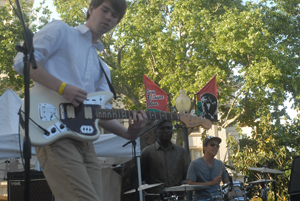
2010’s first Concerts in the Park, now in its 18th year, was mostly about Perry and his talented lineup of youngsters, including Simpl3Jack and Dog Party of
Sacramento News & Review Jammies fame and The Kelps. The show was headlined by the sugar-spiked Kepi Ghoulie, the biggest kids of them all, who played a lengthy set of punk nostalgia piped over zany PG lyrics.
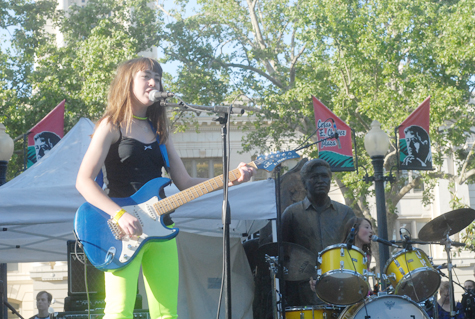
If you don’t know Dog Party, you’re likely so thoroughly out of it, you probably didn’t even know they’re just a couple of adolescent girls with a penchant for neon. Gwen “Don’t call me Meg” Giles beat drums behind her sister Lucy, who strummed her Fender, playing original tracks off their debut album and then rocking a cover of Tegan and Sara’s “Walking With a Ghost.” Two men wrestled for a T-shirt after Dog Party threw out one of their sweet XL tees–such is the zeal of their following, or perhaps the state of things these days.
Kepi
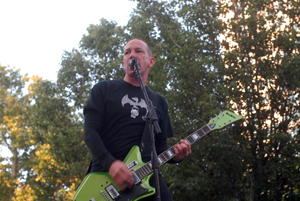
Part Pauly Shore, part Flea in the vein of Yo Gabba Gabba, Kepi shut things down with tunes about supermodels (gross!), chupacabras (ew, yuck!) and rabid monkeys (whaaa?!). He called on the beer garden for a sing-a-long, and they reciprocated like good sports without a worry on Friday night. “Man,” he said, clearly appreciative. “We got a pretty good town.”
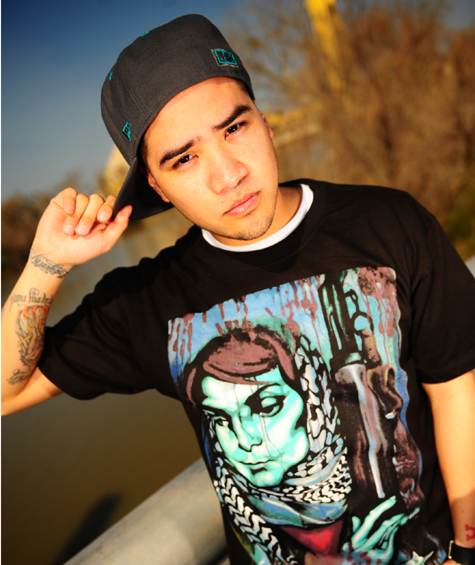
Sacramento MC A.R.A.B. looks to infiltrate bigger markets with The Trojan Horse
Talk with any rapper or MC who’s been hustling in the music business for five or more years and they won’t hesitate to speak on the “salt in the game”—shifty promoters and snake managers trying to swindle for petty pocket money. Sacramento MC A.R.A.B. weathered his fair share of rats, which is why he could not have picked a better acronym (Always Rise Above Bullshit) to summarize the path leading to his new record, The Trojan Horse—even the album title is a proper foreshadowing of things to come.
Along with his crew/company First Dirt Republic, A.R.A.B. is approaching the business with a perspective not often exercised in hip-hop. The sub-genres of hip-hop (backpacker, club, street) rarely mix company, but A.R.A.B. aims to walk among the culture’s various factions, whether it’s the most underground coffee shop show, a neon lit dance floor with caged girls dancing or a high school auditorium—no frills.
He’s seen plenty of the ugly side of the business, and through that gauntlet he’s emerged with a trustworthy manager and publicist, as well as a crew of producers, MCs and various arts performers that he’s able to call family. “We try to keep it close-knit so everybody benefits,” he said. “If you see us together, we’re tight. There’s a core 12 of us that’s only been together officially for three months, but we call each other family.”
Prior to this record, you released several mixtapes; is The Trojan Horse your first official album?
I had one solo project that I put out, then I had two mixtapes following that. I try to stay away from the whole mixtape thing now. I’m just not a big fan of them. I’d rather put my time and energy into something I can put a barcode on. Mixtapes are sloppy and thrown together. I want to spit on my own beats.
Going into The Trojan Horse project, what were some of your goals?
I think every album I’ve done is a reflection of what I’m going through at the time. When I put out For My Culture I had just beat a case, so I had a lot of negativity on my chest. With The Trojan Horse, this is our push as a group. It’s still my music, but it’s [First Dirt Republic‘s] push to get our foot in the door. The idea of a few conquering many is the idea behind it.
With the Greek legend in mind, should Sacramentans fear the idea of a Trojan horse invading their city?
No, our whole purpose is to get out of Sac through the Trojan horse. In promoting this record we’ve gotten shows in Los Angeles, the Bay Area, I’m working on a show in New York. My producer just got back from India and he wants us to do a show out there. My two goals before this project happened were to do a show in New York and overseas. I wrote it down and it’s on my fridge. It just started happening, man. So, I’m a firm believer in writing my goals down and keeping them in mind.
The funny thing is whenever we promote The Trojan Horse it’s either taken as condoms or viruses.
People aren’t privy to the Greek legend behind it?
Not at all, man. We’ll hand out flyers at events and kids will ask where the condoms are at. This has happened several times. It’s kind of sad. I’d much rather have a young kid assume I’m talking about a virus than naturally equate it to sex and condoms. I guess I over-thought the concept.
Your record is club ready, but injects brief nods to your underground hip-hop beginnings. How important was it for you to maintain that balance?
To me, it’s always going to be there. It’s important that regardless how catchy my beats or my hooks are, that I never sacrifice any of my content. Even if I do talk about more catchy, mainstream stuff, I try to implement my wordplay to a point that if a real MC was listening, they’d appreciate that aspect.
That’s where I come from. I’m an underground MC still. The project after this called Vintage is bananas. It’s all stuff like “I’m a Monster.” It will be nothing but sampled stuff—Raekwon type beats. I understand having dealt with certain people in the business; I have different alleys now that if I make certain songs, I can do more than just stay in one market.
So is the goal to ensure there are no limitations on the venue play, be it a club or a dive, you’ve got the material to fit that market?
With The Trojan Horse alone, I can play a show at a club, I can do a show at an underground venue or I could do a show at a high school. It will be friendly to everybody at those three venues. My goal is to reach a larger demographic. For My Culture was just for underground street cats. In my mind at the time it was a big demographic, but now I see it as a pebble in a pond.
You mention your crew speaks and performs at high schools. What messages are you sending to the youth when you visit?
It started off being more of a personal thing. I come from a troubled background and I worked at a nonprofit organization that dealt with at-risk youth for four years of my life. I’ve always been around troubled kids. I always wanted to talk to young people to try to improve their situation.
It turned into something that’s more musically based. I go talk to performing arts kids or marketing kids or somebody who wants a career in the entertainment business, and we burst their bubbles. We let them know it’s not easy. These kids think if they put out a video on YouTube or one song, they’re golden. I don’t try to tell them they can’t make it like that. I share my experiences. You have to deal with a lot of B.S.
What was your first eye-opening experience that introduced you to the ugly side of the music business?
I’ve been approached by three or four different people that wanted to be my manager. Having dealt with those people really exposed me to a different side of the business. I like the music. I like working with other artists, shopping around for beats and creating songs. That’s one side. When you start looking at the side of being managed and getting promotions, more and more it became less of what I thought it was.
I thought going into hip-hop I could leave all the stuff I’ve been through alone. I didn’t think I’d have to be a jerk, be an asshole. I don’t have to show my fangs and be like that. I thought I could just do music. Come to realize more I got into the business, the more I had to do that to avoid getting eaten alive.
So I saw that you’ve got a clothing sponsor that keeps you in fresh clothes. Who’s keeping you stocked with gear?
Revolutionary Me is hooking us up with gear right now. The head guy there likes what we’re doing and keeps inviting us to events. He’s trying to get his line off the ground, we’re trying to elevate our sales, so it works out.
The people we’ve been meeting keep putting us on big shows with big names, names the sponsor wants to be affiliated with, so it works out. The sponsor gets the exposure, we get on the bill.
Ever get sent anything that you refused to wear?
When Tank Theory was still in Sacramento, they hooked us up with a bunch of stuff. I wasn’t rocking too much purple at the time, but I’ve accepted it now. [Tank Theory] gave me a purple hat and this other dude I was working with gave me some purple shoes. At first, I was like I’m not wearing that. I’m not wearing the hat. The longer it was in my closet, I started looking at it like it’s kinda tight. I rock it now.
Now, I got these Los Angeles Dodger blue shoes with white laces. I look at them, and I can’t do it. Eventually I probably will, but for now”¦
Don’t do it, man.

A.R.A.B. will celebrate the release of The Trojan Horse at Harlow’s on May 13. Tickets are $8 in advance and $10 at the door. This is a 21-and-over show.
Wednesday Market at Cesar Chavez Park
I don’t especially like rural or country areas. I like the vibrancy, diversity and speed of the city. However, my Sacramentans, there is one place that the two converge in delight of one another; a place where the best aspects of country and city living come together to inspire and satiate our engagement in life. That place is the farmers market.
My favorite cities in the world are cities where I remember happening upon a display and splendor of crop and crowd—a farmers market, marché ouvert, le Suk.
You may be walking along a dull outdoor cement corridor, and all of a sudden stumble into an open market, with life colorfully exploding all around you. You see every color, smell life emanating from fresh foods, hear varied voices interacting, feel the thick swell of interaction between those alive and those things keeping us alive.
At Cesar Chavez Park on a recent Wednesday, I experienced that beloved sentiment and always-unexpected rush of connectivity to the living world.
As I entered from the northeast corner of the park off of I Street around 12:30 p.m., the farmers market was bustling with people, colors, smells of fresh and cooking food, and soothing sounds of sax and guitar music.
Among an assortment of the normal summer fruits that I got for $1.50 at the J & J Ramos Farms stand (each stand has a banner with the farm the produce came from, so you can remember your fave and make friends), I found a few new treasures.
My very first purchase was an impulsive one. I’m a firm believer in comparison shopping, but with enough practice, a good comparison shopper will know when they stumbled upon a deal sans comparison. V.F. Garden had a pesticide-free serrated-edged deep purple Thai basil for only a buck per generous bushel (what could you really do with a large amount of basil before it went bad anyway?). It was so fragrant and vibrant and tasted slightly of black licorice.
Another one that was new to me was quark from Spring Hill Jersey Cheese in Petaluma. Since I’d never heard of quark, Matt, the young, friendly gentleman behind the table, filled me in. While handing me a half-strawberry filled with the creamy, spread-like cheese, Matt explained how quark is like a German style cream cheese, but unlike cream cheese, this spread is derived from yogurt cultures.
I’d describe quark as certainly tasty with a slight distinctive flavor like that of an extremely mild, chevre frais (fresh goat cheese), but with a delicate subtlety that only fine, fresh, thick cream produces. In fact, Spring Hill Jersey Cheese makes their cheeses with milk from Jersey cows, which produce milk that is typically creamier (or higher in butterfat, for those in the know), than that of their larger bovine counterparts.
At $5 for a mini tub, this fresh quark is a touch pricey, but for a dinner party or date, it could be a great and fairly un-pretentious way to impress.
Although I had a seedless watermelon chilling in my fridge, my very last purchase was a light-rinded yellow watermelon. At $1 per pound, this seemed like an expensive purchase, except that the full size of this watermelon was the size of a large grapefruit. It ended up being a touch tart and soft, but when mixed with seedless watermelon and chopped purple basil in the salad I made when I got home, it paired nicely.
Patrick’s Garden brought berries galore from Placerville for Sacramentans. Along with the usual berry brigade, the selection included golden raspberries, olallieberries and tayberries (both variations of black/raspberry blends). They were a bit pricey, but no more so than at the super market and probably fresher and healthier. I thought it was funny that Patrick’s Garden also had huge red and yellow onions the size of big boobs. Berries and onions? I guess there have been stranger accompaniments.
Just because produce is at farmers market doesn’t mean that it is all good. When picking any fresh produce, think about your selection process to ensure the best of the fresh.
Like anything in life that inspires any sort of feeling, make sure that the produce you pick is inspiring—at least to your appetite. Pick a bushel of spinach that looks green, vibrant and flavorful. Make sure you don’t grab thin-fleshed fruit, like peaches, plums, tomatoes, apricots or nectarines that look like they’ve been involved in some intense bouts of domestic violence. If you have to put them in a bag for a walk or bike ride back, you’ll surely end up with the baby food equivalent of what you’d hoped would be a tasty treat.
Fruit should speak to your senses, saying, “I smell like a sweet invigorating bite of life! Pick me!” Oftentimes, people are off-put by anything that has a very strong smell, so they’re inclined to choose nearly odor-less produce. Unlike fish, the stronger a fruits’ sweet smell is, the fresher the fruit is and the better it will taste. Try it.
I encourage anyone who can make it down to the farmers market to do so and see what kind of inspiration hits you, such as the inspiration to respect connections in the living world; or the inspiration to begin or finish a project that results in positive contributions. Or maybe you’ll feel inspired to eat, which wouldn’t be all that bad either.
If you can’t make it to the Wednesday market from 10 a.m. to 2 p.m. at Cesar Chavez, you can find listings of other farmer’s markets online at california-grown.com, click “market times & locations.”

Cafe Marika
2011 J Street | Sacramento, California
Every culture’s cuisine has its signature ingredient. For the Italians, it’s garlic. The French put burre (butter) on almost everything. Mexican food just wouldn’t be authentic without chilies. Would a good Thai meal be the same without coconut milk? For Hungarian food, dishes just don’t hit the spot without that smoky red spice called paprika.
Although most Americans probably only know paprika as that “red stuff” on top of the haute hors d’ouvre deviled eggs, paprika actually has flavor. Paprika—derived from various dried and ground peppers—offers a complex flavor as well as a gorgeous color to your favorite foods.
Not only is paprika a pretty addition to the presentation of many delectable dishes, it’s available in sweet, smoky, mild and spicy varieties. But, like many a regional/cultural cuisine, paprika is important to Hungarian cuisine that stars meaty stews, handmade gnocchi-like pasta (spaetzel) and sour cream-a-licious sauces. And, hot ‘n’ spicy paprika can really help heat things up.
So, in response to the recently declining degrees of the greater Sacramento area, I set out in search of some spicy paprika to warm me up. The foggy winteriness of last Thursday was the ideal opportunity to visit Cafe Marika on J Street in the heart of Midtown.
I’ve walked past this hole-in-the-wall restaurant during many a Second Saturday promenade and peered in to see the little place packed with diners. Each time, I made plans on my mental calendar to return—I was excited to actually experience Hungarian cuisine.
When I entered the cafe, the mom and pop of the shop welcomed me and invited me to seat myself. I was oddly delighted with the Old World dusty charm that only your grandparents’ house seems to have. With lovely symphony music and conversations of travel setting the scene, the inside of Cafe Marika felt like being in another country.
The lunch menu offered seven options at $7.25 each. Being the smart girl that I am, I chose the combo plate to taste both the old standard Hungarian goulash and the chicken paprikash. To accompany my assiette of poultry, meat and paprika, I couldn’t resist trying the Egri Bikavér—or “Bull’s Blood,” Hungary’s best-known red wine.
The stewed dishes are made fresh daily (believe me, you can taste it); my dish was delivered promptly and accompanied with white bread and butter. The paprika-colored plate of half flavorful-pork-goulash-over-rice, half comforting-chicken-over-spaetzel was nicely garnished with bright purple pickled cabbage.
Both the pork and chicken were wonderfully tender; the former seasoned with a richer, spicier paprika and the latter seasoned with a milder one. If I had a complaint about my meal, it would have been that the chicken could have used more flavor. But, hey, if you’re afraid of bold flavors (it happens), there’s a dish here that you’ll like.
My favorite part of the meal was the cabbage. It had that lovely rubbery, crunchy quality that makes good cabbage dishes so spectacular. Co-owner Eva openly shared with me that Cafe Marika’s pickled cabbage is marinated, but never cooked. Ah ha! Brilliant.
Cafe Marika does not offer the kind of trendy food that you think to crave. Instead, you actually feel satisfied with your meal. I ate my whole meal, and even though I didn’t need to eat the whole thing, I didn’t feel stuffed or bloated when I finished it all.
During the hour-and-a-half I spent in Cafe Marika, only three other customers came in. But, they all knew owners Louie and Eva by name; and have for years. I chatted with the owners a while and they shared recipes with me. Louie even grabbed spices off the shelves for me to smell. I couldn’t resist and grabbed a piece of homemade apple strudel to go for just $2.50. That’s cheaper than Starbucks pastries.
Cafe Marika serves lunch 11 a.m. to 3 p.m. Monday through Friday, and dinner is only Thursday through Saturday nights from 5 p.m. to 9 p.m. Eva said that Cafe Marika has limited hours because there was no reason to be open if they had so few customers. That logic makes sense, but what doesn’t is why they have so few customers. The food is good and moderately priced. It’s the type of local restaurant that all true Sacramentans should visit to enjoy some “Bull’s Blood” and paprika with friends. Its no-frills atmosphere will quickly make it your neighborhood spot.
As Louie said, “We [Cafe Marika] are not a commercial business. We are more like coming to my house.”
Bunny Business
Lawrence Argent is a professor at the School of Art and Art History at the University of Denver. Though he has only paid one two-day visit to Sacramento, in 2011, he—and his long-eared accomplice—will leave an indelible mark on this city. And though Argent’s sculpture hasn’t even been built yet, it is already causing quite a stir with locals, and the reaction isn’t all that positive.
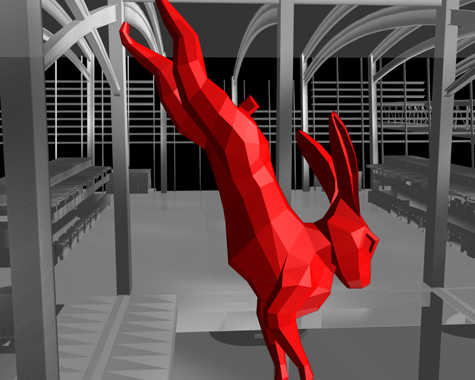
Argent is one of three selected from a group of over 100 artists to create public art works for the new Sacramento International Airport Terminal B. The airport renovation will cost $1.27 billion; $8 million has been set aside for art. Argent’s installation will serve as the centerpiece of the new terminal—a 56-foot red-orange rabbit leaping into a suitcase with a swirling vortex on top. His piece alone will cost $800,000—a figure that doesn’t sit too well with Sacramentans.
“$800,000 for a fiberglass red rabbit? Come on Sacramento we can do better than that!” wrote one perturbed citizen in response to an article about the sculpture on Sacbee.com. The commenter added, in reference to how a big red rabbit is supposed to represent Sacramento, “Ever see a red rabbit—[anywhere]?”
Others, however, have been more accepting. “Believe it or not [$800,000] for a giant, CUSTOM, red rabbit is pretty reasonable!” retorted another commenter to the same article.
The artist welcomes such debate, however. In fact, it’s the sort of thing he strives for. More than just decorating architecture, Argent wants his public art to inspire conversation and make an impression on those who look upon it.
“I understand the sense of negativity,” says Argent from his studio in Denver. “I think that’s part of the discussion about art; art doesn’t necessarily please everybody. I’m not here to please everybody. I’m just hopefully engaging people in a dialogue that can stimulate them in a different way than what they perhaps may have originally thought.”
Though the rabbit may seem like a lighthearted subject—and it is on some levels—the artist ensures that it is by no means a haphazard decision. The journey Argent took to his choice of subject in this particular piece is similar to his life’s journey. Born in England, Argent received a B.A. in sculpture from the Melbourne Institute of Technology in Australia. He later came stateside to receive an M.F.A. from Rinehart School of Sculpture, in Baltimore, Md. before finally settling in Denver.
“I came here to go to graduate school, and I wasn’t really planning on finishing,” Argent says. His plan was to attend graduate school for a year so that he could come to America “to have people I’d read about in books talk to me about my artwork,” and do so a lot more cheaply than it would have been to move here outright and “actually try to find those people.”

He adds, “Through many routes of possibilities, the journey made me end up here in Denver, Colo., which is actually a very nice city.”
Though he hasn’t spent much time in Sacramento (he’ll be making many more trips as his project progresses), he was instantly impressed with the California capitol.
“I think the energy was very positive there,” Argent says. “I see a change, perhaps, in what’s going on in the dialogue of downtown and the urban environment.”
Argent hopes his piece will contribute to and spur on more dialogue. In fact it already has. Though the big red rabbit element steals the headlines, Argent says the piece actually began with a more mundane idea—the suitcase. Suitcase imagery has appeared once before in Argent’s work. His sculpture Travel Companion—an “old suitcase with a rubber mold of a teddy bear, embedded in concrete and covered in polyester resin”—plays with the idea of travel and its effect on the self.
“I’m interested in our voyage, whether that be physical area that we move through in our life, or the spiritual domain that we walk through,” Argent explains “In that particular piece, it was a sense of possession that we have, that we have comfort in the suitcase, this archived version of something that didn’t quite make it, and that’s what that piece is about.”
Starting with the suitcase for the Sacramento Airport installation put Argent in a precarious position. He needed to connect it to something. He began by considering what goes through a traveler’s mind when he or she exits the plane and heads toward baggage claim.
“When we arrive at baggage claim, what we’ve come through to where we’ve been, that journey that we’ve been on is full of angst, it’s full of anxiety, it’s full of joy. We have all these elements that add up to an amazing component of [when] we start to feel whole again when if perhaps our luggage gets there, which is not always the case,” he says with a laugh. “But when it gets there, there’s this sense of reconciliation of joining yourself with yourself—joining with your stuff.”
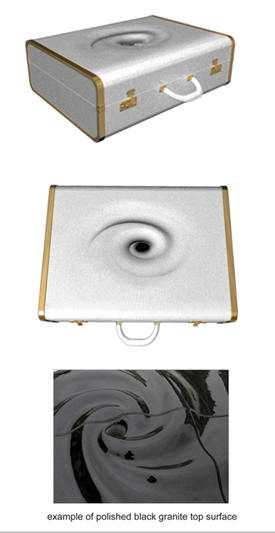
In the end, it was the environment that surrounded the Sacramento Airport that helped lead Argent to his final design. He says that the “green space” outside the facility is unique in that “you can walk outside and you’re in a landscaped environment, and you have the possibility of breathing fresh air—or jet fuel, however you want to look at it,” he jokes. The airports surroundings coupled with the traveler’s anxiety and his/hers desire to deplane and reconnect with his/hers luggage as rapidly as possible pointed toward the image of the rabbit.
“It’s such an animal that I’ve had so much fascination with,” Argent says. “It’s held charge of a powerful symbolism through out civilization—that connection to fables and stories, past and contemporary mythology as well. In it, I sort of sensed a vehicle for an element of paradox that I was interested in.”
To those who are still critical of the piece, Argent hopes that they might change their minds once the installation is actually completed.
“How much can we judge something, by just an image, that’s not even in place yet?” he muses. “When you’ve got this thing leaping at you ” when you’re on your way to baggage claim, you may get a different feeling”¦ That’s a very different experience than what you’re seeing in a rendering.”
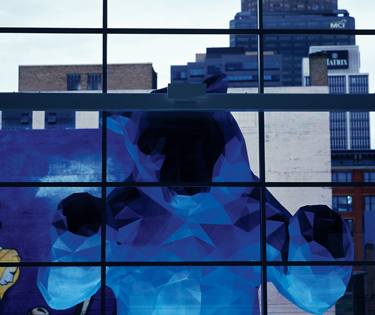
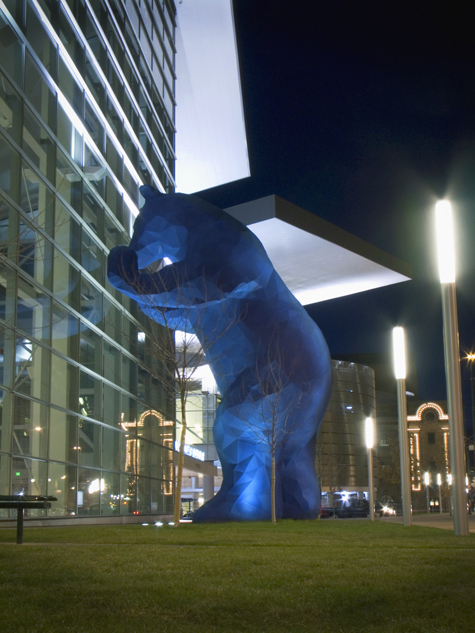
Argent is no stranger to public art projects. He gained notoriety for creating a three-story blue bear that peers into the Denver Convention Center. He is currently also working to create a Holocaust memorial for the University of Denver’s Center for Judaic Studies.
Local Artist Eli Trujillo Mixes it Up on the Palette
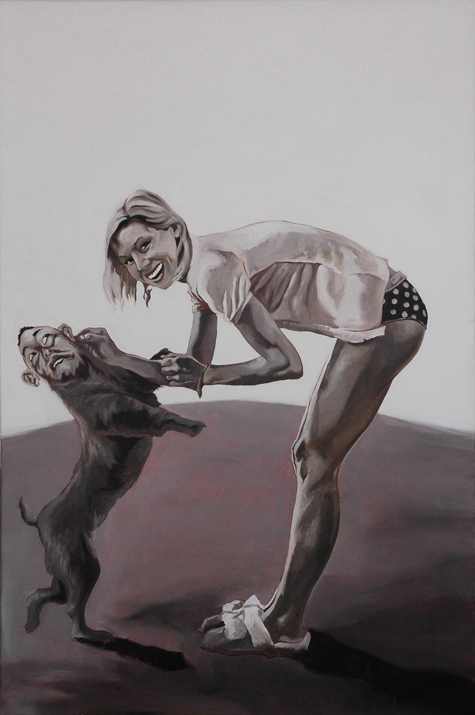
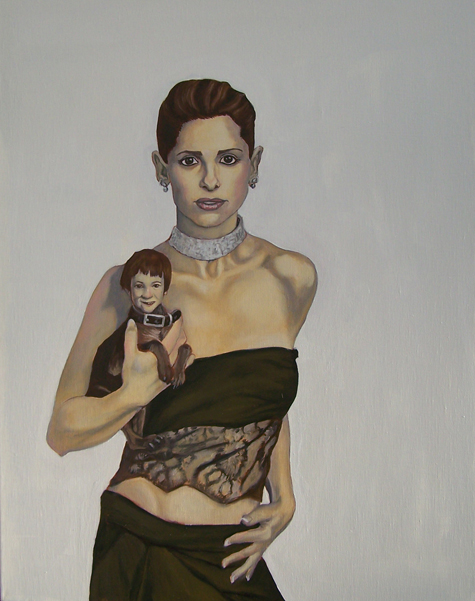
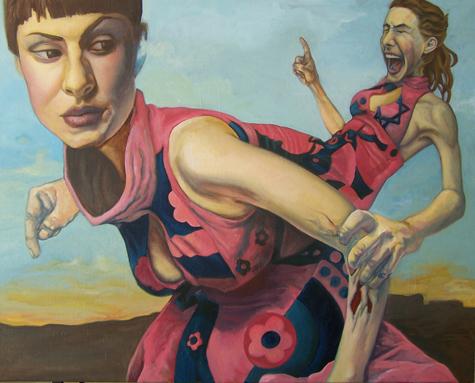
A beautiful blonde plays with her dog in the park—wait, does that dog have a human face? A young couple takes in an art gallery pose for the camera—hold on, looks like the boyfriend has morphed into a gargoyle! Enter the colorful and sometimes bizarre world of local artist Eli Trujillo. Most of his paintings begin with a real person in mind, either a friend or family member, or perhaps a recent celebrity infatuation; but when the genius begins, Trujillo starts making changes.
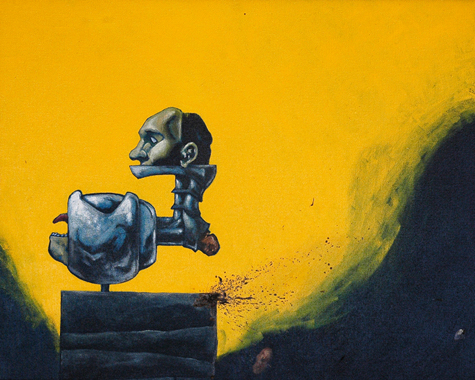
He describes his sometimes funny, sometimes serious twists on real people as “not exactly a remix; more like a cover toon.” Growing up on a diet of comic books, Trujillo cites comic book painter Simon Bisley as the artist who sparked his interest in painting. Add the influence of Norwegian figurative painter Odd Nerdrum, and what emerges are unlikely portraits that morph ordinary humans into two-headed women, dogs with human heads and bug-eyed cartoon beauties.
“One of the major things that comic books did was give me a strange idea of what humans should look like, as far as guys being super buff, having six packs and being able to punch through walls,” Trujillo said.
Unfortunately, the real-life Trujillo does not possess superhuman strength, and spent many years working regular jobs, including a brief stint blending Caramel Machiattos at Starbucks, which he quit after watching Fight Club too many times.
“I just started hearing about consumerism and the corporate world. I was going to try and do with less and see if I could make it not working,” Trujillo explains.
His days of corporate freedom lasted two glorious weeks; then, it was back to the daily grind and another mindless job. Eventually, though, the small boy that used to draw cartoons spoke up, and he began to take his art more seriously. In 2007, Trujillo quit another job to pursue a degree in Art Studio at California State University, Sacramento.
Since moving to Sacramento in 2004, Trujillo’s work has been shown mostly in smaller, more alternative art spaces like Greg Pond Photography in 2006 and Studio Yes in 2007, as well as A Bitchin’ Space in 2007 and the Brick House Gallery in 2008.
Beginning Sept. 13, Trujillo’s paintings will be part of a circus-themed group show at A Bitchin’ Space. The various paintings will make up a circus train, but it’s doubtful that Barnum & Bailey would approve. This show is “a protest for animal cruelty,” Trujillo says. And don’t expect participating artists to spoon-feed their message to the public. Trujillo explains that it’s up to local Sacramentans to decipher their protest message: “We tell people it’s just a circus show,” he said.
Although Trujillo’s paintings pack a powerful (and colorful) punch, most aren’t intended to make a statement.
“I’m just letting people know what’s going on in my head,” he said. Movie buff and self-proclaimed junk—TV watcher, many of his paintings highlight celebrities.
“It’s interesting that you can get infatuated with people that you don’t know,” he said. “Most recently, I have been working with the ideas of celebrity worship, idealism and the unreasonable expectations they create. In conjunction with these works, I am beginning to use photos from my family archive in the same manner, creating an interesting juxtaposition when shown together.”
Trujillo also creates what he calls “personal propaganda” pieces, which serve as good advice—directed toward himself. For example, he’ll paint a picture of himself with no shirt on.
“I’ve got a nice gut going on. [The pictures] make me not want to eat ice cream so much,” he laughed.
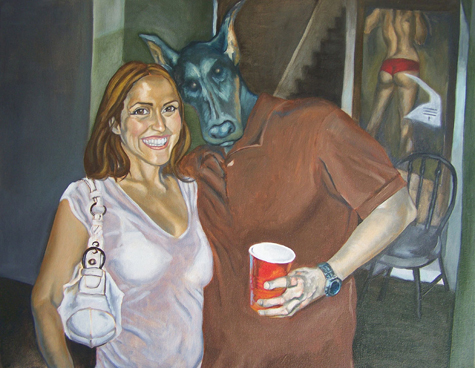
Trujillo says that these paintings are meant mostly for himself, but it’s quite possible that others could learn from them as well.
“Almost all my paintings are personal and autobiographical, so I think it’s hard for people to really get a hold of them,” he said.
Formal instruction in art has greatly improved his ability with techniques like space and volume, and he’s noticed that his paintings have become increasingly more realistic as his skills improve.
“I’ve recently been making a conscious effort to place the figures in an environment rather than, say, a red or gray background, to create a more believable space,” he explained. Looking back on work that was completed in the past, he notes that some paintings are much more juvenile than others, and oftentimes he’ll change or alter these paintings. “Something I’ve just started doing is not being afraid to change things”¦even two years after its finished,” he says.
On the other hand, though, he hasn’t lost his love for goofy-looking superheroes. “Although I take my paintings seriously, I also try and inject a bit of humor into them. I would love to see someone fall over laughing at one of my works, but this has yet to happen.”