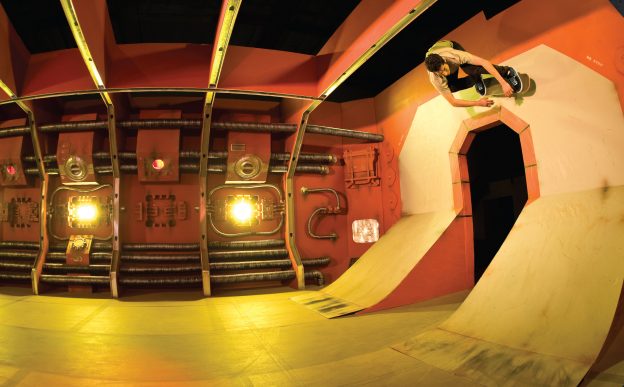
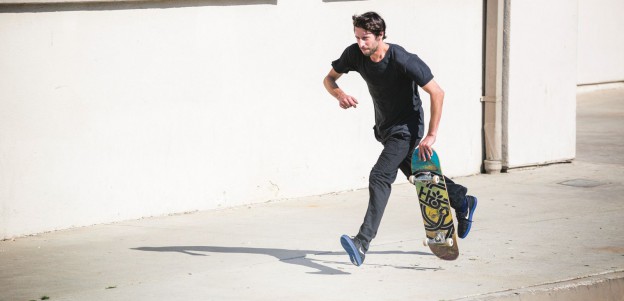
The symbiotic relationship between skateboarding and the arts formed almost from the sport’s onset—the street culture that skating emerged from was one of such complete freedom of creativity that it was inevitable that art would eventually permeate every pore of the industry. The skill and dedication necessary for both are just as indistinguishable, from the tireless hours spent landing and perfecting a trick, to the focus, patience and imagination it takes to erect a piece of artwork, both disciplines seemed destined to unite.
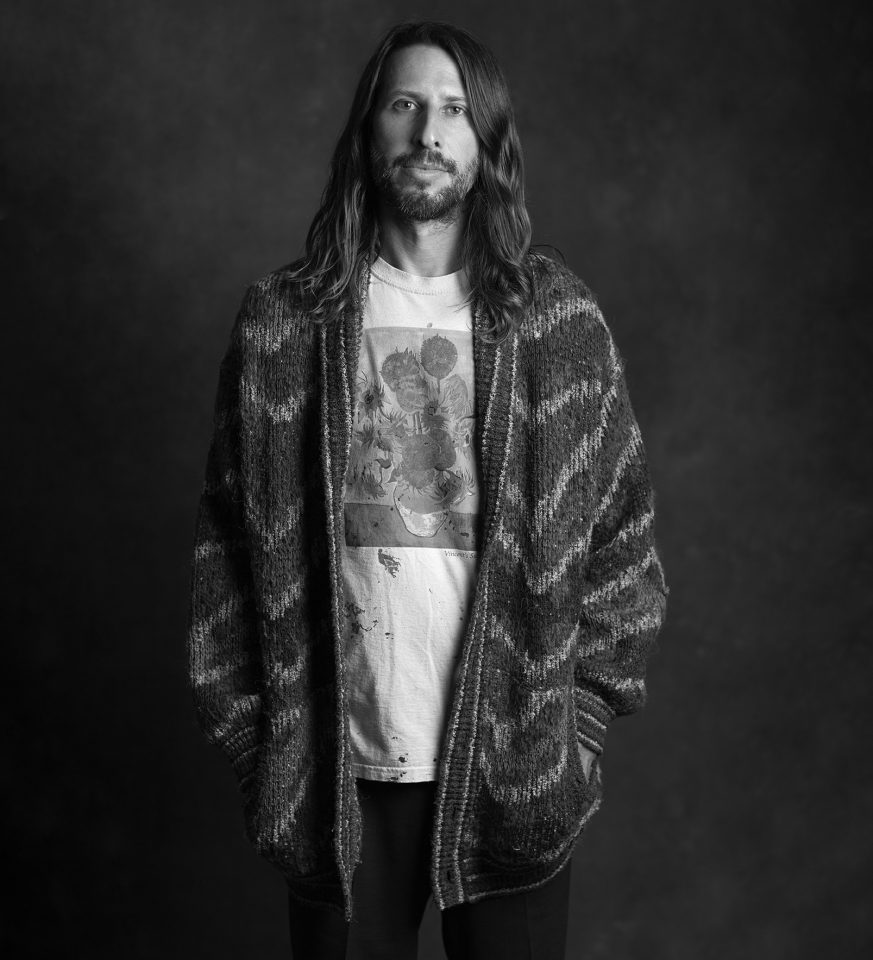
For Stefan Janoski, a local legend of sorts who honed his prowess on the board on the streets of Sacramento with the likes of Brandon Biebel and Omar Salazar, these worlds collided decades ago, too. A professional skateboarder known for his effortless, laid-back approach to some of the gnarliest tricks in the book, Janoski has been painting and sculpting since before he landed his big shoe contract with Nike and launched his eponymous sneaker line in 2004.
“I was into art before I was even into skating,” Janoski admits. “When I was a kid and they [asked], ‘What do you want to be when you grow up,’ I said I was going to be an artist. When my sister taught me that they’re called ‘starving artists,’ I would tell everyone I was going to be a starving artist.”
Thanks to the skate culture’s voracious appetite for celebrity sneakers, and a solid deal with a titan shoe company, Janoski’s able to work on his artistic endeavors without having to rely on the local soup kitchen for sustenance.
Local skate fiends and art collectors unfamiliar with the professional skateboarder’s artistic portfolio are in for a treat when Janoski unveils his new body of work, titled Nightmares of Normality, on Nov. 3 at Beatnik Studios in Midtown Sacramento. For Janoski, bringing this show to Beatnik is a homecoming of sorts—it’s only after departing Sacramento for Brooklyn, New York, in the early 2000s that he really began to focus on his artistic yearnings. Seeking refuge from the bitterly cold East Coast winters, Janoski hunkered down and reemerged with a prolific collection of work that many of his family and friends in Sacramento haven’t been privy to until now.
The bulk of the work in the upcoming show is from those prolific days in his Brooklyn warehouse—a space so massive in scale that the work born from its brick confines reflects the enormity of the space in which they were created.
“You know in New York the winters are very cold, so it’s a great place to do art if you want to stay inside for months,” he says with a chuckle. “I was going on [tour] at the same time, but when I was there I would just be in the house making stuff. I started trying to make, like, really tall papier-mache guys, but that didn’t really turn out, so then I just started hanging huge canvases on the walls and just painting. I just had all of these funny little ideas and I thought they’d be even funnier if they were big.”
Janoski’s work is a menagerie of mediums, scales and techniques. He comfortably shifts gears from the skatepark to the music room—yes, he even finds time to write and play music—to the easel. But it’s the solitary nature of his work that fuels the creative process and breathes life into his creations—introspection, rather than inspiration serves as its catalyst.
“A lot of it’s what’s going on in my head, [and] of course reflective of what’s going on around me,” he explains. “I mostly just either think of something that I’ve never seen that I would love to see, or I have [a specific] idea or sometimes I make stuff for no real reason and then it ends up going together with something else. There’s lots of different ways my pieces emerge.”
With exhibitions in New York, London and Hong Kong, it’s only fitting that Janoski bring his work back home to share with those who have supported both his skating career and creative endeavors since way back in the day, especially with a body of work that shows the evolution of his mediums from sketches to painting to sculpture.
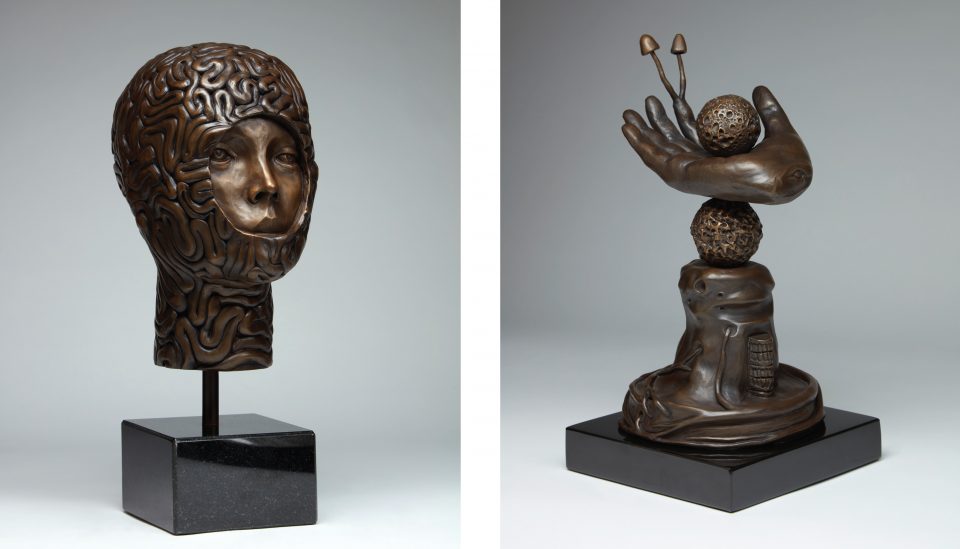
“I had always sculpted, but not very much. I was always much more into paintings and stuff, and then I just had these ideas that I thought would be better as sculptures,” Janoski says. “When I made them, I was like, ‘I’m going to cast them in bronze and do the whole thing.’ Once I did that I loved it. Then all of my ideas became three-dimensional after that. I didn’t even have painting ideas any more. That’s all I’ve been doing for years. I mean, I still do the paintings and drawings and everything else, but mostly when I’m going out to the art room I just sit there and sculpt.”
From the expansive canvases that were born out of the frenetic energy of New York, to his growth in the sculptural arts, Nightmares of Normality will feature work that moves from his commentary on family, to more abstract themes dealing with religion.
“I just learned through trial and error. At first my armatures were not sturdy,” he admits. “I made the sculptures and then had to drive them to the foundry in Queens, and I’d be in the car holding this sculpture that’s wobbling around. The roads in New York have the biggest potholes, so the whole drive me and my wife would be hectically trying to get there without ruining the whole thing. It’s pretty funny, but now I’ve gotten a lot better, so they’re pretty sturdy.”
The upcoming show will showcase seven or eight of the expansive pieces made within the frigid confines of his Brooklyn warehouse as well as a collection of bronze sculptures ranging in size from miniature to colossal. Nightmares of Normality will also feature the work of skateboarder-turned-artist Joe Castrucci, who collaborated with Janoski on several pieces. Castrucci also happens to be of the owners of a skate company that sponsors the skater-cum-artist.
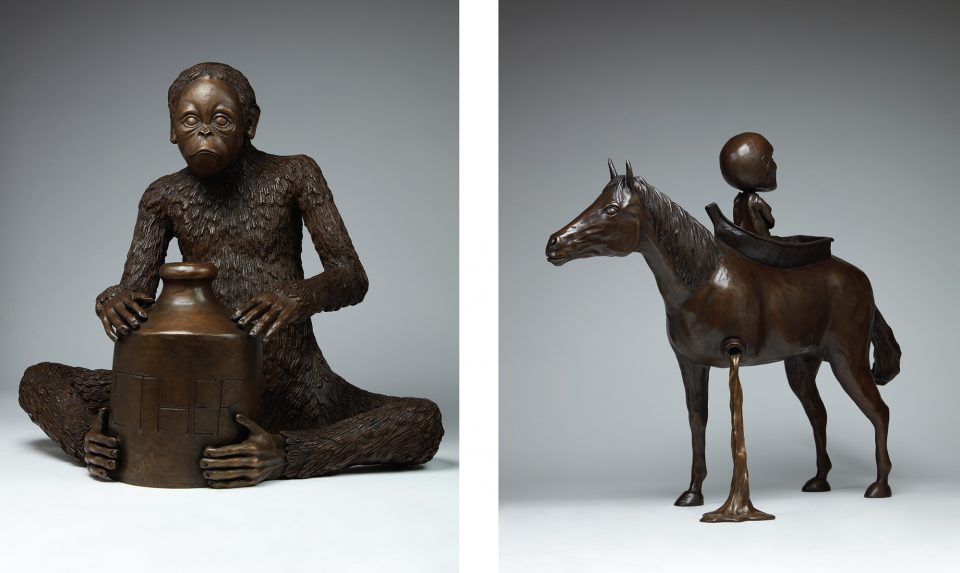
“It’s actually going to be a lot of art, and then Joe Castrucci, who is the owner and the artist behind Habitat Skateboards, made graphics of my sculptures,” Janoski explains. “The art he did for the show is actually based on my art, so there’s going to be skateboards with his graphic interpretation of my sculptures, which is pretty cool.”
Setting up the show was a concerted effort between Janoski, Wes Davis of Beatnik and Castrucci. After all, Janoski currently resides in Los Angeles with his wife, so collaboration was an elemental component of bringing his work back to his native haunts. After delays in coordinating the effort, Janoski credits the team for finally enabling him to bring the work he has amassed during his time away from home.
“I was going to do an art show out here [earlier] but it fell through, so I was talking to Wes, who is my old friend, and [as] we started planning this show, I said, ‘Hey, I have all these paintings and all of these sculptures I did out in L.A. as well,’ so we just figured, like, ‘Hey, let’s just put it all in there.’”
Concepts can get heavy when you talk about art, especially when you’re dealing with the size of bronzed sculptures. But bringing a sense of levity to the work is an important component of the creative process for Janoski.
“I like to have a good sense of humor,” he admits. “I like to take things that are considered serious but show them in a way that shows they’re not serious if you [really] think about it.”
The opening reception for Stefan Janoski’s Nightmares of Normality will take place at Beatnik Studios (723 S St., Sacramento) on Nov. 3, 2017, from 6–9 p.m. For more info, go to Facebook.com/beatnikstudiossacramento or Beatnik-studios.com. The exhibit will be on display until Nov. 22.
**This article first appeared in print on pages 18 – 19 of issue #251 (Oct. 21 – Nov. 6, 2017)**
Submerge chats with Jason Maggio, founder of Sacramento-based headwear brand Official Crown of Laurel
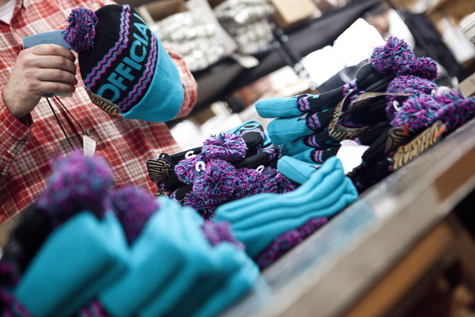
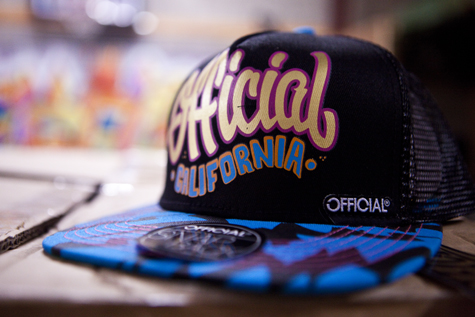
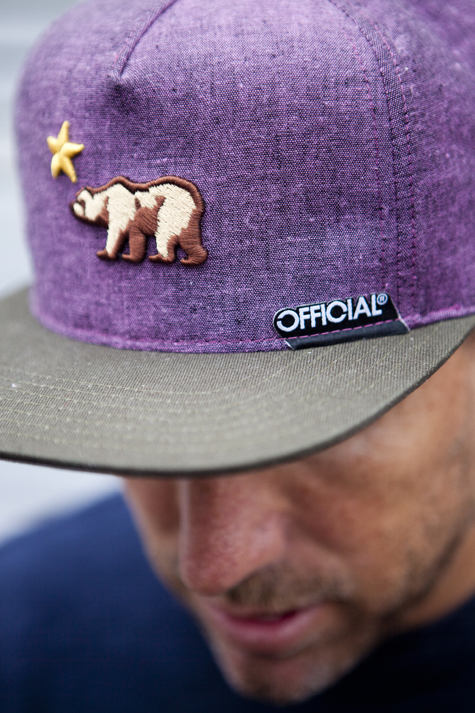
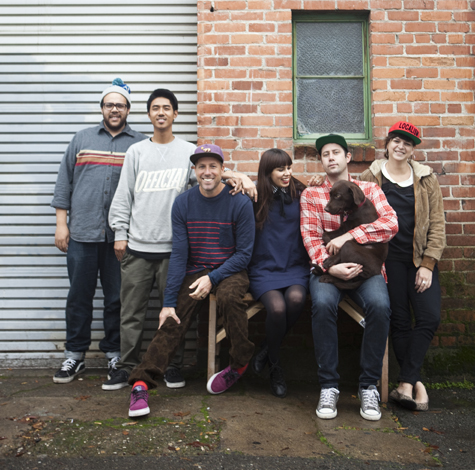
What happens when a creative and well connected thirty-something ex-magazine publisher has a little in between time after selling his company? Does he stop working and just relax, ignoring the entrepreneurial spirit that beckons from within? Sacramentan Jason Maggio sure didn’t in 2007 when he founded a premium headwear company called Official Crown of Laurel, or Official for short. Maggio saw a void in premium headwear with influences coming from skate, street and DIY fashions, and so Official was born. Fast forward a few years and his products have been seen worn by celebrities and tastemakers all over the world. Retailers both big and small proudly carry his products, and much like the shoe companies that attract sneakerheads who collect as many pairs of shoes as they can, Official provides nearly endless options of stylish headwear to an audience with an insatiable appetite for dope street fashion. According to the company’s philosophy posted on its website, “Official regards its headwear as a crown, a statement, an exclamation point and sometimes a simple complement to bigger and bolder things.”
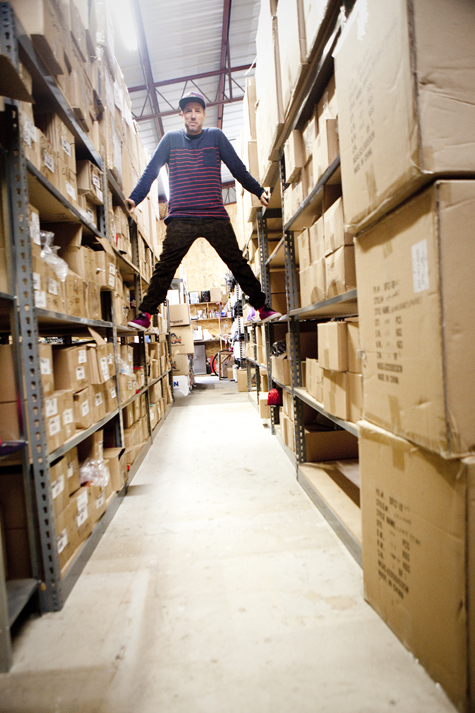
Submerge recently sat down with Maggio inside Official’s nearly 3,000 square-foot warehouse space in downtown Sacramento, which they share with another locally based skate/streetwear brand, Lurk Hard, for the following interview. We touched upon on why he started the company, what it’s like to do business in China, how they recently signed professional skateboarder Stefan Janoski and more.
Take me back to just before Official started. What were you up to job wise?
I was doing a magazine called Vapors. We sold it to a publisher in Los Angeles, and I stayed on for another two years just working as the art director, and I’d have to go down like every other week. I just got tired of it. I have a family, and so it was stressful.
What were you going down there for? To meet deadlines and whatnot?
Yeah, everything. All kinds of stuff, editorial, marketing, events. The magazine was in a good place with the publisher, so it wasn’t like I was ditching it or anything. They were fine. It seemed to be a good time. So I was doing some freelance design, and I did some stuff for a brand that was doing a little hat stuff.
So that’s how you got into the headware game?
Yeah, and then at some point I was like, well I’m here in Sacramento, they were in L.A., so it wasn’t optimal. Basically I decided, OK, I’m going to do this on my own. I’m going to just start doing hats. We produced in California at the beginning and made a ton of mistakes. The hats cost us a fortune for each piece, and there was no profit anywhere.
But it was a learning curve, right? Nothing happens easily and without mistakes.
It was. It was totally worth it. It’s so funny, because even at that age…let’s see, how old was I? I was 35, so you’d think that at this stage in my life, I probably shouldn’t be making these rookie mistakes. But they’re going to happen, and I guess it’s just how quickly you learn from them.
You were coming from a business background that was somewhat related, in that you may have had mutual connections and whatnot, but this was a totally different thing than publishing, right?
Yeah. In a sense I was an entrepreneur with the paper, because we started as a cut and paste ‘zine, you know, and we moved it to a full-fledged magazine. That was a process. I enjoyed the process. But then you’re starting over again with a new brand. It was new territory. Building brands isn’t necessarily a new experience, but the production and distribution and all that, you do have to learn a lot. There was a learning curve there… So we had a really good first year at Official and we were on a good route, lots of good response. That was the idea, for me, I was looking at what was being offered, and just saying that we could do something that wasn’t being offered, and something we really liked. That was what was going to differentiate our product from what was already out there.
Why a headwear company? Why not footwear or eyewear or something else?
It was a little bit of just right place right time, and a little bit of looking at the market and seeing where I thought there were some holes. You see the thing is, with headwear, generally there are big brands like New Era. They are just slow to move on trendy things. So that’s really where we started, was moving on trends. So if we could be quick to market, and get something done in six weeks and get it out there, that’s way faster than the bigger brands that are planning a year ahead.
So early on you had the advantage of being on top of trends and what was hot. In the digital age, everyone wants everything yesterday, right?
Yeah, and by the time the stuff comes out, sometimes it’s too late. That was really our business model. We literally had a delivery every two weeks of two or three styles, so it was just a quick to market delivery and shops loved it. Especially with the economy then, people were buying stuff like there was no tomorrow.
So you mean sort of like sneakerheads with all their different pairs of shoes, people want multiple hats?
Yup! The cool thing is that hasn’t changed too much. It’s a cheaper price point, it’s a lot cheaper than a hundred-dollar pair of shoes.
What happened with Official when the economy started to tank back in like 2008, 2009?
So the economy fell off, and we had to just become a skeleton and weather the storm. I was working out of my house. Everything we have here was in the garage, and it fit, so it wasn’t a lot. Ran it out of my house after that for three years, no offices or anything. And eventually it just started to slowly build again. My idea was, it’s going to be bad, it’ll get better, and let’s just continue doing what we’re doing and we’ll learn a lot. So, what was happening was we were producing in California and it was costing us a lot. We looked at China as an option early on and made a couple trips.
Tell me about the first time you went out to China for manufacturing research. That must have been a mindfuck.
The first time was pretty crazy because we went to a northern city called Qingdao. It’s a northeastern province and it’s so tiny, and I didn’t know anything about Chinese business culture. There’s a whole thing, you know, if you go to China to visit a factory you have to go out to dinner with them. You drink with them, and you eat really weird stuff. And they just love doing that. Sometimes I think it’s malicious [laughs], and sometimes I think they just really want to show you their culture. So that was pretty tricky.
Was it a hard decision to move your production to China?
Moving our production to China was a tough decision, because we were actually pretty proud that [the hats] were made in California. But I think it’s a trade off. I think that moving to China, of course, we don’t get to employ manufacturing here, but I get to have a business and have other employees because I can get that product made in China more efficiently and better than we can do here. What I mean by that is, like, we’re just not a manufacturing country anymore. Back then when I was getting a hat made here, I would have to get the silkscreen done at one place, then the lid was made at another place, so it’d take six weeks to get it shipped back over here. Then have all that applied and sewn here in a hat factory, and still the quality was not up to what we could get in China, and it was costing $11 per piece here, whereas a hat now is costing us way less. I don’t want to necessarily say the price, but it’s way less. And it’s better quality, and we can get everything done in one stop.
You’re going out to China again before this interview will even be out to source for fabrics for your Spring 2014 line. You guys are now designing for lines a year ahead of time?
Yeah, a year out. See, what we were talking about earlier, we’ve become that beast that we were able to capitalize on and take advantage of before when we could be quicker to market. Now we’re designing stuff a year out, and it’s kind of scarier…this is the first time we’ve been that far out. We’ve always aspired to be that far out but like sampling always takes a long time and you run into hiccups. Plus, when we can plan that far out, we can ship more stuff by sea and that really reduces our costs a lot.
Trends can change quickly, does that worry you?
Yeah, and there are smaller companies that can be faster to market with the trends. What we’ve learned is we’ll still have that stuff even a year out. Our bigger retailers will say, “I’m buying for fall right now,” so we have to have fall done! But, we still will get some things quicker to market.
So you’ve found middle ground, it seems, between being too big to move on trends and being too small. Agree?
Yeah, I agree. And then on top of all that, you have to have confidence that what you’re doing is dope and it will stand on its own. You don’t have to worry about the trends. We just have to be that solid headwear brand, not somebody chasing trends. You just have to have that foundation so people can rely on us for headwear every single season and they know they’re going to get good stuff.
The 2012 winter line was released Nov. 1. What were the inspirations behind this season’s designs?
For winter, I don’t know if I want to expose this, but we go pretty safe, because it’s the holidays. A lot of brushed wools, and then some trending things like a lot of camo and sports colorways together. So, like, the 49ers colorway but with camo–that kind of stuff. In the campers we did some metal label stuff, which is kind of cool.
Do you have an Official skate team?
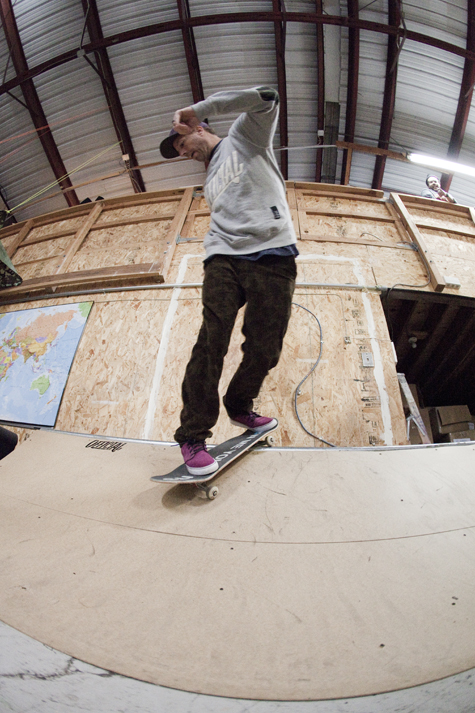
We’ve developed a program that is still in the works, but we have hired Jeff Landi as our team manager. He’s a local guy that’s a staff photographer at The Skateboard Mag. He’s amazing. He’s a good friend. I’ve known him for a long time, so it seemed pretty natural. He has good rapport with so many pros, so he’s building a team. We have a really good list of [amateurs], but right now the pro that I would like to mention that we’re launching with is Stefan Janoski. He’s so hyped and energetic about it. All the stuff is from him, all the designs we’re doing for his line are from him.
That’s cool! To wrap things up, tell me about Official’s relationship with local hip-hop artist C-Plus, because I know you guys are pretty tight, yeah?
It’s really natural. We owe him a lot for the input he gives us. He has a really good sense of style that’s both Sacramento-centric but also a broader perspective, and that’s important. I think that our stuff has a Sacramento and Northern California aesthetic to it, but also can obviously go beyond those boundaries.
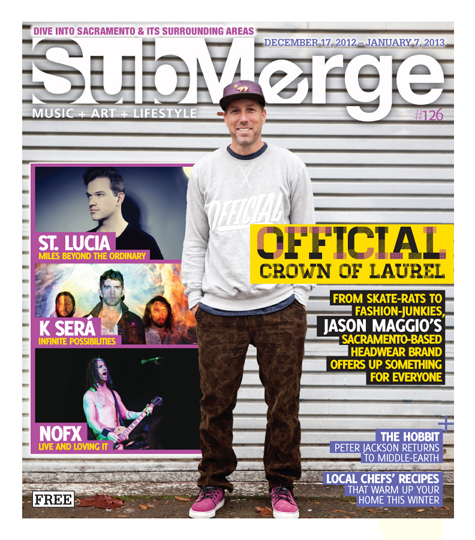
Learn more about Sacramento-based headwear company Official Crown of Laurel and shop for their latest gear at http://theofficialbrand.com/. Look for their collaboration with pro skater Stefan Janoski to drop in their Spring 2013 line.
Put professional skateboarder Omar Salazar on the phone for an interview, even while he’s in Australia on a Nike Skateboarding team trip, and you’ve got one of the nicest dudes you’ll ever meet; caring, witty and all around fun to talk to. Put Salazar on a skateboard, assuredly where he’d rather be than on the phone, and you’ve got a savage on wheels; a straight-up wild man that charges at his tricks with relentless speed, dedication and concentration. The 26-year-old skater from Sacramento has made quite a name for himself in the industry, especially within the last couple years with his part in Alien Workshop’s video Mind Field, making the March 2009 cover of Thrasher and the announcement from Nike that Salazar will have his own signature shoe. But all the success hasn’t come easily.
Salazar was raised by loving and supportive parents who fled to the States from their home country of Chile. Pursuing a career in skateboarding, though, was not exactly what they had in mind for their son in this so-called land of opportunity. “They were always like, ‘Hey look, you’re lucky you have opportunities here, you need to go to school and you need to work for a big company,” said Salazar of his parents outlook on his skating. I was always like, ËœYeah, but I don’t want to do that; I’m not good at that. This is what I want to do.”
Salazar remembers having to hide his skateboards and boxes of products that companies were sending him so his parents didn’t get suspicious. “I didn’t want to disappoint nobody, but I was never good in school,” he admitted. “I mean, I finished high school, but I was never good as far as book smarts goes, I’m better at street smarts.” Those early years also consisted of a lot of couch surfing, riling up change from said couches to hit up Del Taco, raiding Safeway’s sample tables and bombarding open house food platters. “Yeah, I’ve come a long way,” Salazar said with a laugh, looking back.
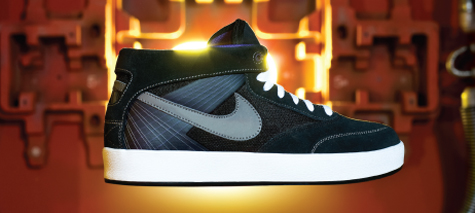
A long way is an understatement, as this month Nike will release Salazar’s first signature shoe, a career milestone for any athlete involved in any sport. Salazar will be the second Sacramento-area skater to get his own Nike shoe, as teammate and close friend Stefan Janoski did so just last year.
“In the beginning,” Salazar remembered, “Before Nike gave anyone shoes, Stefan and I, we’d had offers before in the past from other shoe companies, but I always stick with what I believe in. I believe I’m a loyal rider. That’s just the most important thing. So, I figured if I kept loyal with Nike and the people I work with, then something good was going to happen.”
Even after Nike told them years ago that Paul Rodriguez would be the only team skater to get his own signature shoe, Salazar stuck it out, all the while telling Janoski, “We’re going to get shoes, trust me.” Eventually they both got the phone call and for Salazar, it was sort of an ‘I told you so’ moment when they did.
“I don’t want to sound cliché or lame, but in a way I kind of manifested it because I knew it was going to happen,” said Salazar, not in a cocky manner, but a confident one. “Even before they offered me a shoe, I drew up a design and straight up put one in my room, one in my bathroom and one in my closet.” Salazar would be gone for months on skating trips and he’d come home having forgotten about his dream shoe designs, which re-invigorated him to skate harder, to keep going so that one day it would be a reality. “Like a year later after working hard and having fun skating and stuff, they hit me up and were like, ‘Hey, we want to give you a shoe after Stefan.'”
When it came time to actually visit Nike HQ in Portland, Ore., to meet the people who would be designing his shoe, Salazar was well prepared with his sketches, his favorite color schemes and other things that represented him and his personal style. “When I first started working on the shoes, they were like, ‘Shoot us your favorite colors, your favorite objects, your favorite things around the house, bring us photos of them.’ I didn’t know what the hell they were talking about,” said Salazar. Nike was essentially asking for pieces of Omar so that his shoe “could tell a story.” Turns out, Nike doesn’t just give signature shoes to anyone and when they do, they always have little stamps of the athlete’s personality and style on them. Take for instance Michael Jordan’s famous Air Jordan logo, jersey number, etc. found on his shoes. Salazar wanted a classic-looking silhouette, but with Nike’s new technology infused.
“I’m really into the ’50s and oldies, and I like old tin cans and old rockets and outer space and all that stuff,” said Salazar of some of his personal interests. Hence the reason his shoe features a cool little rocket ship on the sole. Salazar also pointed out that he likes to surprise people, so he told Nike he wanted to make the tongue of his shoe interchangeable. “I wanted to have fun with the shoe and I wanted it to be functional for people,” said Salazar. “Some people like to tie their shoes real tight and some people keep their shoes real loose. Some people like a thin tongue, some people like a real thick tongue,” he said. He also wanted Sacramento-area residents to connect with the color scheme, so he included purples and blacks to match our beloved Kings’ colors.
What really makes Salazar’s signature shoe stand out, though, is the inclusion of Nike’s Flywire technology, something new to the world of skateboarding shoes. Basically, shoes with Flywire are really light, yet really supportive—two attributes not normally associated with one another in the sporting shoes industry. In the past, more material meant more support, but in turn the shoe got heavier. But with Flywire, Nike took Kevlar and spun it into an embroidery-thin thread for reinforcement, and then they added Lycra in areas that needed power and stretch. According to Salazar, they feel great. “Nike’s technology enables the shoe to be lighter and support your foot more and lock it down really well,” he said of the shoe’s feel.
Sacramentans will be able to witness Salazar ripping up B Street Skatepark in his new shoes on Sunday, March 7, at the official shoe launch demo along with Nike teammates Paul Rodriguez, Stefan Janoski, Brian Anderson, Justin Brock, Grant Taylor, Daryl Angel, David Clark, Elissa Steamer and Brad Staba. Anyone who knows anything about skateboarding knows those are some heavy hitters and that this event is will not be to miss. As our conversation was coming to an end, Salazar closed with a bit of advice for the young skaters out there. “The one most influential person that told me how to get shit was John Cardiel, Sacramento’s best skateboarder ever. Whenever I was trying something, just trying for hours and hours, he’d yell out, ‘You’ve got to want it! You’ve got to want it!’ That stuck in my head forever, so if there’s any message I’d give anyone, it’s that.”
Catch Salazar and the Nike SB team on Sunday, March 7, 2010 at B Street Skatepark. Demo starts at 2 p.m.
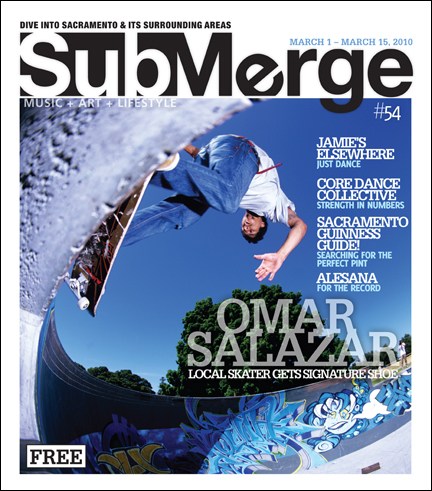
Cover photo by Jonathan Humphries
It’s Gotta Be the Shoes
In 2005, Nike dug their fingers deep into the world of skateboarding by releasing a signature shoe by Paul Rodriguez, poster boy for the Nike SB campaign. Four years later, after compiling a team of remarkable talent—Brian Anderson and Omar Salazar to name just two—the next in line was Stefan Janoski who joined the roster in 2005. A Sacramento resident who hails from the nearby city of Vacaville, Janoski is one of the nicest guys in skateboarding and when you see him on the board it’s immediately clear why Nike has chosen him for their next signature shoe release.
Janoski’s style is fluid, always landing tricks over the bolts whether he’s destroying handrails or whipping out his signature 360 flips. His stylized version of the trick captivated youths around the world when Transworld Skateboarding released a how-to video of Janoski explaining the basics of 360 flips. In charismatic fashion, he performed the stunt on the street, in the skate shop and even at the grocery store while picking up some Cocoa Puffs. In two years time, the video has had over 2 million views and has made him into a recognizable face in the skateboard community here in the U.S. and especially abroad. Celebrity isn’t the best adjective to describe Janoski, though. Genuine might be more appropriate as it best describes his infectious personality, his passion for skateboarding and his outlook on life.
Janoski was born to ride a skateboard and at 29—his 30th birthday lands in July—he’s skating better than ever. For him, age is just a number.
“I feel like I’m 17.” He says. “Thirty-three will come around and I’ll still be doing the same thing. That’s pretty cool.”
Pretty cool indeed considering the fact that skateboarding is centered on youth culture. The average age of the Nike SB team is 31 (its senior member Lance Mountain is 45). It seems that age and experience were deciding factors in the selection process, but then there’s that Paul Rodriguez guy. At 24, he’s the youngest skater on the team, and subsequently the first to receive a signature shoe. But that was then and Janoski is now and he’s excited for the release of his shoe in early May.
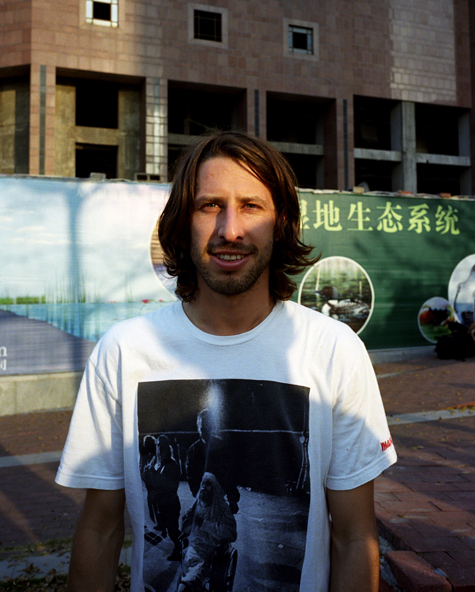
You have a shoe coming out for Nike pretty soon. Is that a really important landmark in your career or does it just feel like a natural progression for you?
I guess it’s sort of a landmark just because I’ve never had a shoe, and it’s pretty common nowadays for people to have a shoe. It’s kind of taken me a long time, just because I’ve never really been set at a company where I really wanted to get that deep and involved and stick around for that long. So usually I’ll talk about having a shoe with a company, and then I get cold feet and don’t really want to stay there.
You have commitment issues?
Yeah [laughs]. It’s pretty cool, though, that I’m finally getting a shoe and also that Nike is finally open to giving people shoes. They’ve always had Paul Rodriguez, who has a shoe, and he was the only one.
Why was it like that?
I’m not sure exactly. I think they were trying to make it a really big deal or”¦I think what they realized is that they have to expand more. There’s a lot skaters out there nowadays, so to really stay in skating they have to have more than one person representing. It’s pretty cool. I’m excited because it’s a shoe I really like.
When does the shoe come out?
They come out on May 8.
How much input did you have in the design and construction of your pro shoe?
A lot of input actually, I had total input. I don’t know if they expected me to get as involved as I did. At first they had samples and prototypes of other shoes already, but it wasn’t what I was going for. So then we started, me and this guy James, from scratch. I brought in a bunch of shoes and kept telling them what I wanted.
You’d bring in examples of other shoes that you liked or what?
I’d bring in a shoe and say that I like the toe on this shoe, and I like the lace hole on this shoe and the tongue on this one—put them all together. I think I had an old Vans a Sperry Topsider and a Converse All-Star. They wanted to use a cup sole at first, which is like a Dunk or a normal sneaker, but it just wasn’t really getting the shape that I wanted. It took a really long time, because we did other stuff first and so this shoe didn’t come around for a while. But then once the prototype came about, it was the best.
That’s surprising, because it seems like Nike would be more overbearing with the product that they are putting out.
I’m a little bit of”¦ If someone’s going to give me a shoe, I’m going to get like, “It’s my shoe!”
Oh, so you’re a bit of a diva?
I don’t know. I just really care. If I’m going to have it be mine, then I want it to really be mine. I don’t have a problem not having a shoe, if it’s not going to be what I want. It sucks to have something with your signature and then hate it. At first they fought it because Nike doesn’t really have this style of shoe. They have everything else and that’s the main reason I wanted it to look like that.
How does the pro shoe thing with Nike work? It looks like from the video footage I’ve seen you’re able to skate it for a while before it comes out. Is there like some sort of test run period?
They’ve been around. I’ve had them for a year, I think. I actually wear the sample size, which is a 9.

Sample size?
Every shoe’s prototype is made in a sample first, but all samples are a size 9. So I was able to wear my shoe way before they made a sample just for me. I’ve only skated in two pairs that weren’t samples.
How do they skate?
Actually, they are 10-times better than the sample. They’re so much more comfortable. They’re quality. Not only are they a cool shoe to wear, but they’re exactly what I want to skate in.
You live in Sacramento, but I know that you are originally from Vacaville. Most people I meet talk a load of shit about that place, but you put the city on your shoe! Are you getting some serious Vacaville love for that? Have they given you the key to the city or what?
No! I don’t know if Vacaville even knows about it. I probably know three people in Vacaville. Maybe five if you count my parents, so”¦yeah.
So, there are no strong ties to Vacaville then?
It’s a joke for me because people really have hometown pride and like to represent where they’re from. People from San Jose are like, “Yo, San Jose is the best! Fuck!” I don’t know, I think it makes it even funnier that I have a shoe with Nike and it says Vacaville. Vacaville is a place that you grow up in and you’re supposed to leave. It’s a big accomplishment to not be there anymore.
But depending on who you talk to, the same thing can be said about Sacramento. Why stay in Sacramento?
For me it’s a home base type of thing. I travel so much and Sacramento is so mellow, there’s no traffic and it’s so quiet. I can come here and just hide out and go skate with Brandon Biebel and those guys. It’s just a hibernation place for me now. I’m traveling constantly and waking up in a hotel in some city somewhere and going skating everyday. So when I come home, it’s hard to wake up early and say, “I’m going to go skating and eat shit all day.”
From what I’ve read, you’re not too into the competition circuit. In fact you don’t place all that well! Is it because you just don’t care all that much? Why do some skaters love it and others like you just not get into it?
I mean, I’ll enter a contest, but it’s hard for me to really care; to really go out there and try to put a run together and work really hard! Contests are an entirely different way of thinking about skating. To me, it’s a way to make money off skateboarding. People win a lot of money in contests but I don’t think that it really has anything to do with skateboarding. It’s a way for people who are consistent and really like it to go and be competitive and win some money and all that. But it’s the smallest percentage of anything that has to do with skateboarding. Most people started skateboarding for the exact opposite reasons. They weren’t competitive, they didn’t like sports and they just wanted to go out and have fun and not stress. I enter contests and if I win a little bit of money, yay! But if I totally fucking lose, then it’s like, “Oh well.” When I started, you didn’t train or practice skateboarding for a big match, you just went skating everyday. Some days, maybe you’re just sitting around on a red curb all day just bullshitting with your friends, you know?
How is the swine flu affecting skateboarding?
I don’t know. I had bacon yesterday. I think it’s a rumor! Isn’t it just on the East Coast? Whatever, it’s population control.