Godzilla
Rated PG-13 {3 out of 4 stars}
Godzilla is one of Japan’s most beloved exports to the United States. He’s a big, dopey, dinosaur-like monster, traditionally played by an actor in a suit, who would stomp around on miniature sets and sometimes battle other actors dressed in monster suits. Silly? Yes, extremely so. Still, America has already managed to muck up what should have been an easy filmic slam dunk. Back in 1998, director Roland Emmerich, armed with an infinitely more impressive arsenal of special effects than his Japanese predecessors, made what was probably the worst monster movie ever. Paying little or no heed to the four decades of Godzilla’s cinematic history that came before him, Emmerich instead opted to make a dumbed-down version of Jurassic Park, and, as you can probably tell, I’m still kind of bitter about it. But I’m not the only one. Even though Godzilla is one of the biggest brands in geek cinema (and geek is so in right now), it took 16 years before America took another crack at The King of the Monsters. This time, little-known Gareth Edwards is at the helm, and though the overall results are lackluster, this latest addition to the Godzilla canon lays down a solid enough foundation for a possible American franchise.
It’s easy to look at the Godzilla franchise and see the films as goofy and campy—they were, for the most part—but there was something else going on too. In fact, the 1954 original, Godzilla (or Gojira as it was known in Japan) was a terrifying and noir-ish monster flick that illustrated the fear and confusion of a people trying to make sense of what had happened less than 10 years prior in Hiroshima and Nagasaki. It would seem that Edwards and his screenwriters Max Borenstein and Dave Callaham wanted to run with the more serious aspects of the monster in Godzilla (2014).
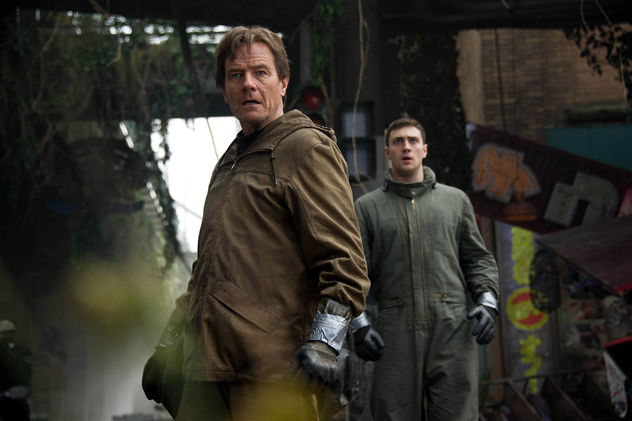
Edwards’ film looks to the nuclear testing in the ‘50s. As it turns out, these weren’t tests at all, but attempts to destroy Godzilla. However, the monster endured, and in the process, mankind awakened other, more dangerous, ancient threats. The movie then fast-forwards to Janjira, Japan, 1999. An American family, Joe and Sandra Brody (Juliette Binoche and Breaking Bad’s Bryan Cranston), is working at a nuclear plant when a suspicious earthquake leads to tragedy and fallout. We jump ahead again, 15 years later, and the Brodys’ son Ford (Kick-Ass’ Aaron Taylor-Johnson) is returning home to San Francisco from a tour with the U.S. Navy. He barely has time to reconnect with his wife and son when the phone rings and his father, now convinced that what really happened at the Janjira plant has fallen victim to cover-up and conspiracy, has been arrested for trespassing in the quarantined zone. Ford heads back to Japan to bail out his dad and inadvertently ends up in an international monster hunt.
International being the key word here, as the film jumps from location to location at the drop of a hat. Hawaii, Tokyo, San Francisco, Oakland, Yucca Mountain Nuclear Waste Repository, Las Vegas…even Lone Pine, California—at times, Godzilla can be dizzying, and not because of its fast-paced action. There are also a lot of characters played by extremely capable actors. Besides the aforementioned, we also have David Strathairn playing Admiral William Stenz, a no-nonsense military man charged with ending this monster debacle; and Ken Watanabe as Dr. Ichiro Serizawa, a scientist of some nebulous discipline who believes that Godzilla is nature’s way of keeping the Earth in balance. While the cast is a nice plus, they don’t really have much to work with. Though the script brushes upon deeper themes that are in line with the original Godzilla (i.e. the consequences of man’s meddling with Mother Nature and his lust for power), there are mostly just longwinded passages of relationship tedium that made me squirm in my seat and grumble, “Where the fuck are the damn monsters, already?”
Luckily, when they do show up, they’re awe-inspiring. Edwards, who has a special-effects background, presents Godzilla as god-like. He’s humongous, and when he first makes landfall in Hawaii, it’s like Poseidon just unleashed the Kraken: a tsunami batters the shore, buildings crumble, people scatter. And unlike Emmerich’s team, who felt the need to redesign Godzilla completely, Edwards once again pays homage to his forebears and recasts Big G in a very familiar light—the upright stance, somewhat pudgy belly and big spines running down his back.
When Godzilla finally encounters the film’s other two monsters, the battles are all-too brief, but satisfying. In a nice twist, the human characters, who had dominated much of the movie’s action, take a back seat to Godzilla’s heroics. It’s far from perfect, but this could be the start of something good. My faith in America has been restored.
Holy Ghost! grows in confidence on the strength of Dynamics
New York City’s Holy Ghost! (consisting of Alex Frankel and Nick Millhiser) is one band that’s keeping the spirit of the dance floor alive and well. For proof of this, go see the band in person. Whereas some electronica-tinged groups have the onstage charisma of watching your iTunes spit out songs on shuffle play, Holy Ghost! has an infectious energy that rouses even the most jaded showgoers into an undulating mass of humanity.
With a sound that harks back to some of the more progressive and futuristic music of the ‘80s, and a light show to match, Holy Ghost! has been touring on the strength of their most recent album (2013’s Dynamics for DFA) on and off for almost a year, according to Frankel. The group first made a splash with their first single, “Hold On,” which was released in 2007 and later appeared on their debut, self-produced, eponymous album four years then (also for DFA).
Dynamics once again saw Frankel and Millhiser at the helm production-wise; however, this time around, with the experience of their first album behind them, the duo had a better idea of what they could get out of the studio.
“The first time around we had our minds mostly focused on getting the drums sound or figuring out how to get the keyboards that we wanted,” Frankel, Holy Ghost!’s vocalist/lyricist said in a recent interview. “It freed up a little headspace for songwriting as opposed to just concentrating on sounds and stuff.”
This bolder mindset translated into more adventurous songwriting, Frankel said.
“On the first record, we wanted to have a long song like [“Dumb Disco Ideas,” which appears on Dynamics], but it never really happened,” he explained. “We were able to go where we wanted to go this time. We were able make the pop songs more pop or long and disco-structured. For some reason it was more facilitated. It might have been technical stuff. I don’t know exactly, but the first time we were just figuring it out, so everything was a battle.”
Frankel did go on to say that their greater confidence in the studio didn’t make the recording of Dynamics effortless. There were some missteps along the way; however, the band was able to more fully realize their ideas on their sophomore release.
“I’m making it sound like we were like, ‘Let’s do a long disco song,’ and then we did it in a day,” he said. “It was still a battle, but it was a lot easier to set out on goals and stuff…not that they all turned out well. There was plenty of stuff that was crap, but we were able to go down a road for a day and pretty quickly come to a decision. The first record, we might have to spend a longer time getting the backbone of the song.”
This growing confidence can certainly be seen on the band’s current tour. In the following interview, Frankel tells us how the live show has had a positive effect on his maturation as a vocalist and why he finds David Byrne of Talking Heads to be such a big inspiration.

You were talking about the song “Dumb Disco Ideas.” Was the title a tongue-in-cheek sort of thing? Like, was it crazy to even try putting together an 8-minute disco song?
[Laughs] No, it was the name of the file that Nick sent to me as a demo. It was a bass line and the drums. The reason we seem to title stuff things that are really hard to remember at times is because we got this email and that’s just what became the name of the song, which is a lot of times how we name songs.
I heard that you came up with the band name at the last second, too.
We had our first single, “Hold On,” that was going to come out on DFA, and Nick had been listening to The Bar-Kays’ song, “Holy Ghost,” and if you looked in the lyrics in the record’s sleeve, it was printed with an exclamation point, and it looked really cool with that, so we were like, it’s not bad, it’s not great…
It must be tough to settle on a band name…
Yeah, I think we got off easy finding a name like that. Sometimes with your friends, you’ll really like their band, and then they come up with a name that’s, like, painful.
Any time I hear something that’s dance-y, I wonder if it’s more difficult to get your ideas across lyrically when the groove of the music seems to take precedence.
No, I mean, with our remixes and maybe some of the songs we do, the music is intended to be played in a dance club; but when we’re writing, we’re not really writing for dance floors. I think people will be able to dance to it, but they’ll also be able to listen to it at home. Some of my favorite songs, music and vocalists are relatively dance. Whether it’s Talking Heads or something like that, I never felt constrained by the groove or whatever.
Are Talking Heads one of the bands that had a big influence on you?
I think me more than Nick for Talking Heads. I’m not a trained singer or anything like that, so when I was 16 or 17…I was like, wow, there’s another guy who can’t really sing, and he has a band, so that’s really encouraging.
David Byrne? Yeah, he can’t really sing a lick, but there’s a long tradition of great lead singers who can’t really sing, like Lou Reed…
Yeah, there’s a long history, but my mom was really against those kinds of singers growing up. Like, there was no [Bob] Dylan allowed in the car growing up. She was like, “If you can’t sing, you don’t belong on the radio.”
You’re not a trained singer, but your voice sounds really good on Dynamics. Were you feeling more confident this time around?
Do you feel like you’re coming into your own as a vocalist?
Yeah, for sure. I think touring a lot, I’ve gotten a lot more comfortable that way—playing tons and tons of shows over the last few years and getting comfortable with the range.
Before, you mentioned remixes. What got you into doing those? Were you always interested in that kind of thing?
We wanted to get into remixes because we were buying them. We were starting to DJ, and we were buying early dance stuff…and early disco. Our friends had something coming out and asked if we’d liked to remix it, and we were really psyched to do it. That was the first one we did, and we took it super seriously and spent three weeks on it. We treat them like our songs, basically. They’re like making our own songs, but a little bit of the pressure is off because the vocals and lyrics are done, and we just focus on the dance part of it.
Being a songwriter yourself, does it affect the way you work with someone else’s material?
We always tell people that we’re not going to guarantee that we’re going to keep any of the elements of the song. Oftentimes, we just scrap 95 percent of the song…or sometimes we only need to scrap 10 percent of the song. For us, there’s no real rule as to how we’ll go about it. Ideally if there’s a vocal, the vocal will be good enough for us to keep. It’s a really subjective thing. Some people might really love the vocal, but it doesn’t work for you. We get hired to do what we would like. There’s already an existing version that people have had their way with. We just kind of do whatever we would like. We buy a lot of records, would we buy it? That’s kind of the litmus test for us. Did we do a good job? If both of us can agree that we would buy it, that’s how we know.
At the time of our interview, Holy Ghost! was scheduled to play one area show at Freeborn Hall on the campus of UC Davis on May 1. Due to unforeseen circumstances, the promoters have cancelled the show. ASUCD Entertainment Council hopes to bring them back for a DJ set in the fall. Keep an eye on their Facebook page for an announcement.
There are far worse things in the world than hearing your favorite late-night talk show host is retiring. I don’t need to list them here (it would take too long), but I was still bummed to hear David Letterman was deciding to hang up his microphone and call it quits in 2015. He’s a lot older than I am, but I feel as if I’ve grown up with him, or more accurately, perhaps, he’s helped shape my personality. I’ll leave it up to you to decide whether or not that’s a good thing.
I don’t remember when I started watching Dave’s little show, but I know I had to be young, because he was still on NBC, on-deck behind Johnny Carson on Late Night with David Letterman. I’m not sure what it was about Letterman that hooked me, but even as a kid, I was instantly drawn to him. It might have been because he looked like the older man I could have grown up to be. He was gangly, had weird hair, wore glasses and had a gap in his teeth. Basically, he was the nerdiest looking dude on television. In an era when male rock stars looked like hot chicks, and hot chicks looked like male rock stars, there was this doofus hosting a late-night talk show. He was entirely uncool, and I loved it.
It was more than I just related to him, but he also gave me hope. In school, I was ridiculed by some of the other kids (I think they call it “bullying” now) because my hair looked like a curly Brillo Pad and I had this nervous tick (I still do) that caused me to emit this strange sort of monotone laugh after everything I say. Basically, I was a fucking dork, and my peers weren’t shy about reminding me of it.
But my parents were pretty cool about letting me stay up as late as I wanted to, even on school nights, and Dave gave me some measure of solace on my worst days. I thought, well, this guy’s a mess, and he’s talking to famous people on television, so clearly bad hair didn’t hold him back.
Not only had I found a kindred spirit, but I was also drawn to his style of humor. Letterman’s sarcastic wit really spoke to me. I loved that he told bad jokes but acted like he knew they were bad, and that’s what made them funny. That’s, like, irony, right? I guess it’s not just for T-shirts after all.
Letterman also brought a whole host of weirdos and nobodies into the limelight, most of whom had no business being on TV. Chris Elliott was an instant favorite of mine, just because he seemed so clueless; Larry “Bud” Melman may have been the most unfortunate-looking human who ever lived; and of course, there was schmaltzy band leader Paul Shaffer, who may have given off the persona of a frustrated wedding singer, but, as Sonic Youth’s Steve Shelley once told me in an interview, was a really down cat. Dave also made celebrities out of common folk, like Meg Parsont, a publicist at Simon and Schuster who he’d often call and surprise with gifts, and Rupert Jee, a guy who owned a deli near the Ed Sullivan Theater in New York City, where CBS’s The Late Show is filmed.
But I guess it’s a different world now. I’m tired of hearing/saying that, but it’s true. No one really watches TV anymore. I must admit, I don’t even get to watch The Late Show as much as I used to. Working nights is part of it, but also I’m so tied in with binge-watching shows on Netflix and diddling around and “liking” shit on various social media sites, I hardly have the time to actually sit down and watch the tube any more.
Jimmy Fallon is much better suited to navigate the changing media landscape. Sure, he has a traditional television show, but he’s keen to post plenty of clips on the Internet. At least a handful of links to a video of something Fallon did with a Muppet or whatever pops up on my Facebook feed every day. I hadn’t seen mention of Letterman at all on Facebook until he announced his retirement. That’s sad, I guess, but not really a shock.
Though Letterman hasn’t yet said his final “good night” to his audience, speculation is already swirling as to who will fill his slot. Howard Stern, Chelsea Handler and Stephen Colbert have all been tossed into the discussion, and I guess any of them could do a good job and bring new energy to the late-night airwaves, but I don’t think any of them could hold a candle to Dave.
Syracuse University media professor Robert Thompson, quoted in a Los Angeles Times article, said of Letterman, “He is the crown prince of the new age of irony. He did more of a parody of a talk show than a talk show itself, and that’s what they’re all doing now.” That’s all very fitting, but I’ll always remember Dave as the dude who taught me it was cool to be nerdy decades before it was actually cool to be nerdy. Thanks, bro.
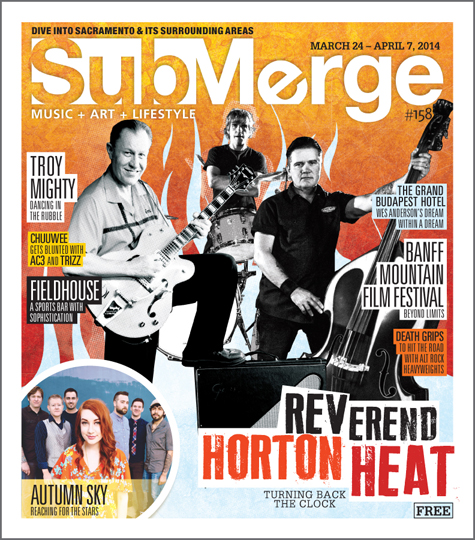
Reverend Horton Heat’s Jim Heath sounds off on life as a career artist
I opened my interview with Jim Heath—better known as the Reverend Horton Heat—the same way I do every interview with a simple question.
“What are you up to today?”
It’s more of a question for me than it is for them. It gets me settled—because long phone conversations with rock stars make me nervous—and on some occasions, when they’re not just doing laundry or mired in a long press day, they’re up to something cool that we can go off-script and talk about.
But Heath isn’t a spring chicken. He’s been doing this rock ‘n’ roll business—and all the sundry things that go along with it—for almost 30 years now. He no doubt sniffed out my stalling tactic right away.
“I’m deep-sea fishing off the coast of Morocco,” he shot back without pause. “And if it’s nice, I’m going to go night-skiing on a moonlit mountain in Switzerland.”
He was joking, of course. In truth he was a bit under the weather at the time of our interview and just relaxing at home in Texas, but given Heath’s fiery music and onstage persona, you’d almost be inclined to believe that wild overseas excursions are par for the course.
“It’s a normal day for me,” he said with a laugh.
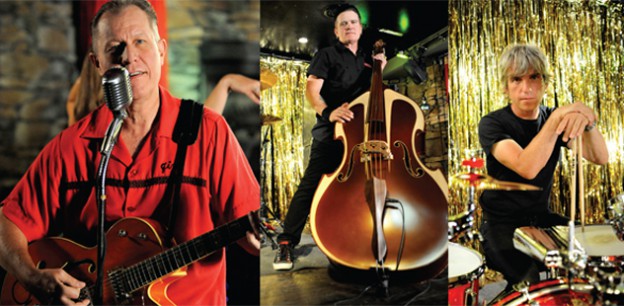
Night-skiing may not have been on the docket for that evening, but that doesn’t diminish the fact that Heath remains one of the coolest, most high-octane personalities in rock ‘n’ roll. And even though he’s a veteran on the scene, he and his band mates (Jimbo Wallace on stand-up bass and Scott Churilla on drums) seem to be turning back the clock on their latest album, Rev, which was released on Victory Records on Jan. 21, 2014.
His 11th studio album, Rev marks the glorious return of the Reverend Horton Heat you fell in love with in the mid-‘90s. Pedal-to-the-metal riffs mark the straightforward, brawny rocker “Smell of Gasoline,” whereas the album’s first single, “Let Me Teach You How to Eat,” rips and roars with more of a sly smile, bouncy rhythm and innuendo-laden lyrics.
Rev is sort of an oddity for a band that has so much history: it’s an album that will appeal to longtime fans of the band, and certainly open the door to new ones. In fact, it’s the highest charting album of the band’s career, having reached No. 111 on the Billboard Top 200.
In the following interview, Heath filled Submerge in on Rev’s intentionally long recording process and reflected on what got him started down the path of a rebel rock ‘n’ roll icon in the first place.
Did you ever expect to have this long of a career in music?
On one hand, yeah, I never expected it, but on the other hand, when I was a kid…I was a rock ‘n’ roll kid. I would listen to Black Sabbath and Alice Cooper or whatever, but then all of a sudden this blues thing hit me and I started to realize all of those guys were career artists. The more I got into roots music and country, I saw people like Willie Nelson who even then—this is going back to the ‘70s—my assessment of Willie Nelson was that he had a long, lifetime career…and the thing is, he’s still going! And the same with B.B. King…that was my assessment of him back then, that he was a career artist. And B.B. King is still out there. In that respect, it kind of makes sense, but to actually have it work out this way is a real blessing.
Congratulations are in order. I read that Rev is your highest charting album of your career.
Well, I appreciate that and Victory is going to be a good thing for us, because they’re doing a really good job, but looking at the numbers isn’t something that’s a good thing for a person like me to do. I’ve gotta focus on writing songs and playing guitar. Starting to look at those types of numbers forces my music into areas that it shouldn’t be.
I could completely go and make some kind of an album that would be bigger than any of my other stuff, but it would be real schmaltzy and full of a lot of cover songs and over-produced and all that stuff. I want to stick with what Reverend Horton Heat does. We’ve got something more important than us going out and having some hit songs.
Your last studio release was in 2009. Can you talk a little bit about how Rev came together and the writing process behind it?
Our last album was called Laughing and Crying with the Reverend Horton Heat. It was supposed to be a straight country album. It leaned really country, but that was on purpose. In Texas we get called to play these well-paying gigs to play the country side of Reverend Horton Heat, and that was kind of a nod to those gigs we were getting. But we’re a rock ‘n’ roll band, and we just wanted to get back to faster, uptempo, rock ‘n’ roll stuff and rockabilly-influenced rock ‘n’ roll stuff that we did in the mid-‘90s.
We got to a juncture there where we didn’t know what label [we’d end up on]. We were on Yep Roc, but they weren’t offering much money, because the way things are going now, all these great bands are able to record themselves and get great results. We got some equipment to record ourselves…we were already starting the album anyway, then we all of a sudden started talking to Tony [Brummel, founder and CEO] from Victory, and it we got on [the label]. So we had a little more money to play with. There’s a few songs and segments of songs that we did in a commercial studio, but by and large, most of that album was recorded in our rehearsal space.
Rev really captures what it’s like to experience the band live. Did that come from recording most of it in your rehearsal space?
I think it has to do with I’ve been recording a long time, and I basically know it should be a good representation of my vocal part, my guitar part, and Scott and Jimbo’s parts and their background vocals. As long as it’s a good representation of that, we can add some little things here and there, but not too much, because that’s not really being true to our sound. Of course, I’m a rockabilly so I like my slap-back echo and my reverb. That’s very much a ‘50s and ‘60s kind of vibe. We don’t necessarily go for that, but that reverb and echo is kind of authentic as a live sound a little bit.
Do you enjoy the recording process?
I really enjoyed this last one because it was all me. I would go up there at all hours of the night and the morning and all sorts of times and noodle around and write. The guys would come in and we’d play. That process went on for about a year—or six months—I kind of liked that, because even if we’ve got a big budget and went into a studio, there’s still a limited time you’re able to do that. If you’re on a really big budget, you might be able to lock out a studio for a month. That’s really expensive…especially a really high-profile one. Locking out a studio in Los Angeles for a month and staying out there and all that, it’s very, very expensive.
And it’s still limited time. A month isn’t really that long, because you’ll go in there and work on your 15 songs, and you may have two days or a day for each song, and so that’s not really that good. On this album, there were several songs that we recorded, we cut and then we’d listen to them for four weeks and say, “We’re doing that song too fast. It needs to be a little bit more heavy,” or something like that. There are several songs we re-cut four times. On a big budget, when you’re locking out a big studio, you don’t have time to do stuff like that. In a way, low budget for us gave us more of a chance to create, so we could get it right. When you’re in a studio, you have one chance to get it right. Being able to redo something four or five times was really cool.
Are you the kind of person who goes back over your older work and wish you’d done it a different way?
Oh yeah, I’m totally like that. But in all honesty, when I go back and listen to our old albums, it’s kind of better than I remember. I’m like, “Oh wow, we were pretty good.” But then I still hear the certain mistakes that are still there.
When you unveil new material to an audience, is it still exciting for you or does it make you anxious?
Yeah, it’s pretty nervewracking. A band like us that’s had a lot of CDs, our fans who paid the ticket price want to hear the songs that made them like us when they saw us live 20 or 25 years ago. We try to play a little bit of songs off of each album, but it gets harder and harder. Then you throw in the new stuff…that’s the good news for us right now. Our new stuff is getting accepted better than it has since the mid-‘90s. It’s got to be really frustrating for some of these older artists—older than us, like the Stones—who’ll spend a lot of money and time to record a new album and go on tour and only be able to play one song or the max two off the new album. Of course, we’re not in that position…but that’s one of the challenges for a career artist, getting that new stuff in there.
Get ready to get your faces melted as the Reverend Horton Heat is coming to town on March 30, 2014 at Ace of Spades. Nekromantix, Deke Dickerson and Infamous Swanks will take the stage in support. Tickets are $20 and can be purchased at Aceofspadessac.com.
With seemingly a new mass shooting every month or so, guns have become a very hot topic. Everyone has an opinion on guns ranging from they’re the cause of all evil to it’s our God-given right to own a whole garage full of them. I’m probably one of 10 Americans to have never fired or even held a gun. I don’t really have a desire to, either. I mean, if you want to, that’s great. Just don’t try to get me to drink beers with you and drive out to a shooting range—because I won’t—and point it the fuck away from me. I’m not sure if that makes me a namby-pamby liberal or not, but I do have to say that it seems as if making tighter gun restrictions is unfortunately pointless. They’re everywhere. In most cases, they’re easier to get than a pack of cigarettes (and it’s definitely easier to find a place to start popping caps in things than it is to find some place you can light up a Camel). You can buy guns in department stores and through catalogs, and now if you’re really hard up for finding something to shoot things with, you can just go to church.
Well, not all churches, just one in particular. Pastor John Koletas of the Grace Baptist Church in Troy, N.Y., has decided it would be a good idea to raffle off a gun in the house of the Lord. On March 23, 2014, the good pastor will give one lucky member of his flock a shiny new, legally modified AR-15 assault rifle.
I don’t play Call of Duty online, so I had to look up what an AR-15 assault rifle is. According to the opening line of the AR-15’s Wikipedia entry says the rifle “is a lightweight, 5.56 mm/.223-caliber, magazine-fed, air cooled rifle with a rotating-lock bolt, actuated by direct impingement gas operation or long/short stroke piston operation.” (Feel free to insert any sexual innuendo you’d like here.) I haven’t the slightest clue what any of that really means, but the entry includes a picture of this thing, and it looks like something you’d find a jacked-up juicehead toting around in a Predator movie.
 Koletas said giving away a rifle is in-step with the teachings of the Bible, which he said is “replete with defending yourself and arming yourself and being capable of defending yourself,” according to an article on CBS6albany.com. Sure, you could say that there weren’t any weapons on par with an AR-15 when the Bible was written, but I guess if Jesus was packing serious heat like this, the whole crucifixion scene may have gone down quite differently.
But not only is it the Christian thing to do, Koletas was quoted in the same article that it was his patriotic duty to start doling out firearms.
“I sort of feel obligated to be a blessing and a help to gun owners and hunters who have been viciously attacked these last few years. It’s their Second Amendment right.”
A Republican senator, Steve McLaughlin, whose scheduled to speak at the church on the special day said he doesn’t understand what all the fuss is about: “I don’t see where there’s a controversy. There are churches that give away cars, there are churches that give away money, there are churches that have Vegas nights. So I don’t see how this is, in any way, a controversial thing to do.”
Well, I guess he does have a point. I used to go to “feasts,” which were kind of the most fun you could have as an Italian-American child growing up in a predominantly catholic neighborhood in New York. Churches would run them and there’d be rides and zeppoles and carnival games outside, and inside the church’s basement there’d be games of chance where you could win money, like roulette and this game with a ball that a barker would bounce and you’d bet on which colored cup it would land in. Even though I was just a kid in elementary school, I was never shooed away from playing along with the adults. I’d ask my mother, “Isn’t this gambling? Isn’t gambling wrong?” and she’d say, “Well, it’s OK, because we’re in a church.”
But winning a few bucks because the ball landed on blue doesn’t seem to equate, as Mr. McLaughlin would have us believe, with winning an assault rifle. With the money I’d won from church gambling, I’d just buy a slice of pizza or a greasy bag of zeppoles. I’m not sure what I could do with an assault rifle other than assault things.
To be fair, they’re not giving away the actual AR-15 at the church. The lucky winner will receive a voucher to pick up the rifle at a local gun shop, and he or she will have to be an “eligible adult” and go through all the proper background checks. So that’s good, right? And let’s face it, the rifle will eventually find itself in a good Christian home, in the hands of a God-fearing, church-going, upstanding citizen. And no religious person has ever committed a senseless act of violence that has resulted in the deaths of innocent people before…
Oh wait, that’s not right…
Pompeii
Rated PG-13 | 2.5/5
There’s an old adage that goes, “Tragedy plus Time equals Comedy.” It actually holds true most of the time…unfortunately, I can’t think of any good Mount Vesuvius jokes. Maybe it’s because it happened so long ago. In any case, the epic volcanic eruption in the mid-first century A.D. that wiped out the Roman city of Pompeii has endured as one of the most awesome natural catastrophes in human history. Luckily for us it makes for a pretty exciting movie too; mostly because it happened so long ago, we couldn’t possibly know anyone who was affected by it.
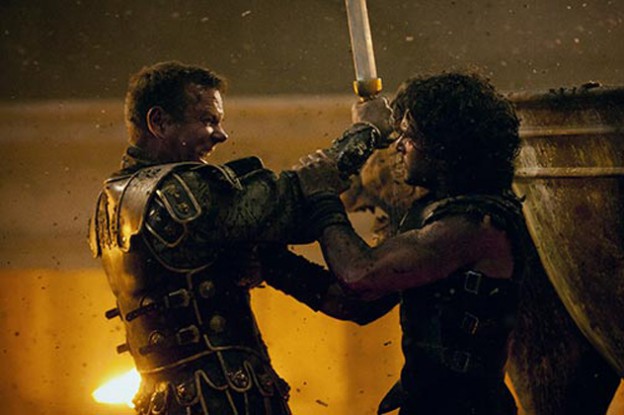
The antiquity of the story works out well for director Paul W.S. Anderson and his screenwriters as well, because it leaves them free to take plenty of liberties and create characters and scenarios that have only a tenuous bond with reality. Check this one out: a young Celt child, Milo, watches as his family and tribe are slaughtered at the hands of a power-mad Roman senator, Corvus (played by a wickedly schmaltzy Kiefer Sutherland). Young Milo is believed dead, but ends up climbing out of a pile of his brethren’s bodies after the smoke clears and the Romans exit. Alone, he tries to survive in the wilds of Britannia but is captured by a different group of baddies.
Seventeen years pass in the blink of an eye, and suddenly we’re in Roman settlement Londinium, which is now London. Right away we see even in ancient times, the weather there sucked. Rain pours down in some back alley gladiator coliseum. Blood forms into a puddle on the floor, and a ramshackle group of spectators cries out for more. Among them is the slave trader Graecus (Joe Pingue), looking bored and yearning for the milder climes of the Mediterranean. He’s there to see a combatant dubbed “The Celt,” who’s said to be the best around. The Celt is, of course, young Milo, now all grown up and played by a well-muscled Kit Harington (Jon Snow from Game of Thrones). Milo dispatches his foes with a quickness and Graecus’ eyes light up with dollar signs…or whatever currency the ancient Romans used.
Milo is brought to Pompeii for The Vinalia, a festival to celebrate the wine harvest. In transit, he encounters Cassia (Emily Browning), a lady of good standing from a wealthy Pompeiian family, returning home from Rome. The two instantly fall in love, we assume, because she’s a babe with a heart of gold, and he’s a horse-whisperer with rippling abdominals. But how can they be together when society is designed to keep them apart? Sigh.
Cassia isn’t the only person of interest in Pompeii for The Vinalia. Milo also meets and forges a strong bond with fellow gladiator Atticus (Adewale Akinnouye-Agbaje), a grizzled champion who believes he will earn his freedom after his next victory and, wouldn’t you know it, Senator Corvus, who’s still a total dick after all these years.
Amid all this human drama, you might be wondering where the volcano is. Well, it’s there, but it takes a backseat for much of the film. Sure, it rumbles a few times and spooks a couple of horses, but mostly we’re focused on the unfortunately flimsy characters.
It’s a pretty run-of-the-mill plot. Corvus has his eyes set on Cassia, the only thing his power and influence hasn’t been able to obtain; meanwhile, Milo seeks revenge for the loss of his family. It’s mildly compelling at times, but really, where’s the goddamn explosion? I want to see stuff slathered in molten lava.
Luckily there’s plenty of action. Anderson, the man who brought us the Resident Evil movies, is really adept at making fight sequences look really flashy, and the bare-bones, sword-to-shield dust-ups look great here. And when Vesuvius finally unleashes its unholy wrath on the unsuspecting Pompeiians, it’s pretty ferocious. Flaming rocks explode as they hit the ground; stone rain pummels confused townsfolk; a giant tidal wave destroys a harbor; volcanic ash falls like deadly black snowflakes, covering everyone in soot; and then the kicker…molten-fucking-lava! Don’t worry: it’s OK to cheer as Pompeii breathes its final breath. Anyone who’d be offended is long gone by now.
Phantogram utilizes greater collaboration for a more mature sound on their new album, Voices
Last Submerge spoke to Josh Carter, one half of Saratoga Springs, N.Y.’s Phantogram, he was making some major moves. Not only was he getting ready to get to work on a new Phantogram full-length, he was also in the process of quitting smoking. Well, as he informed us this time around, the smoking thing didn’t work out so well, but Voices, Phantogram’s major label debut on Republic Records (an arm of the Universal Music Group that’s also home to Florence and the Machine, Crystal Castles and Drake) is due in stores Feb. 18, 2014, and sounds like a worthy, early contender for 2014 year-end lists.
After a few years making serious waves on the indie label circuit, a jump to the majors seemed to be the next logical step for Phantogram; however, Carter admits the process of finding the right new home for the band was a bit “overwhelming.” He says his band was heavily courted by both major and independent labels. (“We met with every major label—literally—and some indies, because we weren’t sure what we wanted to do,” he says.) But Republic won out in the end, because it held the right “vibe.”
“For us, they’re into our talent, and so was every other label, but we really had a good energy with the people at Republic and they really believe in our sound,” he explains. “They just want us to do what we do. We don’t have to compromise anything artistically. We have full creative control, so it’s awesome. We’re the same band as before, just on a new label.”
How much did the change of scenery affect the band? Well, from even a quick listen to Voices, it would appear not all that much. Phantogram remains as dark, diverse and catchy as ever, but if anything, their latest album sounds more complete and expansive. Though different tones and moods are pervasive, songs such as the twisted new wave pop of “The Day You Died,” on which vocalist Sarah Barthel seems poised to be the Debbie Harry for the Twitter generation, sounds right at home next to the dirge-y ballad of the Carter-fronted “Never Going Home.” The album’s first single, “Fall in Love,” sounds as dreamy as its title might suggest but with a throbbing beat that keeps it well-grounded (perhaps even funky).
With the band in pre-production for a string of West Coast dates (with new light show in tow) and an appearance at this year’s South by Southwest on the immediate horizon, Carter took some time away from the business of being a budding rock star to answer some questions about his writing process and how Voices was a true team effort.
How are you feeling about the album coming out in a couple weeks?
We’re super pumped about the album. Very excited.
You recorded it in Los Angeles?
We did a lot of the recording and demoing in Upstate New York, then we moved everything out to L.A. to record the album, and I co-produced it with a guy named John Hill.
How did you like working with John? What did he bring to the album?
I thought it was great working with him, because he’s had a diverse background in production. He has a very wide palette. He’s done power pop and punk bands, hip-hop acts, straight-up pop acts and also electronica kind of stuff. That was really good for us, because we have a very diverse sound within our sound. I learned a lot of great production techniques from him, and he’s just got a really good sense of rhythm. He takes his time. He’s very contemplative. He and I have very similar personalities—at least that’s what Sarah said—so it was really easy for the two of us to jive with John. He had a lot of great stuff to use, too—analog synths, and every guitar pedal you could think of.
As a producer, how was it working with someone else? Were you hesitant about that?
Sort of, but my whole theory behind art and music is it never hurts to work with other people. You can only learn from other people. Sarah and I are a two-piece band, and we hire live members, but I think having too many cooks in the kitchen is a bad idea, especially for me, because I have a very strong opinion. Luckily, Sarah and I have a very similar vision. Working with John Hill, I think he really read that well. I was very open to working with him.
He didn’t make us do anything that we weren’t vibing on. He would just suggest ideas, and a lot of his ideas were very good.
Do you think there’s a perception that a band changes or has to compromise when it moves from an indie label to a major label?
I think a lot of people look at it in a negative way because they’re ignorant to how it really works. Sure, some artists are molded or feel pressured to change their sound when they sign to a major to maybe appeal to a different audience or something, but when you get the yo-yos talking about how it’s a sell-out move, or it’s bullshit when you sign to a major, they just don’t really know what they’re talking about. It’s the same with people who say you’re a dummy for having your music in a television show or a commercial. They don’t understand how musicians have to make money these days. It’s not the ‘90s anymore.
Last I spoke to you, you told me you were the primary songwriter. Did that hold true on Voices, or did Sarah contribute more this time around?
On Voices, I wrote the majority of the lyrics. Sarah has a much stronger presence on the songwriting for this album. It was a lot more collaborative, and it was a lot of fun. We worked together on most of it, and we really just balance each other out. We trade ideas. Sometimes when I’m working on something, and I get sick of working on it alone or get stuck, I give it to Sarah and have her work on it and we trade back and forth. And vice versa…she’ll do the same thing. She’ll give me an idea, and I’ll start working on that. Sometimes we’ll just get together and play music to a click track until we get ideas that we like.
Did collaborating more take Voices in a direction you didn’t expect?
I don’t know. This record is just a natural maturity of Phantogram. It’s an extension of our sound. There are some differences, but I think Sarah’s voice is a lot more soulful on this record, which is fun to listen to. Overall, it’s just a natural progression of what we do as musicians.
As the primary lyricist, what were some of the things that were inspiring you to write this time around?
Generally, our songs have recurring themes. The songs are just about living and life…and love and sorrow. A lot of our lyrics have a very dark nature. That’s just the path that inspires my lyrical writing at least.
Do you have to be in a dark mood to write?
No I don’t think I have to be in a dark mood. Inspiration strikes me when I get a little deeper into things. There’s darkness in everything if you dig deep enough. That’s not necessarily evil or dark in that sense, but it’s just this existential thought of “What is the meaning behind all of this?”
Are you one of those writers who constantly jot down ideas, or does it all come out at once?
It’s funny. I think I have 10 or 12 different journals at my house. It’s hard to organize, because I just sporadically write stuff down in them. Sometimes I just write down something I heard that day and just write down one sentence or one word, even. I’ll think, “What would be a cool name for a song?” So I’ll come up with a name of a song and write it around that.
Do you ever go through your bunch of journals and see a sentence or word that you wrote down and forget why you wrote it down in the first place?
Oh yeah, definitely. That happens a lot. Because I’ve been writing lyrics for 10 years or so, you get a little peek into some feelings that were pretty silly or certain ideas that took me a while to get over before I graduated to other ideas. It’s interesting to read old ideas, but sometimes I can read something that I wrote a long time ago and have this epiphany that I never realized when I’d written it, and I can translate it into something new.
Last time I spoke to you, you were getting ready to work on this full-length and you said to me, “I’ll hunker down and work on something, but we do have a mission statement for the next album.” I asked what it was, but you said it would probably change. Now that Voices is done, were you able to stick to a mission statement for the album and if so, would you be able to share it?
We came up with several mission statements [laughs] and after a while, we were like, “OK, let’s just do what we do,” and that’s what ended up happening. We found it to be too restrictive for our process, so we scrapped the different mission statements that we had. But I would like to work on stuff in the future and practice constraint. I guess our individual songs are kind of like that, instead of the full album adhering to one particular idea. Our albums are very cohesive, but there are a lot of different elements we have in our music.
So was having a singular theme in mind holding you back?
Yeah, I think it was holding me back. It wasn’t natural. It was making me feel like I was thinking too hard about what I was doing. The last thing you want to do as an artist is think too hard about what you’re doing. It should come out freely and flowing.
Check out Phantogram live in Sacramento at Ace of Spades on Feb. 21, 2014. White Sea will also be performing. Tickets are $25 and can be purchased through Aceofspadessac.com. UPDATE: TICKETS ARE SOLD OUT! Look for Voices in your favorite record store on Feb. 18, 2014.

Now that the holidays have long since passed, and we’ve all gotten over sharing pleasant tidings with one another, we can go back to the business of gawking at celebrity fuckups. And thank God for that. All that peace-be-with-you, auld-lang-syne garbage was making me downright cheery. I thought I was going to be sick. Thank you, Justin Bieber, for bringing the perpetual sneer back to my face. I was starting to miss it.
Biebs was caught speeding down a residential street in Miami Beach in a yellow Lamborghini. When police pulled him over, he was uncooperative, failed a field sobriety test and eventually admitted he had been drinking, smoking marijuana and was taking prescription medication. Over the weekend, he was released from jail on $2,500 bail. I’m sure this will blow over relatively soon, and he’ll be back to the business of making shitty pop music and storming off stages like a drama queen in no time.
I mean, good for him. No matter how much he sucks, he should be given the same treatment under the law that any one of us would face in the same situation. Sure, he’ll have a better lawyer than any of us could afford, but, hey, that’s America for you. When this is over, and he pays whatever nominal fine or serves whatever circle-jerk community service he’s sentenced to, we should accept that he served his time and should be allowed to get back to work.
More importantly, though, it’s imperative for us as a nation that he gets back to work ASAP. His shitty pop music is good for the economy. I don’t have the figures in front of me (I never have figures in front of me when I write these things, just stacks of more-or-less sorted Magic: The Gathering cards and used cereal bowls), but I’d imagine it takes a lot of people to make the Justin Bieber Machine work. There are managers, press people, producers, writers and label liaisons at the top of the food chain. But let’s not forget the blue-collar guys (and gals) who keep Biebs’ gears well-oiled (I swear that wasn’t a pun). I’m talking about the sound and set builders and pyrotechnics and lighting people who put in many hours of labor to make a scrawny, floppy-haired kid from Canada look like a demigod on stage. There are people who drive the trucks and buses to get all the equipment and dancers and sound people from show to show. There are also a lot of creative people at work, such as photographers and graphic designers who shoot his press shots and lay out his album artwork (because much to the amazement of all of us, even now in 2014, they still make physical albums).
That’s not even taking into account his merchandising. People need to design and manufacture all those T-shirts, mouse pads, posters, what have you. Then someone has to put them in boxes and ship them to places to be processed. And then those things have to make it out to stores in towns all across the country, where people by this garbage for their tween-age children. Then there are also all the arenas across the country who sell sodas and popcorn and whatnot to his adoring fans. And then there are all the local hotels that have to put up his crew and the press people who follow him around. And speaking of press, think of all the bloggers, music journalists and gossip columnists who get paid to write articles about what Bieber is having for breakfast or whether or not he’s dating Selena Gomez or whatever. I mean, I’m getting paid right now just by typing this. You may think Bieber Fever is lame, and you’re right. It’s so, so, so lame, but it’s probably as important to the United States as whatever the Federal Reserve is doing with the interest rates…and probably a lot easier to understand.
So when someone as famous as Justin Bieber has a run-in with the law, you’re right to pay attention, but not because you want to condemn some stupid kid for doing something stupid. Hey, he’s 19. I bet you were a fucktard when you were 19, too. You were. Just own up to it, and you’ll feel much better. You’re probably still fucking up now. Hey, it’s OK. I do too. I’m reasonably certain many of us have driven a car when we shouldn’t have. We just never got caught. That could be just because we had blind luck on our side; or, more likely, we were driving a beat-up, dull-gray Hyundai and not the most conspicuous Italian sports car in the world…in yellow, no less. Hopefully he’s learned a lesson. Next time he drinks and drives, maybe he’ll just take the hooptie for a spin instead.
Gimme Shelter
Rated PG-13
It’s nice to see a teen star trying to mature without going on a drinking binge. High School Musical’s Vanessa Hudgens tries to make a segue into more of an adult role with her portrayal of 16-year-old Agnes “Apple” Bailey in Gimme Shelter, a film that takes a good, hard look at teenage pregnancy and life in America’s foster care system. While the film is loaded with good intentions—especially Hudgens’ performance—it falls short of having any lasting dramatic impact.
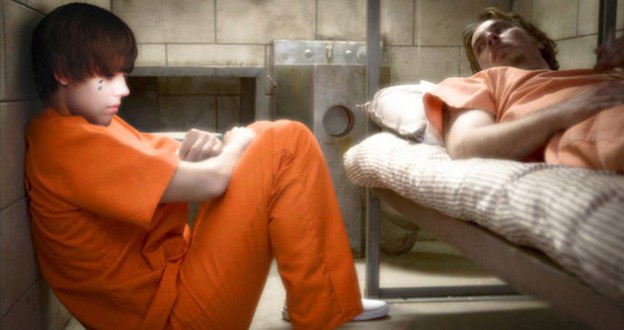
Based on a true story, the film opens with a haggard Bailey chopping off her own hair in a grimy sink. It would appear that she’s hit rock bottom. Living with an abusive mother in an oppressive ghetto, Bailey decides it’s time to finally flee. She makes her way to an affluent suburb in New Jersey in search of Tom Fitzpatrick (Brendan Fraser), who turns out to be the young woman’s absentee birth father.
In a complete 180 from Bailey’s life at home, Fitzpatrick is a Wall Street tycoon. He lives in an opulent gated home and is married to a perfect wife Joanna (Stephanie Szostak) with whom he has two children (one boy and one girl, of course). Reluctantly, Tom and Joanna decide to take in Apple, though at this point in the film she has the dark under-eye circles and complexion of a recovering heroin addict. However, Apple’s mood swings are pretty severe, and when she starts suffering from morning nausea, it is revealed that the young woman is pregnant.
Tom and Joanna think it’s best for Apple to get an abortion, but the 16-year-old momma to be is not so sure. She flees from an abortion clinic and ends up wandering the rough streets of Newark, N.J., where she forages the garbage for food and sleeps in unlocked cars. After narrowly escaping abduction, she befalls a serious car accident that lands her in the hospital where she meets up with a preacher (James Earl Jones), who starts her down a path toward turning her life around.

There are a lot of good feelings circulating around this movie. Each character gets a shot at redemption, though the only one who squanders her chance, Apple’s mother June (Rosario Dawson looking as frightening as Cruella de Vil). Hudgens and Dawson share a touching scene at the hospital after Apple’s accident wherein the mother makes a plea to her daughter to return home. Dawson, as she does throughout the film, manages to make her vile character somewhat sympathetic. At the hospital, she paints a portrait of someone who once had dreams and aspirations but was eventually beaten down by life and was unable to rise out of the ashes.
Elsewhere, though Tom seems to turn his back—once again—on his daughter Apple, he never gives up his search for her, and the two are eventually reunited with a chance to forge a real relationship.
Apple, too, starts as a hateful young woman—understandably. She’s been swept aside by her parents and fell through the cracks of the social welfare system. It’s a painstaking process, but as the film progresses she learns she has to let down her guard and try to trust people. Hudgens does a so-so job of taking us through this progression. Unfortunately, her cosmetic changes—from grungy street kid to cheery girl-next-door-type—are more noticeable than her growth as a character.

What’s nice about the film is that it doesn’t ever get too preachy. Though it contains themes such as teenage pregnancy, abortion and social welfare, it never seems to take a Pro Life or Pro Choice stance. It simply portrays characters that struggle with serious life choices. It pokes around at the inadequacies of “the system” without really pontificating. It’s nice not to feel like we’re being lectured to, but at the same time, any kind of stance would have at least been interesting (whether I agreed with it or not).
Dawson is the only principal player who really distinguishes herself. Though she’s somewhat cartoon-y as the film’s villain, she can be chilling at times, especially when she attacks Hudgens with a razor blade in one scene at a church. Fraser, whom I don’t remember seeing in a film in quite some time, lacks charm and just mopes around with furrowed brow. Hudgens really goes for it, though. She looks a mess and acts one, too. She ebbs from fiery to devious to vulnerable, but overall she seems like she’s trying too hard to assert herself as a “serious” actor (whatever that means). Definitely an A for effort…maybe next time.
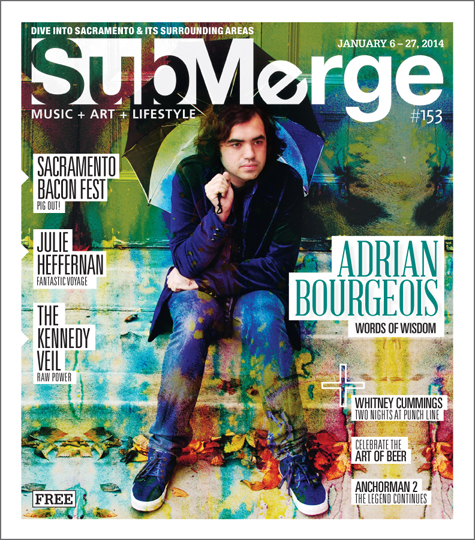
Adrian Bourgeois proves the album is an art form worth saving with his latest release, Pop/Art
The digital music revolution, with its emphasis on EPs and singles, has set into motion the extinction of the traditional long-form album, but local singer/songwriter Adrian Bourgeois says not so fast.
On Feb. 4, 2014, Bourgeois is set to release his latest work, Pop/Art, a 24-song double album. It will be his first release since his self-titled debut, which he put out in 2007.
“You keep hearing that the album is dead and people have such short attention spans and nobody wants to listen to more than 30 seconds of a song… So what’s the logical response to that? Make a double album,” Bourgeois tells Submerge over the phone. “There are really no rules to this thing anymore. Why not just do the absolute worst possible thing to do? You might as well, right? If you love it, if it’s what you want to make, then make it.”
Bourgeois says he’s been working on the songs that appear on Pop/Art for “seven years or so.” After the release of his first album, he’d come to something of a crossroads in his musical career. His debut was getting good reviews and seemed to be generating interest in the industry, but things weren’t quite happening for him just yet. He was unsure whether or not to keep working his first album or start working on a new one.
“I started talking to a couple of different people about the prospects of making a record, and a couple of opportunities came up, but they got postponed,” he says. “All the while, I was writing more songs. At some point along the way, I decided I got to make another album at some point, and waiting for another opportunity to come around is not really getting me anywhere these days, so I should probably take matters into my own hands and do it myself.”
So, Bourgeois armed himself with $500 worth of recording equipment that he says he’d purchased with Christmas money and took a route that many indie musicians have done in the digital age: He started making an album in his bedroom.
While this may sound like a very personal, intimate process (and it was for Bourgeois), the songwriter says he focused more on the craft of the songs as opposed to the feelings behind them.
“A lot of times when I’ll write a song, the first thing that I’ll hear is the track. I’ll hear the finished product before I’ve ever written anything, and then it’s almost like learning the song,” he says.
“It was kind of liberating to sit down and bring them to life.”
He worked on Pop/Art for two and a half years, mostly on his own, playing almost all of the instruments. However, as he said to Submerge in an email, the album wasn’t entirely a one-man show. Cake trumpeter Vince DiFiore and Probyn Wilson (the Brian Wilson Band and many others) both make appearances, as do local colleagues Autumn Sky and Ricky Berger. Bourgeois’ father Brent also pitched in. Bourgeois confides that Berger’s contribution to Pop/Art extended beyond just lending her vocal talents to the record.
“There were some songs on here that I sent to her and she said, ‘You’re better than this. Keep working on it,’ and I trust her enough to hear that from her,” Bourgeois says. “The album would not be as good as it was if not for her.”
Pop/Art is an instantly gratifying album highlighted by Bourgeois’ creamy vocals and lush arrangements. Songs such as “Jonah” provide a grittier rock punch while the piano-driven opener “New December” harkens back to pop’s grand, vinyl past…you know, back when people actually listened to albums en masse. At 24 tracks, it’s impossible to find one that’s simply filler. However, though the album certainly stands as an accomplishment, setting a high bar for Sacramento’s 2014 local releases, Bourgeois remains humble.
“I almost consider this double album to be a complete underachievement because in the amount of time it took me to make this, The Beatles recorded Rubber Sole, Revolver, Sgt. Pepper, Magic Mystery Tour and The White Album, so this is me slumming it I guess, when you think about it, in comparison,” Bourgeois says.
Bourgeois lends further insight into the making of Pop/Art in the following interview.
Were you shopping your debut album to labels?
Yes and no. A label is one potential tool that I considered and flirted with over the years. My goal is to get my music heard by as many people as possible. There were people along the way who have helped me a lot and have provided opportunities. Any musician will tell you this: You get a lot of people with great intentions who say they love you and the music you make and they’re going to make things happen for you, and then you never hear from them again. There’s a lot of that, and that’s fine. I understand there are all sorts of factors that need to be taken into consideration. The good thing about today is that it’s a lot more possible than maybe ever before to say, “I’m going to put it out myself, and I’m going to distribute it myself.” The tools I have to do that really aren’t that much less than what anyone else has. They might have the relationships and the contacts to get it heard by, quote-unquote, the right people…but I don’t even know what “the right people” means anymore. At this point, I want people who like the music to hear it, and those are “the right people.”
It was six or seven years since your last album. Were you getting disillusioned at any point?
I grew up in a musical family. My dad was in the music industry for a long time… I kind of had a balanced view and a realistic view of how everything worked, but it was frustrating sometimes, definitely. I think “Shot in the Dark” [from Pop/Art] was written about that… But I understand. The music industry is a place of short attention spans. They hear you and they love you, but then they hear someone else that they love. There are just so many different factors that I stopped analyzing it too much and took a proactive approach. What can I do to make the life that I want for myself.
Did having a father in the music industry help you gain that perspective?
Yeah, absolutely. It’s definitely given me a lot of experience without necessarily having to experience it first in a lot of ways, if that makes sense.
On the other hand, I feel like I know too much because I’m quicker sometimes to not try something because I know it doesn’t work that way. And then you see some band that knows nothing about the music industry and does something extremely rash and stupid and it makes them world famous. There’s that Catch 22. But overall, he’s great to have around for advice and his years of experience.
You said these songs were written over a seven-year period. You must have gone through a lot of growth as a songwriter and as a person in that time. Do you hear that when you listen to the album? Does it almost sound like a scrapbook of the past seven years of your life?
It’s interesting, because I don’t think I’ve changed all that much as a person over the course of my life. If you’d known me as a 6-year-old, I’m pretty much the same guy, I think…maybe a little wiser, maybe a little less. I think it’s the same thing with my music. A lot of people at some point go through this radical transformation, but that’s never been me. I’ve just evolved over time and refined who I was, but I’ve always been at the core the same person. That’s why I think songs from six or seven years ago fit just fine next to songs I wrote even in the process of recording [Pop/Art]. But it is interesting hearing that growth. It’s almost discombobulating when I imagine what these songs were written about. One song on the record might be about meeting somebody, and the next song is about being in a relationship with that person, and the song after that is about breaking up with that person…
At the end of the day, if nothing else happens, it’s something that I’m always going to appreciate having. It’s like a diary or anything you have in your life that just captures this period of who you were. I’ve never been one for tattoos, but this album is my tattoo, I guess. This is me and who I was and the imprint I made at that point in time.
You said you hear the whole arrangement before you even start writing a song. Have you always listened to music that way? Do you think, “OK, this is how this was put together?”
When I listen to music—I overanalyze everything—but with music, I expect it to be really good. I don’t listen to a wide variety of music. When you ask them what kind of music they like, most people will say they like a little bit of everything, but I’m the exact opposite of that. I like a lot of a few things. It’s less necessarily important to me as to how it makes me feel or if it relates to me, I’m like, “Is this a really great lyric? Is this a really great melody? How is this arrangement brilliant?” And if it isn’t, I don’t listen to it. If I was stuck having to listen to just The Beatles or The Beach Boys for the rest of my life, I probably wouldn’t complain too much.
Celebrate the release of Pop/Art at Luigi’s Fungarden at 6 p.m. on Feb. 9, 2014. In the meantime, pre-order a copy of the album today at Adrianbourgeois.bandcamp.com, and you’ll be able to download a digital copy of the entire thing immediately. Pop/Art will be officially released on Feb. 4, 2014.