Goapele Has the Voice of an Angel, the Spirit of Oakland
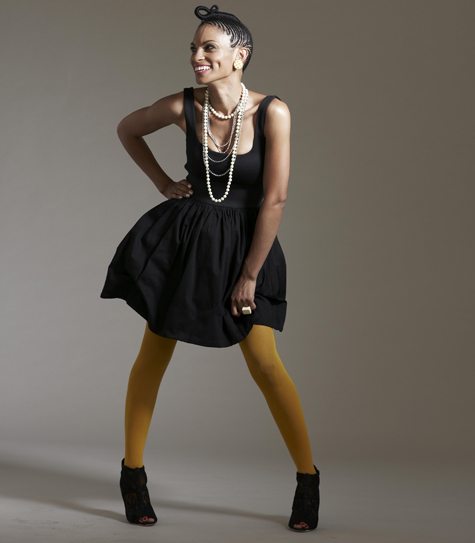
Much like her music, Goapele is not a one-dimensional individual. Born in Oakland to a South African father and Jewish American mother, her lineage and upbringing provided a fountain of culture for her to draw upon. From activism to the arts, she absorbed it all and channeled her experiences through music. With an angelic voice and adventurous ear, Goapele defies genres and has continued to evolve over the past decade.
Since her debut in 2001 the sultry vocalist has gone on to release three albums. After a five-year hiatus brought on by the birth of her first daughter, Goapele is putting the finishing touches on her fourth, titled Milk and Honey. With big name producers from across the country, the album is a melting pot of sounds, from synth-driven and heavy drums to sweet melodies. Goapele says that becoming a mother played a big part in expanding her world and making her “more open in general.”
“I think it was more so how much bolder and empowered, and also how vulnerable I felt after the whole experience,” she says. “It has expanded my sense of love. Also, it really pushed me through the writing and recording process. I don’t feel like lyrically I’ve changed very much, except that I’m putting myself out there a little bit more on this album instead of holding my cards close.”
A soft-spoken, strong soul blessed with boundless talent, Goapele has all the tools. It’s her world, and she is the architect. In advance of her Aug. 13, 2010 performance at Harlow’s, Submerge linked up to talk about Milk and Honey and some of the misconceptions that follow her.
I heard you say in an interview how people thought you would come back and write lullabies, but how that’s not the case.
Yeah, yeah [laughs]. It’s kind of interesting in that way because it didn’t make my music softer or my lyrics more edited, it made me more open and bold.
Â
With your time off did you find you came back with a renewed energy or creative pulse?
I took my time recording this album, and I feel ready right now. After I had my daughter I took time to be home with her and take advantage of that experience, but I have really dedicated the past couple of years to craft this album the best way I can. What it is was that I was able to take more time than I ever had before because it was on my terms and pace.
Â
I feel it’s been public for a long time that Milk and Honey was your next album title. I’m always interested when a title holds for so long. Did you build down from a certain concept and sort of mold the album off of that?
Well, it was one of the first songs I recorded. It was a very sensual song, and I felt like that would be the overall tone throughout this album. There were songs I was writing at the time that had a different vibe, but I really liked the “Milk and Honey” idea. I like that it was something nourishing and sensual… I need to find more words to explain it [laughs].
Â
Did that song steer you in a certain direction?
Not really, I just kept recording. In the creative process I just like to get everything out there. I hooked up with so many producers and musicians along the way things were always changing. I would feel like, OK, I’m done, but then another opportunity would open up so I just kept going. At the end I think it will all make sense, and it will all tie together. When I first started recording, it started with my in-house producers like Bedrock, Mike Tiger, Dan Electric, and throughout the process I got to work with different people I had met throughout the years like Kanye West; Khao, who is out of Atlanta; Raphael Saadiq and others. More recently I worked with Drumma Boy who produced the next single, “Right Here.”
Â
Again, I read a quote I really liked where Drumma Boy talked about playing you his R&B stuff but you identified with the harder, crunk stuff.
Yeah [laughs]. I feel like as producers and musicians, we have to give our truest selves. That’s what I know him for, so that’s what I want from him. I can come off super laid-back and positive, and I do want my music to have a positive impact, but I’m not strictly a calm, soft and gentle person. I really like hard-hitting drums and bass lines. And then my natural way of singing is kind of laid-back, so I like how those two things fit together.
Â
You have a universal sound, but do you feel there is an element that is a direct reflection of your Oakland/Bay Area roots?
Probably the combination in my sound–that it’s raw but still beautiful. I feel like that is Oakland. It has a rough vibe but it’s gorgeous at the same time. It has the water right there, so much green, but there are other elements that can be rough around the edges. I would be happy if the violence went down, but I do like that people can be individuals and not worry about fitting in a box.
Â
Yeah, I feel like that is really personified in the “Milk and Honey” video. It’s a very elegant video, but you got the two slugs in the bottom row of the teeth.
[Laughs] Yeah, exactly. It’s not typical. We all have so many different aspects of ourselves, and in entertainment it’s like people want us to be one certain way but that’s not how most of us are as men and women.
Â
You may have just answered this, but what do you think is the biggest misconception of you?
Yeah, kind of what we were just talking about and people just wanting to keep me in the neo-soul category. Yes, I have been strongly influenced by soul music and I always want what I do to be soulful, but it does bleed out of that category.
Â
Is that a term you have come to disgust, or are you just kind of eh with it?
It turns me off, but I understand it. When you’re doing something that doesn’t quite fit the titles that are already out there then it’s easy to just make a new title, but it’s the best when you don’t have to have any title at all. Just your name. That’s what I’m working for.
Â
Steven Borth’s CHLLNGR takes dub to the next level
Jet setting around the world to collaborate and tour, studio sessions with music’s most renowned creators, and splitting living time in Sacramento and Copenhagen with a beautiful girlfriend would seem to make for a full life for most musicians, yet Steven Borth II seeks more from his endeavors. The well-traveled musician is exploding back onto the scene with his new project, CHLLNGR, a dub revolution that takes some history-digging to get to its source.
Borth was born and raised in Sacramento, but found his niche as a musician in the Bay Area. Remember ska? More specifically, remember third-wave ska punk? It had a good run in the ’80s and ’90s and Steven Borth II was a part of that as a member of the East Bay’s Link 80. He joined the group in the latter years of its existence, but his involvement is integral in shaping CHLLNGR.
Link 80 frequently toured Europe, enjoying the fruits of the punk rock circuit in the United Kingdom. It was on these tours that Borth acquired a taste for dub music. “I would help load in the gear, do a sound check with just enough to time to go outside and ask someone where the nearest record shop was,” he said. “I would make it just in time before they closed, and I would pick up what I thought may be good. How I really got started was collecting the Trojan box sets.”
The dissolution of ska was far from pretty. Link 80 suffered traumatic losses and its surviving members found new outlets. For Borth it was joining Rx Bandits, another Bay Area ska revival band. He’d been in Link 80 for four years, but when Steve Choi offered him a spot, he joined up because, he said, Rx Bandits’ sound shared the direction of his interests musically and politically. Those Trojan box sets he scored while on tour with Link 80 introduced him to dub originator King Tubby, which inspired him to continue his exploration of dub while on European tours with Rx Bandits.
Borth started a side band called Satori while playing in Rx Bandits. He described that band as homage to Jamaican music, which served as a foundation for CHLLNGR—his foray into the next era of dub.
Borth first graced our radar as the bearded, almost Teen Wolf look-a-like saxophonist in Purple Girl. The all-too-short-lived funk band could have been Sacramento’s answer to Hall & Oates, but it was not meant to be. Months later, Borth’s three-piece project Dub Defender emerged at The Press Club. Dub Defender’s first run of shows featured Borth on keys, vocals and sax, with Purple Girl/Who Cares keyboardist Young Aundee contributing falsetto vox and DJ Whores cutting up club-friendly hip-hop samples into the dubbed-out fold.
That night featured hip-hop and indie rock bands, yet wedging a dub set into the mix was far from an uncomfortable juxtaposition. Borth’s willingness to let his projects breathe and grow makes Dub Defender an intriguing plot. There is no blueprint for Dub Defender. Borth opts to let his instincts and interests amalgamate until he’s satisfied with the results. “One of the most important things for me in music and in life is to always be open to new ideas,” he said. “I try to make open roads for myself and anyone that is involved in my projects.”
Borth and company leaked a single, “Change Is Great,” as Dub Defender before changing the name. The project is now called CHLLNGR, which is pronounced “Challenger”—he just dropped those useless vowels. Borth explained that the new name is meant to express the boundless nature of the project. “I felt the name Dub Defender could be restricting stylistically,” he said. “I really want to explore this project and take it as far as it can go.”
CHLLNGR began on a TASCAM 388 reel-to-reel machine made in 1985, which Borth purchase in San Jose, Calif. He enjoyed the dusty aged sound of the quarter-inch tape. “[The seller] tried to say it worked, but I knew that it didn’t,” he said. “It cost me $800 to fix, but in ’85 it was retailed at $5,000. Using it made me think a lot about studios, and if you’re looking for a vintage sound, it’s better to be limited, because that’s technically how it was.”
The recording sessions were structured as a game for the collaborators to play. Borth invited his friends to add their touch to the simple chord changes he’d laid down, until each musician was satisfied with their bit. Once the structure was settled, he recorded on the TASCAM until the proper vibe filled the room.
“I wasn’t looking for perfection as much as I was listening for the take where everyone’s own style came out the most,” Borth said. “What I really captured in doing it like this was that once we got it, there was a certain freshness to the sound since we were really learning and creating the songs while in the process of recording them.”
Those sessions will be CHLLNGR’s debut EP, which is scheduled for a spring release on Green Owl. The EP’s release has been pushed back several times, but the delay has not phased Borth. He said, “When the project gets debuted we want it to be perfect. The people I’m working with on this record have been making music for a long time, so we know how to do it wrong. We’re taking the necessary measures to be certain that the timing is right.”
The live set, since we last heard it, focused primarily on dub vibes; but when Borth mentions collaborating with Zach Hill, Brooklyn’s Ninjasonik, former The Defendants member Dr. Echo and London’s Afrikan Boy, the direction of CHLLNGR becomes puzzling. It’s not surprising his session with Hill in the Bay Area involved noise nuisance disputes. Borth invited Hill over to lay down drums and even took the necessary steps to warn his landlord and neighbors of the impending noise. “I knew it was going to be loud, but I had no idea how loud.”
“[The landlord] said it would be fine but to try to get done by a certain time since they had their grandparents coming over,” Borth said. “Once we were done we walked outside and my landlord looked like he wanted to kill me. He said it shook the whole house. Needless to say, we were done in time and no heart attacks occurred.”
Living the life of a nomad, but keeping an apartment in Copenhagen, Borth said it’s been a taxing process to continue recording CHLLNGR on his beloved TASCAM. “I have been creating a lot more of my music utilizing modern technology, i.e my laptop, micro-Korg and an Mbox, which I think will be reflected in the sound,” he said. “I will most likely use the TASCAM again for this project, but at this point since I am traveling quite a bit, and it is easier for me to put everything in a duffle bag, travel around and capture sounds.”

CHLLNGR played the Submerge 50th Issue Party/second anniversary on Saturday, Jan. 9 at Marilyn’s on K with TAIS and DJ Mike Diamond.
To see when and where CHLLNGR will play next you can check out www.myspace.com/chllngr
Renaissance Woman
By Nicole Martinez | Photos by Michael McKinnis & Eve Soul
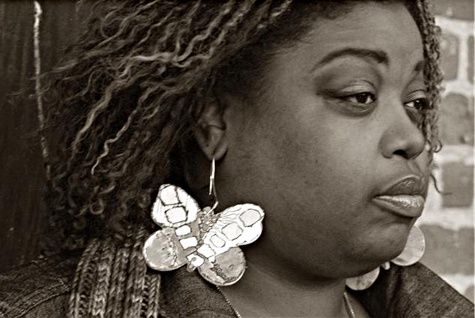
Clever, inventive and undeniably expressive, Cleo Cartel is a vocal, visual and creative artist with passion and conviction. It is an ordinary Sunday, full of sunshine, and Cartel is casually sitting in her salon where she joyfully braids culture and conversation into people’s hair. All around are vivid impressions that she recently designed. There are samples of hand-crafted, one-of-a-kind jewelry, a unique mixture of carefully made, brightly colored, poetically inscribed, wooden and stone earrings, bracelets and necklaces. Paintings with vibrant hues, full of people, scenes and meaningful images from Cartel’s mind enlighten the atmosphere. In a laid-back and relaxed demeanor, her voice warm and welcoming, she begins smiling and freely shares her joy of creating and tells the story of family, community and culture that inspired her confidence to choose art.
“I’ve never been scared to follow my first mind,” she says, “Art is what makes me feel good.” Born and raised in Oakland, Calif., amid an entirety of rich cultures, Cartel recalls, “We were immersed in art as kids.” Growing up part of an African-American, Latino and Asian community, Cartel felt, “There were no barriers to where you could go, what you could see, do and learn.” Her mom would take her around shopping and running errands, Cartel would observe all the different people, notice their different styles and absorb their art and cultural. Cartel specifically remembers one woman who owned her own business and was an innovative dresser. She stood out because of the clothes and culturally unique jewelry she wore. Cartel also thinks back to the Festival at the Lake, a local event where she observed people selling their own arts, goods and crafts. These were meaningful experiences because they served as early examples of “people like me, from where I’m from, being financially stable,” she says. Seeing creative and successful black-owned businesses especially, made her realize as a young girl, “Man, I can do anything. I can be in control.”
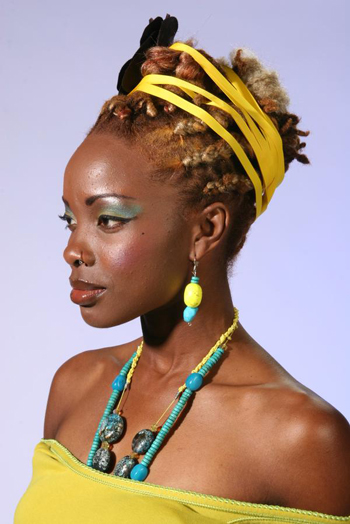
Cartel also had strong models and mentors at home. She credits a lot of her creativity, passion and drive to her father and mother. Her father was a gospel and jazz singer and memories of his jazz records playing when she was young nurtured her first love for art.
“He loved art but, he couldn’t pursue an arts degree; he had no choice as far as education.” She smiles, “He let us do what ever we wanted because he never could, but he always made sure you followed through and finished.” He’d say, “When choosing something extra-curricular,” because academics came first, “you have to think, is that something I can do as a career? And as an artist you need to be a businessman, because you need to feed yourself.” This proved to be a most valuable lesson.
Cartel’s mom, an activist and lawyer, passed on her own share of wisdom. She instilled in Cartel the importance of always having a voice, of being able to express one’s self, and having the ability to state her mind. “I think that’s where I got my poetry side, from my mom,” she reflects. An important contributor in Sacramento’s spoken word and urban poetry setting, Cartel has definitely been using her voice. Always a singer because of her father’s musical influence, she has also been involved with the Sacramento Poetry Slam Team and was an originating collaborator at the fondly remembered Blue Room, a weekly poetry series that was featured at Jazzman’s Art of Pasta many years ago.
It is King Jr. High School, however, where Cartel believes all these positive influences from her community and home first had the opportunity to manifest into the tangible art forms she creates now. It provided the perfect environment that allowed her good business sense, appreciation of art, value in education and the necessity to have a voice come alive. At King she had the experience of taking a wood shop class. Working with wood and using her hands is something she truly relished and soon she began working on her own.
“I was coming in after school and anytime I could,” Cartel says. “I had so many ideas, I never wanted to leave.”
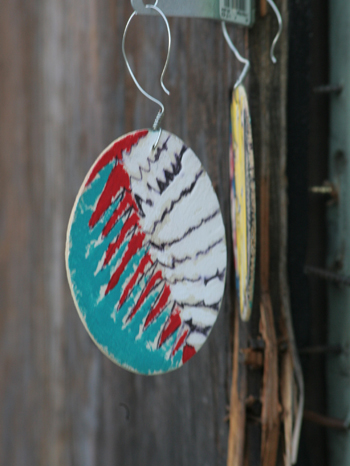
Eventually, Cartel moved from the Bay Area with her family to Sacramento. She felt an immediate sense that something valuable was missing. The abundance of art and the community in which she grew up were no longer present. She thought, “There isn’t anything here that I’m used to so let’s create some.” Throughout finishing at Kennedy High School, Cartel continued to create using the skills first practiced at King. She began making earrings from wood she would shape by hand. She painted and colored the wood transforming each earring into a wearable piece of art. Always full of ideas, she added colorful stones and fabrics to her designs making them truly original in style and form. One very important aspect of Cartel’s pieces includes her own meaningful poetry inscribed on key pieces. Originally, she just designed for herself, but soon people would see her designs, and ask, “Can you do mine like that?” Inspired and encouraged, she continued to follow her passion and has created an entire assortment of accessories, not just jewelry.

Since then, she has worked hard to create freely, share her voice through art and support herself doing what she loves. “I know something about being clear and focused,” she says reflecting on her efforts. “Success that is lasting always takes hard work and perseverance.” Still at it, she admits, “There are times when I want to quit.” Cartel acknowledges that support from her husband helps to keep her on track and encouraged when she gets down. People who invest in her work are also definitely appreciated. She makes an important point saying, “If we can buy stuff that is mass produced and manufactured for stores then we can invest in art.”
She explains, “What is better than getting something made from someone’s own hands? There is nothing better than that!” Cartel is not only an artist, but an avid collector as well.
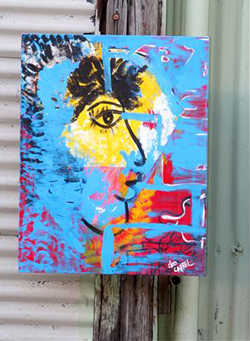
When asked about what she wants her work to convey, she says, “I want my style to represent freedom.” She says she likes to use a lot of vivid colors because, “colors represent a piece of heaven; they’re just something beautiful.” She hopes that in following her passions, maybe her work will continue to motivate that same feeling that she got as a young girl from observing the people in her community. She wants to inspire others to pursue their passion too. “Don’t be afraid to try something new,” she encourages. “You never know what comes with trying something new. You might create something beautiful that the world may need to see.”
More Real Than Reality
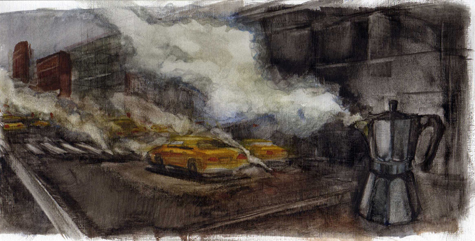
A slice of watermelon, a coffee pot, a steaming train; these things may mean nothing to you, but to the person on your left the same random objects could strike a nerve. In a good way.
When abstract/surreal artist Fernando Duarte had his first Sacramento art showing at The BrickHouse Art Gallery years ago, something extraordinary happened. One Oak Park woman was so touched by one of his paintings on display that she insisted on taking it home that evening. “She just had to take the painting that night,” remembers Duarte of the rare but welcomed occurrence.
“She experienced the same thing I experienced.” Duarte goes on to say, “She later sent me this letter that said, ‘Things happen for a reason.'”
As Duarte carefully pulls the hand-written letter out of a photo album and slowly handed it over he softly said, “That letter to me is more than anything people pay for art. That made me feel like sometimes art really touches people. When that kind of stuff happens, it’s amazing to me.”
Before heading to his current show entitled ABSURDA (an anagram of abstract, surreal and dada) at Inferno Gallery, Duarte graciously took some time out of his Second Saturday afternoon to speak with Submerge in his Midtown studio on topics ranging from “fast food art” to mocking reality.
Were you introduced to art at an early age?
I was born into a family of artists in South America. I am the youngest of seven; four of them are painters and artists. When I was 4 or 5 years old, I used to go to the art school with my brothers. I have no notion of anything else, I don’t know anything about accounting or medicine it was only art in my house. I had no choice; I had to become an artist.
Now that you’re a full-time artist, do you think of it as a regular job the way most people think of their jobs?
Yeah, it’s just like when you’re a monk or something, you cannot be an 8-to-5 monk [laughs]. I try to paint, draw and do prints daily. I go home, I sketch. If I’m at the studio, I sketch. Even if I travel, I sketch.
How did you come to settle in Sacramento after spending so much time in the Bay Area?
When I had kids somebody told me, “Davis is great.” Basically that was the first move years ago, back in ’80-something. I got divorced and moved back to the Bay Area but my kids were here, so they were the main reason to be in this area. Eventually I started working more in Sacramento and knowing more people. And when the economy is so crazy in San Francisco that not even the mayor can pay his own rent, they push you out: From San Francisco to Emeryville and from Emeryville to here. You pay per square foot [for a studio], so I told the guy, “Give me a square foot, I’ll do a 1-foot by 1-foot painting [laughs].” They brought in all the dot-comers and heavy industries. This is what happened everywhere I had been.
Back in ’05 you were quoted saying, “I see a lot of potential in the Midtown area.” Now that it has been a few years, what are your thoughts?
It’s amazing, it’s getting better and better. I think Second Saturday is a little bit cuckoo. It’s becoming what I call “fast food art.” But it’s good; at least it brings people out in the streets. What the people need to learn now is to divide the art, food and music. Sometimes people go into the galleries just like it’s a meat market for the wine and food and that’s it. Art becomes secondary. It still has great potential, though.
Is that why you had the ABSURDA reception before this Second Saturday, to avoid the crowds and the madness?
I did the opening last Friday because tonight I don’t think I will have time for buyers. People came from the Bay Area mostly, along with friends from Davis and friends from here. I like to be with them for one particular day without the whole crowd because I start to lose it. I don’t like openings anyways, but I do it because you have to do it. It becomes like a zoo, you’re like an animal in a cage and they analyze you and check your work. Now what they need to learn is to really understand art. People spend $200 eating sushi but won’t spend $300 on a print that will last forever. It’s an investment for yourself and for your future. Every time I sell something, I invest more than half of it back into art.
So you consider yourself an avid art collector then?
I have over 65 pieces. If I don’t do this stuff, who is going to do it? If you’re a musician, you buy music, you know? If I’m tight on money, I still buy art. It’s important.
I’m curious as to how you would explain your artwork to someone who had never seen it.
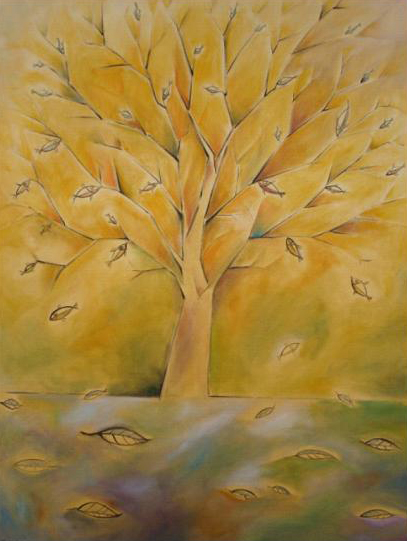
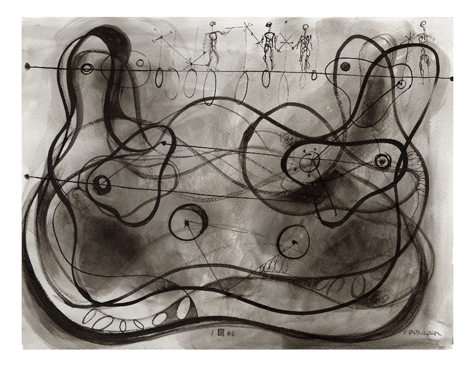
In words it’s hard to say. But I would say that it’s just mocking reality a little bit. I try to make a painting more real than reality sometimes, even if it doesn’t exist. I love the metaphysical or surreal point that you fake reality in a way. Reality can be anything but I like to play with the ambiguousness of reality and non-reality. You have to understand I was born in a town in a country where reality was so crazy. You can walk down the middle of the street and see a horse walking by.
When you’re painting are you thinking about how the piece is going to make people feel when they see it? If so, does that affect your work?
Yeah, sometimes when I’m painting I have this brainstorm in my head about everything, except money, honestly. I am even thinking about the person who is going to frame this work. I am thinking about how is it going to be looked at, how would it look upside down? What are the people going to think, what are they going to say? Painters forget about this, they become so involved with the painting, and that’s good but at the same time you have to think, “How are people going to react to this?” I’m not trying to please everyone and I’m not thinking about if it’s going to look good or bad in their living room, or if it’s going to look bad in their office. I don’t care about that. But I do care about feelings.