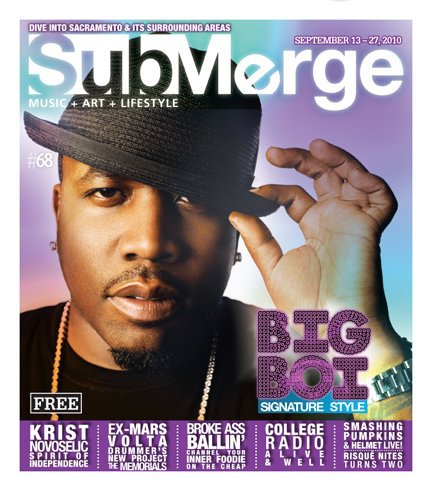
OutKast’s Big Boi dons a fresh persona on solo debut
Words by Vincent Girimonte – Photo by Jonathan Mannion
Nobody would fault Big Boi if he were to sit at home–one of his homes, maybe–put his feet on stacks of platinum 45s and take dog slumbers until his kids tugged on his socks. This is as true today as it was 10 years ago, and maybe a few years before that–it’s been 16 years, even, since OutKast’s Southernplayalisticadillacmuzik, and not much has changed, at least in the sense that there will never be enough Big Boi and André 3000 to go around.
The flipside of that coin may be best depicted by a recent Tweet, simply exclaiming “University of Iowa!!!!!!!!!!!!!” Big Boi (Antwan Patton), touring the United States at a svelte 35 and pushing his fantastic first official solo release, Sir Lucious Left Foot: The Son of Chico Dusty, can’t seem to shake the DNA that propelled him into the spotlight as a youngster.
“I’ve been in the game since I was a teenager, basically grew up in this,” he says. “I believed, but I never imagined it’d take me this far.”
How Big Boi met Dré is worn material: performing arts high school in Atlanta, teenage but not rival MCs signed shortly thereafter, and the rest is the so-called sweet soul, G-funk-meets-Southern-fried history. The aftermath of the Big Boi and André hiatus, which they declared back in 2006, is perhaps the more compelling tale, albeit also worn out if not a bit drawn out at this point. Sir Lucious… began recording in 2007, ultimately to be released on Jive Records, the entity that absorbed OutKast’s longtime label, LaFace (Arista) Records. What ensued was more or less a rehashing of the classic corporate omnipotence versus artistic integrity; Sir Lucious… was tagged as overly artistic, unmarketable–words often de facto euphemisms for excellent, ambitious or at the very least, interesting.
“‘Shutterbug’ had been done for almost three years, but Jive didn’t believe,” he says, speaking on the album’s Scott Storch club-buster single (two words: music video). “They wanted me to follow trends, make another ‘Lollipop.’ I love that song, and no disrespect to [Lil] Wayne, but come on, how are you going to tell me to try to copy someone’s style?”
Most of the recording had been completed on Jive money–Big Boi says it’s essentially the same album minus a few tracks featuring André 3000, who, unlike Big Boi, is still signed with Jive–but the finishing touches were sewn under Def Jam, reconnecting Big Boi with LA Reid, founder of LaFace Records. As for Jive asking Big Boi to “cover” Lil Wayne’s “Lollipop”: “I took that as disrespect.”
“Being at Def Jam and back with LA Reid is like going back home,” he says. “He’s one of the first and few people in this industry that believed in me and Dré from the very beginning.”
Jive probably had their reasons for essentially dropping what many have called the hip-hop album of the year, but it’s really hard to conjure up a decent one, at least to a guy who wasn’t in the room. Put it this way: somebody lost their job.
Sir Lucious is gloriously, triumphantly scatterbrained, dabbling in funk, empowering the ‘80s synth and devolving into dubstep rhythm on a track featuring George Clinton–because of course it would. If there’s a thread to be found, it’s quite simply how well it all comes together.
“You can always tell it’s an OutKast record or Big Boi record because we love taking it in a direction you didn’t expect,” he says. Aquemini, OutKast’s third release on LaFace, solidified the duo’s position as hip-hop’s boundary pushers; “Rosa Parks,” perhaps Aquemini’s lasting single, is bridged with a front-porch, knee-slapping harmonica boogie, at once perplexing and infesting the listener’s conscience.
But OutKast has always used heavy-handed concepts in their recording while avoiding the dreaded “concept album.” Sir Lucious… employs a similar ethos, pulling but never piggybacking, creating something fresh while maintaining a steady bump-bump.
“First of all, the drums have to knock. Funk/soul, it’s all about that boom so that definitely has to be there,” Big Boi says, laying some ground rules for production. The aforementioned “Shutterbug” does well to embody this album’s unapologetic club-ness, using synths and sweet vocals over tight percussion bars. “Tangerine,” featuring T.I. and Khujo from Goodie Mob (“That’s how you represent the A right there, going in strong!”), is in the same vein of classy club–dirty enough for the strobe while lyrically intricate. André 3000, prohibited by Jive from laying down verses for Sir Lucious, does receive a production credit for “You Ain’t No DJ,” a manic, demented cowbell beat featuring fellow ATLien Yelawolf, one of many high-powered collaborations. (Regrettably, a Kate Bush–Big Boi’s favorite artist–cameo fell through for Sir Lucious…; “If you’re reading this then holler at me, Kate!”)
All of the production glitz, like the Jive dispute, has perhaps overshadowed some of Big Boi’s most refined writing. Getting into his old man years, he still manages to keep a fresh, at times hyper-topical, perspective.
“Sir Lucious is me doing my grown man,” he says of Sir Lucious being one of several Big Boi rap personas. Indeed, the album speaks of years on the scene–ups, downs and “busters.” Politics too, such as in “Daddy Fat Sax,” the second track on Sir Lucious…: “And who you votin’ for, Republican or Democratic? Don’t say it doesn’t matter ‘cause that’s how they stole the last one, assassin’s bullet might be waitin’ for Obama, do you think they’ll have a brother before Billy’s baby mama?”
“It’s a little different because when it’s both me and Dré, the work load is split up. But when it’s just me, all the writing is on me, hooks and verses,” says Big Boi. The former half of Speakerboxxx/The Love Below, Outkast’s 2004 release, is essentially a Big Boi solo album, but lacks the introspection of Sir Lucious… And it may help, of course, that there’s no competing with André 3000’s dazzling homage to ‘60s teeny boppers.
As part of a three-record deal with Def Jam, the follow up to Sir Lucious…, titled Daddy Fat Sax: Soul Funk Crusader (after another one of Big Boi’s pseudonyms), is allegedly midway through the recording process. One thing is for sure: University of Iowa hasn’t seen the last of Big Boi.
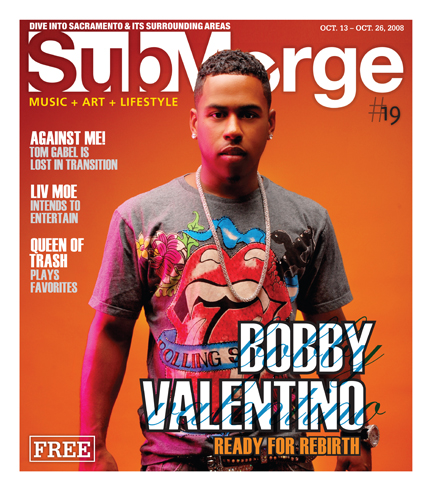
Emerging from Under the Umbrella of Moguls to Fulfill His Own Blu Kolla Dreams
R&B artist Bobby Valentino has set out to make a name for himself as a musical mogul and has no intention to “Slow Down.” Valentino holla’ed at Submerge while touring through the American “backwoods” of South Carolina where there’s nothing to see but “cows and a lot of grass.”
Valentino has certain name recognition throughout the radio and R&B world. He’s that smooth dude who puts out those catchy hip-hop infused love songs, right? Well yeah, but the dude’s done more than just set the mood for baby makin’ or giving a shout out to your “big baby boi boo” on a Sunday night slow jam radio show.
Actually, this Atlanta-based singer started out with a group named Mista when he was a teenager in the late ’90s. The group had a hit single called “Blackberry Molasses” (featured in the T.I. movie ATL). But the success seemed to subside after that single.
“We were a one-hit wonder. That album was very big,” Valentino says.
Returning to high school meant that Valentino went from “being a superstar to being normal again.” Kids would sing lyrics from “Blackberry Molasses” when he walked down the halls of school, he says. The difficult times for the industry didn’t defer Valentino and he wanted to pursue music after high school, but his parents insisted he get the grades and graduate college.
“Being on top one day and on the bottom the next, they realized how unstable the music industry really was,” he says.
Through his college years, Valentino lived a double life. On top of the normal grueling grind of school, he didn’t give up on his musical career and would pull long days where he’d be in the studio at night and wake up early for class the next morning, he says. Although it was hard for Valentino to stay focused at Clark Atlanta University with a 20 to one female to male ratio, Valentino graduated with a mass communications degree in radio and television.
“More than anything from college, I learned how to multitask, how to be responsible and put the most important things first, and everything else, you know it’ll come later,” Bobby Valentino says.
After graduation, Valentino hit the ground running. With three demos post grad, he got signed as a solo artist by longtime connection Ludacris on his Def Jam imprint, Disturbing tha Peace Records. “When I was in the group Mista, Luda was on the radio. So there were a lot of times when he used to interview me on the radio. It’s just funny how things turn and that’s why you learn not to burn bridges,” he says. “He was interviewing me.”
Somewhere along the way, Bobby Wilson became Bobby Valentino from his affection for ladies and vice versa. The R&B love songs probably didn’t hurt either.
“I’ve always been smooth with the ladies, you know, and somebody just came up with the name and started calling me Valentino. I added it on to my real birth name, Bobby, put it together and BAM! You got Bobby Valentino,” he explains.
Under Def Jam and Disturbing tha Peace, Valentino had U.S. Billboard Hot 100 singles like debut “Slow Down,” “Anonymous” and “Tell Me.” After sophomore album Special Occasion reached it’s peak of record sales, the vocal Valentino was released from Def Jam in February 2008. He then met with his team and decided the best thing to do was step out on his own. Valentino asked to leave DTP and officially split in April 2008.
“A lot of people thought I was done. People called me stupid for leaving DTP. People said, ‘It’s over with Bobby Valentino. It’s a wrap.'”
But he wanted to get to the next level as an artist, Bobby Valentino says. “You can’t always be up under the ‘umbrella’ all of the time. You got to step out on faith. If I want to be like Luda who’s a mogul in the game, I can’t be up under Luda.” The only way to do that on his own was to start Blu Kolla Dreams.
Again feeling the inconsistency of the music industry, from February to June of this year was a “real tough time” in Valentino’s life.
“Like I say: A lot of folks, when you’re on top, folks want to hop on the bandwagon, ‘Woo, you’re the best, you’re the greatest.’ But when you’re down, folks they don’t want to talk to you, they act like they don’t even know who you are.”
Valentino used that message to stay focused and started recording his next album. He titled the album Rebirth to “reflect everything that’s happened since he was ‘dropped,’ he’s turned into a new person and he’s humbled.”
“It was tough to actually get things done even though I had a name,” Valentino says.
Valentino kept his head up, kept faith and kept working, insisting, “God works in mysterious ways.” He must have been right because he’s featured on rap royalty Lil’ Wayne’s “Mrs. Officer” joint from Tha Carter III—a song that’s been spreading like California wildfires. Fans are getting a taste of the new album that’s due to drop Jan. 27, 2009 with first release “Beep” featuring Young Joc.
“I couldn’t ask for a better situation or a better set-up,” Bobby Valentino says.
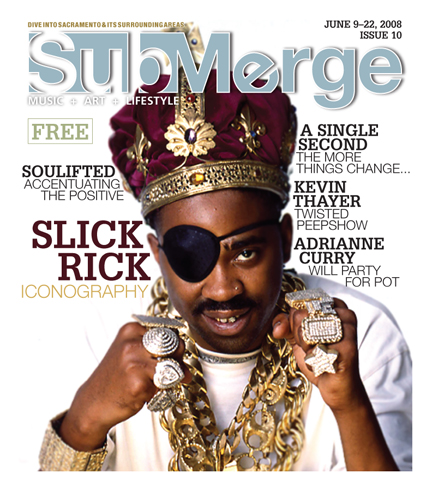
Bona Fide Icon
For more than 20 years Slick Rick has rightfully donned the title The Ruler. He is the original rap Liberace, who epitomized flash and style with a gaudy elegance; the storyteller who influenced an entire culture with his elaborate and witty narratives, and has maintained his exalted legendary status in the face of defamation and turmoil. From his timeless party rockers “La Di Da Di” and “The Show” to his undeniably classic albums The Great Adventures of Slick Rick and The Art of Storytelling, down to the countless songs he has blessed alongside artists from Outkast to Jay-Z, The Ruler’s reign in hip-hop is forever.
As illustrious as his music career has been, it has been severely inhibited by one mistake and a seemingly endless nightmarish bout with U.S. Immigration and Naturalization Services. The British-born MC has fought for over a decade to clear his name, and on May 23 received a full pardon from New York Governor David Paterson, potentially putting an end to the threats of deportation and injustice he has endured. It’s been a long time coming, but the relief from the constant stress will allow hip-hop’s beloved raconteur to focus on what he does best—create and perform.
Headlining the first annual Flashback Friday Fest on June 27 at the Sacramento Memorial Auditorium, alongside Naughty By Nature and H-Town, The Ruler will prove once again why he is a bona fide icon. Many have taken a page from his book, but there will only be one Slick Rick.
Things really got started for you with “The Show” and “La Di Da Di.” Can you talk about the evolution of those songs, and how they evolved from club routines to the classic records they are today?
Doug E Fresh was the Human Beat Box, which means we didn’t need to hire anybody. He would just do his beat box, and I’d do a story on top of it, and there it was. You could go to any club and as long as they had two microphones we could make a party. Doug was already signed to a record label, and I wasn’t, so Doug decided that he wanted to make a record. He stepped to the people that he had to, and they agreed to let him make the record. You know, you tell Doug E what record to mimic, like I’d say mimic “Impeach the President,” which is what “La Di Da Di” was based on, and he would do it with his mouth. So he mimicked the record and I did the rap that I had already wrote and knew by heart, and it took off right away.
And from there you went on to sign with Def Jam.
Well, the thing with Doug E Fresh, the paper wasn’t great. I understood it was his deal and his money, but when it came to splitting the dough”¦OK, let’s say we got $6,000 between the two of us, and plus he got two DJs, but you only get $600 of that. I said to myself, “I feel like I have the potential to get more than that.” I understand this is your ship, I figured I shouldn’t ride on it too hard, but I was like I should at least get $2,000 of the $6,000, or something like that. So I figured I should just step off, and go do my own thing. No hard feelings. So then Def Jam came into the picture, and, you know, I went with Def Jam. I was probably 21.
On your first album The Great Adventures of Slick Rick I know there was controversy around “Treat Her Like a Prostitute” when it first dropped. Did you anticipate that or was it a shock to you when it came about?
Well at that age, you’re not trying to ruffle any feathers, you’re just trying to have fun. It’s the adults that come in and try to play the role. As a child you’re just writing raps to entertain your age group and your audience. “Treat Her Like a Prostitute” was really just a goof on relationships. You know coming in and finding the mailman’s pants—that stuff is humorous; it’s not for critics to come in and dissect and all this other junk. Regardless, at that time, that’s how a younger adolescent was looking at life. I wasn’t saying treat women like a prostitute in the harsh sense of the word; it was really to say when you’re with your chick make sure you’re sexually satisfied before you’re spoiling her because”¦I don’t know how to break it down, but that’s what I was thinking. As you grow up and get older, you realize those words were kind of harsh. You don’t want to hurt nobody’s feelings; you got a mother and a sister too. But everyone forgets the second line, “Don’t treat no girl well until you’re sure of the scoop.” Most people run with the first line; oh, he’s just using women and throwing them in the garbage: “I don’t want him as no son-in-law.” But the second line, “Don’t treat no girl well until you’re sure of the scoop“; scoop means information right? What’s this information on this girl you’re with? Is she out to use you? Is she genuine? What’s the record? Is she just after your dough, or is she going to talk to your friends later? Those were just cute stories to prove my point.
I want to talk about Behind Bars and The Ruler’s Back. I’m curious how you view those albums. I feel like cats don’t talk about them, and considering the situation at hand—dealing with an attempted murder conviction—they were pretty dope.
Those albums were rushed. There was a lot of pressure. I’m on this label where I’m not getting no money, doing all this work and not getting no dough. Def Jam at that time, under those dudes, they were very crooked. When I was with Doug, I would at least walk away with something. Now when I get with Def Jam, and I’m forced to make a whole album”¦and the Doug E Fresh record went Gold and I at least eventually got $40,000. But when it came to Def Jam, my record went Platinum and I didn’t get shit! It became hard to”¦it starts to frustrate you. You start feeling like you’re a slave in bondage and shit. You got to stay current, and you’re feeling pressure from other styles. So now it’s not fun anymore, and it becomes a job. Then not to mention the case I was going through. Those two albums, I wasn’t in a relaxed element. The raps were too fast, and plus, half of it was made without me being there. There were a lot of bad things. I’d say those two albums were a learning experience when you look back as an adult—pressure from other artists or trying to compete with other styles instead of sticking with your own. And then like I said about the record label, how can you make a platinum album, a classic, and you have a lawyer, an accountant and all these things in place so nobody can treat you like you’re stupid, and then they still rob you! They took everything, and left me to pay the taxes on the money they took. Isn’t that crazy? I mean imagine if you made a platinum album back then, and made it for peanuts, you just made somebody like $15 million. If you made somebody $15 million, how do you end up getting nothing and the next thing you know you’re un-recouped $2 million, and God knows how much they said I owed the IRS. So that with the case, so you know. Crooks will be crooks, next thing they’re considered prestigious, but that’s life.
To end things, can you discuss everything that has been going on recently with the pardon from Governor Paterson. I know you can’t go too deep into it, but can you give people a glimpse into the process leading up to this point because I know it didn’t come out of nowhere and that you have been fighting for years.
Well, my whole case started in 1990. The INS situation has been going since like ’93, and has just been dragging on since then. So it’s been over 15 years over a small technicality. The governor felt my pain I guess. A long time ago he had vouched for me when I was fighting INS almost 10 years ago, and I had won my case back then too. Then with Homeland Security and this technicality, it resurfaced again, and it was becoming monotonous. You’re supposed to judge someone on their character not technicalities. We made laws to protect good people, and not let them sit there and be abused. I guess that’s why Mr. Paterson came in and said, “I’ll give you a pardon to wipe away all this stuff.” I did more time fighting INS than dealing with my actual crime. Can you imagine that? I’ve sat in jails more years fighting INS than I did for my actual crime. That shows you right there. That doesn’t make any sense. If you commit a crime, you go to jail and do your time. You shouldn’t serve more time in jail to decide if you are worthy to stay in the country or not. That is not a crime that is punishable for jail. I’m talking years, two here, another two there. It took a human to come in with some compassion and good common sense to see that, and that’s what Mr. Paterson did.