His Life’s Work
There is little escape from the sun at 3rd and Adeline in Oakland. The industrial district is flooded with bodies sweating through T-shirts and bucket hats designed with variations of the three-eyed smiley face symbol of local rap legends Hieroglyphics. The crew is celebrating its fourth annual Hiero Day and among the invitees to perform is Sacramento’s Dibia$e. It seems as though a combination of the heat and the liberal weed smoking reduces crowd participation to a steady head nod that ripples to the signature bounce of Dibia$e’s production.
Although other producers will grace the stage with the same gear at Hiero Day, none manipulate the SP-404 like Dibia$e. His production is glitchy with hints of chiptune and 8-bit, at other times soulful samples finessed with a slice that’s both Dilla-esque and entirely a style all his own.
On this afternoon in Oakland the hundreds gathered don’t move much, but they also don’t leave. Break dancers accompany Dibia$e on stage, stepping to his music and interpreting the rhythms with their moves. It’s almost as though he’s got the remote control over their movement. We are high and in awe. He’s a veteran as much as headliners like Aceyalone and Tha Alkaholiks, but he’s also remained a low-key legend that’s been present at every significant scene in Los Angeles and makes no qualms about his quiet life in Sacramento.
Days prior to Hiero Day, I met Dibia$e at Sol Collective south of Broadway in Sacramento. He was there to record a session with a local artist, but the person had bailed last minute. As we were sitting in a side room tracking the timeline of his career, he said he liked Sol Collective because it reminds him of Good Life Café in Leimert Park, Los Angeles. In the ‘90s, Good Life, a raw food restaurant by day and the rawest open mic by night, was the event for independent rappers in Leimert Park. At Good Life, if you didn’t meet their standards, attendees shouted “pass the mic,” forcing you out of contention until next week. It was in competition at Good Life, later called Project Blowed, that he first earned his stripes as a rapper and later as a producer in beat battles. Dibia$e said once he got behind the sampler to make beats, it became his MO because his friends were always in need of them, and, from winning the battles, he got his first experience paying rent off rap music.
“It was stressful because I had to win like a prizefighter,” he said. “I was the Kimbo Slice on beats.”
From the early 2000s until 2007, Dibia$e was notorious in the California beat battle circuit. His competition at Project Blowed was against burgeoning artists like Nosaj Thing and TOKiMONSTA that prepared him for greater West Coast scene. When he wasn’t competing, he met with L.A. producers like Flying Lotus, Ras G, Kutmah and Exile at a beat workshop called Sketchbook at The Room in Hollywood—a precursor to the now-legendary Low End Theory at the Airliner. In those days, he’d take Greyhound buses to the Bay Area and drive to San Diego for battles. Venues like The Knitting Factory L.A. hosted Beat Society and the Red Bull Big Tune Beat Battles. He would even travel to the Inland Empire for battles in Riverside.
“Even when I’d go to watch, people would come up to me nervous to find out if I was entering,” he said.
He was making do from battling, but concurrently, the admiration for beat music was no longer exclusive to the small producer community. Sketchbook was conceived as a workshop to sit around a boombox and trade beat tapes like baseball cards. Low End Theory was a social event where people went to be scene and photographed; and where musicians like Erykah Badu, Thom Yorke, and Prince came to DJ secret sets. As Low End Theory took off and an arena for beatmakers outside the battle circuit became a reality, his associates from Sketchbook thought he should think big picture.
“A lot of cats used to tell me to leave the battles alone and start doing the shows,” he said. “But I felt like the battling was my market. It got me traveling. I rode that wave for a little bit. I didn’t win every single one. I’d drive far and lose battles. Lose in the finals after going four extra rounds and just miss it. Out $500 after getting that close. That’s rent money.”
In 2010 he was still competing in battles, winning the Los Angeles Big Tune event but falling short in the finals in Chicago, but that big picture was also coming into focus. He released his first solo album, Machines Hate Me, on L.A.-label Alpha Pup, run by Low End Theory mastermind Daddy Kev. That year was also when Dibia$e uprooted from L.A. to close the distance on a relationship with a woman from Sacramento. The move paid dividends. She’s now his booking agent, business partner with their label 10 Thirty Records, wife and mother of his newborn daughter.
While Sacramento did not offer the scene support he enjoyed in L.A., he expressed no regrets in his current status. His fatherhood role, which includes a stepson, structures his time spent making music. As a young producer, he would hole up in a friend’s studio and work in a weekend flurry. Now his lab time in a studio built in the backyard is reduced to a few hours during his daughter’s afternoon nap, the baby monitor at his side by the sampler.
“I can’t squander the day away,” he said. “I’ll play with her and stimulate her brain for a little bit. Sometimes she’ll sit in the lab with me, and I’ll play her some music. Put her to sleep. She sleeps for two hours. I knock some beats out a little bit. I’ll hear her on the monitor. She’s waking up and I’ll feed her again.”
To his stepson and the 6th grade hoop dreamers of California Youth Basketball League in Natomas, he’s Coach Dibia$e. He’s been a youth coach and participated in community volunteer work since his L.A. days and while he only played a year in high school, basketball was a passion growing up in Watts. He said he would play “sunup to sundown” on the public courts growing up. As Coach Dibia$e, his team struggled but competed admirably enough in the first season to maintain his position on the bench.
“I wasn’t going to do it again, but most of the kids requested me to come back,” he said. “They saw the improvement. The last four games we were close to winning all of them [let’s out a big sigh] … but didn’t. That’s that stress part I didn’t miss. But seeing those kids having fun makes it rewarding.”
He admits Sacramento is conducive to creative productivity in its lack of distractions. It shows in his output of three albums (Sound Palace, Looney Goons and Schematiks) in four years as well as several smaller Bandcamp releases. Here he’s lesser known, but his connections to Low End Theory continue to yield opportunities like shows in Australia and Japan. “The time flies,” he said. “It’s only felt like a few months, but it’s going on five years.”
On the horizon is his set at TBD Fest on Friday, Sept. 18, 2015, and more projects with greater ambition, still thinking big picture.
“I’m planning to work with more rappers this year,” he said of his plans for the future, one of which includes aspirations for a project with Detroit rapper and Stones Throw artist Guilty Simpson. Locally he’s got work completed with Chuuwee, Rufio, Wise Child and Tel Cairo.
Still, when he graces that stage, the heart of his life’s work is at his fingertips. The SP-404 is designed to be portable, weighing only 2 pounds, 14 ounces, and he carries his in a shoebox decorated with stickers of the labels who have released his records. His appreciation for the life he leads is in those details on that shoebox. During his Hiero Day set he remixes Souls of Mischief, while sporting a red T-shirt that reads “‘93 Til.” Only days prior he expressed his decades of admiration for the Hiero crew dating back to his drawing days, and that being on that stage was a bucket list item.
“Going back to my junior high days I used to draw cartoon characters of like Hieroglyphics and Souls of Mischief, all them cats,” he said. “That’s the homies and shit now … if they would have told me I would be kicking it with some of these cats in ‘93, I’d have been like yeah right.”
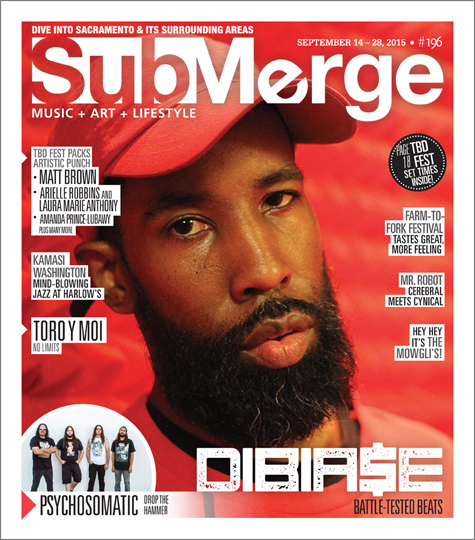
Dibia$e is a must-see artist gracing the stage at this year’s TBD Fest, which will be held in the Bridge District in West Sacramento. For more tickets and lineup info, go to Tbdfest.com. Dibia$e will perform on the opening day of the three-day festival, Sept. 18, 2015.
Grimey: Death Grips
Tuesday June 7, 2011
Townhouse Lounge, Sacramento, California
On Tuesday, June 7, DJ Whores booked dubstep DJs from distant lands like New York City and France. But when the downstairs cleared for an upstairs Death Grips set, for once Sacramento showed some goddamned pride.
Death Grips bears the rumblings of a strange new era for hip-hop–if the genre is even appropriate. Between Death Grips and the teenage riot of Los Angeles’ Odd Future Wolf Gang Kill Them All (OFWGKTA) crew, hip-hop seems to be embracing a DIY and punk mentality that hasn’t been prevalent in the genre since Fab Five Freddie was kicking it with Debbie Harry in the Lower East Side. Devoid of heavy-handed derivatives, Death Grips respectfully appeals to Sacramento and the indie world-at-large’s iTunes playlist without losing an ounce of visceral gnarl. The Ex-Military mixtape is the group’s call to arms through heavy bass warbles, juke break beats and vintage psych-samples from Link Wray and The Castaways. Critics jumped the gun when they hailed New York-based MC Waka Flocka Flame as the first metal god of rap. No one could have predicted Death Grips’ Stefan Burnett, a Kimbo Slice-looking dude from Oak Park, was lurking in the trenches with a deeper-seated metal intent with lyrics, “Dismiss this life/Worship death/Cold blood night of serpent’s breath/Exhaled like spells from the endlessness/In the bottomless wells of emptiness,” over the thunder of Zach Hill’s drums.
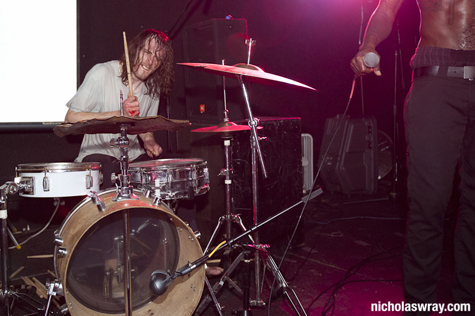
The Sunday prior to the Grimey set, Death Grips played a secret show at Press Club, a set that made its way to YouTube in record time. The Grimey announcement was as last-minute as it gets, with most of the curious anticipating a Davis house show as the unveiling of the mysterious Zach Hill project. The cloak was off entirely, as was frontman Stefan Burnett’s shirt as he stalked the stage, like any moment he might snap and start cracking skulls. No one was injured during the set, nor did a full-on mosh pit ever break out. The surprise was the rush to be on top of Death Grips without taking the stage–an instant embrace virtually unheard of for a local act. Burnett’s coined grunt of “Yuh” was mimicked on cue and other times in brief quiet moments, affirming his bark as the group’s battle cry. Sacramento is excited for its locally raised rap beast–enough to shed the cool, shed the cynicism, shed the apathy and get buck for 40 minutes in ToHo. It caught me off guard so much that I’m reluctant to mention it for fear it might backfire and curse the unabashed enthusiasm.

Whether we sustain our buzz in the home front or not, Death Grips is in takeover mode with or without us. This week (June 15), the group performs L.A.’s Low End Theory, a weekly melding of art and music held every Wednesday at The Airliner, a stage that made the careers of DJ Gaslamp Killer and producer/musician Flying Lotus. In the end, if Death Grips maintains an indifference to hype present within the music, it will always have a home in Sacramento. The nihilistic candor on tracks like “I Want It I Need It (Death Heated)” and “Spread Eagle Across the Block” boasts a lifestyle prevalent in Midtown yet to be captured sonically. I, for one, hope this is the beginning of many voice-shot nights shouting “Yuh” to come.
Daedelus rides the always tumultuous wave of electronic music
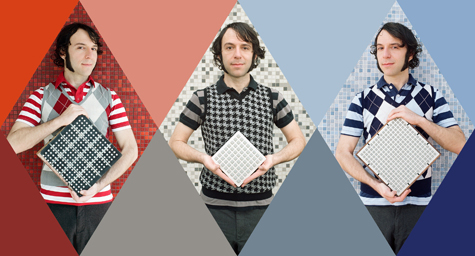
The dandy garb of Alfred Darlington suggests he’s a man lost in the past. His digital instrument, the Monome is a brilliant future trapped in the neon glow of a push-button box. Far from an eye-grabbing gimmick, Darlington is expressing himself beyond the DJ booth of electronic music, which in his opinion will combat banality and the demise of electronic genres of the past.
Darlington is resistant to the label of elder statesmen, but with over a decade of experience in electronic music, he’s seen enough sub-genres come and go to speak eloquently on what it takes to sustain. To him, it’s a presence of personality, which is a glaring separation between the Los Angeles beat music he helped cultivate at Low End Theory and with dub-step. “When [dub-step is] good the bass is really pushing air on your organs, and yet it isn’t about the person expressing it,” he said. “There’s very little energy on stage. It’s usually a very controlled amount of chaos that I think will limit that scene, much like what happened to drum ‘n’ bass. There’s amazing parts of the sound, but personality is hard to come by. Whereas this beat thing, people are really willing to, for lack of a better term, let their freak flag fly–that’s a terrible phrase. But there’s something to it.”
On stage Darlington is Daedelus. He began DJing for Dublab.com in 1999 and by the early Aughts was releasing albums on Plug Research, Mush and Ninja Tune. Much like the mythological Greek character Daedalus, Arlington is a tinkerer and lover of invention. His experimental music caught the attention of Brian Crabtree and Peter Siegerstrong, two developers of the Monome box, which is a sampler imbued with the freedom of improvisation. Through the use of the Monome, Darlington is fossilizing the notion that live electronic music must be static and built on pre-existing recordings. His weapon of choice was our first topic, as I attempted to understand its power.
How did you get connected with Crabtree and Siegerstrong to obtain a prototype of the Monome?
It was really quite accidental; a lot of my career has been a series of happy happenstance accidents. They invited me to play a gig a long time ago when they were undergrads in San Diego. They showed me the prototype, and it fulfilled all my wildest dreams for sample manipulation. Then there was a lot of begging, pleading, bribing and coercing until I got the device in my possession.
It’s funny to think we live in such a wonderful age of invention for young music makers. All the buttons we want to press are out there on some device you can obtain. When I was coming up in the early Aughts this wasn’t possible. Either you got an MPC and did all the weird things like use zip discs to load samples, enduring painful breaks while you waited for the sample to load–five minutes of waiting around. Or you would use the computer and get computer face with the blue screen projected on your eyes and you’d be dead to the world in your bedroom.
Is it a device that made sense immediately? Or did it take hours of fiddling to even get a basic feel for the Monome? Because it looks like a complex piece of machinery, given all the buttons.
There was some stuff to the guts that were complicated initially. What’s cool about it is it’s a very open platform. We’ve added a lot of functionality and play validity, I guess. But the device itself never needed to change because it’s button matrix. The initial idea of sample manipulation was there and it gets more refined as people engage it as an instrument.
It’s funny because at first my imagination tricked me into thinking I could manipulate samples on this, but I’d still need a keyboard to play them. That’s not the case. The potential energy of the instrument was great enough that it’s continued to move forward.
Do you still get a lot of people who are moths to your button machine? Or have they gotten used to its presence and are dancing again?
In 2010 there’s been a sea change. A general shift has occurred and people are used to instruments on stage again. It’s OK. There’s still some of the staring types, but not as many. I think people are kind of getting the idea that electronic music can be live, and it isn’t a matter of life and death that they just stand there.
Have you been following the Anti-Rave Act that is currently passing through legislature?
Yeah, I played at EDC [Electric Daisy Carnival], which is one of the fermentors for the recent spat of anti-rave talk. For a show that was markedly safe with over 200,000 people over two days, which for a non-festival is the single biggest event in America in the past couple years, there was a death of an underage kid there. That began this moral wrestling because it was partially the city of Los Angeles’ fault. There was a lot of controversy, since they were supposed to be carding.
It’s funny because at any given moment people are living their lives outside of a controlled situation, such as a rave or event. I’m sure there are, unfortunately, multiple deaths of teenagers from drinking or drugs on any given night, but they are not all concentrated in one space. With EDC especially, there were paramedics on hand a lot of people being helped and saved, but it’s easy to point a finger.
It’s always been this way. As much as I love the attention given to the scene and the opportunity for young artists to play in front of large audiences, every time the electronic music scene goes underground it tends to bear more fruit. I guess that’s a small piece of solace I’m trying to derive from this negative attention.
How did you feel when you read the phrase “pre-recorded music” as the musical format that this act intends to criminalize? I’m still baffled as to how this definition could be monitored and policed.
At sporting events I’m sure they’re playing pre-recorded music for sleazy cheerleaders. I’m sure people are dying on the field and off, and yet I don’t see them banning those games.
I’ve read that you’ve become an elder in the L.A. music scene, someone who’s even sought out for advice. That has to be a strange transition considering in your younger days. You were treated somewhat like an outsider.
It’s one of those things where when I was growing up I was really enamored for a lot of the new sounds, and for the drum ‘n’ bass scene in general, but it wasn’t for me in the end. It’s a gift that I wasn’t allowed in, because there’s not a lot of those people around right now. Sounds change and being forced to be on my own was beneficial at that time.
By propagating a sound forward there are a lot of likeminded people that have cropped up. I don’t take any responsibility for their music, but I do feel wonderfully inclined toward people like Flying Lotus and Baths. These are people whose weirdo energies can all be combined to make a sort of Power Ranger of Doom.
I don’t know about the elder statesmen thing. I don’t think a lot of what I’ve gone through is represented by what we’re currently in. I had the wonderful benefit of being around when Myspace was influential for instance. I got featured on Myspace and it seemed to make all the difference in the world. In a single day I had 150,000 listens on my tracks. These huge waves are just not there anymore. Facebook doesn’t feature musicians in the same way. In a lot of ways those experiences can’t be propagated. I think the idea of not being bitter is the biggest lesson I’ve learned.
Can we expect dandy garb during your Sacramento performance?
I might have a bit of a tan from a large Southeast Asia tour, so I won’t look appropriately Victorian dandy as far as paleness goes. There are two aspects of it. I like the Victorian dandies and presenting it out of sorts in California. Also by being dressed up on stage, it frees people from their banality, hopefully. They don’t have to worry about someone wearing stupid Kanye West slatted shades and bouncing up and down ridiculously. It hopefully allows people to get into a different headspace.
Your next record on Ninja Tune will be called Bespoke. How far along are you?
It’s done. It’s just artwork that is getting completed. I’m getting ready to begin a big 2011 push for the record.
I’m picking up on a correlation between your retro-fitted clothes and customizing one’s style playing a role in the concept of the record.
It’s definitely bringing it all home. All of these concepts I’ve been propagating for a while now, it’s time to bring them all back. I wanted to do a record that was about combinations. I have a lot of guest vocalists. In a very altruistic way I want the record to be about creating your own reality, customizing your environment to your needs, rather than letting it be banal. I think banality is our worst enemy. Boredom is our worst enemy–the kind of thing that causes people to become punks and other unfortunate subcultures. There’s nothing wrong with being a punk; trust me, I spent my time, but I’m not a big fan of nihilism. We create our own structures and for me it begins with bespoke clothing. People used to hand-make everything for instance, now nothing is made by one person, except for music and the arts. Why not embrace that, push it forward, as opposed to having it be a secret?
See Daedelus and his fascinating Monome as part of the Sacramento Electronic Music Festival on Thursday Jan. 27, 2011 at Townhouse.
The Grouch Set to Leave Paradise for West Coast Tour
Over the past decade, Oakland, Calif. native The Grouch has proven to be the embodiment of the independent musician. Alongside his crew the Living Legends, Grouch built an underground empire from the ground up, building a reputation by pounding the pavement with dope product, selling his music to fans hand-to-hand. He always made himself visible and bridged the often-murky area between supplier and consumer. Hustle aside, it was his music that resonated with fans. Instead of a fast food filling, Grouch based his lyrics in reality—honest and candid, intelligent and insightful. Through 10 solo albums, five group collaborations and more than a handful of Living Legends projects, Grouch has never led fans astray. An inspiration for anyone looking to make it happen by doing it their way, his career has shown that hard work and dedication go a long way.
In support of How the Grouch Stole Christmas, his aptly titled 11-city West Coast tour, the man whose fuzzy 4-track songs I once put on a Maxell mixtape spoke from his newly settled island paradise on topics ranging from modern-day subsistence living to Dr. Seuss—and of course, music.
I understand you’re out in Hawaii at the moment. Is that for work or pleasure?
Nah, I’m living out here doing the family life, growing vegetables and chillin’. Working of course, every day, all day, grinding over the Internet and over the telephone. It’s not a permanent thing, I don’t think, but we like it out here a lot so we wanted to give it a trial period. We were supposed to stay six months, but at the end of the six months we were like, we got to go for another six months. We’re taking it as it comes.
You said growing vegetables, are you really on some subsistence level shit out there or what?
Nah, we’re just living. We’re staying at a house that get its water from the rain and has solar power, and we have a good vegetable garden going. We’re just doing natural family life: kicking it, and jumping in the ocean and drinking coconuts.
That sounds amazing.
Yeah, it’s been a real good experience. It’s a good change, and we did it at a good time. It’s still the United States, but it feels a little bit detached out here. There is less advertising, less TVs around.
Your latest tour, How the Grouch Stole Christmas, is going to take you away from your paradise for a couple days. Off the top, it was nice to see fellow Living Legend Eligh’s name right there with yours.
Yeah, it worked out good because me and Eligh have an album coming out March or April of next year. People always ask when the next G&E album is coming out. Me and Eligh are good friends so when we do shows, it’s always fun, and people love to see the combination of us two. We’re both on the same page, as far as us both doing sober shows and all that, and we’re both at a time in our careers where we are taking everything very seriously and trying to step our games up.
I was going to say, it’s been a long time since I’ve heard mention of G&E as a group. What can you say about the album so far?
We’ve got a strong single with Gift of Gab, so you’ll hear that. But as far as everyone else, we have Mistah Fab on there, Sage Francis and Slug on a couple different songs. We’ve got a song produced by Flying Lotus, a joint produced by Amp Live of Zion I. It’s going to be a good release. I’m really proud of the music so far.
The Bayliens are also scheduled to play, but there is one name that I didn’t recognize: Paul Dateh.
Yeah, he’s dope. He’s from L.A. and played violin on my last album; he’s also a vocalist too. If you Google him, there are some pretty amazing videos of his violin skills, and how he combines them with hip-hop. He’s just coming up and making a name for himself. When you watch the set though, you’re like damn that was dope. Every time I have him open up for me, he gets a really good response. The Bayliens, they’ve been working real hard and I like the way they do their stuff, so it all works together.
Alright, last one to wrap it all up. Looking at Dr. Seuss as a writer, in terms of his story telling, his structure, his rhymes, how would you rate him in MC terms?
Dr. Seuss is a dope poet, and would make a dope MC. I think if he wanted to rap, he could probably have some tight raps. I don’t know how much of a coincidence it is that I’m using one of his themes, but I’ve had a lot of people tell me that my rhyme style reminds them of Dr. Seuss. I don’t know if that’s a diss or not [laughs]. It wasn’t like, “You have the most Simple Simon rhymes in rap,” but I have been told that they can see a resemblance, and I take that as a compliment. I like the dude’s style. He’s not the most complex, but he’s successful for a reason. The way he put his books out there, and the content in them with the pictures and the whole package, I really respect the dude.
Simple or not, at the end of the day he’s saying something of substance, which can always be said of your music.
Exactly.