Artist Chico MacMurtrie Brings Inflatable Robot Technology to Davis
Rambling somewhere around the axis of where sculpture, engineering, robotics and puppetry collide lays the malleable artworks of Brooklyn-based visionary Chico MacMurtrie. For the past 20 years, MacMurtrie’s anthropomorphic mechanisms have taken on many forms, stimulating commentary on the meaning of movement, of life and of the ways in which viewers are allowed to interact with art, while at the same time examining how art interacts with the world at large.
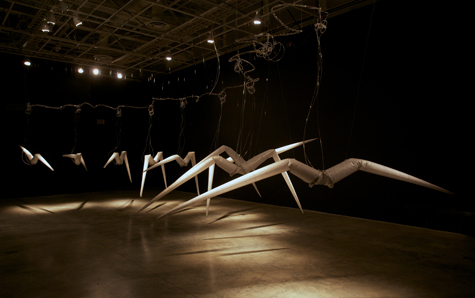
For reference, take MacMurtrie’s large-scale installation, Birds–showing at the Richard L. Nelson Gallery at the UC Davis campus through Dec. 11, 2011Birds brings together a fleet of elegant bird-like creations, hung in a procession above snaking floor lights meant to represent a river. The installation utilizes some complicated mechanics, computers, a revolutionary inflatable architecture technology created by MacMurtrie himself, and very subtle robotics to produce an interactive demonstration. The inflatable technology, made of a light fabric, essentially allows the avian forms, though loaded with mechanical actuators and machines for movement, to approximate seamless, non-rigid organisms. The “bird” sculptures react to environmental sensors–triggered by the people in the room–by coming to life from a deflated form, to begin beating their wing-like appendages as if flying. Portraying qualities consistent with actual living systems, should a viewer get too close to the sculptures, or spend too much time ogling, they begin to devolve, or die, eventually crumbling back into their stasis one by one.
In short, it’s a provocative commentary on environmentalism, over-population, urban sprawl and more…with robots!
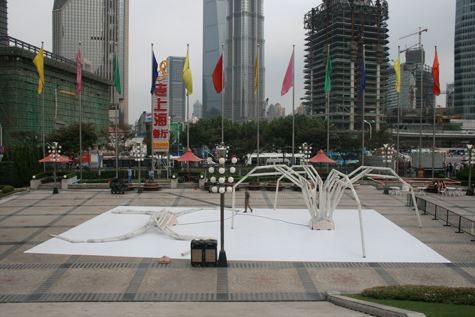
Inflatable Archit Growth Photo: Chico MacMurtrie / ARW
To give an accurate synopsis of MacMurtrie’s robotic sculpture work is nearly impossible, given that the more tangible elements of contemporary art remain satisfyingly absent in his work. Instead, MacMurtrie’s muse is derived from the examination of amorphic shape shifting, using robotics to bring to life geometrically abstract creations–most of them very big–to titillate viewers, and to bring a sense of symbiosis to the art-viewing ritual.
MacMurtrie’s sense of reinvention began during his undergrad college days at the University of Arizona. As a painter, MacMurtrie, 50, says he felt confined by the starkness of the canvas.
“My paintings got more physical, and ultimately I began literally throwing my body into my paintings, using my body as a brush,” explains MacMurtrie. “Ultimately, what I was after was the resulting effect of the paint on my body.”
When the paint had dried on him, the result left a kind of skin. MacMurtrie had an epiphany to move away from painting toward creating transformational performance pieces utilizing body skins. It wasn’t until he took the skins off that the seeds of what MacMurtrie now grows would be sown.

Inner Space - Photo: Chico MacMurtrie / ARW
“Once I emerged out of the skins, I noticed that the skins had a life of their own that was even more interesting and more powerful, in my opinion,” says MacMurtrie. “I began to figure out how to put sub-structures into these skins to animate them.”
MacMurtrie taught himself robotics, and began to see the world in mechanical systems. His new muse was to break down movements mechanically, while utilizing his background in sculpture to form a hybrid of the two. This process began with MacMurtrie’s creation of interactive robotic humanoids in the early ‘90s, collaborating with computer engineers and programmers, and has moved into his innovative work with inflatable robotic architecture. In order for him to progress, MacMurtrie literally had to reinvent the way the processes of construction and implementation were approached for his work–to move beyond robotic automation, and into abstract robotic sculpture.
Simply put, he’s not an engineer. But that doesn’t bother him.
“If I would have gone to engineering school, it would have inhibited [me],” says MacMurtrie. “Often, I’m doing things that are extremely difficult and challenging. People who have a practical understanding of engineering wouldn’t take those things on. I end up creating more work for myself because I’m not an engineer, but it’s more of a genuine process, I think.”
With lots of funding help, due in no small part to five grants from the National Endowment for the Arts, as well as funding from national, local and international granting agencies and 30 corporate sponsors, MacMurtrie and his collaborative group of artists, technicians and programmers–Amorphic Robot Works, founded in 1991–have created more than 250 mechanical sculptures that assume anthropomorphic and abstract forms that have been shown all over the world.
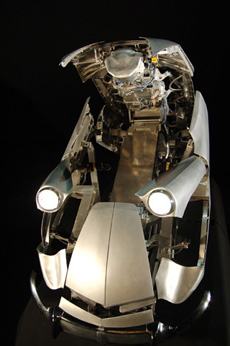
Totemobile - Photo: Chico MacMurtrie / ARW
Totemobile - Photo: Chico MacMurtrie / ARW
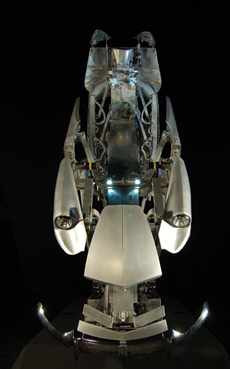
Totemobile - Photo: Chico MacMurtrie / ARW
Big examples of this work include Totemobile–a robotic sculpture that in its settled form appears as a life-sized representation of a 1965 Citroën DS automobile. During the performance process, the sculpture is disassembled robotically, growing slowly from the inside out to finally bloom into an organic 60-foot-tall totem pole. The result–which utilizes the inflatable technology–is a stunning pseudo-Transformers study of pop culture idolization and the inner-workings of organic labor that any construct of man was forced to endure.
With Birds, MacMurtrie tried to create an in-between point from Totemobile, and his early humanoid robots.
“[The birds] could be legs, they could be cones. They are certainly abstractions of birds,” explains MacMurtrie. “People see them as birds because they appear to have wings, and they appear to live and die, and they appear to take flight. They also have a pattern of becoming unified, then falling out of order. It resembles nature. It’s not so important that they are literally birds to me, as much as [viewers] get a sense of: they’re organizing the way nature organizes. They fall apart the same way that nature tends to fall apart.”
MacMurtrie says that the birds have received different reactions the world over. And while the abstractness of his work is true in a geometric sense, his hope is that it inspires people to think beyond the mechanics of his creations.
“The most important thing is that it’s alive, it has a life force, it’s trying to organize itself and trying to find its structure,” says MacMurtrie. “There’s a lot of social commentary [in Birds], but it’s extremely subtle. The birds work pretty much the same way we do. The difference is they’re fueled by air, and if we can’t breathe, we don’t live, and if we don’t eat fuel, we certainly don’t live. In this case, their air is fueled by electricity. It’s similar or parallel to our living.”
Birds shows at the Richard L. Nelson Gallery at Nelson Hall at UC Davis through December 11, 2011. Gallery hours are Monday through Thursday, Saturday and Sunday 11:00 a.m.—5:00 p.m. and by appointment Fridays. Call (530) 752-8500 for more information. For more about Chico MacMurtrie, visit Amorphicrobotworks.org.
Cheri Ibes’ new installation Blank Blank Blank shapes new thought
Cheri Ibes is no stranger to the free-form artistic genre that is known simply as installation. Her work has been locally displayed at Block Gallery where she was the director. In 2008, she opened the gallery with an exhibition in January and closed the year with one in December, both of which were strong, thought provoking shows that received positive attention. Her December show was the end of Block for Ibes.
“Block was an experiment to understand how galleries need to be re-conceptualized and what it might mean for installation and new media artists,” explains Ibes. “How we might develop if we actually had a bit of fertile soil.”
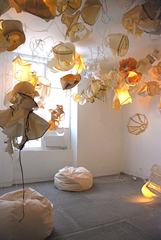
Her new installation might not exactly be the “fertile soil” that Ibes speaks of, but what she’s grown inside of Artifacts in downtown Sacramento is worthy of a blue ribbon. Blank Blank Blank, which opened on Sept. 12 and continues through Oct. 3 is a condensed version of Ibes’ work and shows us a much more linear version of her talent that has not been seen before in her previous work where lamp shades floated like jellyfish and light bulbs were amassed like fish eggs.
Black wooden dowels pieced together in angular shapes touch the wall, leave, and then return only to zig and zag to the floor—ending tangled and awkward. These blank shapes, geometric and strange, cast curious shadows on the stark white walls that they are forcefully fastened to. These shadows create new lines that echo architectural constructs and corners, adding new depth and purpose to the tangled formations that created them in the first place. As I observe Ibes’ installation, a woman brushes lightly up against one of the low sitting conglomerates that consist of ordinary white metal hangars that are fastened together by carefully bound string. The mass quivers and the shadows play, adding a new movement to Ibes’ design.
“I bought all these hangers. I fell in love with these frivolous pristine white forms—their estranged familiarity,” says Ibes.
The movement of her white hangars is poetic. Simply positioned but with such a fervor that it’s hard not to imagine your own distant landscape that they might populate. Her artist statement reads, “Hangars, thin white skeletons, spiny arachnids, scurry from a pole out of an imagined closet like hallucinations from a sick bed or flashes from a forgotten dream. They know nothing—and they know it.”
Blank Blank Blank is her version of this landscape.
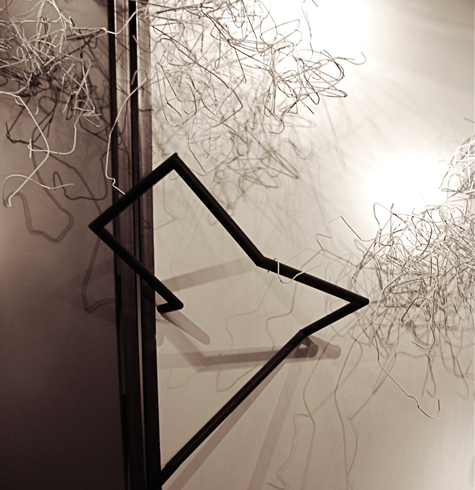
In your installations, Blank Blank Blank, you’ve chosen to use objects like light bulbs, parts of pianos, clothes hangars and wooden dowels. Why these objects? What draws you to one particular object over the over? Is it functionality for the piece mainly or is the decision rooted in aesthetics?
I’m attracted to common things with an intrinsic beauty that is often overlooked because of over-familiarity. I imagine that I have never seen these objects before and have no sense of their function. Function corrupts our perception of these objects so we cannot see their beauty—their wonder really. When I broke open light bulbs and computer keyboards and started deconstructing them, I was amazed to find such enchanting things inside as delicate wire filaments and computer keyboards have all kinds of parts inside. I’m attracted to fragility, but fragility with an edge that can seem a bit threatening. That’s an expression of realism—reality isn’t facile, it’s a mixture often of contradictory concepts and that’s what makes them interesting and makes choices so difficult.
Was it a challenge doing the installation in what is essentially a retail store as opposed to gallery space like Block?
Yes, it was. It’s hard to compete with all the things in the background. Part of the reason galleries always have white walls is to clear out the “noise” of other visual and auditory stimuli, so you can really see the work. Also, installation artists, in particular, are very concerned about the space and having control over it. I knew that would be a challenge, but I prefer this kind of honesty of purpose to showing in a gallery that does the same thing—has too much “noise” by showing too many works of art and placing them too close together so they interact with each other and the viewer has a hard time filtering that out.

Do you think your sculptures can only exist in a certain space, with the right lighting? Or can they transform as they are moved from one environment to another? Will they lose their meaning?
Actually, that’s one of the differences between sculpture and installation art. Sculpture is less concerned with space—although space is always important to how an artwork is perceived. It influences it in so many ways. But installation completely bows to the primacy of the environment, of context. Although I might use all the elements in this work again in another space, it will never be the same, and there is absolutely no loyalty to recreating it. It is this recognition of zero stasis that fascinates me about installation. Thus, no, it will not lose its meaning—that is its meaning.
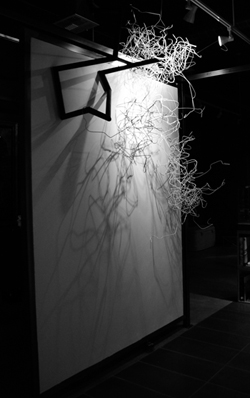
What does the title Blank Blank Blank refer to?
I started thinking about hangers coming out of a closet. Then I saw that the white hanger pieces kind of suggested skeletons, fragile skeleton forms, nerve cells, or plankton, but living. I used that quote from “Canto XIII” by Ezra Pound, a talented insane poetic: “And even I can remember/A day when the historians left blanks in their writings/I mean, for things they didn’t know.“ History has so many secrets, so many folds that we don’t know, or know but don’t really know, or aren’t allowed to know, or are afraid to know, etc. Families and individuals have secrets—blanks in their histories. So I thought of these nervous little skeletal forms as representing the anxiety associated with these secrets and the dowel as representing the closet pole where well-behaved hangers ought to hang. But, secrets are difficult to contain. They have a way of creeping out and creating a subtle underlying anxiety. They are interesting creatures, but they can get tangled in you hair or hook your shirt, so you want to stand a bit back from them.
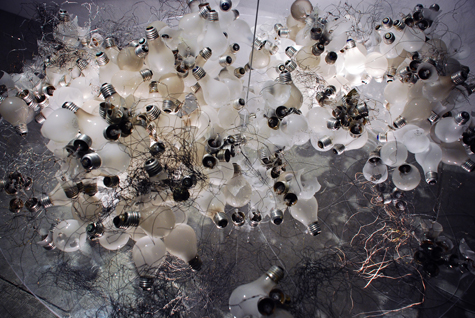
Your press release reads, “To reconcile the irreconcilable—to find harmony between the careless consumption of urbanism and a natural world subject to human infringement.” Can you elaborate on this a little more? What did you ultimately hope to achieve with this current installation?
People have often commented that my work looks “organic.” I didn’t know what to think about that for a long time. But it kept coming out—just naturally, in all my work. So then, I had to finally accept that it must be pretty important. I had to figure out why I was taking these boring, ordinary man-made objects and they were coming out looking like sea life or microscopic organisms. If it happened once or twice, I guess I wouldn’t have focused on it, but it was always showing up and I never made any conscious effort to make that happen. In my life, I have always tried to figure out how we humans fit into the big picture of nature. I mean we’re temporary, small and probably insignificant in the big picture of nature, which existed before us and will doubtless go on after. Our constructs seem so idiosyncratic and so thoughtlessly placed in the context of nature. It’s an odd fit for the most part. So, I think when I take these rather frivolous human made objects and turn them into organic-appearing organisms, I’m talking about that craziness, that trying to reconcile the irreconcilable—putting our stuff next to nature’s stuff. It’s kind of incongruent.

Where does an idea for a show begin with you? For a sculpture?
I don’t begin with the idea of a show at all. I have these weird useless discarded items I play with. I’m curious about them. I do things to them like burn them or soak them in water or break them apart. I look at them. I move them around. I stack them. I lay them on my bed so their objectivity seeps into my subconscious before I eat my Corn Flakes in the morning. Then I usually begin building them as clusters, colonies. I love how their sameness becomes variation, but in a warped way. They become little individuals. I have boxes of slides from two families’ lifetime collections of their vacations that I am playing with now. Already they look like leaves from a tree—so there it is again—that nature thing. I build modules that can be assembled in an environment like mollusks grow on ocean rocks or mold grows on old fruit.