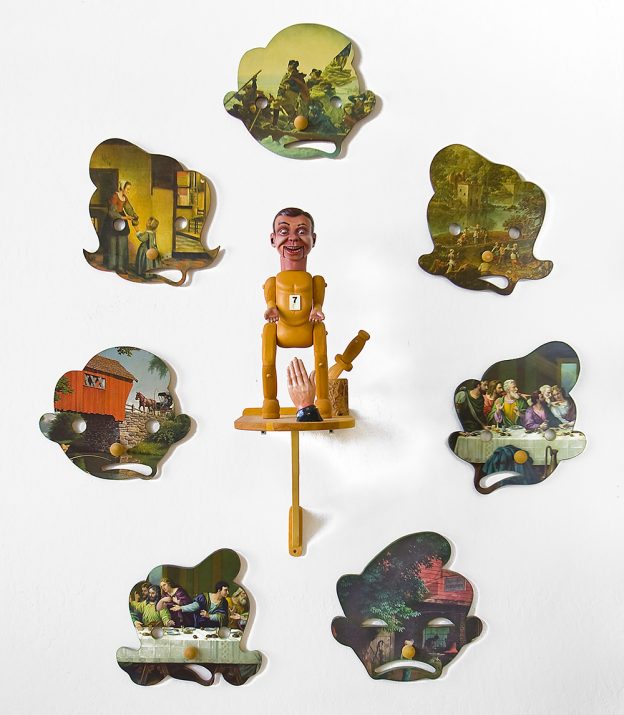
Michael Stevens had not yet arrived at JayJay Gallery when I walked in. This gave me a few minutes to take in one of his pieces, which took up the wall to the right of the entry. A wooden marionette with a puppet’s painted head stood on a wooden pedestal, a disembodied hand protruding from the platform palms-out as if giving the “stop” command, behind the puppet a wooden chopping block with a knife stuck in it. On the wall behind, a background of seven dwarf-faced likenesses arranged clockwise served as oil canvases for various scenes. They represented the seven deadly sins, Stevens would later explain, and the piece was meant to symbolize the act of confession.
Stevens counts his lapsed Catholicism among his many influences, which also include, but are not limited to, Alfred Hitchcock, 1950s television programming, and toys. His diverse inspirations mirror his manner of speaking; Stevens bounced from thought to thought as we talked, finding something interesting in every direction.
Stevens considers himself a storyteller, each piece its own short story. After more than six decades in Sacramento, Stevens had yet to run out of stories to tell as we walked through the gallery.
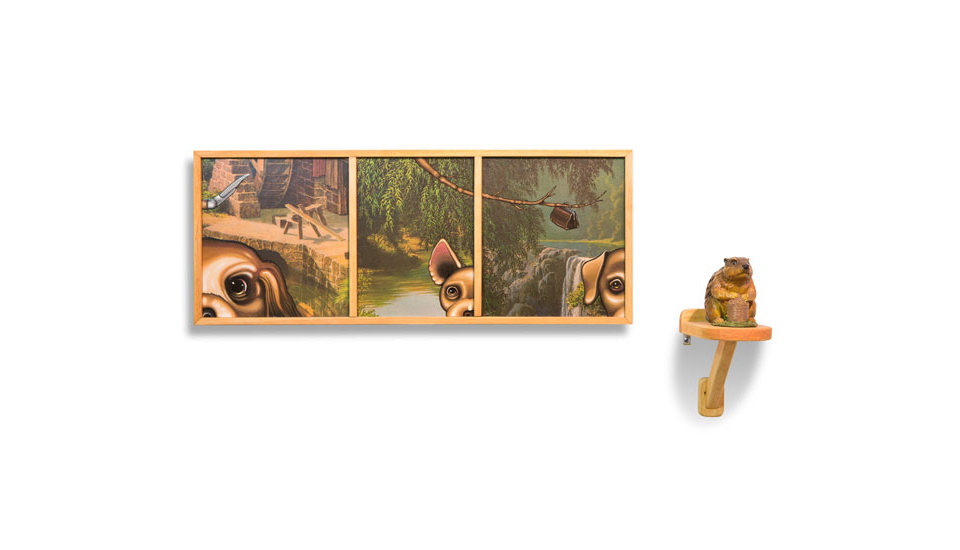
Incident at Beaver Falls | 2008 | 18 in. x 35 in. x 8.5 in.
Ready to talk?
I talk a lot. I teach at Sac City.
How long have you considered yourself an artist?
My first show was in San Francisco in ‘77. Then in ‘78 I did a show in New York, and one of our friends had gone to New York already and met Andy Warhol. So Suzanne and I actually had lunch with him [Andy Warhol] on our first trip New York.
Suzanne is your wife?
Yes. We had been doing art since I got my master’s degree in ‘69, and graduated with an art degree in ‘67. We were doing these large shows in a candy store up in Folsom. Adeliza McHugh ran the candy store. The first 10 years she was showing local work from the Sacramento State professors like Jack Ogden and Irving Marcus. After that she kind of picked up on the Davis stuff when she got Bob Arneson and Roy De Forest. Then after that, the Chicago Hairy Who people moved to town in ‘68, and she started showing Jim Nutt and Gladys Nilsson. So she kept on pushing. When Jim and Gladys and Suzanne and I became really good friends, he [Jim Nutt] bought work out of my graduate show. And he’s a very famous artist, probably the most famous Chicago artist right now. Jim’s pushing 80 and his work goes for $100,000 a pop. We started doing shows at the candy store. My career then really started when Rena Bransten from the Bransten Gallery in San Francisco came up to one of the openings and said, “You need to be in San Francisco. I want you to bring in work.” I ignored her. I got a phone call a month later saying, “Where in the hell are you?” So I packed up some work and showed her the work and did a show with her, and sold a lot of work. People from Chicago came—Betsy Rosenfield, Allan Frumkin—and I started showing in Chicago. From Chicago I went to L.A. Then to Denver. So I’ve traveled around for a long time.
Where did you get your art degree?
Sac State.
So you were born in Sacramento?
No, I was born in Gilroy. Raised in Hayward. Had no choice in it. Then we moved here in ‘55.
We just finished a show in Chico, the new Northern California Museum, which has been open about eight months. I did 14 pieces for that. And I’m working on public art, too. I’m doing a big bronze in September for Sutter Park.
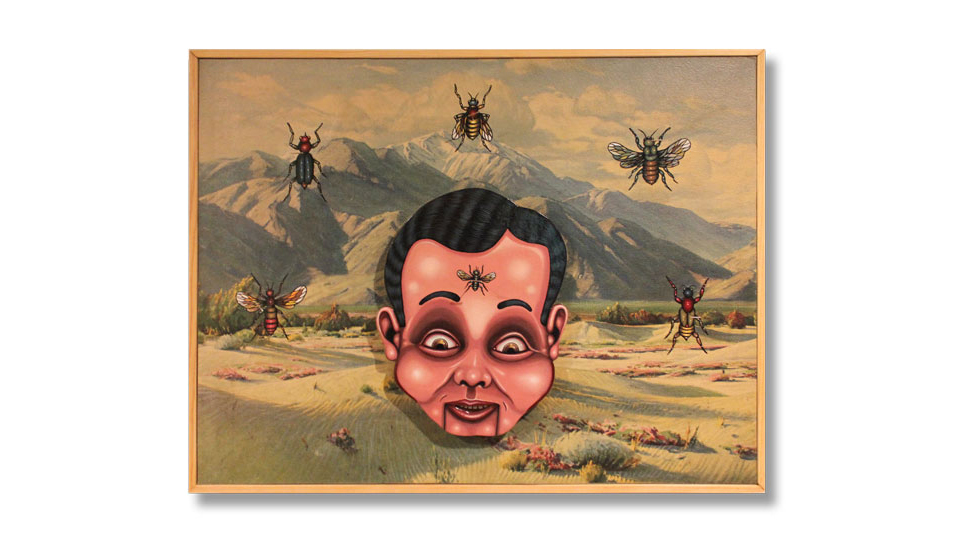
The Collector | 2015 | 28 in. x 22 in. x 5 in.
You’ve been in Sacramento more than 60 years. How have you seen the art community change in that time?
Now Irving Marcus is finally getting his just desserts by having a show at the Shrem Museum. And Irv is in his late 80s. The Sacramento crews that I’ve seen come in here, some are marketers. Some new younger artists who live down at the WAL seem to … How should I put it? A lot of hype? The skills are lacking in a lot of the young people that I see.
Quincy Jones said the same type of thing in an interview recently, about younger musicians no longer having the same skills and fundamentals. Do you think it’s a generational thing?
It’s like the [younger] generation invented sex. I don’t see the passion, I see the hype. Some of these guys are marketers. They dress up real nice with suits and ties and nice clothes. I can’t mention their names, I don’t want to be sued. But I’m aware of them, I’ve seen them, I know who they are.
You mentioned your friend Jim selling pieces for $100,000 each. How do you value your own work?
You work in a vacuum, and I find the vacuum a very comfortable place. Pricing of artwork is really strange. I’ll take work into San Francisco and they raise the prices $2,000. I’ll take work into Los Angeles and they lower it $2,000. It all depends on the market. My concern is, am I duplicating myself as an artist?
Why puppets?
I grew up in the 1950s watching television. So puppets and ventriloquial figures were part of the things that talked at you. People think I find these heads [already painted] so I brought a head to show you. They come like this [unpainted]. And I carve most of my heads. I’ll cut the neck off, take the mouths out, finish the whole thing. And I paint with Rustoleum. Which nobody does, I don’t think. And it can paint on anything—glass, metal, ceramic, wood.
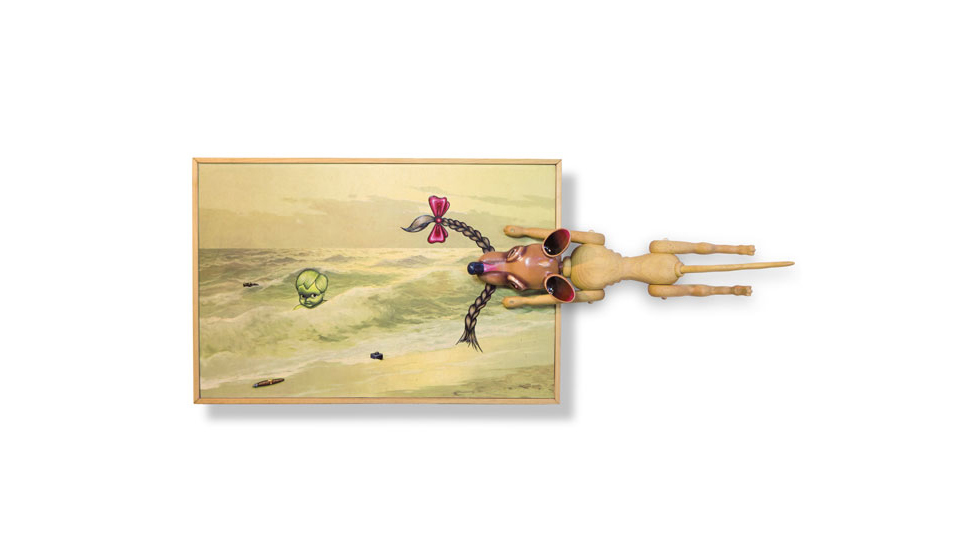
Pilgrim | 2008 | 20.5 in. x 48 in. x 8 in.
It does look like you have fun making these.
I do, and it irritates my wife.
But I get political, too. In my work I have the good and the bad. I was a Catholic. I’m really partial to the Northern Renaissance, the old paintings where they used halos and stuff. And I had to have nuns for teachers back in the days when they were really strict and whipped you. I got whipped for painting the side of the church.
What have some of your students gone on to do?
Well, I had Craig Chaquico from Jefferson Starship in my filmmaking class.
Are you hands-on or hands-off as a teacher?
I’m more of a hands-on guy. I actually demonstrate and show expectations. At City College I teach assemblage, and we did an assemblage show. I would take two classes and send them out to junk stores just to buy stuff. Take a whole week buying junk. And they had better come in with buckets of junk. Once they did, they would then get to swap the materials and make pieces. Then I could give them assignments. Say the assignment was to deconstruct a chair. You take the chair apart, but you have to use each and every part of that chair to construct, say, a figure. Some of the best assignments are just coming up with a good idea and putting everybody on the same page. Then they’re all working together on one thing, they’re learning from each other and getting to see what they’re working with. It’s not one guy over here working with clay and one guy working with paint. They’re all headed in the same direction.
I think the classroom is a theater where you develop a family. I tell them, “When you guys miss a class you’re cheating yourselves. You’ve got this two-hour period of time that is put away for you to create something where there’s never been something there before. And if you cut a class, you’ve blown those two hours. They’re gone, and you can’t make them up.”
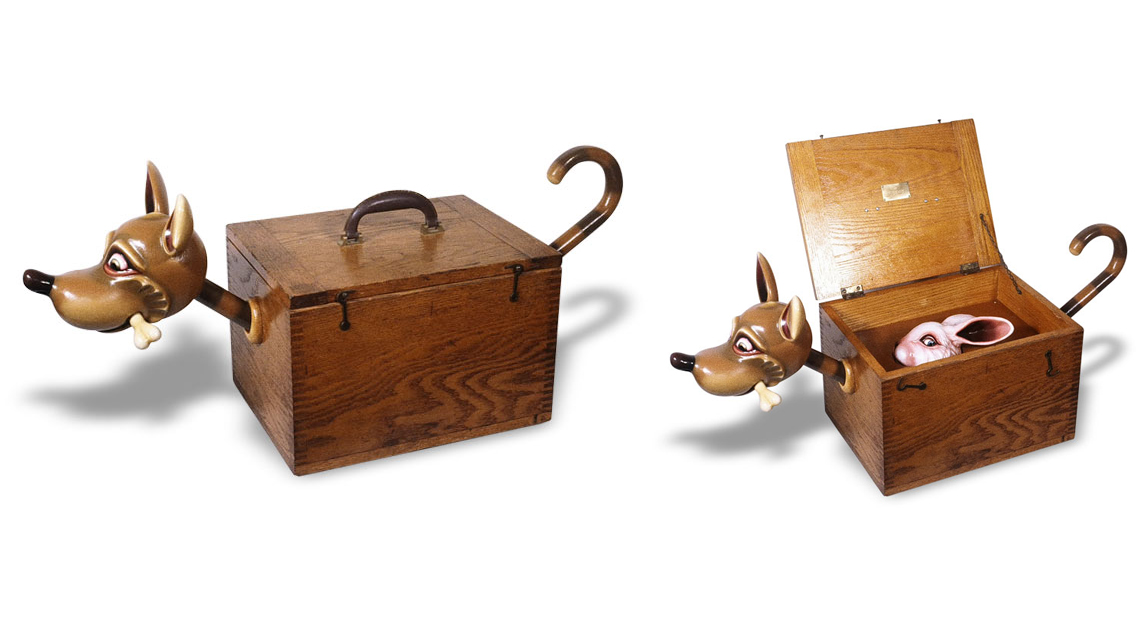
The Tourist | 2008 | 10.5 in. x 32 in. x 14 in.
What do you feel you have left to accomplish?
There’s an endless search. I can tell you right now, when I die, I will not have had enough time to do everything I wanted to do. If it’s tomorrow, if it’s 20 years from now. I could go on for a thousand years.
Too many ideas?
It just flies into my head, mostly in the shower. The scariest thing is to finish a piece and have that excitement and joy and feeling of accomplishment. Then what next? You gotta start from scratch every time. That’s the scary part. You wonder if you’ll ever get another idea again. And the harder you think about it in that moment, the further away you are from accomplishing anything. So, I just wait.
And take showers.
[Laughing] Yes. And then sometimes you’ve got nothing to start with so you find one thing. You just find one thing. And that one thing can give you the impetus to finish the story, and put it all together. Sometimes I know what the piece is going to look like and other times, like this piece I’m working on right now, I just started, because I couldn’t wait for an idea to happen. But it happened. It just came together. I think what happens when an artist becomes really secure with himself is you use yourself as your own reference source. I’ll go back and look at stuff, how did I solve that? I think you’re in a pretty good place when that happens.
You’ve proven yourself to yourself.
Yes. And it’s not about showing in a gallery, it’s not about selling the work, it’s not even about fame,
you just can’t stop doing it. You have no choice in the matter.
Check out Michael Stevens’ work at JayJay Gallery (5524 B Elvas Ave., Sacramento) as part of their group exhibit, Monumental, which also includes the art of Roger Berry, Anne Gregory, Koo Kyung Sook and many more. Monumental runs now through April 28, 2018. For more info, go to Jayjayart.com.
**This piece first appeared in print on page 24 – 25 of issue #263 (April 9 – 23, 2018)**
Michael Sarich’s Work Comes to Sacramento
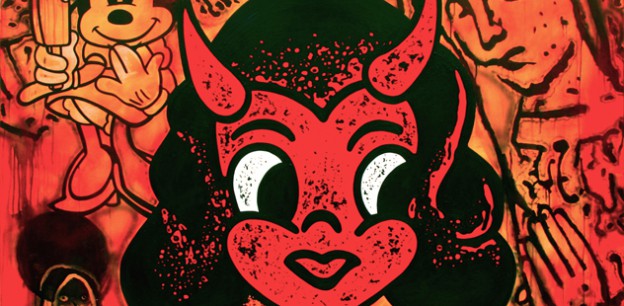
Butting Heads, a solo art exhibit by Michael Sarich at JayJay Gallery ending May 24, 2014, is a visual exploration of pop iconography through painting and sculpture. Sarich’s modern, allegorical, layered compositions are each tornadoes of symbolic imagery that include elements of nature such as birds and fish, intertwined with commercialized imagery like Mickey Mouse, a recurring illustrative devil girl and the Virgin Mary. Large-scale, differing, yet related pieces tell the story of the state of our culture and the banality of its plasticity.
A professor of art at University of Nevada, Reno, Sarich’s own education in painting, drawing, sculpture and printmaking spanned the globe from Illinois and Oklahoma to Austria. His work has been spied by gallery and museum patrons throughout the United States, and even overseas in London and Germany.
While he makes some money off his art, his main source of income is teaching. Says Sarich, “It’s always nice to see how somebody else perceives the visual world.” He works at the university with students that include his kids, and he smiles as he discloses, “I paint right along with them.”
Sarich resides in Reno, where he creates his work mainly in his garage that he has converted into a studio, and spends the bulk of his waking hours allowing social and political themes to take shape beneath his diligent hand.
In spite of being afflicted with Parkinson’s disease, Sarich is a prolific painter and sculptor, and a collection of 30 years of his work was recaptured in a book by Anne M. Wolfe and Kirk Robertson, entitled Like, Love and Lust.
I met with Sarich—a soft spoken yet thoughtful and eloquent man who brought my own questioning voice down a few decibels—at his art opening at JayJay Gallery in East Sacramento on March 8 to talk about his life and the exhibit.
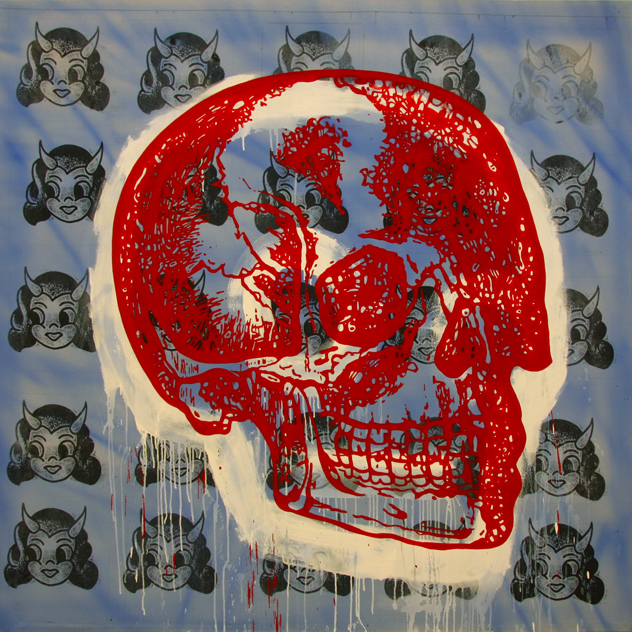
{Sybil • Acrylic on Canvas • 75” x 75” • 2012}
Can you explain the significance of the recurring, intertwined themes of Christianity and Disney characters in your art?
It’s kind of a duality, a hate-love relationship. Disney meant something good, but now it’s been commercialized and spread all over the world. It’s the same thing with Christianity. Icons have taken on a commercial value. The Virgin of Guadalupe is on T-shirts and bumper stickers, so it’s kind of lost some of its identity I think, in terms of reverence.
At the onset of beginning a sculpture or painting, do you have a preconceived notion of a message you’re trying to convey, or is it more organic?
It’s more stream-of-consciousness. I just go with the imagery and let it roll, and I react in a subconscious way. The paintings and drawings just take over. With sculpture, you’ve got to make sure they stand up, so structurally, you have to think about the integrity as you work. But when I glaze and paint them, I just react to the form and tattoo it.

{Good-Bye • Acrylic on Canvas • 78” x 78” • 2012}
You’ve done shows all over the world and throughout the United States. When you do shows, solo shows specifically, do they tend to have a unified theme?
For me they’re all unified, they’re all related, like a theme I’ve been working on for 10 years. Pop iconography as opposed to high art and low art, and what that means…again, they butt heads, high and low. So I push both ends of it.
Do you have a favorite show you’ve participated in?
I guess the retrospective at the Nevada Museum of Art. It’s where my book came from. It’s 30 years of my work. So that was kind of amazing to see all the shit I did in 30 years. Revisiting the past through imagery is kind of a weird thing.
How or why did you begin doing art?
I’ve always drawn since I was a kid, and I got some recognition for it so it kind of kept my interest. When I was in high school I was in-school suspension for a year, and the art teacher would say, “Can you do a drawing every week?” or, “Can you do a painting every three weeks?” It raised my standards of work ethic, and I just loved it, because it was something that I felt was mine, that no one could take away. Growing up with six brothers and sisters in a tiny house, that was real important to me to have something I could keep as my own.
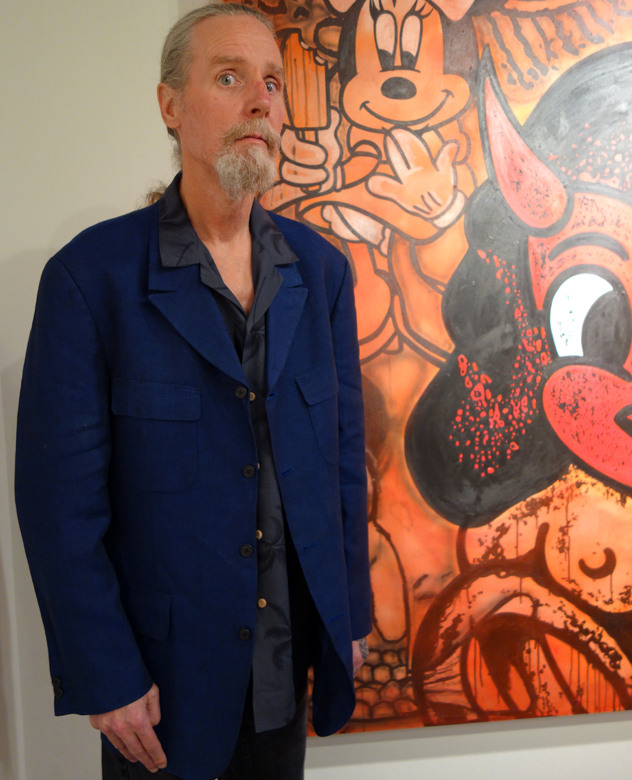
{Photo by Niki Kangas}
What media/materials do you use for your sculptures and paintings?
Well, it’s all about the mark. There’s a variety of applications but it’s all about the speed of the mark: slow, clumsy marks as opposed to rendered marks; airbrushed marks versus the painted mark…so I’m using the language of mark-making to put all these pieces together. Some of the sculptures are glazed and some are painted—mostly ceramic but I do wood, too. I did a series of puppets. I call them puppets but they’re wall pieces that are hinged.
It’s slowed down a little bit because I have Parkinson’s. Lately it’s affected my ability to make ceramics. I can still paint and draw. I get about six hours every day. I’m good in the morning, till about 2 o’clock, then I take more pills. I’ve got a sort of window of work time. I get a window of work time, it’s about six hours but it used to be eight. I’ve had [Parkinson’s] for 14 years, and it gets worse over time, but I’m still maintaining.
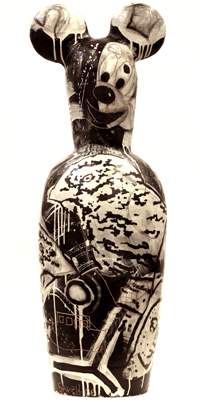
{Head Pin • Ceramic • 43” x 43” x 14” • 2006}
As I walked around the gallery to take in his exhibit, I was overwhelmed by a dizzying sense of feeling lost within and sickened by the “bankrupt on selling” nature of today’s world, while simultaneously being drawn to the imagery of icons that are an ingrained part of the modern consciousness collective, akin to archetypes. I highly recommend paying a visit to Jayjay Gallery to experience Sarich’s world before the show comes down on May 24, 2014. JayJay Gallery is located at 5520 Elvas Avenue.
From infancy to young adulthood, our brain is developing to understand the material world around us. As social creatures, a large part of this development is dependent on our relationships (nature vs. nurture, to put it simply). Arguably, some of the most valued relationships we will develop are with those most influential to us. If you don’t agree, why not ask David Wetzl’s art students. For two decades, Wetzl has been momentously impacting his students at Sacramento State and Sierra College. But after recently being diagnosed with frontotemporal dementia, a degenerative disease affecting the frontal and temporal lobes of the brain, Wetzl has decided to retire and dedicate his time to his personal works. Until March 1, JAYJAY Gallery (5520 Elvas Ave.) will be exhibiting Wetzl’s recent and classic works. Come see his beautiful response to this obstacle in life (for free), from Wednesday – Saturday, 11 a.m. to 4 p.m. For questions or specifications on exhibit show times, call JAYJAY Gallery at (916) 453-2999.
Michaele LeCompte’s Migration of Form is the sum of a lifetime of collecting
The things and people we acquire in life are inherited into our being whether we choose to address it or not. Michaele LeCompte chose to embrace her inheritances and her past through her Migration of Form exhibit, now showing at JayJay Gallery.
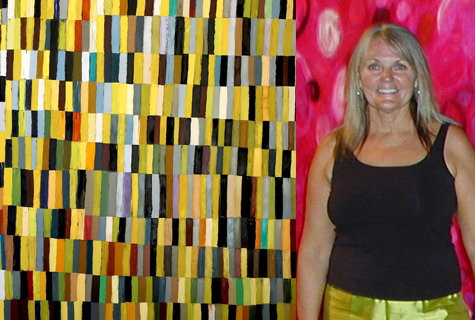
LeCompte, a Sacramento City College art instructor and modernist painter, honed her geometric style through years of pursuing various interests and acquiring creative friends along the way. Eventually she obtained the suitable influence required to produce her latest exhibit. Whether it was a friend’s poem, hand-me-down paints or her own past works, she had the intuition to make sense of their significance.
“The most important quality for me as a painter is my subconscious,” she said. “As soon as I make that mark, I think I’m going in one direction, but the painting starts to speak to me and assert itself. It wants to go in a direction I want to fight like crazy. Eventually I have to investigate where I am supposed to go with the painting.”
As an instructor of 26 years she preaches patience in art and her exhibit is living proof. “A favorite image of mine that I share with my students is this artist named Wolfly,” she said. “He was incarcerated in a mental institution and at some point his therapist saw he had talent. From floor to ceiling in his room he had stacks and stacks of work. I always held that in my mind. When you’ve done that many paintings, then maybe something happens. The idea of being patient with yourself is something I always stress.
“There are lots of young artists doing great work already; some of us just have that luck and the gift. They get carried away on a high energy, but for most of us it’s a slower journey.”
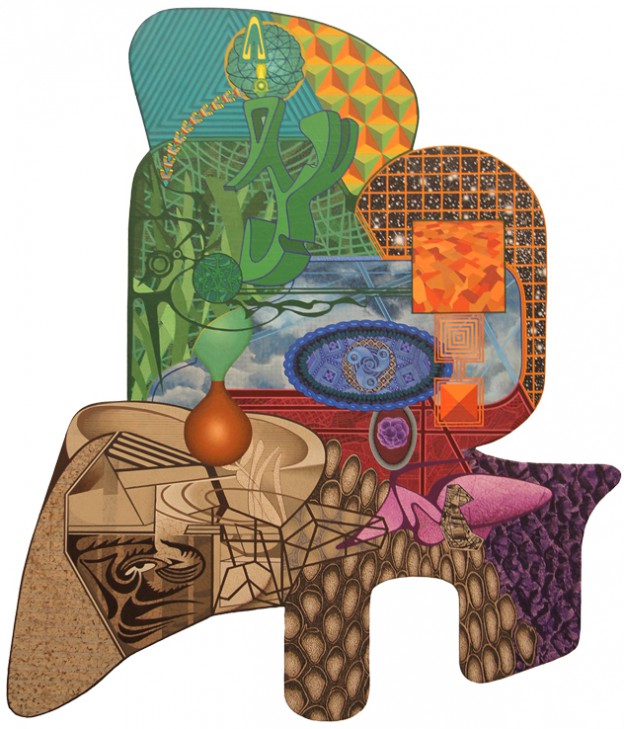
Her exhibit is a vibrant depiction of her collected works, spanning decades, collaged into new discoveries and the transformation of poetry into geometric figures. The glaringly obvious first question was how she found the courage to take the scissors to her past work.

Aerial, 2011
So how did you bring yourself to do it?
Everything you do doesn’t come out the way you think it will or does not hold up to your standards over time. I had a collection of things I felt someday would be a good collage piece. Just this year I had been working on these large paintings and I wanted to have something I could start, put down and walk away from, then come back to.
Was there a specific era you decided was worth using for the collage or is this collected throughout your life?
Some of these pieces have art that goes back all the way to 1975, so there’s little stories in them for me.
Was it difficult to get over the nostalgia for a completed piece from earlier in your life?
Nothing stays the same. What I liked back then does not have anything to do with what I like now, or there will be bits and pieces. So actually it felt like a great weight off my shoulders. To make something from something else that was not working for me and to turn it into something I like better was a neat process. Who knows in 10 more years maybe these will get chopped again.
Looking at these collages, clearly you’ve never had one style. So how did you arrive at the modern geometric forms style that is present in your larger pieces accompanying the collages?
In 2007 I moved into a new studio that didn’t have water. For a very practical reason it made me switch back to oils after many years of acrylics. Plus, I had a friend who had given me a large number of her oil paints…
I didn’t want to use any brush marks. I started using the pallet knife only and that’s how I started the series. My friend Susan is a painter and I asked her how she starts her paintings. She said she starts in the upper left corner and goes to the bottom left corner. It made me laugh so much that I figured if she could do it this way, so could I.
I’ve never been interested in making taped lines. The edge of the pallet knife clogs up and you have to decide if it’s something you can live with or not. Someone was watching me once who was not an artist and he said, “Oh, it’s like you’re frosting a cake,” which is exactly right.

Degrees of Gray, 2010
The piece Degrees of Gray was inspired by the late Quinton Duval’s poem “Oltremarino.” What was it about the poem that spoke to you?
Well, in his poem Quinton uses a quote from another poet, I think it was Robert Hughes, so it’s like we’re all in this line–artists and writers. We have connections and crossovers. But this painting was done so recently after Quinton had died and with the gray pallete, the neutral pallete it was just a perfect thing when I read that poem.
So this is like an artistic time line, in a way?
You can look at it that way. What I aspire to is having my paintings feel like the visual equivalent of what a poem might be. All the parts work, there’s nothing extra. It’s kind of lean and yet it moves you. You get a satisfying, hand-made quality out of these paintings.
Has the overlap of poetry and art always been present in your work?
I’m not making literal connections; I’m not trying for that. I’m not illustrating a poem. There’s a relationship and thread that goes through the work over a long period of time, much the way a poet would rewrite a poem or rework a poem over time.
I got that feeling from your collages. Immediately the words “editing” and “meta” came to mind, which I normally would not associate with art as much as I do with literature.
I’m so bent on working with surfaces that I’ll paint over an old canvas and then you have to deal with the scars that come through from its previous life. I love throwing things together that conflict or press on each other.
Michaele LeCompte’s Migration of Form is showing at the JayJay Gallery now through April 23, 2011. The gallery is located at 5520 Elvas Avenue, Sacramento. For more info, call (916) 453-2999.