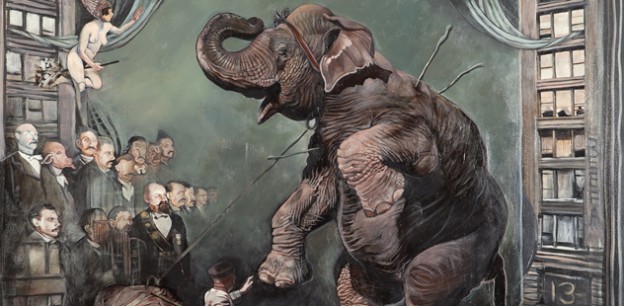
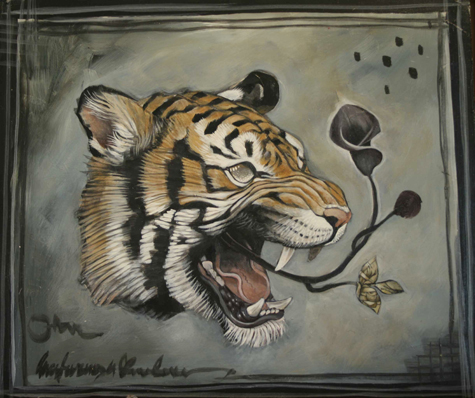
The John Natsoulas Gallery (521 First St., Davis) will play host to the upcoming 10th annual Art of Painting in the 21st Century, a conference featuring two days of guest speakers, workshops, hands-on demonstrations, award ceremonies, an art exhibition featuring work from top collegiate artists and much more. For this year’s conference, which takes place from March 30–31, the gallery has lined up an all star list of contemporary painters who are renowned around the world for their work. Featured artists include San Francisco Bay Area narrative painter Chester Arnold, Los Angeles by way of New York artist Alex Gross (whose work is pictured here), as well as Peri Schwartz from New York, Tom Colcord from San Francisco, and Hung Liu, who is widely regarded as the greatest Chinese painter in the United States. “The conference’s goal is to provide these varying perspectives and allow interaction between young students and professionals in the field, fostering the strong tradition of painting and culture in the Northern California region through exposure and discussion,” organizers write on Natsoulas.com. There, you can find more info, a schedule of events and a link to register to attend the conference. Registration is $35 before March 15, and $50 after that date. Students are free with the proof of a school ID. The exhibition that coincides with the conference will remain up in the gallery through April 7.
**This write-up first appeared in print on page 8 of issue #261 (March 12 – 26, 2018)**
Avery Palmer isn’t the dark, brooding figure his paintings make it seem like he’d be. Looking at his work, I thought I’d be meeting up with an eccentric genius like Thom Yorke. While every bit the genius, there’s something pragmatic and humble that sets Palmer apart from the Thom Yorke crowd. Talking to him one Sunday afternoon, he was as unpretentious about his work as any other accomplished craftsman. The experimental jazz musician known as Sun Ra once called himself a pastry chef, noting that “the only difference is that the pastries I’m making are the ones people end up calling ‘music.’” Palmer’s approach, while much more grounded in reality, seems similarly practical. He talks about work like an artisan cabinetmaker or a sawyer might, calling the work back down out of the ether and splitting it into practical terms. “For a long time as a kid I was really into Legos,” he explains. “I’d spend as much time as I could building things with Legos—I feel like that had something to do with my work.”
What Palmer lacks in mysticism, he makes up for in his magical ability to paint eerily constructed scenes, depicting a world of farce and sadness. A world in which the freaks come out. Palmer’s work is a strangely inhabited collection of ceramics, drawings and paintings that serve as windows into a dark and nostalgic dimension. Starting with drawings, Palmer quickly expanded to painting and ceramics.
“At some point, painting seems like it was just a natural progression from drawing,” he says. “I was teaching myself to paint by doing still lifes at home. I’d do little panels—just one a day, and do two or three little objects, it didn’t matter what, I’d just get the light right and paint them.” As time went on, Palmer’s taste for the absurd took hold and shaped his work. He’s featured in the John Natsoulas Gallery’s upcoming show, ambitiously titled The Art of Painting in the 21st Century. I sat down with him to explore his world.
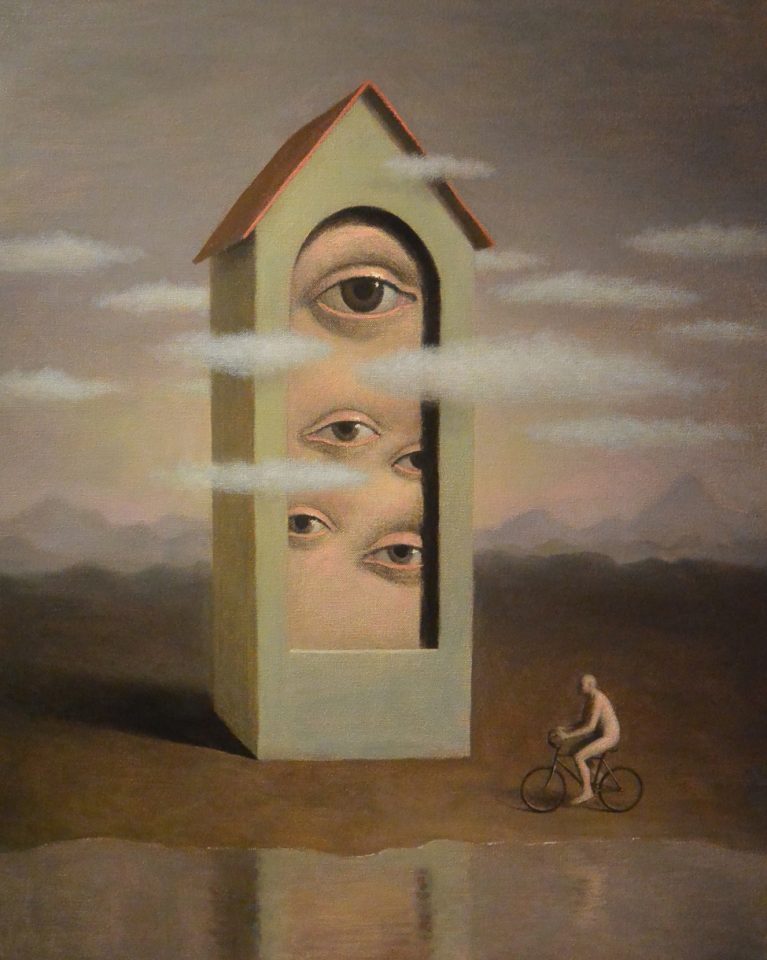
The Boy Who Lost His Way Home, 28″ x 22″
How’d you find art?
As a child I was always interested in things typical little boys were interested in and I’d always draw them, and ended up having a talent at it as a little kid. I guess people were always impressed by my drawings as a kid because I had a better ability to understand the three-dimensionality of things from a younger age, and I got a lot of positive reactions. Those are some of my earliest memories. I always drew as a kid and in high school I started thinking about what I’d be doing with my life, and drawing was the main thing I felt like I was good at. I wanted to see if I could get more serious about it—this was around the end of high school. I became interested in Robert Crumb. I looked at his comics and really loved the way he drew. It’s a cartoon, and it’s simple the way cartoons are, but it had a certain degree of realism to it. In his drawings there was shading and volume more than anyone else who does cartoons.
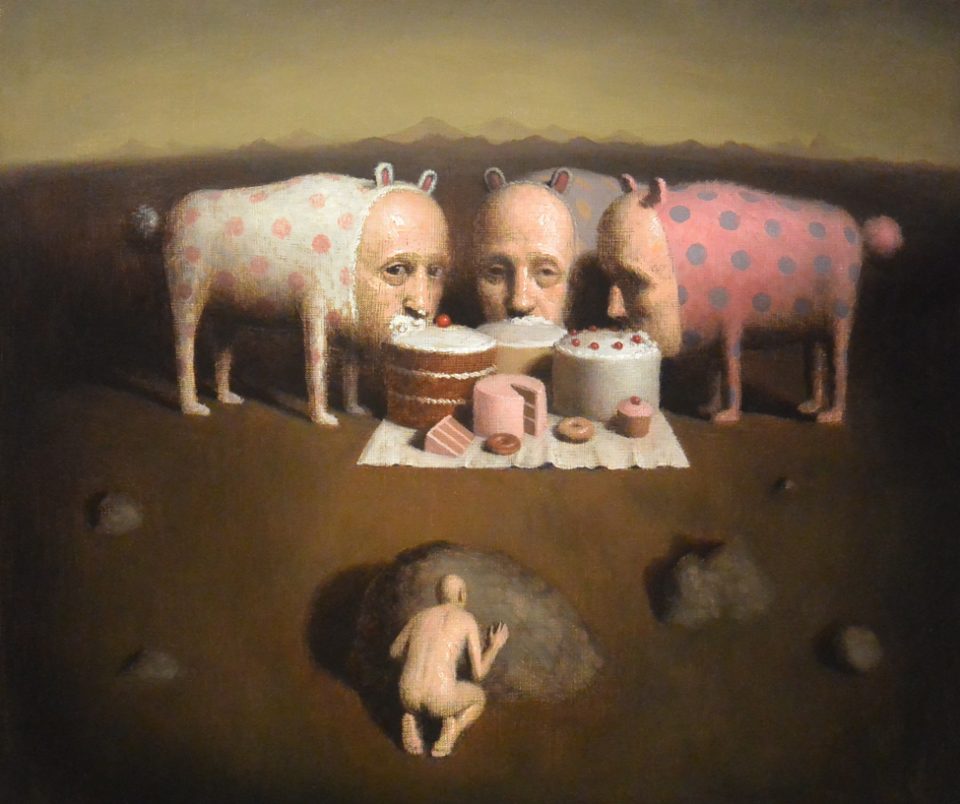
The Hungry Boy, 20″ x 24″
It makes sense that you’d like Robert Crumb because he really seems to favor the absurd, which is something that I see in your work.
Yeah totally. I think that’s true. I think what appeals to me about Crumb’s work is this idea of sitting down with a blank piece of paper and letting your imagination fill it out and create this world. On your page, a whole world where anything can happen opens up. It made me want to pursue that and see how far I could take it.
Do you sit down with any sort of idea or do you just let it unravel in front of you?
I have an idea and I do some sketching. I have stacks of really rough sketches on scratch paper, and any time I come up with an idea I’ll just sketch some compositional elements. Then I’ll transfer that to the canvas by sketching it with vine charcoal, which is a very simple but accurate sketch, and then I’ll start painting with a thinned-down paint. I’ll start filling in the shadows, and pretty much what you see is what you get. Even though I emulate this sort of Old Master style, my painting is a lot different in that they worked in a lot of layers and I actually usually get everything done in one go.
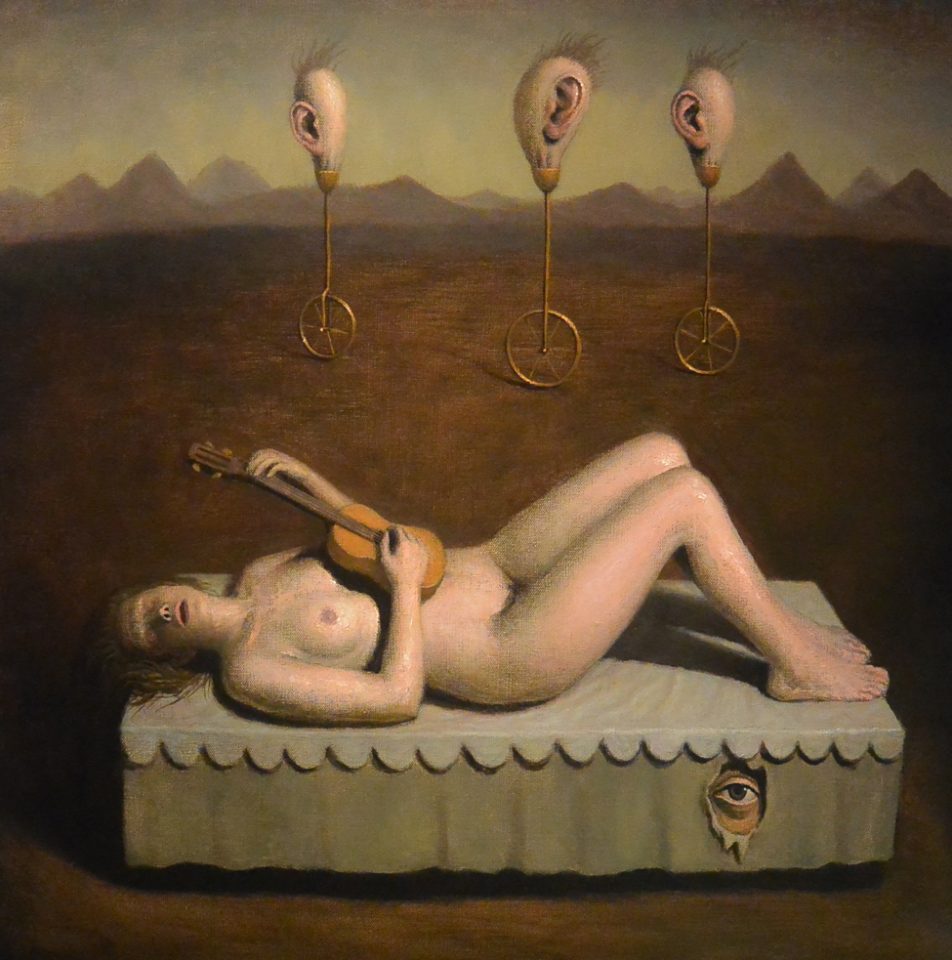
The Audience, 24″ x 24″
So it seems like you work fairly quickly.
Yeah, I like the idea of being efficient in my process. This idea started with Robert Crumb; I like having something in my imagination and just sort of spewing it out. That’s the thing that I love—the central idea that makes me love art is the ability to transform something in my head into reality and I want that process to be as unhindered as possible. Painting is not really easy, and there’s always struggle along the way but my goal is to be able to have an idea and just kind of let it out very freely. I feel like when a painting takes too long and I have to keep coming back and adding layers, it kind of loses that freshness. I try to keep painting pretty quickly, and if it’s a few weeks later, or something, I won’t end up finishing it because my mind will have moved on.
In your statement, you say that, “The multiplicity of possible readings of symbolisms in my work is central to my concept,” and I wanted to have you sort of unravel that a bit. Are you implying that there’s meaning buried under there somewhere, or are you an outright formalist?
I’d say it’s the latter for sure. It’s purposefully vague. I never want to sort of start out with a story. I just spew my imagination onto the canvas in a way.
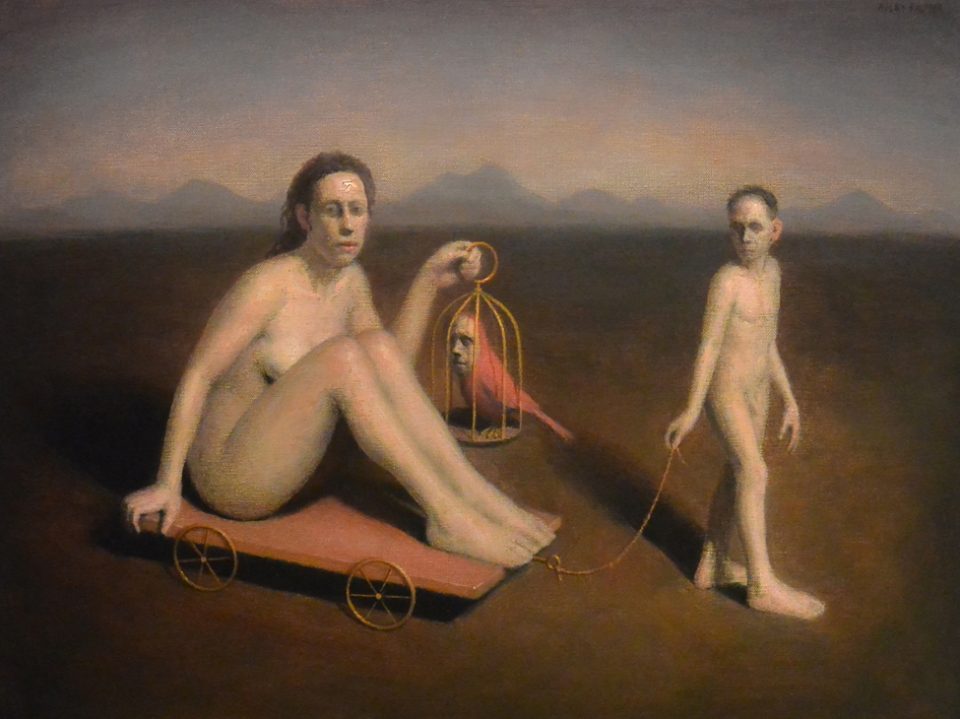
Three Wanderers, 18″ x 24″
So is your work kind of divorced from what you’re feeling at the time?
Maybe. I’m heavily inspired by surrealism, and I think there’s a connection there with surrealism where the idea is kind of free association, where the surrealists would just put random stuff out and see what happens, so when I come up with an idea for a piece of art, something will spark an idea—maybe looking at a painting of someone else, and I see a part of it that interests me, and makes me want to borrow something and see what I can do with it by churning it around in my imagination. So I’ll just take some idea and just start sketching and see what sort of objects I can combine. It’s more like a collection of things that I can’t put my finger on, but they’re all interesting to me.
So this show is called The Art of Painting in the 21st Century. What’s it like to be a painter in the 21st century?
I don’t know, actually. I guess it’s not something that I’ve given a lot of thought to. My approach to painting isn’t like that. I sort of look at my process that harkens back to a tradition. The type of painting that I do is very much emulating an older style, so I’m interested in that. It brings you back and gives you a sense of mystery about some other time, so I’m not sure how that relates to the current, contemporary situation.
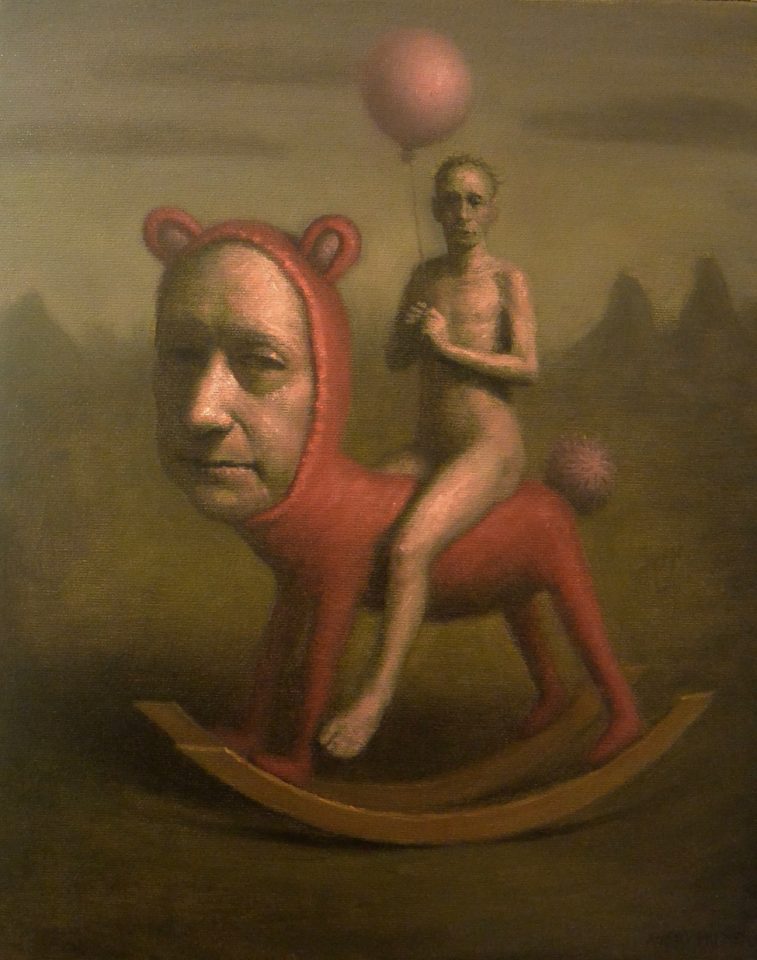
Persistent Game, 14″ x 11″
And do you see yourself going back to ceramics at all?
That’s what all of my ceramics friends ask me. [Laughs] Right now I don’t have much of an inclination, but it’s hard to say.
It’s not the kind of thing you can do it in your spare bedroom.
Definitely, yeah. I went to San Jose State for grad school. I was there for three years, and it was actually during that time that I started to transition to painting more. One reason for that was that as I developed the ceramic work, I had a thing that I was doing and settled on a style, and people liked it, and it was going well. But the thing about grad school is that it’s all doubt challenging you and making you second-guess what you’re doing and pushing you to the next level. In grad school, I was sort of struggling to figure out what my next step would be. I felt like it was getting repetitive and was frustrated with the time everything took with ceramics.
Then do you see any other significant departures in the future?
I don’t know—it’s sort of just a continuous evolution. I don’t have plans. I’m just steadily trying to improve my skill and my ability to just kind of paint whatever pops into my head without having to struggle too much, a lot of my paintings are relatively simple. I guess one goal that I have is to do paintings that are a little more complex, that have a bit more going on. The reason that my paintings are relatively simple is to keep getting the idea out quickly, so I think that if I’m continually improving myself and the speed at which I’m able to get these things out, I feel like eventually, I’ll be able to even more freely put things down on the canvas as they pop into my mind, so I’ll be able to make more complex paintings as time goes on.
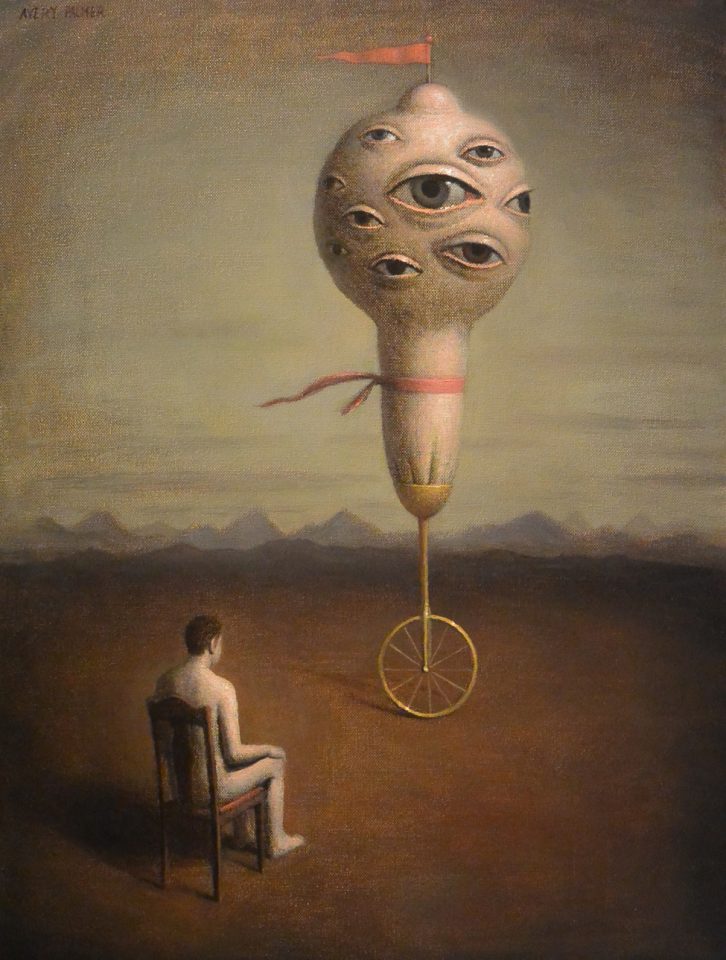
The Visionary, 24″ x 18″
Catch Avery Palmer’s work at the Art of Painting in the 21st Century Exhibition and Conference through March 11, 2017, at the John Natsoulas Gallery, located at 521 First St. in Davis. Find out more about Avery Palmer at Averypalmerart.com.
Enigmatic Painter Alex Reisfar Returns to Davis’ Natsoulas Gallery
Unencumbered by any formal art training, modern surrealist painter Alex Reisfar nevertheless succeeds in imbuing his work with a palpable appreciation for the great painters of the past. Raised by artists—Reisfar’s mother studied under the renowned American New Realist Wayne Thiebaud at UC Davis, and his father is a surrealist wood sculptor—Reisfar honed his own symbol-laden style while dabbling in other creative pursuits, from tattooing to music. Now a parent himself, Reisfar has spent recent years dedicated to his art full-time, including a stint as artist in residence at the John Natsoulas Center for the Arts in Davis last year.
After relocating to Portland, Ore., and joining that city’s newly invigorated art scene, Reisfar is making his return to Davis, with a solo exhibition at the John Natsoulas Gallery. Running through March 1, 2014, the exhibition is titled The Coyote Show and features Reisfar’s latest works, paintings that, though still rife with political and cultural commentary, are also filled with deeply personal, cathartic sagas, using equal parts haunting and ambiguous imagery. In addition, Reisfar used reclaimed wood for the supports of his new works, with the irregular shapes and textures provided by these materials furthering the unsettled, mysterious tone of his art. The unfulfilled search for definition, says Reisfar, is an intentional effort on his part, and one of the recurrent themes found in the paintings on display in The Coyote Show.
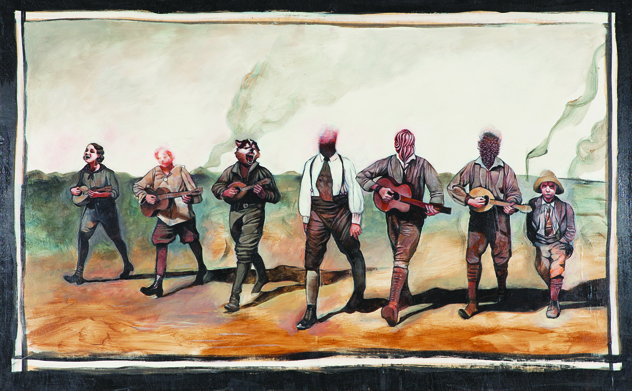
{Six Walk With Me}
How does the new work you’ll have at this exhibition compare to previous work of yours that people may have seen?
It’s similar. It’s definitely in the same vein. My last paintings were more about worldly issues, more about political issues. My newer paintings are more about personal struggle.
Was that an intentional effort on your part?
I don’t even know if I really had that much control over it. It kind of ended up being what was coming out of me. I had a lot of different stuff on my mind that was sort of making its way into the painting. I think the imagery can still be taken by the viewer as being not as personal; the viewer can take it and assign different meanings to it.
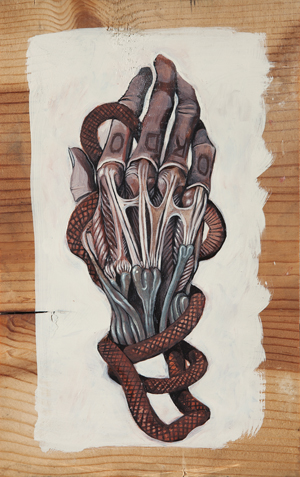
{Hand of God}
So you try to keep the meaning of your work open to interpretation?
I like to have the symbolism be something that’s not so obvious; I like it when there are questions without answers. I like it when somebody has to really wonder what something means and take out of it their own meaning. And people always do come at it from angles that I had no idea about.
Do you hear people’s interpretations of your paintings and say to yourself “Well, that wasn’t what I was thinking, but that works too?”
Yeah, exactly. And every time I get that feedback from people, next time someone asks me what a painting means, I can add that too it.
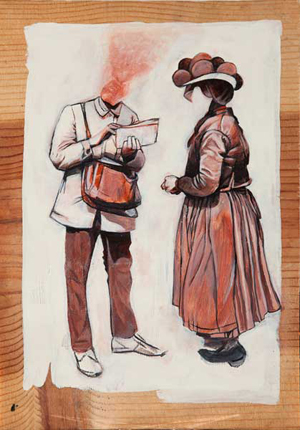
{The Delivery}
You didn’t have any formal art training or go to art school, but your work certainly seems to be informed by a respect for a lot of the great artists and art movements.
I was always inspired, as a kid, by Degas and all the old masters. I always wanted to be really painterly in my paintings; that’s something I’ve worked really hard at getting better at. Then also, I was always interested in the sort of darker surrealist paintings, the darker imagery in Frida Kahlo and Dali and Francis Bacon, all that sort of stuff. As I grew up looking at all the books, that was what I was drawn to. So when I started painting full-time, that ended up being what my style was.
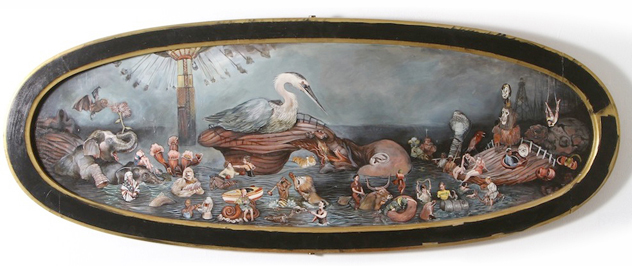
{Skinwalker}
Was art something that you knew you wanted to do professionally, or was there a sort of a moment when you decided you wanted to be an artist?
I always wanted to be a painter, even when I was a kid. I think when I was little, right around the time I was coming to terms with death—the fact that humans don’t live forever—was around the same time I was looking at these paintings that people had done three or four hundred years ago that were in these books. So I think my little brain grasped onto the fact that if you became a good enough painter that you could have some version of immortality, like if you could reach that point. So that was a subconscious thing where I always wanted to do it. The only struggle I ever had with it was that I like to play music, so there were certain times in my life when I was trying to play music and paint at the same time, and trying to balance those two lifestyles at the same time can be really difficult. But painting always sort of wins out for me.
You recently moved to Portland, how is the scene there?
Music and fashion and visual arts, there’s definitely a lot going on. With painting, there was a while where everybody in Portland was drifting toward the sort of simplified, low-brow comic character, cartoonish sort of thing, which is great, and there are a lot of artists who are really good at it here. But it was getting to be where every time you went to a show, that was what you were seeing: something that would end up on a T-shirt or a pair of shoes or something. A lot of the reason that the art here is so strong, unfortunately I think, is that there are a lot of artistically driven companies, and because of that, a lot of the design school students end up coming to work here for Nike and Adidas and those sort of companies. So a lot of the art you end up seeing here is from those artists. But now, there’s sort of a resurgence of painters starting to pop up, and I think the next year is going to be really exciting because there are a lot of people who are just starting to get a foothold.
{Tiger Head Web}
How was the experience in Sacramento and Davis during your residency last year?
It was great. I had a lot of support from the artist community there and the other artists who are part of the John Natsoulas Center for the Arts. I had a really fun time. I stayed in the gallery for a couple of weeks when I was painting a mural, and I met a lot of people at night, the different sort of nocturnal people who were around and who were really great. But there’s a lot of great art happening in Davis. I got to go with [Davis artist] Myron Stephens to the art walk in Sacramento and there was crazy art happening there too.
What are you long-term goals, career-wise?
I want my work to continue to grow. A big goal right now is I want to be able to support myself and my daughter with my painting and be comfortable enough that she can have a comfortable life, so that’s sort of the main drive, for me. But besides that, I just want to continue to make paintings that people are drawn to or intrigued by. Or disgusted by.
See Alex Reisfar’s The Coyote Show now through March 1, 2014 at the John Natsoulas Center for the Arts, located at 521 1st Street in Davis. For more info on the Center, such as gallery hours and other upcoming and current exhibitions, go to Natsoulas.com.

May Izumi brings her fantastical sculptures to Davis
I take great pleasure in escaping to a fantasy world that I have created in the dark chasms of my mind. Many different forms of media fuel my strange utopia: literature, film, music and in the case of May Izumi—sculptures. A Honolulu, Hawaii, native, Izumi’s sculptures depict otherworldly creatures and figures that peer out from pensive eyes and stand with alluring postures that dare you to come in and look closer. Turns out, Izumi is a lot like me—searching the depths of her mind and referencing the words and illustrations of childhood stories and fairytales to create a world of animal hybrids.
Unlike an illustrator of an intricately woven fantasy, Izumi’s preparation doesn’t begin in a sketchbook with a set of colored pencils and an eraser. She prefers longhand.
“I’m an editor, so I actually write stuff out first. Sometimes it’s just words, sometimes it’s phrases,” says Izumi of her process. “In art school, I got into trouble because I didn’t really have a sketchbook, and they couldn’t read my handwriting.”
Her art education had a rocky beginning. Izumi floated through art classes and found no real connections with her classmates (who were much younger) or with the media involved. After having little success trying to paint, some friends suggested potting. Clay was no different—at first.
“I was a terrible potter,” jokes Izumi.
Most would give up, move on and shoot for a business degree instead, but Izumi continued with clay and realized she was good at hand building. She eventually found her niche in sculpture art after, ironically, she ran out of art classes to take. She went out on her own and did some research, seeking out the work of other figure artists to reference. In fact, some of these artists were alumni of the John Natsoulas Gallery, where Izumi and Boyd Gavin will be showing later this month.
“Most of the people that I admire have work in his gallery,” says Izumi.
Izumi’s work is a combination of a refined color palette, the use of found objects and an attention to the detailed gestures that each of her characters possesses. Izumi ties all these elements together carefully and methodically in order to achieve what others have described as worn and vintage.
“I’m not a big fan of bright colors,” she says. “I don’t know if it’s because I’m a hopelessly conservative Japanese American. I like the worn-out looking colors.”
Her tattered and lonely-looking sculptures have a connection with people who see something of themselves in the scarred, oddly shaped figures. A friend of Izumi’s who had struggled with drugs and spent some time in and out of jail told Izumi that her sculptures looked like “they had a lot of trouble but were still here.”
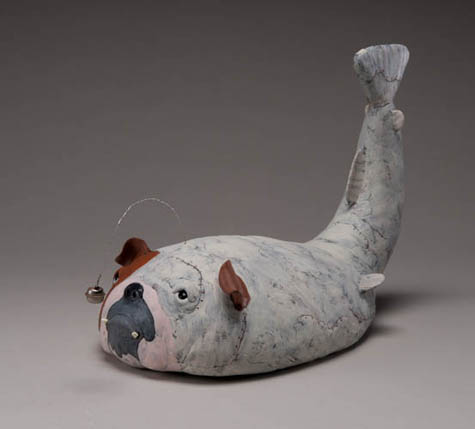
There is a story inside the work that Izumi is trying to tell. It is a story of struggle and of those trying to work their way out of a rut and do better for themselves. It is the message that she has read between the lines and heard in the small and quiet conversations in the halls of the University of Hawaii where Izumi works as an editor for the School of Ocean and Earth Science and Technology. However, it isn’t earth science and oceanography images that she references as having an impact on her work; rather, it’s the people around her.
“We have 700 faculty at the school. I’ll pick up things that people have said or things that people tell me. I’ll get ideas,” explains Izumi.
Izumi begins with a wire frame that she shapes into her skeletal frame. Then, depending on the piece, she might use newspaper to add girth that she then coats in an aluminum foil wrapping. She compares the appearance of her creatures in this pre-clay state as “cryogenic corpses.” The clay she uses is pricey, about $10 for a package roughly the size of a stick of butter, so mistakes can be costly—it usually requires about three or four sticks to cover the entire area of a sculpture. Once that is finished she coats them in sepia ink and then goes over that with the color. This layering process is what gives some of the sculptures the appearance of leather.
The found objects in Izumi’s sculptures also add an extra depth to her work and help the sculptures venture beyond the formation of clay. Izumi salvaged beakers that the university was tossing out, and she used them for a series of pieces that featured endangered and extinct birds. The sculptures were inspired by a show she did with a friend who was working on a project about endangered animals. It struck a nerve with Izumi.
“I find it fascinating that there’s this bird that used to be alive and now it’s gone forever,” she says. “And all we have is this thing in a glass tube to make a new one. I don’t think it will ever be the same.”
For someone who has a full-time job, a limited art education and no real Web site, Izumi has still managed to produce a complete and studied body of work that has all the right components. At 45, Izumi’s future appears bright with her upcoming West Coast appearance and a show planned for next year in Honolulu, where she currently resides. She’s moving at her own pace, a self-proclaimed slow worker; and frankly, it’s worth the wait.
May Izumi’s thought-provoking creations will be on display at the John Natsoulas Gallery in Davis this month along with realist and still life painter Boyd Gavin. The exhibit will run from Jan. 27 to Feb. 20, 2010. An opening reception will be held on Feb. 6 from 7 to 9 p.m.
Dead Western
John Natsoulas Gallery, Davis
Aug. 29, 2009
Words by Vincent Girimonte
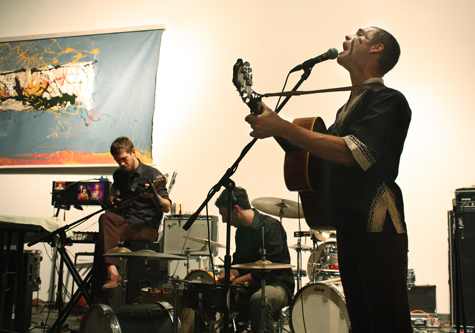
Last Saturday, the ever-embracing arms of Davis’ John Natsoulas Gallery welcomed some pysch-folkers, notably Sacramento’s Dead Western Trio, who played in support of Ben Chasny’s decade-long, discretely prodigious endeavor, Six Organs of Admittance. However, it was the local act who made the show somewhat remarkable.
The Dead Western Trio is a genuine spectacle, both visually and sonicly—each served the band well in a room four sizes too big, with other pieces of high art threatening to pry attention away from the makeshift stage. The high ceilings seemed more conducive to flying a kite than live music, but to his credit, Dead Western frontman Troy Mighty was shrewd enough to wear tights and war paint (the old one-two), perhaps to guard against wandering eyes.
Mighty approached the audience gently picking a guitar, strolling along with the bass and ambient percussion. With the addition of vocals, the music changed drastically, slumping down into an almost macabre tone. The simplicity of the acoustic guitar and bass gave room for Mighty’s calamitous baritone to let loose and emphasize each note. To be sure, an appreciation for the low and slow will help here; the pace never exceeded that of a funeral procession march.
Mighty’s voice—to some extent, Dead Western’s sound—may initially strike the listener as polarizing, engendering a queasy impulse. His clarity and the Trio’s instrumentation might be obscured by his vocal delivery, which has elicited all sorts of zany characterizations such as Big Bird lamenting on Dramamine. Crooning? Maybe Antony Hegarty with a few more Y-chromosomes.
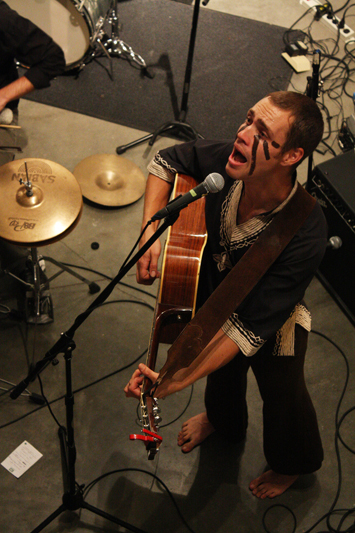
Despite this, midway through his first number, the strange gap between Mighty’s vocals and the Trio’s music had been bridged thanks in large part to his words and the manner in which he employed them. The incongruous pair turned out to be a neat fit.
“Too often, I think, the voice is not recognized as the instrument that it is,” Mighty says, answering a few e-mail questions, “and therefore feels very separate from the music, rather than being rooted in and around it.”
The instrument he speaks of mouthed clear, articulate language, often overtly pensive with lines like, “Tell me how do you write a song that makes things meaningful? How do you reach inside the hearts of those you don’t know?” These are undoubtedly broad sentiments, which fringe upon tired at times, and Mighty doesn’t necessarily stray too far from them in his other tracks. But they surface as familiar and approachable and altogether committed.
Mighty on the not knowing: “I feel very sure about many things at this point; other things, not so sure, and this comes through in the honest songs that I attempt to write. It’s an ambiguity that I am very aware of, and am not afraid to present to others.”
Completing the Trio are bassist Jesse Phillips and percussionist Kevin Corcoran, who remained the steady, honest accompaniments on Mighty’s quest through the weird. And don’t be nervous about the percussionist, as was I; percussionists do shit drummers can’t, like tap fossils against a garbage can. But fortunately there were no wild forays into scraping cymbal solos and nobody, as far as I could tell, pulled out a skull. Corcoran knew what he was doing—an utterly refreshing quality for a percussionist and indicative of Dead Western’s refined sound. They made neat work of filling such a large room.
Dead Western’s Soften Your Screams into Sings is available on LP from KDVS Recordings. Suckle at the Supple Teats of Time will be released in 2010 out of Germany on Discorporate Records.