Recall the first moments of waking, when, adrift in the mental flotsam left over from a night of vivid dreaming, you try and sort the pieces together. The half-remembered places and in-between entities that had charged through the landscape of your imagination with such jarring solidity now burn away like soap bubbles in the sunlight of logic. What allows us to weave these strange symbols and portents together so seamlessly in the sleeping hours? In our best efforts to reconstruct a dream, the results inevitably resemble a collage—fragments of wonder, alarm and mystery snatched from the subconscious.
For Angela Tannehill, the results are more seamless than most. In the two-odd years since she began working on her mixed media pieces—found cutouts layered and blended into textured background painting—she has honed a special knack for creating surrealist landscapes possessed of a storytelling power.
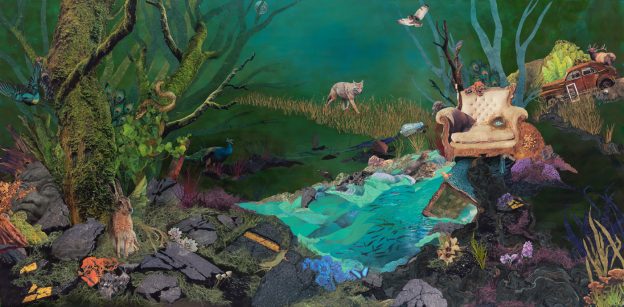
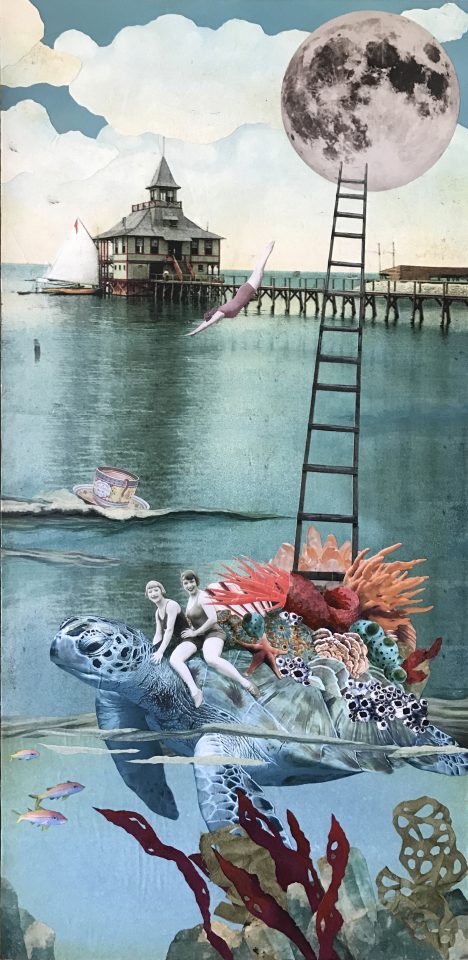
A few months back at ArtStreet, one could see small crowds engrossed in the story told by Tannehill’s largest work to date, After Us. It depicts an edenic wilderness of lush growth and harmonious life: peacocks, wolves, hares and snakes frolicking among the littered remnants of human craftsmanship—an ornate chair, a vintage automobile—gracefully decaying in the new unpeopled paradigm. One of the standout works at the month-long event, it left an impression of depth and animacy, as if it might start moving once all eyes are off the canvas. Her back catalog offers the chance to go deeper into this peculiar realm: Manta rays and starlings fly together in the dawn sky, while polar bears and hummingbirds emerge from portals into space. Though architectural wreckage and a disembodied human presence can be found scattered throughout these constellational works, they are always in some way subsumed by the elements; nature has figured largest in her choice of subject, an enduring influence from a childhood in the countryside.
When she’s not piecing together pipedream perspectives and hypnagogic hybrids, Tannehill harnesses her creative powers for community impact, a vocation she labels “design for do-gooders.” This includes designing promotional material for nonprofits like Sutter Health, and creating around 50 book covers for the youth literacy outreach group 916 Ink, which helps young people tell and publish their stories. If the amount of effort expended in promoting creativity in others has a feedback effect, it has surely reverberated loudly in Tannehill’s work, driving her to create more and amplify outward her normally introverted nature.
We recently caught up with Angela to find out about the ArtStreet experience, the value of community involvement and the virtue of the unexpected in her chosen artform.
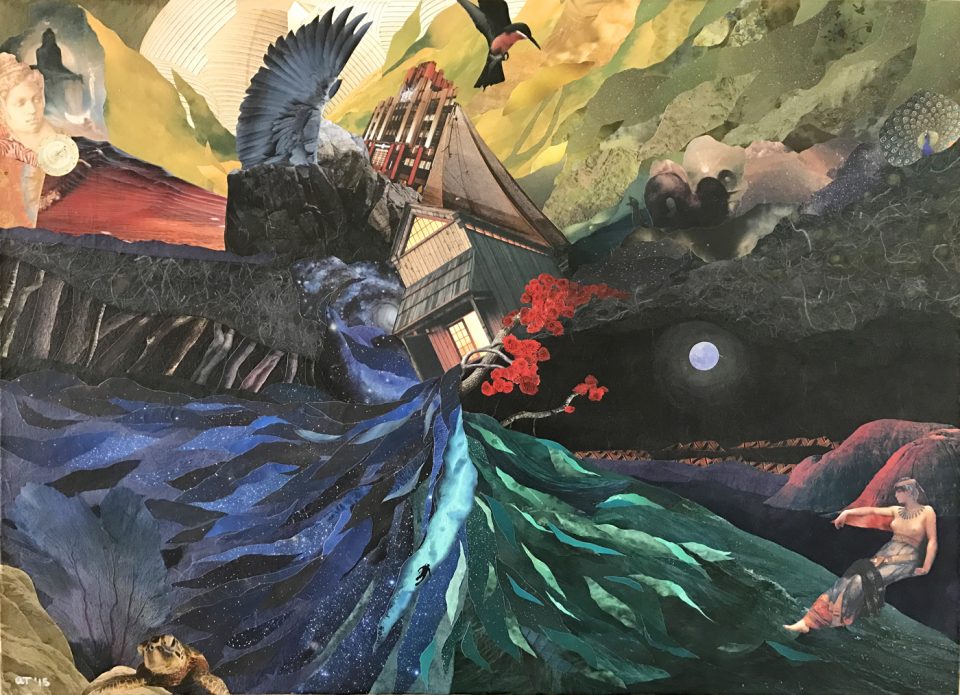
Turbulence | 2015 | 22″ x 30″ | mixed media on canvas
How did you go about making your piece for ArtStreet, After Us?
It was a little different because they wanted to know what I was going to do ahead of time, and I had to put it together loosely as a digital sketch beforehand. I was really nervous, because it was so much bigger than anything I’d done before. I had to build the wooden canvas. Usually I sit back and filter through all these different magazines and books, and whatever elicits some sort of an emotional connection for me, I gravitate to it, put it down, and if it works, it works. With this one, it was harder to use my smaller scrapbook elements because everything was so large. There’s a big tree in the corner, and since there’s no magazine I have with a tree of that size, I printed out little pieces here and there online to make a composite of a tree. I just had to keep in mind what the theme was, which is being us [people] being taken over by nature. In my other pieces, the theme is pretty loose, and it may end up saying something completely different by the time I’ve finished it.
Would you say that nature is the dominant theme in your work? What pulls you toward it?
I just like how organic the textures are—the movement of water especially. And there’s so much symbolism in nature, water in particular. Then there’s the draw to my childhood, because there was so much nature in my childhood that I don’t have quite as much of now. Our family lived in the country, surrounded by fields. When I was around 10 years old, I would take walks out into the field and go fishing by myself. We were always catching anything that moved. My belief is that we truly are connected with every living thing on the planet. And my fear is that right now, it’s like this heartbreaking connection in a way, because the more we learn—the more we know we’re connected, the more we know that we’re ruining things, hurting the world with our presence and our negligence. We’ve lost our connection in some ways, even though it’s unbreakable, but because we’re ignoring it, we’re ruining it. It’s scary, but at the same time it’s comforting, because nature has a way of righting itself. There’s a counterbalance, and maybe it will make up for whatever we’ve lacked. Maybe we won’t fare so well, but I feel like the Earth will right itself.
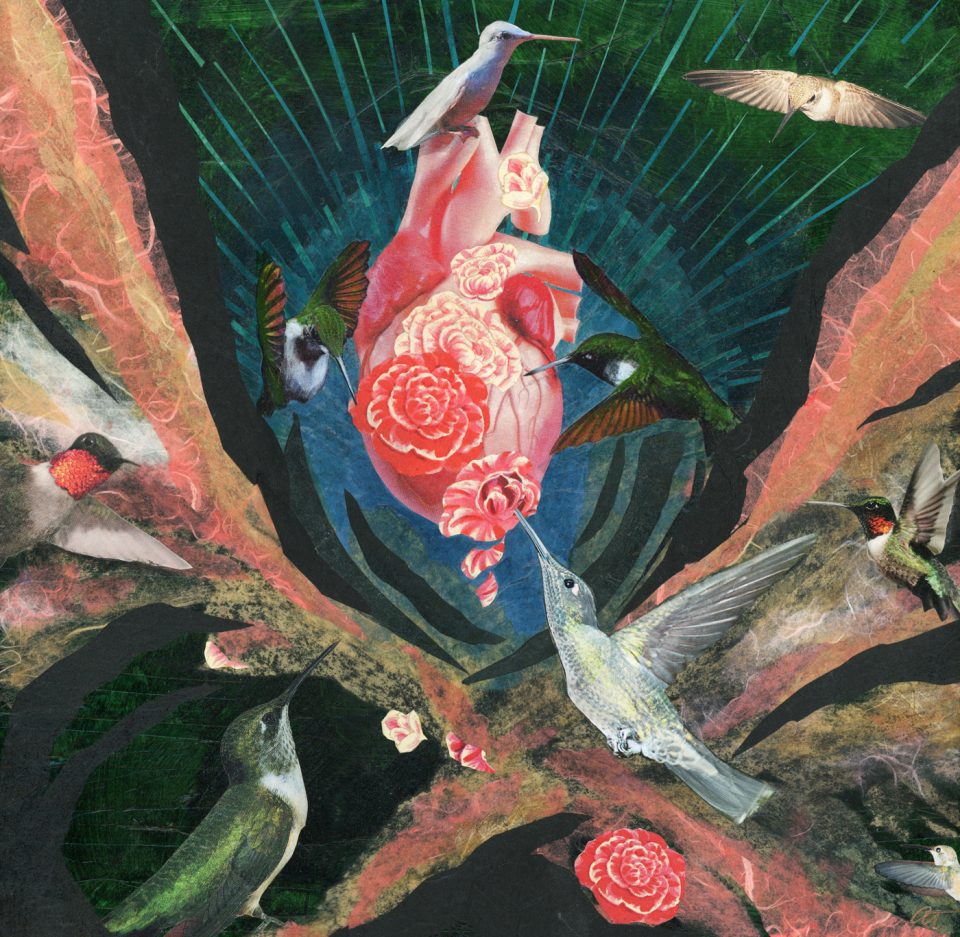
Sweet Heart | 2015 | 12″ x 12″ | mixed media on canvas
How did you begin working in collage?
I went to school for fine arts and I got my BFA, but I really didn’t do anything with it for years and years. I went into graphic design, and I did a few things on the side, but what inspired me to get into collage in particular was the work of Jill Allyn Stafford. She was a board member at 916 Ink, where I do a lot of design work. So I saw that, and I had these little three-by-three wood samples I’d picked up at a thrift store, so I started layering things on them. I think the surrealism and the fantasy themes have always been in the back of my mind—the dream worlds.
I like collage better than painting. I can paint, but I could never do exactly what I want with it. Part of the fun of collage is not knowing where I’m going to be later in the work. It has the element of surprise. I won’t know what a piece is going to mean until two elements suddenly come together. When you’re making a collage, you’re bringing with you the history of whatever piece you’ve just used to the other things on the palette, whereas painting is directing from one source—your mind.
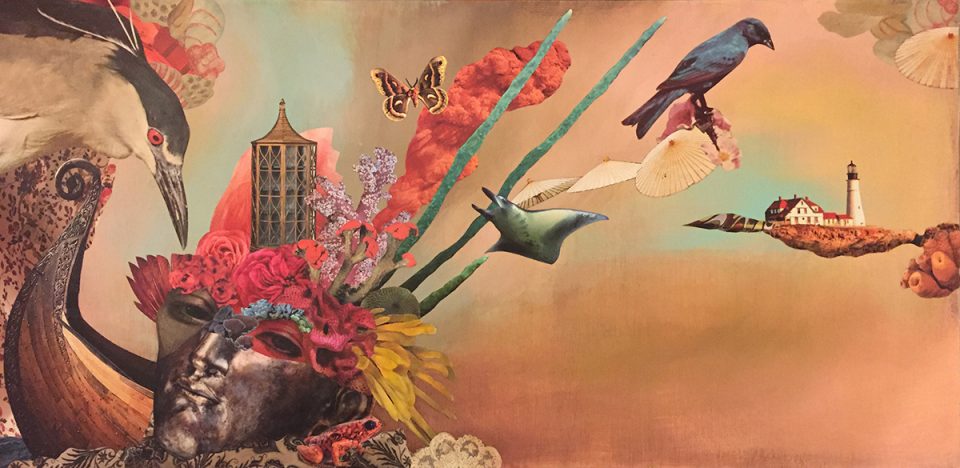
Heady | 2016 | 12″ x 24″ | mixed media on cradled panel board
Do you have a method for hunting down your source material?
I have so many collection items right now that I might have to stop, but usually I have to make a trip. I really like getting pieces from the Time Life series, National Geographic of course, and textbooks are great. I have probably hundreds of magazines and books that I use, but lately, since ArtStreet, or a little bit before, I found Flickr commons, and I use that a lot because I can print to size. If you find the right thing and you want it aged, you can make it look aged. The crackle effects come from a paste, or sometimes it’s layered tissue paper.
Do you have any mood music or media that helps your work along?
I watch bad television, but it has to be a specific kind of TV. Have you ever seen the show Supernatural? Cheesy sci-fi or comic book stuff. Something that would be perfect for the 14-year-old boy, that’s what does it for me. It’s light enough where it occupies only a part of my brain, so the other part can go into dreamland and be automatic. But it’s interesting enough, and a lot of the time there’s weird creatures in there, or something otherworldly. I’ve probably watched every episode twice, I just put it on repeat. The only thing I can’t watch at all while working is comedy—it puts my brain into a completely different kind of rhythm, and everything comes out weird and awful. It’s just something about where my brainwaves land, that puts me in a space where I can create without having to think too hard. When I was little, a big influence was Fantasy Island. That, and we also used to have this Saturday afternoon show that was nothing but dinosaurs, monsters and ghost stories. Anything that has mythology attached to it, or a creature feature of any kind, really drew me in. I guess that’s why those types of shows put me in that right frame of mind, because it just takes me back to my youth. I guess I haven’t changed much.
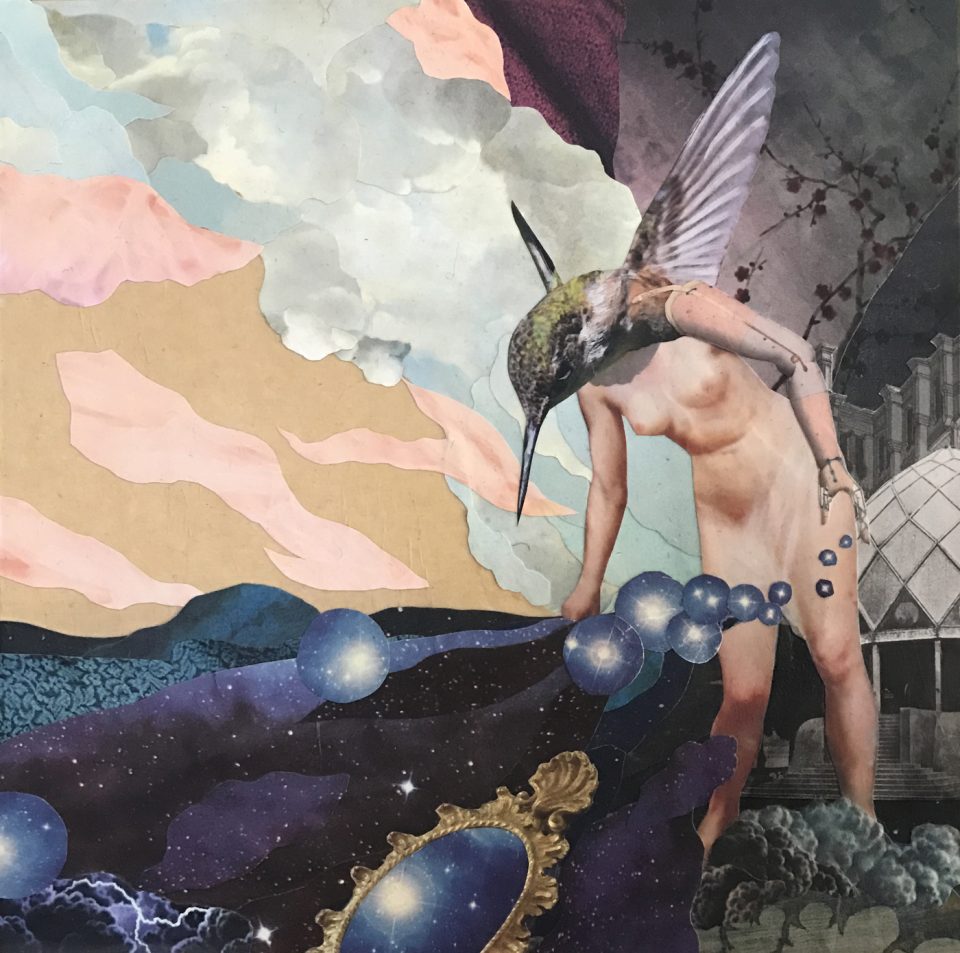
Lady Bird’s Universe | 2017 | 8″ x 8″ | mixed media on cradled panel board
How would you describe the impact of 916 Ink?
Years ago when we started, everybody thought it was going to be a literacy program. And it kind of is, in that there’s reading and writing involved, but what I felt from the beginning that it was going to be, and as it turns out it really is, is kids writing and telling their stories, getting positive feedback and encouragement. You can watch somebody grow, become able to take more chances, have a little more confidence. I swear, you even get a little smarter when you’re allowed to open up, to take things in. You’re not insecure and closed off as much. The kids, more than anything, find this sense of confidence that they didn’t have, and they do better in school and in life. I just posted this the other day, it’s a quote from Rainn Wilson, “If you can tell your story, you can heal yourself.” That’s what’s going on there. I haven’t gone to one of the readings without getting choked up. I’m still fairly new to making art, and I think the biggest thing that encouraged me to start was surrounding myself with people who were positive, encouraging and accepting. That didn’t happen until I started working with 916 Ink. They were great cheerleaders, and they get you to come out of your shell.
Angela Tannehill will be part of the 62 Hues group show at 1810 Gallery, located at 1810 12th St. in Sacramento. The show opens Friday, June 2, 2017, from 6-10 p.m. Tannehill will also be the June guest artist at Studio 10 in Arthouse on R, located at 1021 R. St. in Sacramento. Receptions are first Friday from 6-9 p.m. and second Saturday from 5-9 p.m, with the gallery open on the third Sunday from noon-2 p.m. Find out more at Angelatannehill.com.
**This interview first appeared in print on pages 18 – 19 of issue #240 (May 22 – June 5, 2017)**
PMA-Team
Maya Angelou wisely once said, “If you don’t like something, change it. If you can’t change it, change your attitude. Don’t complain.” The idea is, with the right frame of mind, one can accomplish anything, and with a negative mindset, negativity comes back to you.
If unfailing positivity makes you want to barf, you better get a bucket ready.
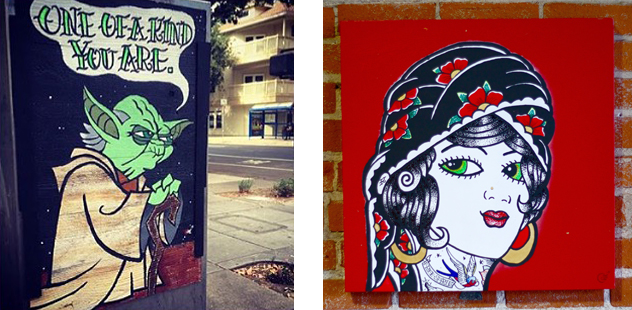
JM Knudsen is a Sacramento-based artist who paints, tattoos, creates clothing, does graphic design and pretty much any form of art he can get his eager hands on.
But he’s not just in it for himself. As coordinator of American Gypsy Apparel and project manager of Sacramento Free Art Drop, Knudsen endeavors not only to create art, but to create new channels for other artists to share their art and collaborate.
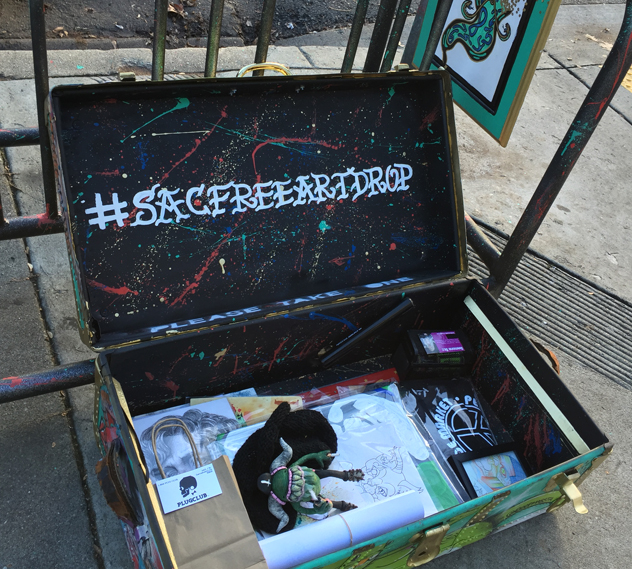
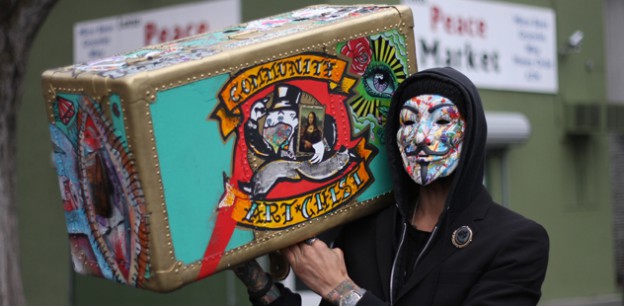
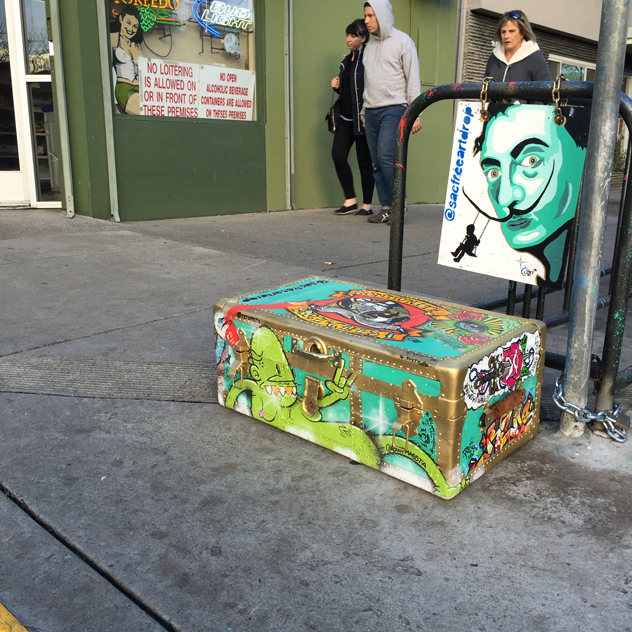
Sacramento Free Art Drop consists of a painted box that shows up in various locations throughout Sacramento and is filled with donated art, free for the taking to anyone who sees beauty in it. Participant Arturo Romero says he was, “… very intrigued by the idea of creating an art hub in the middle of an ‘art desert.’ This city needs color!”
Another participating artist, Ahlo the Alchemist, shares that, “It feels amazing to be a part of such a unique and positive project. It’s cool because you don’t know who is behind the artwork, unless you’re familiar with the local art scene, and [as an artist] you have no idea who can end up with your art.”
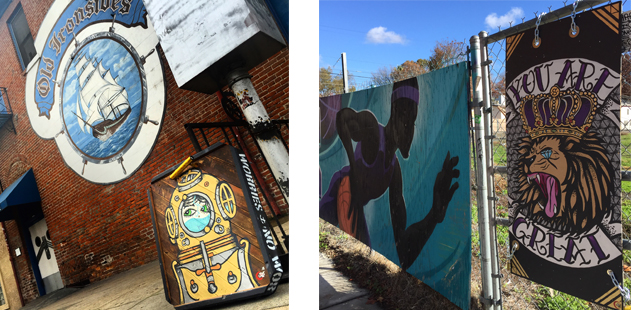
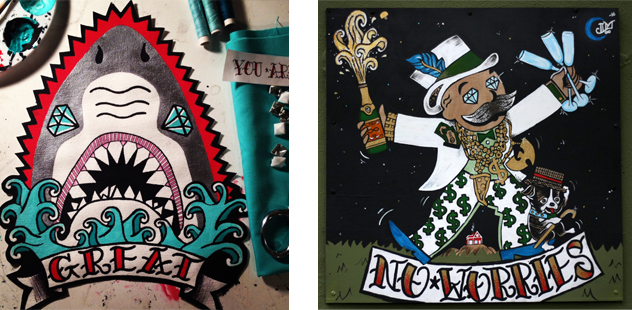
Knudsen’s own artwork can be found throughout Sacramento in public areas, free from the monetary ties associated with galleries. This is not because the artist does not accept payment for his art, but because there are other forms of intrinsic payment that Knudsen also values. Much of this artwork consists of paintings on wood that are held up with chain, temporary adhesive or U-lock.
As Knudsen explains, if you don’t like your local art scene, change your attitude and watch the scene change, too.
Why do you think this project was started?
The SFAD was created to spread local art throughout the community of Sacramento in a unique, new way. It was created to get the art we create as Sacramento residents in the homes of our own people, to cover the walls of Sacramento homes with Sacramento art. To inspire artists young and old to create again, to create for the first time, to inspire future artists of Sacramento and instill a sense of pride in what we can do as people here. To create networking opportunities between artist and admirer. To create a platform for unknown artists to be discovered. To give those without the ability to afford a priced piece of artwork an opportunity to own art.
Artists of all skill levels and mediums are welcome to contribute. Not a single person knows how one drop can affect the course of their lives or the City of Sacramento, so no limitations should exist with who can participate. You truly never know the outcome when you give art without expectation.
And last but not least, you can inspire another to create. No dollar can match this … Without a doubt, art saves.
Have there been any issues with the project so far, or complaints? How is the project being received by the community?
To date, there has been only one real complaint, in regards to a single local artist stating that he wouldn’t drop art in the chest because he felt doing so would devalue his art. But besides that, this project has received nothing but praise from the community.
Describe other artistic endeavors in which you’re involved—from your own artwork, to other collaborative projects.
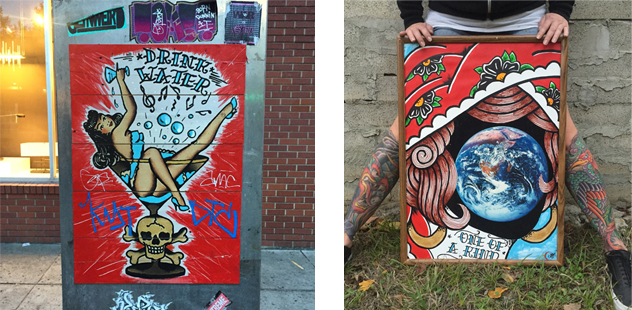
Outside of the SFAD I am the Creative Director/Artist for American Gypsy Apparel “One of a Kind,” an artistic collaborative involving more than 150 artists, including participation in several other U.S. cities and countries. The focus of this group is promoting the idea that we are all “One of a Kind.” The Instagram account has grown to more than 20,000 followers. Some people confuse AG with a brand, AG is not a brand.
For instance, a person in Germany will commission me to design a “One of a Kind” vest with a guitar on the back. I would create that item, text my friend James Cavern for a photoshoot with the vest, and post the photo on Instagram so people can see what James does through tagging him on Instagram, then I would ship the vest.
If an artist shot photography with me for AG, I would pay them with a “One of a Kind” item. Tattoos for sculptures, drawings for haircuts, playing music at an art show for a painting—we find a way to avoid using our currency and trade skills.
In 2016 I have a project with Peace Market around 18th and O streets, with more painting and murals, making art present inside and out. Working with local artists Goop Massta, BAMR and Arturo Romero, we completed a mural on Peace Market the first week of January and we have a group art show at Peace Market together in April.
How does tattooing integrate into your experience as an artist?
Tattooing is a major part of the artistic culture. Midtown Sacramento is saturated with artists and many residents are heavily tattooed. Things I want to express the most, I get tattooed.
What is the state of the art scene in Sacramento currently, in your opinion? What’s going well and what’s lacking? How would you like to see it change?
In my opinion, the state of the art scene in Sacramento is stronger than it has ever been since I’ve lived here. Artists are really starting to come together to do tremendous things, and it’s beautiful to witness—holding events like Launch and TBD Fest that bring in big name artists to our city, and show our artists off to the city. This is bringing us forward in a major way.
The Warehouse Artists Lofts are a great addition to the community as well, a place where artists can afford to live, create, thrive and collaborate. Establishments like the Hacker Lab are a valuable resource where we can learn the tools that can get us to the next level as an artist.
Murals are popping up all over downtown where businesses are becoming more accepting of the artist’s ability to attract through art. Coffee shops like Old Soul and Insight are giving artists a chance to showcase art for 30 days.
With technology, times have changed drastically for artists—many artists who don’t use Instagram are missing out on a free platform to showcase their ability, to network with other artists, to sell their craft and to see what other artists are doing around the world.
How can people find out where the art box is going to show up and when?
To track the whereabouts of the Community Art Chest, follow the Instagram account @sacfreeartdrop. The Chest is set to be at Peace Market on 18th and O every second Saturday of the month for the Art Walk. But the chest can pop up anywhere in Sacramento.
Follow Sacramento Free Art Drop on Instagram (@sacfreeartdrop) to find out where it may pop up next! You can also learn more about American Gypsy Apparel at Americangypsyapparel.com or on Instagram @americangypsyapparel.
Rich and Strange
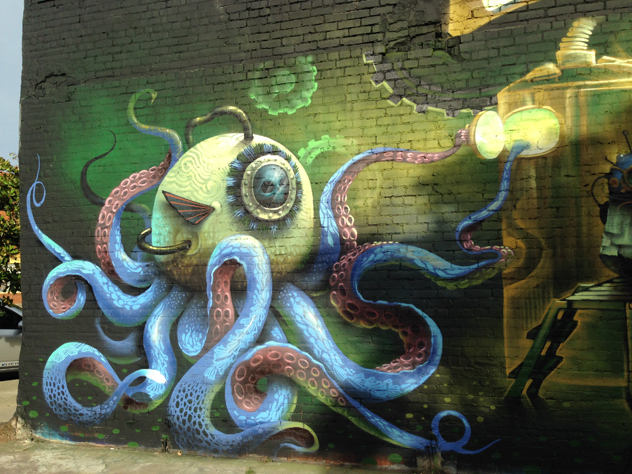
A bizarre creature slithers alongside the brick wall of the Oak Park Brewery. Somewhere between pufferfish and kraken, its alien form elicits menace and wonder in equal measure. From a porthole-like opening in its side peers a glowering skeletal countenance, locked in a permanently frozen cackle, delighted to have entered our poorly defended world.
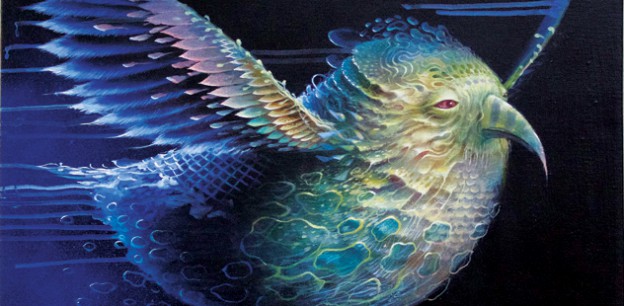
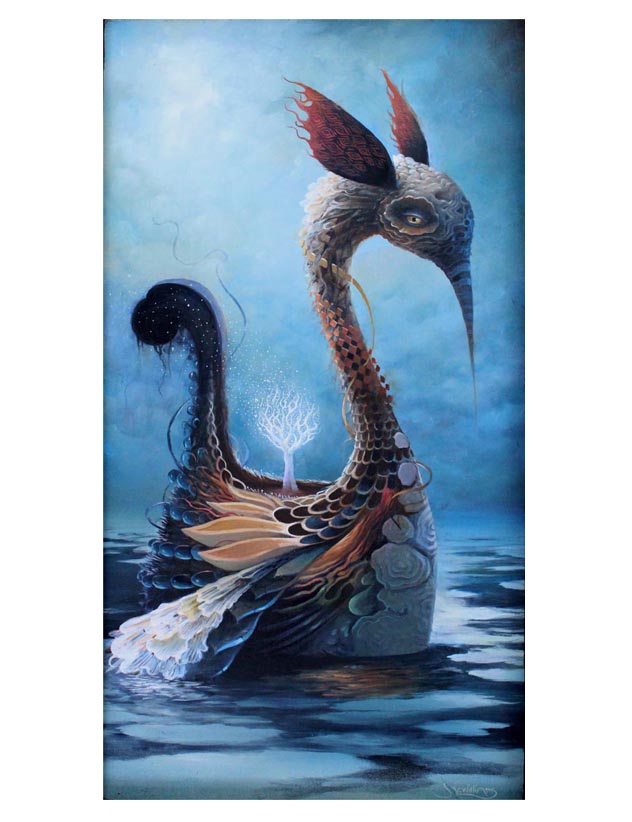
A curious hybrid erupts from the doorway of the Colony on Stockton Boulevard, a kind of bio mechanical sparrow bedecked in sea-dragon’s garb. Peer into the cavernous eyes in the midst of its ornate head and ask yourself, “Is it living? Or is it clockwork?” From what world do such things come, manufactured but intricately organic, natural but forever altered as if under the hand of a 24th century jeweler? In a word, the answer is S.V. Williams.
A Sacramento native resettled in recent years after spending some time in the Northwest, Stephen V. Williams (styled S.V.) has gotten some high visibility of late in the downtown art scene. Several of his works have helped it to expand quite literally, bursting from the confinement of the canvas onto several prominent locations around town. These murals are a specialty of Williams’, whose early background lies in graffiti and other public artforms. Recently, we caught up with the artist at his home and studio to chat about the origin of his work, his Sacramento roots and the challenges of working with an audience.
In August, 1810 Gallery will showcase Williams’ latest works in a more intimate setting with a series called Relics—an apt description of the forms visitors will be introduced to there. Through the shadows and twilight glow of a changed Earth wander magnificent and bizarre creatures, recognizable, perhaps, but having undergone a sea change. Come for yourself, and prepare to get acquainted.
{Tree Ferry}
When did you start painting?
I want to say my first painting was in, like, 1999 … It was with spray paint, and, I don’t know if you’ve seen that movie Man Bites Dog, but I did a portrait of the main character in spray paint. At that time, I was so involved in graffiti art and drawing letters, that I was kind of against branching out into conventional painting. I would say that I really started to consider this a full-time occupation around 2007. I had a show in Portland, and I just had a random assortment of my paintings with me, and this gallery owner in Portland wanted to give me a solo show. At the time, they weren’t very cohesive as a body of work. I had that show, sold some paintings, and got some amazing responses, so after that I told myself, “I’ve got to stop working at this pizza shop and eating pizza all the time and just paint.”
I took some community college classes for art—mostly gesture drawings to get structure and balance down. But I’ve just been doing my own thing, since I started drawing and painting. I haven’t really felt the need to go to art school. I just keep going, developing my own style, doing what I want to do.
{Oak Park Brewery mural}
Is there more a feeling of pressure when you’re doing mural work in public?
When doing a mural I always want to get a basic image down immediately, because when you’re out in public like that, people will see you doing the first part of a work, and though as the artist you know what the final result will look like, they’ll be like, “What are you doing?!” [laughs]. That actually happened to us over at the Oak Park Brewery. We painted the entire wall black first, and were laying down the background when these people came by. We were like, “Hi, how are you doing?” And they replied with something along the lines of, “Well we were doing great until we saw this.” It was in a stage where there were no concrete images laid out yet. So I always try to work fast. Still, I’d say that murals are my favorite work to do.
Contained paintings are great too, because I can isolate myself, hang out with my painting, have beers with my painting. But I just love being outside, and even if there’s a weird reaction from people, I still like getting reactions from people. Even if someone calls it stupid, I’m like, “Thanks for actually noticing it,” you know? Some people will just walk by and look at it and nonchalantly look away, and it’s like, “Do you not know there’s something being created here?”
In what kind of world do your paintings exist?
I guess you could say it’s a little futurist. The way my figures look is what has happened to life on Earth: deformations. It’s kind of dark to think about, but I imagine something similar to animals in the sea that have been around so much trash and debris that their bodies grow around a certain thing because it just got stuck onto them. I kind of see them as a new breed of animal that have survived something. They’re kind of mechanical, too.
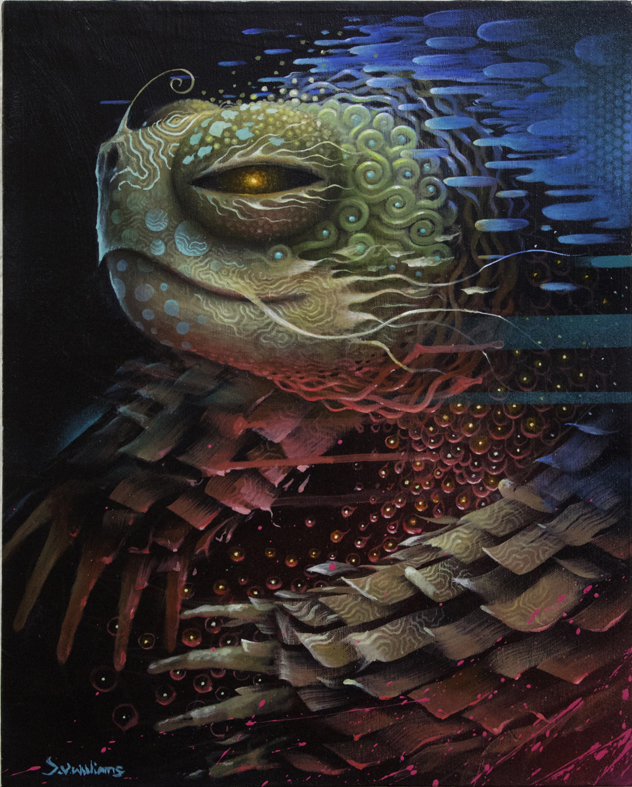
{Turtle}
There’s a large focus on animal forms in your work. Have you always been drawn to this subject?
I’ve always been fascinated with all different types of animals, especially birds and fish. The piece I’m working on now is a stag. I grew up camping a lot with my dad, so I’d see a lot of animals. I’d never hunt or anything, though. What I do to them on the canvas—I feel like I age them, put them in an alternate universe where nature is bound to the animal but there are also mechanical elements, like scales or feathers that resemble metal plating or armor.
But they’re not completely like machines—there also seems to be a warm feeling in these works.
Yeah, especially with the light that I try to add in. A lot of the time I tend to paint really dark, so the light colors really give the painting a warm, soulful feeling. And there’s usually some kind of relationship with the painting and another creature, like moths floating around them in the background. I don’t paint people often. I just find animals, and the mystery about them, to be far more interesting.
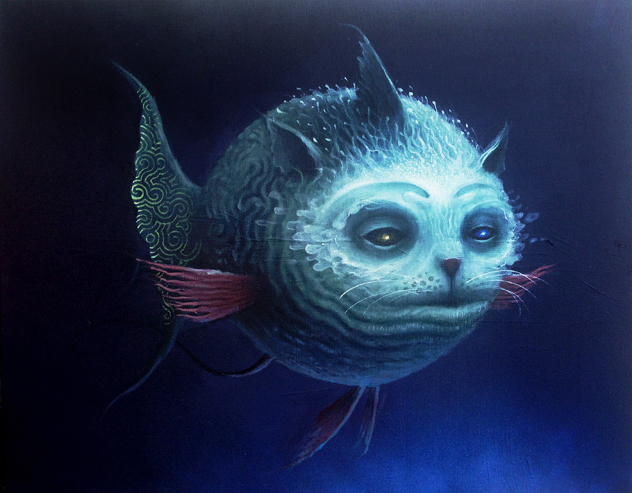
{Ridiculous}
What were your earliest visual influences?
Definitely comic books. I was very into drawing comic books. What pretty much got me to start drawing was, I would just kind of emulate different characters and create my own. And I would always kind of piece things together. How my current drawings come about is, there are tons of different pieces of things but the general structure of it is obviously a certain animal or a certain insect. I usually start off with a rough sketch, sometimes just of a particular feature—the scales, for instance. But as far as comics, I was always into the darker stuff, like Todd McFarlane’s Spawn; there have been a lot of horror and sci-fi influences.
I also hear that you did tattoo work for a while?
I apprenticed for like a few months. One thing—you’re in the shop all day, waiting for people to come to you. I know a lot of tattoo artists, a lot of my friends are tattoo artists, and they make good money doing it, but I would have had to switch around my style a little bit, change things up, make my work a little more traditional looking. I didn’t really want to take the time to relearn my art from the beginning. It’s definitely a skill I appreciate. But mostly now I’m into painting, illustrations, and I’m starting to get into some clothing stuff too. In fact, I have a screen press I’m working on right now, so I’m going to start making some shirts. Throughout the duration of the show, I’ll try to get some of those in the gallery, as it will be up for a month.
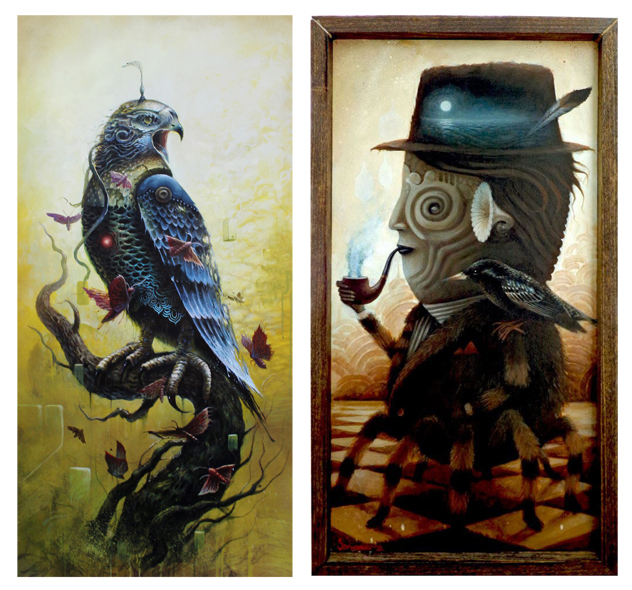
{Untitled, left | Gentle Beast and His Starling, right}
What have been your most rewarding experiences as an artist?
I do a lot of murals and group shows in L.A., and I also do a lot of music festivals. There’s this one big one, Lightning in a Bottle—that’s probably the best time I’ve had as an artist. There is like 60 live painters there, and it’s cool because there’s this big auction at the end and so the whole time you’re there you have the potential to make money. They set up artists all around the festival, and they try to keep them around each other so there’s not some artist who’s way out in the parking lot. But on the last day, they bring all the panels into one area, and so they just like surround this space full of art, and it’s like an art walk. There was also this collaborative piece I worked on with a friend in Coachella that was huge, and somebody bought that. I actually hit up TBD about that, because it would be awesome to have something like that. The music at these events is definitely a big part of my process. When I’m listening to good music, I paint so much better. I was at a Concert in the Park not too long ago—I was set to be painting out there—and I couldn’t get into the music at all, and I could not paint at all.
What’s your go-to painting music?
I listen to a lot of Mogwai, Sigur Ros, things that are a little tripped out. I really enjoy listening to instrumental music, and I can become engulfed in the piece I’m working on. Especially for like a new series of paintings, if there’s a new album, I’ll just constantly listen to that, and I find that a whole series of my paintings will be cohesive with that album.
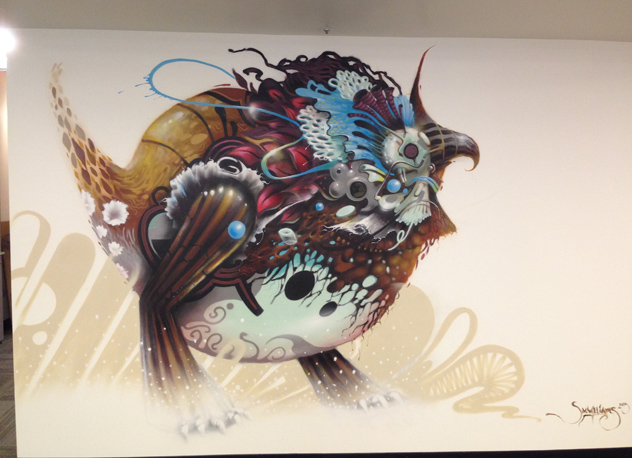
{Reddit mural}
How would you describe the local arts scene?
The artistic community is awesome. It’s growing so much and there seems to be more people and businesses that are willing to showcase murals and other public works of art. I feel like Sacramento is a little bit behind in that sense, because when people hire you for murals, it has to be tied in with the business some way. Like, if I draw one of my creatures it has to be holding a cheeseburger in its hand, or wearing Nike shoes. If you give an artist full creative freedom, then there’s just going to be that much more unique work around town. But just having artwork out in public all the time is going to inspire people, drive artists to push themselves.
To learn more about S.V. Williams and get a glimpse of his latest work, you can visit his Instagram page at Instagram.com/svwilliamsart. You can check out the opening reception for his exhibit Relics at 1810 Gallery (located in the WAL, 1810 12th Street, Sacramento) on Aug. 7, 2015, from 6 to 10 p.m. Check out Facebook.com/1810gallery for more info and upcoming shows.
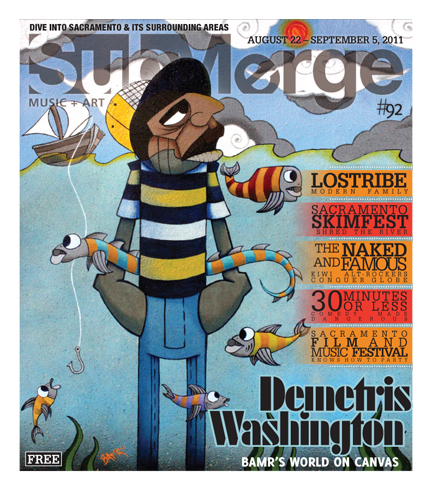
Demetris Washington becomes a better man through art

Photo by Edgar Guerra
As a toddler, Demetris Washington used to think of the world as his own personal canvas. He started off as would any other child, scribbling on anything and everything he could grasp with his tiny hands. To his mother’s disadvantage he would create pieces of art on the walls, the floor and sometimes even paper. “When I looked at my ultrasound, I was in my mom’s stomach and there was a pencil right next to me. I had a palette and everything,” Washington joked while eating an oatmeal cookie outside of Sugar Plum Vegan Cafe. “When I came out [of the womb] I had a No. 2 pencil. The doctor was like ‘He’s going to be an artist.’”
In elementary school, Washington began to create comics with his own characters that left his family wondering where his imagination would take him next. “I never had fun drawing other characters. I never drew The Hulk, never drew Superman or anything like that,” he said. “I always came up with my own characters. My uncle was always asking, ‘How do you come up with this stuff?’”
While attending high school in Stockton, Calif., the realization that art can become a career started to settle in after he got paid to paint a mural of the school mascot in the boys’ locker room. “I really hyped the team up with that one. Every time they came in [the locker room] I could see their faces lighting up. And I thought, I really like this reaction I’m getting out of them, this is beautiful. People are happy with what I’m doing and I’m getting paid,” Washington said. And while getting his associate degree in graphic design at The Art Institute in Sacramento, he boldly tangled the worlds of comic books and graffiti to form a unique genre of art that he has righteously claimed as BAMR. “Becoming a Man Righteously. For a minute I was really skeptical about this name but when I began to tell people, ‘My name is BAMR,’ they would look at me weird. And that’s the reaction that I wanted, for people to look at me weird but then I tell them what it means,” Washington said.
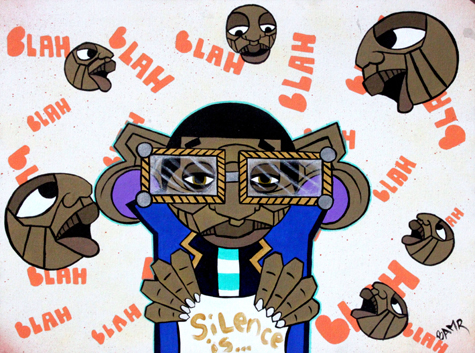
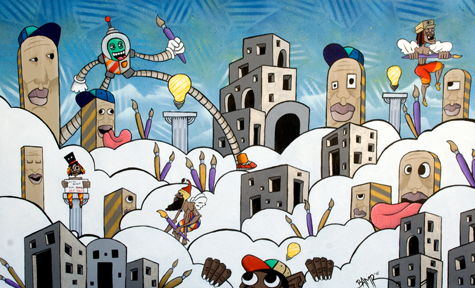
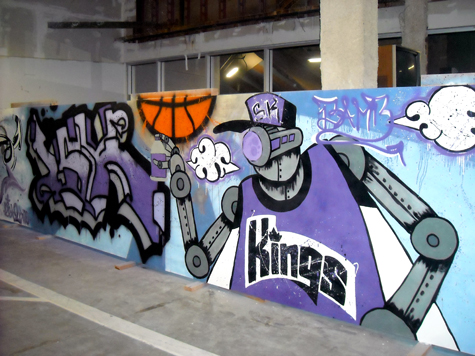
From scribbling on the walls as a toddler to attending art school, Washington has found himself working on projects for the Sacramento Kings, where he would paint on jerseys, shoes and billboards to raise money for charities. Now he has his own show, Building Legacies, at the adorable Legacy Boutique in Midtown. His artwork pops out at you because it is full of colorful characters and shapes that are dying to jump from the canvas and come to life. Although he did not want to draw mainstream cartoon characters as a child, he was inspired by one cartoonist, E. C. Segar, the creator of Popeye.
“If you look at my characters’ arms they look like they ate a little bit of spinach before they went out,” he said with a laugh.
One piece, called Head Above Water (pictured last/used on cover), shows a man with most of his body submerged in water except for his head. The piece represents Washington starting off as an artist who can finally breathe after beginning to make a name for himself and get more freelance work, he said. Most of his vibrant art pieces are based on his life experiences and ideas that he comes up with, normally between the hours of midnight and 5 a.m.
“I do the paintings at night because it seems like that’s when the ideas come to me, when I’m supposed to be asleep, when I’m supposed to be dreaming. It’s like I’m awake but dreaming at the same time,” Washington said. “I don’t need drugs, I got enough in my own mind. That’s another reason why I paint, because I have the hopes that everybody sees what I’m seeing, so I don’t feel crazy… I sit there and I’m literally struggling to stay sane. I’m sitting there painting and all these thoughts and ideas going through my head and nobody to share it with except this canvas.”
Washington uses his one-car garage as an art studio, which can no longer fit a car in order to store all of the art supplies. But these days he is feeling a bit “too big for the castle” in the small garage and hopes to move to Los Angeles by the beginning of next year and find a bigger studio to work in. After living in so many California cities, such as Monterey, Oakland, Hayward, and Stockton, he doesn’t like to compare the Sacramento art scene with other cities. “I see it as squeezing the last of the toothpaste. Definitely a beautiful place to do art but maybe not as many opportunities for every artist, for every style,” Washington said. “I feel it’s kind of biased. But I’m here, and Sacramento has been good to me, so I’m thankful for it.” Outside of his small Sacramento garage, the 20-year-old freelance artist and graphic designer makes sure to balance his social and work life by finding time to spend with his two young sons.
“They really are the reason why I do everything that I do. I want make an impact on their lives. I wasn’t able to spend so much time with them, because I was working so hard just to make sure they had what they needed,” Washington said. “And I realized what’s more important is the fact that I’m there for them. They get material things but it’s not going to fill in that void where love belongs. So I had to stop for a second, pause and spend more time with them. You can’t become a man righteously if you have two sons that you’re not there for.” But finding time for his family is evident because inside of his sketchbook, which is filled with his own intricate drawings, there are the occasional scribbles from crayons. Washington proudly pointed out the different art techniques that his 2 and 3-year-old sons have created on the pages from coloring with crayons. Demetris encourages his young sons to be creative and let their imagination take over, just like their father’s. “People look at my work and say, ‘Dude how do you come up with this?’ I was going to ask you the same thing. I don’t know how I come up with it. It’s just there.”
BAMR’s Building Legacies is now showing at Legacy Boutique, 2418 K Street, Sacramento. The exhibit is free and open to the public. For more info, call the boutique at
(916) 706-0481.
The Scary Art Collective Brings Their Art to the People
A fault of artists is their inability to comprehend a recession. Despite being conditioned for poverty, artists on the Second Saturday circuit continue to tag their work with lofty prices, turning a cold and dented shoulder to the slimmed pockets that stroll through the galleries.
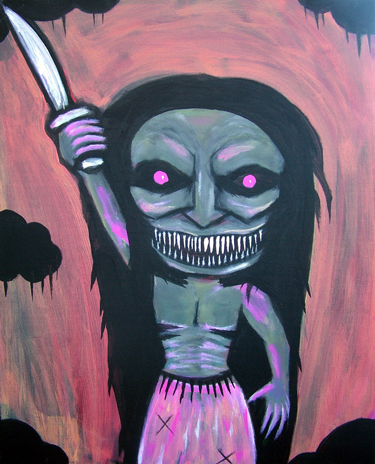
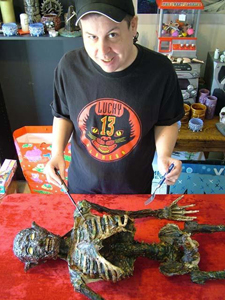
Nicolas Caesar does not have the privilege of letting his art remain in his possession. He’s got bills to pay. Call it low brow, call it tawdry, call it plebeian, but you can’t call it depreciated, as Caesar and his Scary Art Collective are selling their art before they can get it out of the boxes.
Chip Conrad, owner of Bodytribe Fitness, was the first to coin the collective. Four years ago, Conrad opened his fitness center to Caesar and his friends to use as an art gallery one Halloween, the only holiday that complements Caesar’s macabre style. “I remember getting this Myspace message asking if I wanted to show my art in a gym,” he said. “I totally thought I was walking into [a situation] of getting raped, but I’m like the girl who can’t say no.” Caesar did not get harmed, physically or emotionally; instead he formed a friendship that led to a love for the Sacramento art scene. It was a love that he described as a refreshing escape from the Bay Area scene.
From there, it became a repetition of faces. At galleries in Midtown or San Francisco, Caesar was showing his work and cheering beers next to the same few people. In this overlapping, Mark Fox, Temple Terkildsen, Cinder, Krissi Sandvik and Caesar began seeking each other out and sharing galleries. The loose organization has an unrecorded number of members, with an East Coast and West Coast branch. “Since we share the same territory, it’s a cross between Thanksgiving and AA,” he said. “We all share our tragic stories and our successes. Every Second Saturday is like meeting up with our second family.”
The art is mostly Gothic and dark, pulling inspiration from horror movies and the morbid subconscious. The artists share a magnetic desire to express their darkest thoughts, creating an organization comprised of your garden-variety goths to the criminally insane. Caesar is a pen pal with convicted serial killer Wayne “Skid” Lo, who is not a member. “Wayne is not officially a member of the Scary Art Collective,” Terkildsen said. “But, he does trade art with Nick.”
“My whole feeling about it is, the guy’s in prison,” Caesar said regarding his lack of concern. Caesar bought a piece of Lo’s art called Flushy the Toilet Monster. All of the proceeds from Lo’s art go to the victims’ families. “I’m gaining the Gilligan’s Island of strange and weird people [in my life],” Caesar said. “Weirdness is attracted to us.”
Living among the proletariat, Caesar is a self-proclaimed artistic anarchist who disregards the traditional rules of gallery art. He markets his work to the collectors and appreciators that keep a 30 pack of Pabst Blue Ribbon in their refrigerators and eat Top Ramen to get by. “I sell to my own demographic,” he said. “[Artists] don’t really understand who collects their art”¦ Artists have to go back to catering to the people.”
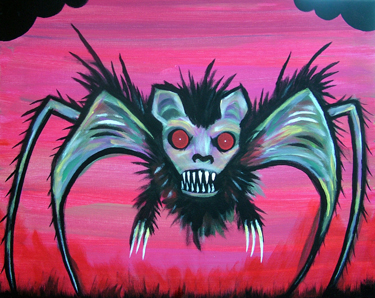
Terkildsen said the members of the collective are firm believers in the bartering system. On a slow night, she’ll trade two cases of beer for her art. “I’ve traded a painting for a haircut,” Terkildsen said. Essentially, they sacrifice the pompous satisfaction of selling one great piece at top value for the opportunity to put hundreds of pieces in as many living rooms as possible. Caesar and Terkildsen do not hesitate to call themselves art gypsies.
For Caesar and Terkildsen, the collective is an extension of their daily routines. Terkildsen said she works her shitty part-time job, works on art for four hours at home and then spends the remainder of the night at Caesar’s home drinking the Blue Ribbon and watching campy horror films. With work habits like that, the duo produce more art than they can store in their homes, making the bartering system all the more necessary.
“I’ve actually timed this,” Caesar said. “I can make three pieces to the movie Escape from New York.”
They are unapologetic in their merits. Both artists recognize the critiques that can be made of their leftist perspective, but they seem to revel in the judgment. Caesar said the collective’s strongest attribute is a lack of competitiveness in a cutthroat profession. Before founding Scary Art, he was frustrated with the unwillingness of his contemporaries to share galleries and the snootiness that comes with a saturation of artists. The Scary Art Collective aims to redefine the relationship between artists and galleries by operating outside traditional spaces. The collective has had shows in adult boutiques, tattoo studios, S&M clubs, gyms, coffee shops, bars, horror and comic conventions, warehouses and churches. Caesar likes Sacramento because of its bounty of unique spaces run by down-to-earth people.
Terkildsen described the horror of galleries outside of Midtown, expressing a loathing for curators who proclaimed they could not show her art due to its pricing. “You’re in a fine art gallery with a bunch of fuckheads you’d never talk to and you think, ‘Wow I really can’t stand this,'” she said. “Immediately, I want out and to be doing a show with Nick. I prefer the open flea market of Midtown.”
Ritually our conversation came back to PBR and living a life without the knowledge of which fork is for salads. To the affluent, this might seem like a life devoid of taste, but Caesar and Terklidsen’s art reflects a deep-seated passion for beer and cheap horror films. Read any of his comics and you’ll find black humor applied to boozed-up zombies. They share a distaste for the art critic, or in Caesar’s mind, the pastime of gremlins suffering from insomnia. “It’s a useless occupation,” he said. “For as many pages as an art critic can write, there’s going to be that person that goes into an art gallery and says, ‘You know what? I like skulls’ and buys our art.”
Terkildsen sees no glamour in an artist living off corn tortillas from the dollar store, nor does she have kind words for art critics. She keeps doing art for the feeling that comes from hearing the excitement in a few little girls’ voices at a recycling show. “I was fixing this skeleton inside this sculpture only to hear two little girls [exclaim], ‘Wow, that’s awesome,'” she said imitating their childish wonder. “How do you put a price tag on that reaction?”
Making Caesar and his friends into scapegoats for lowbrow art would only validate their convictions as monsters of the art form. Growing up, Caesar sympathized with the plight of the monsters in movies—Dracula’s eternal life, the Wolf Man’s inability to control his animalistic hunger. He sees the humanity in these pariahs. It brings to mind Caesar’s drawing of a zombie ghost feasting on a person’s head with the caption “What?! It’s what I do.”
“I was the oddball,” he said. “I was the weirdo and the freak. As an artist you’re perpetually shit on. It’s right back to the peasants and the pitchforks.” He takes comfort in being the artist who stands out from the landscape paintings, by being the guy next to the canvas bearing a bloody headless image.
On Saturday Oct. 24, 2009, Terkildsen and Caesar had a gallery showing and costume party at Side Show Studios at 5635 Freeport Blvd. Ste. 6.