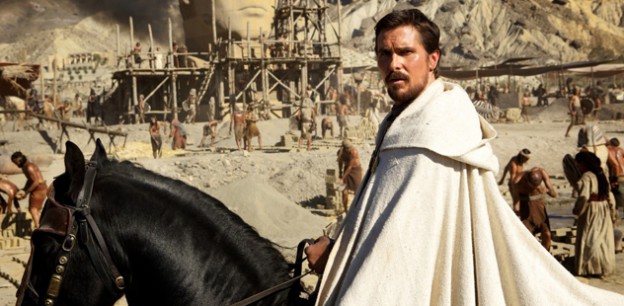
Exodus: Gods and Kings
PG-13 {1.5 out of 5 stars}
Bible stories. You know you’ve been waiting for them. And guess what? They’re here, and some of them star Russell Crowe! Let me just reassure you that there’s nothing wrong with fantasizing about Dwayne Johnson as Goliath in the next James Cameron film. David vs. Goliath is a Bible story, right?
I don’t really remember. Like many, I went to Sunday school as a kid but was ultimately unaffected. I harbor no ill will toward Christianity, though no particular reverence either. I feel perfectly capable of looking at a movie like Exodus: Gods and Kings, and reviewing it without bias. Because when you get right down to it, the Bible is full of amazing stories (whether or not there’s any truth to them is a conversation for another time between people who actually care about such things). But at the very least, the Bible is a treasure trove of allegory and adventure, and it makes perfect sense that Hollywood would begin turning more and more of its tales into major motion pictures.
Exodus: Gods and Kings is the story of Moses. Driven out of Egypt by Pharaoh Ramses after the revelation of his Hebrew roots, Moses defies exile by leading 600,000 Hebrew slaves from their collective shackles under the guise of Almighty God. Christian Bale portrays the man of the hour, leading a relatively star-studded cast that includes Ben Kingsley, Joel Edgerton, John Turturro, Aaron Paul and of course (being that this is a Ridley Scott film) Sigourney Weaver. Seemingly all the necessary ingredients are at hand for a massive epic, and clocking in at 150 minutes, you’d have to believe that Scott felt the same.
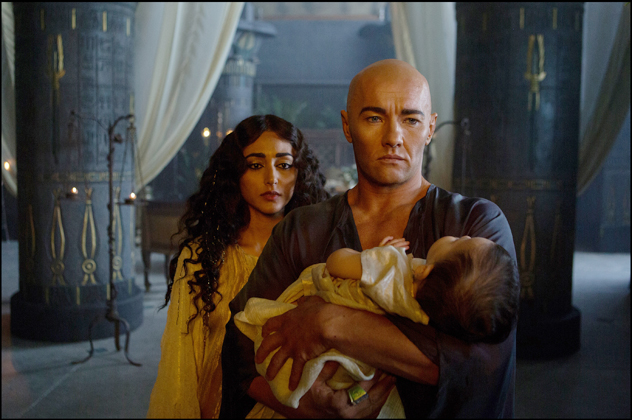
But, simply put, Exodus is boring. No. It’s a horse tranquilizer. Other words that might describe its aspect would be stale, milquetoast and overreaching. Let us now evaluate each word above and its applicable nature.
Boring: Good Lord does this film plod. Long stretches of uninteresting dialogue wrapped in a cloak of Biblical history has a way of wearing one down after a while. And by “a while” I mean about three minutes.
Stale: The acting is lifeless. Joel Edgerton’s portrayal of Pharaoh Ramses couldn’t possibly be less intriguing, and the same can pretty much be said for the lot of ‘em. (When John Turturro is flat-out invisible in a character role, you know there’s something wrong.) And you’d also think that recreating Egypt BCE would equal somewhat of a visual thrill, but again, you’d be wrong. It’s like Moses went to Modesto.
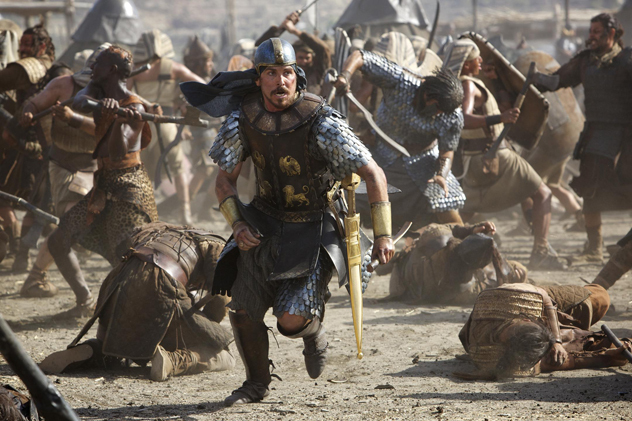
Milquetoast: Difficulty catching five winks in your busy schedule? Try the Exodus action sequences on for size. They’re so spineless, at one point I actually thought the poor soul next to me was taking a nap with his eyes open.
Overreaching: As someone who doesn’t know how many pages in the Bible are actually dedicated to the story of Moses, I can only reflect on what the film has to offer. And what it does offer is a setup far too grand for a payoff far too small. No Charlton Heston moment here.
In other news, I’ve heard some criticism regarding the film’s casting and its general lack of Eastern faces. Moses certainly didn’t look anything like Christian Bale, that’s for sure. But this is par for the course, and follows a long-standing tradition of cinematic opuses that reads like the 11th Commandment: “When in doubt, cast white people and give them British accents.” You’re also sure to hear critiques on the film’s historical accuracy, which to me is laughable, as it is in all likelihood a made-up story in the first place. Though I suppose if you really do believe the Bible word for word, you’ll find something legitimate to take umbrage with, just as I do with, say, The Rum Diary.
I feel comfortable saying that there are worse movies than Exodus: Gods and Kings. It’s not repellent, it’s just not any damn good. I kept thinking how much it reminded me of Kingdom of Heaven, which I later realized is also directed by Ridley Scott. It’s possible that if you’re a practicing Christian, you’ll find a smattering of interest here. But religion should not mask the fact that this is just a dull, forgettable film.
Prometheus
Rated R
Ridley Scott’s Alien came out in 1979, perhaps before a lot of you were born. The sci-fi/horror hybrid was a truly frightening and groundbreaking film that propelled Sigourney Weaver to superstardom and birthed countless comic book crossovers and a long-lived film franchise, of which only the first two films (including James Cameron’s action-fueled 1986 sequel, Aliens) are really worth seeing. Prometheus takes us back before the beginning. It’s a prequel, a word that may have left a bad taste in your mouths after the debacle that was the prequels to the Star Wars saga. In Prometheus’ case, a look back proves to be more enlightening (and opens up even more questions) to the events portrayed in the Alien series as opposed to damaging their legacy.
The year is 2089. Two researchers, Elizabeth Shaw (Noomi Rapace, Lisbeth Salander of the Swedish-language The Girl with the Dragon Tattoo) and Charlie Holloway (Logan Marshall-Green), have patched together clues from ancient cave paintings, left by civilizations from all corners of Earth to create a map to a moon in a far-off solar system capable of supporting life. While that discovery may be monumental enough, it’s even more so because Shaw and Holloway hypothesize that this moon may have been the origin of the human race–as well as the beings known as Engineers who created it.
Peter Weyland (Guy Pierce) assembles a rag-tag exploring party to accompany Shaw and Holloway on their journey. Weyland is convinced that the Engineer theory is correct and that contact with this mysterious race of beings could answer humanity’s greatest question, “Why are we here?” Led by the icy Meredith Vickers (Charlize Theron), the party aboard the Prometheus find what they’re looking for, much to their chagrin.
Story aside, Prometheus is awe-inspiring to behold. Audiences will no doubt be left slack-jawed by the film’s bold look and stunning scenery. In most cases, 3-D seems little more than an easy way for big-ticket Hollywood films to pad their box office numbers, but much like Avatar, which really ignited the 3-D frenzy, it would be to your detriment to view Prometheus in its flat transfer. Sweeping panoramas of alien landscapes, wonderfully rendered computer effects and trippy digital-static overlays are wonderful fodder for eye-popping visuals, and Scott seems to use them to wonderful effect. Do yourself a favor and spring for the extra few bucks.

More traditional elements also enhance this feast for the eyes. H.R. Giger’s twisted cyberotica, which has been an Alien series hallmark since 1979, flavor Prometheus with terrifying notes, touching upon fears that are exotic and familiar. From the macabre marriage of the technological and organic of the Engineers’ fortress and control rooms to the freakishly vulgar creature creations, the uneasiness of the characters seems mirrored in their otherworldly surroundings.
It’s good that the visuals are so stupendous, because the film’s plot is surprisingly basic. Co-written by Lost co-creator Damon Lindelof (with John Spaihts), one might expect a dizzying story with a lot of twists and turns, but there aren’t many to be had. There are instances where we see flashes of the philosophical/spiritual mindbenders that were Lost’s trademark, but in the end, Prometheus stays true to the Alien franchise formula: humans trying to manipulate forces they don’t fully understand to their own greedy ends. There is the rich man, Weyland, who knows more than he lets on (a sort of Charles Widmore, perhaps?) and the android who seems helpful but may have its own nefarious agenda–devices that anyone familiar with these movies has probably come to expect. Unfortunately, other than a tense scene in a robotic surgery chamber, there isn’t much in the way of suspense that made Alien such a classic.
There are a couple of noteworthy performances, though. Rapace, who really gets run through the wringer in Prometheus, is the prototypical Scott heroin. Amazingly fit, she’s also tough, persistent and perhaps a bit bitchy, but she certainly upholds the high standard set by Weaver in previous films as the central character. Michael Fassbender is a wonderful antithesis to Rapace as the outwardly charming robot David, who models his appearance after Peter O’Toole in Lawrence of Arabia. Underneath his classic screen star looks is a personality more akin to 2001’s HAL9000, however.
In true Lindelof fashion, Prometheus answers as many questions about the Aliens’ origins as it poses new ones, which may be answered in another film. As beginnings go, it at the very least opens the door to a promising future.
Cedar Rapids
Fox Searchlight
Naïveté is an endearing quality. The world can be such a shitty place, it’s easy to cheer for the person who seems to be immune–the person who still believes in things like honesty, decency and love. Of course, as we all know, the world is a shitty place and usually eats people who believe in such things for breakfast. The Office alum Ed Helms steps out from his usual role as a supporting actor and into the spotlight as Tim Lippe in the new comedy Cedar Rapids. Lippe, a stereotypical rube from a small town in rural Wisconsin, is somewhat blind to the dangers of the big, bad world, but he learns about them quick when his career takes him to “the big city” and lands him in serious moral and occupational dilemma.
Lippe is just a regular Joe working for Brown Star Insurance, a highly decorated insurance company. He loves his job and even sees his profession–insurance agent–as a noble pursuit. However, things aren’t as typical as they appear. He’s in a relationship with his middle school teacher (Sigourney Weaver), who, though very fond of Lippe’s wide-eyed optimism, isn’t interested in settling down with her younger lover, or anyone else for that matter. When Lippe’s agency’s top agent (Reno 911’s Thomas Lennon) dies from an injury that apparently occurred during a sexual escapade, Lippe is charged with representing Brown Star at a big insurance convention in Cedar Rapids, Iowa. At the convention, he works to secure Brown Star yet another Two Diamonds Award, which is given to the insurance company that not only exhibits success in the field but also the highest moral fiber. Lippe, as innocent a soul as one can imagine for someone in his thirties, seems perfect for the task, but the trials of life outside of his friendly hometown prove to be quite daunting.
At the convention, Lippe meets up with the well-meaning and honest Ronald Wilkes (The Wire’s Isiah Whitlock Jr.), the hard-drinking Dean Ziegler (John C. Reilly) and the alluring Joan Ostrowski-Fox (Anne Heche). The three team up to jostle Lippe out of his shell. Lippe, who had never even been on a plane before, is intrigued and overwhelmed by his new companions, but as the pressures of the convention mount, they do their part to keep the compassionate insurance agent grounded–more or less.
Cedar Rapids is a classic coming of age story, but instead of teenagers throwing that one last party of the summer before heading off to college, this film gives a thumbs-up to the thirtysomethings. And if it’s true that 30 is the new 20, then Cedar Rapids couldn’t come at a better time. Unlike the characters of, say, American Pie, those in Cedar Rapids have a lot more to lose. They have careers, husbands/wives and children. They most likely have mortgages. Their whole lives aren’t ahead of them; they’re in the thick of theirs. In that regard, the subtle dramatic undertones to the at times over-the-top laughs give Cedar Rapids a heartwarmingly human element.
Make no mistake, though; this is first and foremost a comedy, and a very good one at that. Reilly plays the drunk with chronic foot-in-mouth disease to a T, and Whitlock is fantastic as Reilly’s straight-laced counterpoint. In fact, fans of The Wire (and you all should be) will get a kick out of his few nods to the now-canceled HBO crime drama. Heche seems to come out of nowhere with a great performance as a woman who perhaps married and had children too young and lives for her time on the road where she can be a different person.
Helms, however, steals the show. While his character isn’t too dissimilar from the role that made him famous on The Office, he doesn’t buckle under the pressure of top billing. As Lippe, he excels as the bungling hero, the underdog you can’t help but root for. This could be Helms’ fast track to notoriety in the world outside of the Scranton branch of Dunder-Mifflin; but even if it’s not, Cedar Rapids is still the first must-see film of 2011.