Paper Pistols’ Deliver Us From Chemicals examines life in the new age
It’s 2013: NASA is collecting applications for Mars colonists; international, state and local governments continue to gut social programs and education through austerity measures; and California, despite its drastic cuts, projects a minimum $1.2 billion dollar budget surplus for 2013. As I write, the still hot ashes of the Egyptian Revolution are igniting a populist uprising in Turkey. This month, according to major media, suicide is an epidemic. The world is lonely, the global economy is stagnant and in an effort to grow, we’re colonizing space; everywhere—Arrested Development season 4 included—it’s austerity and decadence, riot and romance.
“I’m just here in my body,” sings Julie Lydell on “Oil,” the first track of Paper Pistol’s debut album, Deliver Us from Chemicals, “No weight on my chest/No knot in my throat/Unimpaired by the impulse to make sense/of senseless things/patterns and chaos/God, I’m tired/and I’m sick/of caring about where all this is going.”
Lydell’s voice, slightly nasal and rich in timbre, contains our moment today: the anxious present, the absent future. True to pop form, Lydell locates herself as a body, anywhere and everywhere. The lyric I, here, is alone swimming in gin and existential crisis at the bar, walking the streets of Turkey surrounded by neighbors and teargas, discarding consequence, guilt, frustration and concern.
This chorus increases via the layers of samples, melodies and instrumentation before falling to the austere, the minimalism of Ira Skinner’s rim-shots over a pitter-patter series of electronic clicks. As a song, “Oil” utilizes a Thom Yorke-ish intro, syncopations and percussive pops that sound like a digitized steam engine gathering speed—a tenacity realized by Skinner’s rolling-stop snare work at the end of the track. And during this large arc, the cycle, the song structure builds. This next verse section, a series of piano driven chords, highlights Lydell’s addition to Skinner’s one-time solo project.
“I don’t know any prophets,” sings Lydell, “Don’t ask me for my oil/That lamps been burnt out for so long/I’ve no more light to give.” The play here, as in many other places on the album is a skipping of connotations. From the inability to see the future to the non-existent incentive to invest in it, Lydell and Skinner, in a combination of ups and downs, replicate the cyclical feeling of a bubble bust economy, all dwindling resources and antiquated infrastructure. For this, the album is an emotive, LED beacon in our dimly lit times.
This is not to say it’s anything other than music pushing its boundaries both lyrically and technologically, as Lydell and Skinner are quick to point out.
“This is where music is going now,” states Lydell. “It’s crazy how many frontiers are being expanded. We can almost make music on accident with an app or something.”
With this development of computerized production there’s also a tension that emerges between the traditional role of performers and machines. Lydell understands this as an opening of potentials: “I don’t think you can lose the organic side of it, absolutely never. You can augment or improve on what you would be able to do with the bodies, with instruments.”
“It’s like limitless capabilities,” confirms Skinner, “when you’re playing electronically. We could go up there and just play piano and drums, but why be limited by how many people can touch an instrument? We physically play most of the parts on the record and play them off the laptop live because there are not six of us.” Then he adds, “I think we have trust issues as well.”
Despite the meager numbers, Paper Pistols is a dominant force live. They concentrate on making their concert performances engaging and entertaining.
“We can still be a dynamic band, not sound robotic or fake,” explains Skinner.
“I think there’s such an energy live. There’s a lot of energy on stage—presence. Because of that, most people don’t think, oh shit, half the music’s on a laptop. It’s not like we’re doing anything super unusual for these times. All bands have laptops in their bands now. Ten years ago when I started Evening Episode, that was unheard of. It was a challenge. We had adapters hooked up to adapters just to make it work.
“I don’t think I’ve ever been onstage where I’ve half-assed my performance,” Skinner continues. “For me, it’s a very therapeutic release. It’s such an outlet, and every show I try to push it more. I write my parts based on emotion, parts that feel cool.”
Writing, practicing and performing are vital for both Skinner and Lydell. Lydell even jokes that her daily stress about and frustration with the world dissipates after a good practice session or show.
These concerns, likewise, find expression in the album itself as a conflict between isolation and community, absence and presence. “I think that’s the theme of the record,” Lydell meditates in a sprawling thought, mirroring our complicated contemporary. “It’s hard to have an electronic album and have it be about getting back to this primitive state, or this more pure place, before the world was full of billboards and Internet homepages and anti-depressants, nicotine, alcohol. All the things we can use to escape from ever having to deal with selfhood because it’s really lonely. I think lyrically and thematically, that is the tension this postmodern world promises.
“When people used to be alone, they were truly alone,” she adds. “There was no way to communicate unless there were other people [physically present]. You had to be comfortable being by yourself. [Today] you can focus on your projected self because you can just do it constantly; what do I want to put in this status update so that people can see that I’m having an existentialist crisis and I need to solve it? You don’t have to ever deal with anything if you don’t want to. Or you can take a pill.”
These constant bombardments and over-simplified alleviations express themselves lyrically and sonically on the album. If Lydell drifts as a lyricist between loneliness and connection, then the minimalist verse structures and rich, decadent hooks similarly materialize these concerns through chords and melodies. The album has many moments of quiet tension and multilayered movements.
Lydell sees the work as a collaboration of sorts between opposing forces: “Ira and I have different composing styles. I really like tension. I think there are moments on the album where it’s really decadent, kind of luscious because of how much is going on; epic. Ira’s written film scores.”
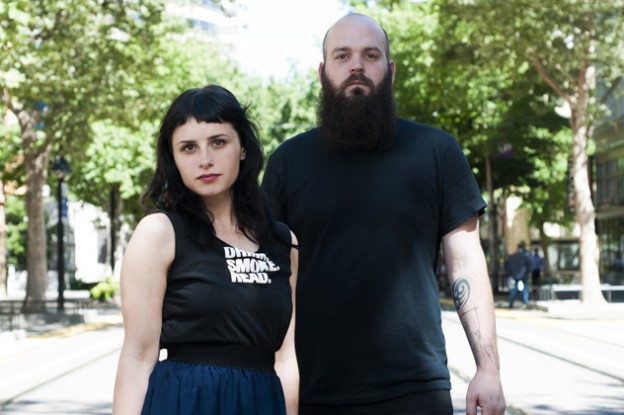
“That’s my part,” Skinner states flatly, his stoic front confirmed by his casually crossed arms, smooth-shorn scalp, burled beard and deep voice. “I specialize in epic.”
Next to him, Lydell seems a bit more dynamic despite her “logical, monotone” self-description. She slouches back sipping tea in black and white wing tips, a long dress and sleeveless denim jacket. Both members casually detail what they hope to accomplish in the next year, which includes finding a manager and setting out on a small tour. Familiar friends, they joke quickly between each other. Their chemistry confirms the band’s back-story: Lydell canceled a return to Austin, Texas, to continue working with Skinner on Paper Pistols, alongside her other musical projects. Thus, the album came to be.
Describing how Paper Pistols came to be in its current incarnation, Skinner, who spends most days recording bands in his Midtown studio or running sound for various local venues, recounts, “After The Evening Episode, I didn’t have a desire to do a band again. I’d need to get a van, a practice space, book tours. It didn’t seem fun to do that again. Playing music with Julie has changed my perspective. It’s inspired me to actually start writing music. It’s an easier process with her because she moves quicker than I do, and she’s got so much energy. It’s different in a very positive way. ‘Astronaut Food,’ we wrote that and recorded it in a day. It sums up the record and so many of Julie’s views on the world. It’s a lonely ass song, too.”
“It’s just The Lion King. In a key too low for me,” smirks Lydell.
“Does that make me Simba?” asks Skinner.
“It does. And I’m still myself,” Lydell quips in return.
Aptly, for both musicians, “Astronaut Food” is an anthem of sorts. Over a music box sample and long sustained piano chords, Lydell sings, “The future looms not as bright for the most of us.” The final crescendo of the song is a surge of booming toms where Lydell repeats in a melancholic affirmation, containing hope and despair, “Deliver us from chemicals.” The song concludes with a four-part, gospel-style harmony that, in a song about literally being isolated above earth, desperately seeks transcendence.
Lydell explains the song, the possibility of a future, as a “conflation of living in the age of celebrity where everyone wants to have something special, look rich. But really we’re underemployed, making $9 an hour. There’s this gap. I think we’re really removed from reality in some ways, and it’s showing up on a bigger scale post-2008. There are so many complex systems, and I can’t even fathom it.”
The future looks similar to Skinner, a monoculture of sorts: “My realm of expertise would be the music business. If you listen to today’s radio, no, we don’t have a future, or at least not a very bright one. The influence that pop musicians have on the youth, artistic or not, it’s not positive. But, I think that’s because I’m old. People who are produced now don’t have an artform.”
Ultimately it’s clear that both Skinner and Lydell would prefer to stay on Earth playing music despite the chaos that surrounds us.
“I wouldn’t fucking go out in space,” Lydell laughs. “I would kill myself first. It freaks me out. I want no part of it. I’ll cling to a tree.”
“They have that thing right now,” says Skinner, regarding Mars. “You can sign up, but you can never go home. You live in a bubble. Who would do that?”
“People who like Burning Man would go. That would be my worst nightmare,” says Lydell.
“That’s what they should do,” concludes Skinner, “dump the Burning Man tickets and send them to Mars. I’m done with some Burning Man shit.”
There it is. Mars, loneliness, anxiety, austerity, decadence: Paper Pistols, Deliver Us From Chemicals, 2013. Transcendence, indeed.
Catch Paper Pistols live on Saturday, June 22 at Davis Music Fest’s City Tavern Stage at 9 p.m. They are also scheduled to play Launch Music Festival, a two-day event going down on Sept. 7 & 8 at Cesar Chavez Plaza. Visit Launch’s website for tickets!

Sister Crayon Steps It Up Further on Debut LP
 It was a gray and windy afternoon on the beaches of Malibu. A tidal wave warning was in effect, but there local band Sister Crayon stood, fully-clothed, sharp shoreline rock at their ankles, as photographer Eliot Lee Hazel barked orders to capture the frozen chaos of crashing white caps for the band’s debut album art.
Lead singer Terra Lopez slipped during one shot, cutting her leg, but Hazel ran his shoot like a drill sergeant. “He just said, ‘Get up. Don’t smile. Don’t look at me,’” Lopez said. “Well, he’s a sweetheart, nice guy, you can sit down and talk to him, but when he’s taking photos he is so intense.”
As absurd as it feels to the members of Sister Crayon, Lopez and drummer Nicholas Suhr spoke of the shoot as one of their most memorable music experiences–even though it had little to do with music. Along with Hazel’s artwork, the band has a high-def music video done by celebrity photographer Robert Ascroft. Browsing both photographers’ websites, perusing the tastefully gratuitous images of Devendra Banhart, Usher, Mariah Carey, Edward Sharpe and Brad Pitt, Sister Crayon will be the first to tell you how privileged, yet out of place they feel. Are these the last remaining minor moments of Sister Crayon before they receive Coachella bookings and Japan tour offers?
In the next few weeks, the band is playing humbler venues like Townhouse for the Sacramento Electronic Music Festival and Luigi’s Fungarden for the Bellow album release party. So our indie darlings have yet to grow too big for our sleepy city. Lopez looks like a siren Viking vixen in the video for “(In) Reverse,” but when I met with her and Suhr at Mondo Bizarro (formerly Butch & Nellie’s) for an interview, she was back in her Midtown garb, a second-hand green army jacket and jeans–the Lindsay Weir of Freaks and Geeks look. She’s still the same shy songwriter, fronting a gloomy pop act that seeks inspiration in the lonesome despair of poets like Jean Genet and Fernando Pessoa.
The Bellow sessions scattered across the span of a year and a half. The newly realized lineup of Sister Crayon crammed in 18-hour shifts at The Hangar with engineer Scott McShane, who described the process as “tense” and a “guerilla recording style.” McShane produced the first Sister Crayon EP, Enter Into Holy (Or)ders, and the band never entertained the thought of working with anyone else. “Recording already is a really intimate thing. We bond so well with him. He gets what we’re trying to do, even before we understand it,” Lopez said.
“He’s able to throw out ideas that’s not in an insulting way. It’s just full-on experimenting and you know that it’s for the best. He pushes us to succeed,” Suhr added.
The tension came from the hourglass pressure of paying for studio time and the unfamiliarity of having a new drummer join two weeks prior, writing his parts on the fly. Suhr was not a complete stranger, knowing Lopez from her stint in The Evening Episode, but he and Lopez talked of the anxieties surrounding a debut full length. “We were zombies. We’d spend 18 hours in the studio and you can hear it in the record,” she said.
Originally, Bellows was intended to be a five-song EP, written by Lopez and synth-keyboardist Dani Fernandez, with “I’m Still the Same Person” being the only pre-released song to make the album. But once the band wrapped recording those five songs, creativity was running high and five more songs were written collectively. “Scott kept telling us there was a lot of tension on the record,” Suhr said. “If you know what was going on at the time it makes sense. There was a lot of time spent coming to an agreement on things, but whenever we’re writing together there’s no awkwardness. It was easy to go into the next five songs with an open mindset.”
Indeed, the settling in is brazen and culminates with a spacious piano ballad called “Ixchel, The Lady Rainbow,” in which Lopez’s visceral croon soars over a piece written by former member Genaro Ulloa. “Ixchel” was the last song the band recorded, a one-take recording done well past the midnight hour. “We did it live tracking,” Lopez said. “He was in the other room and I was in the main room singing. We could see each other through a little window, but that was it. It was the first take and it was incredible. I know it sounds corny, but there were tears in everyone’s eyes. We were all exhausted. Even Scott had tears in his eyes.”
Suhr added, “It’s one of those songs. Every other song on the record we did multiple takes because we felt we could do better. At the end of that song, everyone was just like what the fuck. It’s one of those songs where if it didn’t sound like that, with the imperfections left in, it wouldn’t have worked.”
The gloomy pop instrumentation informed by the troubled words of dead poets is an appropriate setting for an album titled Bellow, but Suhr said a lot of the mood is owed to McShane’s guidance. “I heard the five songs written before I joined, but the mood had changed through Scott’s ears.” Lopez said his touch is most prevalent on “Here We Never Die and “(In) Reverse” as he took the band’s ideas and focused them into a cohesive sound.
In addition to McShane, the Sister Crayon sound, most notably the lyrics, is in homage to the writings of Fernando Pessoa, a 20th Century poet and literary critic. Lopez only admitted her obsession with Pessoa’s work. She has a Pessoa tattoo and her Pug’s name is Ophelia, after Pessoa’s secret crush to whom he never confessed his love. “It’s the despair,” she said. “It sounds dramatic, but he was such a lonely individual. He was very mysterious and obviously people are drawn to that.
“I think that is a huge part of Bellow. ‘Here We Never Die’ is my talking to a lover in that way. The despair and sadness that he wrote is so sad that I can’t even finish one of his books. I have to read a sentence a day sometimes because it’s so much. It just floors me. I have no option when it comes to his presence in my music.”
As intense as Sister Crayon is sonically and visually portrayed, Hazel’s insistency that the band stop smiling as the chilly Pacific waves capsized on their heads speaks of the band’s unbridled joy in its work. As arresting as “Ixchel, The Lady Rainbow” is, Bellow closes with “Souls of Gold,” a cheery campfire sing-a-long with a blasting brass section and woozy synths. “We’re always such a serious band and a lot of our songs are really dark,” Lopez said. “I do like that the album ends on a lighter note than what it could have been.”

See Sister Crayon live at their release party for their new album Bellows at Luigi’s Fungarden on Feb. 19.
A look at the Sacramento scene shake-up in 2009
It was a difficult year for the local musician as at least eight bands met their demise. Swansong shows were played, vans were crashed and relationships collapsed in bittersweet endings. The silver lining in the shambles of bands lost? As we transition into a new decade, we’ll be greeted by fresh and lovely new bands.
That’s how this thing works. Take last year’s demise of The Evening Episode. Had they not called it quits, Terra Lopez would not have gone on to create our beloved Sister Crayon and fill that indie-pop gap in our lives. For now, it’s the breakup that is fresh for these fallen bands. Only last month, Buildings Breeding unplugged from the scene, citing a lapse in dedication as its reason for departure. Vocalist and guitarist Chris Larsen said Buildings Breeding hit a rut after founding guitarist Evan Hart moved to Oakland.
“I can’t really pinpoint what it was that made the decision,” he said. “It seemed the better we’d get, the less people would care.”
Fresh off a May tour, the band experienced a transformation from its lo-fi roots into a polished songwriting style that would become its Kite Fire EP. A man down, the group brought in Kevin Dockter on guitar and Justin Titsworth on drums. “It made the band feel brand new; finally it felt like we had something,” he said. “Even our oldest songs were fresh again. It definitely gave us a second wind.”
Buildings Breeding booked an extensive tour for November to promote the EP, only to learn that three of its six members weren’t available to travel. The band attempted to have friends fill in as best it could, but Larsen said it was apparent from those reluctant moments the band was kaput. “Chris [Vogel] and I would speak every night,” Larsen said. “When we kept coming to the same decision, we knew we had to end it. We decided to honor what local shows we had and add two farewell shows.”
The farewell show happened so frequently this year it could have been considered a fad. Bright Light Fever played its final show at Harlow’s on Sept. 10. The group had a six-year run eulogized by a can of soda.
“We bought a six pack of Sunkist orange soda before we started pre-production on our first record,” Matt Ferro, Bright Light Fever’s guitarist, said. “We drank them all but one can and kept that can in our practice room as sort of a good luck charm for the whole time we were together. When we were loading up for our last show, we looked at it and—no joke—the expiration date was Sept. 10, 2009. Same day as our last show. Poured it out in the back parking lot of Harlow’s.”
It was to Bright Light Fever’s benefit they did not share the newly expired soda. The band’s lifespan was marred by unfortunate events the members wore like an honor badge sash. Within a month of its debut’s release in Oct. 2006 on Stolen Transmission (an offspring label of Island/Def Jam), Bright Light Fever lost its distribution. By July 2007, Bright Light Fever was dropped from Stolen Transmission. The group wrecked two vans in Wyoming on two separate tours. BLF self-recorded and self-released its second record, eventually putting it on the Internet for free download due to “months wasted on empty promises and overall snakery by outside parties.”
The band finally toured without losing money last November. Alas, its follow-up summer tour led to law enforcement issues in Arizona, hitting a deer in Omaha, eight of 12 shows paying nothing and its newest member quitting. “We all genuinely loved the band, so we did it for as long as we could keep our sanity,” Ferro said. “Honestly, all the bad luck inspired us to work harder at what we were doing.”
Punk band Blame Betty attempted to bear the brunt for four years. Lead singer Brooke Sobol said being in a band exposed her to a potential she never understood, but when your band is in a constant shuffle of members, the lack of dedication wanes the drive. The band burned through four drummers, four bassists and two lead guitarists. “The more we accomplished, the more I wanted to accomplish,” she said. “When the dust settled, we had a good, solid group for a long time.”
Blame Betty broke up in September. Sobol said she was exploring a business opportunity that monopolized her time. The stability of Blame Betty suffered. “I just couldn’t do both,” she said. “The pressure of being the front person got to be more than I wanted. I actually have stage fright. There’s a lot of pressure on the front person.” Sobol said she wants to be the girl standing next to the lead now—drinking a beer and playing her guitar like a crazy woman.
Buildings Breeding split without its inner-band relationship suffering. Larsen and drummer Melanie Glover are still together. “Being able to share music with my true love Melanie, it was at times difficult, but so incredible to see her grow as a musician,” Larsen said. This is the exception.
David Mohr found out the hard way when he split with Meg Larkin just before the summer, leaving Sacramento without its premiere dance duo, 20,000. “I tell people now not to be in a band with your significant other,” Mohr said. “People warned me. I should have taken their advice.”
When Mohr ended his six-year run with previous band Didley Squat, he said it felt like an actual breakup, the intimate kind; but losing his band and girlfriend in a breakup was a crushing blow to his psyche. To make matters worse, the laptop they used to make their music was Meg’s computer. Mohr tried to record on his old four-track, but found the process frustrating.
20,000 never had an official last show. The breakup happened amidst scheduled dates around Midtown, each of which drove the nail deeper into the coffin. Mohr remembers one show in particular at Luigi’s Fungarden. “I was dreading that show,” he said. “It was right after we broke up and the plan was to keep the band going. It was just too weird to get on stage with your ex-girlfriend and pretend to have a good time, pretend to be into the songs when really you’re done with it.”
So why is this happening? Mohr said he is concerned by an influx of negative energy. In Bright Light Fever’s bassist Don Suave, he astutely wrote in the band’s obituary, “it has been frustrating to see our fan base consistently waning while, from my point of view, the quality of our work has been consistently waxing. What I’m saying is, ‘It’s all your fault.'” Similarly, Larsen expressed a frustration with the abandonment that came with his band exploring hi-fi aesthetics.
“I think [the band] was let down by that fact because we were all extremely proud of the stuff we were creating together. Add the hopes of being signed to a new label and having them leaving you dead in the dirt, that is sure to shake any band up.”
Blame Betty spent two years convincing a club to let them play and brought 75 paying attendees out on a Thursday night, only to have the rest of the bill spot four people and split the door money. “[The club] didn’t return any of my calls to get another show booked there,” Sobol said. “But, the other band still does shows there.”
Let’s not forget the silver lining. With the dissolution of such great bands, an absence is left within the artist. As Ferro put it, “playing in a rock ‘n’ roll band makes you cool. Like smoking cigarettes. So right now, I’m lacking cool.”
He and his brother Evan immediately continued writing music under the moniker Roman Funeral. The duo hopes to record an album by the spring and tour in 2010. Larsen is doing a “solo-y thing,” while his ex- bandmates have taken to other local acts like bands with ex-The Matches members and playing with Chelsea Wolfe.
Mohr obtained a laptop and has released two free digital records as Favors. His new venture retains the 20,000 sound, but with a lot more heartbreak. He is currently practicing with Ben and Chris of Impotent Ninja, as well as Chris’s girlfriend, which made Mohr wary at first. “I definitely spoke to Chris about it, but I think they might be stronger than Meg and I,” he said. He hopes to do Favors shows by the summer.
Through all the bullshit, each band had no problem expressing its gratitude for the little moments shared among bandmates and fans. For Ferro of Bright Light Fever, it was traveling in a van across the country with brothers and close friends and taking a piss while your bandmates all meet Iggy Pop on a street in Texas. Larsen recalls the feeling after Buildings Breeding’s last show as he thought, “If this many people came to our shows all the time, I would never quit. I could just play Sacramento and Davis the rest of my life.” Sobol recently caught a show with her bandmates. They still flirt with the idea of reforming again, pending a lead singer shows up. Mohr is doing his best to remain friends with Larkin. As of this week, he hopes he can give his friends one last 20,000 record. The two finished, but never released, an album before the breakup. “Up until about a week ago, I didn’t want to get it out,” he said.