Black Cards proves Pete Wentz has many tricks still up his sleeve
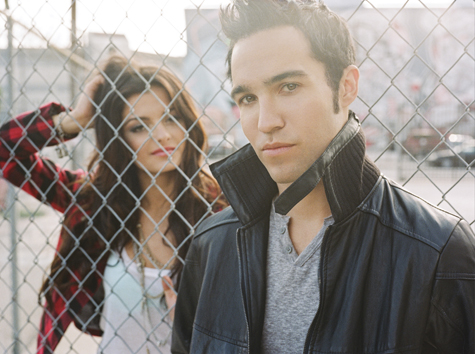
Pete Wentz has become synonymous with energetic, slightly emo pop-punk–not that there’s anything wrong with that. It’s not difficult to understand why. As bassist and lyricist for Fall Out Boy, Wentz helped pen songs such as “Sugar, We’re Going Down” and “This Ain’t a Scene, It’s an Arms Race” that propelled his band’s albums into top 10 rankings on the Billboard charts and garnered the band some hard-earned Platinum. Since 2009, however, Fall Out Boy has been on an indefinite hiatus, leaving Wentz to focus on other things, such as being a label owner, entrepreneur and father. Black Cards is Wentz’s first foray back into music since Fall Out Boy took a vacation, and taking his prior output into consideration, it would logically follow that his new band’s music would be reggae-tinged British-style electro-pop music. Wait…you mean it wouldn’t? Well, I don’t know what to tell you. That’s how this shit works out sometimes.
Wentz started Black Cards out of a desire to do something different. He said in a recent interview with Alternative Press, “I’ve watched people when their bands are on hiatus or whatever it is, and they have the itch to do something, but they don’t really do anything that differently. It makes it all the more easy for people to be like, ‘Well, why doesn’t he just do his [main] band, then?’” But the desire to do something people wouldn’t expect from you and actually pull it off are two entirely different things. Wentz had to go outside himself in order to make it a reality.
The first piece of the Black Cards puzzle was Sam Hollander. A producer and songwriter, Hollander has worked with a wide array of artists from Coheed and Cambria to rap group Arrested Development (he also worked with Gym Class Heroes, who were signed to Wentz’s label Decaydance). Wentz told Submerge that it was Hollander’s encouragement that got him into the studio in the first place post-Fall Out Boy.
“After FOB went on ‘hiatus’ I wasn’t really sure what I was going to do,” Wentz shared via e-mail. “Sam hounded me to come into the studio over and over, but I thought I wasn’t ready. He just convinced me that even if nothing came out of the process I should have a place to let out my energy. As soon as we got in the studio together, it felt right and Black Cards stemmed from that. Sam’s a good friend who knows how to spark my creative side without me even realizing it.”
This new “spark” urged Wentz down a decidedly different path. Instead of penning anthemic rock choruses, he was at work creating his take on Jamaican roots reggae mashed up with the electro pop sensibilities of artists like Lily Allen. Under the guise of Black Cards, he said he’d have the freedom to express things he may have not felt comfortable doing with Fall Out Boy.
“Well after doing something for a number of years–especially with people watching–things are expected of you, and I really feel FOB fans came to expect those type of lyrics and songs from us,” Wentz said. “With Black Cards I really get to start over, be all over the place and it’s OK. I hope fans just take to that and enjoy something new.”
Lyrically, Wentz was looking to get out of his own head. Fall Out Boy’s lyrics tended to be personal. With Black Cards, Wentz is able to look outside himself, and he said that the experience so far has been liberating.
“It’s fun to escape and just be creative,” he said. “You are always the party and everyone isn’t invited: that’s been a hard concept for me to understand. Sometimes I have to learn to give myself a chance to just be me and not worry so much if everyone else is doing OK.”
With a new direction musically and lyrically in place, Wentz needed to find a new voice. Enter unknown Staten Island, N.Y., singer/songwriter Bebe Rexha, whom Wentz heard singing by chance at Hollander’s New York City studio.
“It just clicked when I heard her singing,” Wentz recalled of his first encounter with the young vocalist. “I told Sam that she’s the one we had to work with.”Â
Wentz said that Rexha is sort of like his “battery sometimes.” Her youthful energy hasn’t been bogged down by years in the spotlight. Not only is she a fresh voice for Wentz, but a fresh perspective.
“It’s impossible for her curiosity and excitement about everything not to rub off on me,” Wentz explained. “I definitely feel like the big bro teaching her the ropes and she’s a sponge.”
Writing for a female vocalist also provides Wentz with a new challenge–albeit an enjoyable one.
“Its hard to picture myself outside of my own mind in general,” He said. “It’s especially hard to think as a girl from Staten Island. It’s been a fun challenge that is different than anything I have ever done.”
As of now, no release date has been set for Black Cards’ debut album. Though the band has unveiled a few songs here and there, including “Club Called Heaven” and its accompanying Bonnie and Clyde style video. Wentz has hinted in the past that the album is done, but it seemed from our correspondence that nothing is entirely set in stone just yet.
“Every day we think we’re finally done and every day we think of a way to make a line or melody better,” he said. “We’re still getting to know each other so we’re constantly finding differently ways to execute a lyric or switch up a beat. We just want to make sure the album is 100 percent what we want it to be so I can’t make any promises on when it’ll come out.”
Even the title is up in the air as Wentz said he comes up with a new title each day. However, given the serendipitous way Black Cards was formed, you should shed any expectations of how it should turn out and just enjoy the result, whatever it may be.
Black Cards will play District 30 in Sacramento on July 3, 2011. The event will feature a live performance from the band and a special DJ set by Pete Wentz. There is no cover charge if you arrive before 11 p.m., and drinks are also half-off before then. For more info, go to District30sacramento.com.
Midnight in Paris
Sony Pictures Classics
As far as body of work goes, Woody Allen is a titan among American filmmakers. While his films may not have the epic scope of a Coppola or the box office clout of a Spielberg, Allen’s pantheon is no less impressive, running the gamut of modes from the Greek chorus-inspired Deconstructing Harry to the tongue-in-cheek comedy of Mighty Aphrodite to the bone-chilling Match Point. Allen’s latest film, Midnight in Paris, is more of a return to form than the latter, but is also exceedingly clever and entertaining.
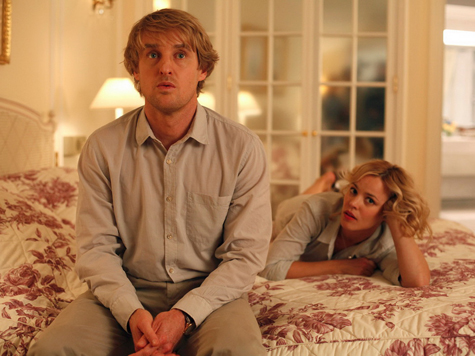
Like most things, nostalgia can be harmful if done in excess. It’s easy to pine for a time long gone, because the mind has a funny way of accentuating the positive and repressing the negative. In Midnight in Paris, Gil (Owen Wilson) is nostalgic for a time he’s never even experienced. He yearns for the Paris of the ‘20s, a place and time he believes was a Golden Age. Gil, a successful Hollywood screenwriter, is visiting Paris with his fiancée (Inez, played by Rachel McAdams) and her wealthy family, abroad on business. Inez’s parents–a far right-wing businessman father and snooty mother–may not necessarily approve of Gil, but they tolerate him, mainly because he makes a good living; but Gil’s soon-to-be wife and in-laws all seem to spurn the writer’s more whimsical side.
Gil is in love with Paris, but his wife and his family can’t wait to get back to the States. He sees it as a magical place, where his literary heroes came to sharpen their skills and tap into the city’s undeniable energy. While in Paris, Gil is trying to become a “real writer” by working on a novel about a man who runs a nostalgia store, but refuses to show it to anyone. After a night of wine tasting with Inez’s pedantic friends, Gil is pixy-led through the streets of Paris. As the clock strikes midnight, he becomes a man out of time, swept back to the ‘20s where he meets giants of the literary and art worlds–Hemmingway, Fitzgerald, Dali and more. While straddling two times, he becomes infatuated with a young would-be costume designer (Adriana, played by Marion Cotillard).
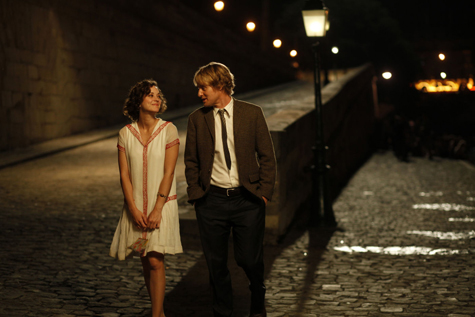
First and foremost, Midnight in Paris is a wonderfully entertaining film. It feels light, but has a richness to it if you care to soak in it. Allen weaves in numerous great writers, artists and luminaries of the ‘20s in a clever way, incorporating their work, personalities and biographies into the mix. Hemmingway is a drunk obsessed with masculinity; Fitzgerald and his wife Zelda have a tumultuous relationship; Dali is, well, Dali (wonderfully portrayed by Adrien Brody). Well-read audience members are sure to share many knowing chuckles, but Midnight in Paris never feels in-joke-y or exclusionary. It’s as breezy as any daft romantic comedy, and that’s refreshing.
The performances are solid throughout. Owen Wilson, as de facto stand-in for Allen, awkwardly mumbles and fusses in the very image of his director. Kathy Bates delivers some of the film’s most powerful lines as Gertrude Stein and exudes a firm, statuesque presence befitting of her real-life counterpart, and Corey Stoll casts Hemmingway as the brawling caricature you’ve no doubt learned about in high school. Overall, it’s an excellent ensemble cast.
As light-hearted as it feels, Midnight in Paris also throws a heavy warning about living in the past. As Gil lives the good life in the Roaring Twenties, his real life begins to crumble (which is perhaps for the best). Unlike the breezy romantic comedies it seems to emulate, Midnight in Paris doesn’t come to an entirely tidy conclusion, much to its credit. Certainly, this film is a welcome addition to Allen’s canon.
My Heart Is an Idiot
Budget Fabulous Films
Love. Well, it’s difficult to wax eloquent about love without sounding trite. That’s probably because it’s the most clichéd of all human emotions, so much so that even recognizing it’s impossible to write about love without sounding trite has also become trite. Without digging ourselves much further into a hole here, let’s just acknowledge that My Heart Is an Idiot, filmmaker David Meiklejohn’s feature-length debut, is a romantic documentary about love, or more specifically its subject Davy Rothbart’s search for love, and move forward.
Rothbart, as you may know, is a contributor for This American Life and the founder of Found, an anything-goes sort of magazine that collects found letters, photographs, etc. that has been published once annually since 2001. He is also a hopeless romantic–at least that’s what he’d like himself and others to believe. As the film opens, we’re treated to a montage of awkward home movies that take us from Rothbart’s adolescence to the film’s present. Rothbart explains his situation via voiceover: His housemate, Alex, is the perfect woman for him, but she’s moving to San Francisco. While the two have shared some modicum of romantic involvement with one another, they are not in a committed relationship.
Rothbart’s relationship history is rocky, often ending in tears (his). One girlfriend was seemingly perfect and devoted. She even learned sign language to communicate with Rothbart’s deaf mother. Inexplicably, Rothbart ruined the relationship when he cheated on her. Rothbart’s next great love, whom he says he shared an intense connection with, spent a year abroad in Scotland and ended up marrying a French window repairman.
The setup exists for a pure romantic odyssey as Rothbart, on tour doing speaking engagements promoting Found, leaves his home in Ann Arbor, Mich., and travels the country, hoping to reunite with Alex. But Meiklejohn’s documentary throws a curve ball when it reveals Rothbart has a secret.
The film purports to be a documentary about love, and in some respect, that’s certainly the case. It seems to examine, and then coldly dissect the conventional wisdom, “When it happens to you, you’ll know.” As Rothbart seeks answers on how to find happiness in his love life from virtually anyone he encounters (including Newt Gingrich, Zooey Deschanel and Ira Glass), the idea of love as it’s presented in the film morphs from a lofty and most noble of emotions into something more apt to inspire intense paranoia and heartache than joy. As far as love goes, most of us have probably discovered that it usually splits the difference between pure ecstasy and sheer misery, with brief flashes of both.
My Heart Is an Idiot doesn’t bring anything new to the table in that regard. There is also some loss of focus as Meiklejohn also explores a couple subplots, such as the death of Rothbart’s friend’s mother–an interesting aside, but one that doesn’t seem to tie neatly into the documentary’s central story. Also, as love stories go, it’s a pretty poor one, but that aspect of the film is what makes it interesting. Rothbart as romantic hero leaves plenty to be desired. In a couple instances, he’s referred to as a con artist (even by his own mother). Meiklejohn hangs Rothbart’s dirty laundry out to dry, and over the course of the film, viewers will most likely get a good whiff. In so doing, Rothbart, who provides voiceover narration for much of the film, becomes unreliable. Is he really the classical wide-eyed romantic yearning for love, or just a wannabe Lothario for the personal branding-obsessed blog generation? It’s love, after all–there aren’t any easy answers.
Davey Havok ponders the endless possibilities of Blaqk Audio’s forthcoming album, Bright Black Heaven
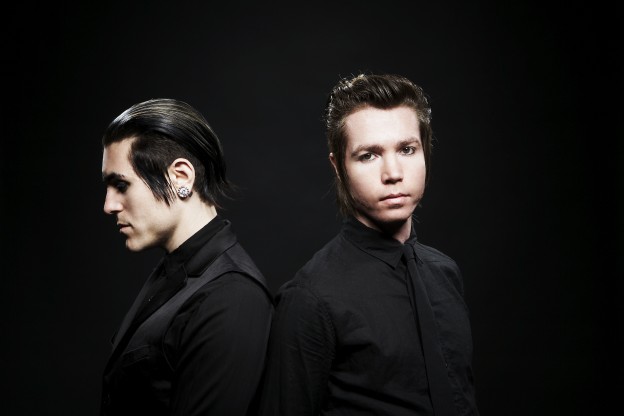
Submerge caught up with Blaqk Audio frontman Davey Havok (you may also know him as the singer for dark punk band AFI) at a strange time. At the moment, though he and his partner in Blaqk Audio Jade Puget (AFI’s guitarist) are very hard at work writing new songs for their forthcoming album, Bright Black Heaven, Havok doesn’t really have anything immediate to plug; which, as you’ve probably noticed, is the main reason why artists do interviews in the first place.
“It’s been a while since I’ve spoken to anybody,” Havok jokes as he tries to remember the name of a recent song (“Down Here” (song above)) the band had posted to the Internet. “It kind of catches you off guard, because you’re not used to talking about this stuff.”
Havok and Puget began working on Blaqk Audio’s Bright Black Heaven shortly after the dance-pop/electronica project’s first album, 2007’s CexCells, was put to bed. In fact, Bright Black Heaven was even completed, but disagreements with their former label Interscope left the album in a sort of limbo. Undeterred, Havok and Puget stuck to what they do best–making music–and an album’s worth of songs ballooned into what could be an entire catalog for some bands. The result is a murky future for Blaqk Audio, still searching for a label, but as we discuss in the following interview, an undefined path ahead doesn’t necessarily have to be a bad thing.
According to Havok, there are now 33 songs tracked and ready to go for Bright Black Heaven. On top of that, 10 to 15 more are written but remain, as of our interview, unrecorded. With the amount of material they’ve been working on, it’s easy to forgive Havok’s fumbling for a song title. Some of the songs that have been created for Bright Black Heaven are three years old, including the aforementioned “Down Here.”
“‘Down Here’” was the first song that we completed after CexCells,” Havok explains. “We were actually sound checking that song during the CexCells tour.”
Given the span of time over which these songs were created, there are certainly differences in the material. Havok says that Puget steers the direction of Blaqk Audio as far as the music is concerned; however, Havok has noticed that what he’s received from Puget over the past three years has run the gamut of the electronic music spectrum.
“We have a lot of very dramatic, dark, down-tempo songs; we have lots of very high-energy pop-y songs,” Havok says. “There’s some stuff that’s glitchy, big room stuff. There’s more traditional synth pop-sounding stuff. It’s really all over the place, which is going to make it difficult when it comes time to choose what’s going to be on Bright Black Heaven, because as I’ve said, there are so many options.”
While the variety may make it tough to choose which of the songs make the cut, Havok also acknowledges that it’s sort of exciting knowing Bright Black Heaven can go in a variety of directions.
“It is fun, because it really leaves the door open for us,” he says.
Though their future is unclear, it’s still possible to check out some of the music Blaqk Audio has been working on online. “Down Here” and “Bon Voyeurs” are available on the band’s Soundcloud page (Soundcloud.com/blaqkaudio). Also, Havok says he hopes the group will release “some 12-inch singles before summer is over.” He also hints that these singles may be available for download. In the meantime, Blaqk Audio fans will have to wait and see, but good things do come to those who wait.
Blaqk Audio, obviously, is so much different-sounding than AFI. Was that something that you thought about? Like when Dave Grohl went from Nirvana to the Foo Fighters, he was still doing a similar type of rock music, so his fans with Nirvana could make the jump to the Foo Fighters more easily.
What we were doing with Blaqk Audio, we really didn’t take AFI into consideration at all. It doesn’t really have–other than two of AFI’s members are in Blaqk Audio–they really don’t have anything to do with each other. It wasn’t a matter of what we do with Blaqk Audio wasn’t meant for AFI fans. Of course, we’d be happy to have AFI fans, and we’re always happy if AFI fans appreciate what we do, but it’s such a completely different kind of music, that wasn’t really taken into consideration.
When you originally conceived Bright Black Heaven, there must have been a certain vibe to it. Now that you have so many different songs, is there any inclination to change the title and make it something completely different?
Not so much. When I think about it, and I think about the songs we have, I think we can put a group of songs to create an album that fits well with the title Bright Black Heaven. I’ve also fantasized about releasing three albums–creating Bright Black Heaven and creating sister albums that are more polarized, less balanced than the Bright Black Heaven album. I can envision doing a Bright Black Heaven album that has elements of our darker side and our pop-y side, and actually do another two where one would be all up-tempo pop, and the other would be all down-tempo, dark dramatic stuff. I don’t know if that’s going to happen. Probably not…we don’t even have Bright Black Heaven coming out [laughs]. It’s a little ambitious to be looking for three when we don’t even have one.
You might as well aim high.
Right? Maybe one of the three will come out.
You said that Jade holds down the feel of the album musically. What have you been focusing on lyrically since the last album?
You know, it’s kind of an extension of the themes that were on CexCells–that hedonistic, sexual scenario/ethos that is running through that record, and it kind of goes further beyond that. For me, electronic music is so otherworldly, which is odd, because it’s so manmade. It’s a machine, but it’s very fantastic. It evokes these images of these endless possibilities of otherworldliness [laughs]. I’ve always loved electronic music for that reason. It has always inspired me in very different ways than acoustic instruments have. Bright Black Heaven is very similar thematically to CexCells. A lot of it is kind of biting–I wouldn’t say tongue-in-cheek, but there’s a lot of humor to it, dry humor, sometimes. It’s hard for me to talk about, again, because there are so many songs. I don’t even know what’s going to be on it.
Changing gears a bit, you played St. Jimmy in the Broadway cast of American Idiot this past March. I saw in an interview you had with Mark Hoppus before your run started that you’d always wanted to do something on Broadway. Now that the experience is passed, did it live up to your expectations?
It’s funny, because it really did. It’s funny you should ask that, because it sounds outrageous and trite to say, but it was very much a dream come true in every respect. As I said in that interview you saw, I grew up dreaming about doing something like that and thinking it would never possibly happen to me, and now that I’ve done it, it was exactly how I dreamt it would be–living right in the center of Manhattan, near Times Square, getting up every day and performing with a hugely talented cast who, as it was in my dream, were really welcoming. There was a huge solidarity between them and us. And of course, the actual performance and being in the show was so gratifying. It’s so fun and has such a purity to it and a precariousness to it and an energy to it that’s unlike anything I’ve ever really experienced, except for when I was doing it growing up, but that was at a completely different level than Broadway. It was one of the best experiences of my life.
Is that something that you’re hoping to pursue further?
I would love to do more acting and more theater. It’s something I’ve always enjoyed, and having just done it, it just reaffirmed how much I love doing it and how much it means to me. I seemed to get a pretty good reaction when I was out in New York, and I met some people, and I do hope they’ll call again. I’m sitting here and waiting for Broadway to call [laughs]… I wasn’t waiting before and it did, so maybe I should stop waiting and it will again.
I heard that you used to live in Sacramento.
I did. I lived in Sacramento from about 1980 to 1986.
So you were a kid at the time.
Yeah, I was a kid, but I wasn’t a baby. I have vivid memories of the city. I used to go to Go Skate, which was a skate shop, I think, on Fair Oaks… There were malls. I remember that I used to go to Sunrise and Birdcage, and they had midnight movies at both. They had Rocky Horror and The Wall. Frozen yogurt–the beginning of the frozen yogurt craze. Everyone thinks Pinkberry is a new thing, but in the late ‘70s/early ‘80s there was Honey Bear Yogurt, and there was a Vans store in Sunrise as well. I always coveted the Spicoli checkered slip-on Vans, but I was so young that I could never get them, because they didn’t make them in kids’ sizes back then, which is really sad. I’ve never had a pair to this day. I can get them now… I’ve often thought I should get those just to have them, because I’ve always wanted them.
Why do you think you haven’t gotten them yet?
I don’t know. I just can’t picture what I’m going to wear them with… But you can pretty much wear them with anything. It’s not like I don’t have a bunch of Vans, because I do. I suppose I eventually should.
See Blaqk Audio play Ace of Spades in Sacramento on June 4, 2011. Boggan and Hamm FM will open. The show gets underway at 7 p.m. For more information or to purchase tickets, go to Aceofspadessac.com. To keep abreast on Blaqk Audio’s new album and to check out some of the band’s new tracks, point your browsers to Blaqkaudio.com or peep Brightblackheaven.com.
Dev and The Cataracs Tour with Usher, Ready to Take the Pop World by Storm
Small town boy (or girl) makes good. It’s a familiar story–pretty much the basis for the American dream. Rising pop star Dev fits the mold. Raised in Manteca, Calif., she was working a 9-to-5 and attending junior college before her life changed forever. An Amy Winehouse cover recorded on her MacBook that she posted on her Myspace page–a diss track aimed at her ex-boyfriend’s new girlfriend–caught the attention of producing duo The Cataracs (comprised of Cyrano and Campa). Now just a few years later, she finds herself touring the country with Usher on his OMG Tour. It’s true that in the Information Age, things happen very quickly.
“My life has taken a complete 180,” Dev says. “It’s the gnarliest thing.”
Fear not, though; this isn’t the typical sad little rich girl tale. Dev isn’t crying about her normal life being turned on its ear. The luster of her burgeoning fame has yet to be tarnished, and during our interview, she expressed nothing but gratitude.
“I’m blessed and I couldn’t be happier,” Dev reports from the Rhode Island stop on the OMG Tour. “I’m getting opportunities to work hard and to travel, and it’s really fucking cool. I’d never even been on a plane like that before, and now I’m on one every day.”
Under The Cataracs’ guidance, Dev quickly became something of an Internet sensation. She sang the hook on the deliriously catchy electro-pop-infused hip-hop track “Like a G6” by Far East Movement. The single was released in April 2010 and its video has amassed well over 65 million views on YouTube. The hook from that song is also featured on Dev’s own single with The Cataracs, “Booty Bounce,” which came to light just four months later.
At the end of 2010, Dev and The Cataracs released a new single, “Bass Down Low,” a slickly produced and sexy party anthem. But the young singer/songwriter doesn’t want to be known simply for dropping it like it’s hot, as she’s hoping her upcoming album will attest. The Night the Sun Came Up, Dev’s anticipated debut, will be released on Sept. 20, 2011. On the album, you’ll get the club hits you’d expect; but according to Dev, you’ll also see her and The Cataracs moving their sound deeper, lyrically and musically.
“It’s really fun for me to write a lot of sassy lyrics and stuff like that,” she explains. “We’re young, but [the album] is my chance to show who I am and what I’ve been going through. It’s definitely a youthful album for sure. I grew up in Manteca for 20 years of my life and moved to Los Angeles and got to travel around as I turned 21. You get to feel all these little adventures, all these little journeys I’ve been going on.”
The music also takes Dev to her roots. Her latest single, “In the Dark,” noticeably diverges from the almost sci-fi sounds featured on “Bass Down Low,” showcasing horn samples and a Latin flavor.
“I’m Mexican and Portuguese, and I’m really close to my family,” she says. “The Cataracs knew that would be important. I wanted to somehow add that flavor in there and be really personal… It was important to me to do that on the album.”
Dev gave us more insights into The Night the Sun Came Up, her relationship with The Cataracs and how she and the duo are holding up on their arena tour with Usher.

The venues are a lot larger on the OMG Tour than what you’re accustomed to. Did you and The Cataracs do a lot of work on the stage show to translate your energy into a bigger room?
Yeah definitely. We spent a couple days just working on the set. Me and the Cataracs, it’s perfect when we perform together, because we’re featured on each other’s songs, and we work together almost every day, but it definitely is a little different doing it together this often. So yeah, we definitely spent time putting something special together, I guess you could say.
In an arena show, there’s not a lot of intimacy. It’s harder to make that connection with the audience. Is that something you’ve had to adapt to as a performer?
A little bit, yeah. The first day that we did this, I thought I was a lot more prepared than I really was mentally, I guess. Then I went out there, and I was like, “Holy shit, there’s all these people out here!” I love performing, though. It’s my favorite part, and usually I don’t get too nervous or shook up because it’s what I enjoy most about what I do. But these shows definitely woke my game up, that’s for sure.
I read that you used to compete as a swimmer. Does that kind of competitive mentality stick with you on stage?
It does. It’s so strange how much my tour life reflects my work ethic from being a swimmer for like 14 years. It’s real, and I guess I’m kind of grateful for dedicating so much of my life to something, even though it’s a totally different thing, because they relate in a lot of weird ways. So yeah, thank God for all those years of swimming.
I even read that you write songs at the same time you used to get up for swimming.
Yeah, it’s so weird that it worked out that way. It’s like my favorite time, it’s so strange.
So you’re an early bird then? I heard you like to write around 6 a.m.
Yeah, it’s so weird! You’d think I would be more of a late person, but 4 a.m. to 6 a.m. is my favorite time.
Is it difficult to keep that kind of schedule when you’re on the road?
For sure. It doesn’t always happen. But when I do get the time to enjoy the morning, it’s always really nice.
I wanted to talk about the album that’s coming out. You recorded the album in Costa Rica, and I was wondering if the experience of being there played into the sound of the album at all.
We were there the whole month of January, you know, setting up the skeleton of the album. We recorded roughly around 13 to 15 songs, I think. The whole Costa Rican vibe definitely influenced our flavor on the album. There are a lot of interesting sounds and references. You can definitely tell we were in another place. It was cool to go someplace where we could relax and be open-minded and channel into a different style than what we were all comfortable with being in the city all the time. I’m really excited for everyone to hear all the different sounds and textures on the album. I hope everyone likes it.
I saw an interview where you or one of the guys said that the album goes a lot deeper than what people might be accustomed to from the singles you’ve released so far. Is that a lyrical statement, or the music?
I think it’s a little bit of both. Me and the Cataracs grew up being influenced by a lot of different genres and musicians. We were really free when we started recording this album. I work with them every day. We lived together for two years. They know what I want to come across on this album, and we were finally in a place where nobody was bothering us and in our heads and we could finally just do that. We have a lot of really good dance tracks and hip-hop-influenced electronic pop music or whatever that we’ve recorded over the years, but I never thought that millions of people would listen to. I was like 19 years old and recording in my bedroom. And now, based on the millions of views on YouTube… And it’s great. I like that I can put out these fun and sassy songs, but it was important to me to show that I am a human being, you know? I’m not just a degenerate. I got to be a little bit more in touch with my feelings for once, which is great.
Did you work with any other producers on the upcoming album?
No, not right now. Right now it’s produced and featuring just The Cataracs. I might do something–I haven’t really told anyone this I don’t think–with Timbo [Timbaland]. Me and him got along really great in the studio. I spent a few days with him in Miami a couple months ago and we worked on a lot of tracks together. There was some really cool chemistry. I’m a really, really strange individual, but we got along really well. That might happen. We’ll see. Right now it’s just The Cataracs. That was important to me, to keep it just me and The Cataracs since they’ve helped me and taught me and guided me in figuring out who I am as a human being and an artist. Whether they know it or not, those two crazy boys have done a lot for me. It was important for me to keep it in our little indie pop squad.
In that regard, since you and The Cataracs work so closely together and have a tight bond, when you work with someone else do you feel a sort of separation anxiety?
Right? Like I start throwing up [laughs]. I guess it is, but I try not to look at it like that. I’m just glad I get to write with people who know me so well, so everything comes off really real, I guess. But I don’t usually freak out too bad. I try to take little bits and pieces from every artist that I’ve met… But I only like working with The Cataracs [laughs].
Dev and The Cataracs currently are on the road supporting Usher on his OMG Tour, which hits Sacramento’s Power Balance Pavilion on May 28, 2011. Akon is also performing. Tickets can be purchased through Usher’s official website, Ushernow.com. Dev and The Cataracs will also host the official after party at District 30. Go to District30sacramento.com or call
(916) 737-5770 for details.
Automatic Static
Friends & Lovers
(Gas Can Music)
Zac Diebels (aka Z Rokk) is no stranger to the studio. The Sacramento local has been around the block, musically speaking. He’s done the major label thing with his old band, Simon Says. The group was signed with Hollywood Records through the late ‘90s and early ‘00s. He even contributed songs to major studio films (such as Varsity Blues). But when that band dissolved in 2002, he took another route, studying political science at Sacramento State, and even got accepted to the McGeorge Law School before he rediscovered his love for music with his current outfit, Automatic Static (not to mention his own “School of Rock,” Rock Inc.), which is ready to release a new EP, Friends & Lovers, on May 24, 2011.
Produced and performed almost entirely by Diebels at Rock Inc. Studios (Matt Franks played bass on the EP), the songwriter shows his deftness behind the boards without sacrificing punching power. Only six-songs deep, Friends & Lovers makes a double album’s worth of noise. It has the feel and energy of mid-‘90s alternative rock, but doesn’t sound nearly as sloppy. There’s purpose and intent in the recording, a calculated, yet wild attack.
The huge riffs and slurred howls of the opening song, “Clique Master,” should be enough to instantly hook fans of aggressive hard rock music, but it’s the EP’s second track that cements Friends & Lovers as worthy of a deeper listen. “Drag Me Down,” is a blaring, seven-minute nü-grunge epic, rife with furious feedback and a vocal delivery to match. Shimmering, tremolo-picked guitar distortion unfolds into a thumping chorus featuring a caterwauling Diebels, firing spit-soaked lyrics. The title track is more radio-friendly, though it opens with some of the second track’s residual feedback. On “Friends & Lovers,” a sinewy, rumbling bass line snakes through the otherwise sparse verses, giving way to the sort of explosive chorus that defined an entire generation of rock music–from Nirvana to Deftones. Diebels does well to nod to the bands that no doubt have influenced him without coming off as overly pandering or downright thieving.
Diebels does veer off path with “Pedal Down” and “Your Name is Not My Name,” with some mixed results. The former offers a nice break from the full-throttle rock of the four preceding tracks before surging into an unduly posturing chorus and somewhat bluesy bridge. The latter has a frenetic pulse and even nicely incorporates some elements of electronic music, for some added flavor.
Friends & Lovers certainly has a radio-ready sound, but it’s not encased in much of the plastic gloss that’s lacquered on most of the hard rock that’s permeating the airwaves. There’s a growl and snarl here that’s been sorely lacking for some time, an immediacy that’s become lost in the tweaking and polishing of every note to artificial and somewhat antiseptic perfection. It’s nice to hear something that sounds like it was actually made by a person again and not a team of engineers, songwriters and studio scientists. And it doesn’t hurt at all that it rocks so righteously.
Life as a middle-aged punk rocker a lot better than it sounds
It’s possible to age gracefully, even if you’re a punk rocker. It may not be the norm, but Mike Watt stands proof that punk isn’t exclusively a young man’s game. Seemingly ageless, Watt continues to make vital contributions to the punk rock lexicon.
Perhaps his indelible character has played some part in his longevity. Much like the Internet, Watt has his own language. You won’t hear a lot of LOLs and OMGs or things of that nature, but he’ll call his albums “operas” or his desire to “keep the peace” at his live shows (he seems to perform perpetually). It’s best not to fumble over semantics, just do your best to keep up.
“You said you had questions?” he asked five minutes into our interview. “Because I don’t want to bum rush you.”
It was kind of late for that, but that’s not necessarily a bad thing. It’s an honor to hitch a ride with Watt. At 53 years old, he seems to have the energy and creative prowess of a man half his age. He made a name for himself as bassist for esteemed art-punk bands Minutemen and fIREHOSE, but Watt has shown a tireless work ethic over the course of his storied career that has translated into numerous projects such as Dos (with fellow bassist and Black Flag alum Kira Roessler), a handful of solo releases and tenure with the reunited Stooges. And there’s a whole lot more to come, which is why he recently started his own label, Clenchedwrench Records.
“My next album is going to be about work,” Watt said of the album he’s planning to write next, a fitting topic that he would seem to know a lot about. “It’s going to be with the Secondmen [Pete Mazich on organ and Jerry Trebotic on drums]. It’s going to be called Pick It Up and Put It Over There. It’s the band I used for the second opera, but it’s not going to be an opera. It’s going to be a concept album. It’s going to be a collection of songs dealing with work, but I have many things I’ve recorded in the pipeline.” Watt says there are about nine or 10 projects currently in that “pipeline,” including the fourth Dos album, which he says will be released in May.
Currently, Watt is on tour (his 65th tour by his count) with his band The Missingmen (Tom Watson on guitar and Raul Morales on drums). He’s on the road in support of his latest release, Hyphenated-man, a solo album and first for Clenchedwrench. Watt calls the album “one song in 30 parts.” It’s his first solo release in seven years and draws from a variety of influences including middle age; Minutemen guitarist/vocalist D. Boon, who died in a van accident in 1985; and the paintings of Hieronymus Bosch–specifically the triptych, The Garden of Earthly Delights, where Watt found the characters for which he named each part of the “one song.” Though Watt normally writes his songs on bass, Hyphenated-man was written on Boon’s own Fender Telecaster guitar.
“I was afraid to talk about certain things,” Watt said. “I thought it would give me courage.”
Though it looks to his past, Hyphenated-man captures Watt in the very moment of his life when he wrote it. We spoke with Watt about his latest creation as he was driving from Pittsburgh, Penn., to Cleveland, Ohio. (“I have one of those Bluetooth fucking things in my head,” he assured us.)
It should be noted that our interview with Watt was scheduled for a Sunday at 3 p.m. After an hour of sitting by the phone, there was no call. He called Monday around noon, entirely unannounced.
Hold on, I have to get set up. I wasn’t expecting your call…
You’re giggling!
Yeah, I laugh a lot. It’s a nervous twitch.
That’s OK! Laughing is OK.
How was Pittsburgh last night?
It was a sold-out show, and everyone was very respectful. You could hear a pin drop. One man was very impressed that Tom was working a Fender and not a Gibson. I shit thee not!
Do you get a lot of crowds like that?
No. Usually they want to hear songs from the first opera–they want me to be a jukebox. They’re commenting on my unmanliness.
So you prefer it if…
No. No. There are enough cops in people’s lives. I’m not going to be a policeman. We just deliver the peace and whatever is, is. I did ask the soundman to take the guitar out of the monitor, because he was fucking killing me. And that really bothered me, because I want to keep the peace whole, you know what I mean? I don’t want to break it up. I don’t want to break the spell.

You’ve been on the road for over a month already…
Last night was the 33rd gig in a row.
How do you keep up that kind of pace?
James, I try to keep it in perspective. I think working in a salt mine and having five starving kids is a lot tougher. I look at the “O” word, opportunity, not the “B” word, burden. I got into music to be with my friends. Everything’s hard, like you’ve got to eat chow, and then shit it. Sometimes you can get too much in a reductionist mode. I mean, God damn. I can get too cynical, like how I almost ended the piece. I was going to end it with “Man-shitting-man,” but I said, no. That was too down. I have to acknowledge those things, because that’s part of the world, but I put a middle song at the end at the last minute.
I read that you decided to do that in a different article, that you wrote the songs in order, but…
Yeah, that’s right but I had to make a change. I normally don’t second-guess anything, but I did in that case.
I loved the last track, “Wheel-Bound Man,” was it difficult to pick that one to stick at the end since the songs seem to have a specific order?
No, it was in the middle. This was different than the other two operas that were beginning, middle and end; this one was all middle so it made sense to me.
As someone who’s always working on other projects and with other musicians, do you have a different approach to your solo career?
Hmm… As opposed to being a Minuteman? Well, with the Stooges, I take direction. With the Missingmen, I give direction. Now, I have other collaborations where I write all the songs on the bass, but I describe them as collaborations where it’s more them than me. The politics of bass is about you look good by making others look good. I like that.
A lot of your career you’ve written on the bass…
This opera was different. I wrote it on D. Boon’s Telecaster. That was a lot different for me. I like writing on bass guitar, because it leaves a lot of room for the guys I’m playing with.
Is that your comfort zone–being upfront but giving the guys you’re working with a lot of room to do their own thing?
That’s my tradition. That’s how D. Boon molded me. That’s how I learned how to play. He wanted political ideas in music. He thought it should be equal–the bass player shouldn’t be lower in the hierarchy, kind of like right field in little league, where you put your retarded friend. I put my drummer right up front. So Boon has had a big effect on how I see music, even though he’s been gone for 25 years.
You mention D. Boon as a big part in your career and this album. Why did you write these songs now, some 25 years after his death?
Oh no, no, no. I wanted to write about middle age. I’m 53 now, but I wrote these songs when I was 52. I wanted to write about being a 52-year-old punk rocker. I wanted to write about now using something from my past, but I didn’t want it to be some sentimental Happy Days bullshit, using ideas from the old days: a painter I liked as a boy, Mr. Bosch; even Dorothy from The Wizard of Oz. I was thinking of her. In the movie, she’s tripping on what men do to be men. I think that’s a big part of being middle aged, maybe. These are all devices to talk about me right now, different than the other two operas, which were beginning, middle and end. This is all middle.
How did the Bosch paintings play in?
I saw them at the Prada in Spain. But I was fascinated as a boy seeing them in the encyclopedia. My mother had the World Book thing. I was into dinosaurs and astronauts too. I think it was just fucking way out shit.
Was seeing his work in person what triggered you to write the songs?
I start with titles, because I need focus. Then I write the music, and then I write the spiel. I used his little creatures to get me focused so I could talk about things in my life. Some things are difficult for me to talk about literal, so I have to use analogy and metaphor. D. Boon said my words were too spacey.
You said that the album’s about being a 52-year-old punk rocker. Was that something you ever thought was possible when you started out?
No. I thought I’d be dead. I never thought about these times. It’s very strange. That’s why I wanted to write about it. It’s OK, though. My body’s lamer, but I have stories now. It’s an interesting place. I know we’re all taught to really dread this place, but it’s not that bad. It’s all a part of the journey.
You’re so busy with all your projects…
James, I don’t know how much time I have left.
Oh, I’m sorry. We can end the interview now if you have to…
No, I’m talking about my life. That’s why I’m so busy. That’s one thing about middle age. The glass is more half-empty than half-full. Does that make sense to you?
It does.
You feel your mortality. I never had children. The closest things I have to children are the albums.
Is that something you regret–not having children?
My father was a sailor, and I never saw him. My life is like a sailor’s, so I didn’t want to do that to a child–never be there.
Mike Watt and the Missingmen will play The Press Club in Sacramento on Thursday, May 12 as part of the Fourth Annual In the Flow Festival. Guaranteed to be a hoot!
Spare Parts and Dismemberment
Josh Fernandez wears a lot of hats. As a writer, he’s worked as a journalist for Spin, the Sacramento News & Review and once even in these pages. He’s also garnered acclaim as a poet. So it would hold true that the poetry in his new collection, Spare Parts and Dismemberment, come from a variety of different places. Here, his work speaks of drug addiction, life as a Latino in America, love, marriage and family. The result is a vivid–sometimes brutal–picture of a life lived.
The first line of the collection is telling. “Here’s a fucking poem,” Fernandez writes in “After Watching Maya Angelou on the Oprah Winfrey Show.” “Mike is on the couch, dope-sick/and the shower/is ankle deep/with piss/and tar-sludge,” he continues. The poem concludes, “And it’s not going/to get better./Ever./Got it?” Clearly, this won’t be an easy journey. His words can be blunt and often harsh, but not without an air of lyricism. The following poem, “The Scream,” an unsettling piece about rape, he writes, “You know, there is a thin sheet/of difference/between fright and pleasure./Sometimes the paper breaks/when erased too hard.” There’s no timidity in his verse. Often employing very few syllables per line–sometimes just a single word–Fernandez’s writing is swift and confident.
Things do get better, though. Later in the collection, “The Wedding” is a wonderful recount of a happy day. Shirking from simple sentimentality, Fernandez includes minutiae like rolled-up socks on a bedroom floor, yawning and loosened braids. The poem ends with a beautifully unadorned sentiment, “We started/this thing/happy.”

These personal experiences are put into a grander social context when Fernandez dissects the immigrant experience in poems such as “Swimmigrant,” “Freya Pulls Me by the Leash to a Tea Party…” and “The Assimilation.” These three pieces offer biting commentary, with the latter featuring the lines, “They tore pages from Webster’s/and filled his throat/with words like ‘gazebo’/and ‘ceremonious.’” Works such as these are set against more humanistic offerings like “Broken Stories from an East L.A. Kitchen” in which a grandmother tells the poet to “Remember the good,/God knows/the bad” as the two roll dough and share tortillas.
Fernandez’s clever turns of phrase seem to get the better of him at times. “The Stranger in the Liquor Store Who Told Me Not to Blaspheme” opens with the tongue-in-cheek couplet “Fuck your God/until he comes.” And “On Receiving My Own Portrait,” a very short piece in which the poet writes that he spent “two-and-a-half hours trying to find a place to hang himself” is rim-shot worthy. However, Fernandez’s wit is sharp for the most part, as poems like “The Grocery Store Clerk,” a genuinely funny take on the reactions of others when you tell them you’re a writer, would attest.
Overall, Spare Parts and Dismemberment is a compelling and fast-moving collection of poems. Sincere and rich with life experience–the good, bad and ugly–the works herein create a complete and most likely unfinished picture of a life. In “Absense,” Fernandez writes, “When I have children/I will never teach them everything I know.” Given the depth of emotion and skill displayed in this collection of poetry, I’d say that would be a shame.

Toy Sculptor Jay222 follows his gut… and then spills it on his grotesque creations
Following your instincts may sound like the easiest thing in the world to do, unless of course a primal urge is pulling you in an unlikely direction. East Bay toy sculptor Jay222 can certainly relate. Just a handful of years ago, he was enrolled in the Paul Mitchell school, studying hard at the hopes of “working full-force in a salon” as a hair stylist. But a class in special effects/horror movie makeup drastically changed the course of his life.
“That one-day class made me want to put all my focus toward creating monsters instead of doing people’s hair,” he says.
Though his skill at his craft may speak of a life’s work, in reality Jay is relatively new to sculpting. He says he started in 2006, barely five years ago. In fact, fine arts were just something he appreciated in the past. He admits he used to “paint a little bit,” but one day he went down to an art store to pick up some clay and decided to make sculpts of his friends just to see how they would come out and to impress the many visitors to his then home in Daly City, Calif.
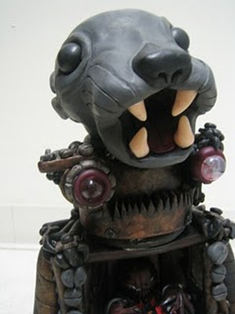
Scratchy Seal Robot
“We always had a lot of people over,” Jay says. “I’d constantly come into contact with so many new people, and I just thought it would be dope if the people who lived in the house had their own figures set up on the fireplace.”
The turn in Jay’s path that led him to toy sculpting occurred when he wanted to bestow a fellow artist with a token of his esteem. After getting tattooed by Horitaka, a renowned tattoo artist and owner of State of Grace in San Jose, Calif., Jay made his way to San Francisco to buy him a gift.
“I was loving his tattoo work,” Jay explains. “I was loving what he put on me. He’s such an amazing artist, so I wanted to give him a gift. I went down to Haight Street in San Francisco–Kidrobot–and I came across a tattooed Dunny [“a blank canvas designed to be repainted and reinterpreted by artists from many different backgrounds,” according to the Kidrobot website; it takes its name from its cartoonish rabbit shape] that Huck Gee had made. That was my first exposure to the art toys, and from there, I was just hooked.”
Jay isn’t the first fine artist to make the jump into making art toys. For example, in addition to the work of Gee, a United Kingdom-born illustrator and toy sculptor, Kidrobot’s Dunny series also includes the work of Japanese manga artist Junko Mizuno and Frank Kozik, best known for his iconic rock posters.
“I think a lot of it has to do with nostalgia, but it’s also something you can hold,” Jay says of the fine art toy movement. “You can bring it with you. You can bring it on trips. You’re able to collect them and display them as three-dimensional art pieces in your home or studio. I think that has a lot to do with it.”
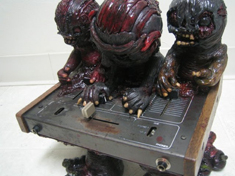
Qbert Mixer
Whatever the reason, toys are clearly not just for kids any more. A quick perusal of Jay’s creations is proof of that. On his website, Jay222toy.blogspot.com, Jay has posted videos (one featuring DJ Qbert) of the artist at work. In them, you can see as he turns blank, white, rodent-shaped action figures into grotesque (yet still kind of cute) creatures–the kind that would make George Romero, Sam Raimi or even Italian “Godfather of Gore” Lucio Fulci proud. Jay’s horror-inspired work can also be found here in Sacramento at Dragatomi, which features his splatter-ific Benny Burlap sculpts and the charmingly nauseating Up-Chuck Throw-Up Kids figure. What’s remarkable about these creations isn’t only the vivid and twisted imagination behind them, but also the level of detail. Strangely enough, it’s Jay’s training as a hairdresser that honed is skill in recreating sinew and fascia.
“At [the Paul Mitchell school], they teach you all anatomy,” Jay says. “I studied it during school and kept all the books and kept looking at all the anatomy and kept trying to match the muscle tissue in the books and recreate what it would look like on these characters.”
Jay will bring a whole slew of memorable characters to Dragatomi April 9 with the opening of his latest art show. A tribute to one of his all-time favorite films, Big Trouble in Little China, this will be the first show for which Jay has served as curator. He’s getting off to quite a start, too. Also featured alongside Jay will be notable artists such as local favorite Skinner, Dave Correia, Task One and Alex Pardee.
“I met Alex a couple years back at Wondercon,” Jay says of Pardee. “When I first saw his work, it really blew me away–his detail, his colors, his imagination. He’s brilliant. He’s a genius. His work really caught me, and I’ve always been a big fan. I was really stoked when he said he’d be down for it.”
Jay describes Big Trouble in Little China as a film that has “everything.” Debuting in 1986 and starring Kurt Russell and Kim Cattrall, it’s a story of a truck driver (Russell) who ends up in the thick of an ancient, mystical battle in Chinatown. The action-adventure/comedy was directed by John Carpenter, better known for his horror films such as The Serpent and the Rainbow and the Halloween series (the good one, not the Rob Zombie one).

“It had black magic, sword fight scenes, martial arts, comedy, monsters, creatures,” Jay gushes about Big Trouble in Little China “It had everything that’s awesome about a movie in one movie.”
While his love for the campy classic is clear, would other artists jump on board and share his fervor for the film?
“I wasn’t really sure how it would go over, because I’ve never seen a show that was based on one film,” Jay says. “I’m sure there have been gallery showings that are based on one film, but I wasn’t aware of any, and I wasn’t sure how it would go over with other artists.”
However, Jay stuck with his original idea, and in the end found that others were just as stoked about the project as he was. “It felt right,” he says.
Jay also went with his gut when creating his contribution to the show. He sculpted the Three Storms, characters from the film imbued with the powers of thunder, rain and lightning, which will be available in three different versions thanks to Task One, who helped Jay with the roto-cast resin process.
“I kind of normally stick with my first instincts as to what to make,” Jay says.
And why not? They seem to be serving him well thus far.
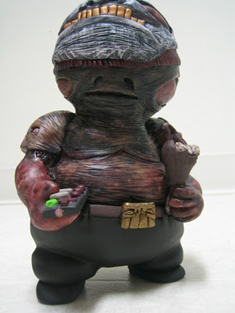
Remote Control
Big Trouble in Little China: A Tribute opened at Dragatomi on April 9. A full list of participating artists can be found at Jay222’s website, Jay222toy.blogspot.com. Dragatomi is located at 2317 J Street in Sacramento and online at Dragatomi.com
Juan MacLean Adds a Very Human Touch to Electronic Music
“You know what’s weird is a name came up on my phone. You must be calling from a landline,” said Juan MacLean from his tour bus. When Submerge contacted him for our interview, we did in fact call from a landline. It was a quirky way to start the interview, but set the tone for speaking with a man whose career in music is flavored with contradictions, and we mean that in a good way.
MacLean, or The Juan MacLean or just John MacLean, began his career in music as a founding member of the ‘90s dance punk band Six Finger Satellites, which was signed to the influential indie label Sub Pop. After he parted ways with his band, MacLean eventually reinvented himself as a solo electronica artist. With help from LCD Soundsystem’s James Murphy, MacLean has released a few recordings under The Juan MacLean moniker for another influential indie label, Murphy’s DFA Records. MacLean’s most recent album of original material, The Future Will Come, was released in 2009 and features another LCD alum, Nancy Whang, on vocals.
When he’s not performing his own music, MacLean can also be found touring the world as a DJ. When we caught up with MacLean, he was on the road with Simian Mobile Disco and had just performed dates in Canada. In 2010, he released his first mix album, DJ-Kicks, a collection of modern house music. MacLean said that the process for cultivating tracks for the mix wasn’t as arduous as creating his own music, a process he described as “torture,” but it certainly had its challenges.
“I did spend a lot of time thinking about it, which might not seem like working,” he explained. “Because of the Internet, you can really start chasing your tail, because at some point you realize that you’re never going to have tracks that people can’t just get within 30 seconds, because everything is out there and everyone knows everything. So playing this game of having the most obscure tracks is pretty much pointless at this stage of the game.”
Instead of trying to find tracks off the beaten path, he took a different approach to putting together DJ-Kicks. He didn’t attempt to wow listeners with rare songs, but rather allowed the craft of actually making the mix take center stage.
“My answer to that was first of all to use all vinyl and mix it in the classic way,” MacLean said. “Making a mix live with vinyl–I think it always does impart this human feel to it…”
It’s this inherent humanity that MacLean feels is missing from modern music. Interesting, considering he has made a name for himself in the world of dance and electronica–two traditionally mechanical genres. He explained that the little imperfections and “constantly correcting the mix in the middle of the mix” creates “a more friendly, human feel to the actual mixing.” He likened the experience to listening to old Rolling Stones or Led Zeppelin albums, “where everything sounds kind of off.” As for the auto-tuned, pitch-corrected and quantized music of today, MacLean added, “They don’t sound like human beings anymore.”
In the following interview, MacLean also shared his opinions on the difference between the dance music cultures in the States and overseas.
How is the tour with Simian Mobile Disco going?
Yeah, it’s actually been really good. Even in places like Denver on a Monday night it’s been insane.
Is Denver just not a happening town?
Yeah, it’s usually really bad for all of us. It’s just one of those places for dance music, it’s just really bad. It was crazy. It was packed. I think they were on a lot of drugs.
That helps, I guess.
It does.
You’re on the road a lot. You must have a pretty good idea of what kind of crowd you’re going to get from place to place, but do you get surprises like that night in Denver often?
For sure. It’s mainly in the United States where there are the most wild cards, because most other places in the world, dance music culture is a little more ingrained and established. You really know what you’re getting when you get there–in a good way. In the United States, it’s a battle. It’s just a relatively new thing here.
So it’s just not as ingrained in the culture here as it is in Europe?
Well, there are a few different elements to it. In the United States, traditionally, people who are into live music–rock or indie rock–are not interested in seeing dance music or a DJ in any way. The two things are incredibly divided. I think it’s fair for DFA to take credit for being a big part of bringing indie rock audiences to the dance music world. Now there is a lot of crossover, and it’s not unusual to see rock music and dance music at the same time, or see a band one night and a DJ the next night. In Europe, that’s just the way it’s always been. They don’t understand that kind of fragmentation–being restricted to one thing.
It’s funny because I grew up listening to alternative rock in the ‘90s, and you see clips of live shows back then and people are just jumping up and down and getting into the music, and then when it began to segue into indie rock, the crowds got very still and stagnant. They don’t move at all. You think that’s part of the reason why it’s hard to get the indie kids to come out and dance?
I spent the ‘90s playing in an indie rock band signed to Sub Pop. I just got used to playing a sold out show and looking out and seeing a room full of people with their arms folded. It was also a very male-dominated thing. The audiences were like 80 percent male. Especially in American culture, doing much of anything while music is playing would be considered really gay or something. We live in a very homophobic society, no matter how open-minded people in the indie rock world think they are, when it comes to indicators like that, I think it’s still a really homophobic batch of people. Dance music seems to be a bit more female-driven, in a practical way. If you’re trying to get a room full of people who aren’t dancing yet, girls are always going to be the first ones to dance, because guys aren’t going to be the first ones out there dancing. I think it’s because they’re afraid of being perceived as gay–unless it’s at a gay night, which are always my favorite gigs to do in the United States.
Just because the crowd is the most receptive?
At gay nights, nobody cares about being cool, about being cool in front of other people. It’s just totally removed. It tends to be just people having fun.
I was reading one of the reviews of your live shows from your current tour and the writer was quick to point out that you use mostly vinyl on stage. I thought it was interesting, because the laptop is the instrument of choice among DJs now.
I think people are starting to take notice again, especially in the United States. They’re just not used to seeing people use vinyl. I think when you see someone up there, even if you’re not doing much and just hanging out and listening, which is fine, to watch someone mixing vinyl or to watch someone looking for the next record play, and putting it on and getting the mix right, it just makes the DJ… For one thing, you have to move. You have to move around a lot, you have to always be doing something. It’s even more interesting just to look at than someone looking at a laptop screen. I think there’s a psychological thing now, when they see someone looking at a laptop screen, that image is what they associate with the world of work or down time looking at Facebook or something. I think there’s a psychological process that is off-putting to people, and that’s not even to disparage people DJing with laptops. I have friends who are amazing using a laptop. I’m not. I just can’t do it. But there are also a lot of people who are abusing how easy it is to DJ with a laptop. I think that’s where the trouble comes in.
Does that bum you out a little bit? I guess it could be relative, but I know photographers who really like digital cameras, but they’re bummed that they make it easy for anyone to think they’re a photographer.
It is very analogous to a bunch of fields. Also graphic design–everyone thinks they’re a graphic designer now just because they have Photoshop and Illustrator. It’s actually been a big conversation on this tour with Simian Mobile Disco, because in America, it’s much more prevalent than it is elsewhere in the world. I think you can say the same thing in any of these fields, which is now we have an abundance of people who are not so good or mediocre at doing all of these things, but it does make it even easier for those who are professionals and have put a lot of time and effort into honing their crafts and have real talent, it makes it easier for them to stand out when people see it.
For the DJ-Kicks collection, you made a collection of modern house music. Dubstep has become really popular in dance clubs recently. Was this mix sort of a statement that house is still alive and well?
Well, from the beginning for me, it’s always been an influence. It’s comparable where for James Murphy in LCD Soundsystem, he’s always really been into disco, but LCD Soundsystem songs often don’t sound very disco. It was just always something I was into, especially early Chicago house tracks–some of them were things that I’ve ripped off for years and years. When it came time to do a mix, it was just the most logical thing for me.
You said these are things that you’ve been ripping off for years, is this your way of paying it back?
Yeah, in a way. This is where I’ve been coming from forever, and also I think in the hipster world, people have been into disco for so long, for me, it got really old and tiring. I thought if there was some way to expose people to what came after disco, then maybe that would be a good thing.
Juan MacLean will perform a DJ set at Mix Downtown in Sacramento on April 7, 2011. This will be opening night of a new monthly party Lights Down Low, featuring resident DJs Shaun Slaughter, Adam J and Alx-T. To RSVP for free admission (before 11 p.m.) go to Ldlsac.tumblr.com