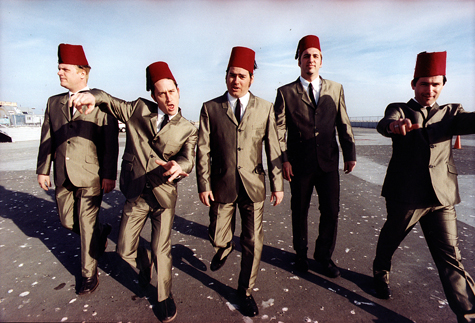
Me First and the Gimme Gimmes Go into the Vault on Their Latest Release
During the 2004 presidential election cycle, Fat Wreck Chords head/NOFX frontman Fat Mike transformed from party punk icon to counter culture luminary. Rarely interviewed in years prior, Mike was almost ubiquitous in print and on television, firing shots at the Bush administration and trying to rally young Americans—especially punk fans—to vote. Though the result of that election may not have been what Fat Mike and his legion of punk voters would have wanted, his efforts did at the very least get a portion of the population that is often seen but rarely heard a voice in the political process.
Fast forward four years later, and the U.S. is once again gearing up for another presidential quagmire. However, this time around, Fat Mike’s voice, at least publicly, is notably absent. But that doesn’t mean he hasn’t kept himself busy. On July 8, Fat Mike and his cohorts in Me First and the Gimme Gimmes (who also include Joey Cape and Dave Raun of Lagwagon, Jake Jackson (aka Chris Shiflett) of the Foo Fighters and Spike Slawson of the Swingin’ Utters) released their seventh full-length album Have Another Ball. Comprised of material from the original Me First recording sessions, the album sees the band covering hits by Simon and Garfunkel, Barry Manilow and Billy Joel. From his car—while fiddling with his new Bluetooth headset—Fat Mike answered a few of our questions regarding the new album.
Where are you headed?
I’m just getting out of NOFX practice.
How did that go?
Pretty good, thanks. We’re demoing right now.
I was reading up on Have Another Ball, and I saw that this is older material from the first recording session. What made you release it now? Why hold on to it for so long?
Well, a lot of it has been on 7 inches. We didn’t use all the B-sides for our seven-inches, we just used these songs because these were the first ones we recorded. And I don’t know, we’ve always tried to recapture that sound of the first record, because it sounds so cool and bad. We thought it’d be cool to release it now, because it has that sound from 10 years ago that you can’t really recreate right now. Plus, I think a lot of the songs are better than the first album.
You cover one of my favorite Simon and Garfunkel songs on there, “The Boxer.” What kept these songs off the original record?
We did two songs by every artist. But that’s the thing; we picked the songs we liked the best at the time, but looking back, “I Am a Rock” is not as good as “The Boxer.” And “You’ve Got a Friend” isn’t as good as “Fire and Rain.” A lot of the songs were better on the seven inches, and we felt they should be put out digitally at some point. Unless you’re a seven-inch collector, most people haven’t heard these songs before.
This is the 10-year anniversary of the band—actually 11 now—did you ever think it would last this long?
Actually, we thought we’d be in this band forever, but when we first started, we weren’t even putting out CDs. We were just putting out 7-inches. The whole idea to be in a local band where we could play bars nearby and not have to tour and not have to worry about being good, or writing songs, because, you know, we don’t do any of that. Since we play covers, we don’t have to spend a lot of time with this band. That’s what we were looking for. This is just a band where you can hang out with your bros. So we accomplished that, but then we started putting out some CDs, and it turned out to be pretty big. We thought we’d be doing this band, and we still think we’ll be doing this band for another 10 or 20 years, long after our other bands call it quits. There’s no reason to not play in a cover band. It’s something you can do for your whole life.
I know people who are in bands, and they usually look down on cover bands because they’re not playing their own music. What’s your take on cover bands?
I don’t like cover bands. There are a couple of tribute bands that I’ve seen that I’ve liked. Yeah, cover bands are a bunch of fucking piss heads. They don’t enjoy what they’re doing, because most cover bands have their weekly gigs, or they play every night in Vegas, or whatever. I once saw a Sex Pistols tribute band that was pretty fucking good. They were called the Scottish Sex Pistols. They were way better than the Sex Pistols.
I saw a Sex Pistols tribute band dressed in drag called the Trans Sex Pistols; they played Sex Pistols songs while dressed in drag, and they were better than the original also.
Oh yeah. The Sex Pistols are terrible. The way Johnny Rotten sings now is fucking horrible. They would be fired if they were hired as a Sex Pistols cover band.
You said earlier that you all were hoping to do this after your other bands were retired. Do you ever envision Me First and the Gimme Gimmes getting a regular gig down in Vegas?
Sure, why not? Actually, if they open CBGBs down in Vegas like they said they were going to, we would have to be the house band.
How do you approach playing these covers as opposed to when you’re playing your own material? Are these songs you really like?
These are songs we really like, but it’s a weird thing. You don’t really get the same satisfaction by playing cover songs, that’s for sure. It’s fun to do. It’s another reason to go out and get wasted.
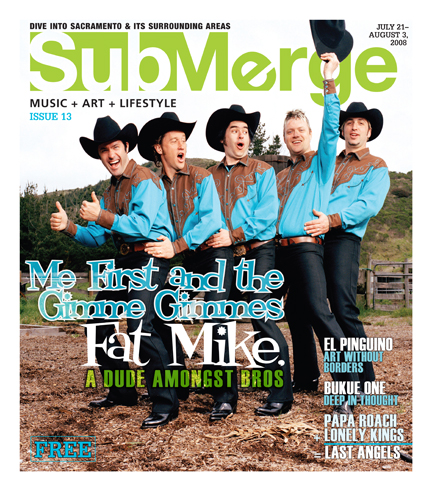
Director Doug Pray on His Documentary Surfwise
Back in 1956, Dr. Dorian Paskowitz—a Stanford graduate—removed himself from regular society. He lived without a mortgage, not tied down to any one place or occupation. He surfed beaches from coast to coast, and then some. However, Paskowitz (nickname of Doc) wasn’t a lonesome drifter. He took his family along for the ride.
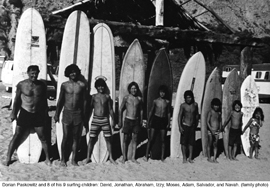
With wife Juliette and nine children in tow, the Paskowitzes inhabited a 24-foot camper as they traveled across America. They lived and surfed together and stuck to a strict, healthy diet, and the children were never enrolled in school. For some, this may sound like a sort of utopian existence, but of course, nothing is that simple.

Veteran documentary filmmaker Doug Pray, auteur behind music-themed documentaries Hype! and Scratch, explores the intricacies of the Paskowitz family dynamic in his latest film Surfwise. Not necessarily a surf movie, Surfwise recounts the Paskowitzes’ life on the road and also catches up with the family—now a bit more sedentary—in the present. Pray admits that when he was first approached to make a film about the Paskowitzes, he wasn’t sure if it was a project he’d be interested in doing. But as he got deeper into their story, he became hooked.
“I’m not a surfer,” he says. “I didn’t understand why the film would be interesting, because I first misunderstood that maybe it would just be a tribute to Doc Paskowitz. But as soon as I got into the family dynamics more”¦everything turned around. It’s an incredible story about a family. It’s not even a surf movie, I mean, it is. It’s set in surfing, but it could have been in rock ‘n’ roll or anything. I got hooked on that.”
Surfwise debuted in 2007, and this past Friday, June 20, opened at the Crest Theatre in Sacramento. While wandering through Chinatown in Los Angeles, Pray answered a few of our questions about life with the Paskowitzes.

It seems that the Paskowitzes’ diet—that they weren’t allowed to eat refined sugars and things like that—that Doc was ahead of his time. Nowadays everyone freaks out about refined sugars and flours.
Totally. He is a doctor, and he was way ahead of his time in terms of preventative medicine, the idea of just taking care of yourself, making his kids eat seven grain cereal. Today, everyone’s like, “Sure, you should eat healthy grains.” But this was in the ’60s. There’s very little about Dorian Paskowitz’s medical approaches or philosophies of health that I disagree with. He was dead on the money, and he’s been dead on the money for 40 years. We do eat too much. We’re dying from eating too much, and our society is sick. We do need to eat less, not only because it helps the planet, but just in terms of health. All those things, he’s been in touch with his whole life. What’s interesting, though is that he’s such an extremist, there are so many kids, that enforcing all of that made it really quite dramatic.
Are the kids still following in their father’s footsteps?
It’s kind of mixed. They respect their mom and dad for the most part. Some of them are like, “I wouldn’t trade the experience for anything. We had the best childhood in the world.” And some of them feel as if the movie paints too negative a portrait. But the movie also is very honest about how some of the kids feel that it was wrong that their father didn’t send them to school, and that he was quite an extremist and it wasn’t very easy living in that household, even though they got to surf every day and didn’t have to go to school. It’s interesting, because I think all nine of the kids are sort of conflicted. It’s still a very close family. It’s not like Capturing the Friedmans. It’s not a very dark tale, but it’s very honest. Their recollections are really honest. They’re just a really honest family, and the movie plays both sides of that coin. I try not to decide for the audience. One minute you think, “It’s so cool what he did. What an awesome father. He loved his kids so much that he didn’t want them to get damaged by public school, and he wanted them to eat healthy. He got them in touch with nature and the ocean.” There are so many things that are cool about that that I really respect. It’s just so bold and gutsy to do that. On the other hand, there are other times in the movie where it’s like, “Oh God. I can’t believe it.” There are nine kids crammed into this little camper. They lived really poorly. They never held down a steady job. He pulled them out of society. It was like a little cult or something.
Watching the Webisodes, there were certainly some cultish undertones. Was that something you picked up on?
He’s one of these very charismatic, very dominant, leadership type characters that you run across every so often in life. Many of those people are in leadership positions or do start religions or cults or whatever. And he does have a following. Most surfers who’ve met Dorian Paskowitz think the world of him, and that’s fine. It’s not like they shouldn’t. He promotes healthy living, and he promotes surfing. That part’s all cool, it’s just how far do you go to drag your kids into your trip? Everyone who watches the movie has a slightly different take on that.
I’ve spoke to other documentary filmmakers, and they’ve said that editing is the most important part of the process. Is preserving that sort of ambiguity one of your biggest concerns when working with an editor?
Yes. All my movies, I’ve always said is 90 percent editing. That’s not to take away from the cinematography or the interviews. If you don’t have that, you don’t have anything. But editing is huge in telling the story in a documentary, because you’re presented—in my case—maybe 100 hours of material, and it’s a question of striking a balance. It’s saying, “A movie has to be a journey. Where do we begin the movie and where do we end the movie? What kind of journey is the audience going to go on?” It can tip over at any one moment. There’s a lot of really intense and some funny scenes in the movie, but if it goes too far in any one direction, it can tip over. If the movie focused too much on just Dorian, then all of a sudden we’re missing out on the kids, and the kids are wildly entertaining. To me they’re the heart of the movie.
There are other themes about sexuality, and how you share that with your family, and that could’ve been a bigger theme in the movie. There’s also a lot of talk about religion and Judaism and the Holocaust, and that could’ve tipped it over. It could’ve become a Holocaust movie, which I guarantee would’ve been the first surfing Holocaust movie ever. Not to make light of it, but you know what I mean. We spent almost a year in the editing room balancing it out. It was extremely difficult, but I’m proud of it. My editor did a great job. It’s like writing a novel. You have all this material and you just try to shape it.

The movie premiered in 2007, but another movie of yours, Big Rig, was completed around the same time”¦
Yeah, they’re totally unrelated, but the timing was really”¦very odd. Big Rig was released this month, and it’s all about truck drivers. We’re doing a truck stop tour this summer, and it’s being shown free to truckers all across the country.
Were there shooting conflicts?
[Laughs] I would literally go from a truck stop in Alabama and get on a plane and go to Hawaii. My brain was completely screwed up—truckers and surfers. I must say that they do have some similarities. Surfers are independent-minded people, and so are truckers.
How do you think the Paskowitzes have adapted to life away from the camper?
Well, Dorian and Juliette have lived pretty much the same for 40 years. They’re still very poor. They live a very meager existence. They live in an apartment and Doc makes all his money from selling his books. He still eats totally healthy food and surfs as much as he can. He’s getting up there. He’s like 80 now. He’s in his late 80s and he’s extremely healthy. He doesn’t take any medicine. He lives his life strictly according to his principles, and so does his wife. Their kids are all grown now, so they do [live according to Doc’s principles] to varying degrees as much as they can. I think they’d all like to be as healthy as Doc”¦and so would I, by the way.
I’d read on your Web site that you had never listened to Pearl Jam before making Hype!, and that you’d never scratched a record on a turntable. You’ve already mentioned that you’re not involved with surfing. Do you get influenced after making a film like Surfwise to participate in the culture you’ve been learning about for so long?
A little bit. More of what it does is give me an appreciation for those areas. For the rest of my life, if I run into a truck driver, I can talk to him or her. That’s the thing I love about my job so much. I get to drop into these cultures and meet a lot of people—many of them become my friends and I keep in touch with them long after. I feel kind of spoiled. The downside of it is that I more tell about those cultures and I don’t really live them. It’s more vicarious. I get to observe and meet these people, but I don’t become them because that would be phony. It’s just not me. It’s not the purpose of my movies.
This has been a busy week for me. In addition to my normal duties, I’ve also been tending to my neighbors’ cats and garden while they’re away on vacation. It’s very rewarding and very stressful work. The cats have taken a shine to me. Now when I approach, they don’t scurry and hide, but they run up all around my legs and meow sweet nothings toward me. The plants have proven to be more difficult. The azalea bush was pink, vibrant and fluffy before it was relegated to my care, but now is shriveled, drab and droopy. On the bright side, the vegetable garden seems to be thriving. The Japanese eggplants are coming in nicely and there are zucchini and squash already coming in. It’s simple, maybe, but it’s very fulfilling work.
While I’ve been busy concerning myself with terrestrial matters, others have been setting their sights toward heavenly bodies. Mars is back in the news again. The Phoenix Mars lander, a space craft deployed by NASA, may have discovered water ice. According to an article by Kenneth Chang published in the New York Times on June 20:
“In a photograph released Thursday evening of a trench that the Phoenix Mars lander has dug into the Martian soil, some white patches that were seen earlier in the week have shrunk, and eight small chunks have disappeared. Until now, scientists were not sure if the white material was ice or some kind of salt.
“When exposed to air, water ice can change into water vapor, a process known as sublimation. Salt, on the other hand, is not capable of such a vanishing act.”
Of course, ice on Mars is nothing new. Scientists have been popping boners over the possibility for years now. Later in the article, Dr. Peter H. Smith of the University of Arizona, the principal investigator of the Phoenix’s mission, threw the scientific method out the window and gushed, “It must be ice! The whole science team thinks this. I think we feel this is definite proof that these are little chunks of icy material!”
In case you were wondering, I added the exclamation points for effect. He just seemed so darn excited. I’m sure his statements were delivered with the proper gravitas.
Water ice, of course, means water. And, as I’m finding out as the caretaker of my neighbor’s garden, water means life—unless of course you live near the banks of the Mississippi, in which case water equates financial ruin and soggy doom.
So did anything ever live on Mars? There is evidence of vast icy material beneath the planet’s surface. There is also a chance that Mars’s environment may have been habitable in the past 10 million years or so. It’s possible, sure, but it’s probably nothing as interesting as the critters from Mars Attacks.
If it turns out Mars is, was or could be inhabitable, we should take it at as a blessing. Shit keeps getting worse here on ol’ Earth. A report issued by the U.S. Climate Change Science Program (got to work on that name, guys) on Thursday, June 19 stated that catastrophes like the aforementioned Midwest flooding—and even the fires that have been raging around us in northern California may become more prevalent and more extreme in the years ahead. Apparently, what was contained in the 162-page report was so gnarly that the vice president and managing director for climate change of the World Wildlife Fund, Richard Moss, called it “really frightening!”
That exclamation point was mine, too. But you should probably grow those gardens while you can.
Two years ago, a series of cartoons depicting the Prophet Mohammad printed in a Danish newspaper made the rift between Islam and the largely Christian West a little bit wider. Most Muslims find images of the prophet offensive. I’m not sure the exact reason for this–I could look it up, but we’re really close to deadline–but when you consider that the image of Jesus is now used to sell everything from mesh caps to bumper stickers, it makes you think that whoever came up with that rule had a bit of foresight.
“Give to Caesar what is Caesar’s,” as the saying goes.
The profane cartoons set off violent protests in the Muslim world that left around 50 people dead and three Danish embassies attacked. Grisly, to be sure, but you would think that would be the end of it.
No such luck. On Tuesday Feb. 12, Danish authorities arrested three men who they believe were plotting to kill one of the offending cartoonists, Ken Westergaard. In response, 11 Danish newspapers reprinted the Westgaard’s cartoon–depicting the prophet wearing a bomb in his turbin–the following day. As you could imagine, this did not go over well.
Coincidentally, Danish Foreign Affairs Committee were set to arrive in Iran on Monday, Feb. 18 “for a three-day trip focusing on human rights and the Islamic Republic’s nuclear program,” according to BBC.co.uk. Tehran demanded an apology and a letter of condemnation from Danish officials. Instead, the Danish committee cancelled their trip two days before. In fact, leader of Denmark’s Socialist People’s Party took it one step further.
“We are not the ones to apologize,” he said. “If anyone needs to apologize for freedom of speech, human rights, imprisonments, executions and lack of democracy, it is the Iranians.”
Meanwhile, back in Denmark, youth violence erupted in ethnic neighborhoods in Copenhagen and other Danish cities. Rocks were thrown at cops and trash bins and cars were set on fire. AP reported that a notable Danish Imam, Mostafa Chendid (probably the only voice of reason in this mess) called for everyone to just chill out.
“The Prophet has not taught you to burn down schools, or burn cars or infrastructure,” he said. “Mohammad has taught us civilization.”
Also in Copenhagen, a radical Muslim group exercised its right to free speech and organized a peaceful protest–800 strong–the Friday after the cartoon was reprinted.
Obviously, I support freedom of the press and freedom of speech. If I didn’t, I’d find another line of work. And I understand that supporting free speech applies as much to the things I agree with as it does to the things I hate the most. But when does free speech become willful incitation?
“We are doing this to document what is at stake in this case, and to unambiguously back and support the freedom of speech that we as a newspaper will always defend,” said Berlingske Tidende, one of the newspapers that reprinted the cartoon.
However, two years ago, when Jyllands-Posten, the paper that originally ran the cartoons, was dealing with the fall-out, they issued an apology saying it wasn’t their intent to offend the Muslim community. In that light, reprinting the cartoon almost seems like retaliation for the attempt on Westergaard’s life. Is that free speech or just simple petulance?
I don’t know. It’s a slippery slope no matter which way you try to climb it. I certainly can see both sides. I don’t find the cartoons offensive, but I’m not a man of faith. I also try to turn the other cheek. Perhaps the grimmest statement to come from this whole incident came from the artist himself. Westergaard said that his “fear” of being murdered had turned to “anger and resentment.” And the rift keeps getting wider.