Dance Gavin Dance Has A New Line-up, A New Record and Big Summer Plans
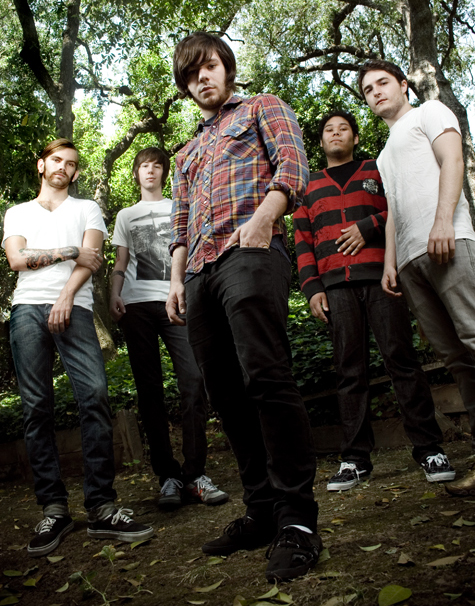
Dance Gavin Dance has seen more roster changes than an MLB team. It’s tough to pinpoint why the Sacramento-based post-hardcore band has had a tough time keeping members, but one thing is for certain: it never slows their tremendous momentum when someone leaves. If anything, it further fuels the fire lit within their fixated fans, who cause a ruckus on Myspace pages, Twitter updates and message boards. The band owes a lot of their success to the Internet and their young, tech-savvy fans who never hesitate to turn to their computers, iphones and Blackberrys to show their undying love (and, in many cases, hate) toward the band.
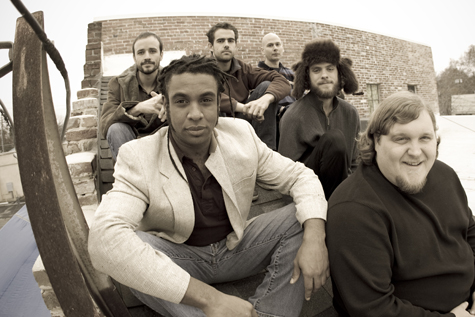
With their third full-length album (Happiness, due out June 9), a new lineup and the entire summer spent on Warped Tour to look forward to, the band seems very happy indeed with where they are. Submerge recently sat down with guitarist/co-vocalist Will Swan during a rare break from touring to chat about the new record, hitting the road and their dedicated, albeit crazy, fans.
I got a copy of Happiness to prep for this interview and I must say, it sounds a lot different than previous material.
It always does; every new record is way different than the one before.
Is that something you go for consciously?
I just want to write whatever comes out. Being the main writer, I try not to have an agenda. So every record, I feel, is just a natural progression. This is just what we were feeling at the time.
The guitars seem less distorted and sound much clearer. Can you talk about that?
We wanted to get a really clear tone so you can hear all the riffs. It’s more like a classic rock tone.
Rhythmically speaking, it seems groovier and almost dance-y at times too.
Yeah, I wrote “Don’t tell Dave”—it’s song number eight, the like, dance-funk song—while we were on tour with Senses Fail. I recorded the drums, bass and guitar. I just wanted to play it with the band [laughs] and they were down, so I taught them the song. It just kind of came together. I was really happy to be able to put it on the record. I have lots of funk influences; I like George Clinton a lot. There’s definitely a lot of funk that came through on this record.
You took over the screaming responsibilities after John Mess left the band. Is that something you’re comfortable with?
You know, at first I didn’t really like it. I’ve gotten a lot more comfortable and better at screaming. On the new record, being able to write my own parts and now being able to perform those songs, it’s a lot better feeling than playing someone else’s stuff.
Would you say Happiness is your best material to date?
Yeah, well of course, I always like new stuff [laughs]. I do hardcore comparisons between records. I feel like this one is the most cohesive vocally. Me and Kurt [Travis, lead vocals] worked together to try and come up with actual themes. We worked more together as one.
There’s one part on the record that really stood out. Who is that rapping halfway through the song, “Powder to the People?”
That’s me.
No way! It doesn’t sound like you at all. How did that idea come about?
Everyone keeps telling me that; I had to lay something over that song and I didn’t really know what yet. I got to the studio and our producer calls me and says, “I’m not going to be there for half an hour.” So I just sat there and listened to the song and thought, “What can I even do here? Rap might work!” So I just wrote the rap right there and when our producer got there I laid it down and he liked it. That song was already so weird I thought it would be cool to do something off the wall.
Another track I’ve been curious about is, “I’m Down with Brown Town.” What does that song title mean?
It’s got a couple meanings. It’s a heroin reference; it’s also an anal sex reference, it just kind of came about. While Kurt is singing, “I’m down with Brown Town“ [on “Nasa,” the track leading up to “I’m Down with Brown Town”], I’m screaming, “it’s only seconds away,” then the next song starts.
So you’re foreshadowing the next song?
Yeah, exactly. But kids online have no idea; they are all confused. Then “I’m Down with Brown Town,” the actual song, has another heroin reference; it’s like the heroin section of the CD. None of us have had a heroin problem, but we know people who have. Those songs kind of tie together both musically and lyrically.
You guys will be shooting a new video soon. What song will that be for and can you hint at the treatment?
Yeah, up in Portland. It’s for the song “Tree Village.” We’re doing all our stuff in one day, then there will be other shoots for the story while we’re not there. So we’re going to go up there and do what we got to do. The treatment for the video, I’m going to keep that under wraps. It’s a weird, kind of abstract treatment. It’s more visual; you’d have to experience it. Anything I said about it would just be like, “what the fuck?”
You’re doing a couple weeks with The Audition and Closure in Moscow leading up to Warped Tour. Are you looking forward to the summer?
Yeah, for sure. I cannot wait to go on Warped Tour. We’ve never done Warped. We played it once in Sacramento, on the Ernie Ball stage. It was fun; we had a good crowd. If we have a crowd like that every day, it would be great.
Your lineup has changed again recently. Are you confident it’s solid now?
Yeah, I think so. I always feel pretty solid about it, though. [laughs]
After perusing your Myspace comments, message boards, etc., I’ve come to the conclusion that you guys have some crazy fans. Why do you think so many people love to hate you guys?
[Laughs] The Internet is just a place for people to complain. They don’t even understand. I try not to pay attention to anything anyone says anymore. Our fans are so crazy. I cut my hair, because it’s getting hot you know? And I’ve been getting a ton of shit for it. Kids are like, “Why did you cut your hair?”
Yeah, you had quite the afro going on. So they’re missing it?
Yeah, they totally are!
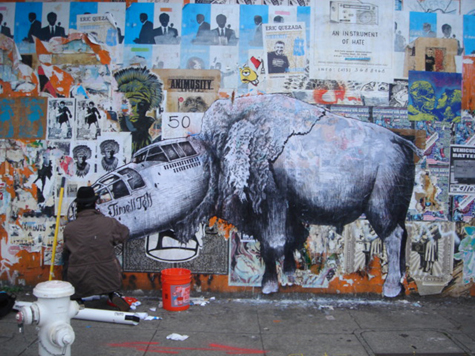
Oakland artist Jesse Hazelip’s mixed-media artwork has captivated viewers throughout the Bay Area and beyond, in locations such as Los Angeles’s Thinkspace and Abacot Gallery and The Space in Chico, Calif., to name a few. The political commentary in Hazelip’s art is not subtle. Many of his pieces illustrate the stark contrast between the destructive nature of mankind and the peaceful beauty of the natural world. The results are unsettling: A buffalo’s body attached to the nose of a fighter plane, or a heron’s body with the head of a deadly weapon, flying across a geometric sky.
Hazelip’s art is evocative of a wall covered in colorful graffiti—pointing to his origins as a graffiti artist. “I used to be really deep into graffiti, and I would always try to paint something different each time I went out,” he explains. As you can probably imagine, this got him into some trouble during school. The rebellious teenager inside of him might be tamer now, but certainly isn’t absent. “I am currently trying to refine my aesthetic into a cohesive body of work, and create a visual language of my own,” he says.
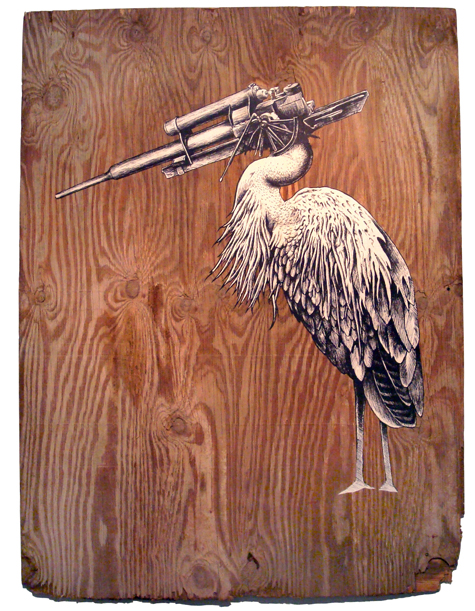
True to his roots as a graffiti artist, Hazelip prefers to show his work where it can attract the most attention. “My favorite place to display my work is on the street, in public domain, in hopes of creating dialog amongst the Proles,” he says. For example, this past February one of his creations could be found on the wall of a building in the Mission District of San Francisco.
While these graffiti-like pieces give the illusion of spontaneity, in actuality he has put considerable effort into every finished piece. “I collect reference and read about potential paths I want to explore. I do tons of small rough drafts, and sometimes large fully rendered drafts,” Hazelip explains. “But the drawing is always the most time consuming aspect of any of my work.”
Considering that most pieces are literally larger than life, the finished products are impressive. “Scale is very important to me, and the gravity of larger pieces has always resounded with me. I like to make things life-size or larger, something you have to stand back from to fully appreciate, but also draws you in to inspect the detail,” he says.
These large-scale pieces are fitting for his subject matter. His themes generally include social issues that he feels need to be addressed, such as war. He uses a variety of mediums to get his message across, and is currently working with everything from drawing and painting to print and mixed media. “I love drawing with practically anything that makes a mark, and the same with painting,” he says.
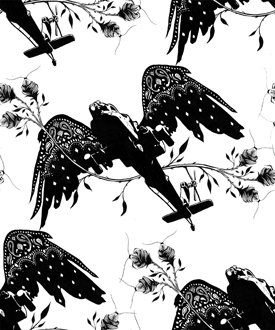
Hazelip received his BFA from Art Center College of Design, and for now, he pays the bills as a commercial illustrator. Someday, he hopes that he can devote himself completely to his own artwork, stating that his goal is “making my art for a living, not having to answer to an art director, having complete artistic freedom.” He is optimistic that although art may not be the easiest career path, it’s the right path for him. “Art is a rough trade, especially in today’s economy, but that’s part of the struggle,” he says. “It’s really hard work, and artists get exploited a lot, but it’s all a learning experience.”
Hazelip’s most recent collection is entitled Tempest Turner, and is aptly named after a WWII bomber plane. In these pieces, Hazelip continues to explore the dark contrast between mankind and the natural world, questioning whether man will ever learn from the mistakes of the past. This collection will include a variety of mediums, such as silkscreen prints, acrylic on wood, ink on paper and mixed media on found wood.
His hopes for his art are far-reaching, and he says he has several dream galleries in large cities like San Francisco, Los Angeles and New York where he would love to show his work—as well as taking the creativity with him and traveling overseas. But no matter how famous he becomes, he retains the humble goal of using art as a communication vessel: “I feel that I have a responsibility as an artist to voice concern with my craft, to seize any platform I can and use it for a greater good.”
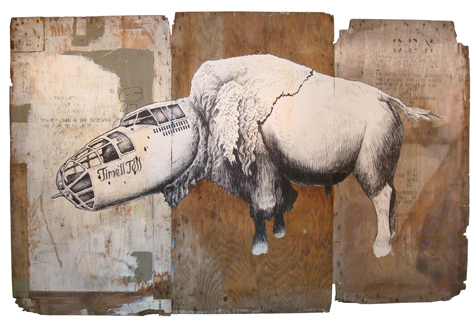
Going to Second Saturday? Jesse Hazelip’s new collection, Tempest Turner, will be shown at Space07, located at 1421 R. Street, Sacramento. The collection will be shown from June 13 through Aug. 9. You can also check out his work online: www.jessehazelip.com and jessehazelip.blogspot.com.
Happy Mayfield, Righteous Movement
Old Ironsides was a rocking boat April 18. Old friends were conversing and new friends were connecting, and for those who were rusty at socializing, the bar was there to hug. Lee Bob fans spoke fluently with leftover Bucho fans as Happy Mayfield heartthrobs conversed in familiar circles with Righteous Movement aficionados. It was clear that everyone in attendance had gathered for the same reason: to have a good time.
If there are two styles of music that are all about having a good time, they are hip-hop and funk. Historically speaking, one came from the other and so it seems so natural that they cross-pollinate. With that said, you need look no further for one hell of a good time than a bill that includes the aforementioned Righteous Movement and Happy Mayfield. If you are from Sacramento, then you’ve most likely seen Righteous but might not be familiar with Happy Mayfield yet. Happy Mayfield, a funk band to be reckoned with, is a harmonious marriage between singer/songwriter Lee Bob Watson and The Park (ex-members of local favorites Bucho). To my delight, I discovered upon viewing the stage that The Park was set up to play with Righteous as well. Hip-hop shows take on a whole new life when live instruments are part of the equation, and the boys in The Park were nice and warmed up after a stint at SXSW where they backed artists Alice Russell, Keelay and Zaire in the buzzing city of Austin, Texas a few weeks back.
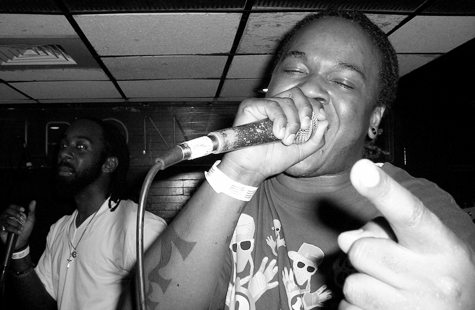
Righteous Movement’s set began with no introduction. Derek Taylor laid right in to the kit with Josh Lippi on bass, Ben Schwier on keys and Ross Grant on guitar following closely behind. Each backbeat groove was laid out with ease for the three (usually four) MCs to do what they do best: rap their asses off. The energy pouring from Old Ironsides’ small, dimly lit stage was almost overwhelming as the seven-player-deep ensemble blasted their way through a continuous set of funk-powered hip-hop tracks. Verses were traded back and forth, and each delivery had its own voice while still achieving that barbershop quartet harmony that Theek, Tais, Skurge and S.O.L. have carved out for themselves. The rhymes were well thought out, the hooks were fun and the gentlemen had a stage presence that exuded personality and experience. Righteous’ own DJ Tofu even made his way to the stage at one point, charismatically raising his poison of choice in a celebratory gesture. The audience, as thin as it had become at that point, needed no persuasion.
At the bar earlier that evening, The Park’s bassist Josh Lippi had told me that, “”¦Happy Mayfield is Lee Bob’s alter-ego.” We laughed and I didn’t think much of it until Lee Bob hopped up on stage wearing a pair of retro frames wrapped around his face, a faded T-shirt and a pair of bellbottoms to finish it off. Now don’t get confused, they weren’t all dressed up like a cheesy ’70s cover band. Happy just had a funky style, man.
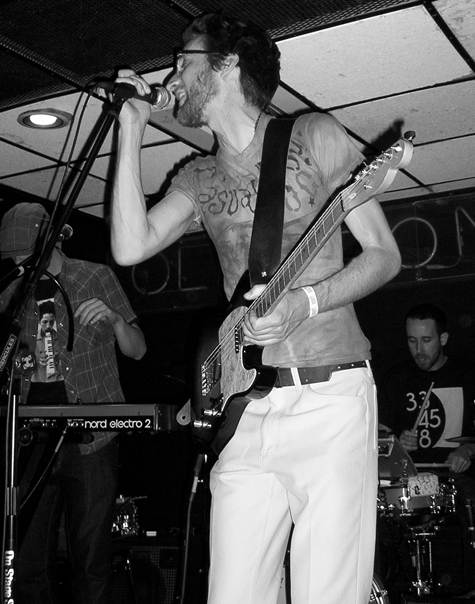
On stage, Lee Bob became this alter-ego. He was some sort of a shaman, writhing and whipping his head back and forth as if possessed by the spirit that he sought to conjure. The defining song of the evening found him screaming, “Happyyy!” at the top of his falsetto lungs—the band behind him pumping away, yelling more and fueling his hysteria. “You can’t get this at no corner store,” he cautioned his congregation. Taylor’s machine gun snare fills stuttered through Lee Bob’s mantra all the while Schwier’s keyboard cried and moaned to the crowd, which hung on every last note, their eyes ablaze and wishing strangely for the song to end but not knowing how; sadistically enjoying the agony. Lee Bob expelled his guitar, sprang onto the dance floor and erupted into an involuntary dance that then sent the rest of the movers and shakers into like positions. Local guitar guru Mike Farell, who had been looming in the audience, made his way to Lee Bob’s guitar and struck up a solo that built as the band swelled, and heavy-washed cymbals filled the spaces in between. Lippi’s solid bass playing anchored it all down. This was funk music in its most raw form.
I finished my Pabst and walked the four blocks back to my apartment feeling”¦happyyy.
Though Sacramento’s Buildings Breeding Started as a Joke, the Band is Serious About Moving Forward
A perusal of Buildings Breeding’s Myspace page will show that the band has a sense of humor. The tagline under the band name describes the group’s genre as a fantastical mix of “healing & easylistening/religious/black metal.” Of course, even a brief listen to Buildings Breeding’s music reveals anything but. In place of these incongruous genres are dreamy male/female vocals bolstered by jangly pop melodies and swift percussive sensibilities. Perhaps “easylistening” isn’t too far off the mark, because the band’s songs are just so catchy.
Buildings Breeding’s ability to poke fun at itself may stem from the fact that the band started as a bit of a joke—albeit a romantic one. Frontman and founder Chris Larsen started the band as a way to confess his feelings for his girlfriend and now band mate, co-vocalist Melanie Glover. Larsen concocted Buildings Breeding as a fake band with its own Myspace page in order to reach out to Glover while she was abroad. This quirky back-story is a bit of a bane and a boon for Larsen.
“It’s kind of a silly story that we’re trying to get away from,” Larsen says with an uneasy laugh. “That story is haunting us our whole career.”
Whether the band was make-believe or not, its music struck a chord with Glover, and others as well. While still living in Davis, Larsen sent his songs out to Mushpot Records, which signed Buildings Breeding, even though it technically didn’t exist.
“I was pretending to be all these people. I submitted to them just as a joke, and they wanted to put out the record, so I was like, I better put together a band then,” Larsen explains.
“I don’t even know if I ever told them, because I didn’t want to ruin the chances of getting my record released.”
Now just a few years after Larsen conceived the band (he says he got the idea in 2006, but the group didn’t really come together until 2007), Buildings Breeding has bloomed from an inside joke to a bona fide five-piece with a bright future ahead of it. This month, the band will release its first nationally distributed album, In the Key of Calloused Fingers on venerable Bay Area indie Devil in the Woods. The album will be available on vinyl, limited to 300 copies (a digital version of the album was released April 28 and can be purchased via iTunes and other online music stores). The album is a compilation of older material from prior Buildings Breeding releases chosen by friends and fans and also some newer songs. Fittingly, Larsen says the title “¦Calloused Fingers also has a humorous connotation for the band.
“[The album] is kind of like a collection of what we’ve been doing for the past couple years,” he says. “We’ve been playing them so much, our hands are calloused.”
Using Myspace, Last.fm and other sites, Buildings Breeding put the “¦Calloused Fingers‘s tracklisting up to a vote. And in some cases, the band was surprised with what their fans chose.
“It brought some songs that—at least for me—weren’t first picks,” says Chris Vogel, Buildings Breeding’s bass player. “There were some songs that did really well off the self-titled [album], but some of the fans picked some of the deeper songs on that record, so it was nice to include them on “¦Calloused Fingers.”
According to Larsen, letting fans choose their favorite songs keyed the members of Buildings Breeding into which of the songs were working better than others.
“When you have people e-mailing you what songs they like, you kind of know what your live shows should sound like,” Larsen says. “There are some tracks that, in my heart, I thought people might like, but it definitely gets you on the right direction as to where to take the band. It’s obvious when you listen to this record, people like certain ways we go better than others.”
However, both Vogel and Larsen say that fan reaction alone won’t drive the music behind their next recording.
“I think what the fans were telling us by picking the songs was definitely important, but at the same time, we want to grow as a band,” Vogel says. “You can sit and make songs that everyone’s going to like all the time, but you’re just going to fail.”
Though the songs on “¦Calloused Fingers may be new to many people nationwide, Buildings Breeding are more than familiar with them. The band is looking forward to recording new material. Larsen hopes the band will re-enter the studio sometime after May.
Whether fan reaction plays any part in the road ahead for Buildings Breeding will remain to be seen. A larger affect on the direction of the band’s music will probably come from the band’s desire to write their next album together, as opposed to Larsen as primary songwriter.
“With five different people’s input, you don’t know where that’s going to take you,” Larsen says. “I think creating a record together will be the happiest thing we can do.”
Recently, Buildings Breeding was injected with new blood. Kevin Dockter stepped in on lead guitar and Justin Titsworth joined as the new drummer. Both members have had a big impact on the band. Vogel and Larsen both praise Dockter for his “tasteful” playing.
“Kevin instantly just opened up a new door for us with his guitar parts,” Larsen says. Kevin really embellished the songs.”
Meanwhile, Titsworth has taken the band to “the next level,” according to Larsen. Titsworth’s arrival allowed Glover to step out from behind the kit and be more upfront with her vocals, with out causing Buildings Breeding to lose anything rhythmically.
“Some of her songs are our best songs and fan favorites, our top sellers of whatever we sold in downloads,” Larsen says. “It really made me disgruntled to not be able to do that properly. It definitely changes everything to have everything we want going on while she’s singing.”
“I think we’re at a point with five members that we can branch out and bring some new stuff to the table that we haven’t been able to before,” Vogel adds.
With a solid roster in place, it would seem that the good humored members of Builidings Breeding have plenty reason to be resolute going forward—whichever direction their music takes them.
Michelangelo’s
1725 I Street, Sacramento
Often, I mention the excitement, importance and necessity of the “culinary adventure.” This is when food lovers, foodies, venture to the edge of comfort to try something new at the risk of a terrible tasting outcome for the sake of discovering a sweet, juicy, raspberry-red ruby of delicious enlightenment.
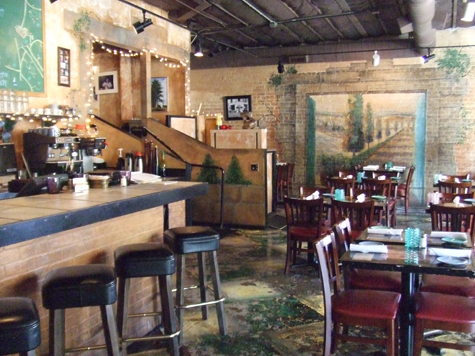
Always on the lookout for a worthy location to learn and try something new, I came across Michelangelo’s while walking around midtown several weeks back. The building appeared to be an art gallery, upon first impression. As I stood outside reading the small plates menu, a guy said, “Are you gonna come in? Or are you just gonna stand out here?”
That guy tried to convince me to go in and eat (even offered to buy me a drink) and told me about the local products and quality of atmosphere and eats found at Michelangelo’s. He turned out to be partial owner of Sampino’s Towne Foods and told me of the delicious sausage that his father made by hand that was served at Michelangelo’s, and how he enjoyed libations and sated his appetite most Thursdays at the restaurant, while being entertained by live music in the small, cozy restaurant.
I did turn down his invitation that Thursday, but I told him I’d come back a few weeks later, to see if I agreed with him firsthand.
I returned two weeks later, ready for food and music. But Michelangelo’s was abnormally closed for the day. Boo. But I wasn’t going to be swayed to change my food safari destination that easily, so I stopped in the next day for a late lunch.
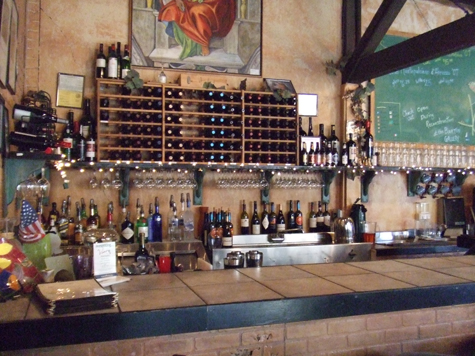
I decided to kick off my Friday afternoon lunch right, choosing a glass of red wine with the help of the genuine, friendly, personable and knowledgeable waitress/bartender, Lisa. The tart, sweet and only a bit dry Boroli Quattro Fratelli Barbera d’Alba 2005 was $8 a glass and tasted of raspberries and cherries. I was so enthralled with my Italian wine that I almost forewent the food. But, I’d picked a unique dish that deserved my attention.
I ordered the $12 red wine gnocchi from the lunch menu, intrigued by the combination of red wine, anchovy, seasoned ricotta and lemon zest. I’m a big fan of anchovies (although I’m always careful when and where I eat them) and was curious how their pungent, salty oceanic flavor would meld with red wine.
I discovered upon arrival of my plate of potato spoon-rolled pasta in a muted mauve sauce that the blend was delish—at first anyway. The wine lent itself to a sour/tart flavor that offset the salty-fishy-ness of the anchovies. Of course, my wine helped my palate along, highlighting the robust and melding flavors. The ricotta was appropriately peppered and salted. I’ve sugared or salted ricotta before, but never peppered. Lovely.
Flavor complexity is generally a good measure of quality. That means the seasonings and spices of a dish are so well melanged that you can’t distinguish one from another and each bite is a ominous flavor surprise. My dish was such.
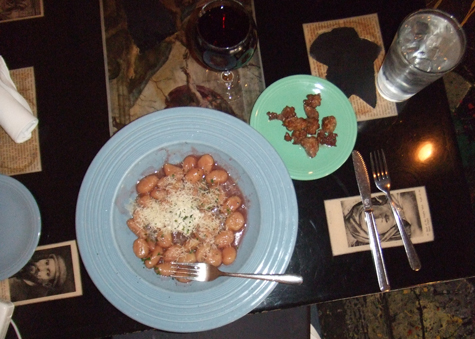
The only real flavor-texture problem was that the gnocchi was probably cooked a minute or two too long. It should be chewy, but more firm than chewy. The chewy-ness of the gnocchi and the sour fishy sauce did become difficult to stomach after the magical effects of the vino took hold of me (a bit too strongly) that fated Friday afternoon.
Recalling my conversation weeks back about the sausage, I couldn’t pass up ordering a side of it. The sausage was incredible, equally yummy hot or cold—not an easy or frequent accomplishment for sausage. A salty, smoke-y flavor popped at first, then a spicy herb flavor finished off the bite.
Honestly, portions were smaller than they should have been. The gnocchi probably $3 more than it should have. And for $5, I got maybe two or three ounces of sausage. That didn’t seem appropriate.
Michelangelo’s offers great Italian wines at what I thought to be a decent price. If you’re not in the mood for splurging on a complex flavor experience, you can get your cheaper thrills with glasses of vino. It’s certainly a shmancy place. You may or may not be disappointed, depending on the pretense of your visit to such a wine-derful place.
Thumbs up for romance or bromance. With close homies or with love interest.
Other circumstances don’t quite take hold of the enchanting quality of vino and vittles at Michelangelo’s.
By Josselin Basaldu
Autumn Sky Charms Fans With Her Upcoming Album
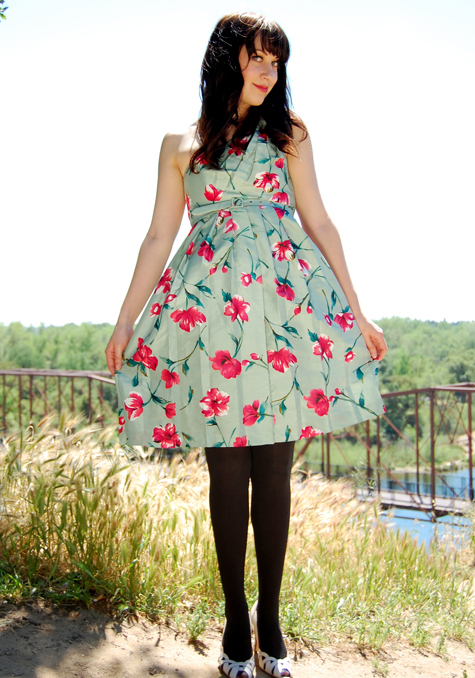
Whether crooning about a budding romance or a broken heart, Autumn Sky’s sparkling melodies resonate long after the final notes die down. Like an intimate conversation, Sky’s confessional narratives are blended with twinkling instrumentals. Her music leaves you with a warm feeling—like reading a book on a rainy day. Most of her songs sparkle with hopefulness and celebration, but there is also the occasional haunting gray lullaby.
Surprisingly, this precocious singer/songwriter is just 20 years old. “I do things early. I don’t really wait around for everyone else,” Sky explains. “I’m not going to be one of those people who sits back and regrets wasting my life on drinking and partying in college.” But, she is looking forward to turning 21 in October—most of the venues she plays are 21-and-over, which means she has to leave the building the second she finishes her set.
Music was something Sky fell into naturally. She already had the name—her first name is actually Autumn, and Sky is her middle name—and she was born into a musical family. “My family is very big and my mom is very musical and she always had us learning instruments or singing,” Sky says. “We were just constantly surrounded by it.”
Being part of a musical family meant early exposure to various instruments, such as the piano at age 6 and the violin at age 12. She had a guitar as a teenager, but admits that it just sat around in her room because she wasn’t motivated enough to learn how to play. “I wanted to go do cool things, and learn the guitar was not one of them. Until it got cool to play guitar, it just sat in my room and looked pretty, like a prop.” Then came the deciding factor: boys. “I went to summer camp and all the cute boys played guitar,” she laughs. “There was a talent show and I was like, I’d better learn a song or something.”
Being home-schooled and graduating at age 17 left Sky with lots of time to spend on herself and figuring out what she wanted to do. “I ended up getting into the scene pretty early on because I had extra time and there wasn’t anything else to do. I had my driver’s license and I had a guitar,” she says.
Like other budding musicians in the Sacramento area, Sky started out playing at local coffee shops and open mic nights and worked her way up to paying gigs. She used to play as many as five nights a week, until someone told her, “slow down, you’re going to kill yourself. You’re not even 20 yet.” Now, she’s discovered that by playing less shows per month in the Sacramento area, she gets a better turnout and a better crowd with much more energy. It also allows her more time for touring and playing in other cities.
Attend one of Sky’s shows and expect a diverse mix of instruments and sounds. Many call her eclectic, to which she modestly responds, “I think I just don’t make up my mind.”
Her shows generally include two to three instruments—usually the guitar, the ukulele and the autoharp. Also in her musical repertoire are piano, organ, tambourine, drums, flute, recorder, accordion and classical violin.
Her sets differ from night to night. “Depending on what the mood is in the set, I’ll be like, ‘well we could use something light and airy.’ So we’ll throw in a ukulele song.” This gives her a lot of control and flexibility, and also ensures that she doesn’t get tired of her sets.
Even though Sky uses a wide array of instruments and writes songs in many different styles, she still strives to create a signature sound. While she is constantly experimenting with the songs she writes at home, these may not make it into her sets. Like some of her favorite musicians—think Regina Spektor and M. Ward—her “sound” has a simple and folk-like appeal. “I really appreciate just plain old stripped-down acoustic songs,” she says. “I really love careful finger-picking and light, jingly sounds accompanying.”
An avid reader, Sky places a lot of emphasis on her lyrics, which are often narratives. “The music I tend to write always tends to be slightly upbeat and happier, hopeful or celebratory. Or at the very least, with a message of goodwill at the end of a very sad song.” Above all, she writes about love in its many forms.
Sky’s EP, Diminutive Petite, was released this past November. The title refers to a line from the Madeline theme song: “She may be teeny-tiny, diminutive petite, but that has never stopped her from being pretty neat.” Her full-length album comes out on April 24, 2009 and is called All Which Isn’t Singing. The title is from the ee cummings poem, “all which isn’t singing is mere talking.”
Someday, she thinks it would be nice to be backed by a band, but for now she is content working as a solo act. “Until you get signed it’s really not practical to go out and hire all these musicians. Unless I’m making enough money to give it back to the musicians, it’s not really worth their while.”
School is still on the back burner, and includes plans to study child development and music therapy. Her little brothers are autistic, and she wants to specialize in autism. But at the moment, music is her main focus. In her optimistic way, she says simply, “I’ve been really blessed lately.”

The Places In-Between
Sacramento is home to John Stuart Berger, a prolific artist who has been creating and showing his paintings for over 20 years. With two decades under his belt, you might imagine a man jaded and burnt-out. He is quite the contrary, instead painting constantly and showing regularly-all while raising his 4-year-old son and teaching art to disabled adults at the Short Center North.
“I’m constantly painting. It’s the one thing that everybody always asks me, ‘Do you have a show coming up?’ and a lot of the times I don’t,” he says.
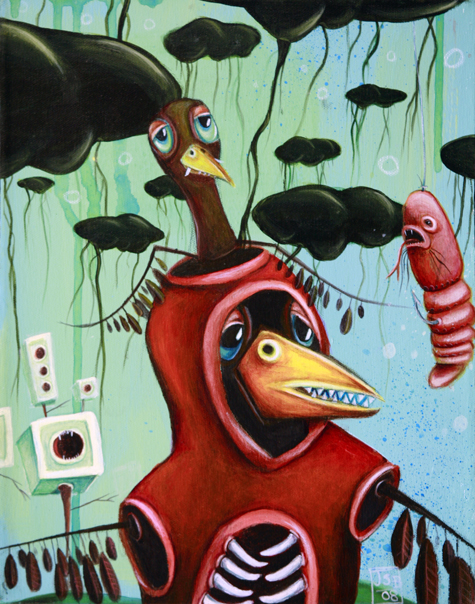
Lucky for you, this time, he does. His show, titled The Ubiquitous Mandible Crushing Sideshow, opens April 11, 2009 at the Upper Playground in Sacramento and runs through May 31. Submerge met up with John at his studio inside the Verge Gallery on 19th and V in Midtown to discuss painting, growing up in Danville and male bonding.
You have a show this month at Upper Playground. Are you doing all brand-new paintings for the show?
For the most part they’re new for Sacramento; some of the pieces I’ve shown in Los Angeles and San Francisco. With the exception of maybe three pieces, they’re all new to Sacramento and then 70 or 80 percent of them I’ve never shown before. I’ve just stashed them away over the last couple months.
Over the past three years, according to your Web site, you’ve done over 130 paintings and I’m sure there’s many more. What kind of time schedule do you create for yourself so that you can be so prolific?
It’s hard [laughs]. I kind of joke and say that I don’t eat and sleep. The fact is, I have a 4-year-old son and he keeps me really busy. I have to make blocks of time. My wife has a really variable schedule too, but usually she has some nights off. So, there are one or two nights a week that I come here to the studio or there’s the male bonding thing over at Skinner’s house [laughs]. We call it that, but occasionally we do get some women that do that whole thing.
But then it’s not as fun because there’s not as many fart jokes, right?
Right, right. We totally want the women to come to the space, but it’s so dominated by testosterone”¦ I mean, I’d be afraid if I were a woman.
I know you and Skinner Davis are pretty good friends and have worked and painted closely together. Have you noticed his style or even his work ethic rub off on you over the years?
I don’t know if we really influenced or rubbed off on each other. I think we just fed off each other’s energy more than anything. I think technically we come from two different backgrounds. He’s got a big comic book influence, which you can totally see in the line work of his paintings. I’ve got that a little bit; I looked at a few comic books when I was a kid but I actually learned to draw from field guides and old 18th century etchings and shit like that.

That’s where that animal and plant influence comes from then?
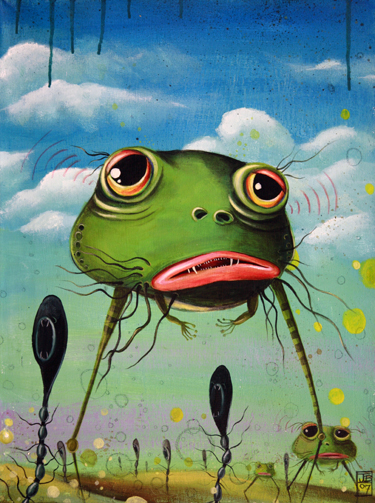
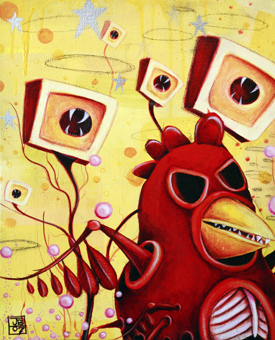
If you look at some of the stuff, it’s that three-quarter profile shot of the birds. It’s classic field guide—Audubon staging—and that’s where I learned to draw. We lived out in the country in Danville when it was very rural. The community that we lived in didn’t even have a sidewalk so it was all ditches and roads, and we had 60 or 70 acres behind us. I was very influenced by that surrounding. We had this big creek behind our house that I would always go to and admire all the crazy plants and animals. Then I got into field guides. I could draw from them because I could have them with me; draw before I went to bed and draw when I was outside. Then I would have fun mutating the animals and breaking them down and doing composite studies.
Looking at your work, it all seems like a photo album of candid snapshots of this alternate animal universe.
Yeah, it’s funny. A few years ago I was showing at more of a fine art venue, like Solomon Dubnick and Himovitz and now I’m showing at these urban”¦like”¦I don’t even know what you would call it. I’m sure there’s a label that’s more appropriate. It’s considered lowbrow now I guess. It’s defined as pop surrealism and it’s fragmented off all these different things.
I just call it Juxtapoz-y.
It’s just that these people have a very different background than me. These guys are all comic books and cartoons. A lot of the stuff that’s popular right now comes from that. I did a little bit of that. I did some skating as a kid and I read a few comic books, but my emphasis and where I drew a lot of my inspiration from is totally different. It’s kind of weird and awkward sometimes too. Everybody looks at you and tries to figure you out. Sometimes I almost feel like I don’t really fit into the fine art thing, and I don’t really fit into what’s going on now. I shift back and forth in the parameters of both.
Do you think that’s a good thing?
I think it’s good. I mean, everybody’s art is derivative in a sense, but I think that it makes me less derivative”¦ I obviously do have influences and then people can draw correlations that make me derivative, anybody can do that. They can construct a hypothesis of who you are but I like the fact that I’m just doing whatever it is that I do, and that I do have a different background. I think a lot of people have a hard time identifying, because I don’t do a lot of people. For a while I tried to lecture myself. I’d ask myself, “Should I do people?” You go through these periods where you beat yourself up. You just get really introspective. Then you’re comfortable and say, this is just what I do for whatever reason.
You said you can be real introspective, which is self-inflicted criticism. Have there been any outside criticisms that have made you question how or what you paint?
If anybody says anything that can be construed as being negative, it would be that everything looks so angry. This older stuff [motions to a painting of fish with piranha-like teeth that hangs on the wall], this is 13 or 14 years old, it’s got these really dark and shadowy backgrounds. Everybody refers to those as everything looking dead; dead and angry, with teeth! I put teeth in everything and I don’t know why I do it. I think I’m fascinated with the whole predation thing; things consuming other things. Now it’s gone to parasites. That’s just my geek background again.
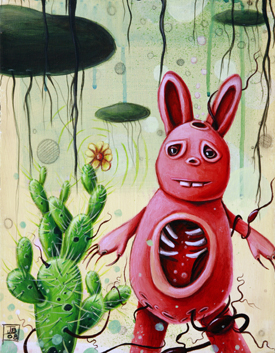
You’re painting the whole field guide, from the parasites, to the birds, to the reptiles.
And I’ve got a whole arsenal of old textbooks. Those are the greatest. If you go to thrift stores, for 50 cents you can pick up an old biology textbook. Just some of the plates you can draw from are great. I got this really great paleontology book a few years ago; it’s just got the most incredible etching line work drawings that are inspiring.
As far as acquiring shows and selling artwork, do you feel that Sacramento has been good to you?
I’m in a weird place right now. I’ve been showing in Sacramento for almost 20 years, which is crazy to think about. I kind of feel like artists are a lot like bands. When you are up-and-coming, everyone wants to see you. Then you get to that point where everybody has seen you”¦ You’ve saturated the market, basically. So the next obvious thing to do is go to the bigger markets. But the bigger markets don’t know who you are, and they either pick up their own people that they’re into or they’re big enough that they’re getting really big people. So, you totally get lost in that shuffle too. So, I’m kind of in that in between area where I’m a little fish in a big pond and I’ve kind of worn out my welcome. That’s the way that I feel, like I’m in this whole in between. Nobody really knows who I am, or everybody’s seen me”¦ But as far as Sacramento being good to me, I like Sacramento. I like the size of it and the fact that everything’s tangible. Proximity too, I can easily go to San Francisco and do a show and it’s no big deal. Then basically everybody that I’ve shown with, artists and galleries combined, I’ve really enjoyed and had a good time. I’ve got a lot of positive feedback here. I’ve had very few bad experiences.

You said you have a 4-year-old son. How has that influenced the way you make art?
He’s probably become aware—what I would consider aware—of my work in the past six to eight months. We’ll go somewhere, around town, and he’ll see stuff 500 hundred feet away and say, “Oh my god, that’s one of daddy’s paintings!” As far as how I approach my artwork, the only thing that’s really changed is how I divide my time up. I really want to be a good dad and spend time with him, but I obviously have this thing where I want to get artwork done. I really have to make my time count, because I used to be a little more haphazard with my time. That’s the influence. I have to structure my life differently so I can still get work done because that’s important to me.
We’ve heard from just about everybody about how bad the economy is and how we are in a recession, etc. Have you been affected or are there always economic ups and downs as an artist?
Ironically enough I’ve already been through one. It wasn’t as bad of a recession as this. Actually it was…when George Bush Sr. was in office. So, I’ve already seen that fluctuation, but this time it’s definitely a lot worse. I just don’t sell as many paintings, but I’ve always been somebody that’s had a day job. I’ve got a couple friends that rely a little bit more heavily” on their art or a facet of their art to make their primary income, and they’re hurting.

Consider This!
It doesn’t take too keen a memory to recall when the underground was rocked by a relatively new animal; a post-hardcore beast gnashing a row of melodic incisors, besmirched by a heavy metal overbite. The critics called it metal-core, then screamo, then a whole host of hyphenated hyperbole until a style of song that sprung from an Iron Maiden fever dream began to homogenize, embraced a pussycat’s slippery sheen, and is now essentially a safe haven for tough kids gone soft. It’s sad but true: Screamo is a fucking joke. Metal-core is a caricature in a Mall of America comic strip. The death rattle for a once mildly exciting punk rock overture has shaken its final clangs.
Sacramento’s Consider the Thief (nee Heartshed) has been toiling within the confines of this breakdown-heavy haze. They are set to release what will no doubt be regarded as either a complete about-face from what their fans expect, a risky career move in a still-fledgling existence, a “fuck you” to what would have surely been a cakewalk into the mainstream-or most likely all three. Guitarist Sean O’Sullivan, formerly of Dance Gavin Dance, attempts to explain the chronology of events leading to this spring’s release of Signs and Wonders.
“All of us paid our dues playing in heavier bands for years before this,” explains O’Sullivan. “After the release of Soldiers and Saints [the band’s self-released debut EP] we decided we wanted to take a leap of faith and write songs that didn’t rely on what had become a crutch for us: screaming and busy guitar/drum work.”
Soldiers… found the band contented in a sound equal-parts Vheissu-era Thrice and a just-crowning Thursday, emerging behind a wall of punishing metal riffs and algebraic time signatures, capped by guttural yelps and pin-prick melodies. It was an underground release that garnered the praises of everyone from Punknews.org to mega-hip glossy rag Alternative Press, who placed the group among their “100 Bands You Need To Know” in 2009.
While still unsigned, the band (rounded out by pianist/vocalist/guitarist Dryw Owens, vocalist/guitarist Jordan Wells, bassist Zack Walkingstick and drummer Lucas Allen) seemed to realize that their artistic bents remained malleable, and with a creeping disdain for the impending creative flat line of their young catalog, they turned a musical corner.
The process was a trying one for O’Sullivan.
“Writing this record was pretty intense for all of us,” says O’Sullivan. “The first song we wrote after the EP was the softest any of us had been a part of. There was that learning curve with the new material, how to go about writing more dynamic and emotive songs. I suffered writer’s block at one point and during that period experienced a lot of growth and was humbled by watching the other guys write.”
The result of such growth has ushered in an atmospheric wash of layered songwriting more akin to the vibrancy of UK sonic-rock supergroups like Radiohead, with a marked emphasis on lyrical themes. These themes rear most poignantly with takes on the Christian parables “The Good Samaritan” and “The Prodigal Son.” But O’Sullivan is quick to note the band’s neutral stance with regard to the presumed theological imprints on their music.
“It wasn’t really a purposeful thing at first,” explains O’Sullivan. “I personally feel it’s important for an album to have a well-rounded lyrical theme. My biggest worry with the lyrics on this record is that people would think that we’re some sort of bible-thumping Christian band. These stories Dryw sings about [are] just as powerful to an Atheist as they are a Wiccan or a Catholic. We’re not trying to convert anyone with a sing-song Jesus chorus; we just want to convey the power and relevance these stories still have.”
The fear of alienation, while something that most artists might invoke as tantamount, took a back seat for Consider the Thief in the process of writing their new material.
“We had a good laugh as we were writing these songs,” says O’Sullivan. “We knew that the kids who love our old material would most likely not gel that well with the new stuff. The vast majority of people have had nothing but good things to say.”
With their initial successes, O’Sullivan points out the band’s gratefulness for exposure on a national level while still remaining unsigned. Signs and Wonders will be self-released by the band, and should be available exclusively on iTunes by May, with a CD release show still in the planning stages. In the meantime, Consider the Thief is gearing up for its future.
“We’ve been so focused on writing and recording that we hadn’t really thought too far into the future, but we are now,” says O’Sullivan. “The reality is sinking in that we have to move on this—that this is something really important to us and, hopefully, to others, is really motivating us to spread it around.”
Breaking a mold that in previous bands they most assuredly helped create is bound to receive attention, good or bad. For the record, O’Sullivan summed it up as succinctly as possible.
“What bugs me most about the current music scene is the overwhelming fear of failure bands seem to have when it comes to doing their own thing,” he explains. “Bands are giving up because they can’t survive and we’re seeing good, hardworking bands break up or lose members to horrendously awful Auto-Tuned crunk groups, and there’s no desire to attempt something that might not pan out. I’m not saying we have that ideology of creativity cornered, but I can for sure say that the record we just wrote is as honest a record that I’ve ever been a part of, and I’m 100 percent proud of it and of the guys I work with. Hopefully people take notice of the bands that are working hard and support them so that they succeed…otherwise we’ll see screamo-crunk-whatever in the top 40!”
What’s More American Than Apple Pie?
Sacramento-based Izabella is set to have their CD release party for their third album, Drugs and Apple Pie, at Marilyn’s On K April 11, 2009. Politically inspired, the album is a product of the election, and a reflection of the supposed positive change that some feel has yet to materialize in the fledgling Obama administration. Now playing keys for Izabella, Jeff Coleman spent last campaign season as a deputy field director for Obama in New Mexico.
“The album is a comment on the bullshit we’ve all been through the last eight years,” lead guitarist Sean Lehe said from a thrift store in Provost, Utah, where he shopped for a Mad Hatter costume for the Alice in Wonderland-themed gig they had in Boise the next night. This is their third album in just more than two years, a “reflection of a young band trying to pull it together in today’s day and age,” Lehe said.
Drugs and Apple Pie comes from the lyrics in the second song on the album, “Bittersweets,” and though the album has political undertones, there is plenty of the band’s specialty—jam rock fused with funk, reggae, bluegrass and jazz. Or, “Norcal rock,” as Lehe described it.
While four of the group’s members claim Sacramento as home, another is from Chicago and the other from San Luis Obispo. “The six of us have a lot of history together,” Lehe said. “We sort of coalesced out of a number of different bands.”
And their musical style reflects that. At shows, they’ll cover the Beatles, Dylan, 2Pac and Ginuwine. They’re influenced by what Lehe calls “pop music from the last 40 years” such as Michael Jackson, Stevie Wonder, Led Zeppelin, Phish and the Grateful Dead.
To pull the album together, Izabella spent two weeks in early February recording in Cotati at Prairie Sun Studio. There, the six-piece found their “natural element,” and they worked with producer and engineer Oz Fritz, who’s worked with greats like Tom Waits, Iggy Pop, The Ramones, Herbie Hancock and countless other musicians.
“Everything was really green in Cotati,” Lehe said, explaining the band’s name, Izabella, “represents the feminine energy of creation—not to sound like a dorky-ass hippie.”
Feminine energy of creation? Izabella is also the name of a Jimi Hendrix song, but these guys are some dorky-ass hippies, and they know it. “Yeah, we don’t mind tie-dyes, and we like to watch girls’ hips when they hula-hoop,” Lehe said.
When they finished in Cotati, the band hopped in the Portabella, a 40-foot 1988 MCI Bus, for their tour of the West. They’ve meandered down the coastline and through the Rocky Mountains, playing Denver for St. Patty’s Day and then Boise. Their tour will take them to Sparks, Nev., then on to Chico and finally to Sacramento for the release of Drugs and Apple Pie, where Seattle’s Flowmotion will open for them. The band is confident Drugs and Apple Pie will bring success.
“We’re dropping one of the hottest records a Sac band has dropped,” Lehe said. “And I’ve lived in Sac a long time, so I can say that with confidence.”
I Am Music Tour w/ Lil Wayne, T-Pain, Gym Class Heroes, Keri Hilson
ARCO Arena
Monday, March 30, 2009
It was 7:20 p.m. and already smoky inside ARCO Arena (not from a fog machine) when the stunningly beautiful R&B singer Keri Hilson took the stage wearing a sexy little black outfit. Hilson’s debut album, In a Perfect World, debuted at No. 1 on Billboard’s R&B/hip-hop album chart last week and made its way to No. 4 on the Top Album chart. The smash hit single “Turnin’ Me On” has been on top of the Urban Radio Charts for over six weeks, so it’s no wonder why the crowd was so excited to sing along when she busted into the song at the end of her short but energetic set. After a round of thunderous applause, Hilson scurried backstage to continue partying, saying she was in a “Celebratory mood,” presumably because of her recent success.
Gym Class Heroes took the stage next and completely changed the energy in the building with their full-band set up and non-traditional indie meets hip-hop sound. Two jumbo screens, one on each side of the stage, were turned on, giving those in the nosebleed sections a much clearer view of frontman Travis McCoy doing an incredible job getting the crowd involved. He briefly poked fun at his celebrity ex-girlfriend Katy Perry and got a good laugh from the audience right before going into their hit song “Cupid’s Chokehold.” “Take a look at my girlfriend, ’cause she’s the only one I got.“ Oh, the irony! Before the end of their set McCoy confessed his love for Sacramento claiming that Deftones are one of his “favorite bands ever.” The band closed with the song “Cookie Jar,” a very dance-y, synth-riddled number that got the entire crowd shaking their stuff.
As T-Pain was set to take the stage, it was apparent things were about to get crazy. Everyone was on his or her feet and the props on stage had a very circus-like vibe to them. After all, T-Pain is knows as “The Ringleader,” amongst his peers (take that, Britney Spears). As the first song started, the crowd erupted and two white-masked little people ran out and started doing the “two-step” dance alongside T-Pain and his other back-up dancer. It was quite entertaining and also somewhat creepy. Most of the songs T-Pain performed were shorter versions of the originals, which allowed him to pack countless hit tunes into his allotted set time. At a couple different points throughout the performance T-Pain did his best to prove that he can do more than sing through Auto-Tune by playing other instruments such as an acoustic guitar, keyboard and an electric drum kit. Unfortunately, his drum solo was nothing to brag about. It was too long, off beat and awkward. T-Pain did prove to be an extraordinary hype-man, though, doing everything in his power to make sure the crowd was warmed up for Lil Wayne, aka Lil Weezy, aka Weezy F. Baby, aka Mr. Carter, AKA”¦you get the point. Probably the coolest part about T-Pain’s set was at the very end when he confessed to the crowd, “I do not give a fuck how you get my music! Just get it!” After a few bows, he left the stage and made way for the night’s headliner.
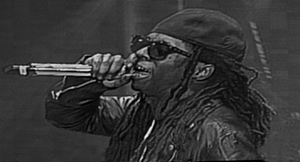
By the time Lil Wayne’s set time rolled around it was so smoky inside the arena that one could hardly see across to the other side. A quick glance toward the stage made it obvious that the layout and lighting set-ups were on a much larger scale. An acoustic drum set, bass, guitars and keys were heard being sound-checked behind a giant white curtain, confirming that Lil Wayne would have a full band behind him and not just backing tracks. Before he came out, his band (which included a very talented female bass player) played a rather heavy rock intro.
When Lil Wayne finally made his entrance, it was in style. He was rocking a black leather jacket, signature sunglasses and as soon as he appeared he jumped up like a kangaroo and upon his landing a huge explosion went off and flames shot into the air from multiple spots on stage. It was quite an epic introduction and the performance didn’t slow down much after that. “Mr. Carter” was the set opener and proved to be a crowd favorite, along with other songs like, “A Milli,” “Mrs. Officer” and “Lollipop.” A couple different points throughout the set Lil Wayne announced, “I ain’t shit without you,” as he pointed out into the crowd. Crowd interaction was a key part of the performance. Like T-Pain, Weezy grabbed a guitar a couple times and basically pretended to play, but he wasn’t really fooling anybody.

After bringing about two-dozen different performers out on stage at different points throughout the set including T-Pain, Keri Hilson and the entire Young Money family, Lil Wayne was ready to wrap up the show. During the encore song he shot huge fireballs out of a flame-thrower that looked like something straight out of a video game. It was indeed a hot ending to a smoldering performance. Some of the last words Lil Wayne’s spoke before he left the stage were, “You all just made history because you witnessed the best rapper in the world.” Hey, at least he’s confident!