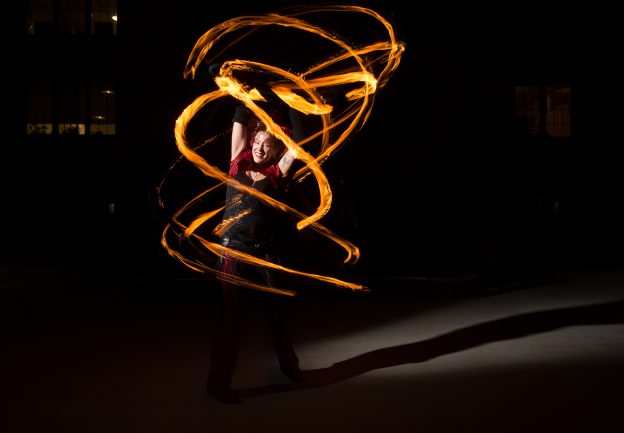
No matter who you are or where you come from, fire is hypnotizing. It’s impossible not to stare. And so it goes with the artistic wielding of flame in the form of dance and performance art. If you’ve been to the California State Fair in the evening recently, you may have seen Sacred Fire, a local dance company that features fire dance performance and is impossible to ignore.
Sacred Fire’s founder, “Sequoia” Jennifer Criteser, recollects, “I had seen many years ago in San Francisco a group of people in Golden Gate Park spinning poi. There were a lot of people and there was a drum circle and they had colorful poi. I remember all these women and colorful things flying everywhere. I didn’t know what it was and just got sort of mesmerized by it.”
It is believed that poi and fire dancing originated amongst the Maori people of New Zealand. It spread like wildfire over a 4,000 square mile area throughout Polynesia. “Poi” means ball on a string in the Maori language, and they were initially used in training for hunting and battle. In the United States, poi wasn’t popularized until the ‘90s when it became a thing at raves, nightclubs, beaches and parties.
Following her first contact with poi dancing, some time passed before Sequoia reconnected with the art form.
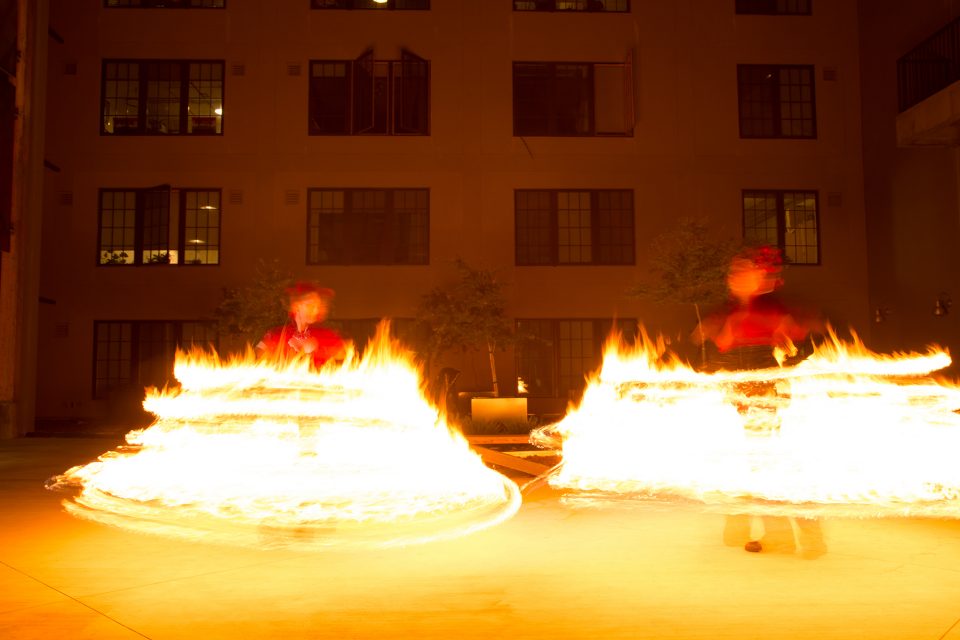
“I kind of let it go, and at some point, I decided that something in me just wanted to explore that. I didn’t know what it was called so I decided to construct my own pair of what I saw. I used tennis balls and braided my own cord, and started just trying to mimic the moves. This was a really long time ago,” remembers Sequoia.
She goes on to describe how Sacred Fire, once called Obsidian Butterfly, later came about: “Fast forward, I had eventually connected with a group out of the Bay Area who put fire in my hands. I never really had thought about the fire part of it, I was just mesmerized by poi dance. This company was a man and a woman and it’s called Fire Pixie. They’d connected me with someone here in Sacramento who was at the same level I was, and that’s sort of how it all came about. Most of the people who started this adventure with me still cameo once in awhile.”
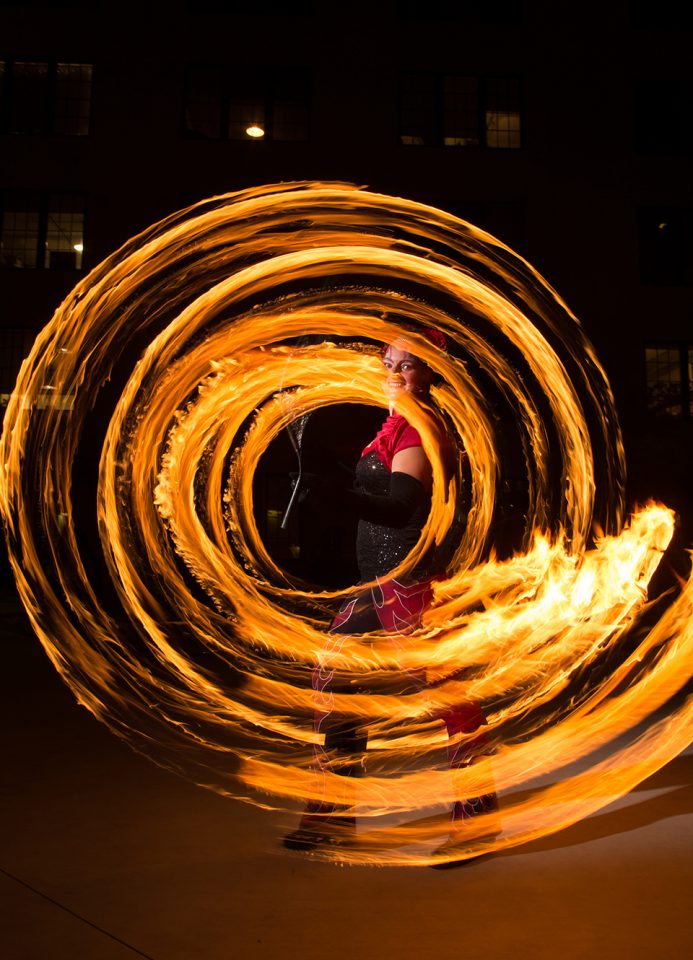
In regards to why she performs, she explains that it’s more about the art than performing. “The performing part has been a major part of it since the get-go. I’ve danced and performed most of my life. I think by nature I am a performer, it’s at the core of who I am. But it was really about the art—movement art and performing art and putting on creative shows.
“We worked through a community called the Horse Cow in Sacramento that was an art community for a period of time,” she continues. “And the Horse Cow was giving us an opportunity and a place to explore, not only to become better performers, but to pursue creative ways to explore our fire. It was really about the art, honestly, in the beginning and the performing and professional company came out of that.”
But beyond art and performing, Sacred Fire also offers education. According to Sequoia, “Everyone comes to the dance to find their own flow, and inevitably that also means to find their own flow through partnership with others … It’s more than just a dance routine. We become close friends. People’s life stories become part of the dance and part of the performance. It’s amazing to help guide people into their heart’s desire, into something that makes them so alive. Some people come to it feeling like they’re not creative enough, and those are the people whose creativity is waiting to burst out. My job is to help them find it and channel it into what we do.”
She continues by explaining how fire itself is another important component of the learning process that she guides, “Most of the teaching I do is to train people to become performers in a company, so it’s more of an apprenticeship and ongoing classes because the process does take so long. Because it’s not just learning dance, it’s learning how to use fire, and that comes with a lot of other elements. Some people are afraid of fire, some people are overly comfortable with it. I myself was super afraid of fire, so respect and humility with it were a big feature for me. And other people who are overly comfortable with it are learning control. Our art form is not a solo adventure. It’s something that, as a fire dancer, we always need fire safety. We don’t ever fire dance alone. As a dancer, I practice dance alone, but I don’t practice fire dance alone. The fire safety people that are side stage are a very important part of our show.”
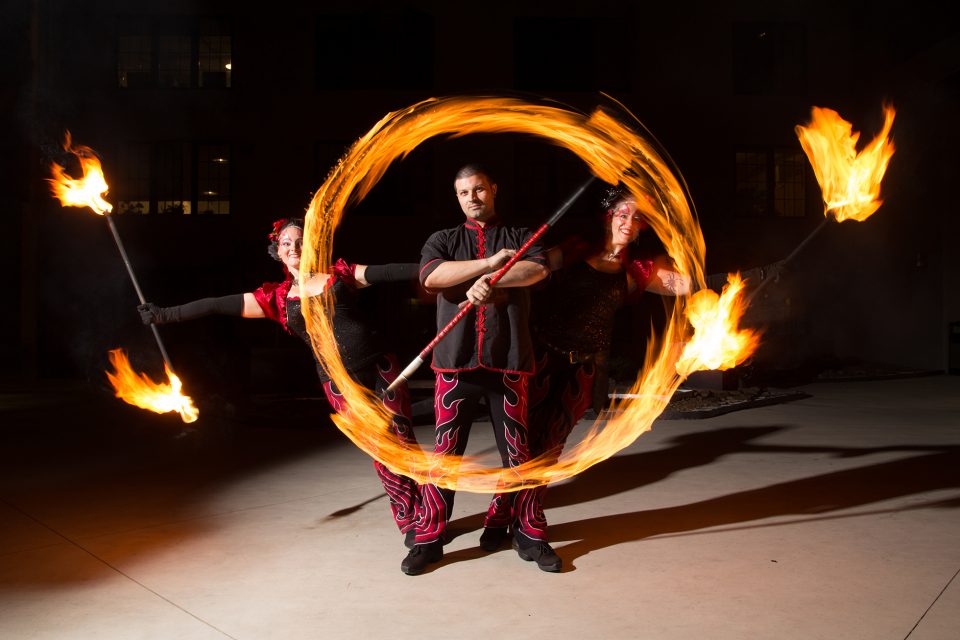
Sacred Fire does all types of events, from small backyard parties to huge affairs. They’re performing at the California State Fair, and this year, they’re also performing at the Oregon State Fair. They perform at Dire World Scare Park in Roseville, Six Flags Marine World and a few local festivals. On Aug. 12, 2017, you can catch them at their self-produced Annual Fire Spectacular in Land Park, celebrating its 10th anniversary.
That’s a lot of teaching, event coordination and performing, so at this point, this is Sequoia’s full-time job. “I’ve got to admit, it is a lot. How do I juggle it all? I am learning to juggle, quite literally. I’m getting better at it. It’s getting to the point where I’ll definitely need a helper. It’s getting to be a lot, and challenging my abilities in time management, and self care and the whole thing,” she admits.
What somebody’s requesting for their event dictates what performances they bring to the table. Sacred Fire is more than just fire dancing. Their performers often study more than one type of dance or performance art, and LED dancing, belly dancing, aerialists, stilt walking and hoop dancing are just some of the skills in their quiver.
But fire is not simply their main attraction, it is sacred.
“Fire opens us up to who we are at the core of our being and puts us in touch with our authentic selves and allows us to internally align and become whole,” Sequoia says. “We’ve fragmented ourselves in many different ways and when we tap into the core of who we are, we become embodied. When we’re aligned within ourselves, it allows us to align with others into social coherency.”
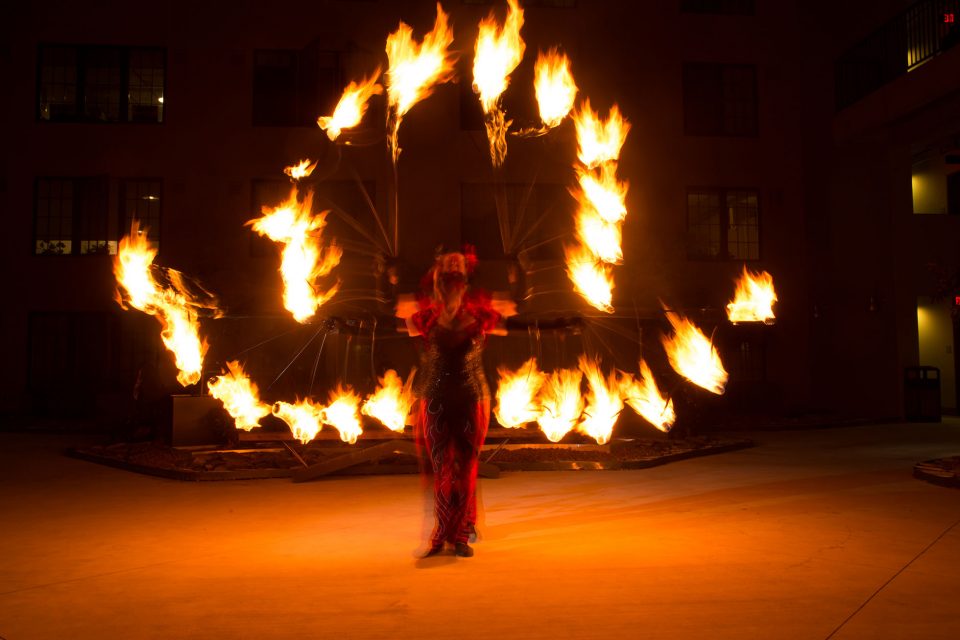
Sacred Fire’s upcoming all ages 10th Annual Fire Spectacular is quite literally Sacramento’s hottest festival of the year and takes place at William A. Carroll Amphitheatre (across from Fairy Tale Town) on Aug. 12, 2017, beginning at 3 p.m. with workshops. The main event goes down from 6 – 10 p.m. Tickets are available online and should be bought in advance as the event is expected to sell out. Pack a flashlight for evening and sunscreen for daytime. To purchase tickets, go to Facebook.com/sacredfire888 or Sacredfiredance.com.
**This article first appeared in print on pages 16 – 17 of issue #245 (July 31 – Aug. 14, 2017)**
For all of its deep fried thrill ride aromatic livestock goodness, the California State Fair can turn into an oppressive oven of exhaustion with no shelter or escape. So when you find the shaded haven of the Blues and Brews stage for relief from the heat and sobriety, what a consistent treat it is to see Terry Hanck and his band playing the blues for you. July 14, will start his 18th consecutive year playing here, and with 14 days a season and three sets a night, that’s more than 700 different performances to date.
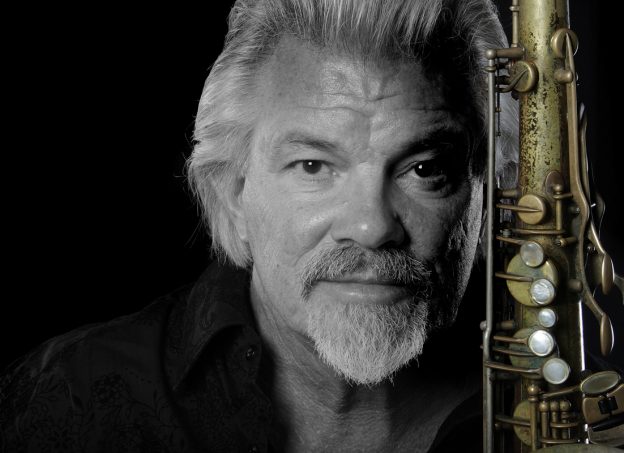
The 72-year-old veteran saxophonist has been playing for 50 years and has performed with Elvin Bishop, Etta James and his own band all over the world during that time. A fixture on the fair circuit in many cities, Hanck is a reliable staple of the California State Fair. He may not get the billing of the big music acts and cover bands that are brought in each year, but his music excellence and intimate floor-level performances have been a consistent reward at the fair for many.
Poetically, I met with Terry Hanck on a 108-degree day in Sacramento and our original meeting point was closed, so we walked to Tapa The World for the interview instead. Just days before, someone had stolen his saxophone and computer from his car, but his optimism and enthusiasm was not dampened a bit.

Photo by Melissa Welliver
How did your sax get stolen?
I stopped at a place in Oakland’s Chinatown, a place I’ve been going to for about 40 years. I was only in there for about a half hour, and they had broken in the side window. They got my briefcase and my horn. It’s my second horn, but it’s worth just as much money. My mouthpiece of over 50 years was in there.
Tell me about a mouthpiece that you’ve had that long. Why is it important?
That’s the one that I started playing on, and I’ve never looked at another mouthpiece. I bought it to look cool. I wanted to look like a jazz guy [laughs]. I didn’t know what I was doing. But over the years that’s become my sound. Now I’m in “Can’t Get My Sound Purgatory.” I’m looking at it positively. Maybe I’ll find something I like better. I’ve had friends that are really helpful and guys that have collections of them they’ll sell me. Everybody’s been really helpful.
How important is the mouthpiece to your sound and style?
It’s very important. The mouthpiece is half of your sound. But I will persevere.
So you’re coming up on your 18th year at the California State Fair?
[Laughs] Yeah, this will be my 18th year here in Sacramento. It goes by so fast. We do 17 days straight. We’re doing the Pleasanton Fair now, and that’s 20 days. Then there’s two weeks at the Sonoma County Fair. The whole series takes us from the middle of June to the middle of August.
Well with fairs and even our local music venues, you see more and more cover bands booked. I know people like the nostalgia that goes with that, and it clearly sells tickets, but it’s interesting to see how that’s evolved. This year seems to be a better mix of established acts at the fair, though.
It behooves them to throw down for good music. It brings people to the fair. We have people tell us all of the time that “this is the best thing at the fair!” People even come in after seeing the big shows and tell us we were better.
So you have people that come back every year to see you.
Oh yeah. We have a lot of loyal fans.
Probably a lot of drunk fans, too?
Oh, once in a while people are over-served.
I saw you a couple years back …
Was I over-served [laughs]?
No! But it’s a very intimate performance. There’s no stage, you’re just at floor level. People are dancing like elbow’s distance from you.
They bump right into you.
It’s a nice immersive, intimate, cozy experience.
It can go where you’re just playing there for a few people, and you’re wondering what you’re even doing there, then all of the sudden there’s a great crowd and everyone’s dancing and digging it and the whole thing comes alive!
What do you like about the fair shows compared to a more traditional venue?
It’s not just a blues crowd, so it forces you to entertain people. They’re there to be entertained. But it’s convenient. We have our own rooms next to the fair, so you’re not driving hundreds of miles a day, checking into hotels, doing sound checks. Once it’s set up, you’re in the groove. You get a new crowd coming to see you every night.
It’s a great way to get new fans.
Oh yeah, we make a lot of connections. Once in awhile you’ll be in a different part of the world and run into someone who says, “I saw you at the fair.”
What I like about listening to your stuff and the blues in general, is that it’s so familiar, but so many different takes on it.
There’s all of these distinct areas and movements where these different styles came from. They’re all completely different. You’ve got the Delta blues, which is mostly guitar, the Hill sound which is mostly string instruments, New Orleans with the horns and the Jump blues from Kansas City with the whole piano thing. Then you have the Delta guys going up into the city for the Chicago sound and it becomes electrified. So many distinct sounds and styles.

Photo by Melissa Welliver
I think sometimes people just forget how much they love the blues. It’s not in your face on the radio, but then you see a live performance and you remember how great it is. It never really goes out of style. It’s always just kind of there.
Well, blues is just a word. When music moves you it moves you.
What’s one of your most rewarding experiences?
That’s a tough question. I don’t know exactly. It could be any one night where I play something and think, “Man, that was really it, that was fun!” I’ve been fortunate to play with some great artists. In the ‘80s I played with a band in Berkeley that was the house band at Larry Blake’s. Most of that band became Robert Cray’s band. We backed up Etta James. I just stayed out of her way and played the best I could. I got a live recording of her years later singing “I’d Rather Go Blind” and I put that on and started to cry because it was so good and moving.
When you’re playing the saxophone, there’s that moment where the song gets frenetic and there’s that super high-pitched squealing that sounds so amazing. What do you call that?
That’s altissimo. You’re playing fake fingering above the normal register of the horn. You’re trying to get the note. In the old days you’d bite the reed and make it squeal, but now with the metal mouthpieces you can’t do that, so you have to do it for real. It took me a long time to get up there. Junior Walker was a major influence on that. In the ‘70s, everything was so loud and everyone was playing rock so I had to come up with something that would cut through. The mellow stuff would get buried and you wouldn’t hear it.
It really gives you that “Wow! What’s going on?” feeling.
People either like it a lot of they’re like, “Why are you playing that note?” I have friends that when I tell them I can’t get the high note on a song they say, “GREAT!” [Laughs] Hey, thanks a lot! But yeah, you gotta use it sparingly and at the right time.
You taught yourself how to play the saxophone. That seems pretty difficult to figure out.
I took a few lessons, but it didn’t sink in. I ended up just figuring it out. When I was 21, I knew nothing about music, just what I liked and what I heard, so I figured out my own system.
Is it hard to keep from eating too much fair food?
I don’t eat much of that at all. There’s a Mexican place next to where we play that’s actually good. I like to eat before we go, though. I don’t like to eat when I’m playing.
So deep-fried Oreos aren’t the best pre saxophone meal?
We actually have a song called “Deep Fried Twinkies” as a tribute to the fair. It’s got livestock sounds and cows in it. Do you have my album?
I listened to it on Spotify.
I listen to music on YouTube. I know I shouldn’t, though.
Oh, they pay them.
Most of the people I listen to on YouTube are dead.
What dead people have you enjoyed recently?
I’m really getting into female singers from the swing era. I like Anita O’Day. She called herself a song stylist. She performed—not scat, it was called vocalese. Other singers like King Pleasure and Annie Ross [editor’s note: Annie Ross is still alive, aged 86, and still gigging live!] did that, too. Anita was the best of all of them. I love her voice. I loved the women that didn’t over sing with a sensual reserved phrasing.
Are you getting new fans from streaming services like Spotify? A lot more people can discover you now.
I get like 1 cent here and there from them. Nowadays there’s so much out there, they aren’t gonna discover some 72-year-old guy. Nobody’s gonna say “The kids will love him!” But this is the problem, getting to more listeners. I don’t have my finger on that pulse. You just keep hammering away at it. You never know, but I’ve been around long enough to know that anything is possible. The main aim is to do what you love and make a living at it.
Do you still love it?
Of course. I’m just scratching the surface. The older I get, the more I realize I don’t know anything. You just keep trying to get better and better. I’m self taught, and I’m hard headed so the way I learn things is that I kind of have to re-invent the wheel for myself.
Get up close and personal with Terry Hanck and his band at this year’s California State Fair, which runs from July 14–30, 2017. They play at 8 p.m. daily on the Blues and Brews stage. For more info and a full list of attractions, go to Castatefair.org. Follow Terry Hanck’s adventures online at Terryhanck.net.
**This interview first appeared in print on pages 18 – 19 of issue #244 (July 17 – 31, 2017)**
Mustafa Shaheen is a local painter, Sacramento State grad student, 2016 California State Fair Fine Art Competition Juror’s Award-winning artist, and likes to eat cake. If you take a look at Mustafa’s bio online that’s exactly what it says, well the cake part anyway.
“I mean I can easily be serious about things but it sometimes feels a little too pretentious. I mean everybody knows that I am typing up that bio for myself,” Shaheen said as he was taking a bite into his chocolate strawberry cake at Rick’s Dessert Diner. “I think the strawberry is a little too tart but it’s not going to stop me from eating it,” he joked.
Over slices of cake at Rick’s, Submerge got to dive into the mind of the dessert-loving artist, who talked about how his art has evolved throughout his undergraduate and graduate years, and his involvement in the upcoming gallery show at Sacramento State.
Two years ago Shaheen started an art group called FORM, a student-run group that brings together artists who contribute their artwork to the Sacramento State campus and community. FORM will be hosting an art gallery show at Sacramento State’s University Union Gallery called Revealing Identity, running from November 21 through December 15, 2016. It will feature realist and abstract paintings, sculpture work and even an installation piece.
“It’s a really cool show because I think it will express the variety of the level of talent that the students at Sac State have. The show will have graduate students in and it will have undergraduates in it too. So it’s going to be really cool,” Shaheen explained.
Currently a grad student at Sac State studying studio art, Shaheen has gone through different stages of creating pieces but it has all surrounded one common theme: empathy.
“Many people are able to not just see art, but experience it visually and internally. For me there was sort of a disconnect, so I became super curious about why that was happening,” he said. “I think I approach things from more of a like a very logical and analytical sort of state.”
Shaheen could never identify himself as a “romanticized” artist that can slash paint on a canvas with little to no thought in mind and create something beautiful. Every paint stroke for him is fully contemplated and thought out, there is no turning off his mind because he is always thinking of the next move.
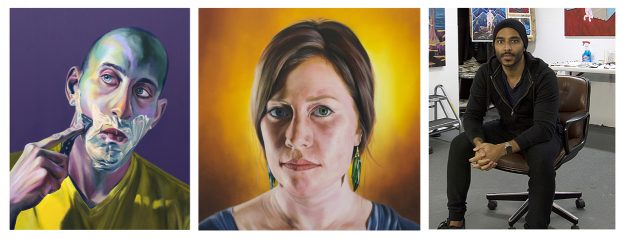
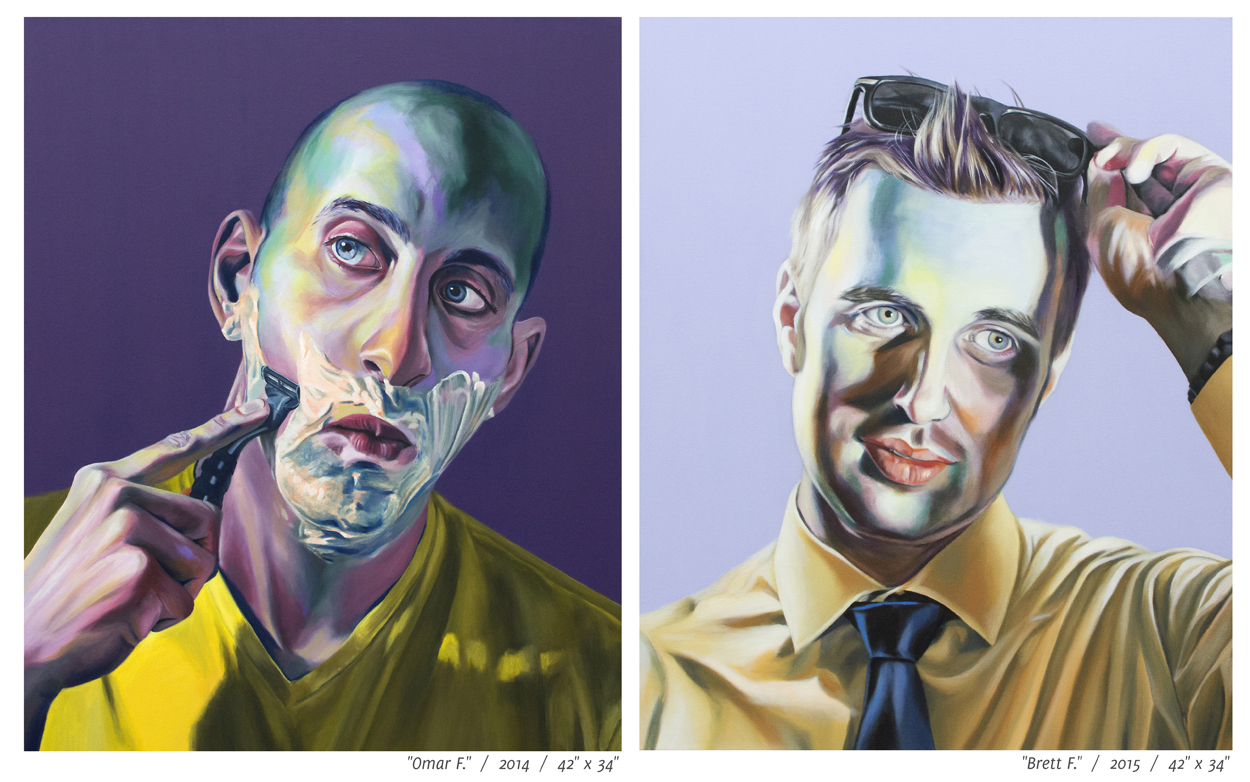
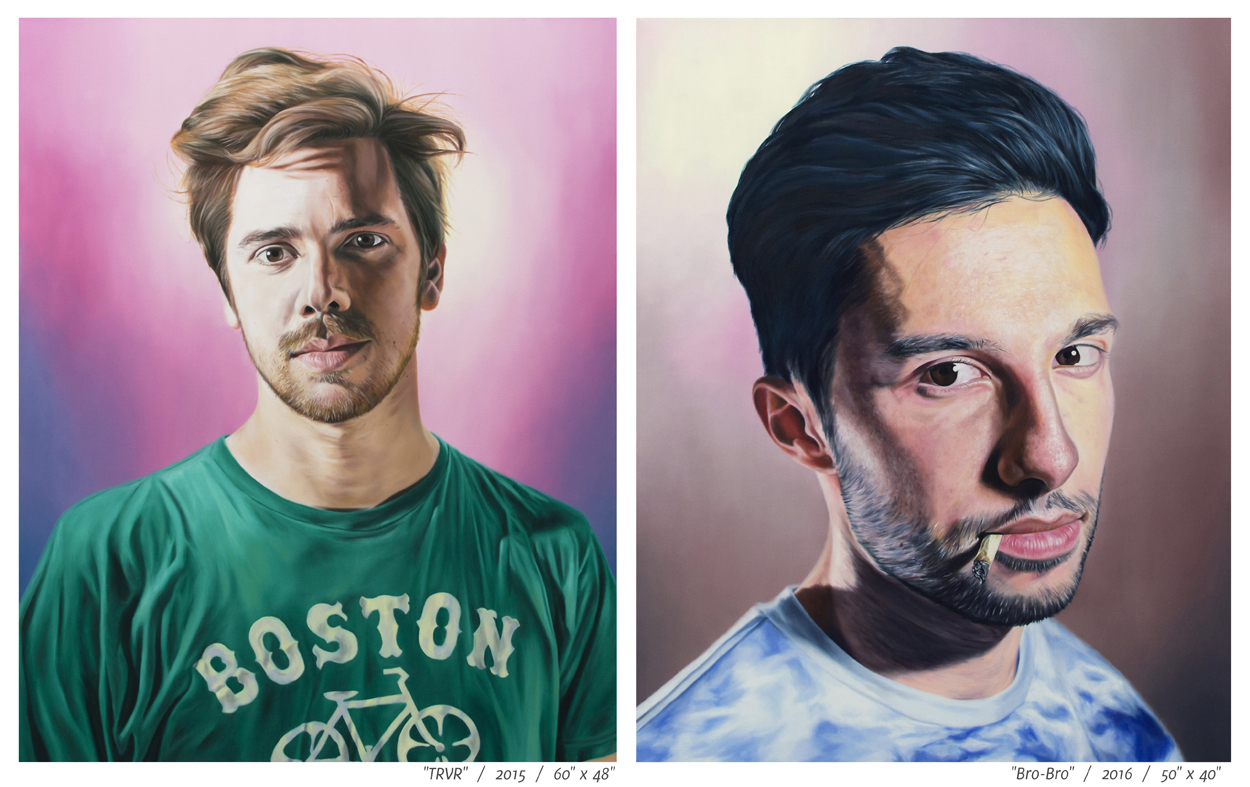
During his undergrad Shaheen focused on painting portraits using the idea of empathy to relate to individuals doing normal day-to-day activities. He would take photographs of people doing “mundane activities” and create colorful, insanely beautiful and realistic paintings. Although the people in the portraits are doing everyday activities it seems easy to make a backstory about their lives and even see what mood they were in or what they were feeling at the time.
“With portraits it’s really interesting because I don’t have to know these people that well but I’m still going to make my version of my experience with them in a painted form. That has always been a little fascinating to me… 10 different artists can paint the same chair and they all have their own expression of that chair, and I really like that.”
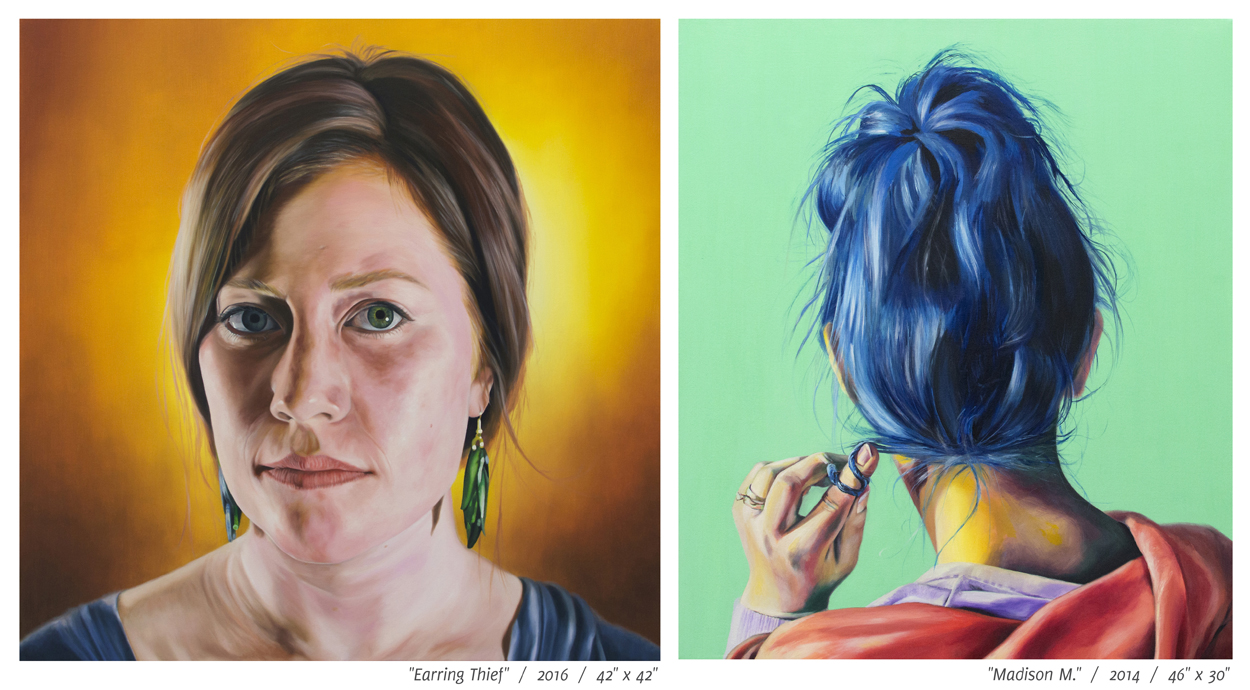
But even with these incredible paintings Shaheen still felt as if he wasn’t pushing the idea of empathy enough through his portraits. He decided to still paint portraits from a photograph but from a different approach. He would ask his subjects to bring in an item of significance with them and hold “mini interviews” with each person. Throughout his photograph and painting process only Shaheen would know the backstory of each person, inviting viewers of the final product to have their own interpretation to the portraits story. One portrait from this gallery of work called “Earring Thief” won him the Juror’s Award (one of the highest awards you can receive for a painting in California) at this year’s Fine Art Competition at the California State Fair.
“They make up their own stories, which I really enjoy and I felt that I was a little closer but even with that, I also felt myself doing more hyperrealistic work and I started feeling like this was becoming more of an egocentric exploration then it is really for the sake of making strong paintings,” Shaheen said. “It felt like it was more like I was just showing off how well I could paint rather than actually make a painting for a painting sake and really expressing something emotionally.”
After his win at the State Fair and the transition of becoming a grad student, Shaheen took a step outside the norm of his usual photograph painting. Instead of using portraits, he is planning to use surreal landscapes and “ambiguous” figures that portray them exploring unknown surroundings.
“They are starting to feel more and more like they are self-portraits,” Shaheen said. “I’m interested in where those are going. I’m not sure where that will go but it’s nice to be a little lost sometimes.”
Even though creating art was pretty natural for Shaheen, from creating comics with action figures as a kid into entering the world of hyperrealism as an adult, creating art wasn’t necessarily something that was always accepted in his culture. He moved from Egypt to the United States in 1996 at the age of 11 and as a young kid, fitting into the American culture meant everything to him. He mimicked the American culture and hid his accent, even though he admitted that his friends at the time would have accepted him regardless. Growing up in Egypt his mom had convinced him that his future career was to be a doctor, he explained.
“I think the fact that I come from a culture where art is not at all seen as important, it takes a very, very sort of back role to the Sciences and Engineering,” Shaheen said. “It makes me appreciate it a lot more because it makes me in a place where I can pursue that and I really try not to take that for granted.”
Since then, Shaheen’s mom has come around and has become very supportive of his artwork. And as he moves to the next phase of truly trying to capture the theme of empathy in his paintings, it will be exciting to see where Shaheen’s art will take him.
See work by Mustafa Shaheen and other members of FORM at Revealing Identity, a group exhibition of both paintings and sculptures exploring the idea of identity that runs Nov. 21–Dec. 15, 2016, at the University Union Gallery at Sacramento State. The opening reception for the show is Thursday, Dec. 1 from 6–8 p.m. For gallery hours and more info go to Theuniversityunion.com/gallery.
The world is full of people (men and women alike) who will lie online or in person about their shortcomings and, more importantly, exaggerate their triumphs. Of course the only way to truly say you are anywhere is to be there and what better way to do so than at the upcoming “en Plein Aire” contest at the annual State Fair. And while we all know at Submerge that you want to see Mike Reno and Loverboy turn you loose with their sexy bass and synth lines, the real lure is painting in the open air with no restrictions (well, maybe a couple). This is not a competitive event and all are encouraged to take part in something that will surely get people talking once again, rather than staring at their cool iPhone. I’m actually entering my 19-year-old son who I am most certain stands a great chance. Sometimes the young and innocent (or seemingly so in the case of my son … Ha!) can teach us the most. Find out more and sign up by July 1 at Castatefair.org/plein-air-fair.

The California State Fair is in full effect and whether or not you’ve gotten your fix of deep fried food and other fair attractions (it’s all about the wine garden!) you ought to block off the final day of the fair, Saturday, July 28, 2012 to witness the fast-paced action-packed AMA Pro Racing Grand National Championship series at The Sacramento Mile. This is flat-track motorcycle racing at its finest: riders fly through the straight-aways at 130-plus mph, strategizing their lines into and out of the sweeping turns of this 25 mile race. Tickets range from $30 to $95 (includes fair admission) depending on where you want to sit (or stand), visit http://sacramentoflattrack.com/ for more information.

For some of you, it was a typical Thursday in Sacramento: dry, with that hot wind that is neither welcome nor refreshing. And while it was that, for some of us, it was something to remember. For some of us, that Thursday was different. That Thursday, Submerge hooked it up and sent your boy to the State Fair V.I.B. status (Very Important Bear) to see the one and only, MC Hammer!
The workday flew by and before I knew it, all clocks read “Hammer Time.” As if the concert weren’t good enough, my awesome editor-in-chief got us two drink tickets and free food. Your boy was officially big timin’, ya heard? After finding our seat, we hit the buffet. My level of “big timin'” sank slightly as I perused the selection. Large hunks of unidentifiable meat (ribs?) and a slurry of Safeway deli counter salads covered the tables. After a bit of line jumping, I managed to find the dessert section and settled in for a bit. Sweets in tow, I was off to the bar area to cash in a drink ticket. My spirits lifted briefly upon seeing liquor behind the bar, only to be crushed back down by shouts of, “I can’t take drink tickets for that!” Heineken it was.
As I settled into my seat for a pre-Hammer cold one, I began to take notice of the crowd. I would say that the most represented group was the 30-somethings. These people pretty much lost their shit when Hammer came out. The others in attendance ran the gamut. There were children, teenagers, young adults, mid-lifers, senior citizens, and yes, even octogenarians. Physically, the crowd went from hotness to hot mess and everywhere in between. One dude had a mullet that could double as a Yosemite Sam mud flap. There was even a Wilford Brimley-esque hippy with a tie-dyed “Let Yourself Go” T-shirt.
As show time drew near, the crowd’s gaze began to focus on the main stage. Large video monitors flanked either end of the stage, and this being the state fair, the screens were filled with a PowerPoint presentation on how awesome California is. Finally, at around 8 p.m., the heavens opened and Hammer appeared. Dressed in a white suit, my man literally glowed in the stage lights.
Speaking of safe, I was worried that Hammer was gonna be on the gospel tip all night; thankfully, I was wrong. In fact, Hammer took steps to separate himself from his squeaky-clean image right off the bat. The sounds of “Pumps and a Bump” filled the stadium, signaling that the show had officially started. The crowd exploded! People of all ages were on their feet dancing like they were at a cousin’s wedding. I believe it was the safest they had ever felt.
Before the crowd could catch its breath, Hammer hit us with “Turn This Mutha Out.” Moving back to his later work, Hammer laced the crowd with a remix of “It’s All Good”; and it truly was. For those in doubt of his street cred, Hammer wants you to know that 2Pac listened to one of his songs in jail, for inspiration. SO DON’T FUCK WITH HAMMER OR 2PAC’S GHOST WILL KILL YOU, BITCH! For those who couldn’t hear the message, Hammer had it translated into sign language. After a few more hits (“Adam’s Groove,” “Pray,” “Here Come the Hammer,” etc.), it was time to bring out the big guns. “2 LEGIT… 2 LEGIT TO QUIT! HEY HEY!“ leapt from the speakers and the asses were out of the seats. During the breakdown, Hammer worked his way through the crowd, pulling people on stage for the grand finale: “U Can’t Touch This!” All I can say is crab-walks for days!

And then, like a dream, it was over. I walked away with a million memories fighting their way into permanency. I knew this story had to be told, so I did my best to avoid more stimuli; but the hold of MC Hammer was just not ready to let go. Outside the fair, I encountered a white woman in her 60s wearing a “U Can’t Touch This” T-shirt. Upon closer inspection, she turned out to also be holding an MC Hammer doll that was in pristine condition. I snapped this super fan’s picture before heading back to the car. Behind me, a group of children sang, “2 legit, 2 legit to quit,” and I couldn’t help but think, yes Hammer, you truly are.
Big Cheese
Icons come in all shapes and sizes. They come from all walks of life. And sometimes, they play polka. Though Eminem and Prince may disagree, there are few people who have made as many contributions to pop culture over the past three decades than “Weird Al” Yankovic. Mixing original songs with parodies of popular songs, Yankovic has proven to be as versatile as he is entertaining. Whether he’s playing polka, hip-hop or grunge, Yankovic has the uncanny ability to make people of all ages smile—as long as they have a sense of humor. Currently on the second leg of his tour promoting his most recent album, Straight out of Lynwood, which features his first top 10 single “White & Nerdy.” From his tour bus, parked somewhere in Springfield, Mo., Yankovic shared with Submerge his thoughts on veganism, file sharing and the imminent rise of polka.
I was reading up on you, and I thought that it was pretty neat that even this many years into your career, you’re still experiencing a few firsts. “White & Nerdy” was your first single to break the top 10. Were you tentative about trying rap songs when you first started out?
No, not really. That’s always been a part of my job description. I just make fun of whatever is popular in our contemporary culture, whether that’s rap or pop or rock or polka. Whatever happens to be, that’s what I do. I’ve never been apprehensive about it.
Do you foresee a day when polka will be a pre-eminent in American pop culture?
I think it’s going to happen any week now. I’m just waiting for the planets to line up correctly.
Would you take credit?
I can’t take credit. I’m only the conduit through which polka is coming to our consciousness.
I saw something on your Wikipedia page—which I suppose should be taken with a grain of salt—that struck me as interesting. It said that you started taking accordion lessons when a traveling salesman came to your door offering guitar or accordion lessons and your parents opted for the accordion. Is that true?
That’s actually very true.
How do you think your life would be different if you chose guitar over accordion?
It probably made a difference, because I wouldn’t have stood out as much. I just would’ve been another kid with a guitar, but a geeky kid with an accordion, that gets noticed. I think that’s one of the reasons Dr. Demento started playing my songs on the radio, because he thought it was quite a novelty for this teenage kid with an accordion to be playing songs and thinking he was cool or something. He gave me exposure early on, and that led me to bigger and better things.
With your original compositions, do you compose them at the accordion? What’s your process like for those?
I generally don’t. That’s a good question, by the way. I usually write the polkas on the accordion. For everything else, I have a pretty standard keyboard. Back in the ’80s, I would literally write all my songs on a $30 Toys-R-Us toy piano, because it was handy. I didn’t have a lot of money back then, so I couldn’t afford a nice synthesizer, and mostly, I convinced myself that if it sounded good on a toy piano, it would sound great produced in a 24-track studio. Nowadays, I use a standard keyboard. It’s an older keyboard, but it sounds great. It’s a Kurzweil K2000.
Which comes more naturally for you—the parodies or the originals?
I don’t know if I can say that either one comes naturally. It’s a real effort for me to write. Every once in a great while some idea will strike me spontaneously, but that’s not usually the case. Usually, I have to force myself to write. It’s a lengthy, methodical and oft-times difficult process. It’s a lot easier for me to write parodies, because there’s not as much work involved. It’s more like a puzzle. I’m working within the parameters that someone has already set. I feel closer to the originals, because that’s 100 percent me. It’s hard for me to pick. They both have their pros and cons, and they’re both difficult in their own ways.
This previous album, Straight out of Lynwood, got you two Grammy nominations, including Best Surround Sound Album. What was your reaction to that nomination being that it was for the technical side of things?
I thought that was really cool, because there were some things my engineer and I were just experimenting with. This was the first album we had mixed in 5.1, and we just thought, hey, this seems like the format of the future, or at least a viable format for a while, and we wanted to offer that as something on the DVD. That was also a way for us to combat piracy. I thought if I made the CD package just chock full of extras, that would give people an incentive to actually purchase it instead of downloading it from a peer-to-peer file sharing site. I thought, well, we’ll offer 5.1 mixes of everything as well as all the other stuff. We did put a lot of effort into it, and I thought a lot of the 5.1 mixes were a lot better than the original stereo mixes. The 5.1 version of “Pancreas” is really cool, and to me, that’s the definitive version of that song. But it was very validating to have the Grammy voters actually recognize that. They put me in the same category as Donald Fagan and Alan Parsons [laughs]. It was really cool to be in that small group.
Do you think in the future you’ll write songs with that format in mind?
It certainly opened up different ideas for the mix, but I certainly wouldn’t rewrite the songs for 5.1, but it’s a format I would like to continue to experiment with. Truthfully, if I hadn’t gotten the Grammy nomination, I wouldn’t be considering it for the next album, but since people actually noticed it and paid attention and actually liked it, that’s a good sign that I would mix it again in the future. I’m not sure what format it’ll come out on—the DualDisc format was already dead by the time I released it [laughs]—but I’m sure there’ll be something”¦whether it’s a separate CD and DVD or hypnoball or whatever it’s going to be, I’ll try to deal with it more ahead of the curve next time, hopefully.
Do you think that with the way people are downloading music now, does that put more pressure on artists to put more work into how their albums are packaged i.e. loading them with special features?
I think it does. Certainly, we live in a new world and the record industry has taken some hard knocks, but it’s up to us in the industry to find a new paradigm that works, where we can still stay in business and make a good living and deal with the fact that now a lot of people are sharing files illegally. My personal way of combating that was not to go after people who were infringing on my copyright or try to criminalize anybody, but it was just to offer something that would be difficult to pirate, and offering a product that people would actually want to own. Now other people might go about it different ways [laughs], but that’s how I thought I’d take a shot at it.
Last year, you celebrated your 1000th live show. I was wondering how that felt and if you did anything special for that.
I think we had all the cheese in the deli trays back stage cut into triangles”¦to celebrate.
Any special kind of cheese?
I’m not sure if it was Swiss or American. It was one of the two.
What kind of cheese do you usually have back stage? Is that what you have on your list of demands?
I actually don’t have cheese on my rider. That would be in the band’s dressing room, so you’d have to ask them. The 1000th show felt like the 999th show to tell you the truth, but it was special in its own way.
Most people are cool with you writing parodies of their songs, but there have been a few who haven’t. One I hadn’t heard about before was Paul McCartney, who objected to you changing “Live and Let Die” to “Chicken Pot Pie,” because he’s a vegetarian. But I’ve read that you’re a vegetarian also. Did you bring that up to him when he denied permission?
I don’t know if that would’ve swayed him. People feel the way they feel, and it was obviously important to him for me to not do “Chicken Pot Pie.” I feel bad that that story even got out, because Paul was an incredibly good sport, and I would still love to do a parody of him some way. It was seriously one of the most exciting moments of my life when I got to meet Paul McCartney, and he knew who I was, which just blew my mind. I hate to put him on the same list as people like Prince, who are basically just humorous [laughs]. Paul actually approached me and said, “I’d love for you to do a parody of one of my songs,” but it just so happened that the idea that I picked, he had problems with, and he actually had a reason. You may or may not agree with his logic, but he had a reason, and I have to respect that. I’m just sorry that he got this semi-bad rap, because it’s not his fault.
Have you ever considered going vegan?
Well, yeah, I sort of am. I’m a bad vegan. I’m trying to be vegan, but my wife is not, and it’s just hard on the road. If you’re vegan, and you stop at a truck stop, you have to decide between the applesauce and the toast. I wish phony cheese was more of an option, but unfortunately Domino’s doesn’t really do that. It’s tough. I call myself a vegan but I cheat constantly.