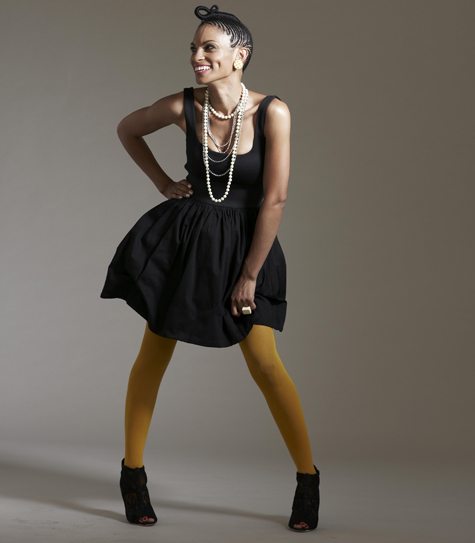
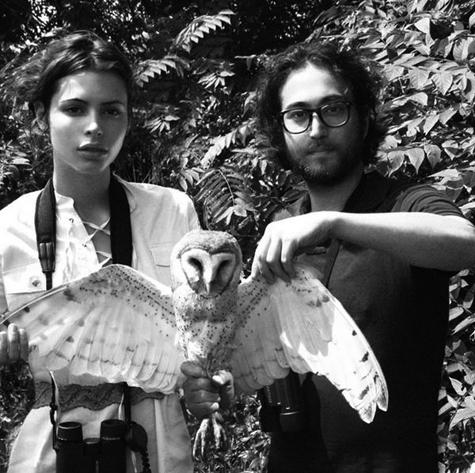
Keeping a band together can be tough, but when you find the right group, you feel nearly unstoppable. Sometimes you come together through your community, and sometimes you’re born into it, like Erika, Rachel and Chloe Tietjen, better known as the T Sisters.
When most people think of a family band, the first thing that comes to mind is air-tight harmonies, which the T Sisters don’t fall short on. Maybe there are inherent genetic similarities (Rachel and Chloe are also twins), but a lot of the connection also comes more from nurture than nature.
“One thing that’s an advantage is we were raised by the same people, we grew up hearing language similarly,” said Erika. “Our voices are definitely not the same, but we have more similarities in speaking and pronunciations than people who are not related, probably. Even though we write different types of songs, we can connect over a lot of the same music. We come together stylistically.”
The Tietjen sisters grew up in the Bay Area, where music seemed to be around from the very get-go.
“We definitely started singing together because music was such a big part of our upbringing,” Chloe said. “Our dad is a singer-songwriter and our mom grew up singing with her sisters, so there was a lot of playing and singing and listening to music in the household. As 8 to 10-year-olds is when we started getting on stage. We did a lot of musical theater around that age.”
The sisters remained in the musical theater world for a long time, eventually co-founding Chthonic Theater in Oakland. Throughout that time, they began writing and performing original songs, though most were angled more toward musical theater. The official idea of the T Sisters formed almost accidentally.
“We were playing at an open mic at the Starry Plough in Berkeley,” Chloe said. “What they’ll do is select one artist to be the featured artist at the next open mic, so the woman who was hosting the open mics at the time was like, ‘You guys are great, we’d love to have you be the featured artist, what’s your band name?’ On the spot I was just like, ‘T Sisters,’ because our last name starts with T and we’re sisters. It was a very spontaneous decision; it was sort of from that point on that we started developing our sound together. We started writing more songs that were outside of the context of a musical theater piece. At a certain point, we started getting offered gigs, and then years down the line we were getting so many gig offers that we thought, we really need to get out of the way of this progress and see what happens.”
The sisters have been on the road fairly consistently since, touring with artists like Amos Lee, Elephant Revival and ALO, simultaneously honing their sound and expanding into a full band with bass, guitar and drums. That early theatrical background feels apparent on some of their first recordings, like the slightly vaudevillian “It Was Me,” which features a French-inspired instrumentation creeping beneath three familial voices moving in swift figure-eights between harmonies and counter melodies, softly landing in staccato on prominent plucked bass, like jumping lily pads.
As time has passed, their style has taken a more distinct shift toward folk territory. Their most recent live EP, recorded at Tiny Telephone Studios in San Francisco, has an Americana thrust to it, especially on songs like “Come to Me” with its chugging snare and clean, vibrant vocal hooks.
Though the theatrical approach no longer feels as audible, it’s become more of a visual performative intention.
“We have songs with the band with choreography that we do, and that’s pretty atypical for a folk band. We play disco songs and that’s really fun,” Erika said. “It’s more fun to have dynamic stage personas and costumes and dance moves and scenery, insofar as we can create that with the means that we have. That’s something we want to continue to develop. We don’t think about our stage performance just as ‘what’s the song about? Let’s play the song now.’ We wanna make things more entertaining, and have some more of those theatrical elements.”
Another outlet for that creative energy has been creating videos for covers, like a recent one for The Ting Tings’ “That’s Not My Name.” A listener might expect a stripped-down folk ballad version, but instead, the T Sisters (along with Megan Slankard) keep its shape as a pop song, bouncing through the choruses with charisma, dressed in leopard fur coats and sparkling red bow-ties.
“It exercises some of our other creative skills. Rachel did the video editing and we did all the recording,” Chloe said. “It’s a fun way to exercise some of those creative muscles that exist just outside of the music, and cover tunes [are] a fun way to bring that in.”
Though their involvement has lessened, the sisters still work with Chthonic, where they’ve been producing an ongoing variety show for nearly a decade.
“That remains something that keeps us connected to our community of artists, because we do a lot of touring, so it’s nice to have a way to create this space for other artists to connect,” Erika said.

These days the sisters spend a majority of their time on the road. It’s a busy lifestyle, and when they’re not collaborating as the T Sisters or within the Chthonic, they’re all in the same home living together.
“It’s all very shared; sometimes it’s hard to draw those boundaries and say, ‘OK now we’re not working, we’re just having family time,’” Chloe said “I think anyone who’s been in a family business, or with their parents or partners [knows] that’s a really hard thing to do, and it does take a conscious effort to turn down the work dial and try to reconnect on those other basic levels.”
One experience that isn’t shared is the songwriting process. Each sister contributes to the song catalogue, and even with those shared familial experiences, they all approach writing uniquely. The trick is to maintain that distinction while keeping a cohesive sound.
“We all have very different songwriting voices, and in order to maintain the diversity of music in our set, we really like to keep the songwriting process separate. Then everybody can really manifest their musical vision,” Chloe said. “We come together for the arrangement process. Some songs are harder than others; sometimes those are the most fun, because that’s where we really get to stretch ourselves creatively to come up with an arrangement that works, that maybe isn’t intuitive right away. We’ve gotten more and more adept at the process of putting our heads together.”
The trio is currently sitting on a batch of new songs they’ll be bringing to Nashville to record in May. Even if they’re stemming from different inspiration, their hearts are all in the same place.
“We have a shared vision, and we’re all equally invested in the project, which I think is sometimes the hard thing about bands: keeping the band on the path together and everybody having the same amount of energy going into the project,” Chloe said “We realize that … What’s that phrase?”
“The whole is greater than the sum of the parts,” Erika interjected.
“We’re really in it together,” Chloe said.
See the T Sisters live at The Center for the Arts (314 Main St., Grass Valley) on March 16, 2018. You can purchase tickets in advance through Thecenterforthearts.org. Honey of the Heart will also perform.
**This article first appeared in print on pages 20 – 21 of issue #261 (March 12 – 26, 2018)**
Devoutly Dynamic
TBD Festival, West Sacramento, Oct. 4, 2014: Even though the sun went down hours ago, warm dust still erupts into the air like the billion microscopic remnants of an obliterated world. My mind is already reeling from the gauntlet of great acts I’ve been shuttling back and forth to glimpse from one patch of riverfront land to the next; brilliant, virtuosic performances seem to flare out on all sides from different vistas, pushing the inter-stage wanderer towards a kind of polyphonic high. The sound, the flashes of light, the smell of incredible food and the miasmatic, billowing dust after a full day of sun have started to take their toll.
Determined yet tired, I trek towards the far side of the concert area, into the volume and light, to secure bodyspace for the concluding main stage performance of the evening. But somewhere around the halfway point, I pause, struck by a bluish ethereal glow and the thrum of brooding synth and bass accompanied by emotive, full-bodied vocals. I am caught off guard; the sound beckons, the conflicted groove is perfectly in sync with my mental state; it zeroes in on me with an intensity that isolates instead of pummeling the senses. I gaze up at the stage, and enter the realm of Sister Crayon.
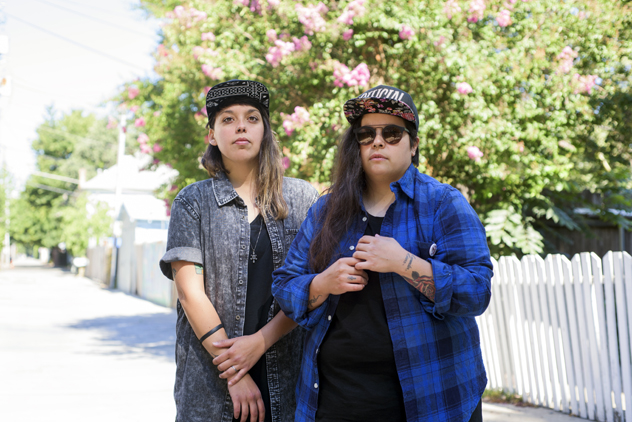
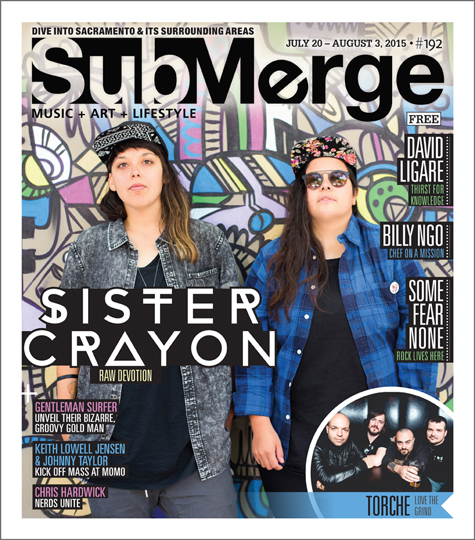
Shine Coffee, Sacramento, July 11 2015: I’m sitting across from Terra Lopez and Dani Fernandez, the creative force known collectively as Sister Crayon. The two are remarkably down-to-earth and open, a fact which their otherworldly, often mercurial music belies. Never before has their sound been honed so sharp as on their newest release, Devoted, released early last month. Pared down from a four-piece to their current duo, the project has plunged ahead with the carefully crafted sonic workings of Fernandez and the intensely personal lyrical performances of Lopez. Both are keen to show the specific sources from which their creative output arises, whether it be turbulent personal relationships or a diverse array of contemporary artists and budding music genres. The night before our meeting, the two even showcased some of their favorite material at Dive Bar as a DJ set, and are gearing up for a live show at Harlow’s in early August—their first locally since the release of Devoted.
Our caffeine-fueled discussion, recorded here, skirts topics ranging from spirituality, love and hate and the risks of creativity. Enjoy!
How did the DJ set last night go? What sort of material did you select?
Terra Lopez: Last night was a lot of fun. Good crowd, good energy. It’s always fun coming back to our hometown. We just like to play songs that we like really loud [laughs]. For our set we selected a lot of footwork, a lot of juke stuff from Chicago, deep house, a lot of drum/bass-heavy stuff that’s really influenced our sound and resonated with us. A lot of beat-driven songs, a lot of bassline.
How was the process in crafting the production on Devoted?
Dani Fernandez: We wanted to focus more on a beat-heavy sound and showcase the vocals, and we’ve never really done that on our last albums. There were so many other things going on before, and we wanted to strip that away.
TL: We wanted to make a sound that was undeniable, with how I was feeling lyrically, we wanted that to take precedence along with the beats, and not have anything crowd it—almost a minimalist approach the whole time.
What was the first creative step taken with that album?
TL: We demoed a lot in Sacramento and in Oakland, [Fernandez] lived here at the time. And we would just send each other ideas back and forth. For the first time, we got on a plane with 20 unfinished tracks—we had never gone into a studio with unfinished ideas, so it was really scary. We both didn’t know what to expect.
DF: This was the first time we had done a record on our own.
TL: Yeah, it was nerve-wracking. We got to Florida to work with our producer Wes Jones in St. Augustine and we spent two weeks there in this tiny little town. We didn’t know anyone except for Wes, and we slept and lived at the studio for two weeks—it was a very isolating experience. We were basically in our heads for two straight weeks, and it drove us a little crazy … But it was awesome. It was incredible to be so isolated, it felt like an alternate world that we were in.
DF: Almost all of it just spilled out in those two weeks, very easily. There was never really any arguing.
TL: It was pretty much a dream to be able to work that way. To have that freedom. And then literally on the last day, on our way to the airport, Omar Rodriguez-Lopez [of The Mars Volta] wrote me and asked if he could help produce the record.
I understand Omar had been a fan of your project before he stepped up to produce?
TL: We were lucky enough to go on tour with one of his projects in 2013, and we toured with them extensively and from that tour, we built a friendship with him and his band and so they really liked what we were doing, they would watch us every night, and hang out with us. You know, he’s a pretty reclusive guy, so the fact that he even wanted anything to do with us was a big deal.
DF: We knew that he liked us when he invited us to the movies one night on tour. He doesn’t do that regularly. He likes to stay to himself on tour, not really be on the scene with everybody, but he was totally talkative, wanted to get to know us, loved what we were doing, loved the sound. And you could tell that he was really curious as to what we were setting out to do. It was really cool.
So overall, it was a pretty tension-free recording process?
TL: Yeah, we were very grateful to have had the team that we had, because it was such an organic process. We would spend eight-nine hours working with Wes on the songs, and if we needed a break, we’d go jump in the ocean, and then come back and work until two, three or four in the morning, and then start over the next day—and it was like that for two weeks.
DF: Now I get why artists tend to record in secluded areas. They’re always holed up near a beach, or at a cabin in the woods somewhere. It makes you really focus and hone in on your music. It’s probably going to be the way we record from now on.
I understand you featured “Ride or Die” as a video to coincide with the recent SCOTUS decision?
TL: We did. We had actually shot it a week prior, and it wasn’t a planned thing. I had woken up that morning and seen the Supreme Court’s ruling and was so inspired. So I reached out to the director and was like, “If there is any way that we could release that video today, it would be so fitting.” The song is a celebration of love; the video definitely is. We really just wanted to celebrate the day. Dani and I had never really put ourselves out there with our orientation; it’s a known thing among people who ask us, we’re very open, but we had never really put it out there in a video. Everyone was on board, so we just released it. It was a beautiful day, just a gorgeous day, a really proud moment. To release something in correlation with it meant a lot to us. We were finally able to put the message of our music forward in our own subtle way.
Along with these feelings of a triumph of love over hate, there’s also been a good deal of ambivalence towards the concept of love in your work …
TL: It’s incredible that you picked up on that, because I’ve done a few interviews where that kind of goes over their heads. For me, I was in a place when I wrote that, when I was starting to write the lyrics for these songs, I was heartbroken. I’d been in a five-year relationship, had my heart broken, and I’d never experienced a loss like that before. A loss of love, but also a loss of self-motivation—it was the first time it had ever happened to me, and I really clung to this record with Dani, in order to get out of bed most days back then. So for me, I wasn’t singing about that love loss, necessarily, I just didn’t believe in love at all. During those months when we were writing, I really didn’t, and I was questioning it, dissecting it. I had always believed in love, and I’ve always wanted to, but I was definitely in a place where I was trying to figure out if I still did. And so the whole album was basically a way—we called it Devoted because it was our way of practicing devotion as a way to restore our faith in it. And so there’s definitely moments, it’s kind of like a roller coaster where I’m clinging to that belief that it’s still there, even though I don’t feel it.
It seems like many of your releases have been influenced by particular relationships?
TL: I think that with Bellow and Cynic I was very vague in my language. Especially on Bellow … we were so young and didn’t think anyone would even hear that album, so we made it for ourselves. As a songwriter, I was very, very vague. I would speak about people in metaphors—you would never know what the hell I was singing about. And Cynic was very much straightforwardly about my mother and my father and my childhood, but I still was a little vague about expressing myself. When the time came for Devoted, there was no way around it. I didn’t have the time or the energy to make metaphors, I had to express exactly what I felt.
Do you think it’s necessary to suffer for art?
TL: I’ve never been able to write when I’m happy, and I admire those who can, but I’ve never been able to. I don’t necessarily need to be in a dark place, but I do need to contemplate. I dwell a lot.
What’s next for Sister Crayon? What should we expect at Harlows on Aug. 1, 2015?
TL: We’re working on two videos and some remixes; a lot of content coming out in the summer and in the fall. As for Harlow’s, expect a brand new set of songs that we’ve never played here. Just an entirely new experience, new merchandise and new feelings We’re coming out with a completely different kind of performance.
Give Dani and Terra a warm welcome home to Sacramento! Sister Crayon will play Harlow’s on Aug. 1 with DLRN and Stevie Nader. Doors open at 9:30 p.m. Tickets for this 21-and-over show can be purchased in advance for $12 at Harlows.com.
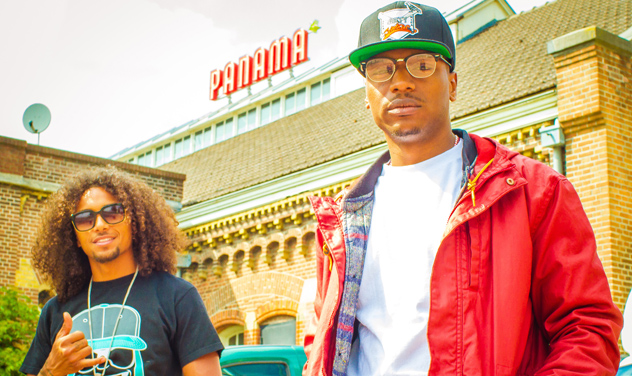
Panamanian-born Bay Area hip-hop stars Los Rakas gear up for Coachella
Words by Andrew Bell
Coachella is arguably the biggest festival in the world. Tickets sold out in just under 40 minutes this year for the two weekend-long festival that will include AC/DC, Drake, Florence and the Machine, Jack White, Lil B and over a hundred other musical acts including Panamanian cousins Los Rakas.
For those of you who haven’t been using their albums as a post-hyphy Rosetta Stone, Los Rakas is composed of MC Raka Dun and Raka Rich. The name Los Rakas is derived from Rakataka, a Panamanian slur for people from the ghetto. The duo is from Oakland by way of Panama and has been all over the country, captivating crowds with their bass-heavy bilingual mixture of dancehall, hip-hop, soul, reggaeton and R&B that can only be described as Raka music.
There was no business model when Los Rakas got started. There wasn’t a detailed plan to bridge a cultural gap by becoming one of the most successful Urban Latino rap groups in history. They just wanted to make music.
“In the beginning we didn’t really think ‘What genre we gonna do? Are we gonna rap in Spanish or in English? Who’s gonna be our audience?” explained Dun. “We were just creating and performing anywhere.”
The Panabay duo has come a long way from peddling mixtapes on Oakland street corners in 2006. Last year, Los Rakas released their first album on Universal Records. El Negrito Dun Dun Y Ricardo received rave reviews, reaching No. 1 in the iTunes Urban Latino Charts. The pair spent 2014 hitting festival stages both nationally and internationally, including Reggae on the River, Supersonico and Cali Roots, and became one of the first Latin acts selected for the Honda Civic Tour alongside Mexican EDM heavyweights 3BallMTY. The duo is one of only three Latin acts at this year’s Coachella including Chicano Batman and Nortec Collective’s Bostich and Fussible.
In one of the most pleasantly unexpected musical moves of 2014, new wave legends Blondie reached out to Los Rakas to feature on Blondie’s song “I Screwed Up” for their new Ghosts of Download album. The track is a playful apology for a drunken night driven by an infectious Cumbia rhythm and finished off with verses from Rich and Dun.
“She was looking for something different and they called us,” explained Rich.
“We didn’t believe it at first,” Dun jokingly explained. “I talked to Rico [Raka Rich] and he’s like, ‘Do you think it’s the real Blondie or is there some new school Blondie we don’t know about?”
El Negrito Dun Dun Y Ricardo follows the duo’s critically acclaimed underground albums Chancletas y Camisetas Bordada and Raka Love as well as a host of popular singles and features that gained them international recognition. Although it is their first major record label release, the Raka duo says the recording process was the same as it always has been for them. “Ever since our first mixtape, Panabay Twist 1, we called it a mixtape for legal purposes but in our minds we were creating an album,” explained Dun. “Every project we do we think of it as an album, whether it’s an EP or a mixtape song, we treat the track like it’s our album song.”
El Negrito Dun Dun Y Ricardo continues the Raka tradition of genre-bending and covers bases from hard-hitting dancehall hits like “No Tan Listo” to some deep hip-hop storytelling on “Sueño Americano” before ending on a highly danceable house/future bass note with “X-Tacy.” The duo took an Outkast-esque approach to El Negrito Dun Dun Y Ricardo and split the album right down the middle with Dun taking the first half and Rich taking the latter. The album showcases Dun and Rich’s individual personalities while also providing the seamless musical fusion that Los Rakas fans have come to expect.
Last year also saw another childhood fantasy come to fruition for Los Rakas when the Panabay duo had one of their songs selected for the soundtrack of their favorite video game. El Negrito Dun Dun Y Ricardo’s electro-cumbia/dancehall banger “Hot” was featured on EA Games’ FIFA 2014. When asked if they played FIFA before being included in the latest edition’s soundtrack, Dun laughs. “We’ve been playing FIFA since the ‘90s,” he explained. “So that was a dream come true.”
In the wake of last year’s success, Los Rakas find themselves lined up to step onto one of the biggest music festival stages in the world this April at Coachella. The feeling is understandably still a little surreal for the pair. “It won’t hit me, like, I won’t believe it until I’m actually rocking on stage. I don’t think we’re nervous as much as anxious to get on stage. We love performing,” Rich explained. “The bigger stage just gives us more room to do more kicks and more jumps.”
Before Los Rakas takes the Coachella stage, however, they will be departing on The Rapture tour alongside a couple of the most prolific West Coast lyricists of all time. The tour joins the duo with hip-hop legends Zion I and Locksmith, and hits Sacramento at Ace of Spades Feb. 17, 2015. “Our first tour was a hip-hop tour with The Grouch,” Dun said. “From there we did reggae tours and Latin tours, but we’re happy to be back on a hip-hop tour because that’s how we started.”
The duo is also busy working on their second studio album with Universal, but as of right now they are keeping details heavily under wraps. According to Los Rakas, there is no working title or release date currently, but they were able to divulge a little bit about the musical direction they were headed in on this next project. “We’re trying to give people a little bit of everything we do in one album,” Rich explained. “This time we wanna put everything in one plus some new genres you haven’t heard us hop on before.”
After years of hard work, gaining corporate sponsorships, touring the world and gaining major record label success, Los Rakas’ music has never deviated from its original intention. The Raka movement at its heart is still the same as it was when the cousins first stood on Bay Area street corners selling mix tapes out of the trunk. The Raka philosophy still centers around fearless creativity without boundaries. “It’s all about positive vibes,” explained Dun. “And not being afraid to just be yourself.”
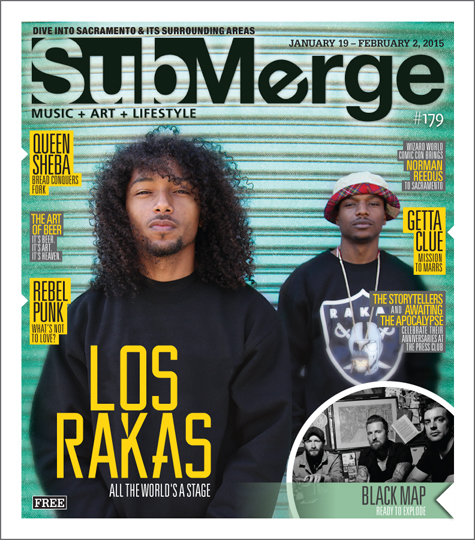
Missed out on those Coachella tickets? Los Rakas will play Ace of Spades Tuesday, Feb. 17, 2015, when the Rapture Tour rolls into town with Zion I and Locksmith. The all-ages show is $15 and starts at 6:30. Visit Losrakas.com or Aceofspadessac.com for more info.
The Sleeprockers team up with Hieroglyphics on the Bay Area’s venerable rap group’s long-awaited new album
Words by Andrew Bell • Photos by Zaved Khan
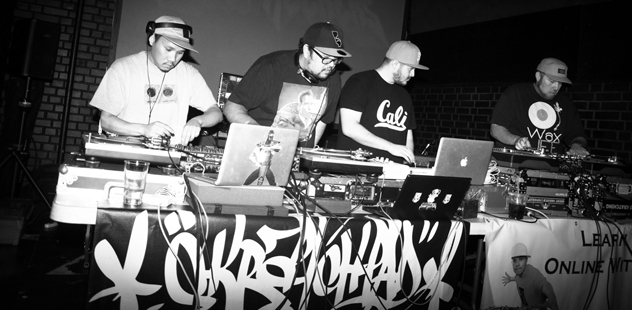
Going to see The Sleeprockers live is like going to watch the hip-hop version of Miles Davis with his band. With an MPC, a mountain of turntables between them and a bunch of pedals, loopers and other alien-looking technology, the crew has taken collaborative live beat production to a new level, even catching the attention of West Coast hip-hop hall of famers Hieroglyphics.
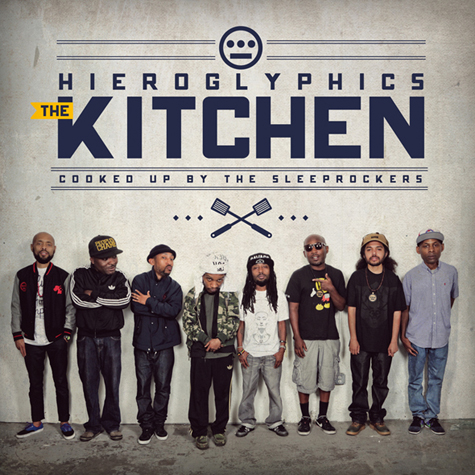
Is it any wonder the Hiero crew would tap the five-man DJ/production crew (DJ Nocturnal, DJ Wanted, Kwes the Bess, Mr. Vibe, and Rated R) to sleeprock (yes, it’s a verb when Hiero asks you to do it) a new group album that would become The Kitchen, the first group album from Hieroglyphics since releasing Full Circle a decade ago?
“They really gave us creative control for the most part,” explained Kwes the Bess. “The more we wanted to push boundaries the more they were with it.”
Aptly named after The Sleeprockers’ practice of setting up their production equipment in the kitchen, the new album is an innovative recipe for hip-hop brought to you by some of the most seasoned lyricists in the game.
Hiero and Sleeprockers go back a few years. In 2010 Hieroglyphics put the word out that they were looking for DJs. “I hit ‘em up and told ‘em I had a whole crew of DJs who came from all different backgrounds, from party-rocking to battling and everything in between,” explained DJ Nocturnal.
In 2011, Hiero asked the crew to collaborate on a new group album that would become The Kitchen. They got busy finding samples, mixing, cutting, scratching and sometimes flipping whole beats.
In the process of recording The Kitchen, Hieroglyphics member Tajai was so impressed with The Sleeprockers’ work he asked them to collaborate on his latest album, Machine Language, which was released January 2012.
All that time, The Sleeprockers have been sitting on what is definitely one of the most anticipated albums in West Coast underground hip-hop.
For anyone under the impression that any of the Hieroglyphics camp has lost a step lyrically over the last 20 years, have no fear. All the uniqueness and funk that you loved about everyone’s signature styles in 1993 are still there, just with updated content and more current beat production. And, of course, sleeprocked.
The bass-heavy, boom-bap revamp is apparent, beginning with the intro track, produced by The Sleeprockers and including juggling by West Coast DMC Champion DJ Wanted (currently residing in Japan), and carrying into the second track “Livin It Up,” a futuristic, funk slapper produced by Del The Funky Homosapien.
The Hieroglyphics camp flexes their own production muscles throughout The Kitchen as well with more than 11 of the 17 tracks produced by Del, Opio or A-Plus. The Kitchen is stocked with that trademark trunk-rattling Oakland funk that the crew has taken around the world.
Lyrically, the Hieroglyphics cast has always had the unique ability to represent both the “street” and “conscious” sides of hip-hop simultaneously, and The Kitchen is no different. The entire album is chock full of social commentary while still…Um… how do you say “Slumps like a MF” in journalist-ese?
After 10 years, there is a distinct development in The Kitchen. More than just a whole crew full of flavorful rappers with flamboyant personalities and flows, there is a cinematic feel to the album. This is largely due to The Sleeprockers’ influence on the intros, interludes, mixes and cutting (scratching) on the album.
So what is it like to work with some of your hip-hop heroes? For The Sleeprockers it didn’t sink in until the end. “I don’t think any of us looked at it like that when we were working on The Kitchen,” explained Mr. Vibe. “But there was definitely a moment after it was done that was like, ‘We just DID that.’”
When asked their favorite individual tracks from The Kitchen, discussion bounced around the room between Sleeprockers. The first track brought up is “That Merch.” Produced by Unjust and featuring Pep Love, “That Merch” documents the hustle involved in peddling the now-infamous third eye memorabilia at shows and how important the merchandise game has been to Hieroglyphics’ success. “That Merch” is to underground rappers what Notorious B.I.G.’s “The Ten Crack Commandments” was to drug dealers.
“Gun Fever,” the first single from The Kitchen, followed closely behind “That Merch.” A conscious banger about America’s obsession with guns, the track features Tajai, Pep Love, A Plus, Del the Funky Homosapien and Casual speaking on their own personal experiences with gun violence.
The track was originally recorded in 2011 before the State of Florida vs. George Zimmerman case was headline news. “It was expressing what was going on in our own neighborhoods,” explained Hieroglyphics member Tajai. Released at the end of April, the music video for “Gun Fever” has reached almost 50,000 views on YouTube in only a couple of months.
Last but not least, Opio’s laid-back, classic West Coast production on “Highway 5” gets passed around the circle as another Sleeprocker favorite. A shining example of the key ingredient that The Sleeprockers bring to The Kitchen, “Highway 5” features both Rated R and Mr. Vibe bringing the patented sleeprock flavor to the track.
There are still tracks like “wShores Galore” (no, that’s not a misprint) for all of the die-hard “93 ‘til Infinity” heads, but the overall feel is an updated, kind of Golden Era 2.0. nostalgic. But for as much as The Kitchen “takes it back” it also moves it forward.
The Kitchen drops July 16, 2013 on iTunes, Amazon, etc., but you can pre-order packages now at Hieroglyphics.com including posters, CDs, T-shirts, and instant downloads of the next single, “It’s Partly Me.”

Word to Your Motherland aims to break down cultural barriers between South Asia, Africa and America
When Nisha K. Sembi and Mandeep Sethi last went to India, they met with a different kind of inspiration than what some might experience on the subcontinent.
Sembi, then a Bay Area graffiti writer and mehndi artist, landed in India on a mission to paint one of her culture-inspired pieces on a city wall (and also, as South Asian immigrants in America often do, attend a wedding with her family in the motherland). What she found were walls already beautifully tagged—far beyond even her own skills—by Indian youths using liquid paint and brushes but in graffiti style because they couldn’t find or afford spray cans.
Alongside tagged walls Sembi saw diverse B-boy and B-girl jams, or breakdancing battles, in the slums, shoeless.
“I came to the realization that hip-hop is more than just art, it’s a revolutionary tool,” Sembi says. “The caste system is still alive and well in India and all these people came together to battle each other in breakdancing, all these people who normally wouldn’t come together because of the different castes. Hip-hop breaks down those barriers.”
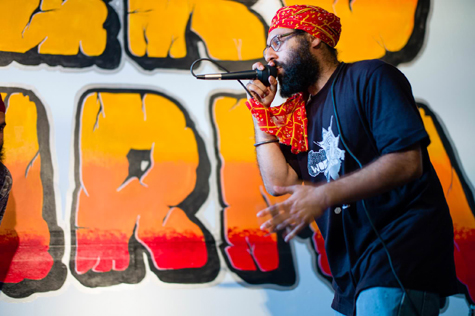
While on his own trip, Sethi, an MC, videographer and youth mentor, also collaborated with Indians who were part of the hip-hop culture in their country, and he filmed, photographed and rapped with them.
Both he and Sembi reached an epiphany.
“I realized my work has more value than just looking cool,” Sembi says, looking back on the experience and wanting desperately to share this connection between two distinct countries to break down stereotypes and barriers.
Sembi and Sethi grew up in California—she in Berkeley and he in Los Angeles—heavily influenced by hip-hop culture. The two stayed tied to their Indian roots but also branched out in different artistic ways to embrace their love of hip-hop, Sembi says, admiring five hip-hop elements: breakdancing, MCing, graffiti, DJing and knowledge.
“I connected with hip-hop because growing up as an Indian girl in America, it allowed me to connect to other people with similar struggles,” says Sembi, who has left the illegal realm of graffiti for a career in fine art, graphic design and social activism.
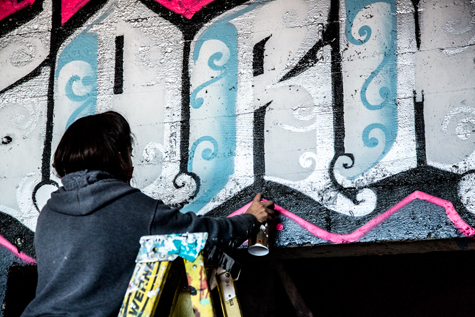
Sethi also used hip-hop to find a way to define himself.
“Hip-hop was a way to figure out where I am in my life, figure out my identity, figure out where I can position myself,” he says. “For a long time I tried to find more Indian youth in the hip-hop community around me and I didn’t find anyone.”
Sembi says she met with the same problem, and both friends started to produce work that became a manifestation of their hybrid identities. Along the way, they found others who also saw hip-hop as a common denominator, and learned more of the deep-rooted relationship between their culture and the hip-hop movement.
For example, Sembi says, one of her inspirations for her artwork is Tupac Shakur and his Thug Life motto.
“Thug comes from the Hindi word ‘thuggee,’ which means thief, and it’s what the British used to call a group of Indians who rebelled during the colonization,” she says. “Tupac knew that because he was intelligent and well-educated.”
A more unlikely inspiration in Sembi’s life—her uncle—indirectly helped solidify her decision to pursue her aesthetic. As a teenager, Sembi remembers helping her uncle move out after he had just graduated from college and stumbling upon his secret graffiti skills.
“I snuck up to his room and the whole room was bombed from top to bottom with graffiti,” Sembi says. “I had no idea.”
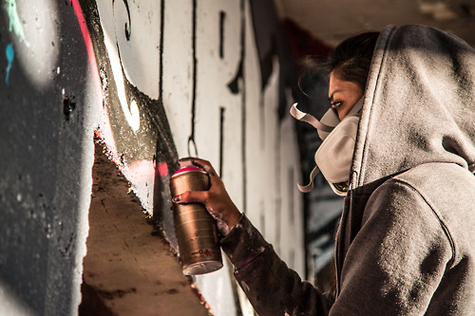
She later confronted him (he was reluctant) and found out he had been a graffiti writer in Oakland in the ‘80s, going by the name “Hero,” a comedic reference to Bollywood actors.
“There were generations before us who embodied this spirit, but never came to light, but with social media and technology, that’s all changed,” Sethi says.
Sembi continues fusing Indian and hip-hop cultures in her work, which has shown in the de Young Museum of Fine Art in San Francisco and multiple Bay Area exhibits. She still tags, but only legally with permission from building owners.
“There have definitely been circumstances where I’ve done painstaking pieces and had them painted over,” she says. “Seventy-five percent of the pieces I’ve done are gone. But within the last four to five years, I’ve transitioned to wood panels and canvases and I can actually sell those.”
Meanwhile, Sethi has become part of the national music scene, MCing across California, working with youth groups nationwide, showing at international film festivals and recording albums.
“I’m 24 years old, so sharing my travels, sharing my experiences with folks younger and older can allow for an exploration of ideas,” he says, joking that his South Asian parents still want him to go to law school despite the success. “I think that it’s important to not only bring back resources to my people in India, but bring back their conversation here.”
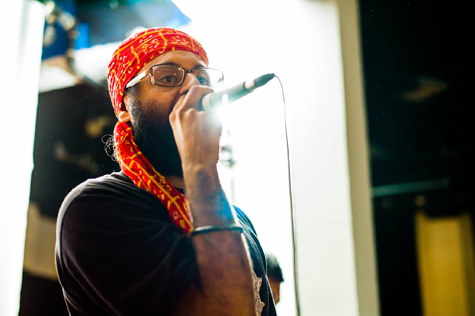
The duo set out to do just that, with the help of fellow hip-hop artists and family members, by curating their first multimedia show Word to Your Motherland.
The show, with Sembi as the featured artist, sets out to recreate an environment that visually, musically and aesthetically transposes the cultures of India and Africa and their people through the intersections with hip-hop culture.
The first exhibition ran in Oakland last year, Sembi says, when curator Anyka Barber asked Sembi if she would like to do her first solo show. The second run starts Feb. 23, 2013 at Sol Collective to celebrate the gallery’s eighth anniversary and recent Revista Siempre Mujer win.
“I thought, let’s use this opportunity to show people in America what’s going on in India,” Sembi says of the Oakland show, which was a success. “For this second one in Sacramento, we’re doing the same thing but instead of just India we’re showing the connection between India, Africa and America. It’s art as a tool for social change.”
Sethi says he wanted to build on the connection between India and Africa because the latter is seen as the original motherland, and the two used to coexist and communicate.
“We kind of lost that spirit so we are trying to inspire others to look inside themselves and rekindle that,” Sethi says.
Some of Sembi’s highlights will include a portrait of Tupac in the style of Indian truck art (part of a series) and political prints like one of Sikhs holding signs that read “Liberate Oakland.” She will also have a large mural installation of her graffiti work as a backdrop to musical performances by Sethi and others.
Guest artists at the show will include Sethi’s brother Puzzl3Peace, a photographer who works exclusively with 35mm film and has a series of shots from India; Eli-Jacobs Fantauzzi, a documentarian who covers hip-hop movements globally; and Sembi’s uncle, who agreed to create a few pieces for the exhibit because of his important influence on Sembi.
Sethi’s photos and films of his time in India with breakdancers, DJs and MCs will also be playing on two projections.
Word… will remain an ever-evolving show, Sembi and Sethi say, and the two hope to continue it in multiple cities.
Word to Your Motherland show runs through March 16, 2013 at Sol Collective, 2574 21st Street, Sacramento. For more information, visit solcollective.org.
Community celebrates fine artist Milton 510 Bowens’ 20 years of service to art and education
Beatnik Studios on 17th between Broadway and X Street blends harmoniously with Milton 510 Bowens’ latest solo exhibition, Echoes of the Sweetest Sounds.
The former is an urban loft-style gallery made of brick that brings photography, music and local artistry to a shared space. The latter is a well-honored fine artist’s resolve to educate about music, history and social justice through art.
Echoes… celebrates 20 years of Bowens’ work with pieces never before seen in Sacramento and gives a unique spin to this year’s local Black Music Month events (renamed African-American Music Appreciation Month by President Barack Obama).
In the last 20 years, Bowens has reshaped his philosophy as a fine artist and taken the approach of a community activist and documentarian. Since, he has achieved great recognition nationally. Starting in 2009, his art became part of the syllabus for a course study in the Harlem Renaissance at Cornell University’s Africana Studies and Research Center. He is also a spokesperson for the K—8 art immersion program Any Given Child in public schools across the country in conjunction with the Kennedy Center for the Performing Arts in Washington, D.C.
Bowens has had paintings showcased at the National Civil Rights Museum in Memphis, Tenn.; been touted by local newspapers as having the largest solo exhibition (150 large pieces) in the United States in his hometown of Oakland; received this year’s Sacramento Artistic License Award; and received a resolution from the California Legislative Black Caucus for his work on arts and education in public schools.
Undoubtedly, this unconventional exhibition has a message.
“After you’ve done something for 20 years, it’s hard to choose what to show, but instead of doing a montage of random pieces…I chose those [pertaining to] music,” Bowens says, leaning back and looking relaxed on a sofa at the gallery after grabbing lunch at Slice of Broadway. “Beatnik, jazz, counterculture…it all goes together.”
The pieces come from Bowens’ Afro-Classical collection and some from his Soul Music series. He journeys through the jazz era and its historical importance in Afro-Classical with recurring images of everything from records, piano keys and musicians’ portraits to railroad tracks, slave ownership documents and tally marks. On his pieces, he writes what he feels, quotes that he admires and pushes the viewer to take a closer look, “Don’t just hear what the work is saying, listen.”
Bowens mixes media with organic materials like cloth, doilies and prints for “richer depth and more substance.” In pieces like God Bless the Child and Straight No Chaser, the use of children’s building blocks and rope along the top of the canvas adds another three-dimensional element.
“I am trying to poetically encourage people to linger a little bit,” he says of his collages with lyricism that sometimes holds a double meaning.
Bowens says he doesn’t approach his art with a “painterly perspective,” though he has the training and knows the techniques. He attended art schools early on as a high school student in Oakland and later at the California College of the Arts and multiple schools while serving in the Army Special Forces. Two military museums collected and showed his work, and his time in the service helped shape his current philosophy.
“I was in a rapid deployment unit with special forces so I got to travel and see art I’d only ever seen in my textbooks,” he says of the experience. “Seeing it in its original environment was uniquely transforming for me. I was exposed to the fact that there is no magical pixie dust when it comes to art. I learned the definition of art–skill, emotion, spirituality, commitment–and that’s where I’m at today.”
The title Echoes of the Sweetest Sounds originally came up in 1998, Bowens says, when his philosophy and technique changed, and it has become a recurring theme.

Eye Too Am America
“When I listen to music, it’s not just for its commercial appeal,” he says, working up to a more pronounced position in his seat. “There is a poetic standpoint, an emotional response. Quality music to me is like a snapshot of history.”
Take Bowens’ piece Chain Gang for instance, named for a Sam Cooke song. It has photo images of black men in striped garb imposed onto it, as well as a white man with his dogs and gun off to the left, and a worker looking down, holding a hoe to the right.
“I love Sam Cooke’s ‘Chain Gang,’ and when you start to listen to the lyrics, that could be considered one of the first civil rights theme songs,” Bowens says.
The top corner is a bright yellow, followed by bright blue and red. The bright colors sit atop Bowens’ neutral base, like all his pieces, of brown and black to portray not only his urban environment but also to hark back to the Harlem Renaissance, and before that, to slavery.
“The only true colors are what rest on top of the surface, and below that the colors are all muted,” he says. “That’s because when I went to a California museum, or the Oakland Museum…nothing there reflected my Oakland, or my California. In my paintings, you will see the gritty undertone of Oakland, because I grew up seeing concrete buildings and basketball courts.”
Documentary filmmaker Ken Burns largely influenced Bowens’ transformation as well. The artist loved Burns’ idea of taking black and white historical photographs, putting music behind them and then putting the interviews conducted in the documentary in bold color. It was the idea of combining “time, space and history” that enveloped Bowens, so much so that it was all he could do. He even went “cold turkey,” he says, on his other techniques.
Since this change, Bowens says his message is becoming clearer, his work more calculated, his compositions tighter. But the exhibition still shows his reach, including a huge drawing done completely in pencil called Ancient Musicians, a collage of jazz masters and cultural icons that brings Bowens’ collection to a detailed, pictorial climax.
Another influence is Bowens’ family. He gives his mother the credit for helping him reach his career today. Being the youngest of 10 children, and the fifth boy (hence 510), Bowens said his mother could have had less patience with him, but instead she gave the notorious child scribbler scrap paper by having his siblings cut Safeway brown paper bags for him. Bowens incorporates brown paper into his works because of this.
Now, the younger members of Bowens’ family are his biggest influencers.
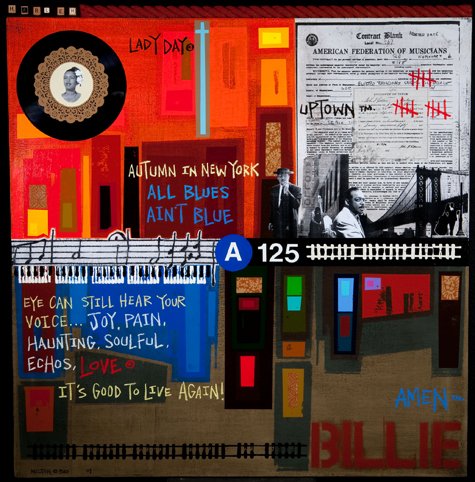
Autumn In New York
“I have two special goddaughters who help me as an artist see how art can affect young people,” he says.
Bowens works with goddaughter Mizauni, a second-grader, spending time with her as she learns to read and write. She recently won her school-wide reading competition and her family has seen “amazing success” in her educational ability since the two have been spending time together.
“I want to model what I’ve done with Mizauni to help hundreds of children in Sacramento,” Bowens says. Sacramento became the pilot city for Any Given Child, in which Bowens helped place local professional artists in schools to provide an integrated art curriculum and one-on-one interaction with students. Schools in other parts of the state, as well as in Portland, Ore., and Las Vegas, are following suit.
“We take what they are studying, like California history or ancient civilizations, and add art as a teaching mechanism,” Bowens says. “Studies have shown that students have better retention of information this way, instead of just memorization.”
Bowens says he is working toward other projects with youths, including starting a mentor diversion program in Alameda County with the juvenile court system and an art and literacy campaign in Sacramento.
“I’m getting ready to rival [my largest exhibition in Oakland] with the Art of Storytelling exhibition that will engage a program for fine art and literacy, specifically one for third grade literacy,” he says.
Bowens is basing the program off a study that upcoming correctional facilities decide on the number of beds they need by looking at the local third grade reading level.
“It’s not something terrible, it’s just if we see a problem coming, we need to prepare for it,” he says. “We need to get involved now. I’m not a minister… I’m not a counselor, I’m a painter. But I believe I have the skills to make a change and inspire young people to read.”
Some messages like this one are loud and clear in his work, while others take a little longer to see. But that’s the beauty of contemporary fine art, and though Bowens says his art “isn’t to decorate, but to educate,” he adds that he does enjoy seeing it hanging on the walls.
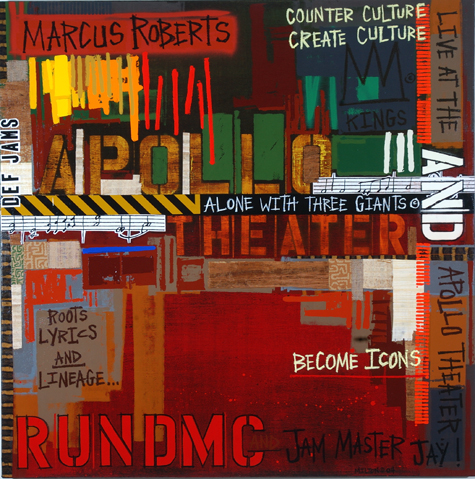
Alone With Three Giants
To catch Echoes of the Sweetest Sounds, visit Beatnik Studios at 2421 17th Street by June 26, 2012.
Ricky Reed infiltrates pop music as Wallpaper
Anyone who’s ever started a band knows that the music business can be a tough and arduous road–even if you don’t have any aspirations beyond playing a few gigs and getting paid in free beer. If you stick with it, though, the rewards can be pretty awesome. Free beer, for one, is always good, but you could become a bona fide super star–or you could find yourself on any number of the rungs on the ladder of success in-between. If you’re looking for an example of sticking with it, look no further than Ricky Reed, the man behind Wallpaper, an Oakland-based electro-pop act. Reed started the project in 2005 as a sort of satirical look at pop music. Ironically enough, he now may be poised for some level of pop stardom in spite of himself.
With the release of Wallpaper’s latest album, #Stupidfacedd, Reed got the attention of MTV and even had the album’s single, the title track, played on the premier episode of this season’s The Jersey Shore. Maybe not the most auspicious venue to get his music heard, but it certainly opened some doors.
“Obviously, you have to be willing to deal with massive amounts of rejection. You have to be able to handle that,” Reed told Submerge over the phone from Los Angeles. “But when all these things came up, they were big and they felt good, but everything feels big and good the first time.”
Before his most recent breakthroughs, however, it was the small victories that kept Reed going.
“The first time that I played at The Press Club in Sacramento and had three to four attractive girls in the crowd, I thought I was winning,” he said. “The first time that I sold out Rickshaw Stop in San Francisco, I thought, ‘Wow, I’m doing it now.’ That’s the great thing about being a musician. As long as you work hard, in theory, things will get better, and every little milestone just feels a little bit better than the last one did.”
Reed’s recent successes have made him something of a sought-after commodity in the pop music world. Recently, he collaborated with Weezer’s Rivers Cuomo to write Cee-Lo Green’s new single “Anyway.”
“We took one shot at it, then took another shot at it, and the second shot knocked it out of the park,” Reed said. “Working with Rivers is crazy. I grew up listening to Weezer, and he’s a really special dude for sure.
“[Cuomo] came with an idea, and we just sort of built it outwards and it turned out great. He’s a class act. That’s the term to describe Rivers.”
When Submerge caught up with Reed, he was in Los Angeles, one night before heading to Las Vegas to play a show at Haze Night Club at Aria with Far East Movement. In Los Angeles, he was diligently working in the studio writing and producing. While he couldn’t divulge all that he was working on, Reed did tell us that he was putting the finishing touches on a new Wallpaper track. He shared some of the details on that and favored us with other words of wisdom in the following interview.

I saw that yesterday on your Facebook page you posted that you’re leaking a new Wallpaper song in a week or two. What’s that track about?
I can say that it’s sports related–jock jams. That’s all I can say about that.
Do you have an all-time favorite jock jam?
Oh dude, all-time favorite jock jam. There are so many good ones–from Gary Glitter… I really like whoa oh-oh-oh-oh whoa oh-oh-oh-whoa-oh-oh-oh whoa oh-oh-oh-oh… Whatever that one is [the aptly titled “Whoa Oh Oh” by Zombie Nation]. That’s a good one. You know what else is a good one? I’m pretty sure they put it on one of the Mortal Kombat themes, you know, “Gonna Make You Sweat” by C+C Music Factory. That was a weird time in music when pop house music was on the radio. Imagine being at a fucking Oakland Raiders game with all your tough cholo bros, and it’s like [singing], “Why waste your time? You know you’re gonna be mine.” The fucking ‘90s, bro. It was fucking unbelievable.
The ‘90s had all kinds of crazy things you’d never hear on the radio now. Like, Soundgarden was a pop band in the ‘90s.
Oh, I know, dude. You’re not going to hear “Spoonman” unless Dr. Luke produces it. I’d love to hear a Dr. Luke remix of “Spoonman.”
So on the scale of jock jams, would you say the song you’re working on is closer to C+C Music Factory or “We Are the Champions” by Queen?
Oh wow, I would say if you could merge those and sprinkle in a “Whoomp! There It Is” kind of flavor. That kind of “Whoomp! There It Is” energy I try to bring to all my records. I would say that “#Stupidfacedd” and “Fucking Best Song Everrr” definitely have a good dose of “Whoomp! There It Is” woven into them.
You’ve got the live show coming up at Ace of Spades in Sacramento. I was reading that your live show has two drummers and at least two other vocalists. Is that something you’d like to incorporate into the studio–having a bigger band?
In the studio, I just try to make the best songs however they want to be made. The live show, we’re trying to produce something special for people in that environment. There’s not a lot of carryover.
We’re going to do something even bigger and crazier for the Sac show. It’s going to be the debut of a new Wallpaper live set. It’s something nobody’s seen yet. We’re doing it that night and on New Year’s Eve with Kreayshawn in San Francisco.
Are you keeping that under wraps?
I want to keep that somewhat of a secret, but I will say that our live act is usually a four-piece setup, but the Sacramento show will be our first performance as a five-piece for those shows.
I listened to your album a couple of times through, and the first time, I definitely picked up on the beats and the energy, but the second time around, I was paying attention to the lyrics, I picked up on some really good lines in there, especially in “#Stupidfacedd” with that bit about the awkward silence. Is that something you throw in just to see if anyone’s paying attention?
You could definitely say that. I think my lyrical philosophy is just try to get people to pay attention to anything, you know what I mean? Like, hear something and realize you just heard it. Pop music is wallpaper. If you ask somebody what was the patterns or the colors on the walls of the rooms they’d been in today, of course they wouldn’t know what that is. They wouldn’t be able to answer you. That’s what pop largely feels like to me. People just run around with their thumbs up their butts, not paying attention to anything.
You say that, but Wallpaper’s music is obviously in that pop vein too. Is this one of those instances where you can be more rebellious inside the system than you can be outside the system?
I think you can stand on the outside and hurl rocks at it, or you can be the Trojan horse. I’ll leave it at that.
I wanted to ask you about the song you did with K Flay. I’d seen her play at a random club a while back. It was one of those instances where you go out and you don’t even know who’s playing and end up really enjoying it. I was wondering how that song came together and if you wrote it with her in mind.
Yeah, well I knew that K Flay was as broke as me… [laughs]. I wrote that record, and I knew it needed something. I think I met her just before that, and it was just the right timing. I thought, “This is perfect, why don’t you get on this?” She did a great job representing herself on that record, but she contributes to the song in such a great way. She’s just super talented and has also become a really good friend of mine.
Like you said, when you’re coming up you have to deal with a lot of rejection, but I’m sure that now that you’re making some headway, some of those nos are probably turning into yeses. How does that feel when that starts happening? Is it off-putting at first?
That was definitely the case. This sensation I feel pretty often is that I’m putting one over on people, you know? I know that my shit is dope, and I stand behind it, but also with how the rest of this stuff is, the rest of this stuff that you guys are signing off on–the powers that be–do you really think that you want to sign me? Are you really sure? Because I’m going to be a big problem for you guys.
Goapele Has the Voice of an Angel, the Spirit of Oakland
Much like her music, Goapele is not a one-dimensional individual. Born in Oakland to a South African father and Jewish American mother, her lineage and upbringing provided a fountain of culture for her to draw upon. From activism to the arts, she absorbed it all and channeled her experiences through music. With an angelic voice and adventurous ear, Goapele defies genres and has continued to evolve over the past decade.
Since her debut in 2001 the sultry vocalist has gone on to release three albums. After a five-year hiatus brought on by the birth of her first daughter, Goapele is putting the finishing touches on her fourth, titled Milk and Honey. With big name producers from across the country, the album is a melting pot of sounds, from synth-driven and heavy drums to sweet melodies. Goapele says that becoming a mother played a big part in expanding her world and making her “more open in general.”
“I think it was more so how much bolder and empowered, and also how vulnerable I felt after the whole experience,” she says. “It has expanded my sense of love. Also, it really pushed me through the writing and recording process. I don’t feel like lyrically I’ve changed very much, except that I’m putting myself out there a little bit more on this album instead of holding my cards close.”
A soft-spoken, strong soul blessed with boundless talent, Goapele has all the tools. It’s her world, and she is the architect. In advance of her Aug. 13, 2010 performance at Harlow’s, Submerge linked up to talk about Milk and Honey and some of the misconceptions that follow her.
I heard you say in an interview how people thought you would come back and write lullabies, but how that’s not the case.
Yeah, yeah [laughs]. It’s kind of interesting in that way because it didn’t make my music softer or my lyrics more edited, it made me more open and bold.
Â
With your time off did you find you came back with a renewed energy or creative pulse?
I took my time recording this album, and I feel ready right now. After I had my daughter I took time to be home with her and take advantage of that experience, but I have really dedicated the past couple of years to craft this album the best way I can. What it is was that I was able to take more time than I ever had before because it was on my terms and pace.
Â
I feel it’s been public for a long time that Milk and Honey was your next album title. I’m always interested when a title holds for so long. Did you build down from a certain concept and sort of mold the album off of that?
Well, it was one of the first songs I recorded. It was a very sensual song, and I felt like that would be the overall tone throughout this album. There were songs I was writing at the time that had a different vibe, but I really liked the “Milk and Honey” idea. I like that it was something nourishing and sensual… I need to find more words to explain it [laughs].
Â
Did that song steer you in a certain direction?
Not really, I just kept recording. In the creative process I just like to get everything out there. I hooked up with so many producers and musicians along the way things were always changing. I would feel like, OK, I’m done, but then another opportunity would open up so I just kept going. At the end I think it will all make sense, and it will all tie together. When I first started recording, it started with my in-house producers like Bedrock, Mike Tiger, Dan Electric, and throughout the process I got to work with different people I had met throughout the years like Kanye West; Khao, who is out of Atlanta; Raphael Saadiq and others. More recently I worked with Drumma Boy who produced the next single, “Right Here.”
Â
Again, I read a quote I really liked where Drumma Boy talked about playing you his R&B stuff but you identified with the harder, crunk stuff.
Yeah [laughs]. I feel like as producers and musicians, we have to give our truest selves. That’s what I know him for, so that’s what I want from him. I can come off super laid-back and positive, and I do want my music to have a positive impact, but I’m not strictly a calm, soft and gentle person. I really like hard-hitting drums and bass lines. And then my natural way of singing is kind of laid-back, so I like how those two things fit together.
Â
You have a universal sound, but do you feel there is an element that is a direct reflection of your Oakland/Bay Area roots?
Probably the combination in my sound–that it’s raw but still beautiful. I feel like that is Oakland. It has a rough vibe but it’s gorgeous at the same time. It has the water right there, so much green, but there are other elements that can be rough around the edges. I would be happy if the violence went down, but I do like that people can be individuals and not worry about fitting in a box.
Â
Yeah, I feel like that is really personified in the “Milk and Honey” video. It’s a very elegant video, but you got the two slugs in the bottom row of the teeth.
[Laughs] Yeah, exactly. It’s not typical. We all have so many different aspects of ourselves, and in entertainment it’s like people want us to be one certain way but that’s not how most of us are as men and women.
Â
You may have just answered this, but what do you think is the biggest misconception of you?
Yeah, kind of what we were just talking about and people just wanting to keep me in the neo-soul category. Yes, I have been strongly influenced by soul music and I always want what I do to be soulful, but it does bleed out of that category.
Â
Is that a term you have come to disgust, or are you just kind of eh with it?
It turns me off, but I understand it. When you’re doing something that doesn’t quite fit the titles that are already out there then it’s easy to just make a new title, but it’s the best when you don’t have to have any title at all. Just your name. That’s what I’m working for.
Â
Whether center-stage or behind the scenes, Sean Lennon continues on a remarkable music legacy
If your father was one of the most respected and beloved songwriters of all time, and your mother was one of the most polarizing figures in pop culture, anonymity would be difficult to come by. Still, Sean Lennon has managed to keep a relatively low profile–and that’s fine by him. The only son of John Lennon and Yoko Ono, Sean hasn’t flaunted the fame that was his birthright. Instead, though he’s followed in his parents’ footsteps, he’s taken an almost workman-like approach to his music career.
“I pretty much started off playing bass with Cibo Matto, and I came to music from that part of the game, which is being a player and someone who plays in someone else’s project, like a session musician,” Sean explains. “That certainly is as much, if not more, a part of who I am as a musician as being a frontman.”
When Submerge spoke to Sean over the phone from New York City, he was keeping himself busy as usual, putting together a mid-February show at the Brooklyn Academy of Music that will honor his mother’s music. Sean says that organizing an event of such magnitude is a new experience for him.
“I’m sort of in pre-production for this BAM show, which is kind of complex, because there are a lot of players involved,” he says. “I’ve never actually participated in organizing anything of this scope, so it’s been a lot of work, but it’s been a lot of fun as well… We have a lot of guest stars performing my mom’s songs, and she’s going to be performing with them, and I’m sort of music directing and producing.”
Sean was also busy with his own music. His latest project is the eerily titled Ghost of a Saber Toothed Tiger, a duo that consists of himself and girlfriend Charlotte Kemp Muhl. GOASTT is still in its nascent stages, but Sean says that he hopes to tour and have an LP out by this summer. Though the name may sound menacing, judging from the songs posted on the group’s Myspace page, GOASTT creates dreamy, incandescent pop soundscapes. He and Muhl are currently in rehearsal for a show at Union Pool in Brooklyn, which will take place Feb. 19, 2009. Sean says that rehearsing for both shows simultaneously has had its challenges.
“I’m rehearsing the BAM show at the same time, so it’s confusing to remember all the different sets–all the chord changes and stuff,” he says. “It’s interesting to have to think about two different projects in the same week.”
West Coast fans can catch Sean Lennon when he performs with GOASTT and also plays with his mother in the Plastic Ono Band at this year’s Noise Pop Festival in San Francisco. Sean co-produced the band’s latest album, Between My Head and the Sky, alongside his mother. The album was released in fall 2009 and received a very positive reception from critics. Sean worked with his mother on a record previously well over a decade ago. Rising was released when Sean was just 17 years old and led him to a worldwide tour with his mother. Though he says he was well aware of his mother’s capabilities going into the recording of Between My Head and the Sky, he found that Ono was still full of surprises.
“I was still surprised at how inspired she was and how prolific she was,” Sean says. “On the most prolific day, we did six songs. She came in with six song ideas, and we recorded them all in one day. The whole record was made in…seven days, recording wise, and then the rest was spent mixing. It was really fast. It was more like a jazz record than a pop or rock record, which are usually belabored.”
In the following interview, Sean Lennon discusses working with his mother, his girlfriend and the excitement of wearing many different hats.
Last year, you put out Between My Head and the Sky with your mother. I heard an interview with her on NPR where she said it was your idea to resurrect the Plastic Ono Band name for this album. Why did you decide to do that?
It was my mom’s band, and I felt it was her best band name. It was really just a matter of aesthetics. I didn’t realize how people would react. I think a lot of people were excited, but I wasn’t really trying to say I was resurrecting the original Plastic Ono Band, which was basically Ringo [Starr], Klaus Voormann and my dad and my mom. It was more that I just liked the sound of the name. I think it’s a cool-sounding band name, and it’s her band, so I figured since it was her band, she had the right to use it.
Was it something she was open to right away, or did you have to talk her into it?
No, no. She was fine with it. I think it was one of the three coolest band names of all time: The Velvet Underground, Spiders from Mars and the Plastic Ono Band. I don’t think any other band names are cooler than that.
From what I’ve heard of the album, it seems like there are a lot of different jumps stylistically, but would you say there’s a common bond between the songs?
I think so. For me, I’m the last person to be thrown off by mixing or shifting between what one would call musical genres, because I don’t even notice it. At this point in time, music is such a diverse landscape, I can’t imagine making a record that just sounds like one thing all the way through anymore. It almost seems like you’re upholding a tradition if you’re doing a jazz record, and it’s the same sound all the way through. It’s almost like a ritual. In this day and age, I feel like there’s so many different styles of music and there’s been so many fusions between different styles that there are no limitations to what you can do on one record. To me, when we were making the record, I wasn’t thinking in terms of genres, I was thinking what was appropriate for each lyric and moment.
Before you mentioned that you made the Rising record with your mother when you were 17. Now you’re a man in your 30s. Did being older affect the working relationship between you and your mother?
Yeah. I think I might be more professional. I have more experience. More tricks up my sleeve. I have more of a sense of what I like and don’t like. I’m probably more patient with myself and others, I think–I hope.
You’re playing a show later this month with your other project, Ghost of a Saber Tooth Tiger. How is that project going?
That project is going great. We just finished a 45, 7-inch. That’s going to be coming out soon. We’re going to be touring this summer, I think, and we’re going to try to finish the record by the summer. I hope we can. It’s hard, because I’m also running the label and have my hands in a lot of different things, so it’s hard to be sure. Sometimes I wish I could just focus on the band and nothing else. I’m trying to wear many hats and see how it works for me.
Can that get frustrating?
It’s never frustrating in itself, because it always feels really fun. It feels like I’m on a roller coaster while I’m juggling or something. It’s exciting, but it can be taxing physically. I can get really tired and not sleep that much because I have to do so much, but I’m sure everybody’s in that position at this point. One of the main things is doing all the visual artwork as well. It takes time drawing. For the label [Chimera Music], we do all the drawing in house, which basically means my kitchen has a drawing table. That in itself could be one job, you know? Trying to do that, design the merchandise and mix the songs and write the songs and perform the songs…no, it’s not frustrating, it’s really fun, but sometimes my body feels really taxed, mostly from not sleeping enough.
With GOASTT, you work with Charlotte Kemp Muhl, who’s your girlfriend. How is it working with your girlfriend on a record as opposed to working with your mother?
It’s totally different just because they’re completely different. There’s nothing similar about it. For me, the most exciting thing I’ve ever done was start this band [GOASTT]. I’ve been really having fun. It’s almost the first time that I’ve ever been proud of what I’m doing. Working with Charlotte has been the most inspiring time of my life.

Sean Lennon will perform twice at Noise Pop: Feb. 23, 2010 at Fox Theater in Oakland with The Plastic Ono Band and Feb. 24 at The Independent in San Francisco with GOASTT. For more information, check out www.noisepop.com“
The Grouch Set to Leave Paradise for West Coast Tour
Over the past decade, Oakland, Calif. native The Grouch has proven to be the embodiment of the independent musician. Alongside his crew the Living Legends, Grouch built an underground empire from the ground up, building a reputation by pounding the pavement with dope product, selling his music to fans hand-to-hand. He always made himself visible and bridged the often-murky area between supplier and consumer. Hustle aside, it was his music that resonated with fans. Instead of a fast food filling, Grouch based his lyrics in reality—honest and candid, intelligent and insightful. Through 10 solo albums, five group collaborations and more than a handful of Living Legends projects, Grouch has never led fans astray. An inspiration for anyone looking to make it happen by doing it their way, his career has shown that hard work and dedication go a long way.
In support of How the Grouch Stole Christmas, his aptly titled 11-city West Coast tour, the man whose fuzzy 4-track songs I once put on a Maxell mixtape spoke from his newly settled island paradise on topics ranging from modern-day subsistence living to Dr. Seuss—and of course, music.
I understand you’re out in Hawaii at the moment. Is that for work or pleasure?
Nah, I’m living out here doing the family life, growing vegetables and chillin’. Working of course, every day, all day, grinding over the Internet and over the telephone. It’s not a permanent thing, I don’t think, but we like it out here a lot so we wanted to give it a trial period. We were supposed to stay six months, but at the end of the six months we were like, we got to go for another six months. We’re taking it as it comes.
You said growing vegetables, are you really on some subsistence level shit out there or what?
Nah, we’re just living. We’re staying at a house that get its water from the rain and has solar power, and we have a good vegetable garden going. We’re just doing natural family life: kicking it, and jumping in the ocean and drinking coconuts.
That sounds amazing.
Yeah, it’s been a real good experience. It’s a good change, and we did it at a good time. It’s still the United States, but it feels a little bit detached out here. There is less advertising, less TVs around.
Your latest tour, How the Grouch Stole Christmas, is going to take you away from your paradise for a couple days. Off the top, it was nice to see fellow Living Legend Eligh’s name right there with yours.
Yeah, it worked out good because me and Eligh have an album coming out March or April of next year. People always ask when the next G&E album is coming out. Me and Eligh are good friends so when we do shows, it’s always fun, and people love to see the combination of us two. We’re both on the same page, as far as us both doing sober shows and all that, and we’re both at a time in our careers where we are taking everything very seriously and trying to step our games up.
I was going to say, it’s been a long time since I’ve heard mention of G&E as a group. What can you say about the album so far?
We’ve got a strong single with Gift of Gab, so you’ll hear that. But as far as everyone else, we have Mistah Fab on there, Sage Francis and Slug on a couple different songs. We’ve got a song produced by Flying Lotus, a joint produced by Amp Live of Zion I. It’s going to be a good release. I’m really proud of the music so far.
The Bayliens are also scheduled to play, but there is one name that I didn’t recognize: Paul Dateh.
Yeah, he’s dope. He’s from L.A. and played violin on my last album; he’s also a vocalist too. If you Google him, there are some pretty amazing videos of his violin skills, and how he combines them with hip-hop. He’s just coming up and making a name for himself. When you watch the set though, you’re like damn that was dope. Every time I have him open up for me, he gets a really good response. The Bayliens, they’ve been working real hard and I like the way they do their stuff, so it all works together.
Alright, last one to wrap it all up. Looking at Dr. Seuss as a writer, in terms of his story telling, his structure, his rhymes, how would you rate him in MC terms?
Dr. Seuss is a dope poet, and would make a dope MC. I think if he wanted to rap, he could probably have some tight raps. I don’t know how much of a coincidence it is that I’m using one of his themes, but I’ve had a lot of people tell me that my rhyme style reminds them of Dr. Seuss. I don’t know if that’s a diss or not [laughs]. It wasn’t like, “You have the most Simple Simon rhymes in rap,” but I have been told that they can see a resemblance, and I take that as a compliment. I like the dude’s style. He’s not the most complex, but he’s successful for a reason. The way he put his books out there, and the content in them with the pictures and the whole package, I really respect the dude.
Simple or not, at the end of the day he’s saying something of substance, which can always be said of your music.
Exactly.