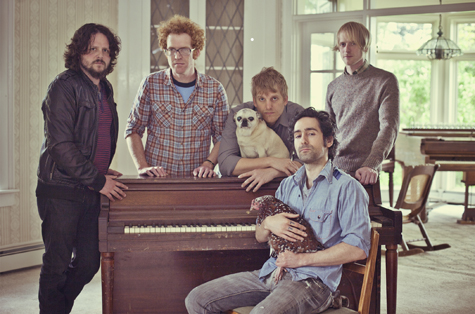
Blitzen Trapper Navigates Nostalgic Avenues on American Goldwing
The key word for the successes and attention over the last five years for Portland, Ore.’s Blitzen Trapper might have to be “patience.” With their conception in 2000 as a six-piece crew of classic-rock connoisseurs–anchored by the songwriting prowess of figurehead Eric Earley–Blitzen Trapper accidentally enjoyed an educational incubation period in garages and small clubs for a full seven years before anyone outside their hometown really had a clue or cared about them. With everyone seemingly looking the other way, the band honed their craft, wrote, recorded and released three albums on their own (2007’s Wild Mountain Nation would eventually be re-released on Sub Pop), and figured out, basically, how to be a band. With Wild Mountain Nation, Earley’s artistic prolificacy, and his isolation/inspiration of residing in the band’s actual studio space during the creation of the record, resulted in a buzz that’s ricocheting even today, complemented greatly by the 2008 follow-up, Furr, and the slightly prog-y 2010 LP Destroyer of the Void.
Blitzen Trapper’s latest release, American Goldwing, is a return to the nostalgic confines of road-weary rock, rumbling with gobs of groove, walls of squalling guitars and Earley’s typically brilliant strokes of capturing the nomadic spirit on tape. Big riffs and catchy choruses abound, showcasing a band maturing a mere 12 years after they first played a note. With the band’s ascent into the consciousness of media heads and music lovers alike having coalesced to form a formidable army of devotees, the band is capitalizing on their impeccable sense of timing yet again, hitting the road for another run of dates that will slither them out of the clubs and into the maw of the festival circuit through the spring and into summer. In anticipation of Blitzen Trapper’s gig at Harlow’s on March 5, 2012 guitarist/vocalist/keyboardist/melodica player Marty Marquis spoke with Submerge via phone from Seattle, where he was slated to headline at his friend’s wedding ceremony.
The band’s been off the road for a while now. How do you relax off tour? Do you tend to hibernate away from each other?
We hang out and do stuff now and again, but for the most part I think everybody’s got their own lives now. When we’re on the road, we enjoy each other’s company, but it’s nice to have a break from the enforced intimacy. I’ve got kids now; our bass player Mike [VanPelt] just had a kid a month ago. The other guys have their own things going on, too. When we started playing together in 2000, we weren’t like, “Let’s make a band and get famous and make a bunch of money!” We just liked hanging out, so we’d spend four or five hours a night, three or four nights a week. We did that for years, just hanging out, playing and recording. We’ve logged a lot of time with each other. We don’t feel the urge to do it all the time anymore.
Do you feel like folk, roots or Americana music is being homogenized by its resurgent commercial popularity? If so, is a band like Blitzen Trapper fearful of a backlash?
The thing to look at is how much of this music is actually folk-Americana music, and how much of it is just the trappings of that. I was hanging out with this guy last week, and he was talking about Mumford and Sons was Journey with banjos and acoustic guitars. There’s nothing wrong with that, but it’s just funny I guess. In the [late] ‘60s, no matter what style of music you were playing it was important to have long freaky hair and wear peace signs or have a fuzz guitar, making your music psychedelic regardless of where you were actually coming from musically. So bands are responding to all kinds of different pressures, and I think especially young bands who are talented but don’t necessarily have much of a sense of identity are apt to go for those folk-Americana trappings.
I don’t know about backlash. I feel like everything is so fragmented and Balkanized in music that it’s hard for me to imagine people being like, “Oh, we’re sick of this folk-Americana stuff!” There are a million other subgenres you can get into that will sell just as well probably.
Eric Earley has said that American Goldwing was written and at least partially recorded during your tour for Destroyer of the Void, and that it was hard playing the current songs when he knew that American Goldwing was the “real” record. Was that the sense for the rest of the band, or had you even heard those songs yet?
We’d heard a bunch of them. In my recollection, I think Goldwing was about half-done when we took off on tour for Destroyer. That’s been Eric’s motive; he’s ultra prolific. If he doesn’t actively stop himself from writing and recording, he’d be recording all the time. There were a lot of different things going on around the time we were putting together Destroyer. One of the things we were trying to do was build a consensus with all these different players–the band members, our label, our management–about what the record was supposed to be. I think because Destroyer wasn’t necessarily well-received, it was sort of easy to say that was a bad approach. It didn’t really represent what Eric as an artistic director was going for. He felt like Goldwing was a lot stronger of a representation of who he is as an artist, musician and songwriter. He felt great about the songs that were on it. On an objective level, the songs on Goldwing are coming from a more honest place than anything Eric’s ever put out before. It’s more about his life and less about fantasy stuff.
As a band, then, how do you reconcile that underlying feeling of having such a great album waiting on the shelf and you’re not able to play it because you have to tour for a different record that you worked on just as hard?
I think there’s always that thing where as an artist, you’re always most excited about what you’re currently working on. But there’s a delay in the music biz where your record comes out six or nine months after it’s finished. So you wrote these songs maybe a year or two before. You’re thoroughly familiar with them and you’re kind of tired of them. And then if nobody else in the world seems excited about these songs, it’s even more tempting to want to move on to the next round. But I don’t think that this narrative of American Goldwing being the “real record” is anything that all of us were thinking when we were touring on Destroyer.
I know Eric writes a majority of the songs, but what collaboratively is happening in the creative process? How informative are you in those processes when recording and writing, and the rest of the band as well?
I’m not very important at all in the writing and recording process. I came in on Goldwing and sang on some songs, but I didn’t play any guitar or anything. Brian [Koch], our drummer, was a lot more instrumental in arranging these Goldwing songs. I think he was a big part of why those songs turned out the way that they did on the rhythm side. I think also there’s this–I don’t know if it’s subliminal or what–but if you’re playing stuff in the van when we’re on tour, Eric’s going to pick up on it and incorporate elements of what he’s hearing, whether or not he realizes it. We’ve been talking about aesthetics and rock ‘n’ roll philosophy for a decade now, so I think we’ve all really influenced each other and been informed together. Also, I think while Eric’s in the studio arranging these things he’s thinking this stuff is going to be represented live by these players, here’s what they do well. He’s arranging these songs and thinking in terms of who we are as a band, as individuals. That’s not strictly collaborative, but I think it still affects the way the songs turn out. The more we go along and become a band, and it sort of crystallizes as a creative performance unit, the more it affects the way the songs end up on the record.
Is there a song that encapsulates the universality of that theme best on this record in your opinion?
Yeah, I think the title track is a pretty awesome song. It’s got a lot of abstract imagery, but it’s about travel, and the willingness to get on a vehicle and go. There’s sort of the spiritual thing that’s built into that song in particular, where the will to travel and the will to move places is somehow spiritually refining. But I think probably the best song on the record is the last one, “Stranger in a Strange Land.” It’s kind of the flip side of that: Once you stop moving, you don’t know where you are.
Catch Blitzen Trapper live Monday, March 5, 2012 at Harlow’s. Opening will be excellent alt-country Portland group The Parson Red Heads. Show starts at 8 p.m. and tickets are $15 in advance. Visit Harlows.com for more information.
Neal Morgan’s Impulsive New Record a Raw Delight
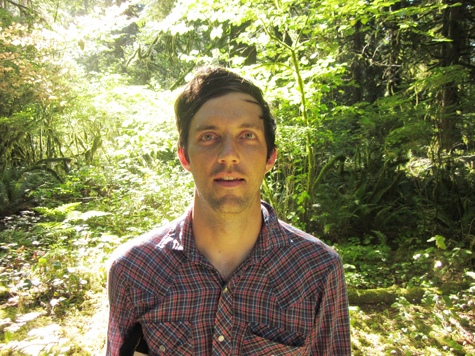
You’re likely at least a little familiar with Neal Morgan, even if the name doesn’t quite ring a bell right away. Fans of Joanna Newsom or Bill Callahan will recognize the name as belonging to the drummer responsible for holding down percussive duties on their respective tours the last few years, as well as on record–notably Newsom’s Have One on Me, and Callahan’s Apocalypse. But Neal Morgan, the solo artist, is something of an anomalous alter-ego to the drummer heard on those recordings. His 2009 debut solo record, To the Breathing World, premiered a symbiosis of voice-and-drums-only compositions, created largely from first impulses to a cassette boom box in his Portland, Ore., garage. The result was a unique, primal offering of polyphonic voice melodies cooing over sometimes-frantic, sometimes-structured drumming. For his newest album, In the Yard, Morgan has also added a spoken word element, a new passion he hopes his work evolves naturally toward.
The self-released In the Yard is out Jan. 24, 2012, with distribution help by Drag City. Morgan is returning to the Sacramento area on the heels of the release, and took some time to speak with Submerge regarding his muses, his music and his hatred of poetry.
Is there anything special about getting into the mindset of making a solo record for you, as opposed to your more regular gig of drumming for other people and being part of a unit?
Well, everything I do is based on first impulses. So even arrangements I’ve made for Bill’s music or Joanna’s music start as first impulses and then it goes from there. But those first impulses when I’m arranging for someone’s record are based on some amount of conversation in advance–what they might be hearing for a particular piece and talking about the piece itself, and then arranging for that. I guess having a blank slate is the major difference.
What draws you to want to create on that impulse, and to have the final product be a really improvisational vibe?
For my own artistic enjoyment, it’s most fun to just be playing and just to do it without thinking too much and editing while I’m working. I tend to like listening to records where it was clearly the first pass that someone made at something. I always love my friends’ demos more than their records, for example. Really early on, I didn’t know how to make music of my own. I thought, “Well you make some demos and then you make a record.” Why make demos? Just make it. Get in the garage and just start and end up in something. Not always, but most of the time I love the thing that happens first, when I wasn’t thinking, the fresh impulse. But after a certain point, I’m a heavy, heavy editor. I spend 20 percent of the time tracking and then 80 percent editing. It definitely flips; it goes from being this impulsive thing into this heavy cerebral experience.
Of the songs that aren’t improvised like “Father’s Day” or “The Evidence,” how do you reconcile getting into the mindset of arranging or composing those songs that are more structured?
Sometimes the first thing you did is just exactly what it needs to be. Sometimes that’s just what happens. There’s a need for further tracking and re-recording of initial impulses. There are a few moments like that on this album, like “Father’s Day” happened fairly quickly. Those initial impulses really just kind of happened. But there are a couple songs on the second side, one in particular–“Thinking Big”–I’d had that drum beat kicking around for a really long time. I decided I wanted to make a highly structured composition. But then the two spoken word pieces [“On Tour,” “I Stand on a Roof”] happened after I thought the record was done. I went away [on the summer 2011 Bill Callahan tour] and came back, and [the record] was very clearly not done with fresh ears. I recorded those in 20 or 30 minutes. It was exactly what the record needed, and I finished it right then.
Sometimes you have to take a step back and give it space…
Yeah. Do you know the painter Philip Guston at all? There’s a response on the record to him, and his painting is on the cover. I think about him a lot and read a lot of his writings and interviews. He talks about being led during the course of painting, and I think that happens. As these things start to show themselves, they kind of tell you which way to go.
What is your recording process like? I read you recorded some of the album on a boom box.
I have a cassette eight-track, and an old boom box that has a microphone. I have a digital program, but I’m not good at any of that stuff. I just wanna hit record and play. Side A [of In the Yard] is really a foreshadowing of what the next record is going to be. Side B is really a wrapping up, I think, of a lot of the ideas that started with the first album. The next one’s gonna be spoken word.
You mentioned you hadn’t really done any spoken word before. How did you get into that?
[I was] in Atlanta [with Bill Callahan], and I was opening the show there. I had just written something that I really liked, but I didn’t really have a melody or anything like that to sing it. I decided just to say it. I just tried it and I loved it.
Was it liberating? It takes a lot of confidence to release music that’s based on first impulses, but also to speak naked words that aren’t under the veil of a melody and just saying it.
Yes, it did feel that way. I think that maybe that’s what continues to draw me to spoken pieces. The next record will be that, because you’re right–it’s the barest of the bare. That show, for me, was an incredible show. My shows are almost always improv. I’ll just decide to play a song at the drum kit one night, or instead I’ll just sing that song. This was a night where I did four or five really new things that I’d never done.
What topics interest you most to write lyrics or spoken word pieces about? Is that also coming from an impulsive source?
I have a notebook, and I’m often writing. You write when an idea comes or something happens that you think is interesting, or you come upon a way to express something that you’ve been curious about. I do a lot of writing and no editing as I’m writing. Zero. I think that’s so important. Then I will look at it some time later, and sometimes nothing resonates for me so I don’t act on any of it. But sometimes pieces of it will resonate and will connect to other ideas I have at the moment. Maybe drum ideas, or they’ll connect to other things I’ve written. Now my process includes speaking those written words in the editing process, because I’m now thinking that way for live and for the next record–hearing how it sounds and seeing how it feels to speak particular lines and then making editing adjustments based on that.
Like working on cadence and intonation?
Yeah, which is all stuff that I’d never really explored before. But it’s all very rewarding for me right now. I also don’t have a lot of frames of reference necessarily, and I want to stay that way.
In terms of spoken word artists?
Yeah, and just for the written word. I don’t have a lot of writers who are heroes of mine in that form. I’m kind of limited in that way.
You haven’t gravitated toward spoken word artists, now that you really enjoy it artistically for yourself?
No, I haven’t done that. I’ve read some more poetry in the past year, but I like so little of it. It’s really wild. But I also don’t devour it. If I read a lot more, I’m sure I would find a lot more I would like. But I really hate a lot of what friends have given me and said, “Oh yeah, this is a great poet, a great book.” I just don’t like it, like 90 percent of it [laughs]. When I’m working on music, I tend to not want to hear much at all. I just want to keep those first impulses what they are without having other ideas flying around.
Neal Morgan performs at the Milk Gallery in Sacramento, Friday, Jan. 27, 2012. The show is all-ages and has a $5 cover. Show starts at 8 p.m. Morgan will also play at the Haven Underground in Nevada City Saturday, Jan. 28, 2012 (also a $5 cover). For more info, go to Havenunderground.org. Both shows feature Aaron Ross opening.
Pocket for Corduroy Reunites, Ponders Next Step
Long before Nevada City, Calif. attained national notoriety as a hotbed for the anti-folk scene of the mid-’00s—a breeding ground for the disciplined howls of the Russian River kids—the city’s musical landscape thrived not unlike that of the monolithic post-punk scene in Sacramento. In the late ’90s and into 2002, Pocket for Corduroy erupted like Vesuvius on an unsuspecting Pompeii, eschewing conventional rock ‘n’ roll chasms to forge an inventive urgency to their sonic explosion. In five years they played alongside some of underground rock’s biggest bands (or those who would go on to become some of its biggest bands)—Pinback, Guided By Voices and The Velvet Teen, among others. And then in 2002, it was over.
Pocket for Corduroy—Andrew Hodgson (vocals, guitar), Dan Elkan (vocals, guitar), Peter Newsom (drums), and Thad Stoenner (bass)—splintered into myriad other projects, including Black Bear, Daycare, Millionaireplanes, Holy Smokes, Hella, Casual Fog and Newsom eventually recorded and toured with Devendra Banhart. Elkan and Stoenner have been busy with the experimental pop-psych of Them Hills as well, but it wasn’t until an old friend, publicist and booking agent (the absolutely darling Jesse Locks) asked the band to play for her 30th birthday party that the band decided to dust off the PFC catalogue and reunite.
There’s no telling how long this reunion will last. As you’ll read in this exclusive Submerge interview with Elkan, the band does have one other show booked aside from the private affair of Locks’ party, at Harlow’s on Sept. 10 with By Sunlight, Bright Light Fever and Silian Rail. But one thing’s for sure: Sacramento is in for a reawakening of one of the brightest bulbs in its flickering history.
How did it feel to be back in the same room rehearsing with all of the original members of Pocket for Corduroy after seven years?
We all currently live in the same town again and are all still friends, but for whatever reason don’t get to see each other that often. I mean, we see each other at shows and barbecues and such. We’ve all played music with each other in some combination or another, but never the four of us, never playing these songs that are all between 8 and 12 years old now.
Being back in the same room with everyone, playing the old songs, felt very natural, actually. In the first practice there was a lot of smiling and laughing. Something about it feels very familiar, but at the same time there’s nothing about getting back inside of your brain of 10 years ago that is not bizarre. The way we wrote, the way Andrew and I formed the guitar structures; all of it feels pretty foreign. That being said, a couple songs into the first rehearsal and it sounded exactly like what you might expect: a Pocket for Corduroy practice.
Do you see the band possibly moving on with some more shows if the first two are very successful?
Great question. None of us know the answer. The original plan was to rehearse and play for Jesse’s birthday [on Sept. 12]. I think we figured that if we were going to put the work in for one show, we might as well do one more. I don’t think it’d feel right to any of us if we didn’t play a Sacramento show this time around. We received so much love from Sacramento at the time we were a band. It really did feel like home every time we played, sometimes even more so. We changed our plans and added another show for that reason. At this time we’ve got two shows booked and that’s it.
We hope the shows are successful in that we hope that some people (including ourselves, and hopefully some new faces) have a good time and enjoy the flashback. My hope is that anyone who wants to check it out will be able to. I’m not sure if any other measure of success with the shows would affect our decision to play more, one way or the other.
In what kind of musical climate do you find Pocket for Corduroy reuniting (if even briefly), and do you find a similarity to the contrast of how you fit in when you began and even now during this reunion?
I haven’t really given much thought to the musical climate in regards to Pocket for Corduroy in 2009. I haven’t considered the context, because I don’t feel like there is one. The fact of the matter is that we started this band about 12 years ago now and the last time we played was over seven years ago. This is a band, like any other, from a time and place. A lot of people have told me over the years that they thought we were ahead of our time and referenced that they felt that following our breakup, there were a lot of bands that were very successful with a similar but more commercial sound than we had at the time. I don’t agree, but I’ve never been a great judge of my music in that way. I never felt like we fit into any scene then, and I certainly don’t feel like we fit into what’s going on in music now. We were always just trying to write good songs and never identified with any genre or fad, probably as a reaction. Maybe that was our mistake. Depends on what you’re going for, I guess.
In what ways did you attempt to distance yourselves from the artistic mark you left with Pocket for Corduroy when you began Them Hills?
I don’t think I ever tried to distance myself stylistically from the work I did with Pocket for Corduroy. I feel like my approach has always been the same. I’m always trying to write a better song than the one I just wrote. When I started Them Hills, I definitely and consciously made the decision to have less going on, hence the three-piece, but other than that, I don’t feel like I’ve made any attempt to distance myself drastically from anything I’ve done musically in the past.
What is on the horizon currently for Them Hills?
We just finished a new Them Hills record that we’re calling Process. We recorded it all on analog tape with a friend of mine, Manny Nieto, in Los Angeles. He did a bunch of work on the last Breeders record, Mountain Battles. We were sold with the sound of it and made arrangements to go record it with Manny, raw style. We are looking for someone to help us release the record on CD and vinyl, but in the meantime we’re pre-releasing it ourselves by having the first half of the record available at shows on CD and the rest of it available soon digitally through the iTunes music store and other digital retailers. It’s already up on Emusic, but iTunes is slow to get it happening. We’ve been laying low-ish but we’re planning on playing out a bunch, and we’re excited about the new record and are getting ready to start writing the next one.
What is your overall goal with regard to this reunion? Would you like to record again, tour again, play again with this band?
The initial goal was to play for Jesse’s birthday. It turned out to be a great excuse for the four of us to spend some time together again, which has been great. We’re going to try to throw together a limited release, a CD that will compile all of our recordings plus a few more that no one has heard. We’ve got a couple shows to play. We want them to be cool. That’s really it as far as we know right now. Though, it has been pretty fun so far!