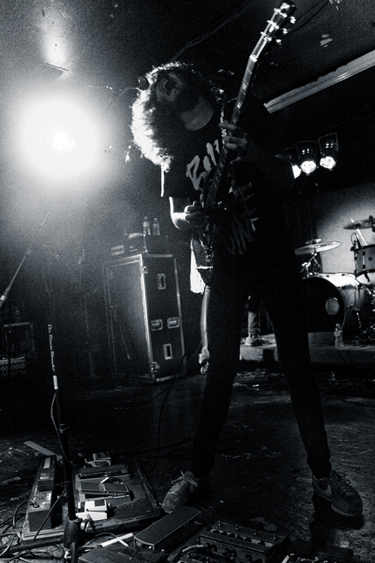
Mike Farrell, Lite Brite
Old Ironsides “¢ Wednesday, Nov. 25, 2009
Words by Adam Aaake “¢ Photos by April Fredrikson
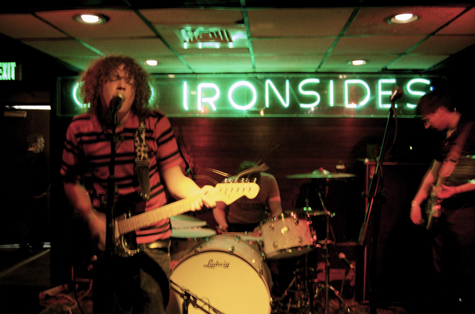
In our last issue, no. 47, local musician and show promoter Ira Skinner said that “Sacramento’s music scene is probably in the worst condition that I’ve seen it in my life.” Sadly, I’ll have to agree with that. But in the season of giving thanks and on the eve of our nation’s holiday, I was thankful for the bands that are continuing to kick ass year after year, night after night.
A crowd of over a hundred gathered inside the warm walls of a familiar Sacramento venue that happens to be celebrating its 75th year of operation—Old Ironsides. Jerry Perry, another icon of our local scene and the man responsible for the majority of the booking at Old Ironsides for the past who knows how many years, has put together an all-star series of shows featuring the best acts our city has to offer. Last Wednesday’s bill began with a block party set from the always entertaining Lite Brite. Imagine Buzz Osborne with a voice like Howlin’ Pelle Almqvist, a drummer from the school of Tom Bonham and a bass player with a warm and fuzzy Rickenbacker; throw in a solid lead guitar player and you’re close to their sound. Their opening song, “Space Shuttle” lifted the crowd from their seats and had them orbiting around the stage like well lubricated satellites. Singer Eddie Underwood was belting lyrics through his thick, dirty-blond hair that sprawled across the front of his face, flailing his arm to the ceiling and arching his body forward as a he played an arpeggiated guitar riff with his free hand. An exhibitionist? Maybe. Pretty bad ass? Definitely.
Their fourth song in was ghostly reminiscent of Far circa Tin Cans With Strings to You. What added to this poltergeist was Far bass player Johnny Guttenberg looking on from the side of the stage. Later he would play with Jackpot, who was also on the bill that night, so I guess it wasn’t too strange. It’s great to hear and see the influence that a great Sacramento band like Far continues to have on the current scene.
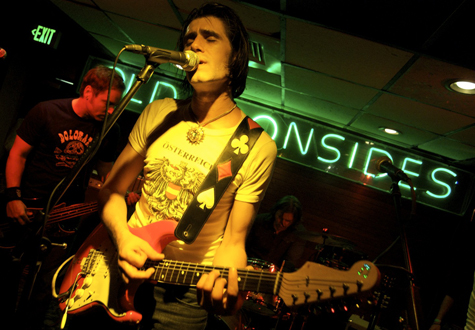
A skinny-framed man with a tight fitting white T-shirt and a thick head of greasy brown hair that was slicked back over his head approached the stage. He slowly picked up his guitar and slid it over his shoulder in a routine manner, adjusting the leather strap that was decorated with the suits of a deck of cards. A dense crowd was surrounding the stage at this point and it was clear that they were here to see the next act. His name was Mike Farrell and he needed no introduction. The second his guitar was strummed and the set began, the experience and tenacity of Sacramento’s guitar legend proved true once again. This time with his own band, Farrell played a set of grimy rock ‘n’ roll tunes that were layered with keys and violin from the talented multi-instrumentalist Liani Moore. Veteran drummer Mike Curry did his thing on the skins while keeping the back end pocket with bass player Shawn Hali.
This performance was all about Farrell, though. When he solos you listen; touching every part of the guitar and producing sounds from his instrument that seem otherworldly. He raised his hand over the guitar as it hummed, controlling it like a shaman—he owns its soul. His mouth pursed, and he stepped to the microphone and muttered his lyrics, more concerned with the noise of his chord that continued to linger.
His music is a rare fixture of the scene that we as the local fans have the pleasure of seeing, and that, my friends, is what I am thankful for. I am thankful for the huge crowd that gathered on a brisk Wednesday to support a bill of favorites and a venue that has housed the sounds of thousands of bands over the course of its live music lineage.
Tonight, Ira would be proud.
Friendly Fires start a burning groove with Samba and”¦R&B?
Friendly Fires are tapping into an energy that has turned entire cities into dance floors. The samba rhythms of Brazil have long been important to music culture, most notably having a monumental influence on jazz. But the boys from St. Albans, United Kingdom, aren’t hangin’ with the “Girl from Ipanema.” Friendly Fires have borrowed from this rich genre of music and have crafted a sound that is at first pop music with an electro edge but when explored exhibits complex polyrhythms and well thought out lyricism. A song like their new single “Kiss of Life” is a prime example of their efforts in full swing.
“On ‘Kiss of Life’ we based it around that kind of rhythm and a couple of samples,” says drummer Jack Savidge. “We got the feedback guitar and the samba group in to play with us. We kind of pushed it.”
The Mercury Prize nominated band released a few singles independently, including their hit “Paris” before they were signed to XL Recordings in 2008. Since becoming label mates with bands like Radiohead and The White Stripes, the pace has picked up a bit and a full-length, self-titled debut featuring the critically acclaimed “Jump in the Pool” and “Skeleton Boy” followed shortly. With all the sudden attention, other nominations for various awards started to come their way, which the band took with a grain of salt after the significant but not devastating loss of the coveted Mercury Prize.
“It genuinely doesn’t really mean that much,” explains Savidge. “I mean, if we’d won the Mercury Prize it would be a big thing for us. A lot of the others, it genuinely isn’t a big thing.”
Currently on tour with the painfully hip The xx, Friendly Fires will be crossing the Atlantic to finish off an extensive tour here in the States. The last time they were here was 2008, supporting Lykke Li and only coming as close as The Independent in San Francisco. This time around, they’re the main attraction.
“I think it will be good. It’s our first proper headline tour in the United States,” says Savidge.
You can catch them live at Sacramento State on Nov. 24 inside the University Ballroom, where dancing will no doubt ensue. Submerge caught up with drummer Jack Savidge as the band was preparing to play a show they helped organize called The Warehouse Project in Manchester.
You guys are almost at a point where you think it’s not going to happen for you, you start off recording songs in a garage, you make limited edition pressings of your music and then all of a sudden you’re on tour with Crystal Castles and then Interpol and after that signed to XL and are now label mates with Radiohead! Has the past couple years been a little overwhelming?
When we were recording the songs in the garage, there was never any fearing that, oh no things aren’t going well. Because as a band starting out, it’s always amazing to have a record of your music. That’s always been amazing for us. So, it wasn’t really like, “Oh no,” we’re just doing this thing and then all of a sudden it was a whirlwind. It seems to have grown kind of gradually. It’s kept on growing and growing and we’ve been touring pretty much relentlessly for the last couple of years. So I guess now we’re seeing the fruits of that. It’s always strange as a music fan, going into HMV and seeing your CD there and to read magazines that you’ve read since you were a teenager and read about yourself. Or seeing a TV program that you videoed as a teenager religiously and then you’re on them. It’s weird. We’re all sort of music obsessive, nerdy types. You can get really blasé about it because it just becomes another thing in the day that you’re going to do. Say, playing a big show or playing a festival. You do kind of get a sense of, look how far we’ve come. We’re doing these things that I dreamed of doing.
I watched your hi-tech Flip behind the scenes footage on the Web site, and it looks like the three of you genuinely get along really well. Is the songwriting process as agreeable?
Yeah, generally. There’s the occasional disagreement, but I think there have been a couple things that have been slight sticking points. Obviously it’s not all white and rosy. But it’s quite easy to, if there is a disagreement, it’s quite easy to just have a deep breath and then get on with it. The mood never gets too dark, even though there are differences of opinion. That’s important for a working relationship. Everyone has their opinions, but I suppose we spend so much time together that it’s either get on well with each other or just have a horrible time all the time. I think we’d rather just get along well with each other.
There’s a lot of emphasis on percussion in your songs. The new single “Kiss of Life” is a Brazilian rhythm, which I know is big inspiration for you guys. What is the layering process like? Do you have a percussive groove that leads the idea or do all the bells and whistles come later?
I’d say, usually beforehand. We generally work on songs from the bottom up. We get something that sounds—some kind of drums and bass groove that sounds good. You know, the mapping out of it all. What might be the verse, what might be the chorus. We tend to add a lot from there. Because of how we write, which is generally ideas go straight into the computer and then we can layer things up like that, rather than if we were working everything out in the mode of a live band. But we’d only be able to imagine half as many songs as there are hands able to play them at one time. As we work on the computer there’s a lot of room to put down loads of percussion and make something sound like a really big rhythm section before vocals get even thought about. We try to do as much to an instrumental track as we can and then usually it leads the way to adding vocals on top. I think it’s kind of helpful to him [Ed MacFarlane, vocalist] to have a vibe there and the percussion definitely helps that. It’s always an atmosphere thing—the percussion. You can get the impression of a lot of energy by building up those layers. That informs the rest of the song.
What is it about the Brazilian samba that interests you so much?
It’s just really exciting sounding music, because it’s so percussive and so intricate. It’s always going to sound really exciting. I think there’s a theme to that. It almost found us by accident, because look at “Jump in the Pool”: almost by accident that had a slight kind of a samba feel. Although that was never what we were actually aiming for, it just ended up like that. I guess it found us. Actually the stuff we’ve been doing recently, there hasn’t been an awful lot of songs that sound very Samba or anything.
What’s the new stuff starting to sound like?
It’s pretty varied, actually. We always want it to be varied. There’s one song that sounds a bit like R. Kelly or something.
Like “Trapped in the Closet?”
No [laughs]. More like “Vibe”-era R. Kelly; like Dangerous-era Michael Jackson. The sort of”¦ Is it new jack swing? I guess it’s new jack swing.
That ’90s R&B sound?
Yeah, yeah. But a bit more upbeat. I guess the ’90s were on Timbaland and stuff, who pushed it a bit more sparse and a bit slower and a bit weirder. But yeah, I think we’re vibing off the early ’90s stuff. There’s some quite groovy ones using a lot of”¦vaguely afro-y. But I don’t want to say that because everyone will think we’re going all Vampire Weekend or something. Actually, we’ve got three ballads on the go. We’ve never really had a very slow—I guess “Strobe” is quite slow; we’ve never really had very slow, lighters in the air songs. So maybe there’ll be a few of those on the next album.
I think what sets you guys apart from similar bands is the content in the lyrics. They’re not these hollow songs with a catchy hook. They have the hook but there’s an emotional edge to each song. Are the lyrics strictly Ed MacFarlane’s or does everybody contribute to the lyrical content?
Ed generally does all the lyrics. But we’ve done a couple of things all together like “On Board” we wrote together. Bits of “Jump in the Pool,” the chorus was a group effort. But Ed generally does it. I think it’s fair enough, because he’s the one who sings it night after night. He may as well believe in it.
It seems as though all these awards have overshadowed you guys, particularly your loss of the Mercury Prize. You joke on your Web site about not losing much sleep over these things, but it has to mean something to you to be nominated. Does it matter really? Or are you already jaded by awards?
I think genuinely, not in a kind of snotty way, but we’re generally not that bothered really. The first few times you’re nominated for an award, it’s really exciting. You get to dress up in some smart clothes and then go and have dinner and spot loads of famous people. Get really drunk on the wine that endlessly turns up at your table. After you’ve done it, you’ve kind of done it. I think for us the Mercury Prize was pretty special, because it’s one of those things that you grow up hearing about and you’re interested in. I remember when I was a teenager there being all this hype about it and who’s going to win; who your money is on. It’s a big talking point. About the others—it’s really nice to be nominated.
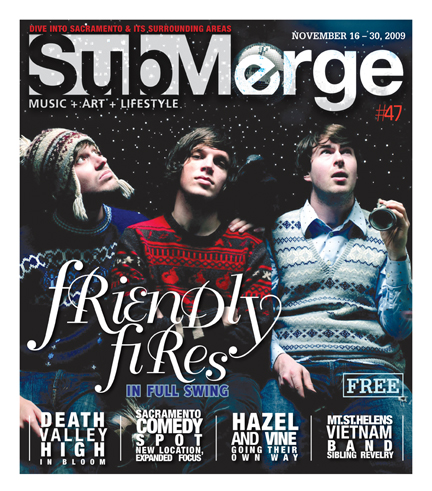
Friendly Fires will played alongside The xx at the University Union Ballroom on the campus of Sacramento State on Nov. 24, 2009.
Mt. St. Helens Vietnam Band has the heart of a teen, literally.
“We didn’t necessarily know what we were getting ourselves into,” explained Benjamin Verdoes, co-founder and lead singer of Seattle, Wash.-based Mt. St. Helens Vietnam Band. He talked over the group’s timeline as he waited patiently for wife and band mate Traci Eggleston to pick him up so they could head to the studio; there, they’d work out percussion kinks for the newest record. This has been Verdoes’ daily schedule as of late: work, then studio.
At this point, all the ideas have been born. The songs have all been written in full and are in the Mt. St. Helens repertoire. Verdoes has been anxious to get them recorded. Now they’re laying out a lot of basics, getting the skeleton of the album built so it can be out by early 2010. They’re progressing, but what’s left is “a lot of little details to fill in,” Benjamin said.
They might sound like old pros at this, but this is an incredibly young group. In fact, that’s essentially what Mt. St. Helens is known for: their youth, belonging in particular to their 14-year-old drummer (and Benjamin’s adopted younger brother), Marshall Verdoes.
“He kind of blows people’s minds every time they see him,” Benjamin said. “He doesn’t even necessarily look 14, and when people find out how old he is they’re genuinely awestruck.”
Mt. St. Helens actually started as just an idea between the Verdoes brothers. When Marshall was young (or younger”¦), Benjamin would bring him along to all the shows he attended, and Marshall would incessantly try to convince Benjamin that they should start a band together. Benjamin slowly started teaching him some tricks on percussion, and was impressed by Marshall’s quick knack for drums.
Benjamin had been involved in other various bands, but after watching his younger brother progress so fast and accurately on drums, he decided to experiment. The two began a project, roughly four years back, as a pair sparking fire for the first time.
“In some kind of form, in some rough primordial state, it was just us playing riffs,” Benjamin said.
It wasn’t until fall 2007 when the lineup became a quintet, including Matthew Dammer, Jared Price and Eggleston.
From the start, there was a lot of quick buzz surrounding the group’s odd approach to hyping their new creation. They made a Myspace page, but didn’t actually post any samples of their music, opting instead for comical blips and parodies that did not relate to their music whatsoever.
“We kind of, through this series of accidents, came up with this thing where we didn’t post music,” Benjamin explained.
The brothers hadn’t landed on a solid demo yet and were in transition from a two-piece into a larger group. Even if they were posting purely to stall for time as the group took form, it worked. Mt. St. Helens gained a ton of interest; enough that at their first show, there were hundreds of awaiting bodies.
“It was an interesting reaction that we got, so we definitely played into it,” Benjamin said.
Things continued to go well, enough so that Mt. St. Helens went from something of a fling to a full-fledged affair. Comparisons in sound were made with bands such as Wolf Parade and Modest Mouse, thanks in part to the driven scratch of Mt. St. Helens’ urgent guitar chords, swelled by slaps of cymbal and other smack percussive movements, exemplified prominently on songs such as “Albatross, Albatross, Albatross.” Impressive, catchy licks with Benjamin’s lightly fuzzed-yet-piercing vocals are displayed nicely on “Anchors Dropped.”
Mt. St. Helens spent the last year touring across country and playing from their self-titled album (which came out in mid-March), which consists of a lot of Benjamin’s older material, mostly songs quilted together with years of pieced ideas. They’ve also been debuting selections from their upcoming release.
Whenever they can find spare moments, be it on a long stretch of freeway in the van, or at pit stops or cafés, Benjamin and Eggleston take turns helping Marshall with his schoolwork. This wasn’t a choice based purely on touring. A few years back, Marshall realized it was much easier for him to get schooling done on his own, away from the traditional school scenario. Benjamin was already helping Marshall with his schoolwork, but volunteered to take on the role of teacher as well. Even off the road, Benjamin and wife Eggleston take turns helping Marshall with school while the other works a part-time job.
Between the commitment to the band, the family tie and the schooling, the Verdoes brothers are virtually inseparable. Luckily, they have a tight bond.
“I spend almost every waking hour with him it seems like, for the last four years,” Benjamin laughed.
For most kids, the kinds of distractions presented by being a traveling musician and still getting school work done would be too much; but the environment has worked well for Marshall, Benjamin said.
As far as the live shows themselves, it’s still a real treat for audiences to see a youth so precise and talented on drums.
“We work really hard on it, but he definitely has a real gift for it. It’s really cool to watch,” Bejamin said in praise of his younger sibling.
Benjamin still finds himself having to pull his brother’s I.D. out for proof of that he’s underage.
“People—they’ll argue with me, they’ll be like, ‘He’s not 14,'” he said.
For the time being, they’ll be touring through the West Coast and finishing up in the studio, still somewhat curious of their own next step.
“It’ll be definitely interesting how this next record comes out in the spring,” Benjamin said. “How we transition into this real, band, I guess.”
Dan Deacon
Luigi’s Fungarden, Sacramento, California
Monday, Oct. 19, 2009
Words by Vincent Girimonte
Photos by Samantha Saturday
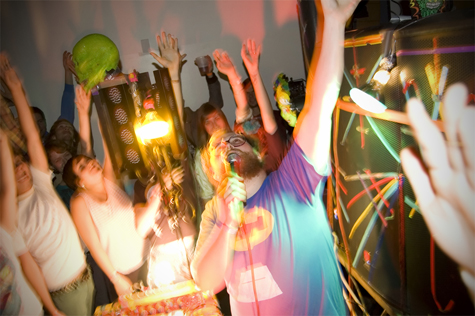
Dan Deacon’s set at Luigi’s Fungarden on Oct. 19 reminded me of that saying, “Angels can fly because they take themselves lightly.” Manifesting this was a state worker boogying next to some teenage princess probably 20 years his junior; and Deacon himself, pleading with us to imagine a “sky of hair” above the dance floor. Suffice to say nobody was caring.
The Baltimore-bred electronic artist owns one of the more egalitarian live spectacles you’ll come across, and it’s anything but gimmicky, despite the merch peddler performing interpretative dance (which was a little gimmicky). Dancing around isn’t compulsory, just highly encouraged. If that’s not enough to get you moving, peer pressure eventually kicks in to where anybody not sweating through his or her shirt may as well be the chaperone. The result was a Fungarden smelling “like a farm,” as one hooligan put it.
Deacon set up on the floor, caved in with lights, amps and a throng of impatient youths savagely bouncing around near his board, which looks like it was made on Sesame Street. This preferred dynamic may be his referendum on the typical live performance hierarchy (the artist being up there, and everybody else down here, having all the fun); or, perhaps being among his crowd he can more easily organize dance-offs and the ubiquitous “human tunnel”—each making an appearance at Luigi’s. There’s an element of wedding MC in Deacon’s shtick, the one that comes free with the venue and wants everyone to be happy while waiting for the buffet. Sometimes you need that guy.
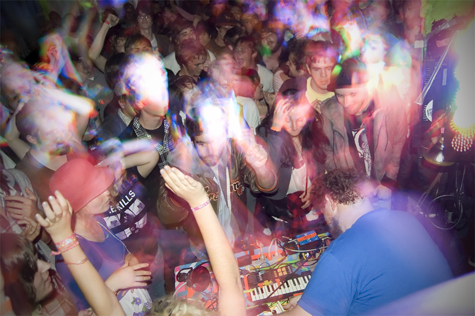
I would hesitate to call Bromst, Deacon’s second full-length release and the primary source material for Monday’s set, “experimental” if he himself didn’t sometimes classify it as such. Admittedly, this is probably out of my own misinterpretation of the word “experimental,” as in you can’t shake your ass to it. Live, the tone is surging and rich, bringing to mind that “noise in tune” adage—but this is also pop music, implying some accessibility. Deacon plants playful, trippy melodies on the grinding rhythms and manic live-drum samples, and from there it just goes up and up at a breakneck tempo. It’s the music of frolicking optimists, and resonated well within the snug confines of the Fungarden.
He grabbed the mic every now and then for some cathartic chanting—not that he can sing, really, but nobody seemed to mind. By the end of the show he was Uncle Dan, commiserating with the Sacramento audience as a Baltimorean knowing what it’s like to live in a city consistently ignored by the hotshot indie tours. Though if this reputation is what brought Deacon here in the first place, it is one we can surely live with for a little while longer, at least until Uncle Dan returns.
Alison Sudol leads A Fine Frenzy quietly into the spotlight
Alison Sudol’s soft voice creaked from the ear of my phone, sounding positively under the weather.
“I got really, really sick,” says Sudol with a cough after I ask her how the nationwide tour she’s on has been going.
“A really weird cold knocked me out and I had to cancel a show, which is rough. But I’m better at least. Besides that, everything is great,” Sudol says optimistically.
She called from a hotel room in Hoboken, N.J., which is right outside of New York City, where the next evening Sudol and her four-piece band would be performing songs from their new album, Bomb in a Birdcage, the followup to their 2007 breakthrough album, One Cell in a Sea. Sudol is the voice behind the Los Angeles-based indie-folk outfit A Fine Frenzy. With a recent spot on The Late Late Show with Craig Ferguson and a video for the single “Blow Away” that made it to the top 20 countdown on VH1 along with rotation on MTVU, Sudol shows no signs of a sophomore slump. While writing Bomb in a Birdcage, she and the rest of the musicians let things happen naturally just as they had with their previous record. There was no calculated process; no planning of the next move.
“I don’t really know what’s going to happen next. I just know that every little step of the journey leads to a final product,” says Sudol.
A Fine Frenzy’s journey is a bit of a fairy tale. A Virgin Records executive came to her house, sat on her couch and listened to a showcase by Sudol and her band. A few weeks later they were working together. Not exactly the grueling path that most musicians take to get a record deal, but sometimes if you’re just that good, then it’s just that easy. At the age of 24, Sudol has already established herself as a remarkable singer/songwriter with the piano chops to match. Her playing is the perfect accompaniment to her soft voice that sounds marvelous in every part of her range, from the quiet whispers to her robust hooks that climb along the scales. Musically, she’s wise beyond her years and has probably taken a tip or two from artists like Rufus Wainwright and Brandi Carlile, with whom she’s already toured. Her songs are poignant and emotionally charged. Bloggers and critics use words like “whimsical” and “pixie” to describe Sudol, but she’s no Tinkerbell. On Bomb in a Birdcage, she and her band wanted to let their hair down a bit and show that they also have a raucous side. Even on tour, their sound continues to evolve with the addition of electric guitar, an instrument that has sparked a new fascination for Sudol.
“I played it yesterday for the first time,” she says with a hint of glee in her voice. “I didn’t want to put it down. It created a monster and now I’m obsessed. In a quiet way.”
Bomb in a Birdcage, which is still fresh in new release displays at record stores around the country, will quickly be accompanied by an even newer release of the seasonal variety. A Fine Frenzy will release Oh Blue Christmas on Nov. 3. This six-song EP will be available at Target and will feature songs from Charlie Brown’s Christmas as well as three originals that were written and rehearsed inside the Sudol’s house this past summer.
“We were writing at night and I would put the fire on and stuff. It wasn’t very summery,” says Sudol about the mood required to write Christmas songs in the summertime. “There was so much energy and because we were playing it all at once and the way it was going down, it felt like Christmas.”
Christmas comes early this year when A Fine Frenzy makes a stop here in Sacramento at The Boardwalk on Nov. 13. In the meantime, throw another log on the fire and snuggle up to A Fine Frenzy.
You just released your sophomore album Bomb in a Birdcage that’s been doing quite well. Did you ever imagine or was it ever a concern that your next album would equal if not surpass the first?
I think that as an artist and as a person, whatever you do at that moment you want it to be better than what you did before. You want to have learned from the whole process and you want to take all that knowledge and the growth that you’ve made”¦and make something better. It was different in a sense that I made the first one [One Cell in a Sea] essentially in a vacuum. The idea that people were going to hear it was a foreign concept. This time, knowing that people would hear it—people who had bought the first album—there was a likely chance that they would buy the second one just to check it out, even. Just knowing that there was a built-in audience and ears on it before it was even out.
But did you have the mentality that you had to gain the respect of new fans while still maintaining the respect of the old ones?
Oh, well of course! I mean you’ve got to put out something good. You can’t think too much on it and worry too much; it’s counterproductive. Because once you start getting into the realm of trying to please people—I don’t actually know what pleases people except for being honest in music and trying to make stuff that I like to hear. That’s really the only gauge that I can trust at the end of the day. I mean, you never know if people are going to respond to that or not. Hopefully, as long as one is putting out something that one believes in with a wholehearted effort you can’t really go wrong there, because at least you know at the end of the day that you did your best.
You’ve said yourself that you’ve stretched your wings quite a bit more on this record in terms of what you can do sonically. Looking back, do you think you stretched enough? Too much? Do you see your songwriting getting louder and more electric seeing as how you’ve already proven you can woo the crowd with the more tender songs?
Actually, no. I never know which way I’m going to go until it starts going there, you know? I actually want to be more folk-y in my next endeavor, and quieter again. For me, it’s sort of more like a pendulum. I’m really quiet for long enough, and then I want to be really loud. Then I’m really loud and I want to be quiet.
Was it difficult to get into the right mind frame of writing and recording Christmas songs when it was the dead of summer?
You know, you’d think so. There was no doubt about what season it was. It was summer. It was hot. My house has the ability to feel quite Christmas-y year round. I live in like a seven dwarfs cottage, pretty much.
You made an effort to set the mood?
Yeah, I mean it wasn’t really an effort for that particular thing. That’s just how I like to be.I’m sort of a Christmas-year-round kind of a girl. Once I started getting into writing Christmas songs, they just fit into each other. I wouldn’t say it’s easy, because it’s definitely hard to write a Christmas song that doesn’t turn into total cheeseville.
I feel like opinions on Christmas songs are quite polarized. Either people want to gag when they hear them or they become tremendously sentimental and can’t wait until December to play them. I think the Charlie Brown Christmas album is something we can all agree on; was that a conscious decision? Choosing those songs?
The three songs that I chose for this—that we chose, because we really discussed it a lot as a band—were “Blue Christmas,” “Winter Wonderland” and the Charlie Brown Christmas song [“Christmas Time is Here”]. Each of them didn’t feel like the typical Christmas song and yet really personified Christmas for all of us in their own way. The Charlie Brown Christmas song, the hardest thing on that really was that it was done perfectly. Perfect. So we were like, “Wait. How are we going to do this without messing it up? It’s kind of hard not to go downhill from there.” But our version is quite different. The whole album is very much its own thing. Somehow, I don’t know how it happened, but somehow “Blue Christmas” sounds cheerful and “Winter Wonderland” sounds creepy. We just tried to put our own spin on it and bring out something different in the songs and tried not to make them gag-worthy. In the other songs, we do use some Christmas tricks, and there are definitely sleigh bells on here, but we tried not to use the typical Christmas shtick unless we did it 100 percent and did it knowingly.
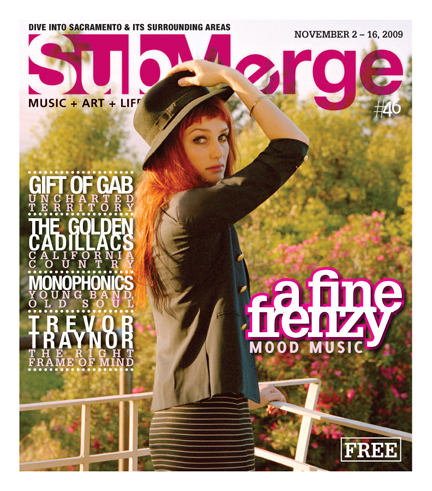
A Fine Frenzy will performed at The Boardwalk on Nov. 13. Oh Blue Christmas will be available exclusively at Target on Nov. 3.
Thursday, The Fall of Troy, The Dear Hunter
Boardwalk “¢ Thursday, Oct. 8, 2009
Words & Photos Russ Wonsley
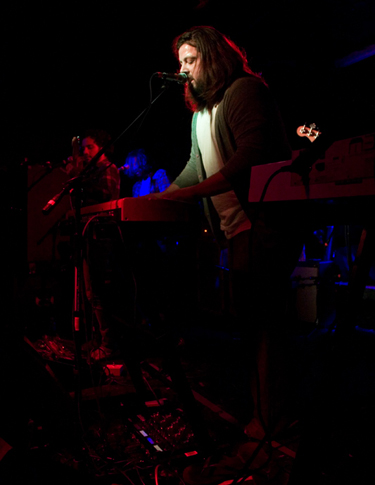
Looking at the lineup for last Thursday night’s show at Boardwalk, I wasn’t sure what to expect. I had heard of The Dear Hunter from close friends but had never taken the time to listen to them. With such a buzz surrounding them, I was interested to have the opportunity to see them live. When The Dear Hunter had finally finished setting up their equipment, I saw that I was in for a unique performance. Three keyboards littered the stage with dozens of effect pedals covering the floor around them. A tall, bearded man took the main microphone; and from the first note he sang, I knew that this band had a buzz for a reason. There was one point when all the members of The Dear Hunter were harmonizing with each other on stage. It was refreshing to hear vocals done without the aid of a tuning program.
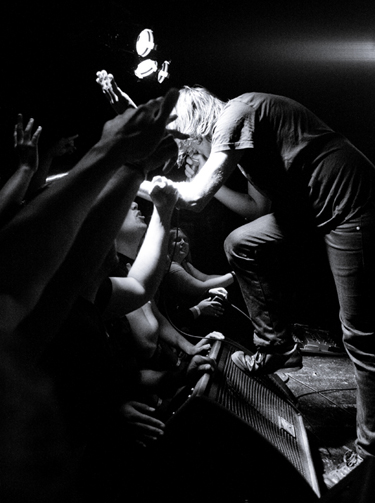
Up next was The Fall of Troy, and their performance was everything I expected it to be. Thomas Erak (lead vocals, guitar) burst onstage with high energy and fast guitar riffs. He jumped up and down the stage and pulled the whole venue into the performance. It was thrilling to see a musician keep riffing while fully engulfed in a crowd of screaming fans. The set list ranged from familiar favorites to songs that had just been released on their newest album, In the Unlikely Event, on Equal Vision Records.
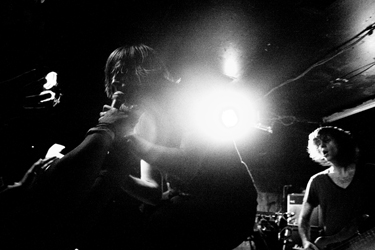
Then, the New Jersey post-hardcore group Thursday finished off the show with a solid performance. They started off their set with solid songs such as “Division Street” and “For the Workforce, Drowning,” and the crowd echoed Geoff Rickly’s (lead vocals) every word. It was apparent that Thursday still has a strangle hold on post-hardcore fans, even after being involved in the scene since 1997. With complimenting reviews backing up their newly released album Common Existence from Epitaph Records, it looks like we can expect Thursday to keep a strong grasp on the genre for many years to come.
Our Hometown Disaster delivers the goods on full-length debut
Local punk outfit Our Hometown Disaster wants you to know that they aren’t fucking around on their full-length debut, The Good Life, out Oct. 10, 2009. “We’re not pussies, we’re not fakes, we’re real guys with real experiences and that comes out in the music we write,” vocalist Brad Edison recently told Submerge. “We put heart into writing our music; we have well thought out and provocative lyrics that actually mean something to us. We are proud of our music; we couldn’t respect ourselves if we weren’t.”
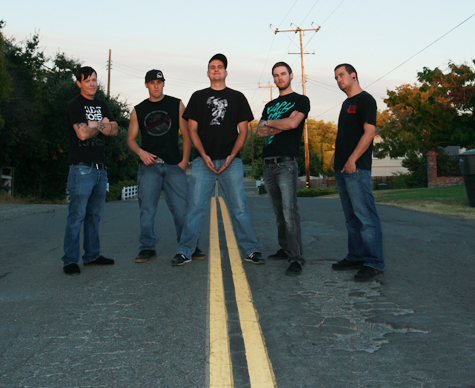
While somewhat new to the scene with this line-up, all of Our Hometown Disaster’s members, including Ted Rauenhorst (guitar, backing vocals), Clint Cargill (guitar, backing vocals), Jeremy Roberts (drums), Brian Lee (bass, backing vocals) and Edison (vocals), have been in well-established Sacramento bands over the years. The note-worthy list of past groups includes Losing All Pride, Drowning Adam, A Borrowed Life, The Revelry, Five Victims Four Graves, Hoods and Vomit. With a résumé like that, you’d expect Our Hometown Disaster to hit the ground running. And they have. They’ve got a new full-length record, The Good Life, set to be released on Oct. 10 at the Boardwalk, a tight sound and big plans for the future.
Submerge recently caught up with some of the guys to cover the basics.
How did Our Hometown Disaster form?
Ted Rauenhorst: It all started with Clint and I around July ’08. We both missed playing punk rock and decided to get together and start a side project just for shits. We started writing and really enjoyed it and started looking for members about a month later. Long story short, we found some kick ass dudes that we really meshed well with and really got going on it. All of our other bands were not doing too well and all pretty much fell apart at the same time. We liked what we started doing a lot and decided to take the band seriously. We played our first show with Authority Zero in February ’09 and knew right then we really wanted to do this band full-time, and here we are.
I got a good laugh out of your Myspace page where it says, “Their goal is to prove that Sacramento’s punk roots are still firmly planted in a land where pussy emo and cock rock are running rampant!” Can you elaborate on that?
Brad Edison: The fact is there is a massive abundance of shitty music. Brian and I were talking a while ago about the fact that we still listen to the same CDs we bought when we were kids. Only every once in a while can we welcome a new CD to the list of quality music.
How does the songwriting process work in OHD? Is there one main songwriter, or is it collaborative?
TR: It’s pretty collaborative. Clint, Brian or myself will come up with a riff or even a full song, and we all get together and throw ideas around. Brad and Brian write the lyrics for the most part. We all like to give input in everything we do.
BE: For lyrics, usually Brian and I take an idea from an experience in our life or one of the other guys and just build on that while listening to the riff over and over and over. Sometimes it’s fairly quick and sometimes it takes a while and a lot of different settings. Some of my favorite lines have come to me while I’m driving or in the middle of the night. And sometimes there are parts that get changed even after all that because I won’t sing something that doesn’t convey the message I want the way I want to convey it.
What does a typical OHD practice look like?
Brian Lee: We all show up late and pissed off from work. We make fun of each other the whole time and run through the set and then work on something new. We got the next two albums written already, but we’re still working on our set because this OHD thing is so new to us all being from metal, punk, rock and hardcore bands. The next shit is amazing.
The Good Life sounds great! When and where was it recorded?
TR: We recorded it a few months back at Pus Cavern.
Nice. How was it working with Joe Johnston?
BL: He doesn’t let shit slide and really pushed us to do the best we could. It was awesome and we are stoked!
BE: Definitely. Joe is a great guy, smart and easy to work with. He knows what he’s doing. The proof is in the pudding; the CD sounds amazing.
What’s the plan for releasing The Good Life? Any label interest? Do you even care about record labels anymore? Or are you going the DIY route?
BL: Labels are what they are. We are old school “work hard for what you want” kind of guys. Smaller labels are cool, because they have the same goal as we do: play hard.
TR: We are just going to put it out ourselves for now. We are talking with a few labels and are looking for someone to put it out. We want to be patient and wait for the right label to come along. We don’t want to jump on the first offer and get screwed. Some of us have had that happen and don’t want to have it happen again.
Any touring plans?
BL: We got some shit going on.
TR: We are planning on going out a lot early next year. We have so much we want to do. It’s hard to say right now where we are going to be going.
I’m sure most of you have done the DIY tour thing before. Do you think touring is important in an age where bands break overnight via the Internet?
BL: The Internet is rad; you can see bands or boobs or whatever you want. Emo pop kids love to be sad and take pictures of themselves all day and will find bands that will do the same. We want to appeal to the skaters and motocross kids that are out and about that actually have CDs rolling around their trucks and loan out to their friends. It’s a totally different crowd. Go out and live fast. How rad can you get staying in your room listening to some losers that dress up for the Internet?
If they say the music industry is in a bit of a bind, Coldplay wouldn’t know the first thing about it. The London-based alternative rock quartet has sold tens of millions of records worldwide and consistently draws enormous crowds wherever they perform. This night was no different; Sacramento and its surrounding areas had shown up in full force. As the blistering sun descended behind Sleeptrain Amphitheatre, a sea of Coldplay fans geared up for a performance they will not soon forget.
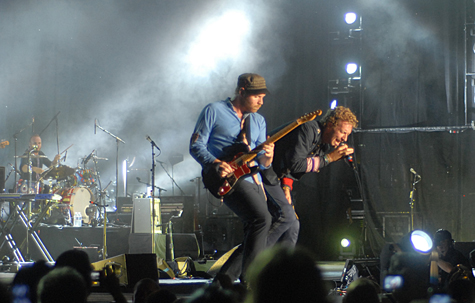
The smell of beer and “other substances” filled the packed amphitheatre. As segue music halted and the lights dimmed, it was finally show time. A couple flame twirlers briefly occupied the stage, mesmerizing the crowd as the band members took their positions behind a giant see-through curtain. Without any sort of introduction, they immediately went into the song “Life in Technicolor,” the first track off of 2008’s Viva La Vida. It’s mostly an instrumental track (it features a couple whoas from all four band members) and served as a great warm-up for the crowd. Fans swayed back and forth to the up-tempo beat as they watched Chris Martin, Coldplay’s bouncy frontman, dance around the stage. The second song, “Violet Hill,” really got the crowd into it. As the mass of fans sang back every word, it was hard not to get the goose bumps. You have a good voice, Sacramento! Martin did a fantastic job making the crowd feel appreciated by changing up the final line of the song that originally goes, “If you love me, won’t you let me know,” to, “If you love me, won’t you take me to Sacramento.“ Clever little bug.
For the next 30 minutes or so the band proceeded to bombard fans with hit song after hit song, including “Yellow,” off their 2000 debut Parachutes, in which dozens of giant yellow balloons were unleashed throughout the crowd. It was quite a sight to see, adding immensely to the awesome light show and videos projecting behind the stage. At the end of the song, Martin popped a couple of the confetti-filled balloons with the sharp, cut-off strings on the head of his guitar, coaxing laughs out of the crowd. The next highlight was when the band completely left the stage and ran into the audience, where there was a miniature stage set up in the upper lawn section, turning the nose bleed seats into the front row. Blankets and chairs were trampled as crazed fans rushed the mini-stage to get closer to the band. They played a few tunes, all acoustic, including a cover of the late Michael Jackson’s “Billy Jean.” Although I will admit I knew the cover song was coming (someone on my Twitter feed spilled the beans the night before when Coldplay performed at Shoreline Amphitheatre—Twitter needs a spoiler alert), it was still a pleasant surprise and Martin sang the difficult melodies quite well.
After the band proceeded back down to the main stage, they played a few more tunes. Then came the obligatory leaving of the stage only to get cheered back on for an encore. After the entire crowd chanted, “Coldplay, Coldplay!” for a few minutes, the band came back out and Martin announced they had just two more songs left. The first of the two was “The Scientist,” the second single off their 2002 album, A Rush of Blood to the Head, and it again enticed the crowd to sing back every word. The final song of the night, “Life in Technicolor II,” is a different version of the set opener (it includes lyrics). It was a great way to bring everything full circle and wrap up an amazing show. Just before exiting the stage for good, Martin explained that they would be giving away CDs for “zero dollars and zero cents,” and thanked fans for “giving us our jobs.” It’s good to know they’re grateful. Everyone walked away satisfied and eager to pop their free CDs into their car stereos.
Middle Class Rut
Cesar Chavez Park – Friday, June 19, 2009
Last Friday’s Concert in the Park Series at Cesar Chavez saw the triumphant return of Middle Class Rut, another long-awaited addition to the short list of bands that have found mainstream success beyond our county lines. This success is partly due to the overwhelming response to their 2008 single, “New Low,” that was played almost nonstop on the now-defunct KWOD 106.5. The stoner-friendly, alternative radio station was a huge proponent of the band. In fact, one year ago on the same exact stage, KWOD DJ Andy Hawk announced them before they hit the stage to a much smaller crowd.
MC Rut, as they are referred to in short, consists of Zach Lopez on guitar and vocals and Sean Stockham on drums and back up vocals. That’s right, they’re a duo. But before you make up your mind based on all the preconceived notions of what a duo can and can’t do, hear me out. They aren’t the White Stripes and they sure as hell aren’t Hella. The energy that is harnessed by these two is stadium caliber, as was witnessed by a huge crowd at the Rock-am-Ring festival in Germany last June. Cesar Chavez Park isn’t exactly a stadium, but it isn’t The Press Club either, and I’ve seen the boys murder that tiny venue to a crowd of 20 on a Sunday night. The point? They’re a versatile band that owns any crowd, and Friday night was no different.
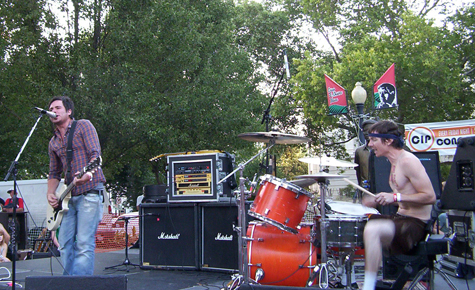
A chant of “MC Rut!” welcomed the two onto the stage; each of them casually settling in to their instruments. Lopez jabbed at his guitar like a child taunting a beehive, the feedback buzzing like angry bees. Stockham adjusted his well-worn orange drum kit and removed his shirt to reveal his “For Sale” tattoo that was inked across his chest in bold red letters. “What’s up, Sacramento?” said Lopez in a classic rock star moment. “How you guys doing?” A loving Sacramento crowd that was clearly there to support their hometown favorite answered back with an eruption of applause.
MC Rut opened their set with “Busy Being Born,” their most recent single that began with one of Stockham’s signature rim tap grooves that Lopez overlaid with slow melodic chords that scraped and dragged while he sang, “The days keep dragging on”¦“ Anticipation mounted until finally the chorus exploded wide open, Stockham punishing his cymbals on each downbeat. A cloud of dust from the stampeding mosh pit was carried toward the stage by a much-welcomed Delta breeze. This would continue for the whole length of their set that would only build in intensity as Lopez and Stockham galloped through song after well practiced song.
During what seemed like the crux of the set, a murder of crows flew overhead to the wafting soundtrack of Lopez’s guitar that melodramatically pulsed in synch with the beating of their wings. “Hold the person you love tight,” Lopez instructed the mesmerized crowd who were eating out of his hand at this point. “I like the way your shirt’s unbuttoned,” Stockham joked with Lopez. Their humor on stage is evidence alone that these two have been friends and bandmates for over a decade now. They seem to be enjoying every moment of their second chance at success after their previous band, Leisure, was signed to and then dropped from Dreamworks.
Before their final song, a white tank top was hucked onto the stage, landing at the feet of Lopez, who remarked that he’d rather they get some bras and panties. And, like clockwork, a black strapless bra made its way to the stage. Stockham was pleased and proceeded to strap the bra on himself with a little help from Lopez, who was all smiles at his bandmate’s cross-dressing showmanship. The familiar metallic percussion that opens “New Low” began, and at that point the whole crowd was in it. They sang every last word of the tune with fists pumping and heads nodding.
Sean Barfly Examines MindX’s Addictive Brew
In 1996, Sean Barfly arranged a jam session at Sacramento’s historic Golden Buddha. He didn’t know then, and seems to this day baffled, that the convergence of musicians would generate what is now a decade-long journey into the fluid annals of MindX. Having schmoozed with some of jam-rock’s most well-to-do performers through various grassroots connections, Barfly soon found himself at the nexus of a thriving chemistry of songwriting, one that boasts an Americana/bluegrass concoction, full of extended compositions and brimming with pop culture parody (“a sick, warped, demented, politically incorrect sense of humor,” hails their bio. And it’s true).
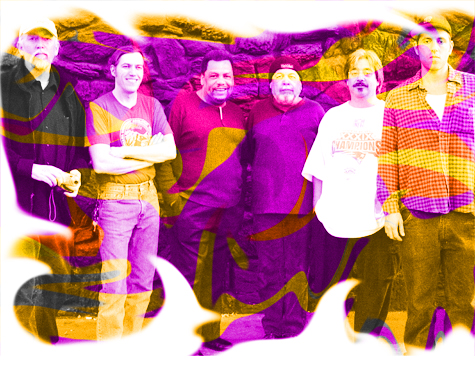
The band has gone through some major changes during the course of its career, with the original quartet disbanding in 2000. It wasn’t until Shawn King and Rick Zamora joined in on percussion and lead guitar respectively that the necessary building blocks were in place for a solid future. In 2003, Peter Philis and Martin Holland joined in and the unit was set. MindX was now ready to saturate the avenues of back porch country, wheat-in-yer-cap bluegrass and flannel-clad Americana for a community perfectly poised for it all.
The long-running jam heroes will be releasing their new album, Jonesers and Tweakers, on June 26. The album features an impressive list of collaborators, including Steve Kimock, Melvin Seals, the late Martin Fierro, Jimmy Pailor, Peter Grant, Tony Passarell and others. Despite a heavy schedule, the band continues to be a staple on the Sacramento Happy Hour circuit, while also readying a comprehensive “party band” tour of bluegrass festivals throughout the summer.
Barfly took time out of his schedule (which may or may not include preparing for a solo gig in Amsterdam this August) to discuss with Submerge the ins and outs of one of Sacramento’s most ballyhooed jam bands, as well as exactly what the hell is the Slapaho Nation. Here we go!
It seems you didn’t set out to do anything more than form a band you could jam with. How does it feel to have now been around for over 10 years and have created a sort of niche within the jam scene?
I really didn’t have a vision of putting “a band” together at the time. I had already played in bands and understood the concept of playing arranged songs, but wanted to really try to let go and see what could be created rhythmically and melodically, and wanted to see what could happen with various textures harmonically. What came out of that was just the opposite. The first six years with Gerry Pineda, David Vandusen and Eric Crownover was the first time I was in a real “band.” Sure, there was some jamming, but our strength was our complexity, arrangements and great chemistry for what we were doing at the time. MindX became a jam band after the original band was no longer playing together and Martin Holland, Peter Philis, Shaun King and Rick Zamora joined the band. As far as how it feels 10 years later, well I guess the best description is trying to reinvent what we do and keep it interesting for the band, as well as our fans.
Explain the Slapaho Nation to the novice of MindX.
Ah, the Slapaho Nation. The whole joke started out with our former bass player Gerry Pineda. He was already a busy working professional when we were fortunate enough to have him play with us, but he was unable to play all the gigs we threw at him. He was in demand for obvious reasons, and we affectionately called him a “ho.” We were booked to play the Trinity Tribal Stomp Music Festival, a festival that is a benefit for various Native American Indian tribes that was held in Trinity County for many years. On the way to the gig in our car, we came up with our own tribe called the Slapaho Tribe, mocking the nickname we had given to our Chief (Gerry Pineda), and it was born. The funny thing is, it has never been a gender thing, and it seems it can be taken out of context and turned into a whole other thing that we find ridiculous if you really know any of us personally.
Has being the only original member left in the band done anything drastic to the direction of the band from a thematic or chemistry standpoint?
Once the original quartet dissolved, MindX became more of the band I originally had conceptualized. We were much more of a jam band, and I think the band members had much more in common musically. The new band was open to far more ideas that I had than the previous lineup, but I think that was more because the band had run its course. The direction of the band at this point was directed by me, which were big shoes to fill as the former group was a total democracy creatively.
It’s difficult to pin down the tongue-in-cheek from the serious moments of your music. How much of it is parody, and how much of it is to be taken seriously?
My philosophy when making a studio record is the jam band thing simply does not work in the studio. My favorite parts of the former band are what works in the studio—complexity and comedy! It’s amazing; we will play a show and throw some complex material at the crowd and you’ll always hear someone scream, “White Trash Town” or “Salty Balls” and we have just finished some complex arrangement I have always dreamed of playing, and they want to hear one of my dumb songs about tweakers. But laughing is the most healing medicine in the world, so that’s cool.
Additional information?
A side story that is very important to the band is that we dedicated this record to the memories of Merl Saunders and our good friend Martin Fierro, but most importantly we dedicated this record to our good friend and brother Erik Klevin. He was one of the greatest musicians/people I’ve ever encountered and we (the music community) miss him every day!