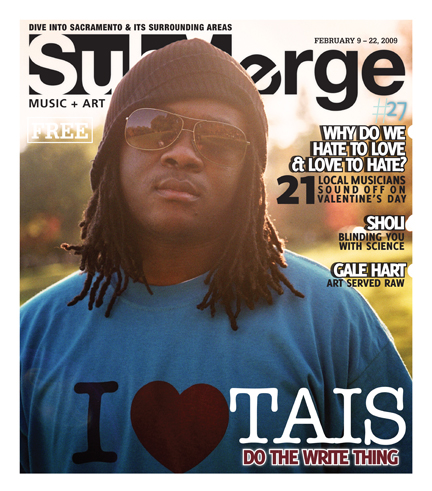
One of my favorite Sacramento MCs, TAIS, is no longer on hiatus. ‘Bout damn time! He’ll play his first official show in what feels like years on Wednesday, Sept. 21 at 12 p.m. at the University Union Serna Plaza on Sacramento State’s campus. If you can’t make that one because you’ve “got a job” or whatever, at least take it as a good sign that TAIS and his live music crew, including drummer (and Submerge food/drink writer) Adam Saake, are creating music together again. Submerge caught TAIS hosting the recent Random Abiladeze album release show at Blue Lamp and the two performed the track “Don’t Be Fooled” off of Random’s new album Indubitably and it was on-point! It was definitely one of the highlights of the night, right up there with the jaw-dropping performance from female MC extraordinaire Ruby Ibarra, who performed at Rock the Bells the following day. Keep an eye out for more TAIS shows and new tunes at Taismusic.com
Tag Archives: Sacramento MC
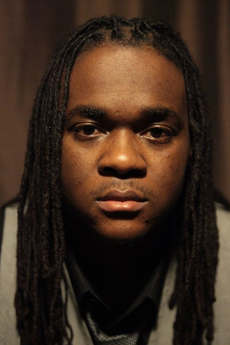
TAIS is no longer on Hiatus (‘Bout damn time)
The Main Event
Chase Moore Steps to the Mic for Cawzlos’s LMNH Records
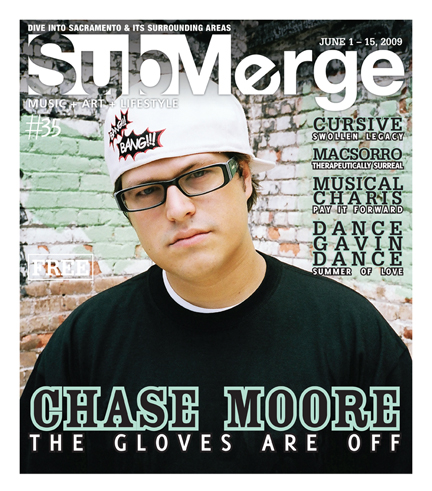
For the true MC, proving oneself in a battle is paramount; not just to prove he is gifted, unlimited with rhymes universal, but as a chance to rep his crew and community. Only the choicest of battle rappers are able to put such weight on their shoulders. After an evening conversation with Chase Moore and his crewmate Cawzlos, it is apparent that someone is hungry for some weight.
Intimidating is not synonymous with Chase Moore’s physical presence. He stands comparative to the average California male, but it’s rash to discount his size in a battle. Mixing words, Chase Moore stands strong on his own, tossing punch lines like darts at his opponents. In March, Chase battled in Santa Cruz, practically eating a burnout local rapper named Dopey Delik alive with lines like, “So if you swear you got great diction/Beware of Chase spitting/You should be scared I’ll raid where you living/I know you got chips/Your parents paid your tuition.“ Stingers.
If you follow the battle circuit, the names will become hella familiar; but rarely is it possible to find music from the rappers, and even more difficult to find good music. For Chase, battling seems like an effortless exercise requiring minimal practice. Chase’s true grind comes from the pursuit of notoriety outside the spitkicker circuit. “[Battling] is really just to raise awareness for my album,” Chase said “I can definitely do both. Ninety-five percent of [battle rappers] make horrible music. You’ll hear rappers who are amazing in battles and you throw on the record and it’s”¦ [Chase shudders at the thought] I spend a lot more time in the studio than I do battling.”
Born into music, Chase’s father, Neil Moore, is an accomplished pianist who invented a playing-based piano teaching method called Simply Music. In 1994, Neil moved his family from Australia to the United States to start his business, which is now an international success. In speaking about his father, Chase used words like “visionary” and “entrepreneur,” appreciating his father’s hustle. “It didn’t happen over night,” he said. “Me, my brother and my sister shared the same room for years. It’s dope, though, that he had that much faith and belief.”
Growing up Down Under, he said exposure to hip-hop beyond commercial hits brought over from the United States was limited. Chase borrowed an old keyboard from his dad in eighth grade to make beats. He learned the drums in seventh grade and said every year he took the hobby to heart, eventually rhyming over his production. It’s no surprise a young Chase was influenced by Wu-Tang Clan’s debut, Enter the Wu-Tang: 36 Chambers. Chase said hearing “Bring Da Ruckus” in sixth grade blew his mind. Now, Chase blasts a hype verse in a gruff voice that’s tough like an elephant tusk. “By the time I really got into hip-hop I had lost my accent,” he said.
Chase spent his young adult life rapping in numerous groups, self-releasing albums to mixed reception. His group Capital Conspiracy earned a Sammie nomination. Chase attributes his youth and limited business knowledge to these ephemeral albums, some of which were never released. In 2007 Chase and Cawzlos moved to Los Angeles with the intentions of getting a record deal.
Young and hungry, the two linked up with Mike Conception, a former Crip who worked with Eazy-E, Dr. Dre and MC Hammer. Conception also allegedly struck a deal with Russell Simmons to call off a hit on rap group 3rd Bass, who dissed Hammer on record, in exchange for a seat next to Michael Jackson at the 1990 American Music Awards. Chase’s song “Lonely Road” briefly addresses his stint in Los Angeles, “I was thrown for a loop/Basically, I was too broke for some food.“ “Working with a heavy hitter in the streets was a crazy experience, but I wouldn’t change it for the world,” Chase said. “For me, as an artist and producer, I just had to move back, regroup and start over.”
Chase is scheduled to release his debut, Moore to Chase, in July on LMNH (Look Mama No Hands) records, a label run by PCM (Paper Chase Music) crewmate Cawzlos. Two years in the making, Moore to Chase seemed doomed from Chase’s lack of focus and his struggles with procrastination. “Because I’m a battle rapper, I relied on a lot of punchlines and wordplay,” he said. “A lot of the material I did lacked content—just smoking weed references and I’m-better-than-you, generic content.”
Now 23 years old, Chase rung in 2009 with a renewed clarity, quitting weed and booze cold turkey. As we sat down to talk at Aura on J St., we casually ordered drinks; myself a Dos Equis and Chase a diet cola. “I started smoking and drinking around 12,” he said. “It got to a point where I was blacking out every weekend, smoking zips of weed. I just felt like I was getting sidetracked.” Chase admitted the vices never go away—a time might come when he returns to them. “I just wanted to get my head clear,” he said. “It was hard at first, but it’s for the better. I made a pact to myself that I will be sober this whole year.”
“I was always loaded in the studio,” he said. Hearing his music sober, Chase spent January re-recording old songs and writing personal songs delving into his struggles with establishing an identity and turning his back on addiction. On “Lonely Road” Chase declares, “In order for my clique to get ample wealth/There’s a lot of business I got to handle myself/And I’m not demanding help.”
Chase and Cawzlos are fervid in establishing their crew and label into Sacramento streets. Fed up with a lack of community support, Cawzlos caused a couple eating dinner next to our table to leave as he shouted “fuck you”s to local radio stations and bars that won’t support local music without payola. “We act as if we hate politics, but at the end of the day our front yard is the Capital,” he said. “We politic like crazy. We clique up. We campaign hard.”
As Chase and I talked, Cawzlos paced the block, talking on his phone and with fellow musicians who happened to pass by. Cawzlos expressed frustration with his contemporaries. He said the conversation was essentially two people “all about their own shit.” Cawzlos recalled when, only a few years ago, Sacramento hip-hop was thriving with artists getting features in Vibe magazine. He said cold shoulders from radio stations caused artists to turn cold shoulders on each other. “If people continually shun you, you’ll recreate a new method to getting your shit out there. And when you figure out your niche, you’re not telling the next guy. Why would you tell the next guy, because it took you 14 years to figure out how to even get to this point?”
It’s not all distaste for Sacramento. Cawzlos is featured on Chase’s album on a cut called “City of Trees,” in which the duo shows love. “We don’t deny that we’re from here, or that we love it here,” Cawzlos said. On “City of Trees” Chase acknowledges a hurt that lingers here as he raps, “When Robert Horry hit the shot we couldn’t stand the Lakers/Could you believe it?/Ai-yo Maloofs we need a new arena.”
The crew recognizes the next few months as a gamble with Chase as the guinea pig. “If you want to swim, you gotta jump in the water,” Chase said. “We’re coming in a big-ass boat ready to dive in the water.” Cawzlos added, “Yeah, I want to be rap star, but as a CEO I have to decide who is the most fit to play that role on our label right now. Even for me to say that, it hurts as an artist, but I’m realistic. Chase is our flagship artist and Moore to Chase is going to be the stepping stone for everyone to follow.”
Moore to Chase will be released in July as a dual package that includes Right on Time, a collection of extra songs that did not make the debut cut. “You have to give a lot more before you can be ready to receive,” Cawzlos said. Catch Chase in Oakland on June 6 battling in the Grind Time Battle of the Bay IV.
Sacramento’s Tais Is Set For Ascension
A Writer Doing the Right Thing
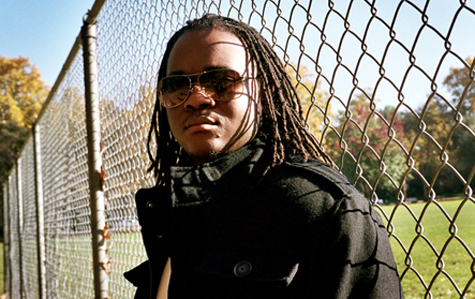
The power of words can make you laugh or cry, act reckless or ignite thought and awake the mind. A writer for more than half of his life, Sacramento’s Tais has never taken his talents for granted. From prose to poetry, spoken word to performing as an MC, the 27-year-old has found a sanctuary in the art of arranging words and has turned his passion into his job. As another great MC with many parallels to Tais’s train of thought said, “It’s a beautiful struggle.” And that seems to be the approach with which the confident yet controlled MC is pursuing his dreams. He’s put in years as a member of Sacramento’s prestigious Righteous Movement, but recently stepped aside to release his debut Truth Arises in Search mixtape (which can bedownloaded for free at www.myspace/tais.com). Urb magazine just named him as one of their top 1,000 upcoming artists (vote for him on Urb.com!) and he’s infiltrating the country’s biggest music festivals in a matter of months. Big things are on the horizon for Tais, and when he gets there it will be on the strength of hard work and his inclination to do right with his words.
When did the power of music resonate with you?
It’s funny, because I get in these ruts and you need music to lift you up. There is one song that I was just listening to that always does it for me, and it’s Outkast’s “In Due Time.” Since I was young, music is always one of those things that I connected to. I grew up an Army brat, so I didn’t really have a lot of friends growing up. We were always moving, and as soon I as made a friend, we moved, but music was that person I could find comfort in. It understood me and I understood it. As I grew and started writing, I was able to communicate what I had going on in my head, because I didn’t have someone to bounce ideas off of.
When did you start to write?
I started to write poetry when I was 12 or 13, but started writing rhymes when I was 15.
What kind of a writer are you? Do you have a notebook of lines that you compile into songs?
Are you the type of person that needs the music to write?
I’m just a writer in general. I have my B.A. in journalism. It’s always been a passion of mine, and to me, is just a great form of communication. But rhymes come to me both ways, but I think for the most part it’s always a line here, stop and think about it and how I want to say it. For me though, if it comes easy, I discard it because I want to say the things no one says but everyone feels. If I think someone else could write a line, I shy away from those lines. So it does take me a long time, the thought process of writing, but sometimes you get the music and it just comes to you and you can spit out the whole song in 30 minutes.
This month you’re rocking three days out at the MAGIC Trade Show in Las Vegas, and then you’ve got the Truth Arises in Search mini-tour, which ends up in Sacramento on Feb. 26. In March you’re heading to Albuquerque, N.M. and then the SXSW Music Festival in Austin, Texas for a couple days at the end of the month. Needless to say, you are a busy man. Is this a surge to really get to that next level of recognition?
Oh yeah. That’s the plan. I’m trying to touch down in new places and get the message out. This is the longest time I’ve been in one city, so it’s kind of weird for me, but at the same time it’s time to branch out and get into the industry and make music a bigger part of my life. It does well for me now. I can go to Texas or Utah or Colorado and make it happen. It’s always a work in progress. When you go to these cities—sure you have Internet buzz or whatever—but when you go to these cities it’s human nature for people to think, “Why should I listen to you?” I’m building every day though.
I was going to say, when you go to all these different areas of the country where people haven’t heard of you, what’s that feeling like? To know that people are going to be pessimistic from the start?
I like the challenge. It forces me to not be lazy. Once you get into a spot where people accept you and you are comfortable, you kind of slack off. Me knowing that I have a show in San Francisco in a couple weeks where people haven’t heard of me, it’s making me prepare because I have to bring my A game. You know hip-hop, you got to show and prove. We have that ego about it. It’s good, though. It keeps me practicing all the time.
I think people sometimes look at rappers and the “rap life” and think it’s one big party, but as you said, it’s a lot of work. As mentioned you’re going to the festivals and conventions—how do you separate the fun and the work of it?
People that know me, they think I work too much. If you saw my daily schedule, you’d think I worked too hard. I have fun doing it, though. Working is what I love doing, and hip-hop is what I love doing, so it doesn’t seem like work when I look at it from the larger scheme. For me, I don’t drink at shows or smoke, just so I can keep that balance and that edge. In the end, I do have fun because I do what I love, even with all the struggles. It is hard work, though. It takes going to SXSW and putting in those hours.
On your Truth Arises in Search mixtape you talk about the other elements of hip-hop. Do you yourself get down with some of the others outside of MCing?
Man, I’ve been through all of them. I did them all! That is where I got my name from. I used to write Tais. I wasn’t the best graffiti artist in the world [laughs]. Nor was I the best breaker or DJ. I went through all the elements, and I think it was like finding my niche. I went through them all though.
So was rapping the last one you experimented with?
Rapping was the one I didn’t want to get pigeonholed into, but it kind of worked out that way. I was always writing, but you know I was breakdancing and all that too, trying to find out what my part was.
To wrap it up, what’s your ultimate goal one year from now? Two years from now?
I see myself on a bigger level, and what I mean by that is being successful and touring. I look at people like Murs and Little Brother, and they’re doing their thing, and I feel like I can do that too. I can see that happening, because it’s happening now. But on another level, I want people to be able to look at my rhymes and say I am a great writer. That is my ultimate goal, for people to respect my craft so much that it’s not, “He’s a dope rapper,” but rather, “He is a great writer.”