Ricky Reed infiltrates pop music as Wallpaper
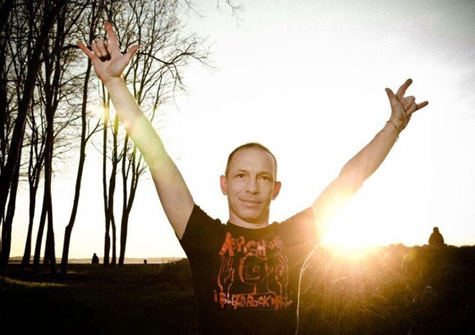
Anyone who’s ever started a band knows that the music business can be a tough and arduous road–even if you don’t have any aspirations beyond playing a few gigs and getting paid in free beer. If you stick with it, though, the rewards can be pretty awesome. Free beer, for one, is always good, but you could become a bona fide super star–or you could find yourself on any number of the rungs on the ladder of success in-between. If you’re looking for an example of sticking with it, look no further than Ricky Reed, the man behind Wallpaper, an Oakland-based electro-pop act. Reed started the project in 2005 as a sort of satirical look at pop music. Ironically enough, he now may be poised for some level of pop stardom in spite of himself.
With the release of Wallpaper’s latest album, #Stupidfacedd, Reed got the attention of MTV and even had the album’s single, the title track, played on the premier episode of this season’s The Jersey Shore. Maybe not the most auspicious venue to get his music heard, but it certainly opened some doors.
“Obviously, you have to be willing to deal with massive amounts of rejection. You have to be able to handle that,” Reed told Submerge over the phone from Los Angeles. “But when all these things came up, they were big and they felt good, but everything feels big and good the first time.”
Before his most recent breakthroughs, however, it was the small victories that kept Reed going.
“The first time that I played at The Press Club in Sacramento and had three to four attractive girls in the crowd, I thought I was winning,” he said. “The first time that I sold out Rickshaw Stop in San Francisco, I thought, ‘Wow, I’m doing it now.’ That’s the great thing about being a musician. As long as you work hard, in theory, things will get better, and every little milestone just feels a little bit better than the last one did.”
Reed’s recent successes have made him something of a sought-after commodity in the pop music world. Recently, he collaborated with Weezer’s Rivers Cuomo to write Cee-Lo Green’s new single “Anyway.”
“We took one shot at it, then took another shot at it, and the second shot knocked it out of the park,” Reed said. “Working with Rivers is crazy. I grew up listening to Weezer, and he’s a really special dude for sure.
“[Cuomo] came with an idea, and we just sort of built it outwards and it turned out great. He’s a class act. That’s the term to describe Rivers.”
When Submerge caught up with Reed, he was in Los Angeles, one night before heading to Las Vegas to play a show at Haze Night Club at Aria with Far East Movement. In Los Angeles, he was diligently working in the studio writing and producing. While he couldn’t divulge all that he was working on, Reed did tell us that he was putting the finishing touches on a new Wallpaper track. He shared some of the details on that and favored us with other words of wisdom in the following interview.

I saw that yesterday on your Facebook page you posted that you’re leaking a new Wallpaper song in a week or two. What’s that track about?
I can say that it’s sports related–jock jams. That’s all I can say about that.
Do you have an all-time favorite jock jam?
Oh dude, all-time favorite jock jam. There are so many good ones–from Gary Glitter… I really like whoa oh-oh-oh-oh whoa oh-oh-oh-whoa-oh-oh-oh whoa oh-oh-oh-oh… Whatever that one is [the aptly titled “Whoa Oh Oh” by Zombie Nation]. That’s a good one. You know what else is a good one? I’m pretty sure they put it on one of the Mortal Kombat themes, you know, “Gonna Make You Sweat” by C+C Music Factory. That was a weird time in music when pop house music was on the radio. Imagine being at a fucking Oakland Raiders game with all your tough cholo bros, and it’s like [singing], “Why waste your time? You know you’re gonna be mine.” The fucking ‘90s, bro. It was fucking unbelievable.
The ‘90s had all kinds of crazy things you’d never hear on the radio now. Like, Soundgarden was a pop band in the ‘90s.
Oh, I know, dude. You’re not going to hear “Spoonman” unless Dr. Luke produces it. I’d love to hear a Dr. Luke remix of “Spoonman.”
So on the scale of jock jams, would you say the song you’re working on is closer to C+C Music Factory or “We Are the Champions” by Queen?
Oh wow, I would say if you could merge those and sprinkle in a “Whoomp! There It Is” kind of flavor. That kind of “Whoomp! There It Is” energy I try to bring to all my records. I would say that “#Stupidfacedd” and “Fucking Best Song Everrr” definitely have a good dose of “Whoomp! There It Is” woven into them.
You’ve got the live show coming up at Ace of Spades in Sacramento. I was reading that your live show has two drummers and at least two other vocalists. Is that something you’d like to incorporate into the studio–having a bigger band?
In the studio, I just try to make the best songs however they want to be made. The live show, we’re trying to produce something special for people in that environment. There’s not a lot of carryover.
We’re going to do something even bigger and crazier for the Sac show. It’s going to be the debut of a new Wallpaper live set. It’s something nobody’s seen yet. We’re doing it that night and on New Year’s Eve with Kreayshawn in San Francisco.
Are you keeping that under wraps?
I want to keep that somewhat of a secret, but I will say that our live act is usually a four-piece setup, but the Sacramento show will be our first performance as a five-piece for those shows.
I listened to your album a couple of times through, and the first time, I definitely picked up on the beats and the energy, but the second time around, I was paying attention to the lyrics, I picked up on some really good lines in there, especially in “#Stupidfacedd” with that bit about the awkward silence. Is that something you throw in just to see if anyone’s paying attention?
You could definitely say that. I think my lyrical philosophy is just try to get people to pay attention to anything, you know what I mean? Like, hear something and realize you just heard it. Pop music is wallpaper. If you ask somebody what was the patterns or the colors on the walls of the rooms they’d been in today, of course they wouldn’t know what that is. They wouldn’t be able to answer you. That’s what pop largely feels like to me. People just run around with their thumbs up their butts, not paying attention to anything.
You say that, but Wallpaper’s music is obviously in that pop vein too. Is this one of those instances where you can be more rebellious inside the system than you can be outside the system?
I think you can stand on the outside and hurl rocks at it, or you can be the Trojan horse. I’ll leave it at that.
I wanted to ask you about the song you did with K Flay. I’d seen her play at a random club a while back. It was one of those instances where you go out and you don’t even know who’s playing and end up really enjoying it. I was wondering how that song came together and if you wrote it with her in mind.
Yeah, well I knew that K Flay was as broke as me… [laughs]. I wrote that record, and I knew it needed something. I think I met her just before that, and it was just the right timing. I thought, “This is perfect, why don’t you get on this?” She did a great job representing herself on that record, but she contributes to the song in such a great way. She’s just super talented and has also become a really good friend of mine.
Like you said, when you’re coming up you have to deal with a lot of rejection, but I’m sure that now that you’re making some headway, some of those nos are probably turning into yeses. How does that feel when that starts happening? Is it off-putting at first?
That was definitely the case. This sensation I feel pretty often is that I’m putting one over on people, you know? I know that my shit is dope, and I stand behind it, but also with how the rest of this stuff is, the rest of this stuff that you guys are signing off on–the powers that be–do you really think that you want to sign me? Are you really sure? Because I’m going to be a big problem for you guys.
I finally did it. After years of staying away from Black Friday, I finally succumbed. I wanted to get my parents a coffee maker, and the deal was too good to pass up. I didn’t cut my holiday short, though. I didn’t opt out of Thanksgiving dessert–though I probably would have been better off if I had–and I even chatted with guests, lingered on the couch watching football after all the plates were cleared and went to the movies to see The Muppets afterward, but I’m still no better than the rest of the herds who busted the doors, slathering for cheap televisions and other gizmos.
When we arrived near midnight, the big box store seemed almost serene and stoic. Its brick façade and bright logo sign implacable against the dark night. I parked as far away as possible, to alleviate the stress of trying to wind through the rows of cars, carts and frazzled shoppers with their wide eyes fixed on nothing but discounts. As we approached the store, we had to march past a group of employees taking in the last free drags from their cigarettes or simply just breathing in the cool night air before the holiday shopping season got off to its frantic beginning. I couldn’t look at them as we passed, but I felt their eyes on me.
“There’s another one,” I could imagine them thinking. “Another fucking asshole pulling me out of my home on a holiday night so he can save $20.” I kept my pace brisk. Still, I couldn’t see the line.
It wasn’t until we’d navigated around half the store that we got to the head of it. Folding chairs lined up, a woman huddled under blankets. I wondered how long they’d been sitting there. It must have been hours–perhaps a good portion of the day. I’d wondered if they even had anything to eat. I assumed–perhaps wrongly–that they were waiting in line so they could buy gifts for others, but if they were there for that reason, where were the people they were so eager to buy gifts for? Shouldn’t they have been together with them instead of sitting in a lonely parking lot with a bunch of strangers?
The line, hidden from much of the parking lot, wrapped around the side of the large store. It was a good five-minute walk before we’d reached the end of it. The people in front of us were huddled in a group. Two women–one a spunky go-getter named Rachel, the other a gorgeous young wife and mother with jet black, pin-straight hair, whose name I didn’t catch, wearing a diamond engagement ring so large that it could have been measured in inches as well as carats–and a third not affiliated with the other two who acted as our guru. She had the circular outlining all the deals. She’d been through this before. I was determined to follow her lead.
Contrary to the reports I’d heard from previous years throughout the country, it was remarkably civil. I’m not sure if I was disappointed or not. I was expecting glowering faces, determined scowls. I was fully prepared to punch a soccer mom (in self-defense, of course) if need be. Luckily, there was no repeat of the horrific trampling death of a Wal-Mart employee that occurred in Valley Stream, N.Y. in 2008. This year, a 61-year-old man shopping in a West Virginia Target became ill and collapsed while shopping. Witnesses reported that people ignored the man and even stepped over him as they went about their business. The Black Friday vet, the gorgeous woman with the ring, Rachel and I had a nice conversation as we waited for the line to move, but I couldn’t help but wonder, what would happen once those doors opened. Would the casual chit-chat we shared outside turn sour once the shit hit the fan? If I collapsed, would they walk over me? Would I do the same to them?
The line, now wrapped around the entirety of the store and with us more or less in the middle, began moving just before midnight. It moved pretty quickly, and within five to 10 minutes, we were inside. We bid farewell to the group of women in front of us and wished them luck as my shopping partner and I made a beeline for housewares. I was determined to just get the coffee maker–one of those single-cup jobs, like the one I’ve fallen in love with at my daytime office. Sure enough, we found it. Since it wasn’t a big-ticket item, the area was pretty clear. I tossed one in the shopping cart figuring I’d head straight for the register and leave this mess behind, but I didn’t.
People carting flatscreens of varying widths congested just about every aisle. The area by the toys was a supreme clusterfuck. Someone rammed me from behind with their shopping cart and I murmured something aweful without even looking to see who or what had hit me. I ended up finding two more gifts and a couple of cheap DVDs for myself. (The Dark Knight for $1.99 was too good to pass up.)
On the way out, we spotted the woman with the ring. She was just as cheerful as she was outside on line. Her arms were full of assorted knickknacks. “I lost Rachel!” she chirped as we parted ways for the final time. I wonder if she ever found her.
The Muppets
Walt Disney Pictures
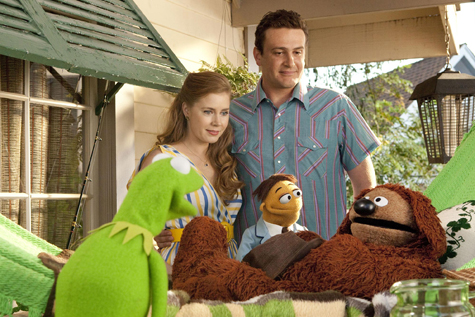
They certainly don’t make them like they used to. The Muppet Show ran five seasons between 1976 and 1981 and brought a rare kind of experience into American homes. Not since The Flinstones beforehand (or The Simpsons to follow) did a program have the ability to stimulate the minds of children as well as tickle the funny bones of their parents. Though its time on television wasn’t notable in longevity, its influence was far-reaching. The show spawned a series of theatrical releases, the last of which, 1999’s Muppets from Space, garnered very little attention at the box office. Walt Disney Pictures, whose last Muppets film, Muppet Treasure Island, was released in 1996, hopes to revitalize the franchise with the plainly titled The Muppets, co-written by and starring Jason Segel.
True to form, the story of The Muppets is as heartwarming as it is absurd. Gary (Segel) is the loving human brother of Walter, a Muppet. The two live a charmingly perfect life in Smalltown, U.S.A. Though the two brothers care about each other very much, they are not blind to the differences between them. Gary grows up into a man and enters into a wonderful relationship with Mary (Amy Adams) that is about to celebrate its tenth anniversary, but Walter remains forever short and made of felt. One thing that Gary and Walter do share in common is their love for The Muppet Show, which, for obvious reasons, becomes a touchstone for Walter throughout his life. To celebrate his impending anniversary with Mary, Gary offers to take her and his brother to Los Angeles to visit The Muppet Theater, which has fallen into disrepair over the years of neglect. As it turns out, evil oil tycoon Tex Richman (Chris Cooper) plans to buy the studio plot on which the theater stands and tear it down for the oil reserve beneath. Gary, Mary and Walter must then convince the Muppets to get the band back together, so to speak, after many years apart for one last show, a telethon to save the theater that was home to so many cherished memories.
Longtime fans will pick up on all the trademark moments. There’s sharp pop culture satire behind all the singing and dancing. In one such scene, vexed with trying to find a celebrity host for the telethon, Kermit the Frog is seen rummaging through his old Rolodex, scratching names such as Molly Ringwald off the list. There are also the numerous, off-the-wall celebrity cameos–from Dave Grohl to Mickey Rooney; Leslie Feist to Judd Hirsch. Characters often break the fourth wall, such as when Gary acknowledges to Mary that he’d just been involved in a dance number, and that signature self-deprecating wit that has served the Muppets well through the decades–and perhaps even left an indelible mark on a generation of people who prefer to downplay their own accomplishments.
But one thing you won’t find here is any shred of Gen X cynicism. This is a film with its heart firmly affixed to its sleeve–a wide-eyed, unabashed celebration of the Muppet legacy. Not only are the Jim Henson puppets praised for their nostalgic value, but they are also served up as a sort of tonic for the state of entertainment today. The top-rated show on the network that hosts the Muppets’ telethon is a game show where teachers are punched in the face by students. Also in the film, Richman strikes a deal with The Moopets (a satire within a satire), Fozzie Bear’s ex-backing band while he was performing in Reno, which Richman calls a cynical act for cynical times. The Muppets Vaudville-style comedy show may be old fashion in comparison, but it proves to be timeless.
Segel and co-writer Nicholas Stoller’s (Get Him to the Greek) script is fawning in its love for its puppet subjects, but it is also clever, engaging and hilarious at times. The songs too, as bright-eyed and bushy-tailed as can be, also have an underlying wink and nod that will delight audiences on multiple levels. Will The Muppets propel the title characters back into the spotlight? Maybe not, but you really can’t fault Segel and company for trying.
J. Edgar
Warner Brothers
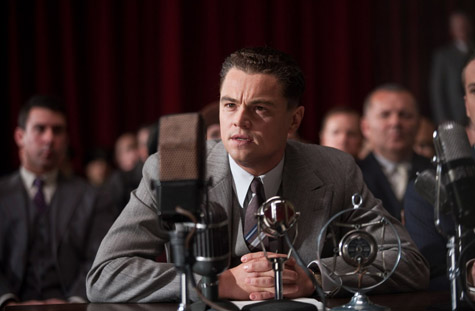
J. Edgar Hoover is a titan of America’s recent past. For decades, under eight presidents, he was head of the FBI and stood watch over the country through some of its most trying times. For that alone, Hoover’s story is perfect fodder for the big screen, but when you add his personal life to the mix–one full of immense personal struggle and hypocrisy–then you wonder why someone really hasn’t done this before. Hoover’s triumph and tragedy is closely tied to America’s own, and this is given its due in a new film from director Clint Eastwood.
J. Edgar comes to us from the unlikely team of Eastwood–former Republican governor of Carmel-by-the-Sea, Calif., and forever entrenched as Dirty Harry in our film lexicon–and Sacramento native screenwriter Dustin Lance Black, who won a best screenplay Oscar for Milk, the story of Harvey Milk, the first openly gay man to win an election for public office in California. In J. Edgar, we find a central character who is far less open about his sexuality than Milk. Instead, his life is his bureau, which through sheer determination and well-placed underhandedness, he manages to elevate from bureaucratic afterthought to the top law enforcing institution in the country.
The story of the film happens in two times. We see the title figure (Leonardo DiCaprio) toward the end of his life–as President John F. Kennedy’s assassination makes way for Lyndon B. Johnson and eventually Richard Nixon. He is relating his memoir to a new crop of agent. As he does so, the film flashes back to a young man eager to make an impression and serve his country. It’s the Roaring ‘20s and the nation struggles with the fear of a communist invasion. By 1924, Hoover’s work combating the “red threat” gets him appointed department head of the then Bureau of Investigation by the attorney general. It’s at that point the agency starts to morph into the entity we know it as today.
Through cunning and hard work, Hoover propels himself and his fledgling FBI into the limelight. Not only does it become a force for law enforcement, but it also captures the public’s imagination. One of the nice quirks of J. Edgar is that the film shows the impact the FBI had on popular culture. It shows film heroes segueing from gangsters to those who catch them, that FBI agents showed up as icons on cereal boxes, inspired toys and how the agency propelled its leader into almost celebrity status, sharing tables at clubs with the starlets of the day.
Behind the scenes, though, Hoover’s life isn’t as easily definable. His overbearing mother, played by Dame Judi Dench, is perhaps the engine behind J. Edgar’s perpetual drive. He’d do anything to please her, even deny his own nature. As far as his personal life goes, Hoover shows very little interest in women, or anyone else who isn’t of concern to the bureau, for that matter. As the film opens, he does try to court Helen Gandy (played by Naomi Watts), but even though that goes nowhere, he still hires her on as his personal secretary (a position she carries throughout the rest of Hoover’s life, according to the film). But it’s not until he meets Clyde Tolson (Armie Hammer) that something stirs in him. Hoover eventually hires Tolson, though he doesn’t seem to meet his agency’s stringent qualifications, and the two strike up a long but chaste companionship that lasts the rest of Hoover’s life. In fact, in real life, Tolson was the benefactor of Hoover’s estate.
It’s the relationship between Tolson and Hoover that’s the heart of the film. Presidents change, the country ebbs and flows in and out of chaos, but through it all, the two men are at each other’s side, though Hoover is portrayed as less willing to express his feelings than Tolson. It’s an interesting choice, considering Hoover’s sexuality has never been proven one way or the other, though rumors and stories persist on both sides. Nevertheless, it makes an already compelling tale even more so. As one of the most powerful men in the country, Hoover kept many secrets (and he wasn’t afraid to use them to his own benefit), including one of his own.
As the film goes, J. Edgar moves at a ponderous pace, switching back and forth from the past to present with clunky transitions. However, a strong cast giving powerful performances is enough to hold it together. J. Edgar is an excellent biopic insofar that it shows the man for all his supposed triumphs and foibles, and in so doing portrays those of a country as well.
It’s amazing what power can do to people, even to those who seem above reproach. You may or may not be a sports fan, but you’ve more than likely heard something about the scandal that has devastated one of the nation’s most respected college football teams and perhaps one of the most beloved men in collegiate sports. And it’s a shining example of how the things you don’t do are sometimes more important than the things you do.
For 61 years, Joe Paterno has been a familiar face on the sidelines (or in recent years, in the booth) at Penn State football games. It was largely in part to him why I followed the Nittany Lions. Short, lumpy and of Italian descent, he could just as easily have been one of my uncles as he was an iconic football coach. More than just a great coach, leading his team to many successes, he was a great molder of young men. Penn State has produced plenty of professional football players over the years–especially great linebackers–but more importantly than that, Paterno, or JoePa as he had become affectionately known in State College, Penn., seemed to be more concerned with preparing his athletes for life after football than his own prestige and accolades. Still, Paterno amassed 409 victories, the most in FBS (Football Bowl Subdivision) history. When his Nittany Lions earned the coach his 400th victory in 2010, Big-10 commissioner Jim Delany said of Paterno, “When they write the history of college football in the second half of the 20th century–and maybe the first half of the 21st century–he will be regarded among the greats. I’m not talking about just football or just college. I’m talking about one of the great coaches in the history of American sports.”
Unfortunately, we’ve learned far too often that being great at what you do doesn’t mean you’re a great person. Now, Paterno and Penn State University are in the eye of a scandal involving sexual abuse of children and a cover-up that lasted almost a decade.
Jerry Sandusky, a similarly decorated defensive coach whose 23-year tenure under Paterno at Penn State ended in 1999, has been charged with multiple counts of sexual assault that could put him behind bars for 460 years. One such incident is purported to have happened in 2002 in the Penn State shower room. Though he was gone for three years, Sandusky still had access to the university’s athletic facilities. According to the grand jury indictment, then-graduate assistant Mike McQueary walked in on Sandusky raping a boy believed to be around 10 years old. Instead of calling the police or, you know, tackling the asshole to the ground and beating the shit out of him, McQueary left the scene to call Paterno, who then called campus police. And that was that–until now.
After the story broke, people were fit to be tied, for obvious reasons, but those defending Paterno were equal in fervor. Students staged a demonstration in support of JoePa when he announced that he would retire his long-held position at the end of the football season. The next day, university officials finally removed their thumbs from their asses and fired Paterno, which set off a riot on campus. School president Graham Spanier has also been fired as a result of this horror story; however, McQueary somehow still has a job with the university and as of the writing of this article has only been placed on “administrative leave.” WOW.
I’ve been cursed with a strong sense of empathy. I can imagine Paterno and company’s side of the story here. He has stated that the incident wasn’t explained to him in the same excruciating detail as McQueary relayed to a grand jury, but even if that wasn’t the case, and God or whoever forgive me, I can still understand where Paterno was coming from. Getting news that a trusted colleague and companion has all along been a psychopathic monster had to have come as quite a shock; or, at the very least, sort of like the time you heard Santa Claus didn’t exist. Sure, you kind of suspected it, but how could you be sure. In any case, believing in the good far outweighed accepting the bad. I think if I were in Paterno’s shoes, my initial reaction might have been similar. Who would want to deal with that kind of news? Also, he didn’t witness it himself. But, I don’t know, after a couple of minutes, after the shock wore off, I believe I would have done what any other human being with half a heart would have done and, at the very least, notified the proper authorities. Instead, a simple decision, to pick up the phone or not to, has ballooned into more victims, lives torn apart for those directly affected–the victims and their families–right down to the young athletes donning the Plain Vanilla uniforms of the Nittany Lions who had hopes of fulfilling their dreams as pro football players one day.
This is a valuable lesson to those students rioting in defense of their once-great coach and the face of their beloved football team. People in power care about one thing. Hint: It ain’t you.
Kepi Ghoulie gets ready to release his fifth solo album in just four years
Most sharks are renown not only for their prowess as predators, but because they never stop moving, even when they’re asleep. They do so in order to keep breathing. Such is the case for local pop-punk impresario Kepi Ghoulie, who lives in a state of perpetual motion as far as his music career is concerned. In fact, his rock ‘n’ roll lifestyle even inspired the song “Rock ‘n’ Roll Shark” on his upcoming album, to be released Nov. 29, 2011 on Asian Man Records, aptly titled I Bleed Rock ‘n’ Roll. Funny enough, Kepi says he wrote that song while hiking Mount Shasta, singing into his iPhone.
When Submerge spoke with Kepi, he was at home, but true-to-form, certainly not at rest.
“I came home last Monday, and I played Thursday, Friday and Saturday, and then I’m painting for this art show, and as soon as that’s done, I’m recording for my kids record,” Kepi says. “So even though I’m at home, the pace is still as if I’m on tour.”
Recently, Kepi hit the road with Canadian pop-punk icons Chixdiggit. He played bass for the group and also opened for them, its members serving as his backing band during his set. As for the children’s record he mentioned, he says he will start tracking that in December for release in March or April 2012. Mike Park, head of Asian Man Records, convinced Kepi to write children’s songs.
“Mike at Asian Man said, ‘You’ve got to make a kids record. Your songs are already kids’ songs,’” Kepi explains. “I have stuff about taking a bath; and I was in Canada for a month, and I ended up writing this song about the provincial flower of each province. It would be cool to have something like School House Rock, where you learn something with each song.”
The children’s songs will be short and catchy–as you should probably expect from the ex-Groovie Ghoulies frontman. He says School House Rock had some of an influence on the songs he’s writing for the forthcoming children’s record; however, he says that some of those songs were too long. His inspiration mainly came from the acts that have inspired him all along.
“I wanted to make [my songs] two minutes,” he says. “A Ramones song, or a Little Richard song, two minutes is perfect–sort of get in and get out. I wanted to do a song about the U.S. presidents or something, but I was like, ‘Maybe I’ll do two songs, so there are only 20 presidents at a time,’ so there are no four- or five-minute songs. I remember when I was a kid, slow songs were weird, and long songs were weird.”
Until then, though, Kepi is focused on his latest release, his fifth since The Groovie Ghoulies went their separate ways in 2007. He has a record release show planned for Bottom of the Hill in San Francisco on Dec. 2, 2011, which is where the paintings he’s been working on will come into play.
“I’m hand-painting 30 album covers for the release show, and I’m going to be selling a test pressing with a hand-painted piece of art for $150. I’m going to do 15 on the show and 15 online,” Kepi says. “I’m going crazy doing that.”
Much like Kepi’s songs, his paintings are fun and perhaps simplistic, but instantly indelible. It’s a straightforward, honest approach that has served his music well over the years.
“A lot of my songs are so minimal, I don’t want to make them do anything else,” he says. “Like, ‘This song doesn’t need a bridge.’ Like, T. Rex, Marc Bolan would just play this riff, and that would be enough for him. I don’t want to mess it up by adding too much.”
Kepi carries his love for minimalism over into I Bleed Rock ‘n’ Roll; however, as he told Submerge, he was eager to inject a healthy dose of huge rock energy into his songs. The veteran songwriter answered questions about the process of making his new album in the following interview.
How’s it going? You’ve got the album coming out in a couple weeks?
Yep! New record coming out. Everything’s great. I’m super excited. I think it’s the best-sounding thing I’ve ever done…
I spent about a month making it in Oakland, because usually I make a record in three days or a week or something. We don’t usually have a lot of time, but my buddy down there had a studio, and we spent a lot of time tracking everything. It was really fun, six layers of guitars sometimes, just stuff I’ve never been able to do because of budget concerns and that sort of thing.
How come you had a little more time this time around?
It was the flexibility with the studio and no rush… I think the songs on this record were a lot more fleshed out. I don’t know what it is, but it was just really fun, and a difference–bigger than what I had been working on.
It definitely sounded like more of a rock record. Was that something you were going for when you wrote these songs?
Yeah, totally. I was in Austria a couple times early this year, and there’s a club called the PNK, and in Europe, after the rock show, there’s DJs playing The Bouncing Souls and The Ramones, and all that stuff, and people are dancing and hanging out. I wanted to make a record that people can dance to at the after party–just big, loud, fun. Songs like “Nikki Lee,” “Part Time Romeo,” “Break My Heart,” those were made for rock ‘n’ roll after parties… It was a goal to make a big rock record that you could dance to. That was part of my mission here.
Usually, you said you make a record in three days, but this one took you a month, on and off. Did that affect your creative process at all? Did you have to tell yourself to slow down in the studio because you’re used to doing things so fast?
No, actually, music and lyric-wise, it came really fast. It’s this big, loud, three-chord rock ‘n’ roll. When I got in, it was like, boom, boom, boom. Like, you know, don’t think about it too much. This isn’t some super profound record lyrically, this is just a big rock ‘n’ roll record. When I went in, I tried to be super up. The other thing was, if I wanted to go somewhere and just sing to the backing tracks, I can. I’m getting these weirder and weirder gigs. I was just flown to Oslo, Norway, for a show, and I was also flown to Nebraska to play a zombie walk… You can’t fly a band to Norway to do one show, usually, so you have to have alternate options. This record was also made for that. Last year, I was in Rome, and I was supposed to play acoustic at this really loud club, and there was no possible way I was going to be able to play acoustic. The DJ happened to be playing a Groovie Ghoulies record, and I just started singing along with it as a joke. He just kept playing more records, and my show ended up being this live karaoke set. I was singing The Monkees and Kiss and Johnny Thunders, and he was trying to stump me, but I knew the words to every song. And people were blown away, like, “Whoa, what was that?” I like the kind of anything-goes factor that’s in my life right now.
You mentioned that the lyrics weren’t meant to be very deep, but toward the end of the album with songs like “I Just Wanted You to Know,” “Love to Give,” “Break My Heart” and “Cupid Is Real,” there seemed to be a heavy love theme. Was that something you noticed when you were writing lyrics for this record?
It’s funny. In the Ghoulies, I never really wrote love songs, but this time a bunch of them came out. “I Just Wanted You to Know,” that one I heard a little T. Rex riff in my head. I demoed it. I tried to send it to Kevin Seconds, but I failed. It was on my GarageBand or something and I ended up recording that. Rusty Miller [of the band Jackpot] played on some of those songs. He did that one and played exactly what I heard in my head. “Break My Heart,” I woke up one day and thought that was a cool little title, like, I know you’re going to break my heart one day, so let’s just get this over with… I don’t know. They all just came. Songs come to me, and if they’re catchy, I keep them. As far as them all being at the end of the record, I always try to pace my records like a movie or a roller coaster ride. I put a lot of thought into how it was going to end, like, “Hard to Forget” is a good song that will hopefully keep ringing in your head after it’s done.
This is your fifth solo album since the Ghoulies split up. That’s not even that long ago. It’s only like four years ago.
I’m averaging about one a year. The first thing I did was put out an acoustic and electric record at the same time, so people couldn’t be, “Oh, he’s doing this or he’s doing that.” I’m doing a bit of everything. It’s really cool. I’m in a place like Neil Young or Johnny Thunders, where I can do whatever I want, and I really like that.

Kepi Ghoulie will play his CD release show at Bottom of the Hill in San Francisco on Dec. 2, 2011; however, Sacramento fans will only have to wait a week after to see him live in town. On Dec. 9, 2011 he will play an acoustic set at Naked Coffee with Pets. Later in the month on Dec. 30, 2011, Kepi will plug in and play with Dog Party as his backing band at Luigi’s Fungarden. Look for I Bleed Rock ‘n’ Roll on Asian Man Records on Nov. 29, 2011.
Thrice’s Ed Breckenridge talks about his band’s new album and the struggles of losing a parent
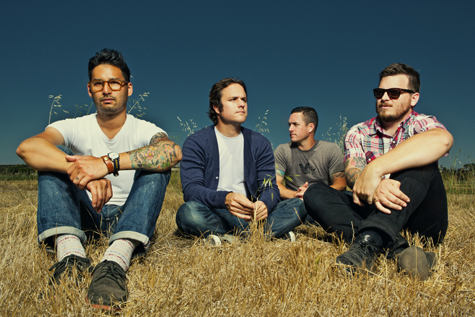
Family can take on many forms, but there is no doubting that it’s important. Thrice could be considered as strong a family unit as there is in modern rock music. The band formed in 1998 and has been together ever since, fronted by singer Dustin Kensrue with Teppei Teranishi on guitar and two brothers in the rhythm section, Riley (drums) and Eddie (bass) Breckenridge. Sure, family can be a headache. The oncoming holidays are always a reminder of that, but during the most difficult times, such as the trying period the members of Thrice endured during the making of their most recent album Major/Minor, it’s always good to know you have someone to rely on.
Submerge caught up with Eddie over the phone before a show in Grand Rapids, Mich. The group had something of a “family day” the day before in Grand Haven, about half an hour west of Grand Rapids, on the shore of Lake Michigan.
“We spent the time walking around and sightseeing,” Eddie says of the much-needed day off. The band has already been out on tour for over a month supporting the release of Major/Minor, which was released on Vagrant Records on Sept. 20, 2011. “The day before, we acquired a bunch of barbecuing stuff, so we ended up doing a little barbecue outside the bus at the hotel where we were staying. Thank God we didn’t get harassed by any police for loitering in the hotel parking lot. It ended up being pretty fun.”
These family dinners have been a tradition for Thrice almost since their inception, Eddie says.
“I think that some of the earlier bands that we toured with, we always tried to meet up and go out to dinner,” he explains. “Whether we’re in the same town as another band or not, we try to have everyone in on a family-type meal.”
These sort of gatherings have probably become even more important during the most recent tour. The Thrice family suffered serious losses during the writing process of Major/Minor. Teranishi mourned the death of his mother, and the Breckenridge brothers’ father also passed away. The pain of these losses is certainly noticeable in Major/Minor, which is a potent mixture of hope and sadness. “Treading Paper,” placed in the middle of this sequence of songs, has Kensrue wailing in a scratchy but forceful voice “Carrying on; unwitting orphans of an unyielding despair.” Later on in the same track, the words look for the light at the end of the tunnel, “If anything means anything / There must be something meant for us to be.” It’s this interplay between light and dark that works its way throughout the album. Musically, Major/Minor is rife with big, crunchy riffs, pounding rhythms and raw vocals. Eddie says the album’s songs have caught on almost immediately by fans.
“When we did a record like Vheissu, it seemed to take a full touring cycle before people seemed like they wanted to hear those songs,” he says. “It’s cool, but at the same time, I can’t help but think, ‘Are we doing something wrong?’”
The album’s producer, David Schiffman, who worked on Thrice’s 2005 album Vheissu, went as far to describe Major/Minor as a grunge record. Eddie Breckenridge doesn’t necessarily agree with that sentiment, but during our interview, he does confess his growing love for Pearl Jam and he also touches upon the loss of his father. Thrice is currently on the road with O’Brother, Moving Mountains and La Dispute.
You’ve been touring for almost a month now on the new record. How has it been going?
It’s been great. It’s been going pretty well. All the bands are a bit different, but I think they all work together really well as far as like a cool-sounding show for everyone. There’s a lot of different dynamics to the music. The people are pretty great too. It’s been really fun. I can’t believe we’ve been on it for as long as we have. It doesn’t feel like that.
You mention that the sounds are really different between the bands. Was that what you were looking for when you headed out on the road?
I think you always try to make it so there’s no band that’s like an odd ball, but I think this tour, we’ve been really fortunate in picking bands, because I think nobody is an odd ball, but nobody sounds too much like everyone else. I think it’s a cool lineup. I think O’ Brother is a bit heavy, and their songs are a bit darker. Moving Mountains is more atmospheric, but they still have some heavy stuff. La Dispute has some really cool instrumental stuff, and their energy is a little more intense than the other bands–maybe not as dark or as heavy, but intense. And then there’s us. Whatever we are.
I definitely want to talk about Major/Minor. It’s funny because when I first listened to it, my first impression was that it reminded me of an old Soundgarden record. After I started reading up on it, I saw that your producer had likened it to a grunge record. Is that something you get when you listen to it?
We weren’t going for anything specifically. When we were writing the record, we were experimenting a lot with major and minor chords in the songs, and I think that’s the thing that sounds grunge-y. I think a lot of bands in that time period were experimenting with a lot of the same kind of stuff. They might have a song that’s really heavy, but it’s in a major chord. I think that ended up stylistically being a grunge-y sound. Maybe that’s where that came from, but it wasn’t an intentional attempt to make stuff grunge-y. I can see how you can relate it, but I don’t think the album on a whole sounds like a grunge-y record.
Definitely. There are some songs that give you that impression–maybe because of Dustin’s vocal delivery–but it definitely sounds like a Thrice record. It definitely doesn’t sound like Mother Love Bone or something like that.
Did you see that documentary, by the way? Pearl Jam 20?
No, I really want to though. Have you?
Oh, it’s amazing.
Why did you like it so much?
I’ve been a fan of Pearl Jam. I didn’t really follow them as much as I would have liked to now after seeing the documentary. It’s just really awesome seeing how they came about and how they tried to deal with what was going on. It was just inspiring. I think two weeks later all I could sing in my head were Pearl Jam songs.
Well you guys have been together for 13 years now. Were you able to see any parallels between that movie and your own band’s career?
Maybe, but not really. They became a huge band pretty quick. I think there were some parts where Eddie Vedder was talking about how hard it was to be in a huge band, but still wanting to play songs that reminded him of Fugazi and people not understanding that–struggling with what people think your identity is, and you wanting them to understand your real identity, but also not wanting them to be too close because you still want to be yourself in private. On their scale, that’s insane. I couldn’t imagine dealing with that, but I can definitely see where they were coming from, on a much smaller scale.
As a band that’s not afraid to do different things, is that something that plays into what you’re saying? Dealing with what people expect of you?
I think it’s important not to give into what people expect, because then you lose your identity as a musician. You need to create. You need to be inspired by things that inspire you, not inspired by people’s assumptions of what they think you should be. That would be a really rough spot to be in, and I don’t think our band would have lasted as long as it has if we were catering to other people’s tastes. It might be selfish in a way, but it’s really important to have it come from a natural place.
You and your brother Riley lost your father during the making of this album, and Teppei lost his mother. Now that other people are hearing the music, does that make it feel less personal to see other people react to it?
It’s hard for me to really play the music with my emotions that were involved with losing my dad. I think playing the music live is a huge release as far as that. I would never want to exploit my feeling for the sake of the music, but I definitely will be playing shows and think of my dad at moments, but I know my dad would enjoy it, because he supported us a ton. I can’t help but feel that sadness turn into some sort of energy. I become, I don’t know, strangely empowered by his memory. It’s crazy. It’s so hard for me to describe because there’s so much involved in it, as far as losing somebody, but also, I don’t know. I don’t know what I’m saying. It’s just been a rough, rough year. There’s no escaping it. Not that I’d want to escape it either. It’s this struggle that I don’t want to escape, but it’s hard not to let it ruin my ability to be happy, I guess.
Thrice and company will play Sacramento on Nov. 6, 2011 when their tour takes them to Ace of Spades. Tickets are $20 and can be purchased through Aceofspadessac.com.
Mastodon thunders across the United States on strength of The Hunter
Over the past decade, Mastodon has established itself as one of the premier forces in American metal. Among critics and fans, the Atlanta-based band has become as huge and monolithic as its name suggests. In 2009, Mastodon showed once again that it had brains equal to its brawn with the release of Crack the Skye, a soaring concept album (in a string of concept albums) in homage to drummer Brann Dailor’s sister Skye who took her own life when she was just 14. Crack the Skye was lauded by critics, and the accolades translated into sales as well. The album debuted at No. 11 on the Billboard Top 200 and also afforded the band the opportunity to tour Europe with Metallica, hit the road with grunge icons Alice in Chains as well as conduct their own headlining tours here and abroad. How would Mastodon follow up the success? Shake up the establishment, of course. They hired a producer better known for hip-hop than progressive sludge metal and ditched their penchant for high concepts to create their most straightforward and accessible album to date, The Hunter, released on Reprise Records Sept. 27, 2011. For those afraid that Mastodon may have Bob-Rocked themselves like their aforementioned European tour mates, fear not. This is not the Mastodon you know and love, but it packs just as mammoth a punch.
You won’t find a lot of math for math’s sake on The Hunter, but Mastodon’s sound is unmistakable. Opening track “Black Tongue” is the Mastodon you remember, just condensed into a roughly three-and-a-half minute burst of ferocity. From there, the album takes a sharp turn into “Curl of the Burl,” where Dailor and crew ditch the intricate progressions and time signature manipulations for heavy-riffed southern-fried rock. What follows is space-age weirdness (“Stargasm”) seated at the same table as beautifully wrought metal epics (the title track). What becomes apparent from listening to The Hunter is that Mastodon are as capable as ever, even when they’re not going out of their way to flaunt their impressive chops.
Submerge had the opportunity to interview Dailor while the band was in preparations for their upcoming headlining U.S. tour, which kicks off Oct. 25, 2011 in Austin, Texas. Dailor says that the band will be unleashing perhaps “the longest set list that we’ve done” at stops on the tour.
“We’re probably doing six or seven songs off the new record, and then a whole bunch of other ones,” he says. “I think we’re doing 23 or 24 songs total.”
Now five albums deep, Dailor says that the band has a lot of material to choose from making the decision of what makes the cut live more difficult, but the band doesn’t just take themselves into account when they hit the road. He explains that he and his band mates keep tabs on fan chatter on message boards and elsewhere to see which songs are getting the most reaction.
“When we’re writing an album, that’s for us,” Dailor explains. “We just try to concentrate on what we like. I feel like the show is more about the fans. It’s about us as well, we want to play the songs we like, but we make sure that we love the songs first and foremost when we put them on the record, but what people are responding to, we make sure to play those live.”
Mastodon will bludgeon through Sacramento on Nov. 2, 2011. In anticipation of the upcoming show, Dailor took some time to converse with us about The Hunter and gave us some insight into the making of it.
I wanted to take it back to 2010 when you guys did the Jonah Hex soundtrack. I read in an interview that you said that was the first time you tried a spontaneous recording process like the one you tried with The Hunter. You said that it gave you guys the confidence to work that way. Why did you go more spontaneous with the Jonah Hex project as opposed to what you’d done in the past?
We didn’t have time to do anything but. We had two weeks in Los Angeles, in a studio, and we were just going in there every day and seeing what we could come up with. That was the plan from the beginning with that, because we really didn’t have time. We were on tour…we were in Europe for three months with Metallica, and we were pretty much fried. We had three weeks off between tour, and those three weeks were supposed to be us going home and chilling out because we’d just run ourselves through the wringer in Europe. Instead, we headed to L.A. … There wasn’t a lot of time to sit and work stuff through for six months. It just wasn’t that type of thing. It was a lot of fun doing that, because you get used to doing things a certain way, and I don’t know if it’s superstition or whatever, but you get used to it because it’s worked in the past. We wanted it to be something that we dug and were proud of, but when you’re writing for a movie soundtrack, it’s not something you can get married to, because it’s not your decision if it gets used or not. It’s a different thing. You have to sort of write music and let it go. We were providing some riffage for their movie and handing it over, so to speak.
So it definitely wasn’t the same mindset you’d go into the studio with when you make a Mastodon record?
No, and that’s not to say that we weren’t going to put our stamp of approval for it, because we did enjoy some of the stuff that came out. But it wasn’t the same thing. A Mastodon album is a different thing. Even though I talked about the new record being more spontaneous–and it was, and I think the Jonah Hex thing did give us some confidence in ourselves that we could just write stuff on the spot and have it come out good–but it wasn’t the same thing. A lot more work went into The Hunter, obviously.
Some of The Hunter was written on the road with Alice in Chains. Was that something new for you guys?
Yeah, kind of. It’s happened a couple of times before. There have been some things that have been written that have come together in sound checks and stuff like that. Somebody will start jamming something and someone will start playing along, and we’ll all say, “Hold on, what’s that? Let’s make sure we don’t lose that. Are you going to remember that? Maybe we can record it real quick, because that’s awesome.” But this time wasn’t the first time, but it seemed like it was happening a lot more often. We had road crew that would go and grab the practice amps and set them up, and they’ll just be back there with a guitar plugged in ready to go… When Brent [Hinds, guitar/vocals] or Bill [Kelliher, guitar] wander back stage, and there’s a guitar and an amp set up and ready to play, they just pick it up and start playing. That started happening every day. I’d pick up my iPhone and hit record if I heard something cool, if I heard something worth our while. If it wasn’t for the iPhone, this record wouldn’t have come together so quickly.
A lot of artists expressed remorse for the passing of Steve Jobs. Was that something that affected you at all?
Absolutely. It’s sad. I feel bad for his family. It’s always sad to lose a loved one when you feel like it’s too soon. His mind, he was one in a million, one in I don’t know how many millions, but we all lost a great thinker and idea person. There just aren’t enough idea people, you know?
The Hunter was dedicated to a couple of people the band lost during the recording of the album. The title is a nod to Brent Hinds’ brother Brad who passed away. Other than the title, did that play into the writing of the album?
I think it did in the aspect of the way the record sounds, the way the record came together. Brent and I were going down there every day. There were a lot of things happening not just with Brent, but with the other members of the band that were really stressful. Where in the past, making a Mastodon record was a really stressful thing, we were banging our heads against the wall trying to fit all this mathematical craziness into the middle of a song. It could be six months of fine-tuning and going in there and getting frustrated and all that stuff. I guess with everything that was going on on the outside, we really wanted the practice space to be a fun place to go and be the one place you could go and close the door and leave everything outside… I think that has a lot to do with the way the album sounds. It’s kind of stripped down. We would write a straight-up rock song like “Curl of the Burl” and be done with it and not care what anyone would think.
We dug it, it was fun. I think it had a lot to do with just the lightheartedness we wanted to approach everything within the practice space. We knew everyone was a little fragile, a little hurting inside, and we didn’t want to make the practice space the stressful place it can be because of all the other shit that was going on outside.
Mastodon will play Ace of Spades on Nov. 2, 2011. This is a stacked lineup that will also feature Red Fang and The Dillinger Escape Plan (fuck yeah!). Be sure to buy your tickets in advance. They can be purchased through Aceofspadessac.com for $28. Doors open at 6 p.m. for this all-ages show.
Phantogram Moves in the Right Direction
Formed in 2007, New York’s Phantogram is just starting to hit its stride. The band, based out of the quaint rural town of Saratoga Springs, is the brain child of Sarah Barthel and Josh Carter. The two have been lifelong friends, but just started making music together relatively recently. Just last year, the duo released its debut full-length, Eyelid Movies, on indie label Barsuk, and Phantogram has more or less been hitting the road to promote it ever since. This fall, Carter and Barthel are set to hit the road again on a month-long headlining tour that will coincide with the release of a new “mini album” titled Nightlife.
Carter hasn’t been taking the rigors of being a band on the rise lightly. Submerge’s first attempt to call the band’s songwriter for our interview was left unanswered. As it turned out, the interview occurred a few hours later. An apologetic Carter confided in us that he was out for a run during our scheduled interview time–an effort to “change up my lifestyle a bit,” he said.
“I’ve been smoking a pack a day for about 10 years–of Newports, nonetheless. That’s like the worst cigarette you can smoke,” Carter explained. “I just want to get healthy, you know? I feel like it will be good for my music. I’ve spent a lot of time on the road drinking way too much and drugging and smoking.”
Carter said he started running about two weeks prior to our phone call. Though he hasn’t been able to cut out the cigarettes just yet, he seemed determined to kick the habit.
“I’m on Chantrix, so hopefully I don’t murder anybody,” he said plainly.
Though this is a new regimen for him, he said he thinks it will ultimately not only improve his well being but also improve his potency as a songwriter.
“People have told me they hit this stride–well, it was my dad, actually–they hit this stride where it clears their minds,” Carter said. “That hasn’t happened yet, but I think it’s going to be a good balance for my life and help my creativity.”
He’ll need all the clarity he can get with the band’s upcoming schedule. The most recent headlining tour, which begins Oct. 20 in Millvale, Penn., will take Phantogram through some cities it hasn’t been to before, such as Santa Fe, N.M.; Baton Rouge, La.; and Houston, Texas. Carter said that he’s looking forward to the challenges of winning over new faces.
“I’m curious as to what kind of draw we’ll have or not,” he said. “But it’s fun to hit up new cities, and sometimes it’s pleasantly surprising, and sometimes it’s just what you expect, like, ‘OK, no one’s ever heard of us here,’ but a show is a show. And either way, we enjoy playing.”
The tour comes on the heels of an eight-week stint that wrapped up in mid-August and an appearance at this year’s Bumbershoot in Seattle in early September. On top of that, Carter said he has an “itch to create” that compels him to be “constantly writing music or making beats.” In fact, Carter said he’s already looking forward to getting back to the studio to make another full-length Phantogram album.
Until then, there’s the matter of Nightlife, which Carter told us would be released the first week of the tour. He called it a bit of a departure from Eyelid Movies, though “it points in that direction.” As far as direction goes, it’s difficult to pin down where Phantogram’s moody songs are coming from. Hip-hop beats bump and grind behind Barthel’s dream pop vocals, while guitar lines slither through a forest of lush synths. He elaborated on why Nightlife may have a more of a raw sound than its predecessor and hinted at what direction Phantogram may be headed in the following interview.
I read a recent live review of your band, and the reviewer said that he’d seen you before, but now you really seem to be coming into your own. Do you feel that on stage? You and Sarah have known each other forever, but are you really noticing a stronger bond when you perform live?
I just think that we’re a new band. We’re pretty young. I just think that we’re getting better at it. I don’t know if you’re a musician or an artist or whatnot, but it takes time to really hit your stride and get in your groove with those sort of things. I think we’re getting better and better every day as a band, and it’s been a lot of fun. We’ve hired a drummer, a friend of ours named Tim Oakley, and that makes it a lot of fun live. I really don’t know what to say. Whoever wrote the review could have seen us as a two-piece and then saw us with the live drums and felt that dynamics change or whatever, but it’s all about just kind of doing it a lot.
Why did you decide to add a live drummer to the mix?
We envisioned our sound to be bombastic and loud, but after a while of playing as a two-piece, we got sick of being just a two-piece, looking at each other. I had played in a few bands before, and I’d turn around and there’d be no one behind me. It was a lot of fun as a two-piece, like, juggling around with the beats and sampling, but we just wanted to add more texture, more dynamic to the live show. We thought having a drummer would make it a lot punchier.
I’d seen the video clip of you guys at the Moog headquarters recording “16 Years.” It’s a really cool video, and it must have been a lot of fun getting to play with all that equipment.
We were like kids in a candy shop, you know? Playing with all that cool, analog gear was so much fun, but as much recording and producing that I do, I’m still not a gearhead, per se. It takes me longer to figure out things, and we had limited time, but we had a lot of fun with what we chose to use. We made a pretty cool rendition of that song, I think. Everybody at Moog was super friendly. They sent us a Little Phatty synthesizer too for doing that, which was amazing. I had a blast, and we got to see the factory. It was in the factory, and I had never realized how much of a boutique company it is. They only had 10, 15 people tops working in there, testing out the oscillators by hand. Their equipment is expensive, but you can really see why because there’s so much attention to detail.
How did that come about?
They asked us to be part of their series that they wanted to start. Since they knew we were into synthesizers and thought we would be a cool band to have.
Earlier you mentioned that the new EP is in some way a departure from Eyelid Movies. Why do you think it’s a departure?
It’s definitely in the same vein to a degree, but when I listen to it, I hear a lot of emotion. I hear a lot of emotion in Eyelid Movies too, but it’s raw. It’s a bit more…hmm…I don’t know. I don’t really listen to our music that often. I wish I could compare and contrast, but it’s rawer, and it feels very emotional to me. Maybe it’s just a departure for me because it’s new. I guess we’ll have to wait and hear what other people think.
Was it the subject matter of the songs that make the new release feel more raw?
It’s really dark subject matter when I write our songs. I write a majority of our music and write the lyrics to our music. This year for me and Sarah–I’m not going to elaborate, so don’t bother asking–but it hasn’t been the easiest year on us emotionally. It’s been a great year for us being in a band, but we’ve gone through a lot of ups and downs. The subject matter hits really hard, really close to home for me.
You said you’re really looking forward to doing another full-length next. Have you put any thought into that yet?
Not exactly hunkering down. Just about every night of the week, I’ll hunker down and work on something, but we do at the moment have a mission statement for the next album. But I’m such a flaky person that that could change in a second. I expect the next album to have a lot more separation sonically. I sort of picture things–and both of us do when we write our music–in a visual sense. Right now we’re thinking really stark, high-contrast black and white. But who knows? Maybe we’ll put out this super duper layered, drone-y, shoegaze, hip-hop, whatever-the-fuck psychedelic record. I don’t know.
Could you share that mission statement?
I think we should keep it under wraps, because it could change.
Mystery is better anyway.
We both listen to so much different kinds of music that we’re not influenced by anything in particular. I think after touring with The XX and listening to that new James Blake record, I really like the idea of more separation, and I guess minimalism to a degree.
Phantogram’s headlining tour comes through Sacramento on Nov. 1, 2011 at Harlow’s. Showtime is 8 p.m. and tickets ($15) can be purchased through Harlows.com. Reptar will also be performing.
Moneyball
Columbia Pictures
In the 1996 film The Fan, Gil Renard (played by Robert De Niro) tells his son, “Baseball is better than real life–it’s fair.” Of course, Renard turns out to have a few screws loose, but this is a lovely statement about the great American Pastime. Sadly, anyone who’s ever played the game or seen a sharp line drive hit right at someone for an out while broken-bat bloopers drop down the line for game-winning doubles knows that this sentiment is fundamentally flawed. Baseball is not fair. Beyond the mechanics of the game, the institution of Major League Baseball doesn’t seem at all concerned with making sure all of its teams have an equal shot at winning a coveted World Series title. It’s a system that rewards the haves while the have-nots languish in the cellar, serving as little more than advanced farm systems for the teams with the highest payrolls. Hence, you have teams like the New York Yankees who are a perennial lock for serious October baseball, while teams like the Oakland A’s have to make do with what’s left over. This is the dilemma A’s General Manager Billy Beane must face in Moneyball.
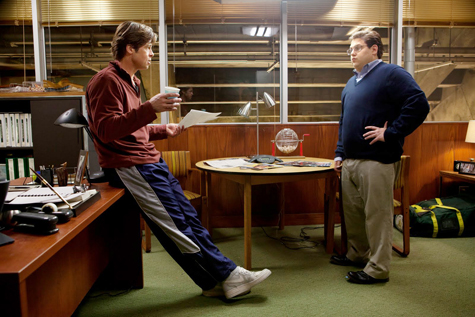
Brad Pitt steps into the real-life role of Beane, whom we meet up with as the A’s are facing elimination in Game 5 of the American League Divisional Series. The team had taken the first two from the Yankees–in New York, no less–but dropped two in Oakland, forcing the series back to the house that Ruth built (if you buy into that sort of thing). Beane sits alone in an empty Oakland Coliseum, fiddling with the on-off switch of a battery-powered radio. He can’t listen as the Yankees do what you’d expect of a team with around triple the payroll of its competitor and take the series in dramatic fashion.
It’s a crushing defeat in more ways than one. Beane stands to lose three of his top players–Jason Giambi, Johnny Damon and relief pitcher Jason Isringhausen–to free agency at season’s end. And with Oakland’s paltry revenue, he’s powerless to stop it. He must find a way to fill the void of Giambi’s MVP-caliber season on the cheap. He comes to the conclusion that he can’t. Damon heads to Boston, Giambi to the Bronx, and Beane starts looking for another way.
He meets up with Paul Brand, a fictional character played by Jonah Hill loosely modeled after Paul DePodesta, vice president of player development for the New York Mets. Brand introduces Beane to sabermetrics, a world of exotic stats, such as Batting Average per Balls in Play and On Base Plus Slugging Percentage, developed by Bill James. Brand, a Yale graduate with a degree in economics, tells Beane that instead of spending his limited funds on players, which are expensive, he should be allocating the money to runs, which, as Brand suggests, can be a lot more affordable.
Beane and Brand’s new approach ruffles the feathers of many in the baseball community. It’s also a complete flop, at first, but eventually the lowly A’s take to the new approach and embark on a historic run toward the American League West division title, at one point winning a record-breaking 20 games in a row.
Moneyball hits home on a lot of levels. Intentionally or not, it plays upon the widening economic gap between the top 1 percent and the rest of us. In theory, there really is no way the A’s could ever compete with the Yankees. They don’t even belong on the same field. Yet, in the span of one at-bat, as one commentator’s voiceover intones toward the end of the film, anything can happen. If money really bought championships, the Yankees would win every year, yet–no matter what the team’s fans would have you believe–they don’t. Conversely, if Beane’s highly analytical approach was really the key to “changing the game forever,” the A’s would be unstoppable. Sadly, there are probably many Oakland fans who are well aware that is not the case. It’s this mix of improbability versus futility that makes Moneyball such a fascinating drama.
Life ain’t fair, and neither is baseball, which is probably why it makes such engaging fodder for stories. Moneyball is blessed with a fantastic script co-written by The Social Network’s Aaron Sorkin and Schindler’s List’s Steven Zaillian, and Pitt could be nomination-bound for his best role to date, cementing his place as his generation’s answer to Robert Redford. Moneyball is a must-see for any baseball fan and a wonderful look at the lives of the people behind the statistics.