The Imposter
Rated R
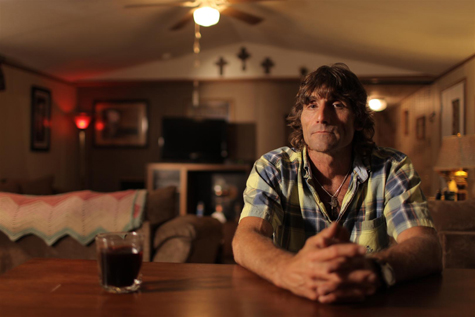
In the mid-‘90s, a 13-year-old boy from San Antonio, Texas, disappeared on his way home from a game of basketball. Miraculously, just over three years later, the boy was found halfway around the world in Linares, Spain. It’s an improbable story, even on face value, but the tale woven in director Bart Layton’s documentary/thriller The Imposter pushes possibility to its breaking point. The film packs the punch of a classic suspense story, bolstered by the fact that it’s a true story; however, like a prizefight that ends in a decision, The Imposter feels unfinished.
The film begins with an unfortunately true family story. Nicholas Barclay, a by all accounts loved but rambunctious, street-smart youth, disappears. Though the boy’s family exhausts great effort to find Nicholas, they have little support from the authorities or the media. It wasn’t a story to them, one family member intones as the film opens, “but it was a story to us.”
Barclay’s family comes to the begrudging realization that Nicholas is most likely dead. Then one day, out of nowhere, the boy’s mother receives a phone call that her long lost child has been found thousands of miles away. The U.S. Embassy and FBI are notified, people are deployed to a children’s home in the south of Spain, and eventually Nicholas’ oldest sister Carey Gibson makes her first trip to Europe to bring the now 16-year-old estranged teenager back home.
The problem is, it’s all a lie. The person posing as Nicholas is actually a 23-year-old Frenchman, who concocts an elaborate ruse that not only fools the authorities, but even Barclay’s own mother. The conman is brought back to the United States, where he and his surrogate family conduct a normal life until it all comes crashing down.
There are great characters in place: the crafty French conman who, telling his side of the story, seems to be a man who fell through the cracks–a man who yearned for acceptance at all costs; a sister (Gibson) who seems to be the rock of her troubled family; an affable and well-meaning, but somewhat daft, FBI special agent (Nancy Fisher); and a flashy southern private investigator (Charlie Parker) who becomes obsessed with the case.
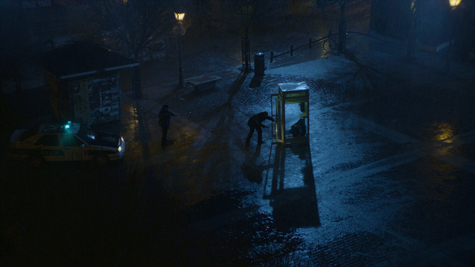
Layton tells this story using beautifully shot, intimate interviews with all parties involved. The film is not just a gallery of talking heads, though; archival footage, home movies, clever editing and brooding reenactments create a film that teeters between documentary and scripted drama. Layton deftly merges these two styles of storytelling, creating a seamless, compelling and sometimes even comical narrative.
Layton’s in-depth reporting gives The Imposter a detached, journalistic quality. All sides and viewpoints are given a voice and ample time to plead their cases. For much of the film, it feels like judgments aren’t made as facts and accounts of these remarkable events are presented quite plainly.
The Imposter flows like a typical documentary until Parker’s arrival when the already extraordinary story takes a spectacular and unexpected turn. Fisher and Parker begin putting the puzzle pieces together and the picture that reveals itself turns out to be rather shocking.
The suspense really ramps up as the film closes. Unfortunately, this rising crescendo hits a wall as The Imposter abruptly ends. This is a documentary, after all, and as is often the case in real life, solid resolutions can be hard to come by. Still, the film’s cool, journalistic stance leaves plenty to conjecture and the imagination, but does little in making an actual point.
Then again, that could just lead to lively discussion. Fantastic stories like this could only happen in real life, so there is truth in the old phrase, “You can’t make this stuff up.”
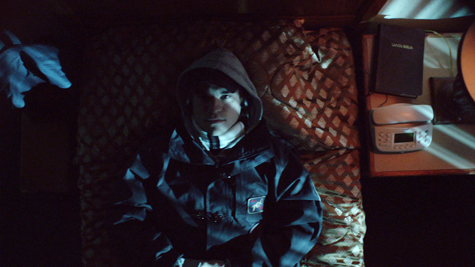
The Imposter opens at the Crest Theater in Sacramento on Aug. 24, 2012. Check http://thecrest.com/ for more info.
Daniel Herrera’s Vaudeville is the work of true photographic alchemy
In medieval times, the practice of alchemy was based on the belief that base metals could be turned into wondrous things such as gold. It was the process of taking something common and turning it into something spectacular. Alchemy may not have a place in modern science, but the idea behind it certainly can be applicable to the arts. Sacramento photographic artist Daniel Herrera stands as proof of that. His latest series Vaudeville combines in-camera effects, simple plants and roots and a little bit of carpentry, and spins these things into something truly magical.
Herrera began working on Vaudeville in 2009, he says, when he started laying the groundwork for the plot-driven series of photographs. The project was part of his work toward an MFA in photography that he earned this past spring from San Francisco State. He’d earned a BFA in photography from San Jose State back in 2003, but took some time off in-between to focus on making a living.
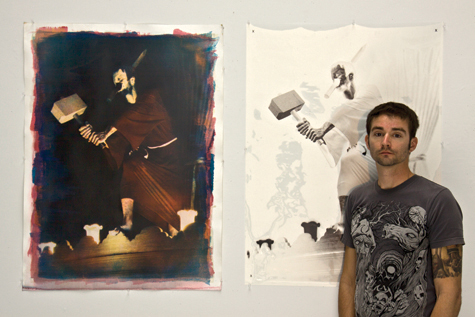
“I spent a lot of time hustling,” said Herrera of the gap between his bachelor’s and master’s degrees in a recent interview with Submerge. “It’s really difficult to make a living as an artist. I would be doing my work and trying to get into shows. I was working on a loading dock for a number of years, and then I started doing design work for about six years. I worked for an art department and did commercial work.”
Herrera discovered a love for teaching, which brought him back to school to gain his MFA.
“I decided to go back to school to get my MFA so I could do [teaching] as my job-job while I could still do my art,” he said. Herrera currently works as an adjunct professor at American River College and the Art Institute of California, Sacramento.
Herrera said that in the years between his undergraduate and graduate education, he stuck mostly to inkjet printing, but he never lost his love for the dark room.
“I still missed being in the dark room and all the chemicals and mixing up all your own stuff. It’s sort of like being this old-timey alchemist,” he said. “There’s some magic that happens in the dark room that I don’t get from being in front of a computer.
“When I went back to school, I knew I wanted to experiment with the old timey stuff.”
”]
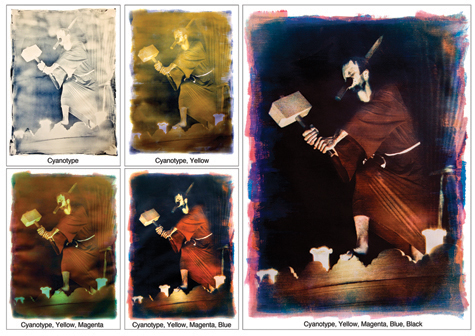
It was this desire to get his hands dirty with perhaps antiquated processes that eventually led to Vaudeville. Though he also employs modern tools such as Photoshop, much of the work in creating these prints comes from a process that was popular in the late 1800s/early 1900s, the time period in which Vaudeville is set. Herrera seemed eager to detail how he made these prints using gum arabic, the base ingredient of watercolor pigment. But quite frankly, the delightfully arcane knowledge he dropped during our phone conversation went right over this interviewer’s head. So, he attempted to break it down in simpler terms.
“It’s like four-color silk-screening almost,” Herrera explained. “I’ll use a blue pigment first, lay it down, and once it’s dry, I’ll re-coat the paper and re-expose it with a different color. Eventually it builds up density and builds up all the colors.”
Herrera said the multi-step process had a “steep learning curve,” where multi-colored prints took days to produce.
“You have to soak the paper for a number of hours and wait for it to dry,” he said. “There’s no way to speed that up. If something goes wrong on your third or fourth print, it wastes two days worth of time.”
When asked if it was as difficult as it sounded, the artist joked, “Yes, probably even more so.”
But even before he started actual production on Vaudeville, Herrera was hard at work sketching ideas and creating the story that serves as the series’ backbone. The idea was borne out of the artist’s love for sci-fi and fantasy film narratives, as well as his interest in the history of photography. These ideas merged in a story he created about an alien traveling vaudeville variety show that has made contact with Earth in the early 1900s–a sort of “magical past,” as he referred to it.
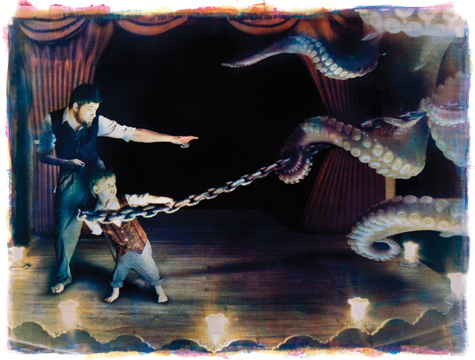
Continuity
The result is fantastical images such as Continuity, which depicts a man and a young boy, who seems to be wrangling a kraken-like creature from the deep with an oversized chain. Giant tentacles flail stage left as the man and young boy huddle together stage right. Though the image is somewhat surreal, the ideas that spawned it are firmly based in reality.
“The idea of it was just social continuity and what we absorb through society and our parents, and the octopus could be like all the bullshit,” Herrera said.
The image itself was also crafted with real world materials. Herrera himself built the miniature stage on which the action in the photo takes place, cutting and finishing the wood and gluing it into place. He even wired it so it had its own working lighting plot. The stage also serves as the setting for other photos in the series and will be on display at Herrera’s upcoming exhibition, the artist said. As for the tentacles, he snagged them from a local sushi restaurant and photographed them.
Another image in the series, The Carapace, which features a tattooed woman with a wild shock of gnarled hair holding a capsule containing some sort of fetal creature, as trickery laden as it may seem, is actually mostly one shot.
“The only thing that was composited in was her hairpiece,” Herrera said of the piece. “Everything else was one photograph. I built that little container. I think the thing inside it is a potato and some other root vegetables that I’d just glued together and painted pink. That was really cool, because when it was suspended in the tank, it started to shrivel and change quite a bit.”
Though the images he creates in Vaudeville may not realistically portray our physical world, they do have a realness about them. The fact that he built the stage, or used real materials and placed them in unreal situations seems to lend more authenticity to the photographs than if they were solely the creation of computer generated graphics.
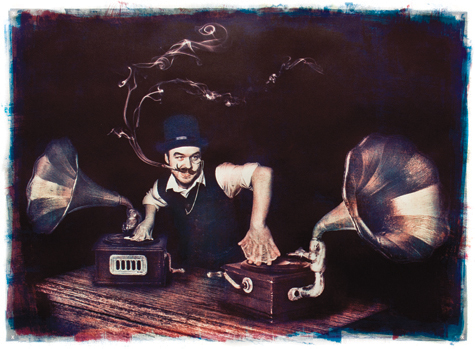
The Wax Tickler
“It’s one of those things that a lot of people do take for granted,” Herrera said. “Once people realize that the things that are in my images actually existed, and it’s not CG or anything like that. I definitely augment things in Photoshop, but I build these things to photograph. I think that changes people’s perception, even if it’s something that they don’t realize when they’re looking at it.”
Herrera informed us that there would be about 10 images on display when Vaudeville opens at the Viewpoint Gallery in Sacramento, but that it was his intention for the series to reach 20 photographs. Each photograph has a story behind it, and when the series is finished, he hopes to collect his writings and compile them with the photographs into a book. In the meantime, the best way to see this strange intergalactic circus will be live, in the flesh.

Daniel Herrera’s Vaudeville will be on display at Viewpoint Gallery in Sacramento starting Aug. 8, 2012 and running through Sept. 1, 2012. An artist reception will take place on Aug. 10, 2012 at 5:30 p.m., with a Second Saturday reception the next day, also starting at 5:30 p.m. For more info, go to https://www.viewpointgallery.org/, or visit Herrera on the Web at http://danherrerastudio.com/
Trishna
Rated R
From an outside, idealistic perspective, India seems like the perfect place for romance. It has a rich and ancient culture, with a mythology as colorful as its people and costumes. In the cinema, the country has become known for ornate dramas and sweeping love stories full of song and dance. Trishna, the latest film from writer/director Michael Winterbottom (24 Hour Party People), has all the makings of a romantic epic. However, this is a rags to riches tale gone horribly wrong. It begins as a sort of Disney princess story, but it keeps the camera rolling to see if there really is such a thing as “happily ever after.” In this case, there isn’t.
The sprawling story of the title character (played by Slumdog Millionaire’s beautiful heroine Freida Pinto) begins in Trishna’s hometown in a rural village in Rajasthan, the largest state in India. She is a proper young woman of 19, the eldest daughter of a large family. She even addresses people as “sir.” Trishna’s life changes forever when she meets a handsome young man named Jay Singh (Riz Ahmed), the son of a wealthy hotel tycoon who is instantly taken by her.
It seems like just a chance meeting, but one day Trishna’s father, who struggles with alcoholism, falls asleep at the wheel and crashes his truck, full of cargo and Trishna in tow. The accident leaves both alive but injured. Trishna has a broken arm, but what’s worse is that her father is unable to work, leaving the already poor family in dire financial straits. Luckily Jay, unable to shake his feelings for Trishna, returns to her home and learns of her woeful story. He offers her a job at his father’s hotel in Jaipur, capitol of Rajasthan, where Jay finally expresses his desire for Trishna. But after their first night together, the shame she feels is too great and she immediately returns home.
It’s the stops and starts in their budding romance that creates wonderful conflict. Jay seems supportive of Trishna and appears to really want her to excel. He enrolls her in college classes in hotel management so she can possibly better her station, but as the film goes on, it seems that all of this generosity comes with strings attached. As selflessness sours into selfishness, so does their story spiral into tragedy.
What’s really at work here is the anything’s possible ethos of modern day, cosmopolitan life butting heads with staunch tradition. Eventually Trishna and Jay meet again. After her abortion leads to exile from her family’s home, she begins working in a factory–the cushy life at the hotel in Jaipur seems miles away. Once again, Jay returns and brings her to Mumbai, where living together as an unmarried couple isn’t frowned upon. Love between the two really blossoms. They are free from antiquated ideas of class and propriety. Still, old values creep in: Trishna, for example, has always loved dancing, and the couple’s artistic friends urge her to pursue it further; however, Jay is resistant to his girlfriend dancing professionally, and in the end, much in the way she seems to follow Jay anywhere, Trishna cedes to his wishes.
Otherwise, things are fine until a family situation forces Jay to return to the hotel business. The couple leaves the liberal city behind once again for Rajasthan. There, steeped in old traditions, Jay becomes more like a lustful sultan than a loving boyfriend. After reading the Kama Sutra, Jay asks Trishna in one of the film’s more poignant moments whether she is a maid, single woman or a concubine. She answers, “I don’t know.”
It’s this sort of inner struggle that’s so achingly portrayed via Winterbottom’s immediate style. Every shot drips intimacy as the film moves sporadically between joy and horror. Pinto’s face, often featured in close-up, displays heartbreaking fragility. Her wide-eyed character wants to see the best in people, and in herself, but that sort of idealism often leads her to make very questionable choices. You want her to succeed–perhaps because she seems doomed to fail. Unfortunately, fairy tale endings aren’t so easy to come by.
Trishna opens at the Crest Theatre on Aug. 3, 2012 and will run through Aug. 9. Go to http://thecrest.com/ for showtimes.
Grouplove turns a chance meeting into beautiful music
The story of how indie rock band Grouplove formed is so unlikely, it’s practically mythic. It’s fitting then that the band first met in Greece on the island of Crete. New Yorkers Hannah Hooper and Christian Zucconi were attending an artists commune there where they bonded with other like-minded individuals from around the globe: Brit Sean Gadd and Californians Andrew Wessen and Ryan Rabin. Though the quintet hit it off, it seemed unlikely that their meeting would be anything more than just a one-off occurrence in a foreign land.
But there would be more in store for the members of Grouplove than just a fond memory. A reunion brought them back together again, this time in Los Angeles, where Rabin, now drummer/producer for Grouplove, had a studio. He invited everyone down to record just for fun. The recordings resulted in the band’s self-titled debut EP, which was released in January 2011.
“When we made the EP, it came to us naturally,” says Zucconi, Grouplove’s guitarist/vocalist.
They were all stoked on the recording, but there were still obstacles, namely the thousands of miles and an ocean that separated them. Eventually word started to spread about the band over blogs, and it became apparent to Zucconi that they had to make a real go at being a band or they would regret it.
“We were all kind of in our own lives. Sean was in England, and Hannah and I were in New York. We all wanted it to happen, but we were afraid to speak up and really make it happen because there were so many obstacles in the way,” he says. “When we got home, and we were listening to the recording and sharing it with friends and everyone started reacting so well, it just started to feel like we should really try to make this a thing.
“I remember writing an email to Sean, I said do you want to drop everything, your life, your family and friends and move out to L.A. and try to do this thing, and he was like, ‘Of course,’” Zucconi continues. “He was on the flight a week later.”
Grouplove didn’t waste any time. In September 2011, the band released its first full-length album, Never Trust a Happy Song, a 12-track clinic on the possibilities of electro-pop infused indie rock. Snarling guitars play well with glitchy beats, and the lead vocal duo of Hooper and Zucconi create melodic bliss with their soaring harmonies. It’s not all blips and bloops either, as the spare, folk-tinged track “Cruel and Beautiful World” will attest. Each member shares writing credits on every song on the album, which speaks highly of the band members’ chemistry. It would seem that they had been writing songs together for a decade or more, but Zucconi says it’s the newness of their partnership that aids them in their wide-open songwriting process.
“There are no bad habits that you picked up from joining up with the kids you grew up with and started a band when you were 12,” he says. “We all kind of started with a clean slate, which is something cool and refreshing. Being someone who has played in bands for a long time, it’s really cool to experience that.”
In the following interview, Zucconi talks about a recent reimagining of Andrew W.K.’s “Party Hard,” which the band performed for the Onion A.V. Club, and gives Submerge some insight on “Tongue Tied,” the band’s biggest hit to date, which in addition to topping charts, has also appeared on Glee and in a popular Apple commercial.

Photo by Aaron Farley
I was messing around online, and I saw you guys did an Andrew W.K. cover for the A.V. Club. I’m a big Andrew W.K. fan.
Oh cool, what did you think of it?
I thought you guys did an amazing job. I love covers that stray from the original.
We wanted to do a reinterpretation of it, change all the chords and the chord progression, but still keep the melody.
I liked the bit you guys did with the chorus, “We will always party hard.”
Thanks, man. I don’t know if you saw online, but he [Andrew W.K.] really liked it. It was really cool.
Oh, so he had heard it?
He Photoshopped himself in one of the shots of all of us in the costume. He put himself in the middle. It was really funny.
Were you a fan of the song?
You know, it’s weird. I kind of missed the popularity of that song. Hannah and the other guys were big fans of it. I guess Hannah a couple of years ago would dress up as Andrew W.K. in the city [New York] for Halloween. Of course, she came up with the idea of getting into costume for the cover. I didn’t have any attachment to the old version, and that kind of helped us. Being innocent sometimes helps with approaching songs, in a way. I remember the album cover really well. It was an iconic thing at the time, but I never really heard his music before.
Just last month, you topped the Modern Rock Radio charts with “Tongue Tied.” How did you react?
It was super surreal. The life of that song has been really interesting, and you step back sometimes to see what’s happening. It was at No. 3 for the past 12 or 13 weeks, and that we were all excited about, like, “Wow, this is really cool.” Then more people started playing the song radio station wise. It’s really exciting. It’s hard to really take in what it means, but we were really pumped on it, and everyone we worked with was pumped. We went out and celebrated. It was really cool.
When you get in a band and start writing songs, you probably don’t think about charts…
Never, yeah.
But when it happens, it must be something like you don’t realize how cool it is until it actually happens. Is it that sort of thing?
Yeah it’s kind of like that. It’s interesting, because it’s a weird concept. Like, when you’re writing a song and you’re playing with the band, you’re not thinking about that. “I wonder what our radio plays per week are going to be?” That was all new to me. As we entered that world, I was just learning about it every day because I never experienced it, and as a listener, I never really paid attention to that kind of stuff. We’re all really proud, and it’s great that people out there like our music and are responding to it. That’s why we do it. It’s great to get that kind of reaction.
That song in particular, I know that you guys share writing credits on all the songs, but how did “Tongue Tied” come about?
It was an early song… I was in L.A., and we just kind of moved there. Sean had just moved to L.A., and he’d only been out there for a week or two. I was scoring a really somber film for my friend. I had a piano out and this little home studio that I’d set up to score. I was working on this really heavy scene, and Sean and Hannah were in the house next door, and I just took a break for a minute and started messing around on the keyboard and just started playing that riff, and it was super fun. It just was a whole 180-degree turn from the song I was just working on. It was weird that this upbeat, happy thing just came out of me. I put down a drum beat behind it and some bass lines–there were no vocals at the time–and I brought it to Sean and Hannah and we started playing it in the yard, and everyone started dancing. They were like, “Play it again! Play it again!”… While we were listening back to it, and everyone was jumping up and down, Hannah started singing “Take me to your best friend’s house…” And we just kind of wrote the lyrics on the spot.
By the time it went through the whole Grouplove machine with Ryan producing, and everyone’s awesome ideas, trading thoughts, it just became a 10 at the end. It really came to life in the studio, and we were all just happy with it.
It was a fun learning process, too, for me personally and Hannah, because we’d never tried to write an upbeat electronic pop song, so it’s fun to experiment in that genre and put our stamp on it, so it was a good experience.
When you guys were done with that one in the studio, did you get an inkling that it would be one of the more recognizable songs on the album, or be the one to push it forward?
Yeah, we did kind of feel that after we were listening back to it. When we were recording, during the process Canvasback and Atlantic [Grouplove’s record labels] were super cool and let us do our thing in house. They were never checking up on us, so when the time came that we had some roughs of the album to bring into the record label office, like, “This is what we’ve been working on for the past eight months,” that was the first song we played them, and they were like, “Oh shit!”
You were talking about Ryan as producer, and he’s in the band also. Does he go into producer mode when you get in the studio? Is it almost a Jekyll and Hyde sort of thing?
When we met Ryan in Greece, he was talking about how he loves music and he’s into recording bands and has been doing so since he was 16. When we made the EP, by accident, we were all in L.A. after meeting in Greece, and we had nothing to do one day. He was like come over and record some stuff just for fun. He has this ability to take the beginnings of a song and put life into it in a way you’d never expect, just by his drumming, his ideas and his arrangements. When we met each other, that’s how I got to know him, through the recording process and writing together and producing. That’s just who he’s always been. We trust his ideas, and he’s super talented. I’ve been in bands a long time, but I never really knew what a producer did because whenever we’d go into the studio, we’d do it all ourselves, and we had all the ideas. A producer brings a whole other perspective on it. He says to speed things up or slow them down.
It’s kind of like how we write. We’re all super open to each other’s influences, because they’re so different. Whoever writes the song, it has everyone’s influences all over it once it’s done.

Grouplove will be a part of this year’s Launch Festival. The band will play at Cesar Chavez Park on Saturday, July 28, 2012. Bring your shades and sun block, because this show gets underway at 11 a.m. For a full rundown on this year’s Launch Festival, go to http://www.launchsacramento.com/, and for more Grouplove, go to http://grouplovemusic.com/. (Submerge hasn’t looked, but we’d imagine that Grouplove.com will bring you to an entirely different sort of website.)
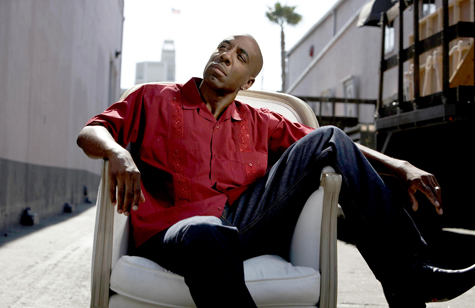
J.B. Smoove lives and creates on the fly
The birth of Jerry Brooks’ first child (his now 18-year-old daughter) was a pivotal moment in his life in more ways than one. Brooks was working as a graphic designer for a T-shirt company around the time his daughter was born, doing stand-up comedy at nights. But the arrival of his baby girl brought him to a crossroads. He decided to veer away from the comfortable path of his career and immerse himself in comedy and acting. In retrospect, it was a very wise decision.
“I quit my job,” he says. “I felt like the only way I can dive in there and do this comedy stuff, I’d actually have to do it. When you have something to lean on, you can’t really achieve your dreams, because you’re always leaning on something else. I said the only way I’m going to be able to do this is if I go full throttle, so the day she was born, I quit my job, which made me have to do it. It made me have to get out there and get downtown and do gigs and go on auditions and get photos taken. It made me have to do all these things to keep the lights on.”
A risky leap of faith with a new mouth to feed at home? Maybe. But it turned out to be worth the gamble. You probably know Brooks better nowadays as J.B. Smoove–who in addition to having a successful stand-up career and being a former writer and performer for Saturday Night Live– has rose in popularity as Larry David’s hilarious foil Leon Black on HBO’s Curb Your Enthusiasm since its sixth season. Prior to his life as a comedian and actor Brooks was in school to be an engineer, receiving a associate’s degree in engineering before the math caught up with him and he decided to move into graphic design.
“I think about The Brady Bunch, and the dad was an architect, and I was like, ‘Damn, no one mentions this part.’ They don’t show the math part; all they show is him walking around with the blueprints and looking real cool,” Brooks says. “But that math will kick your ass so bad, it will make you switch your major.”
A life as a comedian eventually won out over more traditional pursuits. He admits that becoming a father and making the jump into a highly competitive field was “challenging,” but it was the difficulty that drove his passion.
“I get a high off of challenges,” Brooks says. “Even not knowing what I’m going to do in a scene, if they don’t give me any lines, even if not knowing all that stuff, I get a certain kind of energy from that too. Part of me is like, ‘What the fuck am I going to say?’ and another part of me is like, ‘I can’t wait to say what I’m going to say.’ It’s like…someone’s leading you down a corridor and downstairs, and you’re blindfolded, and you don’t know where you’re going.”
Taking that into consideration, it’s clear that Brooks has the perfect mental makeup to excel in a show like Curb Your Enthusiam, which is largely improvised. He explains that the actors were given eight-page synopses of each episode as a sort of guideline, but Brooks says that he never really read those.
“I don’t like to see the outline, because I feel like I’m going to over-think my scene,” he says. “So I just get to the set and allow the writers to tell me what’s going on…I like to go off instinct and what I’m feeling in the moment.”
In this way, Leon Black has become a real person to Brooks, much as the character has to his many fans–or Leon Nation, according to Brooks.
“I find myself talking about Leon like someone I know,” he says. “I would do a bunch of Leon scenes, and on my way home, I’d call my wife and be all, ‘Leon is crazy as hell!’ And my wife will be caught up in it too. She would say, ‘What did Leon do today?’”
Diving headfirst into his character is something Brooks really enjoys.
“It’s hilarious to talk about him as if he’s some other person, which I find to be a better process,” Brooks explains. “I’m more in that frame of mind when the cameras roll. I don’t feel like I have to jump into it. I can just have him ready to go, get dressed, walk to the set and allow him to do what he does. And when I leave, I have the chance to talk about him over the phone to my wife and to my friends. Leon’s a damn fool!”
This sort of approach has fueled his stand-up, which has always featured a good deal of improvising. In the early ‘90s before he broke into stand-up, he got his feet wet by taking an improv class, which taught him how to be comfortable with creating on the fly. Brooks claims that you’ll never see the same J.B. Smoove comedy show twice.
“I don’t perform a set where it’s always 1-2-3, 1-2-3, like I’m doing a dance or some shit,” he says. “I like to perform for my audience.”
He keeps his sets different and fresh by being observant. The day’s weather may inspire him, or perhaps even an everyday object like a stool could be incorporated into his act. Brooks says that he also likes to get around the town he’s in and get a feel for it to find out “what’s funny about that city.”
“I think that’s what makes you in that moment, because you’re actually visiting, and you’re performing in their city,” he says. “You’re bringing everything that you do to them, because you have to let them know what you noticed about being here that’s so cool and so funny.”
The venue itself could also play into his performance. Brooks recalls playing a nautical-themed club called Captain Brien’s in Marco Island, Fla. The décor, which featured fish nets on the ceiling and a replica shark bursting through the wall by the stage, ended up playing a big part in his act.
“Man, I must have did 20 minutes on just that stuff alone,” Brooks says with a laugh. “Somehow I took all of that stuff and made an episode of SpongeBob SquarePants out of it.”
The exciting thing for Brooks is that a performance like that is pretty much unique.
“It was so damn funny, but I realized I could never do it again,” he says. “I could only do it there. It was a one-shot deal. I couldn’t go to Chicago and do that same bit, because it wasn’t the same setting.”
His reputation for off-the-cuff gems such as this and the celebrity he’s garnered from Curb Your Enthusiasm has really started to pay dividends. Next year, Brooks will be featured as the voice of Harold alongside household names such as Billy Crystal, Steve Buscemi and John Goodman in Disney/Pixar’s Monsters University. Familiar with his work, the filmmakers allowed Brooks a lot of freedom to create with his character, which turned out to be a lot of fun for the actor.
“They let me get in there and play around with stuff, which is great. It’s more comfortable. It’s easier to create on the go,” he says.
Brooks will also be featured as the voice in two other animated films slated for 2013, according to IMDb, Hell and Back (as Sal the Demon) and Smurfs 2 (as Hackus).
Between that and his stand-up career, Brooks will have plenty on his plate in the year ahead. But what about Curb Your Enthusiasm? Season after season, It’s always anyone’s guess whether or not the show will return to TV. As Brooks puts it, “I think we’re always at the mercy of Larry [David], so we’ll see what’s going on. When you’re that damn rich, you don’t need a paycheck, you know what I mean?”
But Brooks has been in contact with David and reports that another season may be in the works.
“I give Larry a call off and on just to see what the hell Larry be doing, just to see what kind of adventure Larry is up to,” Brooks jokes. “You gotta check on rich people just to see what the hell they’re doing. What boat you on, Larry? Where you at, what country you in? What room are you in, in your big ass house? Which car are you driving? I like to check in on Larry David once in a while just to see how he’s doing. So far, there’s no definite answer right now. I’m thinking possibly some time in 2013, that’s going to be the platform right now for it. I don’t think it will be any time this year. So I think next year he’ll make his mind up.”
Until then, fans have a chance to catch Brooks live, in-person as J.B. Smoove, bringing the ruckus as only he knows how. It’s hard to say what to expect from one of his comedy shows, but it’s a gamble worth taking.
You have multiple chances to see J.B. Smoove live when he plays five sets in three nights at Punchline in Sacramento, July 19—21, 2012. Tickets can be purchased through Livenation.com or http://punchlinesac.com/
Brave
Rated PG
Pixar and Disney seem to have the perfect symbiotic relationship. Pixar, based in Emeryville, Calif., continues to crank out quality, family friendly films, feeding off of Disney’s epic resources and mammoth distribution; and Disney reaps the rewards of yet another noteworthy brand that has to kick up to the Mouse. Over the years, Pixar has created a new crop of characters that have become every bit as iconic as Mickey, Donald and Goofy. The children of today have grown up with Woody, Nemo and Lightning McQueen. Though the two studios feed off one another, there seemed to be a line drawn in the sand. Disney has stuck to fairy tales and fantasy, while Pixar has created more modern stories with equally strong, and perhaps more relevant morals. With Brave, we see a bit of a crossover. This is Pixar’s first fairy tale with its very own princess. Merida, with her tangled nest of red curls and Katniss Everdeen-like prowess with a bow and arrow, is also the studio’s first female protagonist. This may be old hat for Disney–and the movie-going public–but Pixar proves that a formulaic plot doesn’t necessarily have to translate into uninteresting storytelling.
Merida, voiced by the lovely Kelly MacDonald (HBO’s Boardwalk Empire), is a princess, sure, but she prefers not to act like one. She takes more after her brawling brute of father King Fergus (the always hilarious Billy Connolly) than her proper, lady-like mother Queen Elinor (Emma Thompson). Merida’s tomboy lifestyle is fine when she’s a child, but as she grows older, it becomes time for her to forego her quiver and bow for gowns and curtsies. When Merida discovers her hand in marriage is to be offered to a suitable suitor from one of three neighboring clans, the friction between the young girl and her strong-willed mother becomes combustible.
At a loss for what to do, Merida takes off into the woods, where she becomes pixie-led by the will o’ the wisps and happens upon a witch’s cottage. She purchases a spell that will change her mother’s mind about the arranged marriage. The magic works, but not in the way Merida would have hoped. Merida and Elinor must embark upon a quest to reverse the spell and also repair the severed bonds between mother and daughter.

Brave is simple and sweet, both in its plot and its execution. Grand themes such as fate and destiny are given a very human face as they’re played out in the struggles between Merida and her mother. The story isn’t so much darker than what you’d find in Cars or Toy Story, but it does feel a little heavier. Though the setting may be fantastic, there are some very real world things at work here, such as the juggling of desire and responsibility and whether or not one should put their dreams aside in order to achieve a greater good. There is also a great deal of suspense involved during a climactic showdown with Mor’du, the demon bear that once claimed Fergus’ left leg.
It wouldn’t be a Pixar film, however, without plenty of humor. There are some great scenes of comedy relief provided by Merida’s three baby brothers, and gut-busting laughs are brought forth as Merida and Elinor (quite changed from her queenly form) try to sneak back into the castle past Fergus and the clansmen.
What’s missing is the relentless heartstring pulling that was found in Up, Wall-E or the most brutal tear-jerker of them all Toy Story 3. Though the characters are fun and vibrant, and Merida and Elinor are worth cheering for, the real depth of emotion that seems to punctuate most of Pixar’s best work is lacking here.
That being said, Merida fits nicely into the pantheon of Disney and Pixar’s animated heroes, even though she’s an outcast in both camps. She’s neither an anthropomorphic being, nor the beautiful princess yearning for her prince. Merida’s a bit of a misfit, and she probably wouldn’t have it any other way.
Prometheus
Rated R
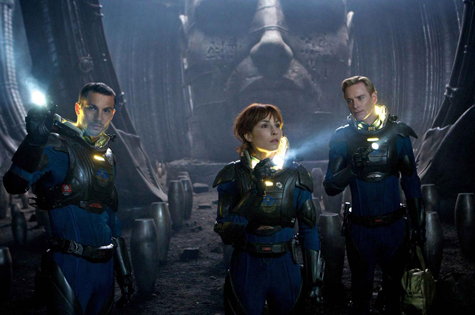
Ridley Scott’s Alien came out in 1979, perhaps before a lot of you were born. The sci-fi/horror hybrid was a truly frightening and groundbreaking film that propelled Sigourney Weaver to superstardom and birthed countless comic book crossovers and a long-lived film franchise, of which only the first two films (including James Cameron’s action-fueled 1986 sequel, Aliens) are really worth seeing. Prometheus takes us back before the beginning. It’s a prequel, a word that may have left a bad taste in your mouths after the debacle that was the prequels to the Star Wars saga. In Prometheus’ case, a look back proves to be more enlightening (and opens up even more questions) to the events portrayed in the Alien series as opposed to damaging their legacy.
The year is 2089. Two researchers, Elizabeth Shaw (Noomi Rapace, Lisbeth Salander of the Swedish-language The Girl with the Dragon Tattoo) and Charlie Holloway (Logan Marshall-Green), have patched together clues from ancient cave paintings, left by civilizations from all corners of Earth to create a map to a moon in a far-off solar system capable of supporting life. While that discovery may be monumental enough, it’s even more so because Shaw and Holloway hypothesize that this moon may have been the origin of the human race–as well as the beings known as Engineers who created it.
Peter Weyland (Guy Pierce) assembles a rag-tag exploring party to accompany Shaw and Holloway on their journey. Weyland is convinced that the Engineer theory is correct and that contact with this mysterious race of beings could answer humanity’s greatest question, “Why are we here?” Led by the icy Meredith Vickers (Charlize Theron), the party aboard the Prometheus find what they’re looking for, much to their chagrin.
Story aside, Prometheus is awe-inspiring to behold. Audiences will no doubt be left slack-jawed by the film’s bold look and stunning scenery. In most cases, 3-D seems little more than an easy way for big-ticket Hollywood films to pad their box office numbers, but much like Avatar, which really ignited the 3-D frenzy, it would be to your detriment to view Prometheus in its flat transfer. Sweeping panoramas of alien landscapes, wonderfully rendered computer effects and trippy digital-static overlays are wonderful fodder for eye-popping visuals, and Scott seems to use them to wonderful effect. Do yourself a favor and spring for the extra few bucks.
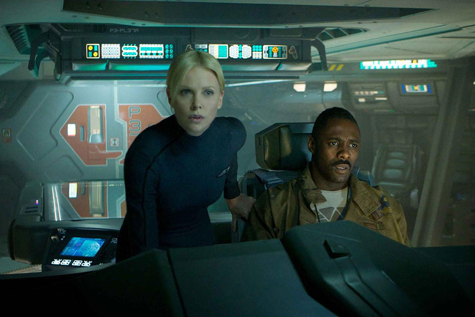
More traditional elements also enhance this feast for the eyes. H.R. Giger’s twisted cyberotica, which has been an Alien series hallmark since 1979, flavor Prometheus with terrifying notes, touching upon fears that are exotic and familiar. From the macabre marriage of the technological and organic of the Engineers’ fortress and control rooms to the freakishly vulgar creature creations, the uneasiness of the characters seems mirrored in their otherworldly surroundings.
It’s good that the visuals are so stupendous, because the film’s plot is surprisingly basic. Co-written by Lost co-creator Damon Lindelof (with John Spaihts), one might expect a dizzying story with a lot of twists and turns, but there aren’t many to be had. There are instances where we see flashes of the philosophical/spiritual mindbenders that were Lost’s trademark, but in the end, Prometheus stays true to the Alien franchise formula: humans trying to manipulate forces they don’t fully understand to their own greedy ends. There is the rich man, Weyland, who knows more than he lets on (a sort of Charles Widmore, perhaps?) and the android who seems helpful but may have its own nefarious agenda–devices that anyone familiar with these movies has probably come to expect. Unfortunately, other than a tense scene in a robotic surgery chamber, there isn’t much in the way of suspense that made Alien such a classic.
There are a couple of noteworthy performances, though. Rapace, who really gets run through the wringer in Prometheus, is the prototypical Scott heroin. Amazingly fit, she’s also tough, persistent and perhaps a bit bitchy, but she certainly upholds the high standard set by Weaver in previous films as the central character. Michael Fassbender is a wonderful antithesis to Rapace as the outwardly charming robot David, who models his appearance after Peter O’Toole in Lawrence of Arabia. Underneath his classic screen star looks is a personality more akin to 2001’s HAL9000, however.
In true Lindelof fashion, Prometheus answers as many questions about the Aliens’ origins as it poses new ones, which may be answered in another film. As beginnings go, it at the very least opens the door to a promising future.
Rocklin Band Wife and Son Release Their Debut Album
Rocklin-based indie pop band Wife and Son is a shining example of why you shouldn’t take yourself too seriously. Formed in 2009, the now five-piece group was originally the brainchild of guitarist/vocalists Richie Smith and Robert Brundage. They had been making music together for a while in a series of what they refer to as “joke bands,” until they started taking music more seriously under the moniker of Wife and Son. This That and the Other, the band’s debut album was released digitally in April but it is now ready for its official physical release.
Smith and Brundage have been friends for about eight years, Smith says, and were introduced through his little sister Alexis. Smith, a Grass Valley native, and Brundage, born in Monterey, Calif., but raised in Folsom, played in a variety of bands before entering into Wife and Son. These early bands included The Outrights and Polar Bear Filth. These outfits garnered some coffee house gigs, but Smith says that they were strictly just for fun. However, though they say that none of the songs on This That and the Other find their origins in the Polar Bear Filth catalog, those formative years of goofing around with music have played some part in where they’re at today.
“I feel like the joking around allowed me to not take anything seriously,” Brundage says. “That way, you’re not afraid to try some crazy harmony that’s kind of flashy or too pop-y–just being willing to try anything, even if it might sound like something that you told yourself you’d never write.”
Funny enough, Wife and Son also started out as a joke but quickly morphed into something much more. With Smith’s wife Mars Wheeler (synthesizer/vocals) rounding out the original lineup, the group immediately started demoing songs.
“We started writing songs, and we really liked them, so we decided to actually try and do it,” Brundage explains.
“The goal was to be as original as possible,” Smith says of the band’s early writing sessions. “We all are big fans of pop music and good pop songwriting, like the Beatles as one of the best examples, but we also wanted to forego the classic pop song formula. We wanted to write freely and not necessarily go with the typical verse-chorus-verse format. Those are the things we would talk about a little bit, and we just wrote these song poems, almost, and put them together.”
Those demos stuck, however. Brundage says that all but one of the songs from the band’s original demo have found their way to This That and the Other, though they have evolved considerably since thanks to playing and gigging them a lot. The additions of bass player Josh Quimby and drummer Luke Arredondo also had a huge role in the songs’ maturation process.
“How we wrote the album was we wrote all the parts,” Smith says. “We composed the bass lines and we composed the drum parts as well. We’re not drummers. We can play a little bit, but we composed in our minds what kind of beat patterns we wanted to go with the songs. We presented them to Luke, and he would make it make sense.”
“He’d make them actual drum parts,” Brundage adds.
This That and the Other was produced and recorded almost entirely by the band. Other than the drums, which were tracked at One Eleven Recording and Music Studio in Roseville with the help of Kevin Prince, the album was recorded in Smith’s apartment using Logic and Brundage’s Macbook. It was an arduous task, but the band is happy with the result.
“We worked on the record over the course of a year, off and on,” Smith says. “It was a long process. There was a lot of stuff we had tracked that we ended up retracking. Honestly, we’re glad to be done with that process. We learned a ton on this first record.”
This being their first album, a lot of trial and error went into the process. Brundage says that some of the songs were recorded up to eight times.
“I was basically learning how to record while we were recording, and we were all learning about production too,” Brundage says. “It was like this huge music school on how to make a record.”

You’d probably never realize the meticulous nature of its recording by listening to This That and the Other. Opening track “Sea Salt” sets the tone with its carefree structure and generous use of reverb. The song feels loose, but in a good way–in a way that speaks of a band just having fun with the music and not coming off as guarded.
“Sea Salt,” one of the first songs the band demoed, was written in a very free-wheeling manner.
“We just hit record and Mars and I started singing,” Brundage says. “We just started freestyling, and we liked what we had to say.”
“Rob and I were just jamming on guitar parts,” Smith says of the song. “We wrote the guitar, bass line and drum part all in one sitting, in about an hour, then Mars woke up from a nap to lay down the vocal.”
Other songs came from a more structured writing process. The Brundage-penned “Little Baby Hurricane” had more intent behind it.
“I just sat down one day, and I just wanted to make a tribute to ‘50s doo-wop,” he says. “I sat down and pretty much wrote the whole thing and brought it to Richie and Mars, and they put in their two cents. Richie added this great guitar solo at the end.”
In this way, Wife and Son mix up their approach to writing. Smith, Brundage and Wheeler all split songwriting duties (as they do with vocals), sometimes writing separately and presenting the songs to the rest of the group, and other times writing together in the same room. The different approaches may have been a reason why This That and the Other, aptly titled, has such a fresh and varied sound.
Though the album is only just recently completed, Smith, Brundage and company have their sights set on the future of the band. Smith says that the band already has enough material on tap for a second album, which they also hope to produce themselves.
“We like the creative control,” Smith says. “The fact that we learned so much on the first record, we’re actually excited to work on the songs for the second record.”
Smith says that the lessons learned will make Wife and Son’s recording process faster next time around. He says the band will set deadlines for itself and work on being more efficient. It almost sounds like they’re taking themselves seriously. If Wife and Son’s exciting debut is any indication, that’s definitely not a bad thing.
This That and The Other’s release show will take place at The Press Club in Sacramento on June 28, 2012. In addition to Wife and Son, The Tambo Rays and Sicfus will also perform. If you’d like to listen to the album before you buy it, go to Wifeandson.bandcamp.com and of course, you can keep up with their latest happenings by liking them on Facebook (Facebook.com/wifeandson).
Composer Danny Cocke gets to work on scoring his first feature film and prepares to release a new album of trailer music
For some, getting to the cinema early for the trailers is just as important as seeing the feature presentation. Who can blame them? The trailers are often more exciting than the actual movies they’re meant to market. Trailers fuse all the best parts of the movie into an endorphin-drenched nugget of excitement, loaded with quick cuts, epic voice-overs and even more epic music. Los Angeles (by way of Sacramento) composer Danny Cocke handles the latter. Though just eight years ago, his music career and his life were in serious jeopardy.
In 2011, Cocke released From the Blue, an album of short but dramatic tracks, through L.A.-based licensing and publishing company RipTide Music. At the time, Cocke admits he was “dirt broke.” Much of From the Blue was even recorded in his old bedroom at his parents’ house.
“I was recording bands at the same time just to pay the bills, and all of a sudden it was the first Thor TV spot, and then Conan…Captain America, Green Lantern, and then I got called into custom score the first The Amazing Spider-Man trailer where they actually gave me picture–where he was in first-person running across the roof,” Cocke says. “I was a huge Marvel fan as a kid… It was totally surreal. I did not expect that level of explosion.”
Portions of Cocke’s music have also been used to promote what will likely be the biggest movie of the year, The Avengers. A full track from From the Blue, “World Collapsing,” was used in the trailer of the recently opened fairy tale adventure flick, Snow White and the Huntsman. Having a full song used throughout the entirety of a trailer is a rarity, according to Cocke.
“It was like, ‘What the hell?!’” he says of his reaction to the news.
Cocke says it’s a rush each time he hears something he wrote in a trailer, even though at this point it’s happening a lot more often. “They Came from the Blue,” another track off From the Blue, was placed in about a dozen trailers, he reports.
“Some of my composer buddies are like, ‘Knock it off!’” Cocke says.
Currently, he is poised to release another album’s worth of trailer music, this time through Position Music, titled The Verge of Total Chaos. The album is scheduled for a July 3 release, but Cocke has already started releasing tracks to his SoundCloud page. He also just started working on scoring his first feature film, The Devil’s in the Details, starring Goodfellas’ Ray Liotta.
His career is on the upswing, but just eight years ago, it almost ended before it really began. Cocke was diagnosed with stage IV testicular cancer, which he managed to fight off after a tough struggle. When Submerge spoke to him, it was the day after his eighth anniversary of his diagnosis, and today he stands cancer-free.
When we caught up with Cocke, he was enjoying some time away from Los Angeles back home in Sacramento. He admits that the concrete jungle of L.A. does wear on him. “There’s a hum of constant sound and lack of nature,” he says. “After about two months, I start going crazy.”
However, luckily for him, his work affords him the chance to leave town often, not that it’s a complete vacation. Cocke enjoys home cooking, creatively speaking, and still composes in his old bedroom at his parents’ house while he’s in Sacramento. We open the following interview talking about his process for scoring The Devil’s in the Details before discussing his latest album and his battle with cancer.

When you did From the Blue, it was an album’s worth of music, do you also approach a film score as if it was an album since it’s about the same length of music?
It’s a very different approach. It’s cool because I’ve slowly built up experience. Last summer, I helped out this bigger composer Paul Haslinger on Death Race 2. He gave me about 10 minutes of scenes to write music for. It was basically ghost writing. [It’s credited as if] everything was composed by him, but 10 minutes of it was me. And then I had two short films that I did, and then I had a bigger scale short film last summer, and then I just finished a 30-minute film that’s being used as a pitch, and that’s crazy looking. It’s like The Dark Knight meets The Bourne Ultimatum. It’s incredible. I had to do 30 minutes worth of music in two and a half weeks. It’s a lot different approach. My album was 30 minutes of music that took six months. Also, though, I’m doing whatever I want with the album. With scoring, everything has to be really tailored to picture, and each scene really dictates what you’re doing.
Have you started work on the Ray Liotta movie?
June 1, 2012, I move into a house just for the summer, down in L.A., in the valley, and that week I get reel one and sit down with the director and start spotting out the cues. It’s all got to be done on Aug. 10, 2012, too, so it’s about 100 minutes of music in two and a half months. It’s going to be crazy.
Do they breakdown the plot for you or anything like that, or will you be going into that June 1 session totally blind so to speak?
Well, I read the script beforehand–quite a while ago, actually, like last year. And I know the director pretty well, so he’s always telling me what his vision is. I just try to get in sync with what they’re seeing and imagining. With film score, there’s such a heavy reference on other film scores, so it’s like, “OK, in this scene I want The Girl with the Dragon Tattoo’s score meets these horror films…” So you have all this really nice reference so you’re not shooting in the dark. So it’s like, “OK, I’m just going to do my version of that.” Set up that kind of a palette, I guess.
Do you have an inkling of what you’d like to do with the film as of now?
I haven’t started making sounds yet. It will discover itself, but I have an idea. The way the movie goes, you don’t know what’s going on. It’s very peaceful, and then all of a sudden, the guy gets held hostage. And from then on it’s super tense. It’s going to be two parts, so there’s going to be some serene music to start off, and then the nastiest, on-edge music. It’ll be fun. I’ll start creating sounds and playing stuff over the picture and seeing what’s working. Creating orchestral elements that don’t sound mocked up is going to be the challenge, making them sound somewhat real.
You’re working on a new album of trailer music, The Verge of Total Chaos…
It’s just now finished. I was actually done with it at the end of March, but the mixer was busy on a film, but he just turned in the last mix. We’re just starting to release stuff online–one track here or there. All the trailer companies have eight of them, but they’ll have all 12 by Tuesday, and they’re already getting cut into a ton of stuff. Then it will come out on iTunes in a few weeks.
With From the Blue you said you didn’t have any expectations, but with The Verge of Total Chaos, you’ve already made a name for yourself. Your music is being used in a lot of trailers for blockbuster movies. With this album, did you, say, have films in mind that you knew were coming out that you thought the music you were making would fit in with?
I didn’t. I attacked it more from a musician’s standpoint. I did a lot of rock songs on From the Blue, and one or two of them got placed. I realized that this hybrid orchestral sound was what was working, what they were looking for, and all the editors responded saying that too. They love the old traditional stuff mixed with this new edgy stuff. But I kind of really wanted to expand on melodies and huge epicness, so a lot of the tracks have a really orchestral, epic feel. The other half is sound design-like, straight up electronic alien robot demons [laughs]. It’s always a risk each time. I just put it out and hope for the best.
Eight years ago yesterday, you were diagnosed with stage IV testicular cancer. When you were diagnosed, how did you react? Did you think, “This is it?”
Well, the first 30 seconds were a shock. I definitely had a panic attack. I’ve had panic attacks my whole life, and surprisingly at that moment after, I was super calm. Something otherworldly told me that there was going to be a lot more, and this wasn’t it. Then it was just going one day at a time. But if I had to go back and do it again, I would do it again–even lose all the hair and throw up every day for six months and get cut open–just to be who I am now. I ended up volunteering in a hospital for a couple of years after and helping other cancer patients. It was such an intense spiritual feeling of helping, and sometimes they wouldn’t make it and it was very heavy too. But it gives you such an appreciation of life. I think I put it all into music in a way that I never would have done.
Did you write a lot of music during that time?
Right before it, my band, we were signed. We were at Nine Inch Nails’ Danny Lohner’s house, and it was just like the most epic, exciting time. We were right on the verge of potentially having a really great band career, which at the time was a dream come true. I’m thankful now. I’m so much happier I’m composing. I’m glad I’m not in a band and touring and doing things like that. That was the biggest frustration. It wasn’t even chemo and all these cancer treatments, it’s that I lost the momentum of the band.
I tried to keep it up as best I could. I actually spent so much time learning even more computer production during that time, because I’d be in my parents’ house. I didn’t really have energy to go down into the band room and practice music live, so I’d just be working on the computer. Definitely after that, six months after treatment and I was in remission, I dove into music like crazy.

The Verge of Total Chaos will be available through iTunes and http://positionmusic.com/. In the meantime, you can hear songs from the album at http://soundcloud.com/dannycocke (or, just go to a movie, because you’re bound to hear something he did in a trailer). You can learn more about Danny Cocke at http://Dannycocke.com or at http://www.facebook.com/dannycocke.
Time travel is usually just a good way to riddle a film with plot holes. For evidence see any movie in the Back to the Future trilogy, which is perfect despite its flaws. No matter how intelligent the script may be or how thoroughly its theory of time and time travel is fleshed out, paradoxes are inevitable. Strangely enough, the third installment of the Men in Black series handles the oft-used sci-fi motif brilliantly by keeping its view of the time line as vague as possible.
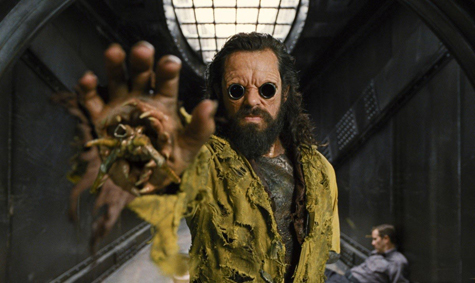
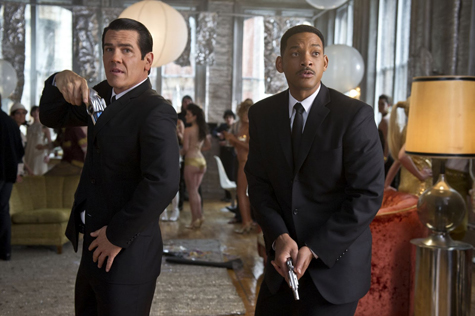
In Men in Black 3, agents K (Tommy Lee Jones) and his partner J (Will Smith) are back again to save the world from an alien threat. This time it comes in the form of Boris the Animal, played by a nearly unrecognizable (much to the makeup artists’ credit) Jemaine Clement of Flight of the Conchords fame. Boris is the nastiest creep in the galaxy, and also one of the most dangerous. K imprisoned him on the moon, saving Earth from imminent destruction 40 years ago, and for all that time, Boris has been planning his revenge. He escapes and tracks down a device to send him back in time so he can dispose of K and lead an army of super villains in an invasion of Earth. Boris succeeds–sort of.
The Animal’s plan did not take J into account. J finds himself in a present where K had perished at Boris’ hands; however, J’s the only one who seems to remember the reality where K was triumphant. It’s up to J to travel back in time and set things right. In 1969 New York City, he runs into K as a younger man (played by Josh Brolin) and the two team up to combat the duo of Borises.
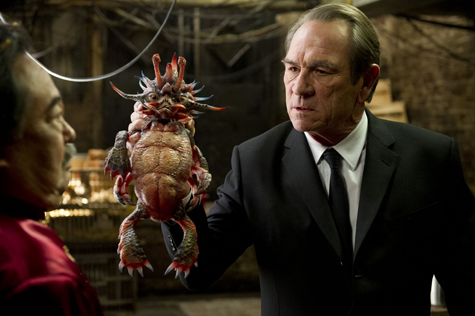
It’s hard to believe that the first Men in Black movie was released almost 15 years ago. (It’s been 10 since the release of the sequel.) Then, the Barry Sonnenfeld-helmed mega–blockbuster was a technological marvel. Now, with Sonnenfeld back in the director’s chair for the third time, Men in Black isn’t much different from any other computer effects-riddled sci-fi/action flick. What does separate it from the rest of the schlock out there is its creativity. The creatures, such as a giant extra-terrestrial fish encountered in the back of a Chinese restaurant or even the grotesque character of Boris himself, are bursting with personality.
Another thing it has that other franchises lack is its star, Smith, as viable a big budget actor as there is. MiB 3 is something of a comeback for the Fresh Prince; it’s been three years since his performance in the somewhat dour Seven Pounds. Here, he’s the charming, wise-cracking, yet still believable action hero we’ve all come to know and love. No doubt he has a great team around him–as if the aforementioned costars weren’t enough, Emma Thompson also chips in as agency head O–but this is the Smith show, and he pulls it off with such casual ease that it hardly seems like he’s accumulated any rust in his time away from the silver screen.
However, as it turns out, the problematic plot device of time travel actually happens to be the film’s greatest boon. Not only does it allow for another nifty performance from Brolin, but it also opens the door for some surface discussions on the nature of time and probability. The character of Griffin (Michael Stuhlberg), who much of the film’s conflict hinges upon, is of a race of beings who exist in “the fifth dimension.” Griffin has the ability to see infinite possibilities and multiple outcomes. It’s sort of a beginner’s guide to string theory and leads to some of MiB 3’s more interesting and even thought-provoking moments. Stuhlberg’s performance is sweet and comical, forging an endearing character.
Of the utmost importance, The Men in Black series is about entertainment, and while this film, like those that proceed it, may not be groundbreaking, innovative or all that memorable, it does well not to take itself too seriously. The mood is light, even when a creature that lives in Boris’ hand is shooting spikes through people’s foreheads. Hey, it’s all in good fun. Who knows if this will be the last time Jones and Smith down the black suits and sunglasses, but if it is, they’re certainly going out in style.