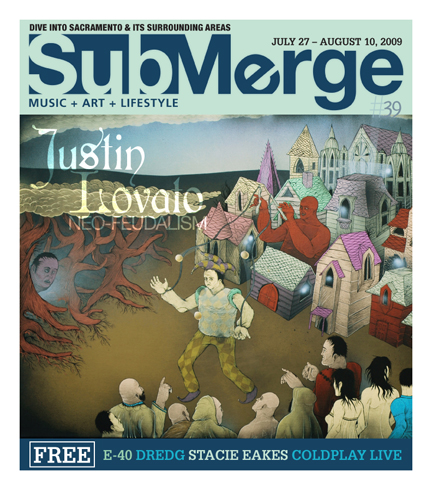
Justin Lovato to Unveil His Latest Series of Paintings, Infinite Bewilderment
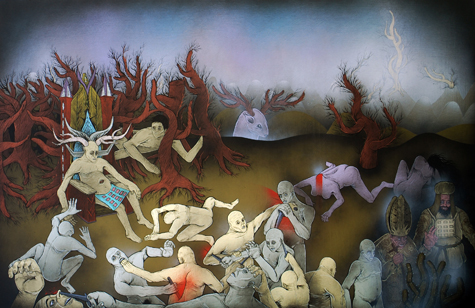
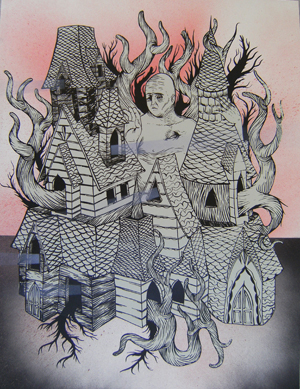
“People generally are unaware of their environment or how their everyday decisions might be affecting somebody thousands of miles away,” says Sacramento painter Justin Lovato, 23, whose latest series, Infinite Bewilderment, predominantly features images of jesters pulled from tarot cards, influential hands that tug at his characters like ventriloquists and symbols borrowed from the Freemason and Illuminati cults.
The series, opening Aug. 8 at Upper Playground on J Street, is challenging the notion that depictions of feudalist peasants might seem dated or have little relevance to modern life. “I like to use a lot of old symbolism in my art,” he says. “I am fascinated with religious-based art. Medieval art is a big influence on me. The whole idea of people in feudalism at that time, I think we live in a neo-feudalist society right now. Everyone is in a constant state of confusion.”
Lovato admits his art can be somewhat blatant, but he would rather the message be obvious than lost. “I think people are psychologically damaged due to a lack of good information and a lack of speculation about why we’re here and what they should be focusing on. I think if people lived moment to moment and redefined ‘need’ they might be more content, focusing positive energy elsewhere.”
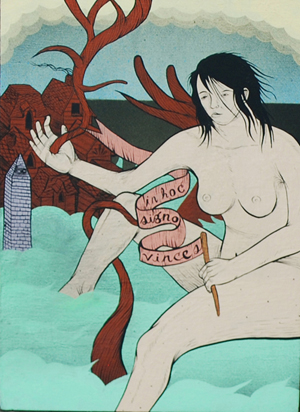
His work borrows medieval art techniques, all the way down to a disregard (although at the time it was lack of understanding) for perspective and dimension. “I like that it’s not very advanced,” he said. “It’s really flat looking, but the point is the imagery is blatant, which I am definitely guilty of. It’s aesthetically pleasing to me.” He also is enamored with the prerequisite of including religious themes. “The idea that you could be chastised for making art that didn’t revere God is intriguing to me,” he said.
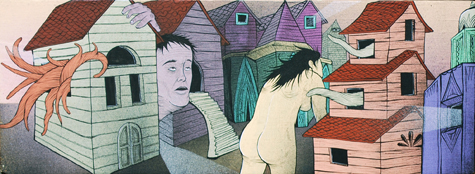
Lovato appreciates the plight of the juggler, who is relegated to “grab ahold of everything all the time.” “It represents the things that are deified to grab hold of people’s energies,” he said.
As for the archetypes of secret societies, Lovato swears he is not a conspiracy junkie. “I use that stuff because it makes for a good metaphor,” he said. “I don’t believe there’s an Illuminati. I think more out in the open there’s a subsection of rich industrialists that make the large decisions that affect the bottom tier, but I don’t believe in a mystical force.”
For Lovato, the unseen hand of influence is more visible than we are often willing to admit. He has a series of paintings in which a ubiquitous hand guides fountain streams of pills to lethargic characters, filling up their stomachs, heads and backs. “It’s a funny take on where we obtain our ideals,” he said.
“Whether it’s from other people pushing you along, or respecting someone else’s opinion who happens to have a print magazine or be on TV. It’s about the general influences that guide our ideals.”
The most controversial of his techniques could be his stripped depictions of the female form. In several of Lovato’s portraits the women are chopped down to the sexual torso. But is Lovato a mysogynist? “I want people to be confused at the image,” he said. “I am portraying the disgusting, abusive, offensive way that we view woman in our society by displaying it in a way that might make a woman feel offended by looking at it.”
Many of Lovato’s characters seem to be obese figures with pattern baldness, lumbering in a glum haze. But he resists a notion that it’s his view of typical Americans. “I don’t think people seem unhappy,” he says. “I enjoy people and talking to people I meet no matter who they are or what they might think or buy into.” He is aware that while he has his convictions, he is not a man with all the answers. “I am [trying to be] more suspicious of my everyday surroundings, and archetypes, and people’s expectations of me as a member of this hive.”
Lovato, who admits to listening to everything from ’60s and ’70s jazz and old punk rock to hip-hop and even lectures (“It keeps your mind occupied, while you’re meditating over a painting,” he explains), got his first show three years ago at The Toy Room from owners John Soldano and Craig Maclaine. Lovato recalls being 16, making trips to the alleyway gallery and gaining a fascination with the lowbrow art featured there. “I started hanging out there when I was a kid,” he said. “I got my first show when I was 20. I actually sold a few pieces, which was encouraging. I started doing it consistently ever since.”
“Consistently” rounds out to six shows a year. Most recently his work traveled to the Washington D.C. area after selling three pieces from a Toy Room show to a gallery called Art Whino. “Craig and John were a huge help in first getting my shit out there,” he said. “That’s the good thing about showing at gallery spots, there’s usually someone there who wants to help you get your name out there.”
When Lovato unveils his pieces Aug. 8, expect a remodeling of the Upper Playground boutique. Lovato plans to repaint the space and include interactive art. “I’ve been fucking around with animation,” he said. “I started looking at old toys from the 1800s. I’ve made these flipbook machines for people to play with.”
Matthew Michel Hopes His Art Will Make You Worry Free
By Nicole Martinez
“I believe in the year 16000,” says illustrative artist Matthew Michel. It is midday, sunny and warm. He is casually sitting at a table in a small teahouse. There is a buzz of hurried customers around him. In and out the door, people walk with quick steps. Those sitting nearby are all on cell phones, laptops or pacing near the counter waiting for their drinks to-go. Almost everyone seems anxious with serious preoccupied faces.
Then there is Michel. Leaned back in his chair, he is slowly sipping iced tea and tasting honey sticks. He is relaxed, mellow and all smiles. He is 6-foot-2 wearing a madras cabby hat, black vest and jeans. Present and in the moment, Michel is in no rush at all, especially when it comes to creating.
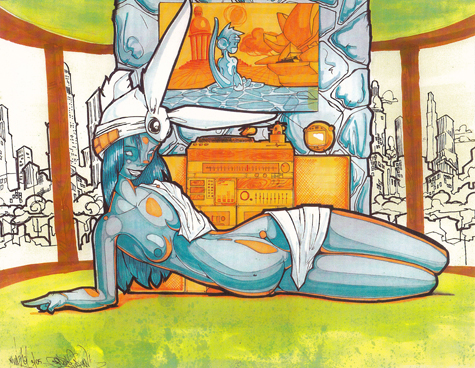
“It’s like the art and music of the past in a futuristic setting where people wear headdresses,” he says describing his pieces. Michel illustrates a post-modern world where elements of the future and the past have merged into a place of relaxation and bliss. Michel imagines that the simple items of today like boom boxes and light bulbs will be relics to treasure in the far, far future. He envisions graffiti throw-ups as huge monumental pieces fixed in stone as unavoidable public art. This of course is juxtaposed with a lovely muse sitting peacefully amid ruins of modern cityscapes and flowers clothed in a flowing robe and giraffe headdress.
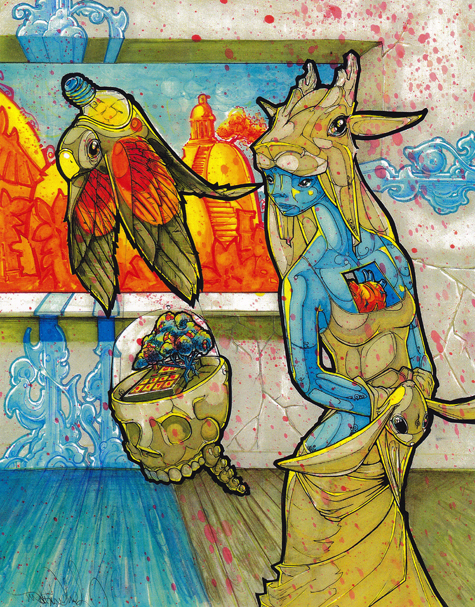
“The headdresses are representative of the feelings or personalities of each muse,” Michel says. He uses animal symbolism in much of his work. Giraffes representing regality and elegance, birds as fleeting dreams, pandas can be simple and fish are wise. “It’s like when nature takes back over.”
Contrary to the plain and worn out portfolio in which he carries his prints, each brightly colored ink drawing he shares is a vibrant colorful scene. He uses vivid hues of reds, oranges, yellows and turquoise-blues to capture attention and make certain images stand out. Backgrounds are subtle browns, grays and tans to soften the mood and create a calm, leisurely feel.
“I would like to use my art to encourage people to take it easy,” he says. He offers a visual opportunity for people to leave their current world of stress, schedules, jobs and worries behind and melt away into a state of relaxation. Recently liberated from his job as an accountant for a law firm, Michel is ready to relax and enjoy the small things himself.
“I’d rather look at the lighter side of things, the good side of life,” he professes about himself and his art. Michel wants people to get a sense of “neat-o” when they his work. “I want to illustrate a positive experience, to encourage people to participate, to listen to some music or just enjoy themselves.”
Born and raised in Sacramento, Michel is part of a network of creative people. His mother and father are musicians. Of his two brothers, one is a very precise architect and the other a musician. He himself has always been science and math minded in school but was always sketching and imagining with a pencil in his hand. Working with his family and friends, Michel is part of two art collectives, the Gerald4um, and Revenge of the Cool. Both are collaborative groups of artists, musicians and dancers. Their intent is to bring all sides of art together for people to connect with and just feel good.
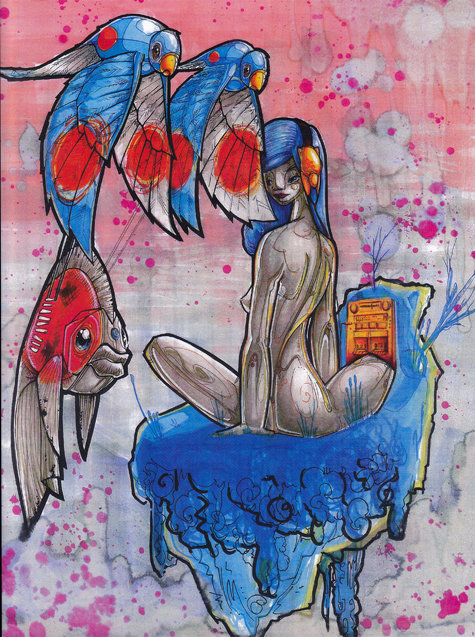
“I’ll always be an artist, why not?” says Michel. He can’t help it. “I just want to see what things would look like for the fun of it. Like dinosaurs pushing shopping carts.” He aims to take simple ideas and express them in new ways. He takes pleasure in the world surrounding him and puts it all together, past present and future. With markers and pens he aspires to create the next elevation. Inspired by everything around him he asks, “How can you not do something?” Sitting back again, Michel grins and looks up out the window. “Enjoy the clouds,” he encourages.
Renaissance Woman
By Nicole Martinez | Photos by Michael McKinnis & Eve Soul
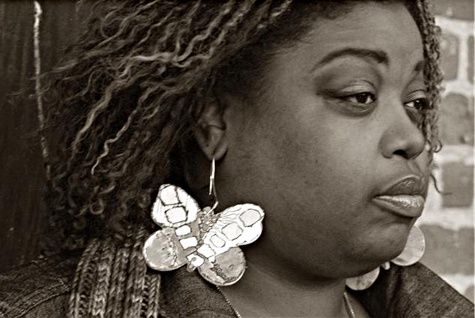
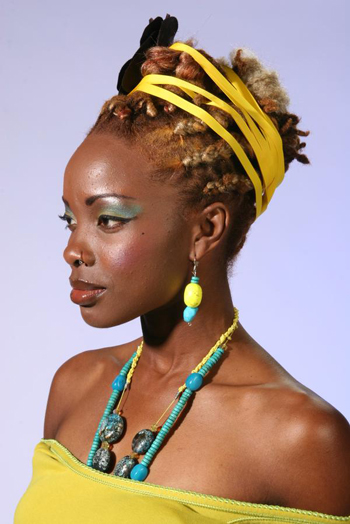
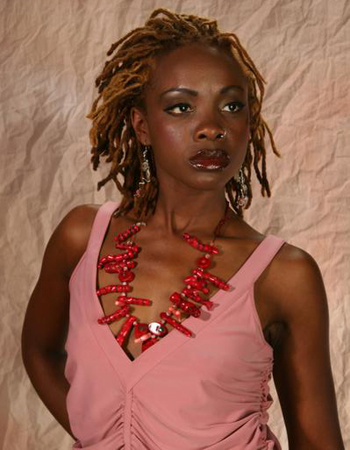
Clever, inventive and undeniably expressive, Cleo Cartel is a vocal, visual and creative artist with passion and conviction. It is an ordinary Sunday, full of sunshine, and Cartel is casually sitting in her salon where she joyfully braids culture and conversation into people’s hair. All around are vivid impressions that she recently designed. There are samples of hand-crafted, one-of-a-kind jewelry, a unique mixture of carefully made, brightly colored, poetically inscribed, wooden and stone earrings, bracelets and necklaces. Paintings with vibrant hues, full of people, scenes and meaningful images from Cartel’s mind enlighten the atmosphere. In a laid-back and relaxed demeanor, her voice warm and welcoming, she begins smiling and freely shares her joy of creating and tells the story of family, community and culture that inspired her confidence to choose art.
“I’ve never been scared to follow my first mind,” she says, “Art is what makes me feel good.” Born and raised in Oakland, Calif., amid an entirety of rich cultures, Cartel recalls, “We were immersed in art as kids.” Growing up part of an African-American, Latino and Asian community, Cartel felt, “There were no barriers to where you could go, what you could see, do and learn.” Her mom would take her around shopping and running errands, Cartel would observe all the different people, notice their different styles and absorb their art and cultural. Cartel specifically remembers one woman who owned her own business and was an innovative dresser. She stood out because of the clothes and culturally unique jewelry she wore. Cartel also thinks back to the Festival at the Lake, a local event where she observed people selling their own arts, goods and crafts. These were meaningful experiences because they served as early examples of “people like me, from where I’m from, being financially stable,” she says. Seeing creative and successful black-owned businesses especially, made her realize as a young girl, “Man, I can do anything. I can be in control.”
Cartel also had strong models and mentors at home. She credits a lot of her creativity, passion and drive to her father and mother. Her father was a gospel and jazz singer and memories of his jazz records playing when she was young nurtured her first love for art.
“He loved art but, he couldn’t pursue an arts degree; he had no choice as far as education.” She smiles, “He let us do what ever we wanted because he never could, but he always made sure you followed through and finished.” He’d say, “When choosing something extra-curricular,” because academics came first, “you have to think, is that something I can do as a career? And as an artist you need to be a businessman, because you need to feed yourself.” This proved to be a most valuable lesson.
Cartel’s mom, an activist and lawyer, passed on her own share of wisdom. She instilled in Cartel the importance of always having a voice, of being able to express one’s self, and having the ability to state her mind. “I think that’s where I got my poetry side, from my mom,” she reflects. An important contributor in Sacramento’s spoken word and urban poetry setting, Cartel has definitely been using her voice. Always a singer because of her father’s musical influence, she has also been involved with the Sacramento Poetry Slam Team and was an originating collaborator at the fondly remembered Blue Room, a weekly poetry series that was featured at Jazzman’s Art of Pasta many years ago.
It is King Jr. High School, however, where Cartel believes all these positive influences from her community and home first had the opportunity to manifest into the tangible art forms she creates now. It provided the perfect environment that allowed her good business sense, appreciation of art, value in education and the necessity to have a voice come alive. At King she had the experience of taking a wood shop class. Working with wood and using her hands is something she truly relished and soon she began working on her own.
“I was coming in after school and anytime I could,” Cartel says. “I had so many ideas, I never wanted to leave.”
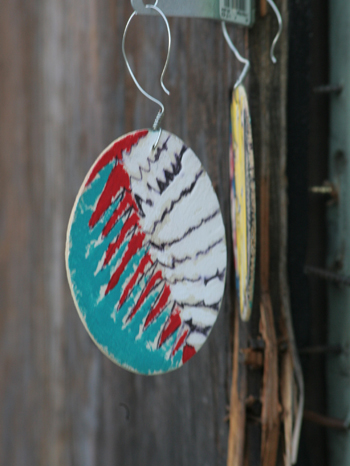
Eventually, Cartel moved from the Bay Area with her family to Sacramento. She felt an immediate sense that something valuable was missing. The abundance of art and the community in which she grew up were no longer present. She thought, “There isn’t anything here that I’m used to so let’s create some.” Throughout finishing at Kennedy High School, Cartel continued to create using the skills first practiced at King. She began making earrings from wood she would shape by hand. She painted and colored the wood transforming each earring into a wearable piece of art. Always full of ideas, she added colorful stones and fabrics to her designs making them truly original in style and form. One very important aspect of Cartel’s pieces includes her own meaningful poetry inscribed on key pieces. Originally, she just designed for herself, but soon people would see her designs, and ask, “Can you do mine like that?” Inspired and encouraged, she continued to follow her passion and has created an entire assortment of accessories, not just jewelry.

Since then, she has worked hard to create freely, share her voice through art and support herself doing what she loves. “I know something about being clear and focused,” she says reflecting on her efforts. “Success that is lasting always takes hard work and perseverance.” Still at it, she admits, “There are times when I want to quit.” Cartel acknowledges that support from her husband helps to keep her on track and encouraged when she gets down. People who invest in her work are also definitely appreciated. She makes an important point saying, “If we can buy stuff that is mass produced and manufactured for stores then we can invest in art.”
She explains, “What is better than getting something made from someone’s own hands? There is nothing better than that!” Cartel is not only an artist, but an avid collector as well.
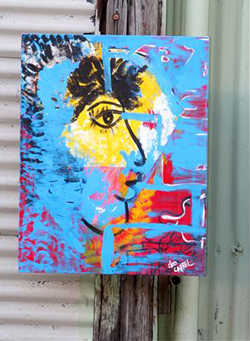
When asked about what she wants her work to convey, she says, “I want my style to represent freedom.” She says she likes to use a lot of vivid colors because, “colors represent a piece of heaven; they’re just something beautiful.” She hopes that in following her passions, maybe her work will continue to motivate that same feeling that she got as a young girl from observing the people in her community. She wants to inspire others to pursue their passion too. “Don’t be afraid to try something new,” she encourages. “You never know what comes with trying something new. You might create something beautiful that the world may need to see.”
It’s OK to Smile
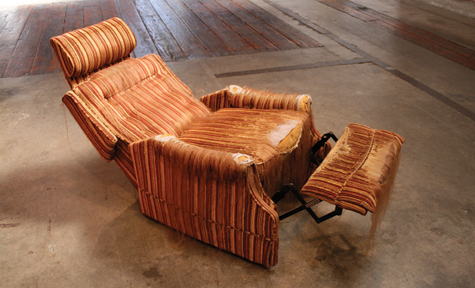
Go ahead and laugh. No, seriously—when it comes to her work, local artist Liv Moe intends to entertain. Drop all textbook philosophies and art-school vocabularies at the door, and prepare yourself to confront a hodge-podge of ordinary objects set against each other in such a way as to make you reconsider the objects we surround ourselves with on a daily basis. “My work really revolves around the environments that we construct for ourselves,” Moe explains. She says that although not all of her individual pieces have a specific meaning, there is a central theme that runs throughout her art, which is: “What American culture surrounds itself with. We’re a culture of stuff. We’re packrats; we have so much junk.”

Hair Chair
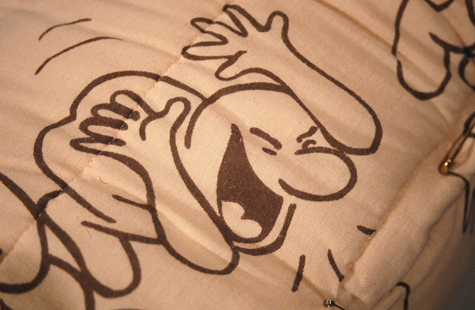
Her current show at The BrickHouse Gallery will run until Oct. 31, and is entitled Giggles. The show is titled after a particular piece bold and assertive enough to coax a nervous laugh from just about anyone: large male genitalia fashioned from a comic-print sleeping bag that Moe picked up at a thrift store. She was originally attracted by the cartoon pattern, but once she brought it home she noticed that this was no ordinary sleeping bag; it zipped up the center instead of the side, and the top was meant to be folded over on both corners so that someone could wear it “like a little cocoon,” she says. “When I put it together in my studio the way it was intended to be worn, I realized that it looked like a giant cock and balls,” she laughs. This phallic symbol created from such a light-hearted print makes for an interesting juxtaposition. “For me it references that nervousness that happens when kids are confronted with sexuality. It’s something bigger than they can understand, so the way that [they] address it is to giggle about it.”
Moe had been waiting for about a year for just the right opportunity to show this particular piece, and it all came together while planning her current show. Many of the pieces were previously shown during her thesis show at Sacramento State last April, and she remembered hearing a lot of laughter from people who viewed her work—and so, a theme was born.
“In some cases an uneasiness happens with some of the work. I think that’s why people nervously giggle when they see things that are odd or funny but they don’t totally understand them, so I thought it was appropriate to name the show Giggles,” Moe says.
In a conversation with this amazingly articulate artist, Moe shares the inner-workings of her artistic mind.
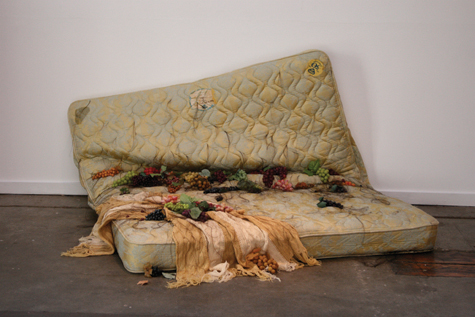
Spring Air
Tell me a little about your current art and how it came to be what it is. Did it start with an idea of something that you wanted to express, or did it just come to be on its own?
Once I started working with materials, I was so compelled to work with materials. It was all I wanted to do. Suddenly I was so excited about art and wanted to pursue a degree in it. It was like, this is what I want to do. I’m not totally sure how I’m going to do it or what my focus is or what I’m specifically interested in expressing through it, but this is what I want to do. I realized over time that I have a sensibility that when I approach objects, there are things that I just find humorous or culturally interesting.
Many of the items used in your art would be considered junk by most people; when did you begin to see these items as art?
It’s one of those things that you just 100 percent have to believe that what it is can be art, and push it as far as you’re comfortable pushing it”¦I’ve realized with my own art that once I start the questions, I’m over. I should just stop making the piece, [or] you start feeling that you’re just fooling yourself, and that what you’re doing is just silly or odd or dumb, and you can’t develop your idea any further than that.
Do you set time aside to collect the items used in your work, or do you just gather things as you come across them?
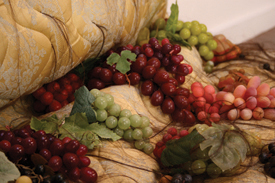
It just depends”¦. When I’m in my practice, I usually go looking for materials a couple times a week”¦ Sometimes something will start out really organically, like I’ll find one material, then I’ll find this object, then I’ll start putting them all together, and I’ll realize that in order to make this successful, I need a ton of grapes. So you mine the thrift stores as far as you can, and suddenly the piece becomes going to all the dollar stores you can find, and going on the Internet, researching how much rubber grapes cost”¦Once something comes together, you’re on this really funny journey.
You’re both a writer and an artist. Do your left-brain and your right brain always get along, or is it hard to find a balance between the two?
There is a part of me that is overly analytical and I ask too many questions and I think too much about why I’m doing something without just letting myself do it. So there’s really a balance for me between over-documenting what I’m doing or writing about what I’m doing or photographing what I’m doing and just letting it happen.
You use a lot of items from the domestic sphere; do you consider yourself a feminist artist?
I identify myself as a feminist very distinctly, but I don’t perceive what I make as feminist work”¦ The work is something that is accessible to everyone and it’s not about furthering a feminist philosophy.
If you could have viewers understand just one thing after going to one of your shows that they didn’t think of before, what would it be?
It really is simple. It’s about the components you’re looking at, and then suddenly all that work became more accessible to me and more interesting, and so I think that that’s really the thing that I hope people will take away when they look at it is that it’s OK, you can really just look at what’s actually there and make your decisions based on that.
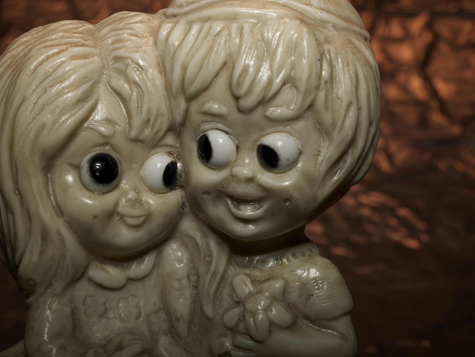
We Need Each Other