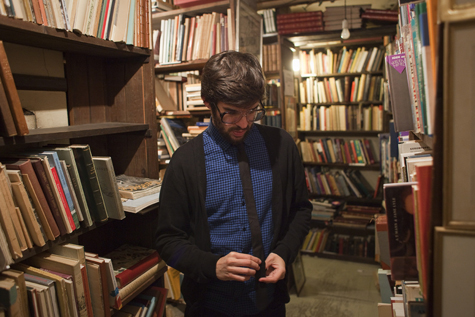
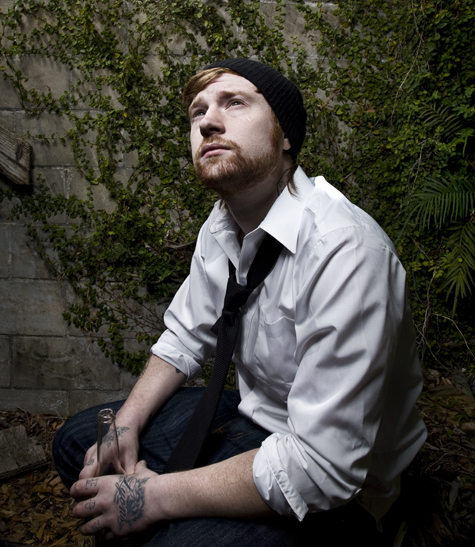
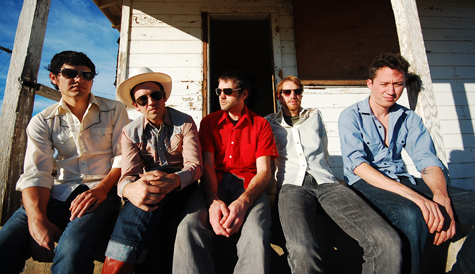
7Seconds, Youth Brigade, Pressure Point, Boats!, The Knockoffs
Shire Road Club “¢ Friday, Jan. 29, 2010
Words & Photos by Anthony Giannotti
When I heard about this show I was really excited for several reasons: First, I hadn’t seen some of the bands in almost 10 years; second, it showcased a wide cross-section of Sacramento punk rock talent; and third, it gave me a reason to get out of the grid and check out a new all-ages venue. So I made the trip all the way out to The Shire Road Club.

The Knockoffs
First up were The Knockoffs. The band consists of guys from other great Sacramento punk bands The Secretions and The No-Goodniks and Berkeley, Calif.’s Mr. T Experience. Right out of the gate these hometown heroes hit us with three-chord punk that would do The Ramones proud—songs chock-full of sing-alongs, power hooks and quirky choruses about girls. I found the drummer of this band to be very interesting; in fact I couldn’t take my eyes off him. Imagine if The Rock stopped taking steroids and played with the exact facial expression/drumming style of Ringo Starr circa 1964.
Next up was the pop punk trio Boats! The set started out with some equipment malfunction that caused the guitar player to miss some notes and forget chord changes. Anyone that has played in a touring band understands every show can’t be the best one you’ve ever played; you just move on and play better next time. These guys did have some catchy tunes. Similar to something you might hear on a late ’90s Screeching Weasel album, fun goofy three-chord punk. The bass player David blew me away, honestly one of the best young punk bass players I’ve seen in a long time.
The third band, and arguably the best band on the bill, was Pressure Point. I really don’t know what else to say about these guys, they are just fantastic New York style hardcore punk. Apparently I was not the only person who felt this way because the previously motionless, expressionless crowd burst into a wild circle pit, fist-flying singing along to all the songs. These guys brought a little more musical complexity to the night, more than five chords per song and some flashy lead guitar. Pressure Point brought out an interesting observation; punks, skinheads and hardcore kids attended this show. Not a lot of other cities can boast such unity.

Youth Brigade
As soon as Youth Brigade hit the stage I was immediately unimpressed. Yeah I know, punk legends, been around forever, whatever. For some reason Shawn Stern (lead singer) had a problem with the majority of the audience not being born before his band started. He seemed to imply that we weren’t there so we don’t “get it.” This is the equivalent of Boss Hogg telling me I don’t “get” Dukes of Hazard because I wasn’t born in the south. I don’t see this in any other genre of music but for some reason some old punk rockers are ageists. Sorry for being younger than you. I don’t know what you want me to do about it. If you’ve seen the classic punk documentary Another State of Mind, you’ve seen modern day Youth Brigade. They still play teeth grinding aggressive ’80s style barking hardcore punk. Shawn is still singing about politics and playing the same power chords, I didn’t get the impression that he wanted to be there. He acted as if he was going through the motions, to get paid.

7Seconds
7Seconds was the last band to take the stage, they immediately kicked down the doors and tore the roof off. They played fast, loud, and hard. I was surprised Bobby didn’t break a string the way he slammed on that guitar. Steve Youth played about as complicated of a bass line as you can fit into a blazing fast punk song. I loved Kevin’s vocals, that distinct higher range is one of the things that has made 7Seconds so recognizable over there career. What an extraordinary band, they are celebrating there 30th anniversary so get out and see them!
All said and done it was a good night with very talented bands. It was a good reminder of what I love about punk rock. I hope Shire Road Club has more of these shows in store for us.
Sacramento music wunderkind Michael Franzino talks A Lot Like Birds
Words by Julie De La Torre
Photo by Daniel Dare
[audio:02 Hallows or Horcruxes_.mp3]
A Lot Like Birds isn’t, well, a lot like anything else you’ve heard before. Starting out as a two-man project led by frontman Michael Franzino, the experimental group soon picked up five additional members and hasn’t looked back. Since winning the Jammies with former band She’s a Dead Man in 2007, the precocious 20-year-old has not only grown up mentally, but musically, as well.
Submerge had the chance to chat with Franzino about everything from his main sources of inspiration to what it was like recording an insanely sophisticated debut release in the confines of a suburban living room. With their ball-busting stage presence and new full-length album, Plan B, A Lot Like Birds is proving to be one of the most promising up-and-comers of 2010.
So, first off, what are you trying to accomplish with A Lot Like Birds that’s different from your other musical projects?
In my previous and first band, our appeal lied solely in our live shows, due to youthful inexperience and naiveté in musicianship and our wildly eccentric and strong stage presence. People came to our shows to dance or laugh at how silly we could be. A lot has changed in my life in the two years since the demise of She’s a Dead Man, and a hell of a lot has changed since the beginning of it four years ago, when the majority of that music was written. It’s kind of like being a senior laughing at your goofy freshman self in retrospect. I’d like to think (or hope, really) that A Lot Like Birds gives people something stimulating or moving to listen to, while we lose our fucking minds on stage night after night.
What were your biggest challenges while recording Plan B?
That would most definitely be the drum programming process, which took five of the nine total months in the studio with the great Jack O’Donnell’s Shattered Records. I basically had a big MIDI spreadsheet before me with every possible beat and every possible drum and cymbal where I had to dictate, as a guitarist, every single drum note and how hard it was to be hit. That, and we had all kinds of nail-biting computer troubles; Jack never expected to record songs with over 100 tracks.
What have you taken from this entire experience? What have you learned since your days of winning the Jammies in high school?
What I learned most from this experience was the recording process really, and how to utilize it as another dynamic in my music. There are all kinds of tricks [and] ways to change moods or make parts sound bigger or spacey or creepy. Utilizing effects and compression appropriately can really make a song or part something different. There’s so much more to making a record than people think; it gives me such a new love for the albums I revere.
It seems like the album has a lot of Mars Volta/At the Drive In inspiration behind it. If so, how does that come into play? What/who are your main influences?ÂÂ
Omar Rodriguez-Lopez is certainly a hero of mine. If I take anything from the man, it’s a driving insistence upon challenging myself and an audience. Using chaos and discord to contrast gentle and beautiful or making tension and anxiety in a big build are some of my favorite dynamics, and Omar is a master of them among many other things. If the music I write is influenced by anything I can articulate, it’s moods or phases in my life. The past few years in which Plan B formed in my head were some of the darkest times I’ve seen. I think you can hear it in comparison to my embarrassing former work.
[audio:05 Your Ex Marked My Spot.mp3]
What was it like to record with 10-plus musicians?
It’s absolutely amazing. I wouldn’t have it any other way; I like big compositions with all kinds of layers to tear apart and fall into. I’d be tragically bored in a typical three-piece rock band. The performances I witnessed in Jack’s studio were absolutely beautiful. Most of these guest musicians came in without hearing the music once and laid their parts down in one to two takes. I could not be more grateful to have such helpful and incredibly talented friends.
This album was very reminiscent of a rock opera—was that your intent?
It was not, but I had certainly hoped for the songs to flow well into each other and for it to be an album, not just a collection of songs. I think there is a difference; each song on the album is intentionally placed where it is.
Describe the live show of A Lot Like Birds… What do you think sets you guys apart from anyone else right now?
Our live show was an interesting entity to orchestrate, with the album consisting of so many musicians and all. Originally intended as guests on the album, Cory Lockwood, screamer; Ben Wiacek, guitarist [of post-hardcore project, Discovery of a Lifelong Error]; Athena Koumis, violinist [of folk-rock project, Life as Ghosts]; Juli Lydell, vocalist/keyboardist and Tyler Lydell, drummer [of experimental-folk project, The Dreaded Diamond] have all banded around myself and bassist Michael Litterfield. Making us seven strong, there’s rarely a time when you don’t have something to watch. We arrive to shows with every intent to walk off stage extremely sore, sweaty and out of breath.
What are your plans for 2010? Any ideas for a tour or additional albums?
We are going in to record an acoustic EP called Fuck Morrissey within the next two weeks and after that another full length, because if this took nine months to record, only God knows how long the next one will. As far as touring, we are most definitely going to tour at all costs this summer, hopefully with the backing of a label or management company, but DIY will suffice.
Any last words?
Yes, please listen to the bands whose musicians were guest on this album, including: The Dreaded Diamond, H. Letham, Life as Ghosts, Discovery of a Lifelong Error, Zuhg and our friends The Speed of Sound in Sea Water!

A Lot Like Birds headlined Jan. 16 at the Shire Road Club in Sacramento.
To find out when and where they’re playing next check out www.myspace.com/alotlikebirds
Steven Borth’s CHLLNGR takes dub to the next level
Jet setting around the world to collaborate and tour, studio sessions with music’s most renowned creators, and splitting living time in Sacramento and Copenhagen with a beautiful girlfriend would seem to make for a full life for most musicians, yet Steven Borth II seeks more from his endeavors. The well-traveled musician is exploding back onto the scene with his new project, CHLLNGR, a dub revolution that takes some history-digging to get to its source.
Borth was born and raised in Sacramento, but found his niche as a musician in the Bay Area. Remember ska? More specifically, remember third-wave ska punk? It had a good run in the ’80s and ’90s and Steven Borth II was a part of that as a member of the East Bay’s Link 80. He joined the group in the latter years of its existence, but his involvement is integral in shaping CHLLNGR.
Link 80 frequently toured Europe, enjoying the fruits of the punk rock circuit in the United Kingdom. It was on these tours that Borth acquired a taste for dub music. “I would help load in the gear, do a sound check with just enough to time to go outside and ask someone where the nearest record shop was,” he said. “I would make it just in time before they closed, and I would pick up what I thought may be good. How I really got started was collecting the Trojan box sets.”
The dissolution of ska was far from pretty. Link 80 suffered traumatic losses and its surviving members found new outlets. For Borth it was joining Rx Bandits, another Bay Area ska revival band. He’d been in Link 80 for four years, but when Steve Choi offered him a spot, he joined up because, he said, Rx Bandits’ sound shared the direction of his interests musically and politically. Those Trojan box sets he scored while on tour with Link 80 introduced him to dub originator King Tubby, which inspired him to continue his exploration of dub while on European tours with Rx Bandits.
Borth started a side band called Satori while playing in Rx Bandits. He described that band as homage to Jamaican music, which served as a foundation for CHLLNGR—his foray into the next era of dub.
Borth first graced our radar as the bearded, almost Teen Wolf look-a-like saxophonist in Purple Girl. The all-too-short-lived funk band could have been Sacramento’s answer to Hall & Oates, but it was not meant to be. Months later, Borth’s three-piece project Dub Defender emerged at The Press Club. Dub Defender’s first run of shows featured Borth on keys, vocals and sax, with Purple Girl/Who Cares keyboardist Young Aundee contributing falsetto vox and DJ Whores cutting up club-friendly hip-hop samples into the dubbed-out fold.
That night featured hip-hop and indie rock bands, yet wedging a dub set into the mix was far from an uncomfortable juxtaposition. Borth’s willingness to let his projects breathe and grow makes Dub Defender an intriguing plot. There is no blueprint for Dub Defender. Borth opts to let his instincts and interests amalgamate until he’s satisfied with the results. “One of the most important things for me in music and in life is to always be open to new ideas,” he said. “I try to make open roads for myself and anyone that is involved in my projects.”
Borth and company leaked a single, “Change Is Great,” as Dub Defender before changing the name. The project is now called CHLLNGR, which is pronounced “Challenger”—he just dropped those useless vowels. Borth explained that the new name is meant to express the boundless nature of the project. “I felt the name Dub Defender could be restricting stylistically,” he said. “I really want to explore this project and take it as far as it can go.”
CHLLNGR began on a TASCAM 388 reel-to-reel machine made in 1985, which Borth purchase in San Jose, Calif. He enjoyed the dusty aged sound of the quarter-inch tape. “[The seller] tried to say it worked, but I knew that it didn’t,” he said. “It cost me $800 to fix, but in ’85 it was retailed at $5,000. Using it made me think a lot about studios, and if you’re looking for a vintage sound, it’s better to be limited, because that’s technically how it was.”
The recording sessions were structured as a game for the collaborators to play. Borth invited his friends to add their touch to the simple chord changes he’d laid down, until each musician was satisfied with their bit. Once the structure was settled, he recorded on the TASCAM until the proper vibe filled the room.
“I wasn’t looking for perfection as much as I was listening for the take where everyone’s own style came out the most,” Borth said. “What I really captured in doing it like this was that once we got it, there was a certain freshness to the sound since we were really learning and creating the songs while in the process of recording them.”
Those sessions will be CHLLNGR’s debut EP, which is scheduled for a spring release on Green Owl. The EP’s release has been pushed back several times, but the delay has not phased Borth. He said, “When the project gets debuted we want it to be perfect. The people I’m working with on this record have been making music for a long time, so we know how to do it wrong. We’re taking the necessary measures to be certain that the timing is right.”
The live set, since we last heard it, focused primarily on dub vibes; but when Borth mentions collaborating with Zach Hill, Brooklyn’s Ninjasonik, former The Defendants member Dr. Echo and London’s Afrikan Boy, the direction of CHLLNGR becomes puzzling. It’s not surprising his session with Hill in the Bay Area involved noise nuisance disputes. Borth invited Hill over to lay down drums and even took the necessary steps to warn his landlord and neighbors of the impending noise. “I knew it was going to be loud, but I had no idea how loud.”
“[The landlord] said it would be fine but to try to get done by a certain time since they had their grandparents coming over,” Borth said. “Once we were done we walked outside and my landlord looked like he wanted to kill me. He said it shook the whole house. Needless to say, we were done in time and no heart attacks occurred.”
Living the life of a nomad, but keeping an apartment in Copenhagen, Borth said it’s been a taxing process to continue recording CHLLNGR on his beloved TASCAM. “I have been creating a lot more of my music utilizing modern technology, i.e my laptop, micro-Korg and an Mbox, which I think will be reflected in the sound,” he said. “I will most likely use the TASCAM again for this project, but at this point since I am traveling quite a bit, and it is easier for me to put everything in a duffle bag, travel around and capture sounds.”

CHLLNGR played the Submerge 50th Issue Party/second anniversary on Saturday, Jan. 9 at Marilyn’s on K with TAIS and DJ Mike Diamond.
To see when and where CHLLNGR will play next you can check out www.myspace.com/chllngr
In 2008, when fashion designer Traver Rains’ highly acclaimed label Heatherette started to dissolve around him and then-boyfriend/co-designer Richie Rich, he found himself tired and torn. For nearly 10 years, he and Rich had built an empire; their eclectic, unusual designs were seen on countless celebrities and famous models on runways, in magazines, on television and in movies. The two traveled the world together showcasing their work at upscale fashion shows and hosting celeb-studded events and parties—basically living like rock stars. Rains guest judged an episode of Project Runway and appeared on America’s Next Top Model. You get the idea—Rains and Rich were, and still are, a big deal in the fashion world. Because of his success with the Heatherette label, many in the fashion scene expected Rains to dust himself off and jump right back on the horse immediately after it shut down, but he had other plans.
Rains began using his newly acquired free time to focus on another passion, photography. This familiar outlet of artistic expression (he spent his fair share of those 10 Heatherette years at photo shoots) soon influenced the launch of a T-shirt line called T-Rains. His photography and new line are heavily intertwined and feed off each other creatively, as you’ll see in the following interview. Rains will be in Sacramento on Dec. 17 at the Haute Holiday Gala hosted by International Academy of Design and Technology, giving us a chance to view his impressive work in person.
How serious do you take your photography? Would you say it’s your main focus now?
Yeah it’s my main focus right now. I’m having a lot of fun with it.
Do your design work and photography feed off of each other creatively?
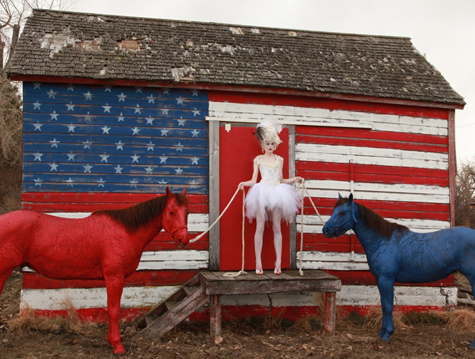
Yes definitely, that’s sort of the point to the new T-shirt line is to have the connection between the two. I spent nearly 10 years in New York doing Heatherette and a lot of that time was spent on photo shoots, and that was always a fun part of the design process. I learned a lot being behind the scenes and seeing everything that goes on. After we wrapped Heatherette up, I kind of felt like I had grown up on a photo shoot”¦ I was a little bit tired of the whole fashion/design aspect of everything, so it was just sort of a natural transition. Another thing that sort of inspired me was going back home to Montana, and we have a big horse ranch and on the property there’s these amazing old buildings from the settlers and they’re all sort of collapsing and falling down. I sort of wanted an interesting way to capture them, so I flew in a model and a hair and makeup team and that was sort of my first endeavor behind the camera. I started thinking of the images I had taken on T-shirts and sort of just out of habit, I guess, I stared making them. I decided I could try and tie the two together, instead of sell the photography as a picture, sell it as art on a T-shirt.
I’m looking at a few of those photos from Montana, and they are beautiful! When was it? It looks like it was cold.
It was springtime, and the poor girl was freezing.
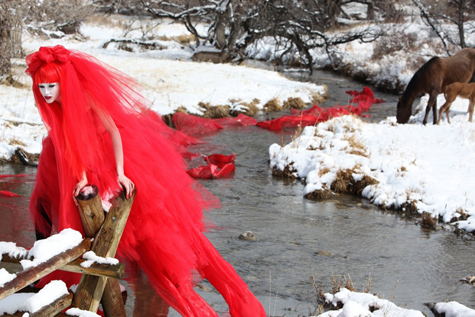
The one where the woman’s red dress is flowing down the creek behind her, how did you set that up? Was that photo pre-meditated or did it just happen?
Yeah, I kind of had that image in my mind for a couple of months. The dress is made up of like two hundred yards of that red material and most of it is all connected to the train of the dress. And so even though the creek wasn’t moving very fast, it was still so much fabric that it was pulling her off of that ledge. She was in heels and there was snow and ice everywhere.

Horses show up in a lot of your work. Are they a big inspiration for you?
Yeah, I basically grew up on the back of a horse. I had a pony before I could walk. So yeah, the western thing has always been really important to my whole vibe. I wear a cowboy hat and boots everywhere still; I just grew up that way. I like the leather, the rough-and-tough feel, even my T-shirts I’m sort of adding that into them.
The Heatherette label that you ran with Richie Rich has been inactive for some time now. Do you miss it?
Oh yeah, definitely. It was the best experience. We did 16 New York fashion shows and then we did almost another 20 around the world, everywhere from like Russia to Austria to Miami to Los Angeles. All those photo shoots and celebrities—it was amazing and a lot of work.
What was it like when famous models and celebs were wearing your designs on the runways, in magazines, on television—it must have been like a dream come true!
Yes, I always was pinching myself. Always.
Do you and Richie still stay in touch?
Yeah, we’re completely on great terms. I see him every once in a while in L.A., and he’s still running around like crazy, so we don’t chat every day or anything.
Do you find now that designing as a one-man team, as opposed to a duo, is easier? Harder?
It’s different; working with another person is easier because you have somebody to help you out and you always have to give and take and collaborate. I definitely couldn’t have done what I did at Heatherette without Richie involved. I learned so much from that, that working alone isn’t that tough. I kind of know the ropes now. I’m just re-starting out really slow; I’m not going to go into any mass production thing right away. I want to keep it sort of artsy and small for a little bit. Also, I don’t want design to take up so much of my time that I can’t do these photo shoots.

Traver Rains’ work was displayed Dec. 17, 2009 at the Haute Holiday Gala sponsored by the International Academy of Design, Sacramento. IADT is located at 2450 Del Paso Road, Suite 250, Sacramento. For more information, visit iadtsacramento.com
Jonny Craig is front and center on his solo debut
Jonny Craig is a name many of you might be familiar with. The now Lexington, Ky.-based singer is currently frontman for Rise Records’ indie core sextet Emarosa. However, now that he has a bit of down time from his regular gig, he’s decided to start from scratch, so to speak, with a brand new project—his first ever solo album, A Dream Is a Question You Don’t Know How to Answer.
Local music fans may also know Craig for more infamous reasons. He also served as co-vocalist for local groove-heavy screamo heroes Dance Gavin Dance—a group that Craig left on bad terms. In our 2008 interview with the band, Dance Gavin Dance’s then co-vocalist Jon Mess (also no longer in the group) said of Craig, “We just couldn’t get along with him at all. No one in the band liked being around him.”
That was some time ago, however, and both parties have moved on. In fact, Craig and Emarosa even toured with Dance Gavin Dance earlier this year. The “Squash the Beef Tour” just wrapped up last month on Oct. 19 in Omaha, Neb. Craig wasn’t too forthcoming about details but he did say the experience was a positive one.
“It was good,” Craig said through spotty cell phone reception from Dallas, Texas. “We’re all good to hang out again, and that’s about it. It wasn’t awkward.”
Despite the messiness of his break up with Dance Gavin Dance, Craig also said that he wasn’t surprised to tour with them again—albeit as part of a different band.
“Nobody holds grudges in the industry that we have,” he said. “You can’t just hate somebody forever.”
With the past behind him, Craig is on the road now with the equally talented Tides of Man serving as his backing band. These are just his first string of dates as a solo artist; however, Craig and company have gotten off to quite a start. Craig played his first solo show in support of Northern California punk legends AFI.
“It sounded good, but everyone was really nervous because we’d only practiced once,” he confided.
Despite these auspicious beginnings, Craig said he is looking forward to building his new endeavor from the ground up.
“It’s a little harder to do a solo band, because you have to start over, so I’m not going to be drawing 200 or 300 kids like Emarosa or Dance Gavin Dance would, because no one’s going to hear about the show,” Craig said. “But it’s still fun to go back and do shows like you were doing when you first started playing.”
Submerge spoke with Craig before sound check for his Nov. 23 show at The Door in Dallas.
Has having to start over with a new project reignited your passion for the music—having to rebuild a fan base with your own music?
In a way, it kind of sucks trying to go back and build a fan base, but then again, there’s not so much pressure. Like, “Oh, I’ve really got to nail this one, because everyone’s watching.” It kind of gives me a chance to go back and breathe a little bit and not be so worried about everyone’s opinions. Only I’m the one that matters. The backing band, if I mess up, they don’t care. Instead of having six opinions, you only get one. It makes it a lot easier for someone who fronts a band. It’s like, “There’s only one person writing this stuff; it’s you. So just relax, have a good time.” All you have to do is make sure your band is in place, and you go with it.
From what I’ve heard of the album, there seems to be a lot of different styles from song to song. Were you looking to branch out and try different things?
Like I said, we wrote skeletons to the songs, and then I sang over them. I just sang what I heard on the tracks. And then we were like, “This song’s a little funky, let’s put some weird guitar behind it or piano.” That’s how it really got decided. It was just me singing what I heard, and then it went from there. After we had the skeletons and the melodies down, then we did all the real guitar work and all the stuff that made the album—like the fillers.
So it sounds like a lot of it came together in the studio then”¦
Yeah.
Is that a lot different from how you’ve worked with Emarosa and Dance Gavin Dance in the past?
No, man. I just really like to go off the head when I record. I don’t like to over think melodies, over write things. I just like to go in and bust shit out, and think about it on the spot. If I don’t like it, I’ll start all over and find something new. I like to be 100 percent—I wouldn’t say improv—but not so organized. I like to relax and think to myself, “Hey, I want to go in here and do whatever I hear, because I’m going to trust myself. Instead of being like, “Oh, this needs to be catchier,” you know?
Before you mentioned that with this project, you don’t have to consider other opinions, just your own. Did that give you more leeway to explore the kind of stuff you were hoping to, like maybe stuff you weren’t able to do before with your music?
That’s the best thing about it. I didn’t go in writing anything. I didn’t go in expecting it to be, oh, like, “Let’s write an acoustic album,” or, “Let’s write a pop-y hip-hop album.” I just wanted to get in there and see what we could come up with. It was all about whatever came to my head. I hate people who over think everything and are so critical about what they play and how it sounds. I want to have fun singing. I just wanted to make an entire album just like that and show people that it can be done without stressing, and without really having much of a care except that you love music.
I watched the video for “I Still Feel Her, Part III” while getting ready for this interview. Was that a concept you came up with yourself or was it a director’s idea?
That was my idea.
Is it pretty true to the lyrics?
No, it has nothing to do with the lyrics. It’s a private meaning for me, and I’m not going to give it away.
It was pretty racy in the beginning with the two women making out half naked on the bed. Have you caught any flack for that?
No, you know, it’s whatever. Controversy is my middle name.
It doesn’t seem like something you shy away from.
Yeah, you know. I like to have fun. I like to do what I want, and I don’t care what anyone else does”¦ I just think a lot of people put up a front. Obviously, people aren’t as perfect as they portray. Like, they want to be in this band, and they want to be responsible and be role models for kids and stuff. I make music for myself, and I shouldn’t have to hide who I really am, because I make music to keep myself alive. I’m sorry that I might not be the best role model for someone’s child, or I might not be the best person for someone to look up to, but I want to be myself. If people say, “He drinks too much, or he does this or that.” I’m not going to hide who I am just so I can be bigger”¦ It’s just not who I am.
Writing music, I’m sure, you put a lot of yourself into that also”¦
The funny thing is, I never hid behind anything. And if you can’t grasp who I am or what I’m about, then that’s your problem. I guess that video—without giving too much away—is just me being like, this isn’t something I care about, people saying I drink too much or party too much”¦ I’m not going to get into it. It is what it is.
Jonny Craig will played The Boardwalk in Orangevale on Dec. 1, 2009 with Tides of Man and Sleeping With Sirens.
The Golden Cadillacs Evoke Classic California Country Sounds on Their Debut Album
Friends who drink together stay together. That’s a saying, right? Regardless, it’s worked in the case of Nick Swimley and Adam Wade, who have been friends since high school. Two and a half years ago, they combined their shared love for music and formed The Golden Cadillacs, a Sacramento-based country outfit, which now stands as a five-piece band that includes James Neil on drums, Aaron Welch on guitars and vocals and Joe Davancens on pedal steel guitar and organ. Submerge spoke with Swimley and Wade as they were “just sipping on a few cocktails,” and they filled us in on the group’s origins.
The Golden Cadillacs’ roots spread as far as Placerville, where Swimley and Wade are from. The small town on the doorstep to the El Dorado National Forest may not be known for much; but like any town, it had a bar, which turned out to be an important landmark in the band’s history. Poor Red’s Bar-B-Q, located in neighboring El Dorado, is housed in a building that dates back to the mid-19th century. Both Swimley and Wade remember frequenting the establishment with their fathers while growing up.
“It was down the street from where I grew up,” Wade says. “It’s this real historic, funky old country kind of place.”
It was there that he and Swimley decided to form the band, while sipping (what else?) golden Cadillacs.
“We were drinking The Golden Cadillacs at the time, and all we had to do was basically look down and get that band name,” Wade says. Listening to the band’s music, it would seem like Jim Beam or Budweiser would be more apt alcoholic beverage complements as opposed to a frou-frou concoction of crème de cacao, Galliano and cream; however, as Wade says, it could have been worse. “We didn’t want to be the Buttery Nipples,” he quips.
Poor Red’s wasn’t only The Golden Cadillacs’ birthplace, but it also served as inspiration for the band’s de facto first song. On Nov. 27, the band will release their first album, a nine-song self-titled effort, of which the opening track is titled “Poor Red’s.” Wade says he wrote the song while battling a bout of homesickness.
“It’s the first song I wrote,” Wade says. “I was living down in San Diego at the time, and I was kind of missing my hometown and wrote that song.”
Wade and Swimley have a long history of playing music together, even prior to that night at Poor Red’s. In fact, Wade reports that they played music together the first day they met. The two were introduced by friend and band mate Joe Davancens.
“I guess three of us”¦started jamming as early on as high school,” Wade recalls. “We all went our separate ways during our college years and went to schools in different states.”
Wade and Swimley reunited to play a show at the Cosmic Cafe in Placerville, and The Golden Cadillacs were born later at Poor Red’s that same night. However, at the time, the band was in a different form, performing as a three-piece.
“When it started out, it was just Adam, myself and my brother on drums,” Swimley says. “We made a little demo so we could get gigs. Joey was going to school in New York, but he moved back, so we added him to the band, and my brother kind of moved on to another group, and we hired our drummer, James, and then Aaron came in.”
Swimley says the current lineup has been together for about a year. He says the addition of the new pieces was “huge” in filling out The Golden Cadillacs’ sound, allowing them to do things that were difficult to pull off as a trio.
Their debut CD was recorded together as a five-piece over the summer in a barn on Davancens’ parents’ property in Placerville. Davancens had converted the barn into a studio, and the setting turned out to be a great place for the band to work. Without having to keep one eye on the clock and the other on their wallets as they would have at a traditional studio, The Golden Cadillacs were free to create at their own pace.
“They have a bunch of acreage, and they have horses out there and the whole nine,” Wade says. “We’d just go up there and drink beer and make music. Whatever came out, came out. They had a pool, and we barbecued. We got to hang out in the sun. It was a really relaxing experience. We just wanted to make sure that we got the sounds and the parts that we wanted.
“It was cool not worrying about who we were paying or who we’re working with or how much time we had.”
Having a band member who doubled as an engineer was a great boon as well.
“It helped to have Joey engineer all of it,” Swimley says. “He’s got a great ear, and I trust his judgment more than anybody’s.”
The result was a sun-baked country album that pays homage to the classic California country sound, a rich tradition that Wade and Swimley take very seriously. However, The Golden Cadillacs realize they have some way to go before they can be mentioned in the same breath as their heroes.
“We look up to”¦Buck Owens, Merle Haggard, Dwight Yoakam—all those guys who came out of California and played honky tonk country music,” Swimley says “We hope our next record will be more straight up country sounding. I think we’re just trying to find our feet with our first record.”
Maybe they’re still working out the kinks, but The Golden Cadillacs are off to a great start. In fact, they’ve already caught the attention of notable California country songwriter Dave Gleason. The Golden Cadillacs have recently become Gleason’s backing band, a major compliment considering Wade and Swimley were big admirers of Gleason’s music before ever meeting him.
“Nick and I used to practice in Oakland, and we’d drive to Oakland and back every week,” Wade says “Nick turned me on to Gleason about three years before we ever knew him, and we were listening to Gleason the whole ride down and the whole ride back every week. It’s a mind bender to be in his band now.”
Despite their work with Gleason, and though their first album hasn’t been even released yet, The Golden Cadillacs are already at work on their next release. Though their self-titled album was mostly a product of Wade and Swimley “boozing and writing songs” together, their next release will be more of a true band effort.
“The thing we’re trying to go for is the less-is-more vibe,” Wade says. “The whole vibe of the songs that we’re all so fond of is the real lyrics and the real life aspect of it. It’s like being a great chef, right? You don’t want to get too crazy on it. You just want to make something really simple and good.”
If their early returns are any indication, it would seem that The Golden Cadillacs have the right recipe for a strong future. At the very least, they should find bright skies and good times along the way.
The Golden Cadillacs will celebrate the release of their first album at The Fox & Goose on Nov. 27, 2009. The cover will be just $3, and Leroy Virgil of Hellbound Glory will also perform.
STILL BARELY SCRAPING BY IN TOUGH TIMES
Words by Mickie Rat
I first heard of Swingin’ Utters in 1992 during my time as a DJ for KSSU, a fledgling college radio station at Sacramento State. They sent us a 10-inch record entitled Scared, which listed the name of the band as Johnny Peebucks and the Swingin’ Utters. The whole staff laughed at the name, but no one had any desire to listen to it but me, the station’s token punk rocker. I instantly loved it. I still do. I wish I knew where that 10-inch was now. I could go look in the station’s music library but I’m sure some college poseur-punk has stolen it and sold it for clove money on eBay in the 17 years since I used to play it on my show.
I really can’t blame them. Times are tough. Seventeen years of being in my own DIY punk band with limited success has taken most of my time and almost all of my money. Hell, I would probably sell that album on eBay if I still had it just to pay my dental bills. One would think that the with Swingin’ Utters being on the Fat Wreck Chords label now, with a fair amount of success, that they wouldn’t have to worry about finances. My recent telephone conversation with frontman Johnny Peebucks has shown that they are still struggling just like the rest of us in this 9-to-5 petty wage economy.
Hi Johnny, thanks for talking to me today.
Yeah, sorry I didn’t pick up right away, I was cooking some fish for the kiddos. I’m ready to go, though; I can keep an eye on the fish.
What kind of fish are you cooking?
Salmon.
Salmon sounds delicious. OK, first question: I imagine after 20 years or so the Swingin’ Utters must have a massive amount of material recorded. How did you decide what tracks to put on Hatest Grits: B-Sides and Bullshit?
Darius [Koski] our guitar player did most of the decision making. He’s sort of a packrat so he has kept everything we’ve recorded, even some of our first practices on cassette. He’s the main guy that went searching through all of it to figure out what should go on the CD.
Who wrote most of the new songs on the CD?
I think it’s sort of a split between me, Max [Huber] and Darius.
Darius is the main songwriter for Swingin’ Utters. Since you’ve been in Druglords of the Avenues and Filthy Thieving Bastards have you been writing more songs?
Yeah I think I have a little bit more freedom with those other bands because the Swingin’ Utters got sort of pigeonholed. I like having the freedom of writing whatever I want in Druglords of the Avenues and Filthy Thieving Bastards, any style of music I want. I think with the Swingin’ Utters’ records I kinda just lean toward punk automatically because it’s been around the longest of all my bands. We sort of stick to the punk formula. Darius is the best at writing songs out of every band member, so he writes the majority of that stuff, but I’m gonna try to pitch in on this new one and we’ll see how it goes.
So Swingin’ Utters are recording another full-length soon?
Yeah we have something in the works for maybe early December, it should be a “low-budge” type album just because the way things have been going lately with Fat Wreck Chords and with us not touring that often. We just wanna get in there and get it recorded and get out so it doesn’t cost that much.
Do Swingin’ Utters have plans to tour more after the next new CD comes out?
Yeah as soon as that record comes out I’m sure we’re gonna have to go out in support of it. I think I overheard Darius mentioning something about Europe; we kinda wanna go over there because we haven’t been in a while so we’ll probably do something like that. Then maybe we’ll do some two week chunks here and there that cover the States, you know we gotta keep our jobs so we can’t be taking off for months on end.
What’s the trick to getting a job that you know will still be there for you when you come back from tour?
Yeah that was the main reason why we didn’t tour for a while. I got laid off a while back, and this job just kinda fell in my lap. This guy owns a business and he’s been in punk bands in the Bay Area. so he knows that every once in a while I’m gonna need a couple days off to go on tour, so it worked out well since I started working there. It’s tough; we’re barely scraping by. I think everyone is right now, so I’m just thankful that I’m able to do stuff like that, and I’ll never take it for granted because times are tough, everyone knows that.
After 20 years of “barely scraping by,” as most punk bands do, do you think it’s become easier or more difficult to be an independent band?
It hasn’t gotten harder, because we haven’t been touring that often. But if we tried to make a go at it now, it would be insanity. There’s no way I could do it. I couldn’t bail on work that long, and the kids and my wife. I like my home life and I don’t wanna bail on it that often, so it would be really hard to actually try to make a living at it. You gotta tour to make a living off of music, obviously. Right now we have a good balance.
Swingin’ Utters are now in the “elder statesmen” position of influence over new fans that are starting bands of their own. Is it odd to you to be looked up to as an influence by newer bands?
Yeah that’s insanity. That’s the reason why you get in a band, and if that’s happening, that gives me the chills. I mean it blows me away that people would even want to make a tribute record or are influenced by us; even older bands would tell me that. It’s always gonna blow my mind, and it’s very flattering and I never thought it would get this far so it’s not strange; it’s kind of awesome you know?
Do you have any idea when that Swingin’ Utters tribute might be coming out on Red Scare?
I just sent out the artwork that I did for the cover not too long ago. I think they’re waiting on maybe one or two bands but they’re getting down to laying it all out. They needed the artwork just a couple days ago so that means that they’re probably on the finishing stages.
For people who might be unfamiliar with some of your other bands, what would you say are the main differences between the Swingin’ Utters, Druglords of the Avenues and Filthy Thieving Bastards?
Filthy Thieving Bastards is more leaning toward folk, and it has some psychedelic leanings as well, but I think that’s the most experimental out of all three bands. Druglords of the Avenues is sort of a bizarro Swingin’ Utters, played by a bunch of young kids with me writing nutty lyrics to it, so it’s not really that different from Swingin’ Utters, but you can tell that it’s not played by the same kinda guys. But they’re great kids. They’re really talented. But we’ll be hitting the Pixies, the Breeders, rockabilly and so far a lot of different styles of music. I let them write all that music, and then I just plug in some weird lyrics.
Is there a song that all three bands could do and make it their own?
Druglords of the Avenues do the actual song “Druglords of the Avenues” by Filthy Thieving Bastards, Swingin Utters does another Filthy Thieving Bastards song, one of Darius’, I can’t remember which one. It’s on the Dead Flowers, Bottles, Bluegrass and Bones album.
So the different bands like to cover the other bands’ songs every once in a while just to mix it up?
Covers are fun to play; I mean we started off as a cover band, so we sort of got that out of the way early on. But I’d like to do like a weird Elliott Smith cover or something like that, sort of bring up the pace a little bit and make it our own. I’ve been listening to him lately and have been really into it. That’s what I really wanna do but I’m sure there’s other band members that will wanna do other shit, but we’ll see.
Every once in a while, the Swingin’ Utters will play at a tiny bar called the Distillery in Sacramento, and it gets so insanely packed that there is barely room to move. Are those shows fun or do they drive you crazy?
That’s fun. I love shows that don’t have stages and you’re in everyone’s face, and they’re in your face and yeah, it’s a little dangerous, and as I get older I’m a little worried about my kneecaps being shattered and stuff like that.
Or your teeth being smashed in by the mic?
Yeah exactly. But it’s exciting and fun. I mean when there’s danger involved your adrenaline just goes crazy. I enjoy that more than stages. I enjoy being on the ground. In the Druglords of the Avenues, if there’s a small stage, me and the guitar player will drop down to ground level and just play from there because it’s a lot more entertaining; it’s fun. People seem to be smiling a lot more when you’re down there.
Those are all the questions I have for you today. Thanks for the interview, and I hope you didn’t burn your salmon.
No, but thanks for asking!
Swingin’ Utters will be played in Sacramento at the Blue Lamp on Friday, Oct. 30 at 9 p.m.

Dan Deacon
Luigi’s Fungarden, Sacramento, California
Monday, Oct. 19, 2009
Words by Vincent Girimonte
Photos by Samantha Saturday
Dan Deacon’s set at Luigi’s Fungarden on Oct. 19 reminded me of that saying, “Angels can fly because they take themselves lightly.” Manifesting this was a state worker boogying next to some teenage princess probably 20 years his junior; and Deacon himself, pleading with us to imagine a “sky of hair” above the dance floor. Suffice to say nobody was caring.
The Baltimore-bred electronic artist owns one of the more egalitarian live spectacles you’ll come across, and it’s anything but gimmicky, despite the merch peddler performing interpretative dance (which was a little gimmicky). Dancing around isn’t compulsory, just highly encouraged. If that’s not enough to get you moving, peer pressure eventually kicks in to where anybody not sweating through his or her shirt may as well be the chaperone. The result was a Fungarden smelling “like a farm,” as one hooligan put it.
Deacon set up on the floor, caved in with lights, amps and a throng of impatient youths savagely bouncing around near his board, which looks like it was made on Sesame Street. This preferred dynamic may be his referendum on the typical live performance hierarchy (the artist being up there, and everybody else down here, having all the fun); or, perhaps being among his crowd he can more easily organize dance-offs and the ubiquitous “human tunnel”—each making an appearance at Luigi’s. There’s an element of wedding MC in Deacon’s shtick, the one that comes free with the venue and wants everyone to be happy while waiting for the buffet. Sometimes you need that guy.

I would hesitate to call Bromst, Deacon’s second full-length release and the primary source material for Monday’s set, “experimental” if he himself didn’t sometimes classify it as such. Admittedly, this is probably out of my own misinterpretation of the word “experimental,” as in you can’t shake your ass to it. Live, the tone is surging and rich, bringing to mind that “noise in tune” adage—but this is also pop music, implying some accessibility. Deacon plants playful, trippy melodies on the grinding rhythms and manic live-drum samples, and from there it just goes up and up at a breakneck tempo. It’s the music of frolicking optimists, and resonated well within the snug confines of the Fungarden.
He grabbed the mic every now and then for some cathartic chanting—not that he can sing, really, but nobody seemed to mind. By the end of the show he was Uncle Dan, commiserating with the Sacramento audience as a Baltimorean knowing what it’s like to live in a city consistently ignored by the hotshot indie tours. Though if this reputation is what brought Deacon here in the first place, it is one we can surely live with for a little while longer, at least until Uncle Dan returns.
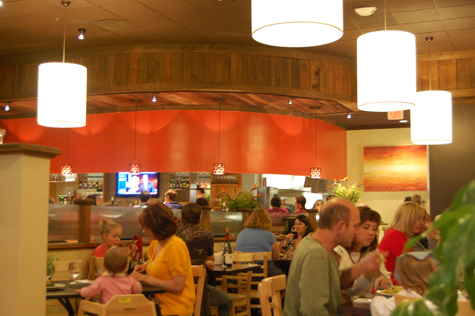
Matteo’s Pizza & Bistro
5132 Arden Way
Sacramento, California
Words & Photos by Josselin Bassaldu
Oh, October. You are like that boring friend that you forget is so interesting until they let loose and entertain the hell out of you.
How about them apples, October? You make them so sweet and crispy, just in time to be baked with spices to warm away the on-setting winter chills.
You are the sacred month, October, that wraps up the worldwide celebration of foamy, yeasty brews. It does seem to be brews that bring brothers, best friends and even sometimes the begotten together. (I hope you all have enjoyed Oktoberfest.)
Oh October, you’ve outdone yourself this year with some well-needed Sacramento-area restaurant openings. The first of which is yet another contemporary pizza place—not parlor, but a 21st century chic version. Can one city really have too many good pizza places, Sacramentans?
Supper Club owners Matt and Yvette Woolston must have had a similar power-of-good-pizza epiphany and opened Matteo’s Pizza & Bistro Oct. 9 at the Five Points Shopping Center on Arden Way and Fair Oaks Boulevard.
Cashing in on the local connection, I was able to dine at Matteo’s at a discount during one of the three staff training nights Oct. 6-8. By reservation only, guests got a sneak peak into the Matteo’s manifesto. Fellow foodie and writer Pippa (as we’ll call her) was present to challenge my culinary opinions over a bottle of fresh, food friendly and sometimes smoky Huber Hugo Gruner twist-off capped Austrian Veltliner wine.
The menu isn’t huge, but certainly varied. Appetizers, pizzas and pastas are featured, as well as hot and cold sandwiches, soups and salads.
Polenta has become a staple in many restaurants. I’ve seen it in fried balls, grilled with cheese and served creamy alongside portions of meat. But I’ve yet to have polenta fries, so I did at Matteo’s. These thick, crispy and fluffy fries ($6.95) were served with a smoky, mild basil marinara. Polenta can have a way of tasting too much like chicken broth, but the polenta fries had a subtle cornmeal flavor that was highlighted by shavings of very salty asiago cheese. Yum.

Opting for a dish with new culinary components, the Spaniard pizza was interesting but familiar.
Its slightly sweet, smoky and salty flavors were like a super palate surprise. Cured Serrano ham and salty olives (which were supposed to be green, but were Kalamata) complemented the smooth, slightly sweet, sliced fingerling potatoes and Italian basil. Romesco sauce—a Catalonian mix of almonds and hazelnuts, olive oil, garlic and small, dried red pepper—added a hint of mystery to this pizza. The crust, light and of a medium-thin thickness, was prepared in a “top of the line” oven, as our server informed us and gave the pizza a cooked-on-a-campfire kind of woody, charred taste.
Unlike many pizza places, Matteo’s also offers formal bistro-style entrees and vegetarian dishes.
The Tree Hugger BLT left us off-put by its strange name, but intrigued thanks to the use of Portobello mushroom bacon. Served on a whole-wheat walnut sourdough (bread comes from Grateful Bread) with arugala, tomato and white truffle aioli ($8.95), this sandwich could make it easy for anyone to be a vegetarian, according to Pippa. Reminded that quirky author Sloane Crosley boldly and probably accurately stated in her book I Was Told There’d Be Cake, that the one thing that vegetarians miss is bacon.
“Any vegetarian that misses bacon has found their heaven in this sandwich,” Pippa exclaimed.
Pippa had a point. But I had concerns.

An overall good sandwich with nice crispy, yet potato-y skinny fries, I was somehow expecting the Portobello mushroom bacon (cured at the Supper Club) to be crispy and the bread to be at least toasted. The bacon was cold and soggy, sliced up into little pieces and certainly cured in liquid smoke. A comprehensive bite of the sandwich was delightfully peppery, earthy and balanced, but when I nabbed up a little piece of Portobello bacon that escaped the BLT, it tasted like eating cigarette smoke. This sandwich was good and a bright idea, it just needed a bit of tweaking.
Matteo’s has created a dining experience to meld together those of a formal dining era, the organically inclined and intimate lounge-like hip food scene. Matteo’s has the mother earth mold and offers a dining experience for any type of diner to enjoy.
There are some restaurants that I say I might return to, but I’d return to Matteo’s Pizza & Bistro and actually spend my own money. Plan for this place when anticipating a possibly stressful meeting—like a date or reconnecting with old friends—or for a good meal. The frequency of calm is invigorating, the attitude is refreshing and the food makes you happy.
Cheri Ibes’ new installation Blank Blank Blank shapes new thought
Cheri Ibes is no stranger to the free-form artistic genre that is known simply as installation. Her work has been locally displayed at Block Gallery where she was the director. In 2008, she opened the gallery with an exhibition in January and closed the year with one in December, both of which were strong, thought provoking shows that received positive attention. Her December show was the end of Block for Ibes.
“Block was an experiment to understand how galleries need to be re-conceptualized and what it might mean for installation and new media artists,” explains Ibes. “How we might develop if we actually had a bit of fertile soil.”
Her new installation might not exactly be the “fertile soil” that Ibes speaks of, but what she’s grown inside of Artifacts in downtown Sacramento is worthy of a blue ribbon. Blank Blank Blank, which opened on Sept. 12 and continues through Oct. 3 is a condensed version of Ibes’ work and shows us a much more linear version of her talent that has not been seen before in her previous work where lamp shades floated like jellyfish and light bulbs were amassed like fish eggs.
Black wooden dowels pieced together in angular shapes touch the wall, leave, and then return only to zig and zag to the floor—ending tangled and awkward. These blank shapes, geometric and strange, cast curious shadows on the stark white walls that they are forcefully fastened to. These shadows create new lines that echo architectural constructs and corners, adding new depth and purpose to the tangled formations that created them in the first place. As I observe Ibes’ installation, a woman brushes lightly up against one of the low sitting conglomerates that consist of ordinary white metal hangars that are fastened together by carefully bound string. The mass quivers and the shadows play, adding a new movement to Ibes’ design.
“I bought all these hangers. I fell in love with these frivolous pristine white forms—their estranged familiarity,” says Ibes.
The movement of her white hangars is poetic. Simply positioned but with such a fervor that it’s hard not to imagine your own distant landscape that they might populate. Her artist statement reads, “Hangars, thin white skeletons, spiny arachnids, scurry from a pole out of an imagined closet like hallucinations from a sick bed or flashes from a forgotten dream. They know nothing—and they know it.”
Blank Blank Blank is her version of this landscape.
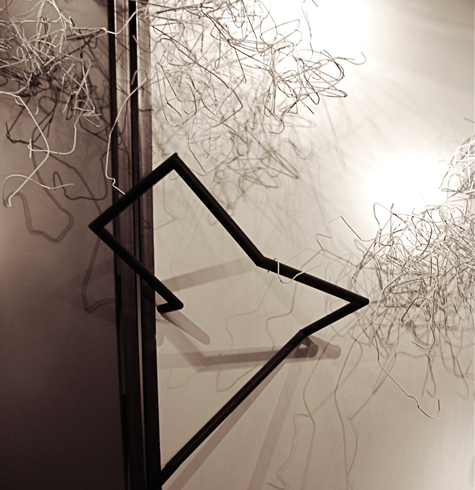
In your installations, Blank Blank Blank, you’ve chosen to use objects like light bulbs, parts of pianos, clothes hangars and wooden dowels. Why these objects? What draws you to one particular object over the over? Is it functionality for the piece mainly or is the decision rooted in aesthetics?
I’m attracted to common things with an intrinsic beauty that is often overlooked because of over-familiarity. I imagine that I have never seen these objects before and have no sense of their function. Function corrupts our perception of these objects so we cannot see their beauty—their wonder really. When I broke open light bulbs and computer keyboards and started deconstructing them, I was amazed to find such enchanting things inside as delicate wire filaments and computer keyboards have all kinds of parts inside. I’m attracted to fragility, but fragility with an edge that can seem a bit threatening. That’s an expression of realism—reality isn’t facile, it’s a mixture often of contradictory concepts and that’s what makes them interesting and makes choices so difficult.
Was it a challenge doing the installation in what is essentially a retail store as opposed to gallery space like Block?
Yes, it was. It’s hard to compete with all the things in the background. Part of the reason galleries always have white walls is to clear out the “noise” of other visual and auditory stimuli, so you can really see the work. Also, installation artists, in particular, are very concerned about the space and having control over it. I knew that would be a challenge, but I prefer this kind of honesty of purpose to showing in a gallery that does the same thing—has too much “noise” by showing too many works of art and placing them too close together so they interact with each other and the viewer has a hard time filtering that out.

Do you think your sculptures can only exist in a certain space, with the right lighting? Or can they transform as they are moved from one environment to another? Will they lose their meaning?
Actually, that’s one of the differences between sculpture and installation art. Sculpture is less concerned with space—although space is always important to how an artwork is perceived. It influences it in so many ways. But installation completely bows to the primacy of the environment, of context. Although I might use all the elements in this work again in another space, it will never be the same, and there is absolutely no loyalty to recreating it. It is this recognition of zero stasis that fascinates me about installation. Thus, no, it will not lose its meaning—that is its meaning.
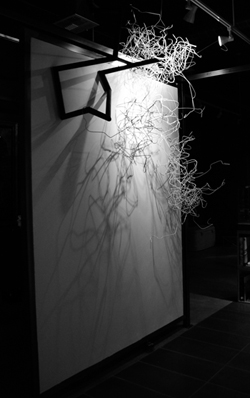
What does the title Blank Blank Blank refer to?
I started thinking about hangers coming out of a closet. Then I saw that the white hanger pieces kind of suggested skeletons, fragile skeleton forms, nerve cells, or plankton, but living. I used that quote from “Canto XIII” by Ezra Pound, a talented insane poetic: “And even I can remember/A day when the historians left blanks in their writings/I mean, for things they didn’t know.“ History has so many secrets, so many folds that we don’t know, or know but don’t really know, or aren’t allowed to know, or are afraid to know, etc. Families and individuals have secrets—blanks in their histories. So I thought of these nervous little skeletal forms as representing the anxiety associated with these secrets and the dowel as representing the closet pole where well-behaved hangers ought to hang. But, secrets are difficult to contain. They have a way of creeping out and creating a subtle underlying anxiety. They are interesting creatures, but they can get tangled in you hair or hook your shirt, so you want to stand a bit back from them.
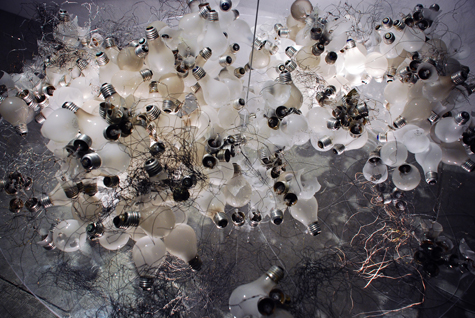
Your press release reads, “To reconcile the irreconcilable—to find harmony between the careless consumption of urbanism and a natural world subject to human infringement.” Can you elaborate on this a little more? What did you ultimately hope to achieve with this current installation?
People have often commented that my work looks “organic.” I didn’t know what to think about that for a long time. But it kept coming out—just naturally, in all my work. So then, I had to finally accept that it must be pretty important. I had to figure out why I was taking these boring, ordinary man-made objects and they were coming out looking like sea life or microscopic organisms. If it happened once or twice, I guess I wouldn’t have focused on it, but it was always showing up and I never made any conscious effort to make that happen. In my life, I have always tried to figure out how we humans fit into the big picture of nature. I mean we’re temporary, small and probably insignificant in the big picture of nature, which existed before us and will doubtless go on after. Our constructs seem so idiosyncratic and so thoughtlessly placed in the context of nature. It’s an odd fit for the most part. So, I think when I take these rather frivolous human made objects and turn them into organic-appearing organisms, I’m talking about that craziness, that trying to reconcile the irreconcilable—putting our stuff next to nature’s stuff. It’s kind of incongruent.

Where does an idea for a show begin with you? For a sculpture?
I don’t begin with the idea of a show at all. I have these weird useless discarded items I play with. I’m curious about them. I do things to them like burn them or soak them in water or break them apart. I look at them. I move them around. I stack them. I lay them on my bed so their objectivity seeps into my subconscious before I eat my Corn Flakes in the morning. Then I usually begin building them as clusters, colonies. I love how their sameness becomes variation, but in a warped way. They become little individuals. I have boxes of slides from two families’ lifetime collections of their vacations that I am playing with now. Already they look like leaves from a tree—so there it is again—that nature thing. I build modules that can be assembled in an environment like mollusks grow on ocean rocks or mold grows on old fruit.