Marnie Stern’s Unintentional but Compulsive Musical Attack
Last fall when Tina Fey won the Mark Twain Prize for Humor, she remarked she was honored to be one of the few females to win this noted honor but looked forward to a time when we stopped counting women’s successes. Can’t a girl just be good at something without it being such a novelty? In Marnie Stern’s song, “Female Guitar Players Are the New Black,” she mocks that idea through her own musical lens.
Sure, Stern has worked hard. Back when she was 23 (she’s now nearly 35), she became quickly enamored with gritty, Northwestern rock a la lady punkers Sleater-Kinney, and soon after became immediately inspired/obsessed by finding her own niche in music. Her determination turned into long hours of learning the ins and outs of hammering out guitar licks–straightforward, jaggedly lined noises. Stern’s approach morphed into finger-tapping, method-fierce sounds and nimble fingers.
While that’s all pretty far back in time, she has recently come full circle. In early January she released Demo, the compilation of songs that originally landed her on Kill Rock Stars, a large majority of which comprise Stern’s first release, In Advance of the Broken Arm. The cassette/digital only release is a good refresher on Stern’s earlier work, rooted mostly in fixated-nit-picked strings, “trying to lock weird guitar parts together to see if they fit,” Stern said.
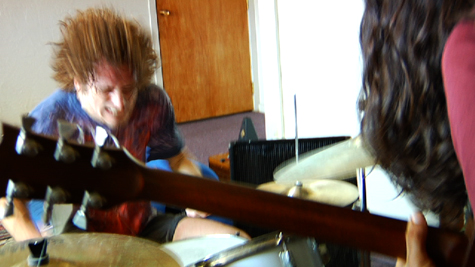
When asked by her label who would be her dream drummer, Stern automatically noted Hella’s drummer Zach Hill, who agreed to play and produce the project, and went on to tour with Stern as well.
Hill seemed like the perfect match for Stern’s aural energy. The Sacramento-based drummer has adorned many projects with his marvelous percussive powers. His drumming is both rambunctious and polished–explosions of sound, two-steps ahead of the listener. Hill is known for his unorthodox approach to time signatures and his quick ankle-work with double hits of the bass drum. His adventurous style was the perfect nail bed for Stern to lay her own spiky sound upon.
Following her original first release in 2007, Stern was immediately put on a media pedestal as a technically driven female artist. Venus Zine named her one of the “Greatest Female Guitarists of All Time” in their Spring 2008 issue, followed by various nominations at the 2008 Plug Music Awards, including “Female Artist of the Year.” People instantly took to Stern’s quirky approach as both overwhelming and awesome, but being known as so technical has become more of a stigma for Stern.
“I find it annoying. It puts a lot of pressure on me to be good at it and puts pressure on me as if I’m walking around with a guitar slung on my shoulder telling everyone on the street that I’m a good player,” Stern said.
Sure it can get on her nerves, but it’s not all bad. Sleater-Kinney was the predecessor for Stern’s career, and the train can easily continue, bringing new creative ladies to the limelight. Women like Kaki King and St. Vincent push the average bounds of their instrument, looping rhythmically and complexly composed pieces to make full, symphonic-feeling music, changing the normal frame of a female solo artist’s classically simple song. Sound evolves, and if that’s a product of a little extra pressure on Stern, then it’s not all bad, so “at the same time, if it inspires any girls to play music, that’s good,” Stern said.
Stern taps away at her fret board, notes piling on top of each other in a mess, like dropping a deck of cards. Her chaotic guitaring is laid on beats that are all at once anxiously abrasive and so quick they barely touch down as a tangible rhythm. Absorbing it is like drinking five cups of coffee and listening to your heartbeat.
“I really don’t know how or why, I get pretty compulsive about stuff. For instance on tour right now Vince [Rogers, drummer] and I are going to start a Tetris tournament, and I will sit and play Tetris as many hours as it takes to win. So I guess the same thing happened with guitar. I just decided and played it for 10 years every second,” Stern said, and quickly added, “and also it’s fun.”
However, as Stern has gone on to develop in her musical career, she’s lost her drive toward focusing so specifically on guitar parts.
“I used to be more technically driven…and I don’t really care as much anymore,” Stern said. “I would prefer people to focus on my songs themselves, as opposed to just the guitar parts.”
Last fall, Stern released her third full-length, a self-titled piece. While listeners might have expected to have pinned Stern’s style to a specific frantic-guitar pattern, they’ll be surprised by Stern’s resistance to style repetition.
“It always has to be different, and never can be formula, or else it sounds like formula to me,” Stern said. “I always have to just look down and not know. It always has to be a blank screen, unfortunately, which makes it much harder for every single song but more exciting when it catches.”
With her head down, following a new path, Stern has branched out of her own dexterously savvy road to a more lyrical terrain, but reluctantly, which in result gives a tough but honest product. It’s no coincidence such a vulnerable piece would be self-titled. Things haven’t changed too much–she’s still the speed queen–but Stern’s effort to sing out and be heard is far more apparent on this album. For an artist with such a forward musical presence, Stern’s always been notoriously shy when it comes to the lyrical side of performance.
“It’s uncomfortable for me; it’s the hardest part, vocals and finding melodies, so I focus on it,” Stern said. “The last record was real personal for me, and I put myself really into it, and I’m proud I felt brave enough to do that.”
When asked to specify what beyond the writing itself made Stern so vulnerable in this particular album, she simply replied, “The way I’m singing, I mean, the whole thing, it’s like Barbara Streisand.”
Zach Hill discusses his new album and his Tao of Drumming
If Zach Hill is anything, he’s prolific. The definitive characteristic of his drum style is constant movement, an unrelenting source of rhythm. The list of musicians he has performed with extends across the globe. This year alone, his name will accompany a drum credit on five studio releases: Cryptomnesia by El Grupo Nuevo de Omar Rodriguez-Lopez, Ice Capped at Both Ends by Diamond Watch Wrists, by- from the duo Bygones, Aggressively Humble by CHLL PLL, and last but not least Face Tat by Zach Hill himself, scheduled for release Oct. 19, 2010. He plays drums for one out of six groups on Sargent House Records alone. And there are more recordings pending, the upcoming Hella record being one. Just to catch him for a conversation, Submerge had to squeeze two hours from his week-long break between a tour of South Korea and Japan with Carson McWhirter, and an Australian leg with the Boredoms he left for before we even went to press.
Hill is aware of the all this. “Not to sound pretentious, but I’ve released over 100 records,” he said. Self-taught, he’s become a financially independent musician. He states it simply, “I’m proud of most of what I’ve done.”
But to summarize his catalog is a superficial gloss of what Zach Hill is all about. Behind a quiet demeanor lies a restless mind, stirring constantly like so many endless drum fills. We talked mainly about the process of recording the new album and how his schedule creates a disruptive focus that enables him to participate in so many projects simultaneously. We also discussed the appealing qualities of an expressive live performance and improvisation. And then he left for Australia.
Face Tat is a fast-paced album full of hard-hitting drums and a million sounds that prove difficult to catalog. Multiple musicians aided Hill in his composition. “A lot of friends definitely contributed good amounts to the record,” says Hill. “Generally when I make my own records, there’s a lot of other people involved, writing, contributing musically. We record together and by the time they hear it I’ve changed it completely, in lots of different ways. Whether it was cut up or totally deconstructed or destroyed, I take whatever my friends have contributed and make it something different.”
This process, reworking the material parts and manipulating them into new sounds, is a consistent approach to Hill’s songs. In digital recording this could lead to endless editing, yet Hill has been able to stay focused. Many of the tracks have specific structures, which the guest musicians build upon, “It’s a specific idea or sound or part that I’ll ask a friend to play,” says Hill. “Or, I’ll play myself; I’ll already have a drum track, with the song entirely composed on drums, and I’ll have an idea of rhythmically and/or melodically what I want to happen. Or, I’ll be working with a series of samples of sounds that other friends contributed while they were playing with me and I’ll flip those and change them up. It’s a sound collage style, nontraditional. There’s a lot of diversity within the record. I’m excited about it.”
One exception to this process of recycling musical parts would be “Face Tat,” which is a duet of sorts between Hill and guitarist Carson McWhirter. A YouTube video is available of them recording, which reveals little change to the finalized song.
Hill’s calendar is filled with touring, which means recording the album had to be done over a long period of time. “I recorded with my friend Andy Morin at home studios all over town,” says Hill. “Because of touring and all kinds of stuff going on, other musical obligations, it was recorded over the course of a year, with breaks. I’d work on it for a month and then I’d have to leave. I didn’t want it to be genre-hopping, but I wanted to have it evolve and touch on all sorts of sources, approaches and feelings.”
The constant interruptions never felt like an obstacle for Hill, who was able to utilize his time at home. “I like working on records in concentrated periods, having focus, and then also having space away so that you can sit on it and listen to it and get an outside perspective of what you’re doing,” he says. “I work best like that, rather than just digging myself in a hole for months working on the same shit over and over and over. Sometimes having distance keeps me from changing something that is just cool how it was at first. It can keep me from working something into the ground.”
Despite the small periods of time available, Hill was able to compile a lot of material for the album, which contains 13 songs. “I always record way more than is necessary for the most part,” he says. “I’m always recording, when I’m practicing or whatever. I’m recording right now and I don’t even know what it’s for. Once I create a deadline for myself then I think about all of the things I’ve been compiling. It’s a motivator to actually finish it. Nothing’s ever really finished.”
Next spring, Hill will have the time to schedule a tour in support of Face Tat, but he says there’s much work to be done before then: “I need to put together a group to perform that material. I’ve thought about doing raw, more abstract versions of the material. It’d be awesome as a minimal three-piece, more stripped sounding. It’s not necessary to cater to the album because that’s not going to happen–based on the way it was made. For a more literal version I would need like four or five people, probably. But it would take a certain type of person or player in order to do it.”
Hill has strong motivation to play. It’s something he’s been doing for 15 years and the drums are almost a part of his consciousness. He likens working on his craft to a bodily expression: “I don’t sit there and practice rudiments all day or anything like that. To me practicing is doing a lot of different things. It’s normal for me to practice interweaving patterns and rhythms, basically not stopping for an hour. I’m improvising in free form, or with form, in and out of time. Whatever I have in my head instantly happens on the drum set without breaks. It’s just my style or whatever. I try to play infinitely, that’s my approach to practice. Zero stopping, zero pauses. Flipping things, reversing things, in and out of everything I can think of in my mind, changing speed, changing punctuation, running through everything I feel like I know on the drums. I’m connected by the drums, being able to put all of those things in any shape or form together. By practicing my brain and my body on that level, I’m able to interlock or change any kind of beat. That’s also practicing your endurance, practicing the physicality of playing the instrument.”
His description of playing drums fluidly is comparative to stream of consciousness writing, where the author lets the text move forward in composition without intent or hesitation. Hill says, “I’m really into seamlessness of playing. There’s a sound I’m always trying to achieve of hyperfluidness, and I don’t mean that in the sense of being graceful. It’s not necessarily a peaceful fashion or a proper, correct way of playing. My favorite musicians, I can’t sense them thinking about what they’re going to do next. That’s the two things I’m interested most about playing music, particularly live. A live show is all about projecting energy.”
The musical energy that Hill admires stems in a way from his mellow external mannerisms. He places it within a space of aesthetic representation: “Just like with any art form, you’re expressing something that can’t really be expressed in any other form. We all have something in us that needs some other platform to get out. Words don’t cut it; normal interaction doesn’t cut it. Talking about it defeats the purpose of even doing it in the first place. It’s a double standard because the entire reason you do it in the first place is because you can’t talk about it. I can’t even explain what I’ve got going on. That’s the whole point.”
Hill’s experiential perspective of music is evident in his experimental works and their subversive forms. “Anything I’m involved in there’s a natural tendency to be going against the grain. I’m drawn to a contrarian’s perspective. That’s just my spirit, to not accept everything at face value. That’s just what I relate to, wanting to look at things a lot deeper and I think that’s a common thread in all different forms of music,” says Hill.
In pursuing music, Hill attempts to “find something that’s relevant, or make a statement that’s of the future, not the past. I’m not a big retro person.” And ultimately Hill is quite happy to be drumming forward into tomorrow. “It’s definitely a blessing. I’m far from jaded. I’m still way grateful and really inspired to do what I do.”

Wavves gets back on track with new album
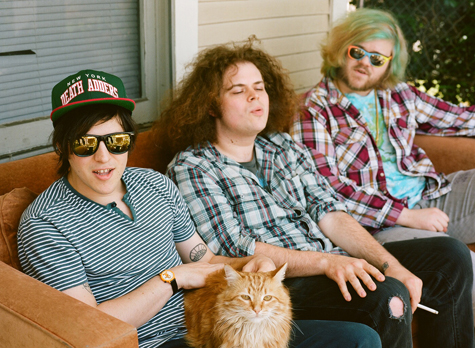
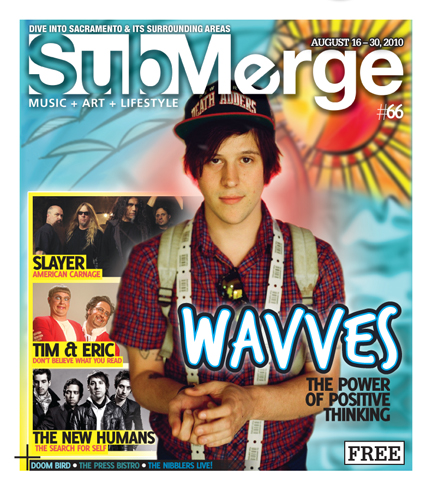
Wavves’ frontman Nathan Williams may very well be the poster child for what it means to be famous in the blog generation. In 2009, Williams came out of nowhere to become the blogosphere’s newest wunderkind. His second album in two years, Wavvves, powered by the ecstatically apathetic single “So Bored,” propelled Williams into bona fide Internet fame. In the year that followed, Williams stoked those flames, whether he wanted to or not, with erratic behavior an inter-band feud with The Black Lips and most infamously, a meltdown at the Primavera Sound Festival in Spain (which we were kindly asked not to talk about–but really, if you haven’t heard enough about it already, you’re probably not that cool). What started as some fuzzed-out psych pop home recordings had blown up big–like Tay Zonday big. Now after clumsily negotiating in record time every trap set to befall the person lucky (or unlucky, as the case may be) enough to be tagged with the “next big thing” moniker, Williams, with another Wavves album already in tow, is ready to put the focus back on his music.
Submerge caught up with Williams first in his car, then at home, where he was making guacamole. There were some stops and starts throughout the interview. First, after rescheduling, understandably, so Williams wouldn’t have to talk and drive, we called back only to have our phone call answered by “Will,” who turned out to be Wavves’ new full-time drummer Billy Hayes.
“They don’t want to talk to me,” he says, trying to get Williams to take the phone. “They don’t want to talk to the drummer.”
Eventually, Williams granted our interview request, passing off to Wavves’ new full-time bassist Stephen Pope once, and answering call waiting to push back another interview.
At least this time around, Williams is busy answering questions about his music and not his antics. Released on Aug. 3, King of the Beach takes Williams out of the bedroom and into the studio. The album was recorded in Oxford, Miss., at Sweet Tea Recording under the guidance of producer Dennis Herring. A Grammy-winning producer for his work on Jars of Clay’s If I Left the Zoo, Herring has also worked with Counting Crows, Mutemath and Modest Mouse. Certainly, this would be a step up for Williams, who had recorded the past two Wavves albums himself on his laptop. Williams says he was happy to graduate into a proper studio and relinquish a small amount of control over his recordings.
“It was a little bit weird at first, but I’m not a producer,” he says. “I did it out of means when I was doing my earlier stuff, but I sat there throughout the mixing process every single day that Dennis did, so I didn’t have to hand too much over.”
Williams says that relocating out to Oxford–a far cry from Los Angeles–was also helpful in allowing him to focus on recording.
“There wasn’t much to do,” he says. “The city center just had a couple of stores, so most of the time we were just concentrating on making the record.
“When bars close at 10, and you don’t get out of the studio until 12…it’s a little hard to party.”
The additions of Pope and Hayes also had a significant impact on the album. More than just players on a couple songs, Wavves’ two new members also contributed their own songs. Williams met up with Pope and Hayes shortly after that fateful performance at Primavera Sound, which left Williams without a live drummer. Pope and Hayes joined Williams as his touring band at the end of 2009 and had played together previously as Jay Reatard’s backing band. Reatard passed away in January due to cocaine-related causes.
In a recent story, SPIN reported that Fat Possum, Wavves’ record label, lobbied for Pope and Hayes to be replaced on the album, but Williams stepped in and insisted they stay on board.
“I don’t know if that was Dennis or the label,” says Pope. “One of the people who we can’t speak of wanted another person who we can’t speak of who is very famous and costs a lot of money to come in and play drums. And then that NW [Nathan Williams] character said no, that would have been a really bad idea.”
Pope says that this modicum of tumult didn’t get him down.
“There wasn’t really anything I could do, and we got really high enough every day that I really didn’t think of it that much,” he explains. “Whatever was going to happen was going to happen.”
Pope and Hayes stayed on and made solid contributions. Pope says Hayes brought two songs he’d written–“Baby Say Goodbye” and “Convertible Balloon”–while Pope brought along “Linus Spacehead,” one of the album’s more infectious tracks. This was a different experience from their work with Reatard, who pretty much handled everything.
“Jay did everything himself, except for a few songs on the newest album,” he says. “Billy played some drums. Other than that, Jay did everything himself. We changed up the live show and were able to play what we wanted then.”
Pope says of the songs he and Hayes contributed, “They weren’t really intended for anything. They were easy to Wavves-ify and make it sound like the rest of the album.”
Armed with better tools and new players, King of the Beach still sounds very much like a Wavves record, except without much of the fuzz. Titles such as “Super Soaker,” “Baseball Cards” and “Mickey Mouse” put a carefree façade on songs that can be downright misanthropic. But it’s not all angst-riddled bile–King of the Beach has its sun-shiny moments, such as its title track. As tongue-in-cheek as it may be, it’s still pretty darn cheerful. Its defiant chorus, “You’re never going to stop me/You’re never going to stop/King of the Beach,” is goofy-smile shout-along ready.
“It’s kind of like a posi-core song, isn’t it? It’s really positive,” Williams muses. “I think ‘Take on the World’ has the same vibe. I don’t know. I wrote them both around the same time, and I guess that was just the shit I was on right then–trying to be positive for these young kids! Tell them what’s up!”
Sarcastic or not, Williams has plenty to be positive about. He is, after all, young and “playing music…and making a living doing it.” Whatever petulance he’s displayed early on in his career may fade with time. In any case, Williams reports that he’s already been in the studio with Pope and Hayes and says he may start working on another album later this year. Also, he’s recorded music with Hella’s Zach Hill, which has yet to be released.
“There’s like a six-month wait after this album is out before I can release anything else, and then I’m out of contract,” Williams says of his recordings with Hill. “Hopefully end of the year or something like that.”
With plenty more music on the way, Williams can finally put the meltdowns and fistfights behind him. Plus, the good thing about the blog generation is that it’s got a short memory.
Steven Borth’s CHLLNGR takes dub to the next level
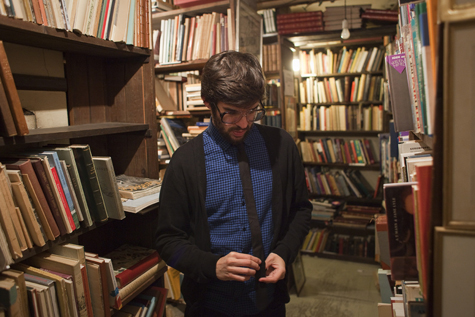
Jet setting around the world to collaborate and tour, studio sessions with music’s most renowned creators, and splitting living time in Sacramento and Copenhagen with a beautiful girlfriend would seem to make for a full life for most musicians, yet Steven Borth II seeks more from his endeavors. The well-traveled musician is exploding back onto the scene with his new project, CHLLNGR, a dub revolution that takes some history-digging to get to its source.
Borth was born and raised in Sacramento, but found his niche as a musician in the Bay Area. Remember ska? More specifically, remember third-wave ska punk? It had a good run in the ’80s and ’90s and Steven Borth II was a part of that as a member of the East Bay’s Link 80. He joined the group in the latter years of its existence, but his involvement is integral in shaping CHLLNGR.
Link 80 frequently toured Europe, enjoying the fruits of the punk rock circuit in the United Kingdom. It was on these tours that Borth acquired a taste for dub music. “I would help load in the gear, do a sound check with just enough to time to go outside and ask someone where the nearest record shop was,” he said. “I would make it just in time before they closed, and I would pick up what I thought may be good. How I really got started was collecting the Trojan box sets.”
The dissolution of ska was far from pretty. Link 80 suffered traumatic losses and its surviving members found new outlets. For Borth it was joining Rx Bandits, another Bay Area ska revival band. He’d been in Link 80 for four years, but when Steve Choi offered him a spot, he joined up because, he said, Rx Bandits’ sound shared the direction of his interests musically and politically. Those Trojan box sets he scored while on tour with Link 80 introduced him to dub originator King Tubby, which inspired him to continue his exploration of dub while on European tours with Rx Bandits.
Borth started a side band called Satori while playing in Rx Bandits. He described that band as homage to Jamaican music, which served as a foundation for CHLLNGR—his foray into the next era of dub.
Borth first graced our radar as the bearded, almost Teen Wolf look-a-like saxophonist in Purple Girl. The all-too-short-lived funk band could have been Sacramento’s answer to Hall & Oates, but it was not meant to be. Months later, Borth’s three-piece project Dub Defender emerged at The Press Club. Dub Defender’s first run of shows featured Borth on keys, vocals and sax, with Purple Girl/Who Cares keyboardist Young Aundee contributing falsetto vox and DJ Whores cutting up club-friendly hip-hop samples into the dubbed-out fold.
That night featured hip-hop and indie rock bands, yet wedging a dub set into the mix was far from an uncomfortable juxtaposition. Borth’s willingness to let his projects breathe and grow makes Dub Defender an intriguing plot. There is no blueprint for Dub Defender. Borth opts to let his instincts and interests amalgamate until he’s satisfied with the results. “One of the most important things for me in music and in life is to always be open to new ideas,” he said. “I try to make open roads for myself and anyone that is involved in my projects.”
Borth and company leaked a single, “Change Is Great,” as Dub Defender before changing the name. The project is now called CHLLNGR, which is pronounced “Challenger”—he just dropped those useless vowels. Borth explained that the new name is meant to express the boundless nature of the project. “I felt the name Dub Defender could be restricting stylistically,” he said. “I really want to explore this project and take it as far as it can go.”
CHLLNGR began on a TASCAM 388 reel-to-reel machine made in 1985, which Borth purchase in San Jose, Calif. He enjoyed the dusty aged sound of the quarter-inch tape. “[The seller] tried to say it worked, but I knew that it didn’t,” he said. “It cost me $800 to fix, but in ’85 it was retailed at $5,000. Using it made me think a lot about studios, and if you’re looking for a vintage sound, it’s better to be limited, because that’s technically how it was.”
The recording sessions were structured as a game for the collaborators to play. Borth invited his friends to add their touch to the simple chord changes he’d laid down, until each musician was satisfied with their bit. Once the structure was settled, he recorded on the TASCAM until the proper vibe filled the room.
“I wasn’t looking for perfection as much as I was listening for the take where everyone’s own style came out the most,” Borth said. “What I really captured in doing it like this was that once we got it, there was a certain freshness to the sound since we were really learning and creating the songs while in the process of recording them.”
Those sessions will be CHLLNGR’s debut EP, which is scheduled for a spring release on Green Owl. The EP’s release has been pushed back several times, but the delay has not phased Borth. He said, “When the project gets debuted we want it to be perfect. The people I’m working with on this record have been making music for a long time, so we know how to do it wrong. We’re taking the necessary measures to be certain that the timing is right.”
The live set, since we last heard it, focused primarily on dub vibes; but when Borth mentions collaborating with Zach Hill, Brooklyn’s Ninjasonik, former The Defendants member Dr. Echo and London’s Afrikan Boy, the direction of CHLLNGR becomes puzzling. It’s not surprising his session with Hill in the Bay Area involved noise nuisance disputes. Borth invited Hill over to lay down drums and even took the necessary steps to warn his landlord and neighbors of the impending noise. “I knew it was going to be loud, but I had no idea how loud.”
“[The landlord] said it would be fine but to try to get done by a certain time since they had their grandparents coming over,” Borth said. “Once we were done we walked outside and my landlord looked like he wanted to kill me. He said it shook the whole house. Needless to say, we were done in time and no heart attacks occurred.”
Living the life of a nomad, but keeping an apartment in Copenhagen, Borth said it’s been a taxing process to continue recording CHLLNGR on his beloved TASCAM. “I have been creating a lot more of my music utilizing modern technology, i.e my laptop, micro-Korg and an Mbox, which I think will be reflected in the sound,” he said. “I will most likely use the TASCAM again for this project, but at this point since I am traveling quite a bit, and it is easier for me to put everything in a duffle bag, travel around and capture sounds.”

CHLLNGR played the Submerge 50th Issue Party/second anniversary on Saturday, Jan. 9 at Marilyn’s on K with TAIS and DJ Mike Diamond.
To see when and where CHLLNGR will play next you can check out www.myspace.com/chllngr
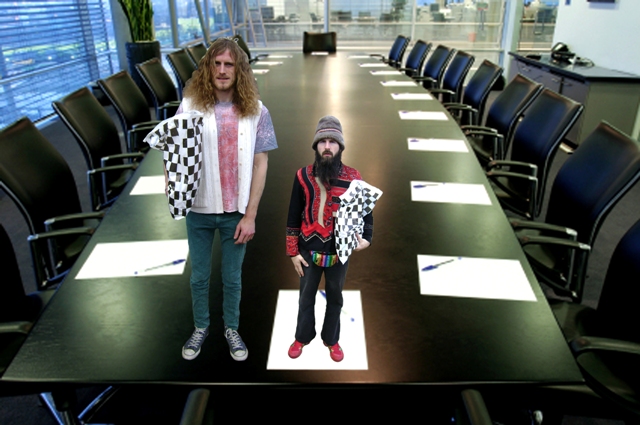
Four years ago, the world was a different place: electing a black president was still just a fantasy; thought of a serious, wordwide recession was just another thing for alarmists to rant and rave about; and Sacramento’s spaz-rockers Hella was together as a duo.
Now in 2009, no one bats an eye as Barack Obama helms the sinking ship of the U.S. economy toward what most of us hope are greener pastures (Rush Limbaugh), and Hella has began work on their first album as a two-piece band since 2005. Zach Hill (drums) and Spencer Seim (guitars) announced today on their Myspace page that they’re writing a new record.
Details are still few. According to the band, “the album will be recorded and finished this year of 2009.” However, as of now, no label or producer/engineer have been chosen. Uncertain music for uncertain times. What better band than Hella to serve as the soundtrack for the wild year ahead?