We all know that the heavy use of pesticides in our produce, which also sneaks its way into the processed foods we eat, can cause a host of health problems, including cancer. While some religiously steer clear of genetically modified organisms (GMOs) and non-organic food, and find it hard to eat out without questioning what insidious chemicals they might be ingesting, most of us don’t have time to stand in grocery store aisles thoroughly perusing every nutrition label, and thoughtlessly toss whatevs into the cart.
EASTsmf, a year-old restaurant on J and 32nd streets in East Sacramento, offers a well-executed, ever-changing menu—but they also offer a relaxing dining experience, paired with peace of mind. All of the food and drink served in this comfortable, casual space is organic and non-GMO. Additionally, most ingredients are sourced locally. Whether you’re a meat eater or vegan, all are welcome.
Owned and operated by husband and wife team Rhonda and Tony Gruska, EASTsmf is the couple’s second organic restaurant endeavor. Monticello was located in Davis, a town that is known for its food conscientiousness, albeit while also housing notorious GMO-purveyors Monsanto. After a four-year tenure, they shuttered Monticello in mid-2015, but Rhonda and Tony didn’t give up, and learned from the experience. “Most people are aware that restaurants are a tough business, but that situation was pretty much untenable from the start for a number of reasons. It was such a beautiful space, but our investment was misplaced,” said Rhonda of Monticello’s closure.
The lessons, besides downsizing their brick and mortar, included getting in where you fit in, and being in Sacramento, a hotbed for slow food, was the way to go. Beams Rhonda, “We love it here.”
Tony gained an appetite for cooking as a child, inspired by his Polish grandfather. “There were crocks of sauerkraut fermenting in the basement and freshly ground horseradish and beets in the refrigerator. On weekends, he took me along to visit the local butcher and we’d always stop by the bakery for Polish cheesecake. The first full meal I cooked on my own was at age eight. I was cooking regularly from that point on, and it’s no surprise to me that I ended up in this profession, as cooking and food have such a strong association with my beloved grandfather.”
Also a foodie at heart, Rhonda met Tony in college working at the Segundo dining hall at UC Davis. “Tony was back of the house and I was front of the house. We’ve pretty much had that same dynamic going on ever since. After college, I went into politics, while Tony started a catering business. It was the perfect combination. My job involved a lot of event planning and fundraising and Tony handled making sure we always had great food,” recounts Rhonda.
Although EASTsmf is by no means preachy, it is a dining establishment that is rooted in food politics and a philosophy of health and quality. “We don’t want to serve our customers anything we wouldn’t eat. That’s why organic is so important to us, and if it’s not organic, we make sure it’s non-GMO. Genetically engineered ingredients are really insidious because, unlike other developed countries in the world, we have no labeling laws. Americans are eating GMOs in the form of oils, margarines, sugars derived from sugar beets or corn, and a myriad of fillers and emulsifiers. It’s a lot of work figuring out what’s safe to eat in the U.S. because our food system is controlled by the same people who profit from it,” explains Rhonda. “Local, seasonal organic vegetables make up such a large part of our menu, so our farmers bringing in something new means the menu is going to change. Tony’s inspiration for a new dish is driven by what our farmers have that particular week.”
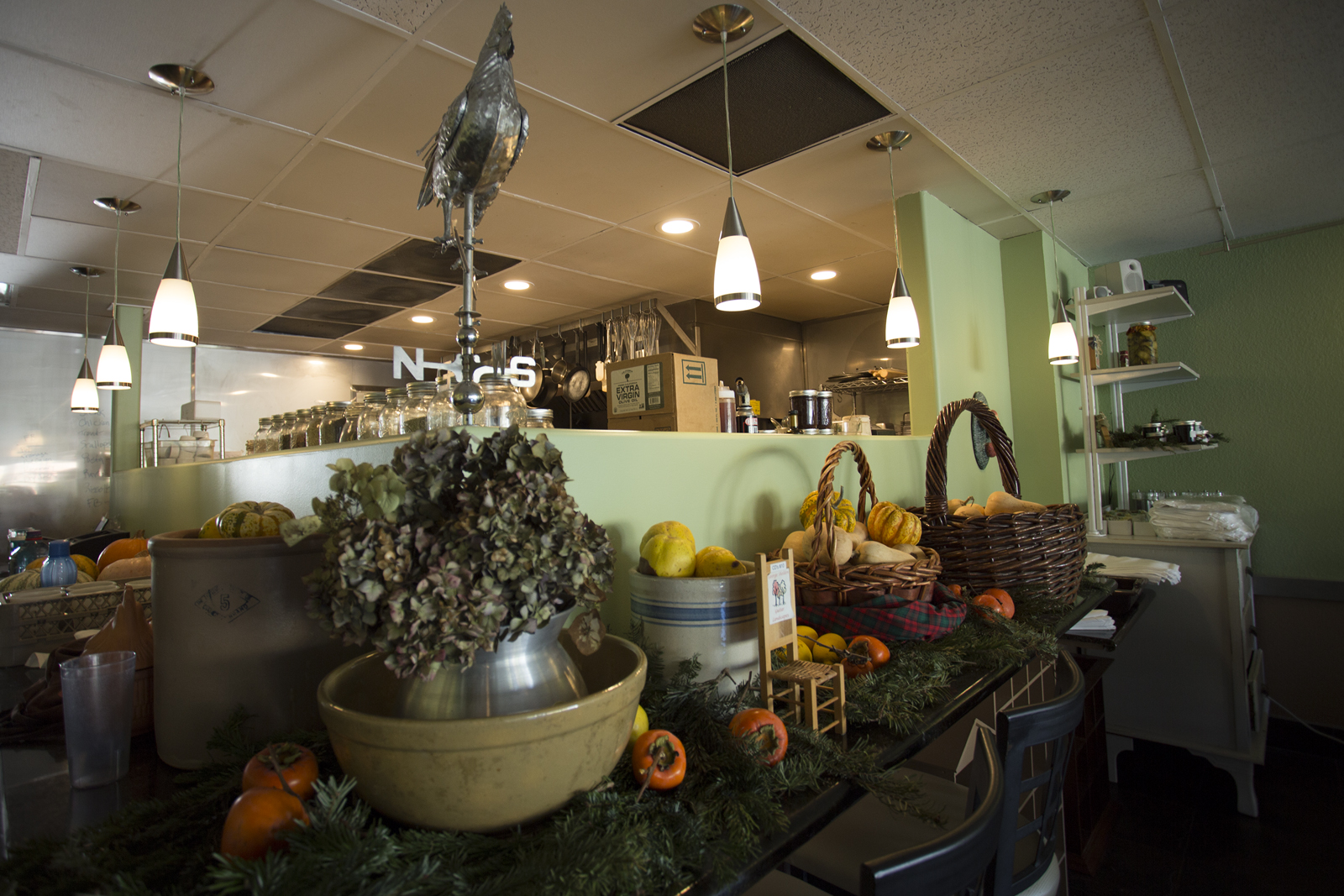
Photographer Evan Duran and I visited EASTsmf for dinner, and after passing through its outdoor patio, we entered into a simply decorated, tranquil space. Louis Armstrong’s crooning, slow swing set the mood. Curated art and photography don the mint green walls and a small, open kitchen in the corner is wrapped with a counter upon which rest a cornucopia of flowers and gourds. A rooster statue sits atop and the restaurant has a very Petaluma feel.
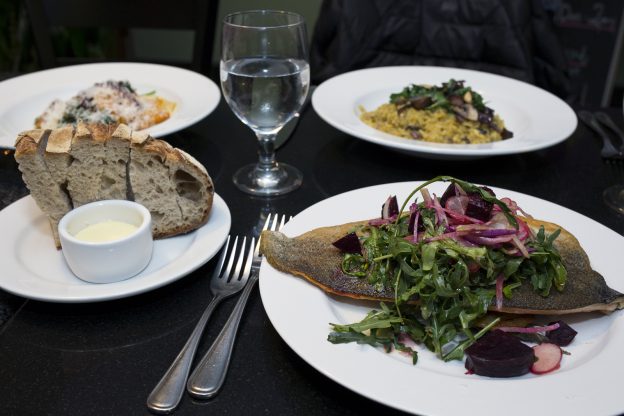
The menu is categorized into starters and mains, and even the beer and wine are organic. The soup of the day is always vegan and gluten-free. After some deliberation, we ordered the vegan wild mushroom risotto, the butternut squash soup, the cheese plate, the pan-roasted trout and the fresh pasta.
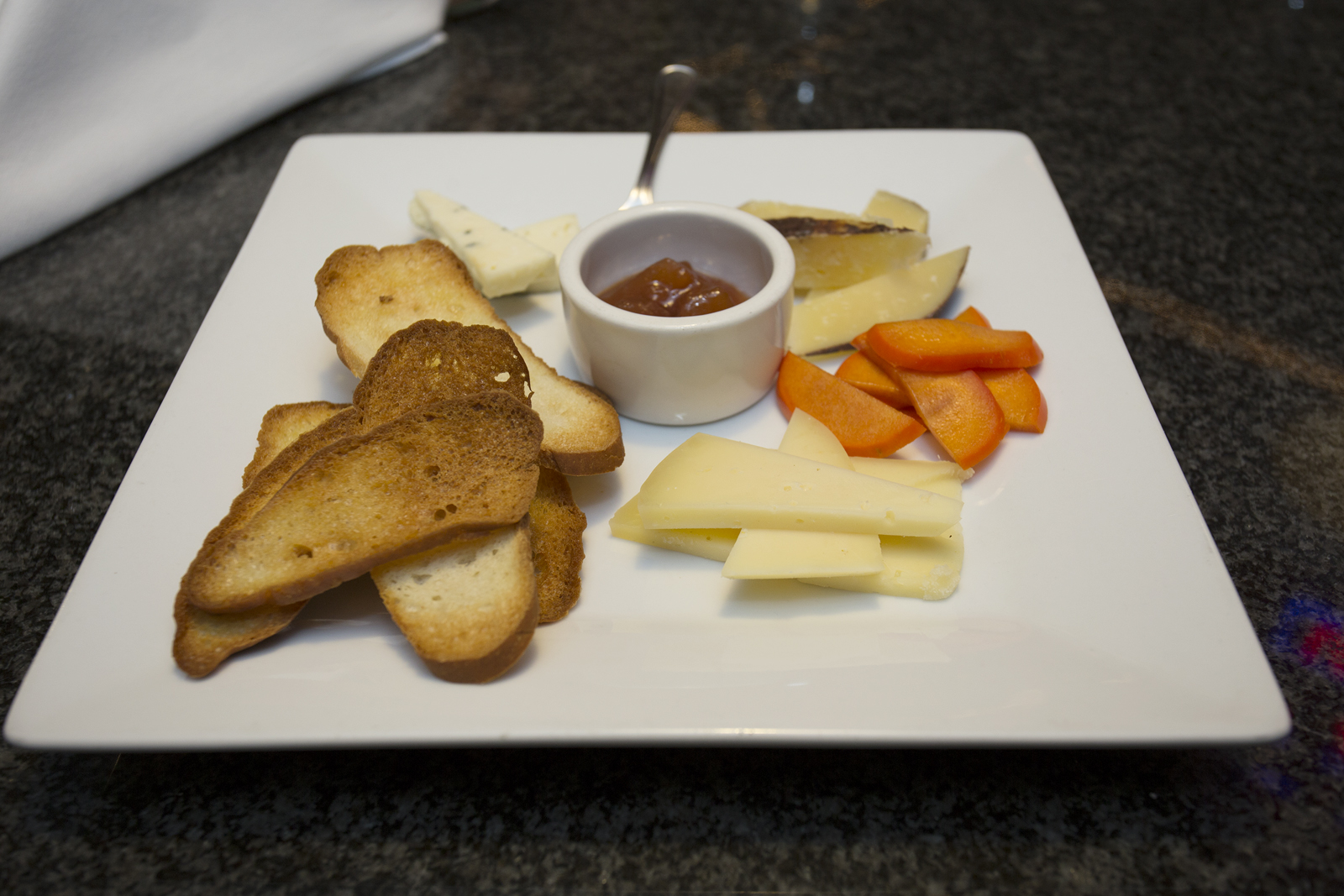
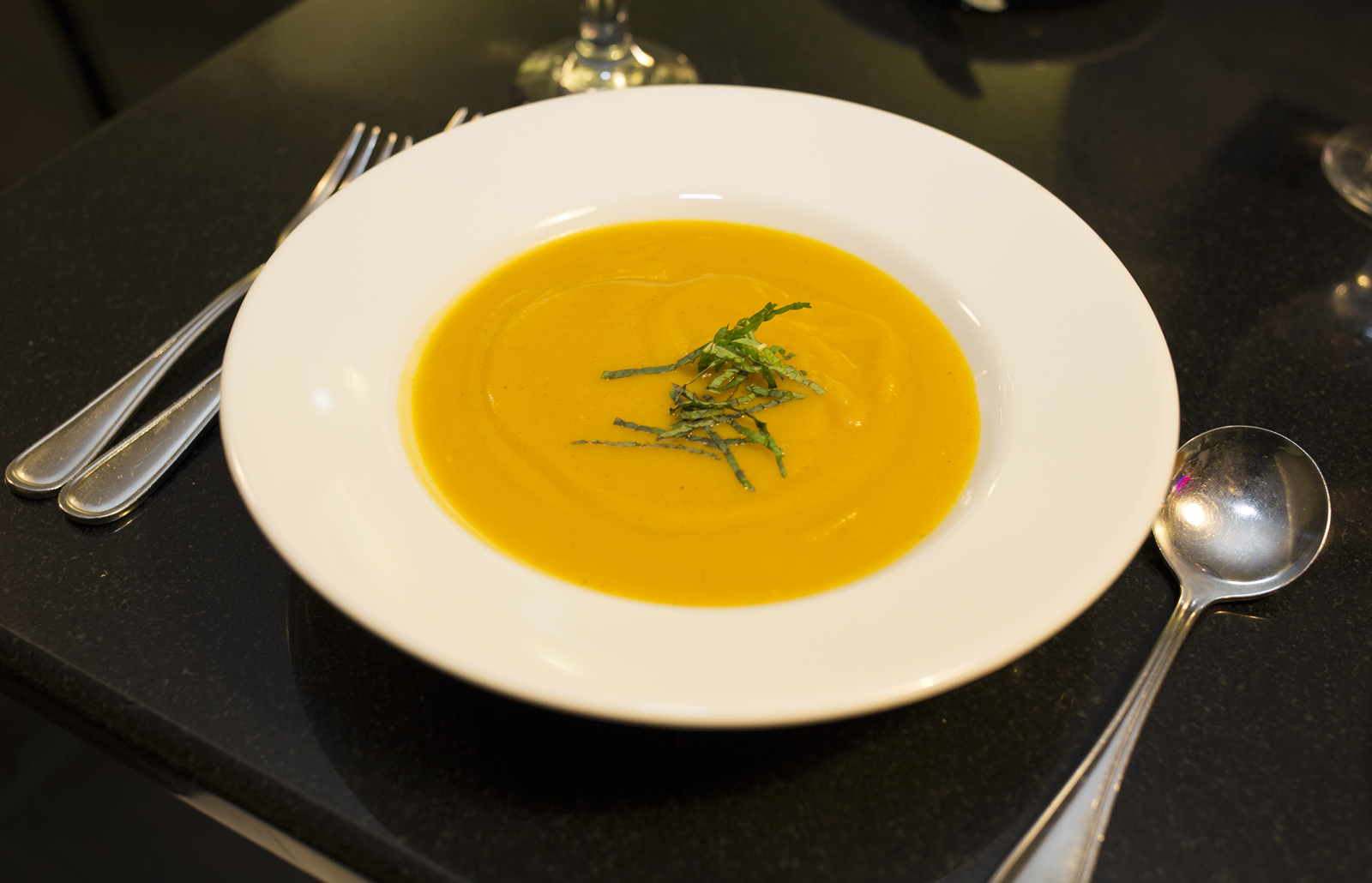
The cheese plate and soup arrived first. Sliced persimmons, Point Reyes Toma, Vella dry jack, Point Reyes blue cheese and a peach preserve made in East Sacramento by Nina at Old World Farm comprised the cheese plate that evening. The butternut squash soup was thick, creamy and savory, and topped with shredded mint leaves.
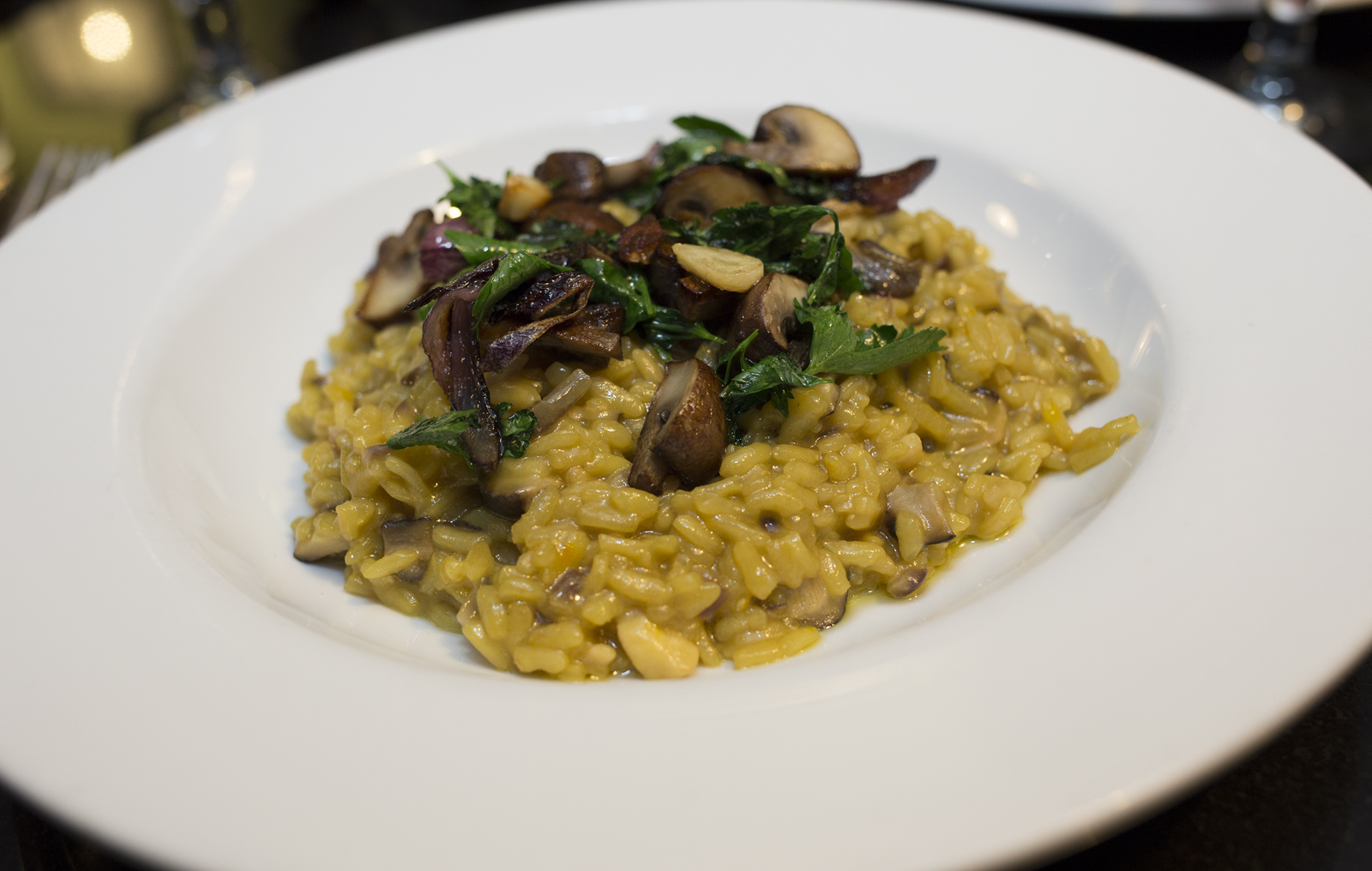
When the mains arrived, Evan remarked, “This is the best risotto I’ve ever had.” The wild mushroom risotto was loaded with rich saffron, delicious wild mushrooms, caramelized onions, and roasted garlic and topped with fresh parsley.
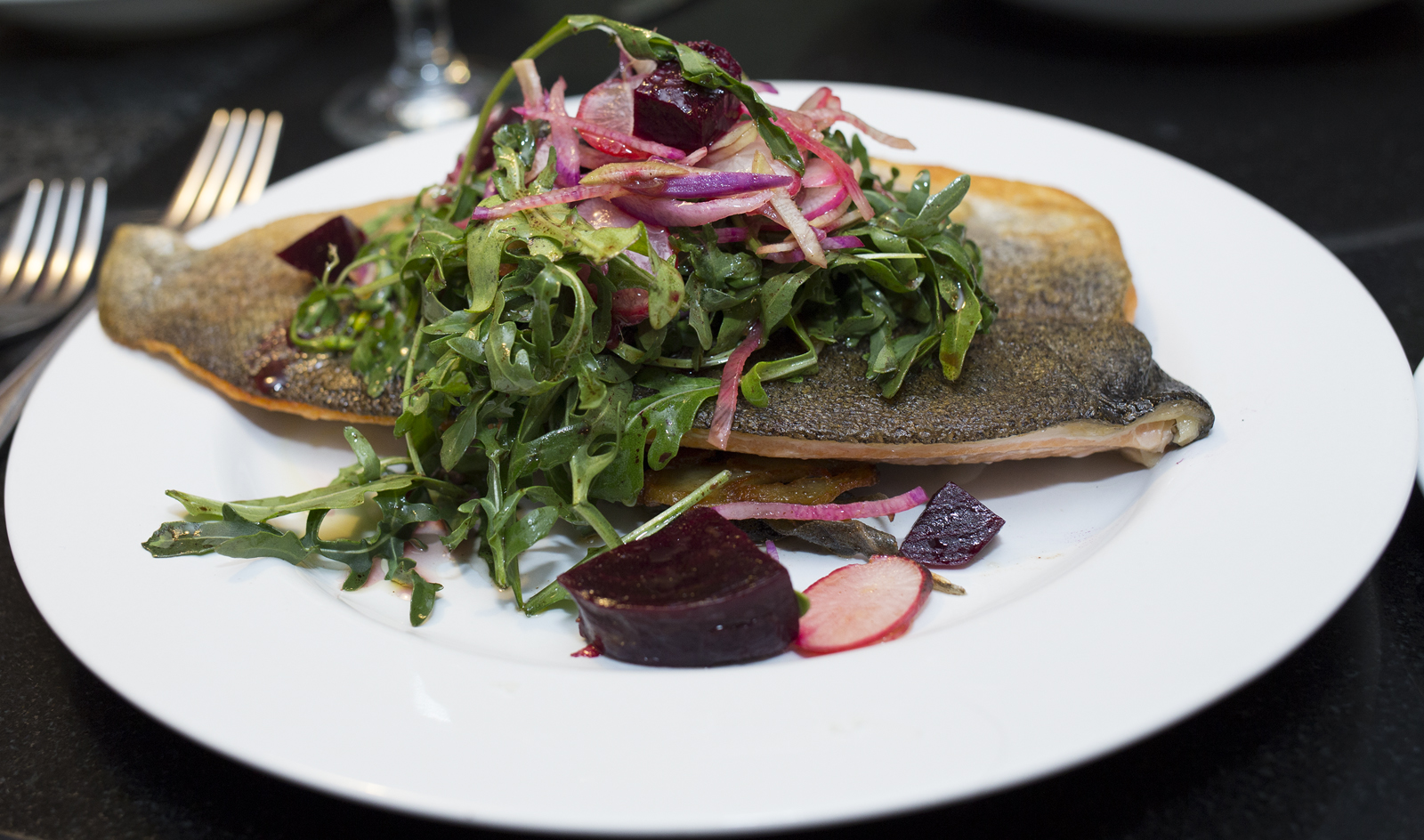
Similarly, I found the pan-roasted trout to be the most beautifully plated and perfectly executed fish dish I’d ever sunk my eager teeth into. Undeniably fresh as a daisy, the trout was seared, crispy skin-on and laid on a bed of roasted potatoes and arugula with a blanket of roasted red beets and thinly sliced radishes.
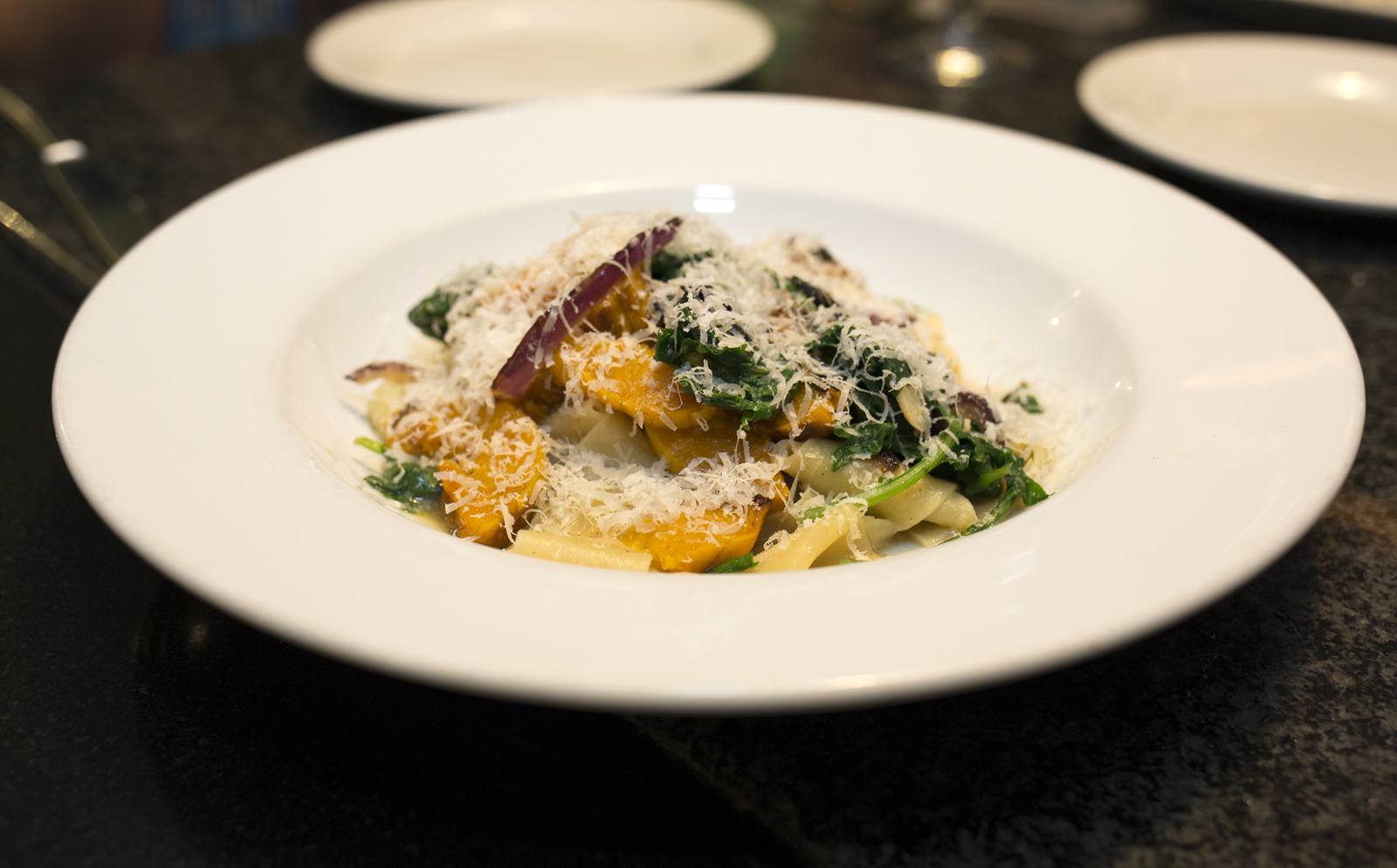
But best of all was the fresh pasta. On this day, it was a pappardelle dish with chunks of roasted butternut, sautéed farm greens, sage brown butter, caramelized onions and parmesan. It was savory, creamy, buttery, al dente and unforgettable.
Whatever caused Rhonda and Tony to close the doors of Monticello, EASTsmf deserves to succeed with its healthy, top-notch culinary offerings in a homey setting, situated in a fairly central location that tends to welcome similar concepts. And it deserves your attention.
“We wish we had come directly to Sacramento in 2008 after our two-year stint as a pop-up in Winters, but that’s hindsight for you,” reflects Rhonda. “We’re currently doing our best to live every day in the present, and while restaurants are hard, especially when you take the extra steps we do as far as sourcing and preparing everything from scratch, we’re very happy. This is a very pleasant place to work and live.”
EASTsmf is located at 3260 J St. in Sacramento. The restaurant is open for lunch Tuesday–Friday from 11:30 a.m.–2 p.m., for dinner Tuesday–Saturday from 5 p.m–9 p.m., and for Sunday brunch from 10 a.m.–2 p.m. Find more info at Eastsmf.info.
On Amtrak one very early morning from Sacramento to the Bay Area, the train rolled by pastures dotted with grazing cattle along Interstate 80 in Yolo County, and for the first time I wondered if the animal I’d eaten that week had also ruminated in these hills.
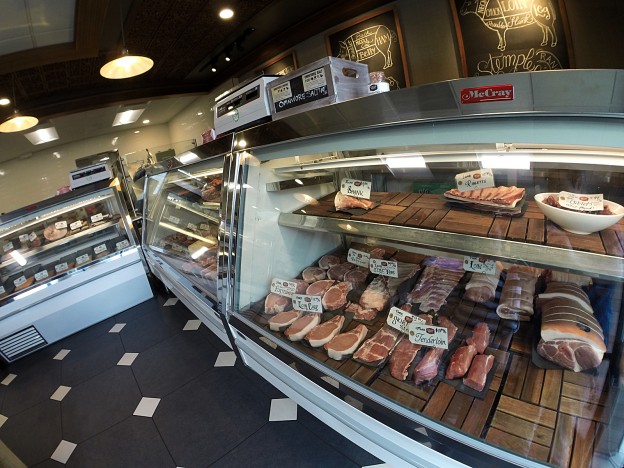
After visiting Eric Veldman Miller and his whole-animal butchery in East Sacramento, it’s a thought I’ll have more often before biting into a piece of meat.
V. Miller Meats opened last November and has quietly—but overwhelmingly—taken over kitchens of even the most novice of neighborhood cooks. The shop focuses on home cooking, not offering catering or large restaurant orders because of the limited quantity. For now, Miller orders one full steer a week (but is going up to two for the summer), along with four pigs, two lambs and one flock of chickens.
Miller, a longtime local chef and former Le Cordon Bleu chef instructor, has always subscribed to Sacramento’s farm-to-fork mantra but didn’t really see the same attention given to meat as he saw being given to vegetables.
“People ask, ‘When was that carrot picked? Where was it picked? Is it a heritage breed carrot?’ But, for me, that’s not the most memorable part of a meal,” Miller says. “I thought, we can do this, too. Tie meat into farm-to-fork. So I started meeting other butchers from around the country and it’s working in places that aren’t even as ag-central as Sacramento.”
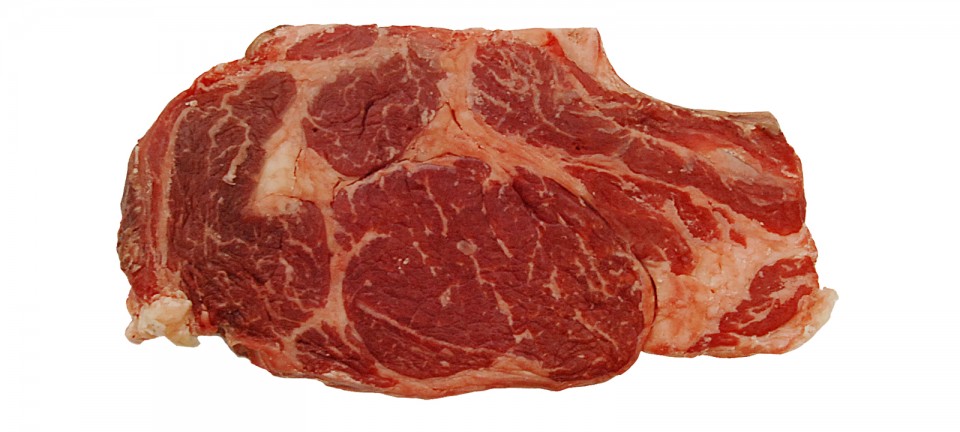
Miller chose just a few farms from which to purchase whole carcasses, making sure the farms were small, humane, located within 100 miles of Sacramento and raised heritage breeds that are grass-fed and grass-finished.
For now, V. Miller is the only butchery of its kind in Sacramento, and Miller says he isn’t trying to compete with anyone. He even compares his shop more with restaurants than he does grocers.
“The main difference between a restaurant and a butcher: How often does someone go into a restaurant and ask what’s in the sausage?” says Miller, who, along with his three-person staff, makes sausage, hot dogs, bone broth, and several other products to ensure the whole animal is used in-house and never frozen. And he’ll tell you exactly how he did it. He might even show you, as he did with regular customer Keith Bisharat, a longtime River Park resident.
On this morning, Bisharat came in just as the shop opened to pick up items for dinner and says he hasn’t found anything comparable in taste, or anyone who can talk about the cuts and process as it’s happening.
“The chicken reminds me of the chicken I ate when I was a kid,” he says, noting he’s told all of his friends and family about V. Miller. “One of the challenges they’re going to have is that people are used to the taste from big names like Foster Farms and Tyson.”
V. Miller’s head butcher is Cindy Marlene Garcia, a 25-year-old UC Davis grad who started in the veterinary program and ended up loving her meat lab courses so much that she switched careers.
“We aren’t reinventing the wheel, we are simply reconnecting everyone to where food comes from,” Garcia says. “I like thinking we are working toward a future where people know that their food lived a natural and healthy life.”

Garcia remembers how proud she was the first time she brought home a steak after slaughtering and processing at the UC Davis Meat Lab. She originally signed up for the 10-week course for anatomy practice as a pre-vet student, but couldn’t get enough.
“The feeling was incredible—I told my parents all about how it was raised and how it came to their plate,” she says. “The simple feeling of bringing home meat for my family is primitive but so fulfilling. I have stayed with the profession because I love talking about meat with people and love helping people understand the anatomy and physiology of the animal and why certain cuts require different techniques to cook them. I also really enjoy explaining why the care and treatment of the animal is so critical in achieving the optimal flavor.”
Garcia adds that in East Sacramento’s tight-knit community, she and Miller have formed a lot of bonds with people because they now see them every week. She admits to even having ruined people’s meals because her instructions weren’t clear enough or the execution went awry, but she works together with her customers to try again, noting some cuts are out of people’s comfort level, but she wants to push the boundaries to use the entire animal.
Miller adds that a lot of the fun, and also some aggravation, comes when trying to determine what to do with all the animal parts.
“This weekend we had 13 different types of sausages going,” he says. “Even our hot dogs are Stemple Creek Ranch. It took a while to make a really good hot dog but we’ve done it. We always have two to three new projects going as test batches.”
The shop also offers cooked rotisserie chickens for $18 on Tuesdays and boxed meals for two, complete with sides and ready to eat, for $25 on Thursdays.
Potential customers may have preconceived notions that the shop’s prices are out of range given the type of product, but in fact, Miller says, he’s kept prices comparable to the area, and less than full-priced organic meats at Whole Foods.
“This sounds counterintuitive, but I would prefer people buy less meat,” he says. “A big part of your plate should be vegetables, and that’s also more affordable. But we are stuck on this idea that if you are throwing a party, everybody needs a ribeye. I’d say, just get a roast that you can cut into slices and you’ll still have leftovers.”
Miller also hired chef and former instructor Dave Nelson to assist with the shop and cooking, and Matt Davis to help with cleaning. Now, all four can handle different levels of the operation as business picks up, and Miller is looking for a second experienced butcher.
“People think, as we all here did, that we’ll just become butchers, no problem,” he says. “But you’re always cold, you smell like smoke and meat, you’re cutting things all day, and it’s physically very taxing.”
But Miller also tries to have the same mentality he did as a chef—if the chef is having fun, everyone else in the kitchen will, too. If a team member has an idea, they’ll try it out. Some of the quirkier ones have included tongue pastrami, rump roast jerky and ghost pepper hot links.
“You walk in the back door, welcome to nirvana,” he says, and smiles. In the background, Nelson has just skinned a cow tongue and is about to marinate it.
V. Miller Meats is located at 4801 Folsom Boulevard and open Tuesday through Sunday. Find out more at Vmillermeats.com.
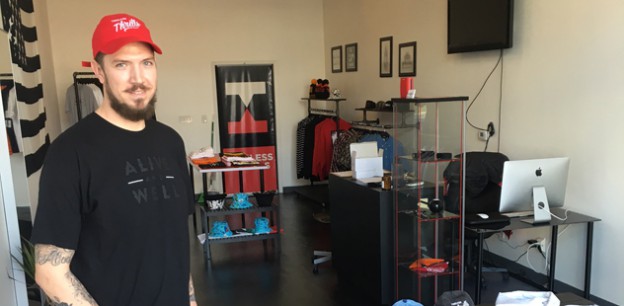
After selling their goods online and through other retail outlets, one local clothing company now has a little over 800 square-feet on J Street to call their own. Just this last weekend, Timeless Thrills opened the doors for a soft opening of their flagship store, located at 3714 J Street in East Sacramento. A few days before that, Submerge stopped in to shoot the shit with owner Tyler Wichmann and to get a sneak peek at the space.
Wichmann and crew did a great job setting up the store with a minimal, yet functional vibe. Tall ceilings, bright white walls, black floors, it’s all very clean looking, like an art-gallery-meets-boutique. The shop is freshly stocked with Timeless Thrills’ signature high-end menswear. Sweaters, jackets, T-shirts, polo shirts, hats, beanies, bandanas, tote bags, socks, belts, patches, heck even doormats all don the classic-looking TT logo or other engaging designs. For the past four-plus years, Wichmann has sold his Timeless Thrills goods online at Timelessthrills.com, and through popular local retailers like Getta Clue and GoodStock. Now he’s looking forward to being able to funnel all of his gear into his own shop, a dream come true for the young entrepreneur (he’s just 28 years old). The grand opening party is set for Saturday, Jan. 23, 2016 and will feature a special collaboration with popular local photographer William Thompson (@goodthompson on Instagram).
Look for other creative collabs in the future as well now that Wichmann has a space of his own to get down with. We’re looking forward to seeing what the future holds for Timeless Thrills! Learn more about the brand by following them online (@timelessthrills on all social media), or just stop in and say what up to the man himself.
East Sacramento’s Best Hole in the Wall
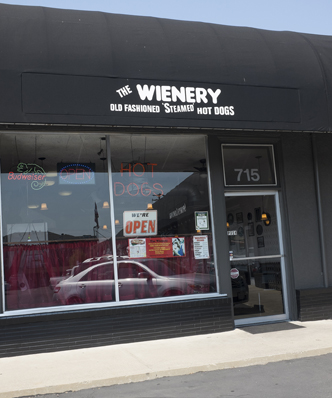
With great food, tasty drinks and a big city feel, the new restaurants and bars that are popping up in Sacramento have just about everything you can ask for. With that being said, all of the new establishments—many of which I frequent and enjoy—lack a couple of things that can surely be acquired over time: history and tradition. I’m not talking about the history of the building itself, or the tradition of a classic cocktail, but the history of a worn countertop and the tradition of bringing your child to a restaurant where your father once brought you. This is something you’ll find in East Sacramento’s hot dog staple, The Wienery.
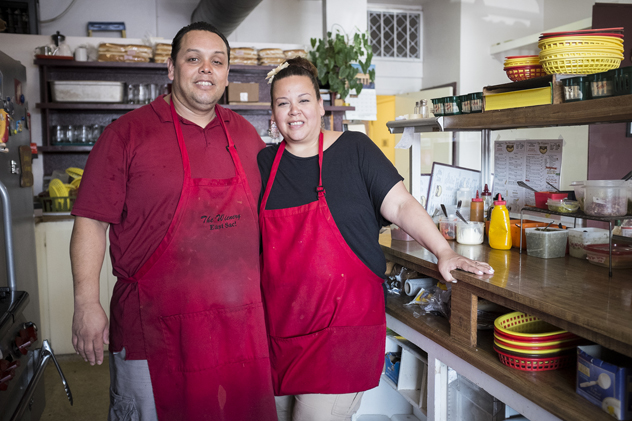
The warm feeling you get when walking into The Wienery can only be earned with decades of hard work and a willingness to curate what has already been established. Owners Hector Meza and Carolyn Canas kept this in mind when purchasing the business more than five years ago.
Canas explained, “When we bought The Wienery we just gave it a little facelift. This place has been here for at least 45 years. We wanted to update it a little bit without making our loyal customers feel uncomfortable. We didn’t want them to think it was too different or too new. At the same time, we wanted to make it someplace that will be inviting for new customers, too. When people come here they’re looking for an experience that makes them feel cozy and like they are home away from home.”
This is evident in the framed photographs that hang above the tables. “We wanted to add a tribute to East Sacramento on our wall,” said Canas. “The wall was filled with photos of our customers, but over time many of the photos faded away so we had to take those down, but we enlarged and framed some of the best pictures and put them back up.”
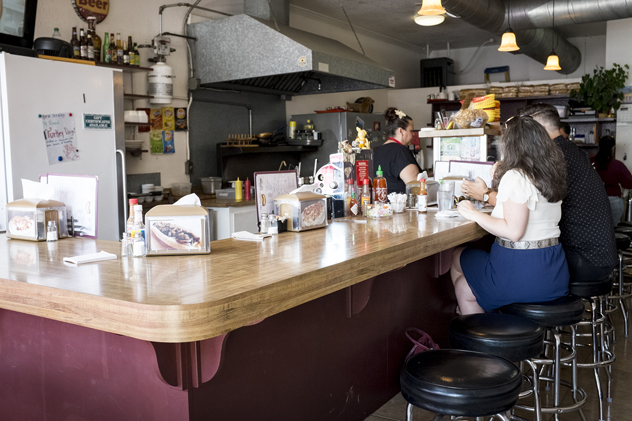
Once inside I grabbed a stool and bellied up to the counter. One of the first things I noticed when looking around was the diversity of the patrons. I sat next to a gentleman in his 80s finishing up a mustard dog, and next to him sat a couple in their 20s who ordered two veggie dogs.
Taking a look at the menu I realized that the tradition in The Wienery’s atmosphere seamlessly carries over to their menu which offers timeless hot dogs, sausages and soups. I wanted to try the whole menu after seeing all of the enticing ways the links can be prepared. But obviously that would be absurd, so I made the rational decision to only order a mere half of what they offered.
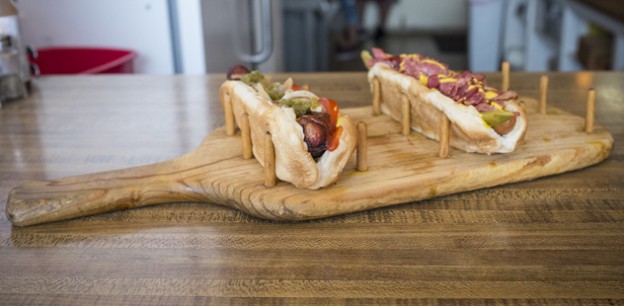
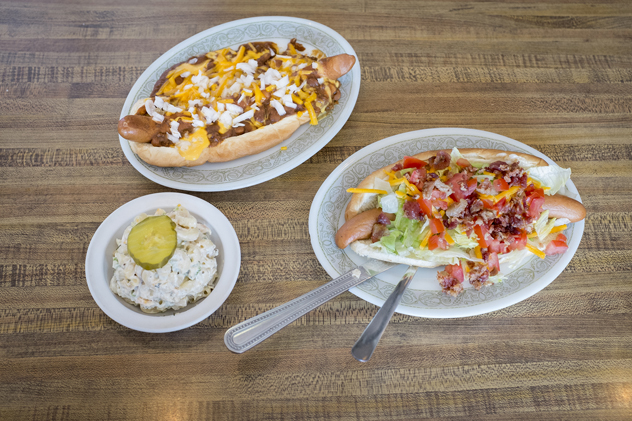
I started the first phase of my epic lunch with the B.L.T. Dog, Italian Summer Dog and a root beer float. I quickly learned that when the hot dog’s description starts with “open face,” you are in store for an overly generous mound of toppings, which you’ll never hear me complain about. This was the case for the B.L.T. Dog. The ends of the hot dog peaked out of the bun while liberal amounts of lettuce, cheese and tomatoes made a mound for the huge meaty chunks of crumbled bacon to cascade down. The hot dog was cooked perfectly and had that snap that any traditional hot dog should.
After enjoying the balanced and flavorful B.L.T. Dog, I turned to the ice cold, frothy root beer float as a palate cleanser before I focused my attention on the Italian Summer Dog. The butterflied Italian sausage was served grilled on a sesame seed bun with mayonnaise, mustard and a house-made roasted red pepper relish. The Italian Summer Dog is a great option if you’re craving something a little different. And after taking my first bite, which was filled with relish, it was clear that The Wienery’s attention to the little things is what sets them apart from other hot dog joints.
After a bit of a breather—and more consumption of my root beer float—I decided to order round two. This consisted of a Chili Dog, a Bacon Wrapped Dog and a cup of their Famous Navy Bean Soup. The Chili Dog was served open faced with a heaping amount of homemade chili, cheese and onions. I opted for the traditional chili, which is vegetarian, but they also offer it “Con Carne” style with ground beef. Their hearty, bean-filled chili is comfort food at its finest; I’m sure you will find me at The Wienery many times this winter snuggled up to a large bowl.
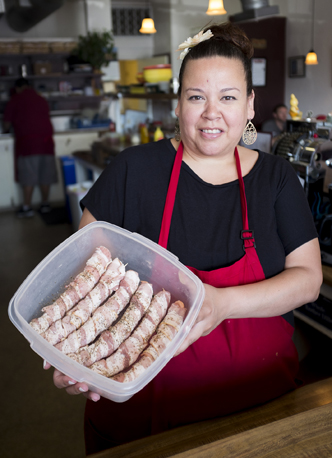
The last dog to arrive at the counter was the Bacon Wrapped Dog. This hot dog was grilled to order and topped with ketchup, mustard, mayonnaise, tomatoes, sautéed onions and house-made jalapeño relish. Bacon wrapped hot dogs are by far my favorite, and I am very particular about how they are made. A good bacon wrapped dog has to pack a wallop of heat, and this one did not disappoint thanks to the jalapeño which flawlessly complemented the dog. Biting into this link instantly reminded me of the bacon wrapped dogs found on the streets of the Mission District in San Francisco.
At this point I was overly stuffed and extremely satisfied. Then out of the corner of my eye I saw the Famous Navy Bean Soup. Even though I’d already eaten a Kobayashi-amount of hot dogs, I pulled the soup over and took my first bite. It was thick and creamy, yet the beans still held up. I have never been one to order soup at a restaurant, but the Famous Navy Bean Soup at The Wienery has changed my mind.
When talking to Canas about The Wienery, you can tell that she and her husband Hector care about every single person who walks into their restaurant, “Our customers are friends with us and friends with each other,” she said. “We’re just an old school hole-in-the-wall but we keep the food good.”
Many restaurants overlook the art of a well-prepared hot dog or simple bowl of soup. Clearly The Wienery takes pride in their food and it shows. The hot dogs are cooked to perfection and their made-from-scratch soups and relishes are full of flavors that will bring you back again and again.
The Wienery is located at 715 56th Street, Sacramento, in the Elvas Plaza. Check out Thewienerysacramento.com or call (916) 455-0497 for more information.
The Cultured & The Cured brings West Coast Cheeses & Charcuterie (and more!) to East Sacramento
I love a good ol’ dorky pun. So it’s no wonder The Cultured and The Cured, a newly opened meat- and cheese-centric market and deli in East Sacramento, brought a smile to my face with their cheesy tagline, “Livin’ on the Wedge.” A scan of their menu brought a rumble to my tummy—who doesn’t love tasting fancy meats, cheeses and other savory finger foods? Oh yeah. Vegans. Sorry, vegans, good luck with that soy cheese crap—I’m unapologetically stepping out to The Cultured and The Cured.
Upon entering the shop, I was promptly greeted by a friendly, pretty young woman named Hannah, who eagerly showed me the menu and answered all my questions. The husband and wife owners, Chef Andrew Hillman and Kelly Heath, were also hard at work on site, until Kelly departed to go to her nursing job at Dignity Health.
The Cultured and The Cured is a smallish space (844 square feet) at 3644 J Street that is bright, clean and inviting, with a back wall of rustic wood planks, prominent eat-in menu boards, a few tables, an engaging deli case presenting distinctive meats and cheeses, and a row of shelving containing beautiful displays of locally made, epicurean dry goods.
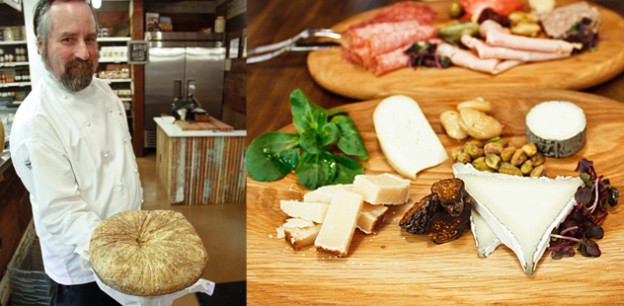
Although tempted by the gourmet sandwich, soup and salad offerings from the kitchen, I thought it best to get a gouda sense of the meat of what this place was all about, and after a couple of questions for Hannah, decided upon the mixed meats charcuterie board and the goat cheese board, which change frequently based on the varying inventory of the shop.
The mixed meats charcuterie board we ordered was a display of small portions of Fabrique Delices Pâté de Campagne with Black Pepper, Fra’ Mani Nostrano, Creminelli Milano, Molinari Finocchiona and Creminelli Mortadella amid smatterings of almonds, mustard and dressed microgreens. The goat cheese board showcased the Cypress Grove Bermuda Triangle, Capri Classic Blue, Achadinha Capricious and Cabricharme goat cheeses, all equidistantly spaced on the wood plank and interspersed with pistachios, mâche drizzled with vinaigrette, dried cranberries and marinated fava beans. Both were served with a basket of assorted organic artisan crackers by Potter’s Crackers, made locally in Sacramento, and also available for sale on the shelves of dry goods within The Cultured and The Cured.
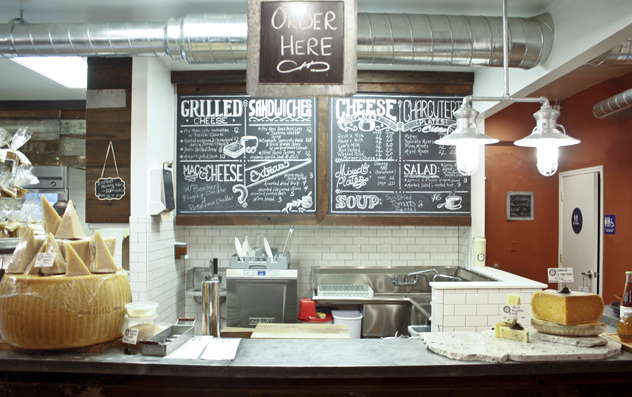
After sampling it all and trying to not draw attention to ourselves by suppressing the urge to moan at every bite, my favorite item of all was the Achadinha Capricious, a goat cheese made in Petaluma, with a rind that smelled like nasty feet and tasted like heaven. Chef Hillman informed us that a wheel of this cheese costs him about $560, and it dawned on me that it was truly a treat to enjoy samples of several such cheeses for only $12.
Also for sale on the shelves of The Cultured and The Cured is the entire line of Preservation and Co. products. Jason Poole, once a bartender at the Pour House, gained national recognition when Absolut Vodka declared his the Best Bloody Mary in California.
His handcrafted mix, coupled with his Sriracha Salt around the rim of the glass, were then in high demand by craft cocktail connoisseurs, and after partnering with Brad Peters, Preservation and Co. was born. You can find the Bloody Mary Mix, Hellfire Hot Sauce and the Sriracha Salt at The Cultured and The Cured, along with pickled items such as cayenne carrot sticks and balsamic beet slices. An array of other interesting and uncommon foods and beverages can be brought home from this East Sacramento meat and cheese shop to pair with your smorgasbord or elevated midnight snack.
“I have people that come in the store, walk over to the Preservation and Co. products, check out and walk right out the door,” says Hillman.
The bulk of their clientele purchases foods to take home rather than to dine in, although my guess is that once the shop secures their beer and wine license, more customers will be inclined to sit down with a glass of local wine and a cheese board as a decadent happy hour revelry. Bonn Lair bar flies across the street can also order cheese and charcuterie boards, which The Cultured and The Cured staff will deliver.

Hillman and Heath opened the doors in November 2013 with a locavore philosophy in mind. They source local products (or, at the very least, American-made) as much as possible. This ideology is even carried through in their shop’s décor, with reclaimed wood from Sonoma, Marin and Sacramento homes and barns, and earth tone paint formulated with goat’s milk from Pescadero. They focus on cheeses from the West Coast; only four cheeses are derived from Europe, and all meats in the case are domestic, although sometimes they will feature extra special imports if there is no comparable product created in our corner of the world.
Chef Hillman has been a member of Slow Food for 15 years, and has worked in restaurants for 30 years, having trained at the Culinary Institute of America in upstate New York—the same school where Anthony Bourdain and many other famous chefs earned their educations.
While the focus is decidedly to be a retail cheese and charcuterie store, Hillman and Heath recognize that unlike small European shops, they have to feature more items to catch a wider audience in America, where people normally shop at supermarkets rather than specialized stores, and they have to do more to capture the attention of their audience through events and partnerships.
“It’s an evolving animal that we have to figure out, that’s the hard part,” Hillman says.
They are planning to start holding cheese classes on Sunday evenings, and to participate in a major upcoming cheese convention at the Sacramento Convention Center.
“The ACS (American Cheese Society) is having their annual convention here in Sacramento at the end of July. It’s the first time it’s ever been out of the East Coast,” explains Hillman. As part of the festivities, they will be holding special events, and be featured on the ACS tour of local haunts to score hard-to-find cheeses. Additionally, they will be partnering up with Evan from Evan’s Kitchen to help with a cheese-focused wine dinner on Feb. 3.
Until then, brie a sport and make your whey to Sacramento’s latest fromagerie and sample the bounty of West Coast cheese and charcuterie.
The store is open Tuesday–Thursday from 11 a.m.–9 p.m.; Friday and Saturday from 11 a.m.–10 p.m.; and Sunday from 11 a.m.–5 p.m. Visit Culturedandcured.com for more info.
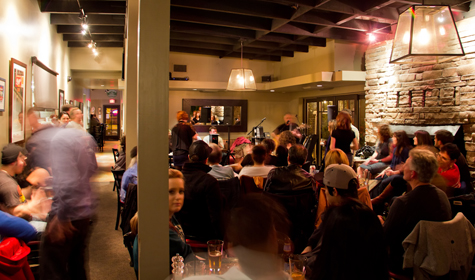
One of our favorite East Sacramento joints, Clark’s Corner (5641 J Street), has a new open mic night every Friday. Grab your guitar, mandolin, keyboard, cowbell or whatever it is you play and come sign up and perform a couple tunes. The first two weeks were a great success and saw a large turnout of both local performers (many of them being past SAMMIES winners) and attendees looking to hear some music. It’s being hosted by local musicians Andrew Barnhart and Mac Russ, and there will also be featured performers each week. Sign-ups start at 9 p.m. and all ages are welcome. There is no cover, but donations are accepted with 100 percent of proceeds going to the SPCA or other local charities. If you’re a performer, this is a great opportunity to get in front of a welcoming crowd, and if you’re just looking for good music, food and cheap drinks ($3 drafts, $3 wells, $6 apps), this is the place to be on Fridays. Hit up http://www.facebook.com/clarkscornerbar916 for more information.
If you’re into gardening or like garden-fresh food, check out Sacramento’s first Edible Garden Tour in East Sacramento on Sunday. The tour will wind through six homes in East Sacramento, some of which will have something, like heirloom tomatoes or fresh fruit and herbs, for visitors to taste. Each home will be themed differently, where attendees will have a chance to explore French intensive gardening, year-round kitchen gardening, front yard edible landscape gardening or more than 100 varieties of fruit grafted onto 40 trees. Master gardeners will be available to discuss gardening techniques in each of the gardens, and Sacramento Symphonic Winds will play music in the gardens throughout the day. Soroptimist International of Sacramento, Inc. is organizing the event, and all proceeds will go to local charities. The event will run from 10 a.m. to 4 p.m. Tickets cost $20 in advance and $25 the day of. Tickets can be purchased online or at locations around town. Check “events” at Soroptimistsacramento.com for more details.

Formoli’s Bistro
3260 J Street – Sacramento
Words & Photos by Adam Saake
Eating is a special experience. Food at once entices our senses with glorious smells, vibrant colors and curious textures while filling the basic human necessity of calming our hunger and nurturing our bodies. The experience continues with our journeys into cooking and learning how to feed ourselves and others in a way that makes meals memorable landmarks in our lives. And the final movement is to be fortunate enough to watch masters at work in their kitchens. When a dish is masterfully prepared right before your eyes, epiphanies occur and all of a sudden it all makes sense.
There are few places in Sacramento that can deliver an experience that encompasses all of those elements, and that’s OK. Sometimes we just want to be to ourselves and enjoy the company we’re with or maybe just grab something and go. But for the whole experience, for the spectacle des spectacles, there are places like Formoli’s Bistro in East Sacramento that, from the moment you open the door, you are drawn into all things exciting about dining out.
The brief hallway leads you into a bistro alive with kitchen sounds and smells and neighbors dining elbow to elbow for the sake of good cuisine. For those intimate nights or celebratory get-togethers, the dining room is just big enough to accommodate your fancy. But the best seat in the house is at the bar, sitting across from chefs Aimal Formoli and Joseph Contreras, watching the plates unfurl in a flurry of spices and demi-glaze. Hands fly in the air as seasonings fall and the pans in motion add a percussive backbeat to the chatter of the bistro.
But I digress. We’re here to talk about the food and what a mouthful there is to say. Out came the stuffed dates, a small offering that reflects Formoli’s Persian heritage mixed with his French training from the California College of the Arts in San Francisco. Stuffed with goat cheese and crispy pancetta and served on top of Belgian endive (an interesting white, crisp vegetable that grows from the roots of chicory) and topped with Champagne vinaigrette ($12), this dish is the flagship of Formoli’s cooking and is a gateway to the rest of his remarkable dishes.
The bruschetta arrived next, and I was excited to see what Chef Formoli was going to do with this classic Italian appetizer. Thick slices of bread with a perfectly toasted crust were topped with the cool, acidic sweetness of the cherry tomatoes and rounded out with a nice salty, olive oil tapenade. Each of Formoli’s dishes have such an incredible color palette that your eyes light up as they arrive. The brown, white and soft green of the dates or the yellows and reds of the bruschetta are nothing short of dazzling. Even purple makes an appearance in the blue cheese smashed potatoes that accompany the filet.
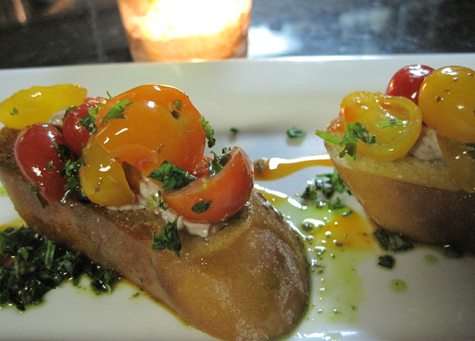
“As a chef, I try to be an artist too. That’s kind of my thing. I just love when a plate pops out at you. The colors are big for me on the plates,” says Formoli.
Upon my first visit, I was thankfully introduced to the whiskey burger that knocked my socks off. Formoli sears his blended, pepper encrusted patties in whiskey before finishing them in the oven. A perfectly toasted bun marries the cheddar cheese and habañero aioli to complete one of the best burgers in town. But while I ate, I watched a number of dishes being prepared including a pasta dish with medium rare flat iron steak sliced thinly on top. A white wine cream sauce with fettuccini noodles is one thing, but then to top it with such a great cut of beef that is cooked carefully and arrives tender is a whole different ball game. The fresh herbs and tomatoes make this dish pop, and you have the creaminess of the sauce with the savory texture of the beef–a real entrée.
Formoli’s is approaching its third year of business and not without its share of blood, sweat and tears along the way.
“What me and my wife [Suzanne Ricci] had saved is what we dumped into it and then halfway through, we ran out of every resource; every dime we had,” says Formoli.
Their dream was so big that these obstacles didn’t stand in their way. Quietly throughout the years, tucked away in the non-descript East Sacramento shopping center, Formoli’s Bistro built an outstanding menu that developed just as Formoli and Ricci wanted.
“Not being in the limelight too soon was good, because I was able to fine tune everything in the restaurant,” Formoli says. “That’s the last thing I wanted was hype.”
Then there’s the service. Front of the house experience is overflowing from servers like Patrick O’Neill, Sarah Heimann and Christina Gonzales, the latter two recipients of the Sacramento Bee’s “best server” accolade. The best word here is genuine. Customers aren’t talked “at” but rather delicately handled and the focus is on enhancing the meal rather than up-selling. With such a high turnover rate for servers in the restaurant industry, Formoli has found a team he calls his “family” that has been with him since the doors opened.
Look out for some cosmetic work being done on the inside and outside of the bistro this year and if you haven’t let the Formoli’s family wow you yet, there’s no time like the present.
The Invented Worlds of John Tarahteeff
“Most kids draw, but I just kept doing it,” says artist and East Sacramento resident John Tarahteeff of his early forays into art. Tarahteeff has been “just barely” supporting himself as an artist for the past 10 years; however, when he was in college, he decided to channel his creativity toward more practical pursuits. Tarahteeff graduated from U.C. Davis, majoring in landscape architecture and minoring in fine art, in 1994. However, he says that it wasn’t until his life after college that he did most of his studying of painting.
“When I graduated from Davis, I lived with my parents for a couple of years, so that was low rent,” Tarahteeff says. “In school, I was caught up with the landscape architecture studio courses, so I didn’t have much time to do my art stuff. When I graduated, I would just paint all day for like 14 hours a day”¦ After two or three years of doing that, I started to show my work.”
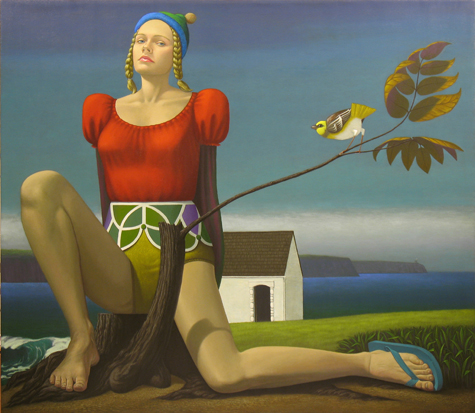
Back then his art did not bear the surrealist bent it does now. Tarahteeff says he experimented with a lot of different ways of painting before settling on the style for which he’s become known.
“There was a whole year there that I wasn’t even painting representationally,” he explains. “I’ve experimented with a lot of different ways to paint and settled into this sort of surreal representation, I guess that’s the best way to put it. And it’s sort of developed, but once I hit on that, I used figures and landscapes and invented worlds, I’ve just kept working in that vein.”
Tarahteeff’s latest collection of works Seaworthy can be seen now through Oct. 3 at the Solomon Dubnick Gallery. In the following interview, Tarahteeff shares his thoughts on interpreting his own work, his feelings about the use of the term “surrealism” to describe it and also sheds some light on his artistic process.
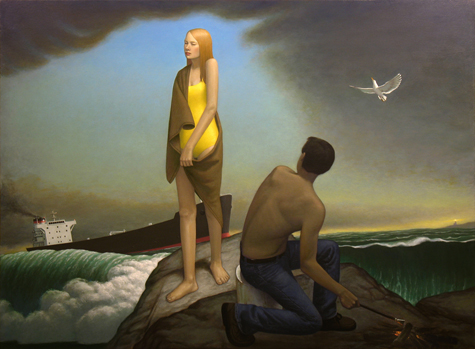
Do you consider yourself a surrealist painter?
I don’t really like that term too much, but I’m not really fighting it anymore. It kind of gets people in the ballpark if I say “surrealism”—the idea of the consciousness coming through. Anyone’s a surrealist anytime they do something. It’s descriptive, but it’s not real descriptive.
Are you a fan of the surrealists?
Yeah, I remember in high school, when [I saw] De Chirico, and his surreal, empty landscapes with the long shadows, I was really struck by that. Even though in humanities, I’d studied more realistic painting, I was like, “Wow, I still like this. It’s kind of abstracted.” I think that was an evolution for me. I think most young people tend to like Rembrandt, like, “Wow, it looks so real.” That was the first time I think that I really liked something not for the virtuosity of the painting, but just because of the mood.

Before you said you tried a lot of different styles. How did you settle on what you’re doing now?
I’d noticed that when I was studying, I was trying to figure out what the essence of painting was for me, like what was important in terms of form. I’ve always had a formal bent to my work—just line, texture, color, tone. What is really important to me? Content, it’s like, what’s important narrative to one person is gibberish to another. So what about form? Maybe there’s a universal thing that’s the essence of what I want to say formally? And so I explored minimalism and abstraction, and representation dropped out. I was trying to get at what can I take away and it’s still a painting to me”¦ I came to the conclusion that I was stripping away everything, and it was almost like I was in my own world and I turned the volume down so low that I could hear what was going on, but it wasn’t communicating to anyone else”¦ So then I just flipped and went in the opposite direction. It was like, take on everything. At first it seemed weird taking on representation—like cartoon-y and everything seemed cliché, but I thought, “Just do it anyway.” And then, as I did it, I found that I really liked it, just coming out of that low volume and all of a sudden incorporating everything that painting could do. Now I tend to gravitate toward paintings that try to do everything, like old master paintings where there’s narrative and abstract qualities in terms of the colors and the composition—just all these levels and symbolism.
A lot of the paintings of yours I saw don’t seem to have much empty space. They’re almost sensory overload.
In some of them, yeah. It’s real dense. There’s something about when the images get dense, there’s an inevitability about them. You can’t really move something without messing something else up. It’s like the painting has to be that way, because everything is so intertwined and interdependent that formally it has a resolution.
In the description of your Picturemaking series that you wrote for the Dubnick Web site, you said that you don’t start a piece of work around a particular theme. If you don’t paint with a theme in mind, where do you begin?
When you called me, I was sketching. I sketch all the time. I’m sketching every day, even if I’m going to paint that day. Usually what I’m drawing is figures in different positions, almost like what a comic artist would draw. After a while, like when I go and revisit the sketches, I go, “Oh, this figure would fit in here.” At first, it’s just fitting these figures together in a sort of puzzle”¦ The process is just making an image for its own sake, and some world emerges. I’ll put the sketches away, and sometimes I’ll see a sketch that I put away maybe two years ago, and I’ll start adding to it again. Eventually, I’ll have something that I’ll try on a canvas. A lot of times, it doesn’t work out at first, and I take something out even on the canvas. Even when I get on to the actual painting, a lot still changes.
Is that difficult to change the composition once you’ve started painting?
Sometimes it goes pretty straight, but most of the time it doesn’t. There are times when I think I’ve got a totally resolved composition, and I go to the canvas and work for a month on it and realize it just isn’t going to work. I’ll save one figure or something that I really like and then just try to rework something else. Sometimes the ghosts of the other figures, like when I’m painting them out, they start to become something else. You start to see other images within it and a whole new painting can come about.
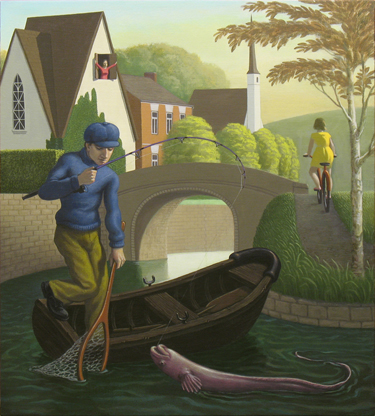
And you’re doing all that without the benefit of Photoshop.
Yeah [laughs]. Just about two years ago, I got turned on to the whole computer thing”¦ I don’t compose with it, but the one way it’s been helpful is that if I think of something like, “Oh what are they wearing,” or, “What instrument are they playing,” and I don’t really know the details, I can go online and just look up “bagpipe,” and I get little bits of information that are real specific that aren’t quite in my memory bank, and it fleshes out the details.

Musical instruments seem to pop up in your work often. Do you play music yourself?
Yeah, I’m in the closet guitarist vein. The only ones who really hear it are my girlfriend and me. And my girlfriend’s a cellist, so I’m learning more about the classical music. I’ve always been more into pop music. But that’s something I’ve noticed, too. Instruments are coming in there more, and I’m not sure what that’s about.
When you look back at older paintings that you’ve done—maybe 10 years ago—do you pick up the symbolism more now than you did when you painted it?
That’s what tends to happen. A lot of times, I can’t even title a piece when it’s done. I have the hardest time, because I need that distance to see what it’s about. I just see all the formal components when it’s more recent. When it’s been done for a while, I just take it on its own terms. I don’t think of it as red over here, or black over there. I just look at as if someone else did it, like, “What does that mean?” I do that with other artists’ works already. I start generating a narrative, even if it’s not what the artist intended, a story inevitably emerges.
For your latest collection at the Dubnick Gallery, is there a narrative in those paintings?
Yeah, I think a lot of times, independently a painting might have a narrative, but what intrigues me is the narrative over the course of my work. That’s the one I’m more interested in”¦ I see characters that recur in my paintings. There are things in my paintings, like a bird”¦and I’ll see that bird in a piece three years later. I know these archetypes in my head have some sort of meaning, and I’m bringing them into each painting. Those archetypes are what I’m interested in, at least as far as narrative. I don’t think in one piece that I ever really get at the narrative that I’m after, but it allows for these archetypes to inhabit these prefabricated worlds. A lot of the genres I take are already out there as far as art history goes. They’re scenes that exist already, and I’m kind of mutating them.
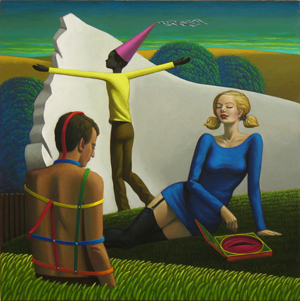
One painting in particular of the new series that I wanted to ask about was The Game; it seemed almost nightmarish. I was wondering what the thought was behind that one.
You know, I don’t know. That one just kind of came out. I’m not sure [laughs]. Yeah, but there’s something. I know that in a lot of my older paintings, I play with the game of desire and seduction. I think it has something to do with that, but I don’t know specifically.