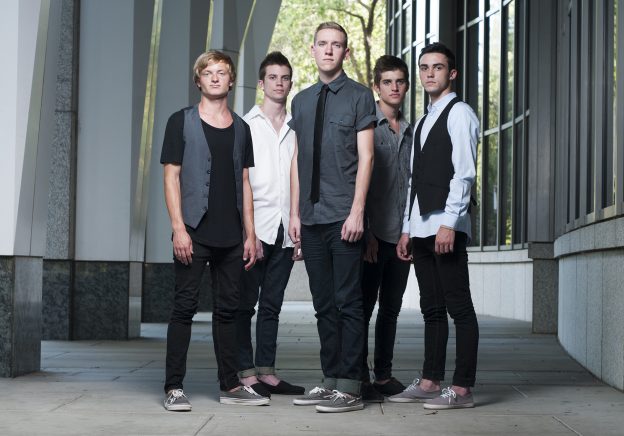
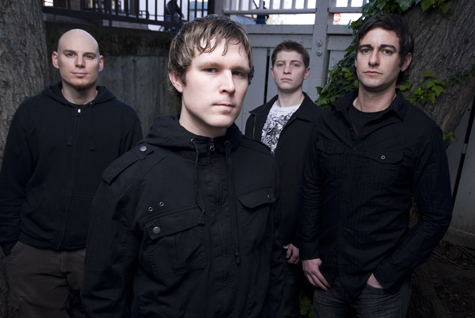
The Speed of Sound in Seawater is Ready to Take the Next Step
Words by Andrew Scoggins • Photo by Phill Mamula
Sacramento produces some odd bands. From the barbaric yawps of industrial-rap duo Death Grips to the hedonistic dance-rock in short shorts of !!!, Sacramento has never had a concrete “scene” in the usual sense. Sure, there were a few smatterings of crust punk and that unfortunate period in the mid-‘00s where it seemed you couldn’t go to a venue without hearing Christian hardcore, but no one genre has ever truly dominated the scene. So it makes sense that math-rock band The Speed of Sound in Seawater would spring through the cracks in the concrete and onto the national stage. The Speed of Sound in Seawater is alternately geeky and totally badass, and it’s this awkward dichotomy that makes them so interesting and, well, completely endearing.
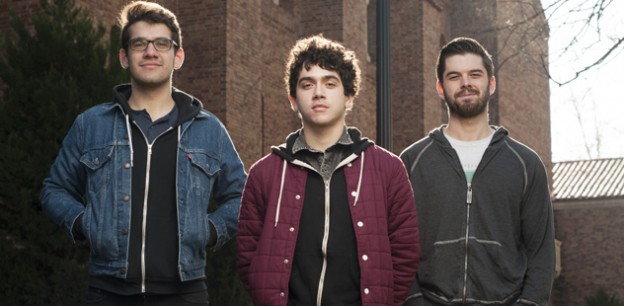
Everyone in the band looks like the quintessential laidback 20-something college student, which makes sense because two-thirds of the band is still going to school between tours. Damien Verrett just graduated from UC Davis with a degree in technicultural studies, bassist Luke Ulrici is currently studying microbiology and drummer Fernando Oliva is studying architectural design. These aren’t the easiest majors but it makes sense to have smart guys in a math-rock band.
On a recent visit to the band’s practice space (guitarist Damien Verrett’s parents’ house in deep Elk Grove suburbia), the living room is crowded with amps and instruments. The guys pick them up, and, after fiddling with a Mariah carey sample, Verrett looks over to Oliva, who counts off. And the band just goes.
The first thing you’re struck by is the technicality of the music and how seamless the transition is from their recorded songs. The beats are crisp, the melodies are spot-on and the band simply motors like it’s another day at the office. It’s like it’s not a big deal that Verrett is shredding with the frenetic energy of The Fall of Troy or that Oliva is beating every inch of his minimalistic kit to create the thundering, jittering rhythms that hold the intricate workings of the song together. But in between the complexities and musicality you find yourself humming along to the fat, glimmering pop hooks in songs like “Lots of Love for Logan,” and “The Oddest Sea.” Verrett’s crystal-clear voice brings comparisons to Circa Survive’s Anthony Green or even to some more pop-y indie acts like Freelance Whales or even Ben Gibbard. All these disparate elements blend and shift, and work in a way that doesn’t quite make sense, but is incredibly intriguing. And that’s The Speed of Sound in Seawater’s charm. The band is utterly without pretension, they’re simply really good friends who make really, really good music.
The Speed of Sound in Seawater is a band that readily rejects most, if not all of the typical rockstar clichés. There’s no band drama, the guys don’t party (“I’ll drink a little bit but then we have to get up and drive for 13 hours, so I can’t really drink that much,” Verrett said). They don’t have groupies (“It’s really just a lot of like really young girls and some old creepy guys, which is kind of disturbing,” Oliva said). They just come together and rock their balls off. And that is exactly what they did when they came together in August to record their first proper LP in Seattle, First Contact.
“In this one we just participated a lot more in the songwriting process together. Before it was just Damien who’d come and be like, ‘Hey check out this sweet riff bro,’ and then I’d be like, ‘Check out this lick bro,’ and then it’d be like, ‘You wanna put it together bro?’ and then we’d high five.” Oliva said with a laugh.
“I just wanted it to be really polished, really clean where you still have that verse-chorus structure but with some different elements thrown in to keep it interesting,” Verrett said.
This marks a departure from the band’s previous, admittedly brotastic, method of simply jamming out songs until they worked.
“Before, we would really just kind of feel out the songs and the time changes on the fly. It was super stressful,” Oliva said.
“It’s like one time it’ll be really good and the rest of the time it’s just going to be awful,” Ulrici said.
But this change to a more structured approach has not been without its detractors. The band has gotten a few calls from their “fans” to return to their older, more chaotic style that was present when they released their first two EP’s, Blue Version and Red Version, four years ago.
“It’s like you spend hard-earned money, you work for hours and hours writing and practicing, and then you go to a really nice studio to put out the best thing you possibly can. And then some stupid idiot on the Internet just goes, ‘well, it’s not as good as that one song you wrote in two hours and recorded in your fuckin’ bedroom.’ It’s just frustrating,” Oliva said.
But these small hiccups seem to just be growing pains for a band that is attempting to plan a national tour for the summer.
“I think every band goes through something similar,” Verrett said. “We’re just growing up I guess.”
“It’s just about writing good songs and good melodies. It’s about musicianship rather than just being like world’s best fucking drummer!” Oliva said.
The new approach seems to have paid off as First Contact is easily the band’s catchiest and most polished record to date. The technicality of the math-rock element of the band is still preserved in songs like “Soulmate 2.1” and “Anyanka,” but these sections are interspersed with hooky vocal melodies that give the tracks some breathing room. Instead of unhinged, frenetic jamming, the songs feel like songs. The dynamics build, ebb and flow. One of the highlights of the album, “The Macabray,” even takes a few interludes with violins, accordions and clarinets to build and layer the song brilliantly. It is in these instances where the technicality is honed to a heartbreaking point, that the band’s gift for writing simply beautiful music shines through.
This is not to say that The Speed of Sound in Seawater has given up the immediacy that made their early works so enduring in the eyes of their fans. The stomping payoff to “Apples to Apples, Dust to Dust” is as great a crescendo as the band has ever written. And if that isn’t enough, the band still uses their prog-y, rowdy shout-along “Hot and Bothered by Space” as a bombastic live finale.
Overall, The Speed of Sound in Seawater is simply a brilliantly talented band that somehow manages to stay humble even at the onset of their wider success.
“Honestly I get more excited to meet the fans than they are to meet me,” said Oliva, “I still get stoked when we’re hanging out in a parking lot in Oklahoma or something and somebody comes up to me and goes, ‘I drove six hours to see you guys and you fucking killed it!’”
“It’s like someone will get a tattoo and I’ll be like ‘Let me take a picture so I can show my mom!’” Verett said with a laugh.
The Speed of Sound in Seawater is still a young, growing band but look to see these guys blow up in a big way. Sacramento is lucky to have them, for at least a little while longer.
Start the New Year off right with The Speed of Sound in Seawater when they play what is sure to be a must-see show at Luigi’s Fungarden in Sacramento on Jan. 2, 2014. It will be the first show of the band’s Unsinkable Tour, so be sure to send them off properly. Feed Me Jack and Paper Pistols will also perform.
Backstreet Boys, The Fray
Ace of Spades, Sacramento
Wednesday, Dec. 4, 2013
What could be sadder than a 38-year-old man going to a Backstreet Boys concert by himself? Well, to be honest, probably a lot of things. For instance, that last copy of Zoppi’s Suspended CD that remained untouched at The Beat since it was released in 2000 is pretty heart-wrenching. And images of the abandoned Ferris wheel at The Neverland Ranch are downright depressing. So, I dunno, there are things.
But here’s the weird part: Right when I heard Backstreet Boys were coming to Ace of Spades (and that the show was sold out), my first thought was, “I need to cover this” without even questioning for one second why in 2013 I would actually want to see the Backstreet Boys. And even weirder: After a bit of thought, it dawned on me that I don’t know any of the members in the Backstreet Boys. And the only song I can recall is the one that goes, “Backstreet’s back alright!”
Which is when my existential crisis kicked into high gear.
“Why?” I thought. “Why would I beg to review this concert? What is the point? Why is this band important to me if I don’t even know the members or any of their songs?” Even more difficult to understand was at the end of every question came only one answer: BACKSTREET BOYS. It made no sense that I could think no further than that, as if my mind was somehow clouded by their stardom.
Why do I want to go to this concert? BACKSTREET BOYS.
Who are the members of Backstreet Boys? BACKSTREET BOYS.
What is the … BACKSTREET BOYS.
It’s like a satanic curse that landed me in a hellish underworld of dramatic finger pointing, waxed male nipples and stylishly choreographed dance moves.
However, because I am a professional, my research began, and through that I learned that Justin Timberlake is, in fact, not a Backstreet Boy. And I found out there’s a Backstreet Boy named Howie. And I guess one of the guys, Kevin, is back (hehe, get it?) and Nick Carter, the tall baby-faced blonde with porn star qualities, had a cameo in Edward Scissorhands … So, armed with as much Backstreet trivia as my brain could handle, I set off for Ace of Spades.
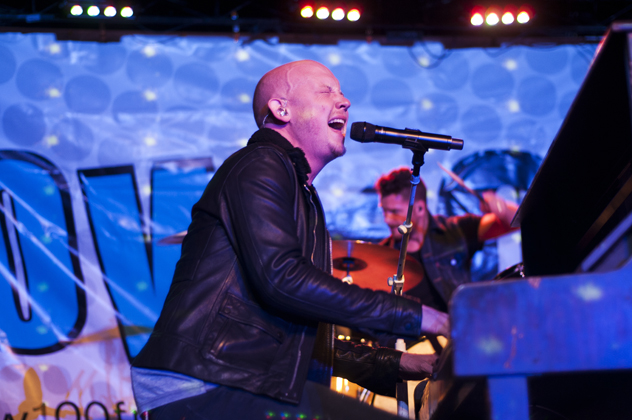
A band called The Fray took to the stage at 8 p.m. I actually listened to a few of their songs before seeing them live—enough to determine that their whitebread form of rock ‘n’ roll sounds like music a menopausal woman might listen to right when she says, “Fuck it,” and tries heroin for the first time. The Fray went on for an hour-and-a-half. A long, grueling hour-and-a-half that I mostly spent standing next to Mark S. Allen, analyzing his beautiful and flawless face. If that ageless man isn’t handsome I don’t know who is. Anyway, the most interesting part of The Fray’s set was when two bleached blonde soccer moms fistfought by the bar.
When the Backstreet Boys (there are five of them, I learned) finally took to the stage, my life force had been uncomfortably moistened by The Fray’s steaming pile of music. However, I was quickly intrigued by their presence. They looked healthy and spry, like a boy band should. And their voices, while a little on the low end and muffled by the loud backing tracks (yup, no live band), sounded competent enough. They hit their melodies and demonstrated complete control of their voices (let’s be honest: not even Lauryn Hill can do that anymore). And all that while dancing in tight pants.
After a few classics and a performance of their new song “Show ‘Em (What You’re Made Of),” a surprisingly sparse and catchy single, Nick Carter announced that the Backstreet Boys aren’t just a boy band. “We can play instruments, too,” he said, which took us down a long, boring road of acoustic pop songs.
To be honest, all their songs sounded the same, but I sort of enjoyed standing there in that fog of Axe Body Spray, watching good-looking people sing and dance—if only for the change of scenery. It was certainly a change from watching death metal bands while standing in a crowd half-filled with methed-up neo-Nazis.
Halfway through the Backstreet Boys’ set, I felt the tip of a fingernail grinding into my shoulder. It was a woman, probably in her 50s, wearing an obscene amount of eye shadow and blush.
“Hey, you need to move because I’m trying to keep an eye on my daughter,” she said.
“No,” I said. “There’s no room for me to move.”
“I’m trying to watch my daughter,” she shot back, pointing to the teenage girl in front of me.
“If you cared about your daughter you’d leave the bar and stand with her,” I said.
“How dare you?” she yelled, as if nobody had said no to her in her life. “Why won’t you move?”
I grinned, because the answer, of course, was BACKSTREET BOYS.
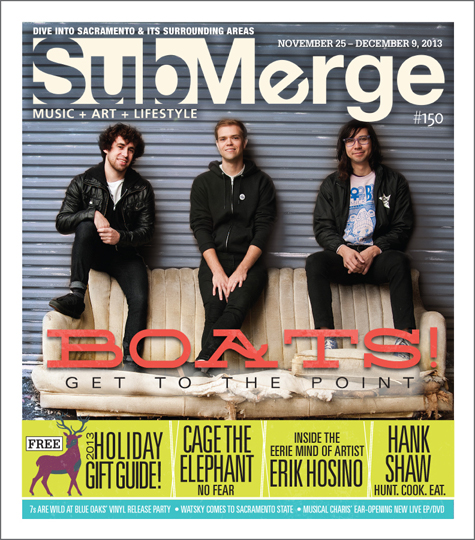
Local punk trio BOATS! talks about their latest LP and being misunderstood
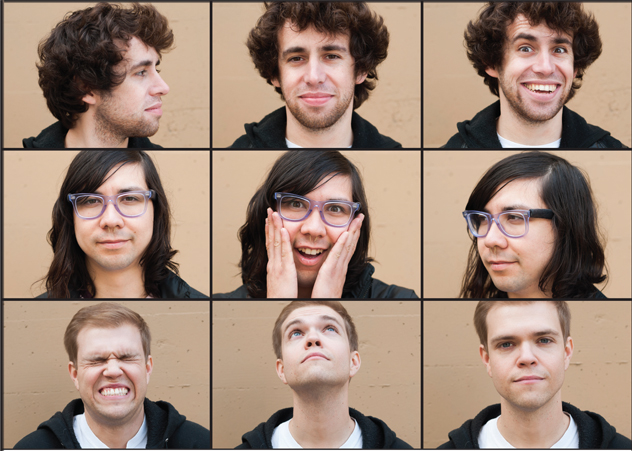
The guys in local punk band BOATS! could have a future in comedy. It’s difficult to know when they’re being serious, and when they’re just baiting.
During their phone interview with Submerge, they gave us permission to make this whole article up. We didn’t take them up on the offer, so you can keep reading.
When we spoke with two of the three members, the band was prepping for the official release of their LP Black and White (the first LP they have released since Totally Jawsome in 2010), coming up at Café Colonial. It’s been a long time coming. Local musician Ted Angel recorded the album in the back of a boat warehouse in North Sacramento almost two years ago.
“I was in my mid-twenties then,” says BOATS! bassist David Hayden.
“I couldn’t even grow facial hair yet,” adds lead guitarist and singer Matt Leonardo.
Why the delay? They would have put out the album much sooner, except they were waiting almost a year for Adeline Records to “press go.” The record company, which is co-owned by Green Day’s Billie Joe Armstrong, initially expressed interest in releasing the BOATS! LP after hearing a demo, and then backtracked.
“They were into it, and Billy Joe Armstrong reportedly liked it, or liked us (I don’t know if he actually even heard the record),” Leonardo says. “We were talking to them, but they were kind of stringing us along.”
“We really wanted to put out [the LP] with them, so we weren’t really looking for other labels,” he adds. “Then we realized that it wasn’t going to happen.”
After almost a year of holding out, BOATS! released the record through Sonoma label Modern Action Records instead. Black and White will be available on cassettes and vinyl, but if you still do CDs (does anyone?), you are out of luck.
Since their beginning in 2007, when BOATS! surfaced from a previous project called the She He He’s (inspired by Portland’s Clorox Girls), the band has rotated several members. Nowadays, though, BOATS! is solid, consisting of core members Leonardo and Hayden, both 27, and newest addition Adam Jennings, 19, on drums.
All and all, Black and White is no more than 12 minutes of quick and dirty punk songs with silly lyrical jabs, like “Smoking Is Cool.”
“Obviously smoking isn’t cool,” Leonardo says. “But, it’s cool. I don’t know about you, but James Dean is cool. Audrey Hepburn? Cool. The Fonz, I think smokes. He’s cool.”
Then there is the song on the album called “Watch You,” which, Leonardo says isn’t about much of anything except looking into people’s windows as he drives by, just to see what’s going down.
Comedy aside, in all seriousness, these guys claim their love for Sacramento.
“People think that we hate it here,” Leonardo says. “For some reason in Sacramento people just think we’re dicks. And it makes it hard to feel good about yourself at home when everybody says they don’t like you.”
“Sacramento is really big on new bands,” Hayden adds. “We’re no longer a new band, so our 10 minutes is kind of up in the punk rock scene.”
Thus, they tour a lot.
Fortunately, touring is easy for BOATS! these days. Whereas they once toured for two months at a time, broke, now their tours last about two weeks. If a show gets cancelled, it’s not too big a deal, because they don’t spend days driving to get there. Instead of using a tour van, BOATS! will fly to wherever their shows are booked, rent a car and borrow gear from one of the other bands playing the same show.
“Some bands look down on us for doing that, that’s the con,” Hayden says.
Other than occasional flack, there are those rare occasions that make touring rough, like when Hayden got sick during one of the East Coast shows in March.
“I spent most of the night having diarrhea in the shitty bathroom of this punk club,” he candidly recalls.
How did you guys get into punk music?
Matt Leonardo: I got into punk music because I got tired of listening to metal when I was like, 12. I was really into Slipknot, and I decided that I liked the attitude in punk more than I liked the attitude in metal. But when I was into metal, it was nü-metal like Korn and Slipknot, so it wasn’t really cool metal like Judas Priest. So, yeah, I got into punk that way. I just kept going, I couldn’t stop.
David, what’s your story?
David Hayden: I was just listening to Green Day, forever. I never stopped. And that’s like, the punk-est band you’ll ever come across. [Laughs.]
Alright.
ML: [Laughs.] She’s like, “bullshit.”
DH: I recently got into Good Charlotte, too. I don’t know if that’s like, punk, but…
ML: And that’s not even a joke. He literally got in my car the other day, and he was like, “Let me put on some tunes, I’m really into this band,” and it was Good Charlotte.
It’s hard sometimes to hold down band members. My impression is drummers are even more difficult.
ML: Oh yeah, you gotta have a good drummer. If you have a drummer that sucks, then [the band] would suck. You might as well not have a drummer at all.
DH: We tried out two other drummers before Adam. If we didn’t find Adam we probably would have broke up.
Especially for punk bands, one of the ways to promote shows has been through posters and flyers, but record stores are dropping off the map. So how are you guys promoting your shows?
ML: Mostly Facebook. I actually just deleted my Facebook because of all the cyber bullying that happens. Social media is kind of the new telephone pole, I guess. It kind of sucks, though… The band is still on Facebook, but I’m personally not on Facebook anymore.
What are you releasing the album on?
ML: It’s on vinyl, and then we’ll have it on cassette. We will not release it on CD. We’ve actually never put anything out on CD except for a CD-R when we first started out.
Why is that?
ML: I don’t buy CDs, I don’t know about you, but I don’t go out and look for CDs anymore. I have a six-disc CD changer in my car, and I have six CDs in there, but I never listen to them. I just put six CDs in there when I bought the car and that’s it… If you are going to put this in the article, then I would say: if you bought the record, and then asked for me to email you a digital copy of the record, I would.
What can you tell me about the new LP?
DH: It’s not as catchy as Good Charlotte.
ML: It’s close though, it’s a close second. We like to describe our music as catchy.
DH: Short and catchy: Our songs don’t go past 2 minutes and 50 seconds.
ML: I don’t think there’s a song on the new record that’s longer than a minute and 10 seconds.
I think there was one that was a minute and 30 seconds.
DH: We like to exaggerate. They’re short otherwise.
ML: If we were playing it live we would speed it up to keep it under a minute.
And that’s because…?
ML: I don’t know, when we play live we just get excited and we just play faster. People got things to do, they don’t have time to listen to a band. So you just got to get it out fast.
They’re not there to really get the full experience; they just want it short and sweet, huh?
ML: Yeah, I don’t know about you but I hate going to a show and the band plays for, like, 45 minutes, and you’re like, “Is this song ever gonna end?” And then they play an encore. For us it’s like, alright, let’s do this. Fifteen minutes, then we’ll get out of here and go grab some food.
Your shows aren’t really 15 minutes, are they?
ML: Sometimes. In the beginning we obviously didn’t have that many songs, so it was probably close to 15 minutes. We could probably do a 15-song set in 15 minutes. We usually do like 30 or 40 minutes [now]… We don’t like to dilly-dally; we’re straight to the point.
And it’s always been that way?
ML: Yeah, I think so. I think that’s what we always kind of aimed for. I think it originally started out because I haven’t always been the strongest songwriter, so it’s easy to write a song that’s first chorus, solo, chorus, and that’s it. That’s like, 57 seconds, and that’s the song.
DH: One thing that people either like or hate about us is, we like to talk more than we like to play music.
ML: We should be stand-up comedians.
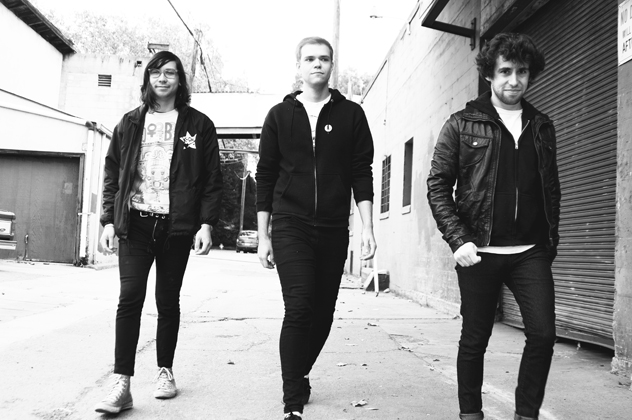
Catch these standup guys at their official LP release show Friday, Nov. 29, at Café Colonial. BOATS! will be joined by The Left Hand, The Barfly Effect, and the Phenomenauts. The all-ages show starts at 7:30 and is $10. For more info, visit Facebook.com/boatssacramento.
Horseneck: Born out of Booze and Ready to Rock Your Face
Most of us would agree that bars are wonderful places. They’re great places to go with your friends or significant others, or to meet new friends or significant others (at least significant for a night or so). And, hey, if you go alone, your bestest buddies Jack Daniels and John Jameson are already there waiting for you. Besides sources of booze, bars can also be houses of inspiration. Artists, writers and musicians have flocked to bars for as long as they’ve existed hoping to find their muse—either at the bottom of a glass, or hidden in the cacophony of overheard conversation. As Sacramento heavy music purveyor Anthony Paganelli tells us, his newest band Horseneck owes a lot to local bars.
He had known bandmate Lennon Hudson through their mutual manager, Eric Rushing. Paganelli and Hudson were both entrenched in the music scene as members of other bands (Paganelli as part of Tenfold, Shortie and Will Haven, and Hudson as part of Still Life Projector). The two got together one night at Golden Bear with Hudson’s longtime friend Matthew Ison, and the conversation eventually turned toward the three playing music together.
“We weren’t doing anything else but drinking and having fun,” Paganelli says. “We were like, ‘Might as well start jamming, kill time that way.’ We started a band. It wasn’t this band. Then we changed it to Horseneck and it just felt right.
“Will Haven wasn’t really doing much. They’d put out a record and did a little bit of touring in Europe, and that was it,” he goes on to say. “I was getting really bored and I wanted to start something new. I had all these riffs and ideas, so I called Matt and Lennon and said let’s do this.”
Paganelli says that he formed Horseneck because “there weren’t very many heavy bands out in Sacramento that I could relate to.” A counterpoint to the many scream-o and metalcore bands on the scene, Paganelli wanted Horseneck to hearken back to a different, blues-based era of metal.
“I was drawing influences from all the classic rock like Led Zeppelin and stuff like that…blues-driven rock stuff,” says Paganelli, who says he first started playing blues when he picked up the guitar, inspired by the music his father would listen to, before he got into punk and metal later in life.
The music got heavier, though, when the band decided to put Paganelli behind the mic. He says Horseneck felt right as a power trio, and they really didn’t want to go out and find a vocalist that would possibly stir the pot.
“None of us could really sing, so I just grabbed a mic and started yelling and it just worked,” Paganelli explains. “We became this heavy band, but that was what we wanted anyway. We wanted to do what everyone else wasn’t doing.”
Their vibe must have been right as the band released two EPs in 2013. The first, Belly Full of Blood, is the heavier of the two—a low, throbbing, grungy, Melvins-esque five-song EP with similarly gruesome song titles like “Dirt Turkey” and “Hooker Toilet.” The second, The Worst People Ever, is still heavy but is less pure brute force and has more of a calculating attack.
“The first EP, we had just started playing. That was the first five songs we wrote. I was trying to figure everything out,” Paganelli says of the difference between the two EPs. “I feel like it was a little bit harder of a record, too—more metal influence. With The Worst… EP, we were a little bit more organic about writing. We were jamming more, and I felt a little more confident with my vocals. With the new stuff we’re writing, it’s getting more organic, and I’m even more comfortable with my voice.”
The differences between the two was one of the reasons why Horseneck ended up having two separate releases as opposed to one full-length album.
“We never planned on releasing anything,” Paganelli says. “I gave it to Eric Rushing, because he’s a longtime friend of mine, and I thought he could help me get on shows or just network and stuff, and he told me to hold on to it and not release it. He said, why don’t we go back and record more songs, and we’ll talk to the label, Artery Records, and maybe release it through Artery.”
Horseneck has a distinctly different sound than many of the bands in Artery’s stable; however, both Rushing and Paganelli thought Horseneck could help the label diversify.
Both EPs were recorded at Pus Cavern with the help of Matt Pedri, who’s worked with Armed for Apocalypse and Will Haven in the past. The Worst People Ever was mixed by Dance Gavin Dance’s Josh Benton.
“We went back and recorded seven tracks, which became The Worst People Ever EP, but they sounded totally different,” Paganelli says. “We recorded them in a different process and spent more time… We weren’t going to put them both together as a weird sandwich, like, we don’t care if they sound weird. So I said, why don’t we release them as they were recorded? That sounds better. It makes more sense. We felt comfortable with that approach, and Eric thought it was a better idea as well.”
Paganelli says the band is currently writing new material for a possible full-length, hopefully to be released early next year. He says that the confidence in his songwriting that he built coming into The Worst People Ever is continuing to grow on the new material.
“I feel like I’ve thought it out a little more than I did in the past,” Paganelli says of the new material he’s working on. “Having more confidence in my ideas helps.”
Paganelli also has a new songwriting partner, his 1-and-a-half-year-old son.
“I play guitar for my son, and when he likes it, he dances around. So sometimes I actually bounce riff ideas off of [him],” he says. “We play guitar all the time at home and sing songs and stuff. It definitely changed a bit of my songwriting.
“It’s more difficult being in a band as a parent, because, obviously, you have a lot more responsibility,” Paganelli says of being a rock ‘n’ roll dad. “Touring is a little harder, practicing is a little harder, but it’s still doable, and it’s still fun. We still do it. I don’t think I could not do it. He enjoys it. He watches me do it, and maybe when he’s a bit older, I could play with him, or he could play with me. It would be rad.”
It’s funny to think that the good chemistry and momentum Horseneck has going probably started with a simple conversation between colleagues over drinks at a bar. The opening track on The Worst People Ever, “The Birth of the Neck,” is actually an homage to the band’s booze-y beginnings. It’s a short track featuring ambient bar noises—conversation, people fiddling about. In fact, the whole EP is based on the bar that Paganelli, Hudson and Ison usually hang out at, Cheaters.
“Most of the songs on that EP are reflections or stories or things that we went through hanging out there all the time,” Paganelli says. “It’s a bunch of inside jokes, well, not just inside jokes, but things that happened to us there. That whole EP is a little story about that bar…a little Cheaters storyline, I guess.”
So what is it that makes bars so inspiring?
“I love bars,” Paganelli enthuses. “I was a bartender for like four years. We collectively love to drink. Love beers and whiskey. I live on 32nd and Matt and Lennon live on 35th so Cheaters is smack dab in the middle and that is our home base. I love bars! I love bar noise. I love meeting people and the social interaction you get at a bar. It is different than any other place.”
So get out there and go to a bar. You never know. You might even become inspired. As if you needed another reason to go out drinking…
Check out Horseneck as they blow the doors of the place at Blue Lamp in Sacramento alongside Armed for Apocalypse and Death Valley High on July 12, 2013. Horseneck’s EPs are available via iTunes. For more on the band, go check ‘em out at Facebook.com/horseneckmusic.
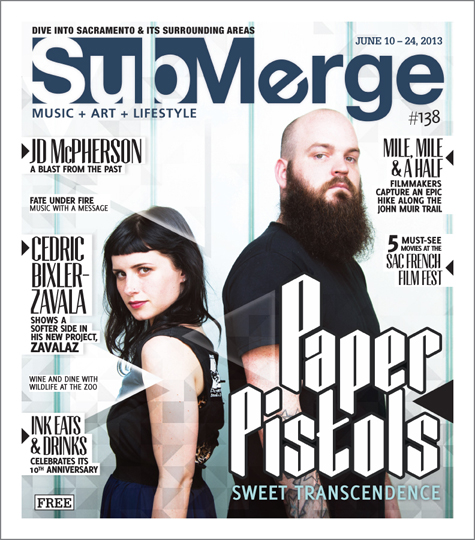
Paper Pistols’ Deliver Us From Chemicals examines life in the new age
It’s 2013: NASA is collecting applications for Mars colonists; international, state and local governments continue to gut social programs and education through austerity measures; and California, despite its drastic cuts, projects a minimum $1.2 billion dollar budget surplus for 2013. As I write, the still hot ashes of the Egyptian Revolution are igniting a populist uprising in Turkey. This month, according to major media, suicide is an epidemic. The world is lonely, the global economy is stagnant and in an effort to grow, we’re colonizing space; everywhere—Arrested Development season 4 included—it’s austerity and decadence, riot and romance.
“I’m just here in my body,” sings Julie Lydell on “Oil,” the first track of Paper Pistol’s debut album, Deliver Us from Chemicals, “No weight on my chest/No knot in my throat/Unimpaired by the impulse to make sense/of senseless things/patterns and chaos/God, I’m tired/and I’m sick/of caring about where all this is going.”
Lydell’s voice, slightly nasal and rich in timbre, contains our moment today: the anxious present, the absent future. True to pop form, Lydell locates herself as a body, anywhere and everywhere. The lyric I, here, is alone swimming in gin and existential crisis at the bar, walking the streets of Turkey surrounded by neighbors and teargas, discarding consequence, guilt, frustration and concern.
This chorus increases via the layers of samples, melodies and instrumentation before falling to the austere, the minimalism of Ira Skinner’s rim-shots over a pitter-patter series of electronic clicks. As a song, “Oil” utilizes a Thom Yorke-ish intro, syncopations and percussive pops that sound like a digitized steam engine gathering speed—a tenacity realized by Skinner’s rolling-stop snare work at the end of the track. And during this large arc, the cycle, the song structure builds. This next verse section, a series of piano driven chords, highlights Lydell’s addition to Skinner’s one-time solo project.
“I don’t know any prophets,” sings Lydell, “Don’t ask me for my oil/That lamps been burnt out for so long/I’ve no more light to give.” The play here, as in many other places on the album is a skipping of connotations. From the inability to see the future to the non-existent incentive to invest in it, Lydell and Skinner, in a combination of ups and downs, replicate the cyclical feeling of a bubble bust economy, all dwindling resources and antiquated infrastructure. For this, the album is an emotive, LED beacon in our dimly lit times.
This is not to say it’s anything other than music pushing its boundaries both lyrically and technologically, as Lydell and Skinner are quick to point out.
“This is where music is going now,” states Lydell. “It’s crazy how many frontiers are being expanded. We can almost make music on accident with an app or something.”
With this development of computerized production there’s also a tension that emerges between the traditional role of performers and machines. Lydell understands this as an opening of potentials: “I don’t think you can lose the organic side of it, absolutely never. You can augment or improve on what you would be able to do with the bodies, with instruments.”
“It’s like limitless capabilities,” confirms Skinner, “when you’re playing electronically. We could go up there and just play piano and drums, but why be limited by how many people can touch an instrument? We physically play most of the parts on the record and play them off the laptop live because there are not six of us.” Then he adds, “I think we have trust issues as well.”
Despite the meager numbers, Paper Pistols is a dominant force live. They concentrate on making their concert performances engaging and entertaining.
“We can still be a dynamic band, not sound robotic or fake,” explains Skinner.
“I think there’s such an energy live. There’s a lot of energy on stage—presence. Because of that, most people don’t think, oh shit, half the music’s on a laptop. It’s not like we’re doing anything super unusual for these times. All bands have laptops in their bands now. Ten years ago when I started Evening Episode, that was unheard of. It was a challenge. We had adapters hooked up to adapters just to make it work.
“I don’t think I’ve ever been onstage where I’ve half-assed my performance,” Skinner continues. “For me, it’s a very therapeutic release. It’s such an outlet, and every show I try to push it more. I write my parts based on emotion, parts that feel cool.”
Writing, practicing and performing are vital for both Skinner and Lydell. Lydell even jokes that her daily stress about and frustration with the world dissipates after a good practice session or show.
These concerns, likewise, find expression in the album itself as a conflict between isolation and community, absence and presence. “I think that’s the theme of the record,” Lydell meditates in a sprawling thought, mirroring our complicated contemporary. “It’s hard to have an electronic album and have it be about getting back to this primitive state, or this more pure place, before the world was full of billboards and Internet homepages and anti-depressants, nicotine, alcohol. All the things we can use to escape from ever having to deal with selfhood because it’s really lonely. I think lyrically and thematically, that is the tension this postmodern world promises.
“When people used to be alone, they were truly alone,” she adds. “There was no way to communicate unless there were other people [physically present]. You had to be comfortable being by yourself. [Today] you can focus on your projected self because you can just do it constantly; what do I want to put in this status update so that people can see that I’m having an existentialist crisis and I need to solve it? You don’t have to ever deal with anything if you don’t want to. Or you can take a pill.”
These constant bombardments and over-simplified alleviations express themselves lyrically and sonically on the album. If Lydell drifts as a lyricist between loneliness and connection, then the minimalist verse structures and rich, decadent hooks similarly materialize these concerns through chords and melodies. The album has many moments of quiet tension and multilayered movements.
Lydell sees the work as a collaboration of sorts between opposing forces: “Ira and I have different composing styles. I really like tension. I think there are moments on the album where it’s really decadent, kind of luscious because of how much is going on; epic. Ira’s written film scores.”
“That’s my part,” Skinner states flatly, his stoic front confirmed by his casually crossed arms, smooth-shorn scalp, burled beard and deep voice. “I specialize in epic.”
Next to him, Lydell seems a bit more dynamic despite her “logical, monotone” self-description. She slouches back sipping tea in black and white wing tips, a long dress and sleeveless denim jacket. Both members casually detail what they hope to accomplish in the next year, which includes finding a manager and setting out on a small tour. Familiar friends, they joke quickly between each other. Their chemistry confirms the band’s back-story: Lydell canceled a return to Austin, Texas, to continue working with Skinner on Paper Pistols, alongside her other musical projects. Thus, the album came to be.
Describing how Paper Pistols came to be in its current incarnation, Skinner, who spends most days recording bands in his Midtown studio or running sound for various local venues, recounts, “After The Evening Episode, I didn’t have a desire to do a band again. I’d need to get a van, a practice space, book tours. It didn’t seem fun to do that again. Playing music with Julie has changed my perspective. It’s inspired me to actually start writing music. It’s an easier process with her because she moves quicker than I do, and she’s got so much energy. It’s different in a very positive way. ‘Astronaut Food,’ we wrote that and recorded it in a day. It sums up the record and so many of Julie’s views on the world. It’s a lonely ass song, too.”
“It’s just The Lion King. In a key too low for me,” smirks Lydell.
“Does that make me Simba?” asks Skinner.
“It does. And I’m still myself,” Lydell quips in return.
Aptly, for both musicians, “Astronaut Food” is an anthem of sorts. Over a music box sample and long sustained piano chords, Lydell sings, “The future looms not as bright for the most of us.” The final crescendo of the song is a surge of booming toms where Lydell repeats in a melancholic affirmation, containing hope and despair, “Deliver us from chemicals.” The song concludes with a four-part, gospel-style harmony that, in a song about literally being isolated above earth, desperately seeks transcendence.
Lydell explains the song, the possibility of a future, as a “conflation of living in the age of celebrity where everyone wants to have something special, look rich. But really we’re underemployed, making $9 an hour. There’s this gap. I think we’re really removed from reality in some ways, and it’s showing up on a bigger scale post-2008. There are so many complex systems, and I can’t even fathom it.”
The future looks similar to Skinner, a monoculture of sorts: “My realm of expertise would be the music business. If you listen to today’s radio, no, we don’t have a future, or at least not a very bright one. The influence that pop musicians have on the youth, artistic or not, it’s not positive. But, I think that’s because I’m old. People who are produced now don’t have an artform.”
Ultimately it’s clear that both Skinner and Lydell would prefer to stay on Earth playing music despite the chaos that surrounds us.
“I wouldn’t fucking go out in space,” Lydell laughs. “I would kill myself first. It freaks me out. I want no part of it. I’ll cling to a tree.”
“They have that thing right now,” says Skinner, regarding Mars. “You can sign up, but you can never go home. You live in a bubble. Who would do that?”
“People who like Burning Man would go. That would be my worst nightmare,” says Lydell.
“That’s what they should do,” concludes Skinner, “dump the Burning Man tickets and send them to Mars. I’m done with some Burning Man shit.”
There it is. Mars, loneliness, anxiety, austerity, decadence: Paper Pistols, Deliver Us From Chemicals, 2013. Transcendence, indeed.
Catch Paper Pistols live on Saturday, June 22 at Davis Music Fest’s City Tavern Stage at 9 p.m. They are also scheduled to play Launch Music Festival, a two-day event going down on Sept. 7 & 8 at Cesar Chavez Plaza. Visit Launch’s website for tickets!
Faith is a powerful thing. It drives people to do all kinds of things–both positive and negative. For Sacramento Christian hard rockers The Seeking, faith has been a nourishing force in the band members’ lives. The band stands to release its full-length debut, Yours Forever, on Nov. 6, 2012. Before that, they will launch on a mammoth cross-country excursion, touring in support of Woe, Is Me.
The tour begins in Atlanta on Nov. 2, 2012 and circumnavigates the United States before culminating in Greensboro, N.C. The trip will keep The Seeking busy, playing shows almost every day, and it’s so extensive that some of the band members (which include Taylor Green, vocals/screaming; Dylan Housewright, clean vocals/guitar; Grayson Smith, guitar; Shane Tiller, bass; and Ben Wood, drums) had quit their day jobs, taking a leap of faith in their music, so to speak.
It would be a nerve-wracking experience for anyone, diving headlong into a career in music, but considering the members of The Seeking range just 18 to 21 in age, it may even be more so.
“We’re probably going to cry,” Taylor Green joked in the first of two phone conversations about the band spending such an extended time away from family.
Green started the band with Housewright in 2010, the two still in high school. Green wasn’t sure what his role would be in the band they wanted to get together. He considered bass and guitar, but didn’t want to buy the gear. He even thought about drumming, but the physical coordination proved difficult.
“I was going to try to do drums, but the only thing I really needed to try to get down was the feet,” he said. “It’s the hardest freaking thing. I don’t know how Ben does it.”
Green had done more traditional singing in his church’s youth group, however, and settled on becoming Housewright’s vocal counterpoint in The Seeking. Though Green also provides traditional clean vocals, his guttural screams shake up Housewright’s soaringly melodic voice.
“Screaming showed up out of nowhere,” Green said. “I figured I’d just try it. I just went for it.”
It would seem Green made the right decision. The band signed to a label (Razor and Tie) in September, and when Submerge talked to Green, he and the band were in Los Angeles, recording with well-known producer John Feldmann, who’s worked with a litany of well known artists (The Used and Papa Roach this year alone) and is also the frontman for pop-punk stalwarts Goldfinger.
Listening to The Seeking’s Yours Forever reveals a barrage of heavy rock sounds–crushing guitars, pummeling breakdowns and snarling vocals–but the album’s most striking feature is its melodicism. It’s the band’s pop tendencies that The Seeking is working to bring out under Feldmann’s keen, catchy songwriting sensibilities. Green reported that the band was re-recording “Alone,” perhaps the most hook-laden track on Yours Forever, reworking it to make it even more radio-friendly as well as working on a new as-yet untitled song the band co-wrote with the producer that should be released in 2013. In the following interview, Green described what it was like working with Feldmann, offered clues into the band’s first music video and discussed matters of faith.
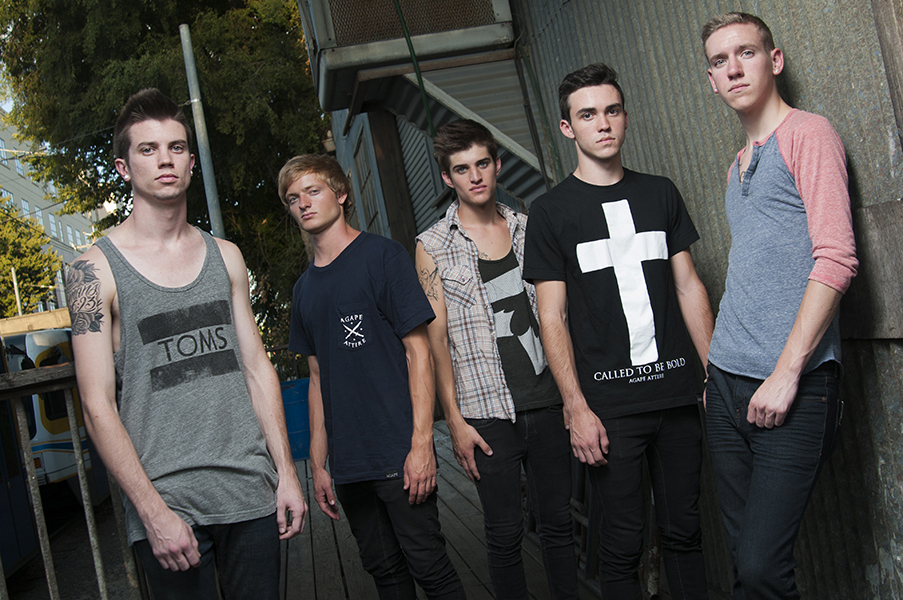
How has it been working with John Feldmann? What have you done in the studio so far?
Oh, it’s amazing. It’s an awesome experience working with him. The bands he’s recorded are legendary bands, and he’s done some solo artists as well. So far, it’s been awesome. We’ve done a lot of demoing the past couple days, and today we started doing the final product and it turned out really good. We’re laying down some drums, we got the bass track laid down in there. It’s turning out really well.
You mentioned a couple days ago that you were going to be working on “Alone.” Is that the track you’re going with for the radio?
We’re actually working on two songs. We’re releasing “Alone” on the album, the original one, but this one is redone a little bit. It’s going to have some new parts to it. It’s going to be released separately for something for radio–hopefully it will get there. We’ve got another song that we started completely from scratch, and it’s all ready to go. It’s all demoed out. That one sounds amazing as well.
You said you were working on rewriting the chorus for “Alone” with John Feldmann. How was it writing with him?
His writing is pretty cool. His studio is separate from his house–he works on his property–but he’ll go play his piano in his house. Dylan met up with him at the house and they worked something out. It’s definitely hot, and it’s definitely catchy, and it’s definitely awesome. It’s going to fit so well.
Tell me about this new song you guys started from scratch. Was it based on any ideas you and the band had kicking around?
We had some ideas, but we came in and we didn’t really get a chance to show them. He [Feldmann] started off asking us some questions when we first got there and took off and started writing. We came together and figured everything out. It’s all from scratch. We started writing it when we got here. It’s turning out awesome.
What kind of stuff did John ask you guys to get you going?
He just wanted to get to know us a little bit, to see what kind of band we were. We covered the fact that we were a Christian band. He asked us about how we grew up and what type of music we started playing and how were we before we got signed, and how we’re evolving. He went off and started recording stuff. The chorus is definitely the catchiest part, but it’s a really pop-y side to us. We think people are going to dig it.
You guys seem to be exploring the pop-ier side of things. You were saying that you came from a heavier music background. Is it fun for you to do something outside of your comfort zone?
It’s really fun. We’ve been playing a style for so long, and we definitely see ourselves staying in that style for a while, but this is something that’s different from the album. It’s way pop-ier than the album, but it’s fun to go in there and throw down some singing–no screaming at all.
You’re going to be filming your first music video on Sunday. What song are you shooting the video for?
It’s going to be for the title track, “Yours Forever.” I’m not sure where it’s going to be yet, but it’s somewhere in SoCal. It’s going to be fun.
Did you have a hand in the concept of the video?
Yeah, we picked the concept a couple weeks ago. We had about three concepts to choose from, and this one fit the meaning of the lyrics more. The other two didn’t fit the lyrics too well, but this one definitely did.
Can you talk about the concept more?
I don’t think so [laughs]. I’m not too sure what I’m allowed to talk about. The lyrics are about God talking to us… I’ll get into a little bit. I believe it’s about a girl, and something happens where she could lose her life. Right at the last minute, or right after she dies, her life flashes before her eyes, and then the music video kicks in, like everything kicks in, to what she sees in her future. It flashes to her at the end, to her before her dying, and then the video changes from there, and there’s a twist to it. I’m really excited about it. It’s a cool concept.
A lot of your music deals with your faith. Is that the band’s first goal when it comes to making music? Are you concerned with expressing that?
Definitely. We want people to know that we express our faith through our music. We’re not like those preaching bands, like For Today, but when we play, we want to show people that we’re there to love on them, and God is there to love on them. We’re here for a reason, not just to play music, but we’re here to be a shoulder to cry on or a friend to them. We’re trying to show God’s love through the band to them. It’s just an opportunity to show people that they’re not alone in struggle, that if they want to try God out, we definitely encourage that. Just, not make them feel uncomfortable when they come to watch us, that we’re there to simply hang out with them and talk with them about anything. If they want to have faith in the Lord, then we’re there to encourage them. Faith is a huge thing with the band. It’s something we want people to recognize.
Was music one of the things that helped you discover your own faith?
Yeah. I became a Christian when I was young, but nothing really hit me until I started high school, and even then, I wasn’t in any bands or anything. I grew up in a Christian home. My parents didn’t, but when I was born, they became Christian and their faiths grew as well. They didn’t pressure me like a lot of parents would. It was more of a choice for myself. I was always a clean-cut kid. In high school, I thought for a long time I’ve been faking it, but let me see what it is to really put myself [into faith]. It was an awesome experience. I grew to love the Lord. Music is one thing I want to do with the band, because I knew it would get me out of my comfort zone of just staying in my hometown and going to church and being on the worship team. I wanted to step outside my comfort zone and see where God could take me. I trust Him to take me out on the road…and see what He could do with me. It’s an awesome opportunity, and it’s going to change my life.
The Sacramento area will get a few chances to see The Seeking live. First, they play with Jonny Craig for a two-night stint at Luigi’s Fungarden on Oct. 26 and 27, 2012. The band returns on Nov. 19, 2012 with Woe, Is Me at Ace of Spades. The Seeking has also set up a donation page to raise money for gas during their long arduous trek across America. Help keep the fuel tank full by going to http://www.indiegogo.com/theseeking. For more show info, go to http://www.facebook.com/theseeking.
Local hard rock band Misamore ready to release new EP
For local rock guitarist Josh Amolsch, April 13, 2011 is a very important date, one that’s long overdue. The band he founded way back in 2003, Misamore, will finally release their first official recording, a five-track EP titled Horizon, at Powerhouse Pub in Folsom. “This album has been a very long time coming,” Amolsch recently admitted to Submerge. “Every time we tried to put something out it always ended up going sideways due to one reason or another. So having this album finally come together is a huge achievement for this band.”
He added, “This record was kind of ‘do or die’ for us.”
Misamore’s sound lies somewhere between that of Tool, Pantera, Mudvayne and Metallica. The EP’s opening track, “The Desert Shade,” boasts speedy guitar riffs and a huge range in singer Mace Corona’s vocal abilities, who can change from melodic hook to brutal scream in a heartbeat. “New Beginning,” the second track, has a much more radio-friendly vibe to it, but still showcases the band’s musicianship and knack for weaving in oddly timed rhythms seamlessly. “Dead” is a whole lot slower than the first two songs and acts as a great centerpiece for the EP. “Forebay” gets a little tripped out at times, sort of Mastodon-ish, and proves that Mike Dragony can slap the shit out of his bass with some impressive playing in the intro; and “Home” brings Horizon to a close, leaving you wanting more.
Submerge caught up with Amolsch recently to chat about the band’s tumultuous past, their new EP and the status of heavy music today.
Why did it take so long to get an official release together? There have been quite a few ups and downs for this project, right?
Well, we had never had a full band together long enough to put a legit album out. We are very meticulous with everything we do and didn’t want to put out something we weren’t proud of. With that, there have definitely been more downs than ups. Misamore first came together in February 2003 after my old band broke up. I, along with the drummer from that band, launched Misamore. The next four-and-a-half years saw many member changes, a move out to Texas and back and a brief period of time when I just flat gave up and started playing drums in a punk band.
How did the current lineup come about?
I have known Mike for years. I first met him back in 2000 when both of our bands played a show up in Chico at a house party. We met Mace through an ad on Craigslist in 2008 and although it took a year to finally hook up, it clicked right away. Mace met Ryan [Maples, drums] at our rehearsal spot back in December 2010 just walking in the front door. I’m told that Mace just had a weird feeling about this guy and turned around and asked him if he played drums. We had fired our old drummer about three months prior to starting the record, so we were looking for a permanent replacement.
Being the group’s founder, are you also the main catalyst for songwriting? How does that process work for you guys?
I think we work very well together. Mike and I have been writing together for years. He and I will just sit, sometimes for hours and just pound out riffs. We record everything too. I must have 60 gigs of material just sitting on hard drives around my house. We will then sequence riffs together based on vibe, tempo and energy to make sure we are capturing the right feel Mace needs to get across what he feels. And then there is Ryan. He makes sure everything flows and bounces according to his standards. It really is the most healthy writing routine I have ever been a part of.
When were the songs on Horizon written? Are these all older, newer or a mix of the two?
Definitely a mix. It was tough deciding which songs would make it on the debut, but we narrowed it down the five we felt would represent us the best and reach the most people. The oldest song on the EP is “The Desert Shade.” I wrote that song back in 2006 when I was in Dallas. The most recent one is probably “Dead,” written in November 2009.
What are your thoughts on the status of heavier music today? It seems that with all of metal’s sub-genres it’s easy to get classified as “this” or “that” and sort of get pigeonholed, you know? What does a band like Misamore have to do to stand out from the rest?
Well, I am only speaking for myself, but I think that a lot of the heavy music out today sounds very similar. To my ears, there are very few bands that stand out lately. Looking at the big picture there are always trends. Right now, in metal, I just hear breakdown after breakdown accompanied by myriad screams with techno beats for effect. Although it was kind of cool and different when I first heard it, I’m rather bored with it now. I can’t tell if it is my ADD or just my yearning for a new wave of timeless tunes. Misamore is all about energy. We pull from Muddy Waters to Norma Jean. At the end of the day it’s not about how hard a song is or if we got enough double kick or guitar harmonies in there. We want our songs to be in people’s iPods 20, 30, 50 years from now. That is our goal.
What’s more important to you, sounding good live or sounding good on record?
I would have to say sounding good live. However, most people will come to your show based on a good recording. I like the old fashioned word of mouth and the respect that it brings from friends of friends telling their friends and so on. It’s kind of like we are all just a bunch of friends when we get to the venue. Life feels so synthetic lately with computers and texting and social networking; to get in front of a bunch of people and exchange energy with them, that is living man.
Ten After Two sets sights on debut EP, then the world
Words by Bobby S. Gulshan | Photo by Phill Mamula
My editor said, “I want you to interview this up-and-coming band from Roseville. Here is their demo.” I gave it a listen and thought, “Yeah, these guys can really bang it out. Let’s do it.” I asked if maybe we could arrange to meet at a bar, so I could have an excuse to do my job and drink at the same time. Turns out, not a one of them is old enough to get past the door. Coffee then?
The dilemma faced me cold and hard like the hangover I was hoping to have after the interview at the pub: How the hell am I going to interview some youngsters about the serious issues surrounding contemporary metal music, and do it sober? What are we going to talk about? Am I just getting old? What would Lester Bangs do?
Vincent Adorno (drums) and Sean Wall (vocals), of Ten After Two met me at Starbucks downtown, and they blew me away. Sure, their music kicks ass. They deftly combine elements of technical metal precision with catchy, clean and melodic hooks that are as timeless as any angst-ridden power pop chorus. Their soon-to-be-released EP, If You Don’t First, is incredibly well produced and exhibits a remarkable level of musicianship. It is at times brutally heavy, and at other times unrepentantly accessible.
Moreover, these guys are serious. Don’t let the “just out of high school” thing fool you. Ten After Two have a precocious feel for both the music and the music business. The forthcoming EP is the product of collaboration between Rise Records, Artery Management and Hot Topic. The tunes are precise and structured, and it became clear through the course of our conversation that these guys have a clear and precise vision of themselves and their creative endeavors.
Tell me how you guys got started.
Vincent Adorno: Back in the day I used to jam with my buddy Pat [Hennion, guitar], after that we had this school thing between two schools, Oakmont and Woodcreek. And we found Josh [Doty, guitar/vocals] through that. He was the singer in this guitar class. Josh and Sean were in a band together at the time called Eleanor Manor. Josh and Sean joined us and we found Danny [Clark, bass].
You are pretty young guys.
VA: Yeah, I’m 17.
Sean Wall: I’m 20.
And this is why we are having coffee and not conducting this interview at the pub. So what made you guys interested in playing metal?
VA: We were into that genre at the time, and it’s a growing genre. And I see it as something that is only getting bigger.
SW: The genre lets us do a lot of things musically and allows us to put our own thing into it. We don’t have to feel so contained into something simple.
So what are some examples of that?
SW: We can do more chord progressions. We can try something new. On the future full-length you will hear it, going out of the box and doing different sorts of harmonies and stuff.
On the EP I noticed that you guys combine the melodic, clean vocal elements with the growling heavy vocals. Is that an example?
SW: Yeah, exactly.
Other than rock and metal, what else are you listening to?
SW: When I think about it, we listen to a lot of stuff. Oldies, classics, electronica, anything that is good musically we listen to.
Let me ask a similar question. What’s the exact opposite of the kind of band that you would want to be in?
VA: I don’t want to be in a band with people who aren’t serious about it. I am trying to do this as a career, so definitely nothing that is only about fun or just a personal thing.
SW: I hate really limited bands. I wouldn’t want to be in a band where all the songs sound the same.
So you are more interested in the idea of exploration and the endless possibilities of what you could do?
SW: Exactly. The endless possibilities of music.
In terms of making it a career, what does that mean for you?
VA: There is going to be a lot of work that goes into it. We are going to be totally broke for a while, but eventually we want to be able to make a decent living and have some fans really love it. I just want to do what I love and hopefully do it for the rest of my life. And this is what we all love doing.
So the EP is coming out on Nov. 9, 2010. What is the deal with Hot Topic and the exclusive release?
SW: Our management hooked us up. They had connections with Hot Topic and wanted us to do it. It will be available through Hot Topic and iTunes.
In terms of style, I know bands don’t like to be categorized, but we writers live and die on categories. Some might call what you do metalcore or emo-core. So what do you think of these labels?
SW: We are a rock band. We have straight 4/4 time, minor key type stuff. You could call it alternative rock or whatever, but we are basically a rock band.
You guys love the breakdowns, don’t you?
VA: It’s what kids can relate to. I don’t know why, but these days the kids love it, and we love it too, so yeah. It’s heavy, and it’s what everyone feels. They can feel the heaviness.
You guys show a certain level of musical sophistication. The songs are well structured and well put together. You mentioned theory earlier, but what about technique? There seems to be an emphasis on technical ability in the songs.
SW: We like to be guitar-driven and very musical. I think our songs tell the story through the guitars.
There was one track, “Behind Locked Doors,” where that acoustic guitar comes in near the end, and I was blown away by how clean the production was on that.
SW: Yeah, Colby [Wedgeworth, producer] does some amazing stuff out of his house and at Hollywood North off of Douglas. It was a great time and the end result was killer.
What are some of the themes you guys are exploring with the music?
VA: So far it’s stuff about girls, I guess. Some of it is about this reoccurring theme about home. It makes sense if you listen to it.
SW: It’s like taking the time to be introspective and knowing within you what home is. When do you know that you are completely comfortable? How well do you know yourself to know that you are at home?
Is it that where you are from isn’t necessarily where you are at home?
VA: It’s like a personal feeling, feeling whole and home in the universe.
SW: Like you are your own universe.
Does this relate at all to being from Roseville, which is nice but it’s still the suburbs, and it’s not that open-minded a place?
VA: Well we all want to get out of there.
SW: Suburban scum.
VA: We don’t like the way the kids act out here. People are really egotistical, even though they don’t have much to show for it.
SW: These themes get brought up. People have stuff, but don’t know happiness. They have material things but not much else. They don’t know themselves.
VA: And the world has gone to shit.
I feel you on that. So what do you guys have coming up?
SW: We are going to Florida in December, be there for a month.
VA: Yeah, we are going to go out there and record our full-length.
Touring?
VA: Yeah definitely, after the full length gets done.
SW: We are hoping to tour all next year, starting in the spring.
So what are the ingredients for future success?
SW: The fans, connecting with our fans.
VA: Fans and keeping up with the writing. We can’t overthink it. We can’t lose what we know. We lose the feeling if we think too much about it.
SW: Like Vinny is saying, we want our fans to be a big part of it. But if we try too hard to write for others, we are not going to be able to write it how we feel it, and in the end the people listening are going to be able to hear that.
Aside from the music, how else can you connect with fans?
VA: We want to try everything–contests and charity events. Basically anything to connect with people on a real human level is really important.
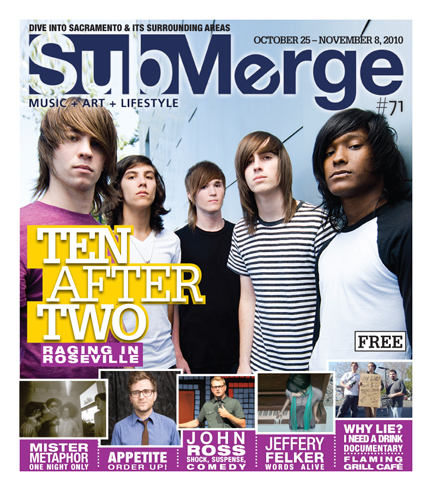
Ten After Two’s debut EP will be available at Hot Topic starting Nov. 9, 2010. The album will also be sold on iTunes.