Blue Note Special
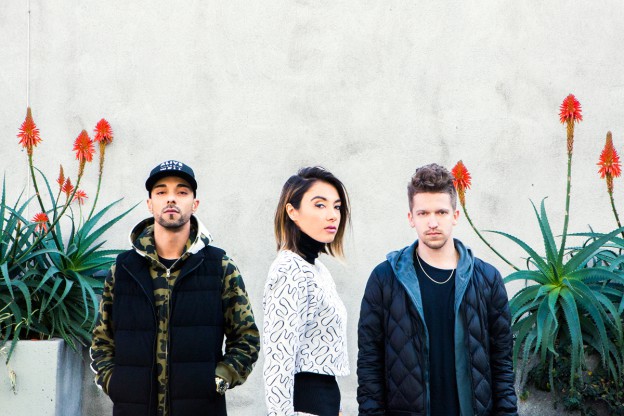
The Seattle-based three-piece band The Flavr Blue describes itself briefly on Facebook as “synthesized love notes, dreams, vices and a whole lot of Flavr!” The first of those tags proves especially true with their latest EP, and the last, without question, has held up through the span of their career.
The trio’s third release, Love Notes, which dropped this past November, stands as a testament to their ever-evolving sound and versatility in and between different genres.
Musically, The Flavr Blue sprouted from a more uptempo, almost purely electro-pop foundation on 2012’s Pisces, then expanded into a more ambient soundscape on 2013’s Bright Vices and now, almost three years later, has really settled down into perhaps the most intimate, organic R&B groove it’s ever been in.
Compared to the group’s last two collaborative endeavors—where vocal duties were oftentimes shared evenly between band members Parker Joe, Lace Cadence and standout songstress Hollis Wong-Wear—Love Notes serves as a particularly noteworthy moment, for its the bands lone female member who graces a majority of the eight-track EP as the lead singer.
It’s fitting, too, that Wong-Wear is getting a bit more spotlight within the band, seeing how she’s made the biggest splash in mainstream media as of late.
Having provided the hook for Macklemore and Ryan Lewis’ hit “White Walls” off their Grammy award-winning debut album The Heist—not to mention working production on two other videos from that record as well—Wong-Wear has probably been the most active of her Flavr Blue counterparts.
In addition to singing, songwriting and producing, she also engages her local community in a variety of capacities. From speaking publicly and performing slam poetry at conferences and conventions to serving on the Seattle Center Advisory Commission and Seattle Music Commission, among other public arts agencies, Wong-Wear certainly wears a number of hats, to say the least.
Most recently, she’s been outspoken about a controversial headline her hometown paper—the Seattle Times—wrote about her, where her achievements as both an independent and collaborative artist were downplayed and then, at the same time, coated in racial connotations that left a bad taste in just about everyone’s mouth who heard about it.
The original December headline, which has been corrected and publicly apologized for since, read: “Warmth and intimacy from The Flavr Blue with Macklemore sidekick Hollis Wong-Wear.”
As the Seattle band ventures on their latest outing around the country in promotion of Love Notes, Submerge was able to talk music, band dynamics and the aftermath of the Seattle Times bungle with The Flavr Blue in a phone interview that shed some light on where things stand with each other, the media and the future of their careers.

TBD Fest 2015 | Photos by Phill Mamula
I wanted to touch on the latest EP, Love Notes, and just kind of work our way down into other topics. I have my own ideas on the differences between this project and your last two. But I’m curious what you guys think are the main distinctions.
Lace Cadence: Bringing in more live elements to it, honestly. Because, definitely, on our first album—Pisces—it was pretty much strictly electronic-based. And on our second project, we kind of started to mold a little bit more instrumentation into it. And Love Notes is definitely kind of the opposite—just, like, more instrumentation. More live music, and way less electronic aspects.
As far as inspiration goes for writing, I’m guessing everyone is drawing from their own personal experience. Right? Or do you all lean on one person’s experience for song content, or is it just a collaboration between everyone?
LC: It’s usually intended to be a collab, but I think it leans a little bit more on Hollis—for this record especially, because she does most of the vocals. So it’s coming from all of us, but I think it’s a little bit more personally geared toward some of the things Hollis was dealing with. Because she had to a lot more of the writing on this project, so it’s going to come from her a little bit more.
Hollis, what were some of the things you were going through at the time that you leaned on for inspiration in writing a majority of this record?
Hollis Wong-Wear: I think one good realization that I had through writing this project was—obviously this project is called Love Notes. And I think romantic love is obviously like a through line for the concept of the songs. But also, it was just a reminder that the idea of love is really universal and actually transcends just a romantic or personal relationship. It can actually just kind of touch on your relationship with anything, whether that’s, like, the world or your own aspirations or your dream of being an artist. So to have heartache doesn’t necessarily mean you get your heart broken by a single person. You can have heartache from different things … So it was just a reminder for me that even though it can be channeled into the relatable kind of one-on-one relationship, that really doesn’t define your relationship with everything.
I noticed the pace of each album has gotten progressively slower and more intimate, at least that’s my take. Do you guys get that sense too, and if so, was that move deliberate?
Parker Joe: Yeah, I think that’s pretty accurate. A lot of that happened pretty naturally. Again, it’s like Lace said—just starting to work with more live instruments and rehearsing and just having a guitar around to start to doodle around on a song. We started replacing something we used to do with a synth with a guitar, and it just very naturally progressed.
Is that a trajectory you guys are trying to maintain going forward? Slowing things down a little?
PJ: Some of the songs on Love Notes—like “Supply”—we started two or two and a half years before they came out. It’s interesting, because there’s a song on there called “Oxygen” and another called “Pretty Girl.” Both of those are sort of collaborative songs that we did only, like, five or six months before the project came out. And those are much more club-y and dance-y, so we still kind of have that goal as a group and that passion for more upbeat stuff as well. But we definitely focused this project toward songs that kind of melded together in a package that felt more intimate. And that’s definitely what Love Notes became.
I wanted to ask about the dynamic of the group a little and how the media has tended to cover you guys. It seems like Hollis usually gets a lot of the exclusive interviews and sort of represents the band on her own a lot. Do you or Parker ever feel like your roles in the band are minimalized at all because of that, or like you’re not getting as much credit or coverage as either one of you deserve?
LC: That’s a good question. Um, no, not at all. We’re in this together and just because Hollis is an active, popular young lady, that would never bother me. I feel like that only comes back to benefit us. So, if there is any animosity like that going on in the band, I think it’ll just hold us back. So Hollis doing her damn thing is not a problem for me. I feel like a lot of people wonder that, and it’s not a problem for us.
Hollis, I know you wear a lot of different hats in your professional life … As your careers move along with The Flavr Blue, do you feel like one of those roles will have take precedence while the others take a back seat?
HWW: I mean, for me, I’m always somebody who enjoys working collaboratively. But The Flavr Blue is my main musical project. And it’s a project I’m passionate about bringing to light and to follow its evolution. And that’s not going to interfere with how I work with other people or do my own independent work. I’ve been a freelancer for, like, the last four or five years. So I think people perceive me as doing a bunch of different things, but it’s actually like an ecosystem of how I support myself as a working artist. So I’ll just continue to make decisions for myself that best benefit my artistic growth, including growing The Flavr Blue.
I wanted to ask about the recent Seattle Times headline that called you a sidekick. Since this all happened in December and there’s been a couple months of backlash, is it settled now, or is it still an ongoing issue?
HWW: I’m not somebody to dwell or to even make a scene of something. And my desire, obviously once the initial headline came out, wasn’t to half-wage a campaign against my hometown paper or to try to call people out. But at the same time, I have a really strong support system in my city and my community, and I felt it would be remiss of me to not publicly comment on what my experience was. And I think it speaks, to me, about my passion for equity and my passion for everybody to have dignity in media coverage. And if I were able to use the example of how I was treated to just kind of cast a light on how artists of color and communities of color are portrayed in the media—like, it’s a growing call. It’s not like I’m a spearheading a movement by any means. But I guess I’m not interested in dwelling on any one incident. But I am interested in organizing around the need for artists and historically marginalized people to be better represented, to be respectfully represented and the way we’re covered in the press.
I know the editor-in-chief eventually apologized publicly and privately. Do you feel like you need more from them for closure?
HWW: Honestly, my sights are set a little higher than engaging one-on-one with the Seattle Times. I talked to the editor-in-chief and we had a conversation, and then I left that conversation stating my hopes for them that they would take their collective education and evolve seriously. But I’m not really interested in hand-holding any one institution. I’m more interested in organizing and generating within my community and within my band and in my artistic career, rather than trying to reform another organization or institution.
Are there any similarities that you guys are aware of between Sacramento and Seattle at all? Or do any of you have any memories of Sac, or have you ever been before?
HWW: Yeah, we played TBD [Fest] in September and that was awesome. And then we also played Lowbrau last year—or maybe two years ago—in November when we did our first West Coast run. We had a really fantastic time. I don’t know, we had a really strong [showing]. A lot of people came out. People in Sacramento really enjoy independent music and have really sophisticated music taste. So every time we’ve been in Sacramento, it’s been a real pleasure for sure.
The Flavr Blue returns to Lowbrau in Sacramento on March 8, 2016. Doors open at 9 p.m., and the show is FREE. To RSVP, go to Facebook.com/letwisttuesdays. In addition to great music, there will also be drink specials. Lowbrau is located in the MARRS Building (1050 20th Street in Sacramento).
Weird by Design
If I ever needed to hire a hype group, Tell the Wolves can take all my money. The Sacramento five-piece is as energetic and bright as a crackling fire in rock ‘n’ roll hell.
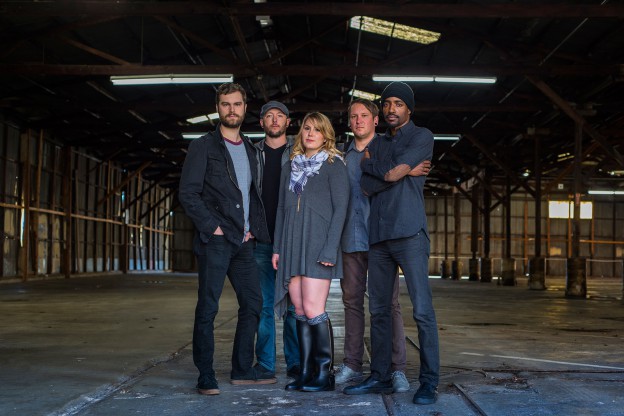
Offstage, the band is full of welcoming, positive and joyous dudes. Onstage, however, they turn awesomely erratic and sonically chaotic. I sat with vocalist/guitarist Leryan Burrey and bassist Zack Davis to talk about the release of their upcoming EP The Great Design, and how they manage to balance being the extremely optimistic, super nice guys making music that delivers a riveting middle finger.
Tell the Wolves has been together since 2013, and has only added members in their few years of being a band. The band’s name comes from multiple instances of wolves popping up in their lives. The main one being when Davis came across the book Tell the Wolves I’m Home (by Carol Rifka Brunt), and was struck by the ring of it. He went to his bandmates, who had been knocking around band names for quite some time, and presented them with his band-name epiphany, “Tell the Wolves.” Destiny was manifested that day, and the rest is history.
Burrey and Davis first met at Harlow’s, where coincidentally, they will have their first EP release show with their band. “The details are a little murky,” Burrey admits. “We had both had a bit to drink that night.”
At this point in the conversation, they both go back and forth in trying to piece together what happened that night, and how it led to their partnership. The conclusion was: “Essentially, it was a labor of love brought together in a drunken blur.”
Both guys have been long-time musicians in Sacramento, and attribute their accomplishments to local networking. “We wouldn’t have been able to accomplish anything. Not Concerts in the Park last year, not any of it,” Davis said. “The Sacramento music community is so supportive and they all like and share our stuff. It has all been a very supported ride.”
The first show the band ever played together was also at Harlow’s, where they played for pretty much just bartenders and girlfriends, “The place was completely dead,” Burrey reminisced. This time, for their EP release show at that same venue on Feb. 6, 2016 things are already turning out much better.
“We have already been selling some tickets, so we are stoked to have the support this time around,” Burrey said.
Zack added that, “Harlow’s and Old I are some of our favorite places to play. Last time we played at Old I, though, we were physically too big for the stage. It’s a bummer because it is our very favorite dive bar. It has such a super awesome atmosphere. And it has the scent of dive bar.”
Tell the Wolves has mastered the art of creating erratic rock ‘n’ roll with a soft spot. They like to emotionally vomit their heart out into song.
“I like bands that do weird things and are not afraid. I appreciate the fact that they take so many risks,” said Davis. “I like feel-good-for-you music that is creative and interesting, but still meaningful. My favorite bands, like Incubus, don’t just make art for art’s sake. They make art so that you feel something. On the other hand, I can honestly say that those guys can shit in a bucket and I would buy it.”
He continued,“You can think of your favorite musicians and pinpoint how their music makes you feel. That’s what it is all about. For example, Rage Against the Machine, who are one of my biggest influences, started out as a couple of young guys who sung about their frustrations with the system. Here we are 20 years later, and what they sang about sadly still matters and is relevant. They used their music as an honest platform, and they are absolutely timeless. Surrounding myself with music like this for years, has rubbed off on me and made want to create similar music experiences.”
Tell the Wolves says that their EP is a “Culmination of everything we have ever wanted to do. EVER.”
“We wanted to make some groundbreaking, beautiful, rock and roll,” said Burrey.
“We had already made all of this music, played all of these shows and had a bunch of fun making our music. This EP seemed to be the only thing missing, and it’s kind of being used to sum up the work that we have done in the past three years,” Davis continued.
“This EP took us a year and a half of fun, fighting, drinking, hangovers, deaths, crying, things we can’t even talk about,” Burrey said.
“And a couple of murders,” added Davis, “This is off the record, right?”

Photo by Phill Mamula
Davis’ overall experience with Tell the Wolves and his music can be summed up with a little help from Justin Timberlake. “We were so excited to write this music, and we are so excited to play it. We have such a good time goofing the fuck off,” he said. “It is so important for us not to take ourselves too seriously. Most of the time, our music is really emotional and serious, but when people see us live or get to know us, they will see that we aren’t like that. Music is our outlet for that. Justin Timberlake once said, ‘I don’t take myself too seriously, but I take what I do very seriously.’ We hope people hear how much we love to create music. I want them to feel our love and the passion that goes into it. The studio is our sanctuary, and it’s where we get to express all of those feelings that are all bundled up. We get to let loose with noise and share it with our audience. This is what music is all about for us.”
The whole album was recorded mostly every Sunday. Saturday night before recording would always turn into ridiculous nights of catastrophic drinking. “My girlfriend affectionately named the Den we would drink at ‘The Den of Bad Decisions.’ And so it was,” Burrey said. “All of the songs on the EP were created through the urgency to express ourselves through all of this craziness in our life. We would have these wild emotional journeys, like my issue with alcohol, that I was really able to deal with through making this EP.”
You can catch Davis and Burrey with the rest of the Tell the Wolves crew at Harlow’s Feb. 6, 2016 for the release of their very first EP, The Great Design. Also performing that night will be Some Fear None and Hero’s Last Mission. Doors open at 10 p.m. for a 10:30 show. Tickets can be purchased in advance through Harlows.com.
They’ve been called an emo band, which is weird. When I think of emo I think of a mopey teenager, clad in black, slouched in front of a 7-Eleven, writing dark poetry in a notebook while sucking on a clove cigarette and waiting for a homeless man to buy him beer. Actually, now that I think of it, that seems really fun.
But not as fun as Little Tents.
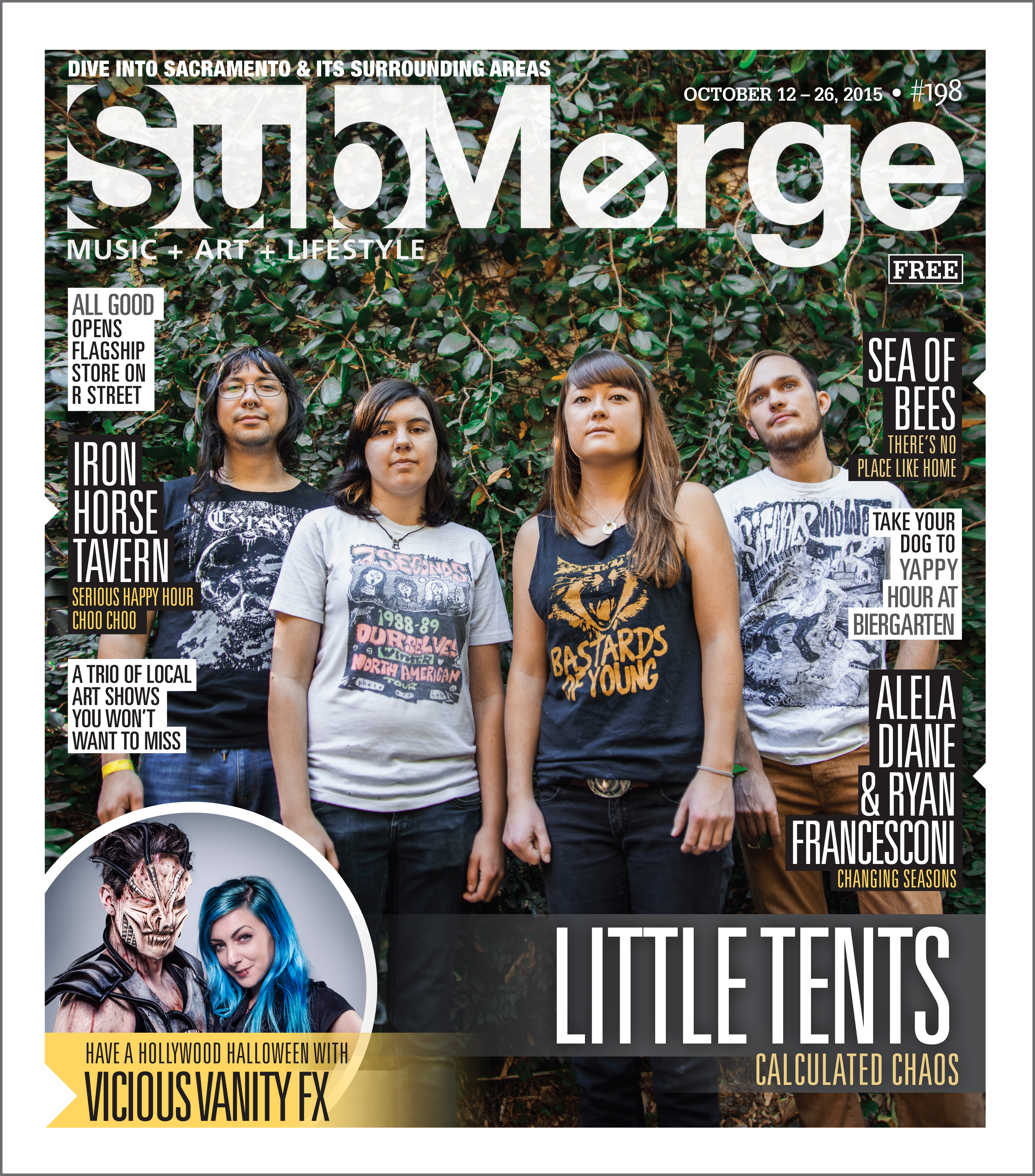
Little Tents is what I would call a pop punk band, but that’s the problem with labels: When I hear “pop punk,” I immediately think of Blink-182 and that’s exactly what I don’t want you to think of. Or, actually, think of Blink-182. I don’t give a shit. But Little Tents is pop punk in the way Jawbreaker was pop punk—melodically interesting, catchy, lyrically expressive, yet just hard enough to make your conservative uncle say, “What the fuck is this shit?”
Little Tents’ debut album Fun Colors (out now on Bomb Pop Records) is a short collection of seven quick songs that jump back and forth from melodic to chaotic, and it really couldn’t be any more delightful. And unexpected. Plus, there’s something enigmatic about the band. Perhaps it’s the upbeat tempo, which is pretty much the opposite of the dark, drone-y shoegaze that seems to have permeated underground music as of late. Or maybe there’s just something about Little Tents that isn’t quite right, an incongruous quality that I can’t quite pinpoint. For example, take these lyrics: “Inhale as the sky rains death. Through a haze, planes crack twilight/Smoke-filled teeth chatter with the chill of another night alive/The air will choke you. The water will kill you.”
That’s some darkly poetic shit, right? Some literature written by a deeply disturbed wordsmith? Maybe that’s why people call Little Tents “emo.” But the name of the song is “Shrimp Pants.”
“Shrimp Pants.”
It makes no sense.
Here’s another lyric: “Dawn gives birth to a bleeding child/The hope for a new day leaves us alone with a pile of tiny bones.”
Damn! That’s some evocative, Nobel laureate-type language, right?
“Khakis on the Beach.”
Yup.
So this begs the question: What does the song title “23N60” mean? Is it a super secret combination that unlocks a vault containing Little Tents’ vast fortunes? Is it the Bible Code? Or is it the name of an infectious disease?
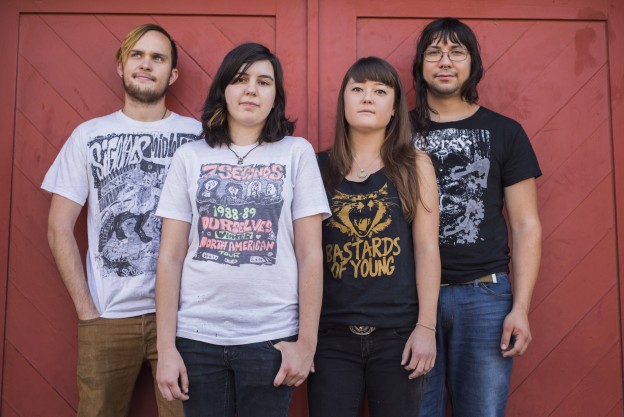
To find the cut of Little Tents’ collective jib, I thought I would lure them with pizza (if there’s one thing a pop punk band loves it’s free pizza) so I could interrogate them. So, we—Lys Mayo (guitar), Audrey Motzer (guitar), Jordan Trucano (bass) and Adam Jennings (drums)— gather at Pete’s to hash it out.
They order a big ass pizza and some beer, and I order a douche-y vegan sandwich.
“So what does 23N60 mean?” I ask.
They laugh, while Mayo and Motzer explain that it’s the GPS coordinates of a weird logging road by the American River where they once got lost on a camping trip.
“Khakis on the Beach?”
Well, that song was named such because a guy wearing khakis walked by on the beach.
In short, there is no rhyme or reason as to why they name the songs the way they do. They just like naming songs weird stuff, so they do that.
I also wondered about who exactly sings the songs, because when you listen to the album, you hear a sweet voice and then a bunch of screaming, and it can be disorienting. For some reason, I figured Lys Mayo does most of the vocals, but it turns out Audrey Motzer sings a lot of them and Mayo does a lot of screaming. There’s also a dude (or a couple of dudes) who scream, too. Or maybe more. I don’t know. Even after they told me, it’s still confusing.
I think it’s confusing to them, too.
“She sings all the hits,” says Mayo, pointing at Motzer, who blushes.
It becomes wholly evident that the band does whatever feels right, which is often just an intuition and a willingness to practice until something cool-sounding comes out. In fact, it’s how their band became a band.
“[It] was me and Lys drinking in her backyard with acoustic guitars,” Motzer says. “We both didn’t know what we were doing at the time—and I still don’t.”
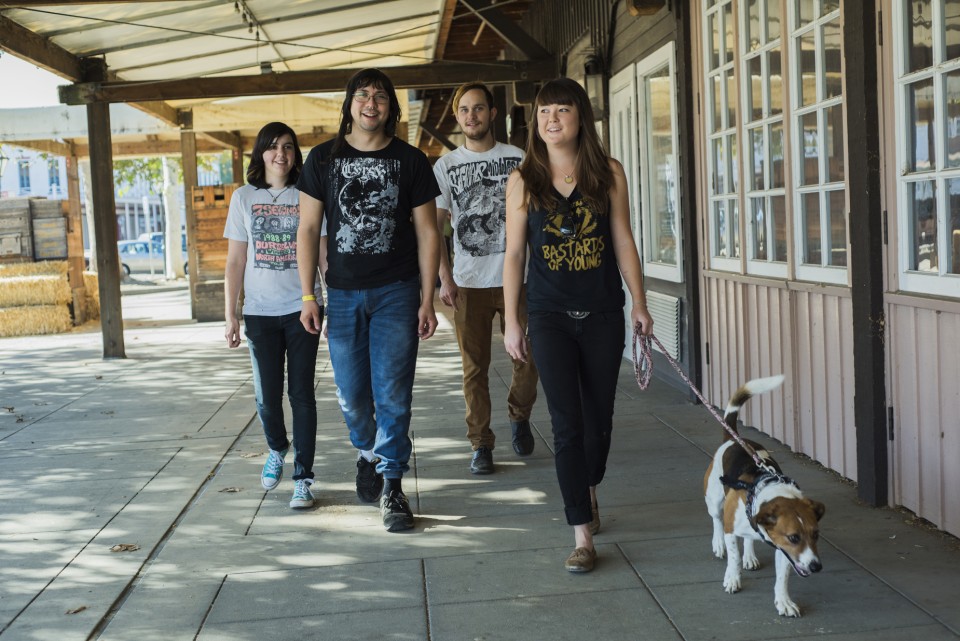
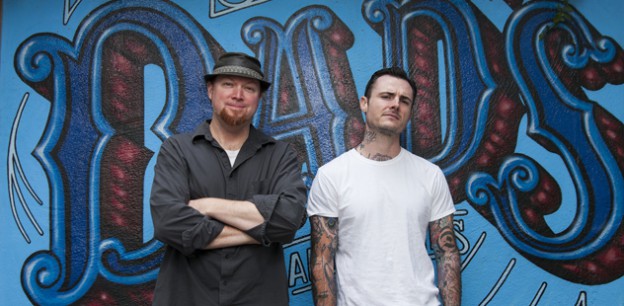
Their style of music comes from a wide swath of influences—local bands like Gentleman Surfer, Dead Dads (in which Mayo plays drums), Church and VVomen inform a portion of their musical landscape.
“Between all of us, we listen to a lot of different music,” Trucano says. “So we just threw it all together.” Jennings adds that they have all been friends since they were pre-teens, so they spend a lot of time together, sitting around, drinking beer and melding minds, the resulting songs a compilation of dueling ideas and differing tastes, a sort of auditory representation of their friendship.
“A lot of the decisions that we make for the structure of the songs is relatively arbitrary,” Jennings says. “We’ll kind of just pick it and do it that way every time.” They try to match their live songs to the way they’re recorded in the studio to maintain some sort of consistency.
This insight into the Little Tents process is fascinating, but, ultimately, super unhelpful when trying to trap them into a genre-specific categorical box. Nevertheless, we end up talking for a while as the band devours their cheese pizza, but none of what we cover—the lack of all-age venues, a sketchy house show where the hosts dosed unsuspecting guests with LSD, Sacramento’s inherent radness, Charles Albright getting shitfaced at a party—helps me understand Little Tents in the context of a genre or as a cohesive band. Everything they do seems to be on accident. Aside from their close friendship, there is no real narrative line that runs through the band’s history. They’re fascinating, of course, but only because of a random series of beautiful miscalculations. Or maybe not.
At the end of our conversation comes the most revealing part of the interview. There are two pieces of pizza left. Jennings eyes them both and slides them onto his plate. He reaches for the leftover ranch dressing and slathers it on one piece and puts the other piece of pizza on top. He then eats the slices like a sandwich. A pizza and ranch sandwich.
“How was your pizza sandwich?” I ask when he is finished.
“It was pretty tight,” replies Jennings, smiling a wide smile.
I’m here to tell you, friends: Little Tents are a band of genius punks.
Pick up a copy Little Tents’ debut album Fun Colors in digital form at Littletents.bandcamp.com or on CD at Bombpoprecords.com. Check them out on Facebook to look for upcoming show dates.
Devoutly Dynamic
TBD Festival, West Sacramento, Oct. 4, 2014: Even though the sun went down hours ago, warm dust still erupts into the air like the billion microscopic remnants of an obliterated world. My mind is already reeling from the gauntlet of great acts I’ve been shuttling back and forth to glimpse from one patch of riverfront land to the next; brilliant, virtuosic performances seem to flare out on all sides from different vistas, pushing the inter-stage wanderer towards a kind of polyphonic high. The sound, the flashes of light, the smell of incredible food and the miasmatic, billowing dust after a full day of sun have started to take their toll.
Determined yet tired, I trek towards the far side of the concert area, into the volume and light, to secure bodyspace for the concluding main stage performance of the evening. But somewhere around the halfway point, I pause, struck by a bluish ethereal glow and the thrum of brooding synth and bass accompanied by emotive, full-bodied vocals. I am caught off guard; the sound beckons, the conflicted groove is perfectly in sync with my mental state; it zeroes in on me with an intensity that isolates instead of pummeling the senses. I gaze up at the stage, and enter the realm of Sister Crayon.
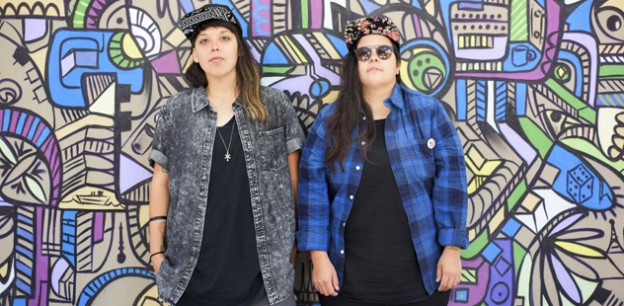
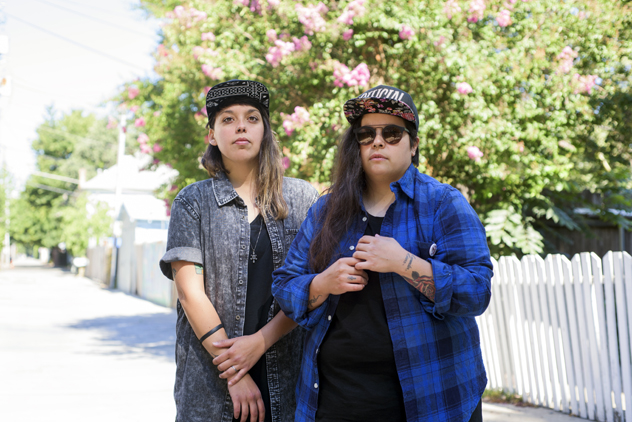
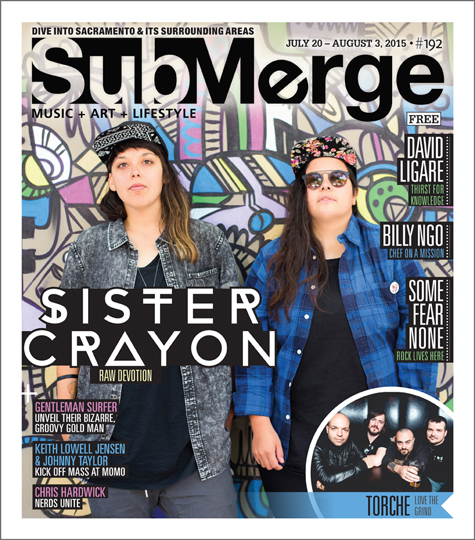
Shine Coffee, Sacramento, July 11 2015: I’m sitting across from Terra Lopez and Dani Fernandez, the creative force known collectively as Sister Crayon. The two are remarkably down-to-earth and open, a fact which their otherworldly, often mercurial music belies. Never before has their sound been honed so sharp as on their newest release, Devoted, released early last month. Pared down from a four-piece to their current duo, the project has plunged ahead with the carefully crafted sonic workings of Fernandez and the intensely personal lyrical performances of Lopez. Both are keen to show the specific sources from which their creative output arises, whether it be turbulent personal relationships or a diverse array of contemporary artists and budding music genres. The night before our meeting, the two even showcased some of their favorite material at Dive Bar as a DJ set, and are gearing up for a live show at Harlow’s in early August—their first locally since the release of Devoted.
Our caffeine-fueled discussion, recorded here, skirts topics ranging from spirituality, love and hate and the risks of creativity. Enjoy!
How did the DJ set last night go? What sort of material did you select?
Terra Lopez: Last night was a lot of fun. Good crowd, good energy. It’s always fun coming back to our hometown. We just like to play songs that we like really loud [laughs]. For our set we selected a lot of footwork, a lot of juke stuff from Chicago, deep house, a lot of drum/bass-heavy stuff that’s really influenced our sound and resonated with us. A lot of beat-driven songs, a lot of bassline.
How was the process in crafting the production on Devoted?
Dani Fernandez: We wanted to focus more on a beat-heavy sound and showcase the vocals, and we’ve never really done that on our last albums. There were so many other things going on before, and we wanted to strip that away.
TL: We wanted to make a sound that was undeniable, with how I was feeling lyrically, we wanted that to take precedence along with the beats, and not have anything crowd it—almost a minimalist approach the whole time.
What was the first creative step taken with that album?
TL: We demoed a lot in Sacramento and in Oakland, [Fernandez] lived here at the time. And we would just send each other ideas back and forth. For the first time, we got on a plane with 20 unfinished tracks—we had never gone into a studio with unfinished ideas, so it was really scary. We both didn’t know what to expect.
DF: This was the first time we had done a record on our own.
TL: Yeah, it was nerve-wracking. We got to Florida to work with our producer Wes Jones in St. Augustine and we spent two weeks there in this tiny little town. We didn’t know anyone except for Wes, and we slept and lived at the studio for two weeks—it was a very isolating experience. We were basically in our heads for two straight weeks, and it drove us a little crazy … But it was awesome. It was incredible to be so isolated, it felt like an alternate world that we were in.
DF: Almost all of it just spilled out in those two weeks, very easily. There was never really any arguing.
TL: It was pretty much a dream to be able to work that way. To have that freedom. And then literally on the last day, on our way to the airport, Omar Rodriguez-Lopez [of The Mars Volta] wrote me and asked if he could help produce the record.
I understand Omar had been a fan of your project before he stepped up to produce?
TL: We were lucky enough to go on tour with one of his projects in 2013, and we toured with them extensively and from that tour, we built a friendship with him and his band and so they really liked what we were doing, they would watch us every night, and hang out with us. You know, he’s a pretty reclusive guy, so the fact that he even wanted anything to do with us was a big deal.
DF: We knew that he liked us when he invited us to the movies one night on tour. He doesn’t do that regularly. He likes to stay to himself on tour, not really be on the scene with everybody, but he was totally talkative, wanted to get to know us, loved what we were doing, loved the sound. And you could tell that he was really curious as to what we were setting out to do. It was really cool.
So overall, it was a pretty tension-free recording process?
TL: Yeah, we were very grateful to have had the team that we had, because it was such an organic process. We would spend eight-nine hours working with Wes on the songs, and if we needed a break, we’d go jump in the ocean, and then come back and work until two, three or four in the morning, and then start over the next day—and it was like that for two weeks.
DF: Now I get why artists tend to record in secluded areas. They’re always holed up near a beach, or at a cabin in the woods somewhere. It makes you really focus and hone in on your music. It’s probably going to be the way we record from now on.
I understand you featured “Ride or Die” as a video to coincide with the recent SCOTUS decision?
TL: We did. We had actually shot it a week prior, and it wasn’t a planned thing. I had woken up that morning and seen the Supreme Court’s ruling and was so inspired. So I reached out to the director and was like, “If there is any way that we could release that video today, it would be so fitting.” The song is a celebration of love; the video definitely is. We really just wanted to celebrate the day. Dani and I had never really put ourselves out there with our orientation; it’s a known thing among people who ask us, we’re very open, but we had never really put it out there in a video. Everyone was on board, so we just released it. It was a beautiful day, just a gorgeous day, a really proud moment. To release something in correlation with it meant a lot to us. We were finally able to put the message of our music forward in our own subtle way.
Along with these feelings of a triumph of love over hate, there’s also been a good deal of ambivalence towards the concept of love in your work …
TL: It’s incredible that you picked up on that, because I’ve done a few interviews where that kind of goes over their heads. For me, I was in a place when I wrote that, when I was starting to write the lyrics for these songs, I was heartbroken. I’d been in a five-year relationship, had my heart broken, and I’d never experienced a loss like that before. A loss of love, but also a loss of self-motivation—it was the first time it had ever happened to me, and I really clung to this record with Dani, in order to get out of bed most days back then. So for me, I wasn’t singing about that love loss, necessarily, I just didn’t believe in love at all. During those months when we were writing, I really didn’t, and I was questioning it, dissecting it. I had always believed in love, and I’ve always wanted to, but I was definitely in a place where I was trying to figure out if I still did. And so the whole album was basically a way—we called it Devoted because it was our way of practicing devotion as a way to restore our faith in it. And so there’s definitely moments, it’s kind of like a roller coaster where I’m clinging to that belief that it’s still there, even though I don’t feel it.
It seems like many of your releases have been influenced by particular relationships?
TL: I think that with Bellow and Cynic I was very vague in my language. Especially on Bellow … we were so young and didn’t think anyone would even hear that album, so we made it for ourselves. As a songwriter, I was very, very vague. I would speak about people in metaphors—you would never know what the hell I was singing about. And Cynic was very much straightforwardly about my mother and my father and my childhood, but I still was a little vague about expressing myself. When the time came for Devoted, there was no way around it. I didn’t have the time or the energy to make metaphors, I had to express exactly what I felt.
Do you think it’s necessary to suffer for art?
TL: I’ve never been able to write when I’m happy, and I admire those who can, but I’ve never been able to. I don’t necessarily need to be in a dark place, but I do need to contemplate. I dwell a lot.
What’s next for Sister Crayon? What should we expect at Harlows on Aug. 1, 2015?
TL: We’re working on two videos and some remixes; a lot of content coming out in the summer and in the fall. As for Harlow’s, expect a brand new set of songs that we’ve never played here. Just an entirely new experience, new merchandise and new feelings We’re coming out with a completely different kind of performance.
Give Dani and Terra a warm welcome home to Sacramento! Sister Crayon will play Harlow’s on Aug. 1 with DLRN and Stevie Nader. Doors open at 9:30 p.m. Tickets for this 21-and-over show can be purchased in advance for $12 at Harlows.com.
This Band Walks Into a Bar …
So, two fat guys, a Mexican and a Japanese girl start a band…
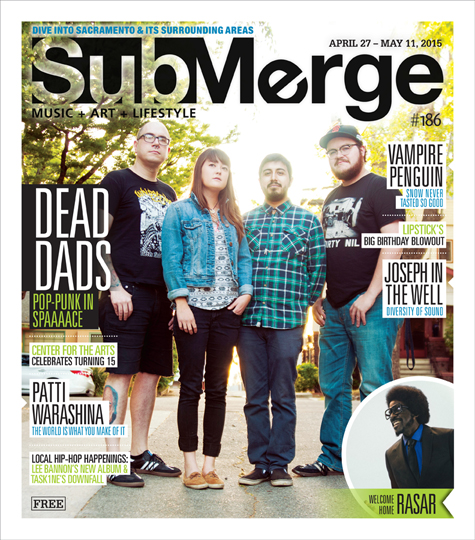
What’s the punch line you ask? Dead Dads.
“Yeah, Dead Dads is the punch line,” Tony Silva of the Sacramento pop-punk band Dead Dads explains of their Facebook page’s band description. “It’s kind of like that NOFX album, White Trash, Two Heebs and a Bean.”
“I think the three of the guys in the band are pretty immature and Lys is mature,” lead singer and guitarist Cory Wiegert jokes.
All jokes aside, if you’ve been around the Sacramento music scene long enough you know that bands are not just bands—they’re bands, within bands, within bands…well, you get it. A guitarist may moonlight in another band as its bassist, or a drummer may trade in his sticks for a guitar strap—Multi-instrumentalists are commonplace in this town.
Such is the case for the members of Dead Dads: its frontman, Wiegert, also plays guitar and sings backup vocals in the local bluesy rock band the Peace Killers, while Lys Mayo on the drums, guitarist Tony Silva and bassist Joe McKinney, also known as Joe Friday (yes, inspired by the character on the TV show Dragnet) also lend their skills to other musical outfits around Sacramento.
While the band also describes its brand of musical stylings on its Facebook page as “stoner pop-punk,” Dead Dads’ music is a fun romp in the world of pop-punk—you know, the cousin to punk, a fusion of fast punk beats and blaring guitar riffs with pop-y melodies and arrangements.
“When we first started, we didn’t want to just call ourselves pop-punk because we were mixing all of these kind of weird riffs and such, and so we started saying stoner pop-punk,” Silva explains. “I think it is a good way to describe us—I mean really we’re a pop-punk band. We take a lot of influence from the Bay Area pop-punk bands.”
The quartet began simply as a band of friends—going to shows and hanging out around the Sacramento music scene. What started off as something fun to occupy their time quickly grew into a full-fledged band.
“Our first show was in November 2011, and we had our first practice, probably, late September/early October 2011,” Silva explains.
“We didn’t practice very long before we started playing shows,” Wiegert chuckles.
“Our first show was for one of Danny Secretion’s cancer benefit shows,” McKinney explains. “And it was at this venue that was also an art gallery in Midtown—which I guess wasn’t a totally legit venue, it didn’t have the proper permits or anything. The name of the venue was a venue called, Digitalis, the show was going well and we were probably the fourth out of five bands [on the bill] and right as we were finishing up our last song the people at the venue working there came and said, ‘Hey, you guys got to stop…cops!’”
While the police may have busted up the renegade show, the band forged on and their efforts transformed from just playing music and having fun into a serious musical endeavor—ultimately materializing into their first EP, simply titled Ben.
“Once we did our first recording it started to get a bit more serious,” Wiegert explains. “It really was just to play local shows as first; we hoped we could do more than that. We’re just now starting to venture out of town, but there wasn’t a particular goal in mind. We found a small label to put out our album and I guess that was somewhat of a goal.”
Huddled around a cell phone in the back of Wiegert’s dark blue Dodge Caravan in the parking lot of their practice space (House of Hits Recording Studios in Del Paso Heights, near the Marconi-Arden Arcade light rail station and next to the 7-Up factory), the quartet spoke to Submerge about their early influences, the driving force behind their sound, the dynamics of the band’s creative process and their latest album Space Camp.
“I was a band geek starting in fourth grade, I played trumpet and all that stuff and then I heard Green Day and saw [the movie] School of Rock and I decided I wanted to play drums, and that was that,” Mayo says.
“Not many of the people my age like the music I like, and the specific music I had in my head that I wanted to play, which was some sort of pop-punk that was reminiscent of the old Bay Area pop-punk bands,” Wiegert, the elder statesman of the band, explains. “And we all smoke a lot of pot and get weird, so it just really worked out that way.”
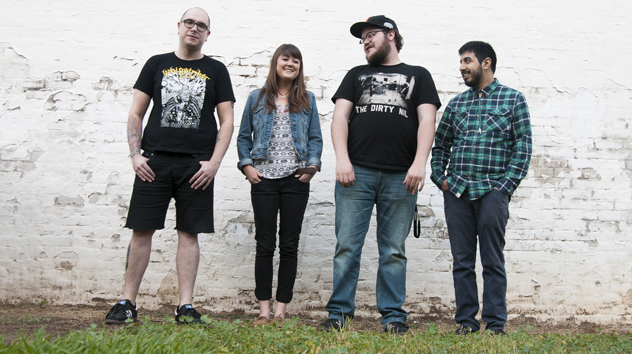
And while you typically don’t see many females in town wailing away behind the drum kit, Mayo is quick to dismiss the idea that being a woman in a band with three dudes is anything remarkable.
“I don’t think it’s any different than having a group of four guys or anything like that,” Mayo says, elaborating on the guy-girl dynamic in the band. “They’re just my three best friends, so we inspire each other, we drive each other nuts, we write good music, we write some bad music, it’s not that much different than [any other band out there] … I’m in a band with girls as well, [and] to me I don’t think gender plays a huge role in the dynamic.”
The band’s second EP, released earlier this year, was recorded by a mainstay in the local music scene—Patrick Hills, who is also a musician in the punk band Bastards of Young. However, it wasn’t something that the group banged out in a couple of weeks—quite the contrary, whenever the band and Hills had any free time they chipped away at bringing the 10-song record to life.
“We started recording it, I think, at the end of the 2013 and we didn’t actually finish recording ’til probably around the summer of 2014,” Wiegert explains. “And then it took a long time for us to find somebody to put it out and everything. But we recorded it with a guy named Pat Hills at his place called Earth Tone studio in Rocklin. It was a long process; finally just in the last few months we were able to put it out.”
And yes, for all of you movie buffs out there, the inspiration for the album’s title did, in part, come from the teen flick Space Camp as well as a bit of mix-up with the lyrics during the recording process.
“What happened was, we were listening to Cory record his vocals for one song and one of the lines I thought he [sang that] he was going to space camp, and I just kept singing it over and over again and then yeah [it just stuck],” McKinney explains.
“Also, I missed seeing movies where people went to space camp. It is a total ’80s/early ’90s thing,” Wiegert continues. “When I was a kid I always thought it sounded so cool.”
The artwork for the cover, a collection of ethereal jellyfish on a black and gray space-like background, was brought to life by a friend whose artistic vision spoke to the foursome.
“We had a few different ideas…but a friend of ours Jessica Vosburg drew up the cover and then I colored it just using Photoshop and such—she did a sketch of it in black and white and we colorized it,” Wiegert explains.
“She drew that probably early 2014—it was probably one of the first album cover ideas we had and we tried about 30 other things and that was the one we always came back to, so two years later we liked it and chose it,” Mayo continues.
So, a jellyfish walks into space camp…OK, bad joke, but check out Dead Dads at their upcoming show and get weird!
For more info, checkout Deaddads.bandcamp.com or their Facebook page.
A Sip of Nostalgia
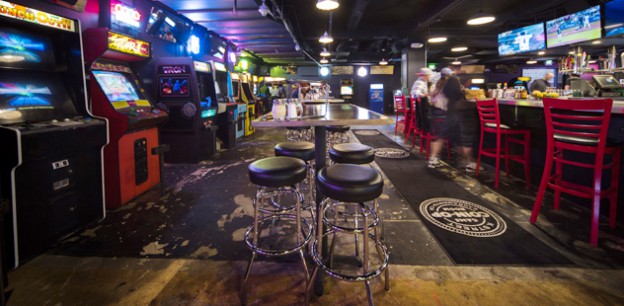
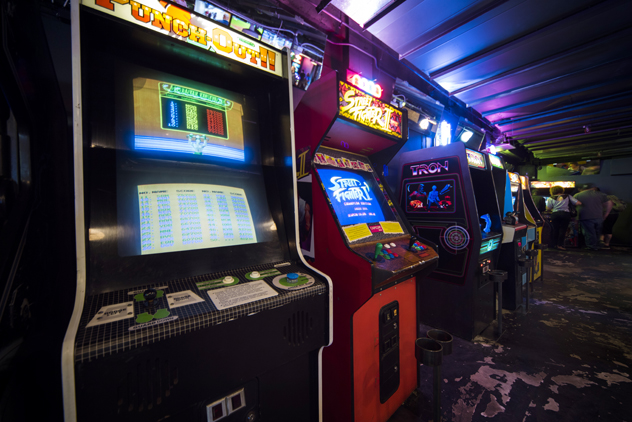
The new Coin-Op Game Room may have a bouncer at the top of the stairs, but this is not a typical posh downtown bar. The wooden staircase winds down into a patio, where people are sipping drinks and playing a giant version of Jenga. Inside, the space strikes a nice balance between a trendy dive bar and a friendly neighborhood pub, with neon beer signs, slices of pizza served on brightly colored Frisbee plates and beer lists printed on chalkboards decorated with pictures of Mario and Luigi. A few people are gathered around the actual bar, but everyone else is clustered around the various arcade games that line the walls—about 40 in all. After Burner, Spy Hunter, Pac-Man, Donkey Kong, an entire row of pinball machines—this barcade is sure to stir up some feelings of nostalgia.
Originating in San Diego, Coin-Op Game Room offers adults a place to play the games they loved while they were growing up while enjoying a craft cocktail or microbrew. According to Evan Louis, one of the managing partners: “We like to explain it as a place that you can play nostalgic video games, get your Pac-Man on, or your Dig Dug or your Street Fighter on, and get a proper Old Fashioned.”
Coin-Op Game Room is a joint operation between Louis and partners Hassan Mahmood and Roy Ledo, owners of the original San Diego location. They also own Lion’s Share, a San Diego bar and restaurant that specializes in craft cocktails and exotic game meat like antelope, wild boar and kangaroo.
When they decided to expand to a third establishment, the original plan was to open another Coin-Op Game Room in Chico. Mahmood and Ledo stopped in Sacramento on their way up to Chico. They explored the downtown area and ended up liking what they saw, especially with the prospect of the new Kings arena on the horizon and all the development that has been happening in Sacramento over the past few years.
“We think in the next five to 10 years Sacramento is really going to move,” Louis says. So they made an executive decision and chose Sacramento over Chico, and settled on the building that used to be Marilyn’s on K. Evan feels they made the right choice in opting to set up shop in the capitol.
“Chico is a college town and nobody wants to pay $6 for a beer. The video games would definitely attract, but you’d have to have some really low prices,” he says.
The Sacramento Coin-Op Game Room is double the size of the San Diego location, but the concept is identical.
“We definitely expanded on that location but it has the same vibe. Craft beers, craft cocktails,” Louis says.
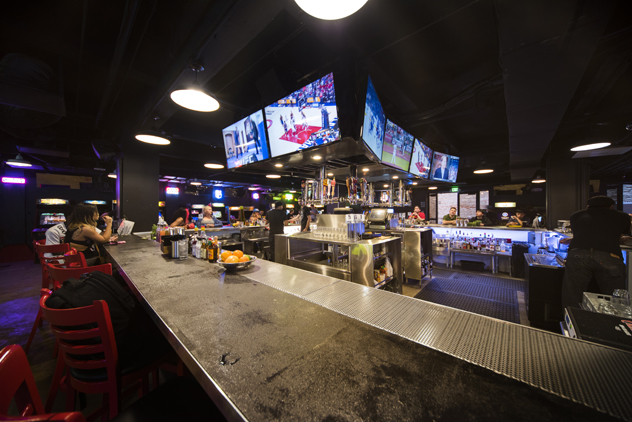
The location ended up being pretty ideal because K Street will become the gateway to the new arena. In San Diego, Lion’s Share is near Petco Park, the baseball stadium, which has been a big draw for getting customers. Louis hopes that the downtown area will soon be picking up.
“Midtown is a little bit more happening, but we definitely think that we can draw some of that midtown crowd to the downtown area and make downtown what it used to be, a little more fun and hip,” Louis says.
Coin-Op Game Room has the potential to draw in a more fun and lively crowd to downtown Sacramento. The bar will host regular tournaments and competitions for the more popular arcade games, such as pinball and Street Fighter.
“There’s actually a huge following of pinball. There are pinball associations across the United States, and we’re already on their radar,” Louis says.
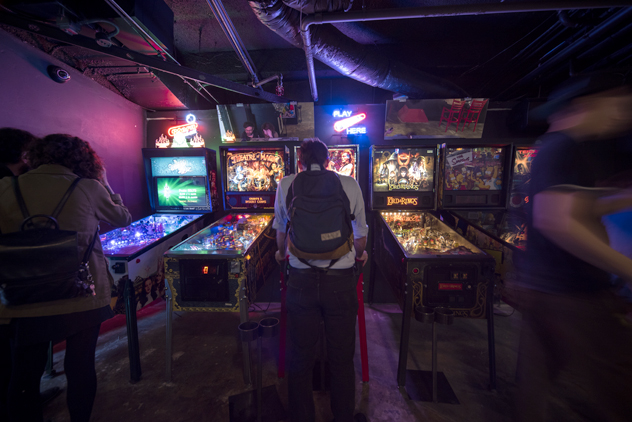
They’re also looking to work with one of the liquor companies, possibly Jack Daniel’s, to do a special Big Buck Hunter competition, offering monthly or bi-monthly specials. The person who gets the highest score over a certain period would get to fly out to Tennessee for a tour of the Jack Daniel’s distillery. And keeping with a San Diego tradition, the last Sunday of every month is free play, and all the games are free. “It’s a really good day for us in San Diego and also a way to give back,” Louis says.
They’ll also have DJs on Friday and Saturday nights. “There’s not too much room to dance but at least you can have some cool ambiance and vibes,” Louis says. They’ve partnered with local DJ Shaun Slaughter, who will be at their grand opening on May 28, and hope to have more local DJs on a regular basis.
The food at Coin-Op Game Room is perfectly suited to the casual, nostalgic feeling the arcade games impart. You can get a slice of cheese, veggie or pepperoni pizza if you just need a quick bite while wrapped up in playing Street Fighter. If you come with a group, you can order a whole pizza pie for a greater variety of toppings, like pesto, prosciutto or the “carnivore.” They also serve appetizers, including typical bar food like hot wings, or more unusual options like meatballs or an olive plate. Food is served until 1 a.m., and unlike many of the bars in the area, the bar stays open until 2 a.m., every night of the week. Louis says he has really enjoyed the crowds they’ve had on the weeknights since they’ve been open. “Sunday was a good crowd. We got a lot of industry people, and that’s like what we get in San Diego,” he says. “We like to cater to the late-nighters.”
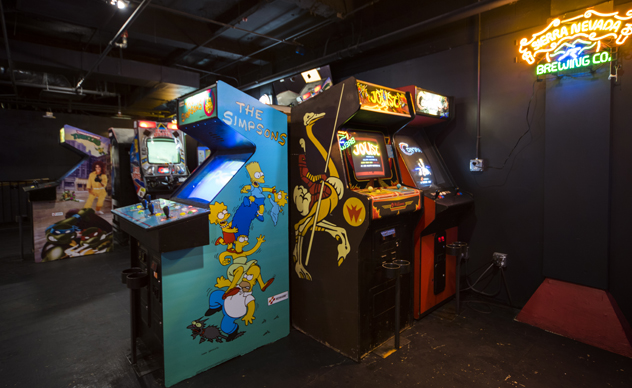
The beer menu is impressive—18 beers on tap, with a range of styles and breweries—varying in strength from session ales to a triple IPA, coffee stout, hard cider and even a sour. Some of the breweries featured at the moment include Alpine Beer Company, Green Flash, Deschutes, Dogfish Head, Track 7 and Knee Deep Brewing.
Their cocktail menu features creative concoctions priced between $7.50 and $9.50, and the names are as intriguing as the ingredients: the “91 Unleaded,” which contains rum, Temple cold brew coffee, cinnamon and black walnut bitters; or the “Tangerine Speedo,” rye, tangerine, tarragon, lemon and ginger beer. For something a little more classic, try the “Leggy Blonde,” a refreshing blend of vodka, pressed ginger and lime, cucumber and mint. For a group, Coin-Op Game Room also has punch bowls, which serve eight.
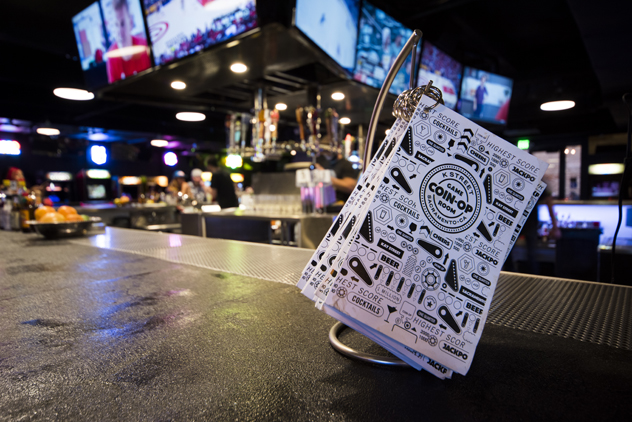
“It’s nice and communal and that’s something we definitely strive for here,” Louis says. But punch bowls are not meant to be enjoyed alone—in fact, the establishment won’t sell them to groups of less than three people. “We don’t want anyone getting sauced up carrying around a punch bowl by themselves,” he adds.
Despite the complicated cocktails and an overwhelming selection of draft beers, Coin-Op Game Room doesn’t have an exclusive or pretentious vibe. “This is a place where you can come by yourself, or with a group of friends, or come to make friends. You never know who you’re going to play Street Fighter next to. Next thing you know you’re having a beer at the bar together,” Louis says. “You can be in a comfortable environment and still get delicious drinks.”
Travis, the bar manager, chimes in: “We’re bringing the cocktail to the people.”
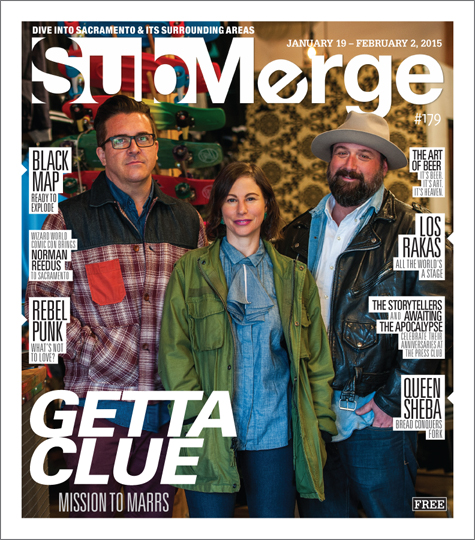
After 17 Years in Downtown Plaza Getta Clue moves into Midtown’s MARRS Building
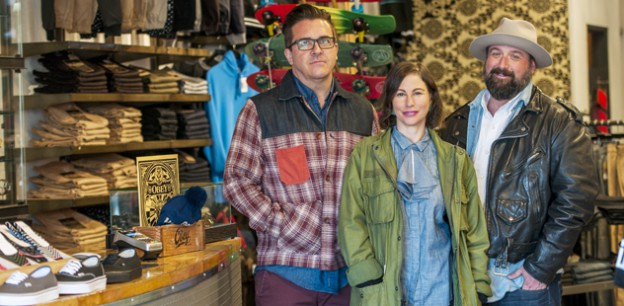
When it comes to running a small business, the odds are stacked against you. It’s sad, but true. According to the U.S. Small Business Administration, only about half of all new establishments survive five years or more, and only about one-third survive 10 years or more. This, in part, is what makes local retailer Getta Clue’s 20-plus year run so impressive. Locals Scott Gilbert and Justin Bilbao first opened their hip, fashion-forward men’s streetwear store in 1992 on Broadway and after a few years there, as well as a couple-year stint on K Street, they eventually settled into the Downtown Plaza. That’s where Getta Clue stayed, quite successfully, for a long time—17 years to be exact. That is until this month, when Gilbert, Bilbao and their longtime general manager Maia Friedman decided to ditch the Plaza (which in case you’ve been living under a rock is where the Kings are building their new arena) to move into Midtown’s popular and highly sought-after MARRS Building (MARRS stands for “Midtown Art Retail Restaurant Scene”), home to happening spots like LowBrau Bierhall, Block Butcher Bar, Sac Comedy Spot and more.
“It’s a hard move in the sense that we had a great run at Downtown Plaza and we were very successful down there,” Gilbert recently told Submerge in an interview. “But the time was right for us to change and we’ve had our eye on Midtown for a long time and we love the vibe of what’s going on, especially right here on the block, which to us feels sort of like the heart of Midtown. So when the opportunity came up, we were eager to jump on it.”
Getta Clue’s newest incarnation in the MARRS Building is approximately 2,200 square feet, and when Submerge visited last week, it already felt like it had been there forever. “Yeah, we’ve moved a couple times,” joked Bilbao when talking about how quickly they got the new shop set up. “This was actually a nice long journey of three whole days to set up instead of 24 hours!”
He isn’t kidding when he says they’ve moved a lot, and not just the Getta Clue store either, as Bilbao and Gilbert also own Goodstock Boutique, a men’s and women’s clothing store that was first started in 2009 at Howe Bout Arden before moving into the Downtown Plaza right next to Getta Clue’s old spot, but is now located at Arden Fair Mall (are you keeping up?).
Set aside the shuffling of locations over the years and one thing remains: This team knows their fashion and is constantly stocking some of the hottest gear and brands on the market. Getta Clue carries goods from popular international streetwear brands like Obey, HUF and Publish, as well as gear from locally based companies like Official (who even has a one-of-a-kind “Shop-N-Shop” set up in the back corner of Getta Clue), Timeless Thrills and others. They also stock a ton of sneakers from companies like Nike and Vans. If you’re a guy in Sacramento and want to look fly, there is no better place to turn than Getta Clue!
Submerge recently chopped it up with Gilbert, Bilbao and Friedman about their move into Midtown, how Sacramento’s sense of fashion has grown over the years and how music and art influence the fashion and retail worlds.
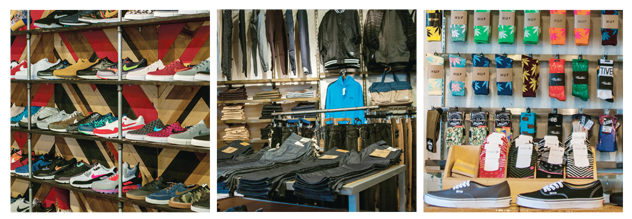
What is it about this area of Midtown, specifically the MARRS Building, that drew you guys in?
Maia Friedman: The MARRS Building drew us in by the diverse mix of art, music and food. These areas have always been great and have continued to grow for a better Midtown. That’s why we wanted to add retail to the mix.
Over the years you guys must have seen it all when it comes to different trends coming and going. A lot has changed right?
Justin Bilbao: Yeah. When we started back in ‘92 it was kind of actually where it is now. A lot of independent, smaller, streetwear brands. Real hip, skate oriented, a lot of people pushing the envelope in their style and in what they were putting out there. Then it kind of grew over the years and then it became corporate and big. Then it got real hip-hop based for a long time and then it kind of switched back, then hip-hop itself kind of went back down to street and skate. We kind of ride the trends of who is doing what, but at the same time kind of put things in front of people that they haven’t seen before. So trying to play both sides. But it’s funny, it’s actually coming full circle and now the small companies over the last six years have become bigger, larger companies, like Diamond and Huf. Now there’s a new crop of smaller companies that are growing and starting to show some relevance. Then we do a lot of support of local companies and brands like Official and Lurk Hard. Timeless Thrills is coming up, Higher Moons is a local kid doing stuff, so there’s a lot of new brands that are starting to come up out of the woodwork which is great because it makes it fun for us to give them a place to show their stuff.
Scott Gilbert: In order to stay relevant, especially in the fashion business, you have to be good at reinventing yourself. It really is second nature to us just because we eat, drink, sleep, live and breathe this. So it just kind of comes naturally to us to reinvent ourselves because we’re just part of the fabric of what’s happening. If you’re not able to reinvent yourself and get stuck in a rut, that’s when you get into trouble as a business.
What are some of your favorite (and least favorite) styles and trends that you’ve encountered while working so many years in the fashion business?
MF: My least favorite trend of all these years (and I am so happy its gone), is the 3X tee on the size Large male. I have encountered so many styles and trends over the years. I would have to say some of my favorite would include: Americana, workwear, unique colorways of sneakers, mixing and matching prints and simply using your own individual style and making it your own.
How do you feel that Sacramento’s sense of fashion stacks up against other big cities that you guys have visited?
JB: It’s grown exponentially in the last five years; it’s been huge. With the Internet that obviously gave everyone an opportunity to see a lot more things, but especially Sacramento in the last couple years, I mean, their style has gotten great! They’re grasping onto independent designers and trying new things, mixing old and new, taking all sorts of styles and kind of blending them, so it’s cool. Sacramento has definitely evolved a lot!
SG: I think there’s a wider customer base here that travels more, and a lot of people who have moved from other areas, bigger cities like San Francisco, New York, Los Angeles. They bring the style from there to here and that’s a big compliment to Sacramento that people are choosing to come and reside here. I think the city is finally being taken over by a younger generation of entrepreneurs in the restaurant business, the bar business, the fashion business. These are all very fashion savvy people. I think Sacramento is finally starting to see the result of that. So we’ve seen that customer base grow, especially like Justin said over the last five or so years.
Things like music and art, as well as different facets of sports, like skateboarding and even mainstream sports like basketball, seem to play a huge factor in the fashion/retail world. How do you guys embrace and incorporate these things into your stores?
JB: Skateboarding has always been part of our DNA. We’ve carried skate since day one. That’s always been a part of what we are and it obviously is an integral part of the whole streetwear culture in general. It plays a heavy part in all of it. Then as far as music and stuff like that, we’ve been heavily influenced by everything. It’s great, the scenes that have evolved, from the electronic music scene that we’ve always been pretty involved with, to the local hip-hop scenes, all of those things have always played a heavy dynamic of who and what we are. The artists that we know, the DJs that are our friends that come and spin, different artists that come and do signings, both local and ones that are from L.A. or New York or whatever that are coming through. We are the hub. When they come to town, they’ll come through to see us.
SG: When we first opened Getta Clue there wasn’t even the term streetwear or anything like that, it wasn’t even a term. A lot of the stuff that we stocked was just skate stuff. Back then it was a lot of record label product too, like we sold Def Jam T-shirts and jackets, we sold Nervous Records. So anything kind of creative. Then the art side of that was the street art that we supported back then, it was still even more underground than it is now, there wasn’t any Banksys or anyone like that.
It’s been said before, but music, art, fashion, they all go hand in hand.
SG: It’s just part of our generation. People want street art and that has evolved and as we’ve gotten older you’ve seen like the successes of the Shepard Faireys and the Banksys and stuff like that. The music has obviously evolved and heavily influenced the fashion. So those things, art, music, fashion, skating, everything is just kind of like all part of the same big old stew.
What are some brands and/or products that you guys are hyped on right now? Any predictions for what 2015 and beyond will hold for brands and retailers?
MF: Super hyped on all the retro runners that are coming out. Basics and classics that include Vans, Nike Retro and denim. Predictions: Cleaner lines, simpler style and easy to wear pieces that can go from day-to-night. Also, socks will continue to grow as a whole.
JB: It’s a lot of local and small, then at the same time we do a lot of business with Nike. We do a lot in the footwear and sneaker business, men’s and women’s. A lot of the retro stuff is coming in. Fashion styling-wise there is a lot of marriage between real traditional classic Americana and sports wear now. So you’re seeing a lot of like tech fabrics and technical pieces being integrated into classic stylings. So you’re going to find different things like oxford shirts but they’re going to be wicking and things like that. As far as brands, we still do a lot with Obey and Publish. Official obviously is a big thing that we should mention with their “Shop-N-Shop” here. This is a first of its kind, I think. Their product will be rotating constantly, limited production stuff, collab stuff, all of their team skaters will come through. A really cool integration of those kinds of styles is happening right now. Herschel bags are huge; accessories in general are just a huge market. We do a lot with Huf socks, with Huf in general as a whole brand, but their socks are a thing unto themselves.
That’s interesting to hear about the blending of sporty gear with classic wear!
JB: You’ll see that marriage start to happen more over the next year or so. You’ll see a lot of that kind of stuff. But we’re still just really good at basics, too, like simple clean old school Vans and clean denim.
Stuff that never goes out of style, right?
JB: Yeah! And just simple T-shirts, simple jackets and real clean basics. It’s those things all together that we try to do.
Visit Getta Clue’s new location at 1050 20th Street, Suite #180. Their hours are Monday to Thursday 10 a.m. to 8 p.m.; Friday and Saturday 10 a.m. to 9 p.m.; and Sunday 11 a.m. to 7 p.m. On Second Saturdays they are open 9 a.m. to 10 p.m. Stay tuned to Gettacluestore.com and/or Facebook.com/gettacluestore for an announcement of a Grand Opening Party sometime in March.
94.7’s Electric Christmas (feat. Bush, Young the Giant and others)
Wednesday, Dec. 10, 2014
Wednesday, Dec. 10: The night sky overhead is becoming pea soup as I pull into the parking lot of the Sleep Train Arena (formerly PowerBalance, forever ARCO to locals). Everyone expects an apocalyptic typhoon to hit town sometime toward the end of tonight’s show, and a streak of giddiness runs through the concertgoers as they straggle toward the entrance; there are worse fates than being stranded in a storm with a collection of their favorite performers.
Joywave – Photo by Phill Mamula
Once inside the arena, I take a few moments to mill through the crowd and assess the demographic that Sacramento’s favorite alt-rock station, 94.7, has brought forth. The population here skews rather young, from college-age couples to ‘tween wolf packs far too young to enjoy the fruits of the event sponsors, Bud Light. Scattered here and there among the budding hip crowd and a handful of parents are slightly older holdouts from the KWOD era that can only have come to rock out to Bush (a prediction that reveals itself to be correct at the end of the night).
I move down into my arena seat and prepare to take in Sactown’s largest holiday rock party; the bar has been set high for this event, riding off last year’s performances by Cage the Elephant, Joan Jett and Grouplove. The second annual Electric Christmas has arguably improved the diversity of their lineup, showcasing the acoustic pop of Vance Joy and the more frenetic, multi-instrument styling of Fitz and the Tantrums.
Here we break down EC 2014 set by set, to see if 94.7 was once again able to deliver the goods.
Joywave
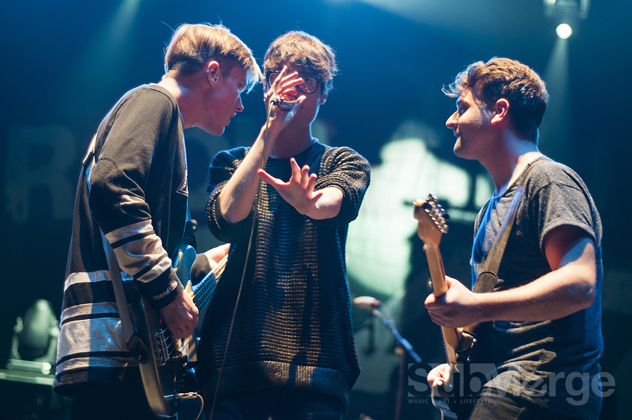
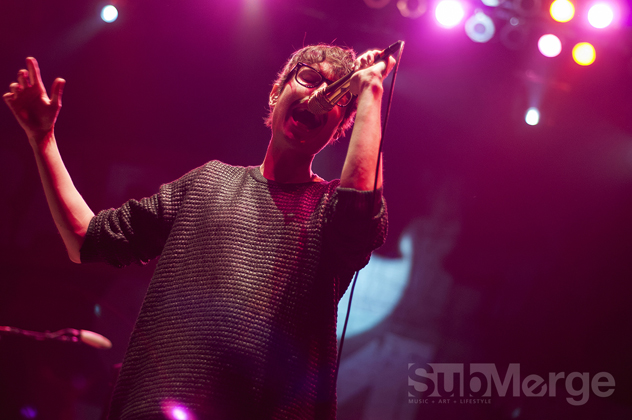
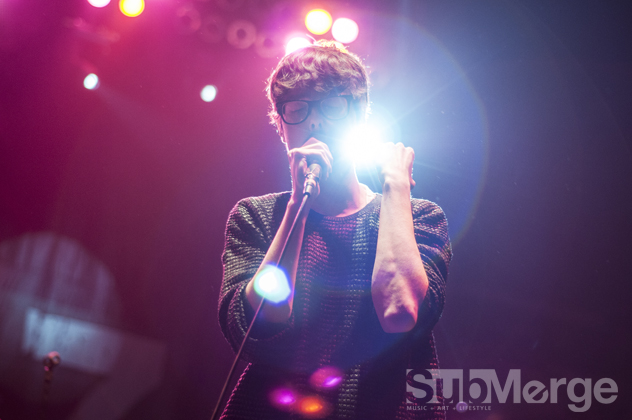
Upstate New York up-and-comers Joywave have made a splash of late with unconventional music videos and a spot on the Earth to Echo soundtrack (a collaboration with Big Data, also sharing the stage). Tonight they hit all the right hooks, showing a natural gift for pop song craft embellished with retro-leaning electronic production. Something about them suggested a younger, mass-appeal Hot Chip. It might have been the insane catchiness of their tracks, or the oddball appeal of frontman Daniel Armbruster (whose narrow mustache became a compulsive focal point when blown up on the Jumbotron).
Vance Joy
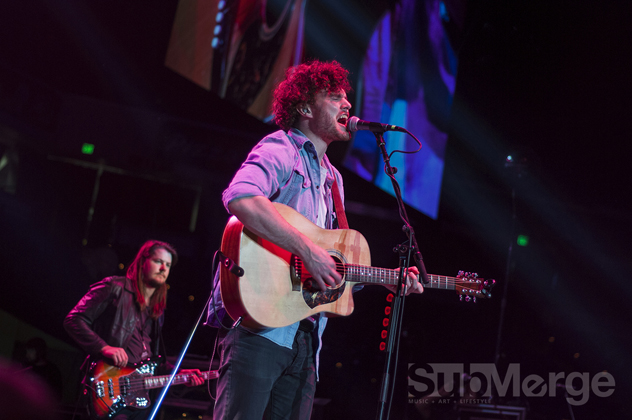

The proceedings quickly took a turn for the intimate with the night’s second performance. Melbourne, Australia,-native Joy repped the folk flag, particularly the brand of bouncy, coming-of-age folk-pop that has become the pre-eminent flavor in millennial music tastes. His set was marked by sincerity and professionalism, briefly turning the spacious arena into a personal venue for the singer-songwriter’s acoustic musings. Despite one small power glitch involving a ukulele during his signature hit, “Riptide,” Joy breezed through his set with grace and left his audience feeling refreshed and relaxed (perhaps too relaxed).
Big Data

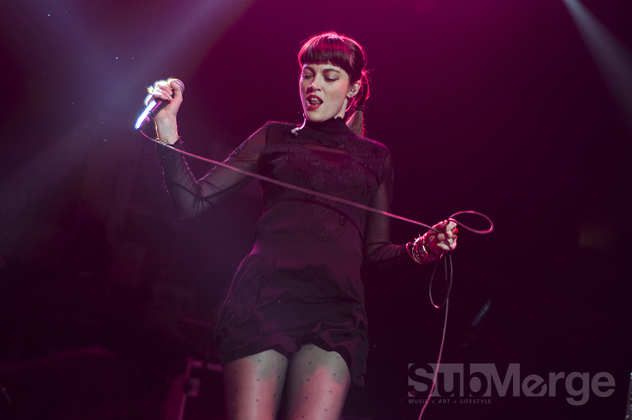
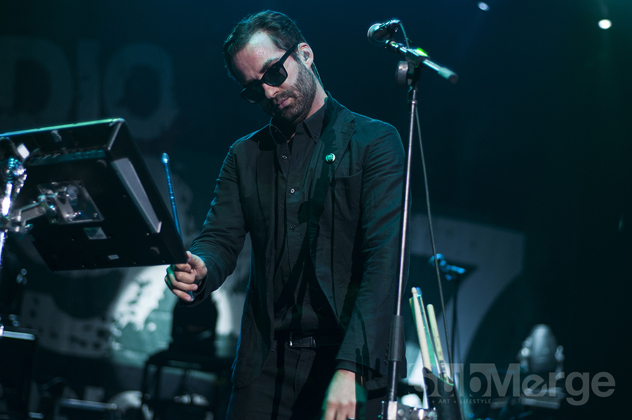
The character of this group asserted itself in charismatic frontman Alan Wilkis (the only permanent member), a high concept (the creeping surveillance of the Internet age) and a talented revolving cast of musicians that managed to complete Wilkis’ vision with their ominous yet party-friendly grooves. Two highlights of the night went to Big Data for the crowd-pleasing single “Dangerous” (featuring Joywave’s Daniel Armbruster) and a high quality cover version of Hall and Oates’ classic “Private Eyes,” its paranoid themes played up for theatrical effect.
Fitz and the Tantrums

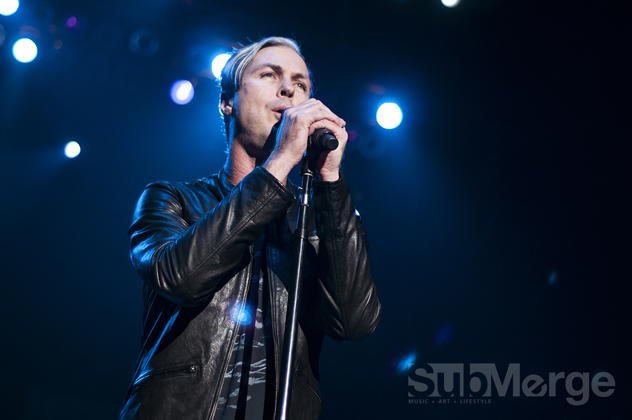
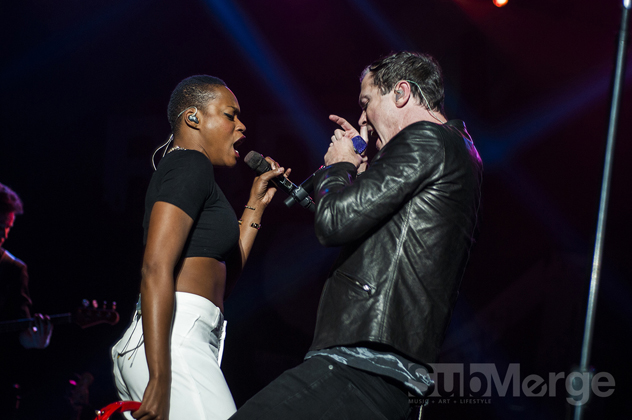
Energy levels spiked somewhere in the middle of Tantrums’ set, their eclectic vibe meshing with every key demographic in the audience. As far as pop acts go, this one had it all, from new wave covers (Eurythmics’ “Sweet Dreams”), baritone sax solos and dirty dancing from front-people Noelle Scaggs and Michael Fitzpatrick. The showmanship on stage primed the audience for a mid-set command for everyone to “get low.” It wasn’t too difficult to get people to comply.
Young the Giant
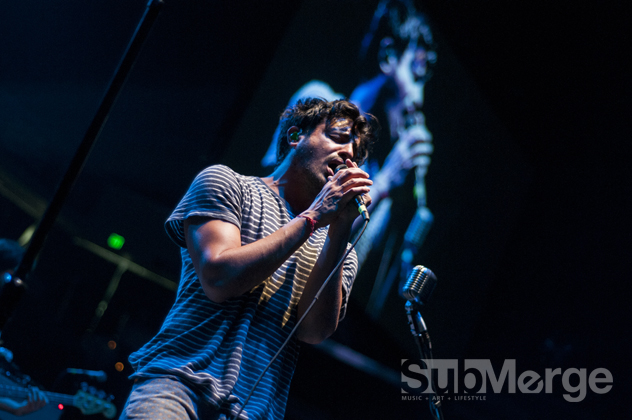
Judging from the intermittent displays of crowd tweets on the Jumbotron, the majority of concertgoers were amped for the penultimate group, whose plaintive, anthemic brand of indie rock had one super-fan behind me belting every lyric. Although the choruses of “My Body” and “Cough Syrup” were undeniably infectious, this set found itself in uncomfortable territory between the comedown from Fitz and the Tantrums’ show-stopping performance and the gradual buildup to the night’s finale.
Bush
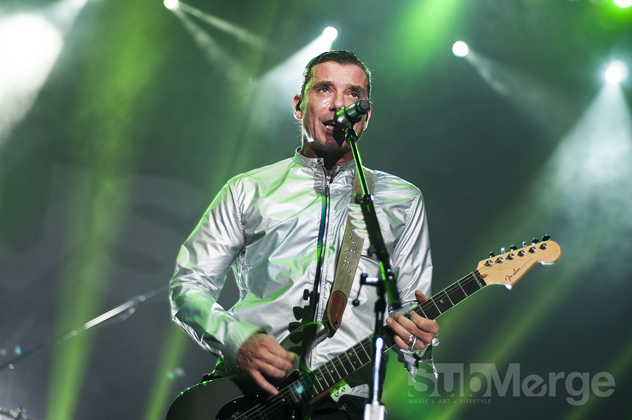
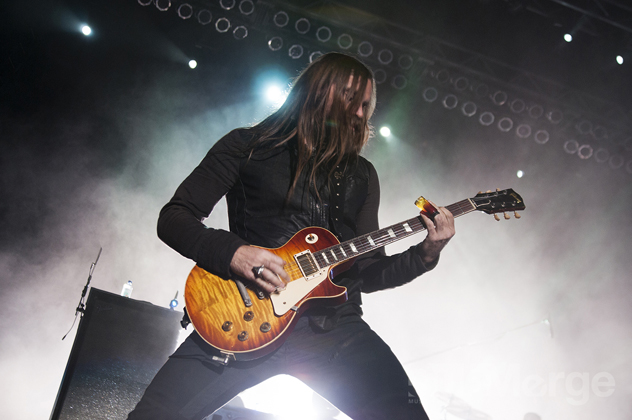
There was an unmistakable changing of the guard at the end of 2014’s Electric Christmas, the crowd in front of the stage becoming densely concentrated while the outer limits of the stands emptied out. Much of this shifting seemed fabricated along generational lines and two distinct interpretations of “alternative.” As the younger, pop-crazed fans appeared to make their way toward the exits, a large minority remained, one who attested to a more abrasive, riff-heavy time for alternative airwaves. In this respect, Bush did not disappoint, introducing old fans to material from their new album Man on the Run while rewarding the grunge-specific pleasure-centers of the brain with buzz anthems “Glycerine” and “Machinehead.” It was the alt way to end the night.
YG, DJ Mustard
Ace of Spades, Sacramento • Tuesday, May 20, 2014
If the name YG doesn’t perfectly ring a bell and summon the image of a tall, skinny completely-tatted-from-the-torso-up MC from Compton, California, I don’t really blame you.
Unless you’re a regular hip-hop head or a longtime fan, it probably just sounds like another rapper confusable with other big names in the game—Tyga, Ty Dolla Sign, Yo Gotti, etc.—who might have had a club song you heard at one time which somehow became your go-to banger on your iPod one summer.
In case you need a refresher, YG is the “Toot It and Boot It” guy, but boy has he come a long way since then.
Whether you’ve realized it or not, YG the Young Gangsta has been putting out hits ever since his fame skyrocketed back in 2010. Most recently, he’s been getting a lot of airplay from his two newer singles “My Nigga” and “Who Do You Love?” off of his first studio album My Krazy Life, released March 18 of this year.
Following the release of the album, the Compton native has been on the road for his nationwide My Krazy Life Tour, having stopped by the capital city this past Tuesday, May 20, to pay his Sacramento fans a visit. Ace of Spades hosted two shows for Mr. G, both of which sold out long before the day of. Fans showed up by the hundreds (or should I say hunnids?) to see the West Coast icon perform.

I attended the second show that night, and I’m happy to say the experience—or at least YG’s set—was about the most fun I’ve had at a concert in a while.
It all started as I turned onto R Street at around 6:30 p.m. and noticed an already long line forming across the street from Ace of Spades, slowly creeping its way over to 14th.
By 6:45 p.m., the crowd from the first show was escorted out and security steadily ushered in the newcomers in waves.
Soon enough, everyone had flocked inside and gotten themselves settled, with people starting to squirm left and right in the sardine-like packed room. It wasn’t until about 8 p.m.—an hour after the show was scheduled to start—that the first of five openers took the stage and officially kicked things off.
With none of the openers being formally announced ahead of time, it seemed like they were just some unknowns filling in slots until DJ Mustard—YG’s beat partner in crime—could make an entrance and really spark some excitement.
Mustard shuffled through his playlist that featured songs such as Tyga’s “Rack City,” French Montana’s “Ain’t Worried About Nothin’” and Kendrick Lamar’s “M.A.A.d City,” at which point his goons came out and unloaded on the audience with Super Soakers. The crowd absolutely loved the gesture, desperately needing a boost from having to wait through so many uninspired opening acts.
After the water gun hijinx, a set piece was unveiled onstage resembling the facade of a suburban-looking house straight out of a hood in Compton—tagged up and all.
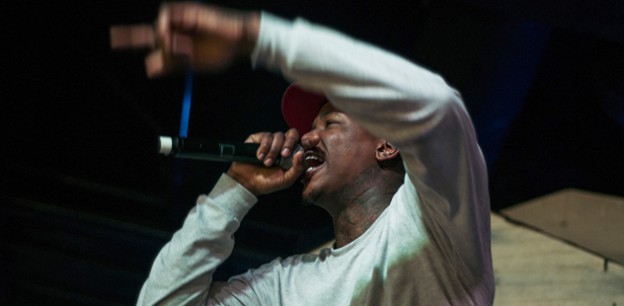
As the lights came down, the music for YG’s opening track “BPT” started to play. Everybody’s camera was raised high in anticipation ready to record, until finally YG stormed the stage through the house’s front door barking the lines, “Nigga I’m from BPT!” as everyone chanted with him and cheered.
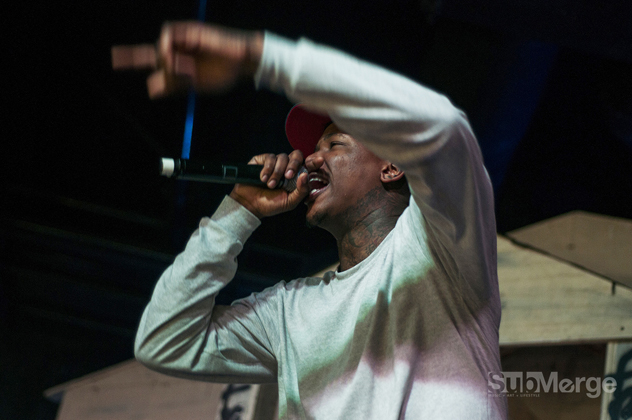
The tone for the show was pretty much set after that. YG rifled through his set with a medley of songs from the album including, “I Just Wanna Party,” “Bicken Back Being Bool,” “Bompton” and “Really Be (Smokin N Drinkin),” not once losing an ounce of energy along the way.
He even touched on some older material from his mixtapes with songs like “B I T C H,” “Bitches Ain’t Shit,” “You Broke” and, of course, his hits “Up” and “Toot It and Boot It,” getting the entire room to dance and sing along.
Though his set was mostly wired with up-tempo dance beats, YG also had some surprisingly slower moments with songs such as “1AM,” “Me and My Bitch,” and a very intimate performance of “Sorry Momma.” These songs were a nice change of pace in the rotation, and very much appreciated by the crowd while they clapped out some of the beats and listened closely as he went a cappella a few times.

But in true YG fashion, the Young Gangsta couldn’t stay quiet for too long. Some of the show’s most notable moments were when he was at his most hyped: calling girls on stage, heading down into the front row, getting two girls to flash him and perhaps best of all, taking an Instagram picture with us as a final send-off.
YG finished his set with his two hottest singles, starting with “My Nigga” and closing with his verse from “Who Do You Love?” The echo of the crowd reciting that final verse with him could still be heard ringing even after everyone made their way out of Ace of Spades’ doors.

Dad’s Sandwiches Celebrates 10 Years…
We’ve been lurking at Sacramento sandwich shops since the Earl of Sandwich was holding it down on 16th among prostitutes and hourly hotels. And though the Earl no longer exists, and one of those godforsaken Goodwill dropoff points has taken its place, there are actually more options for sandos in our great city than ever before. One of those establishments, with an attention to working-class principles and restaurant quality, is Dad’s Sandwiches.
Established in 2004 by a father-and-son duo, Dad’s Sandwiches emerged as one of the premier spots on the south side of downtown. At the time there wasn’t a lot on S Street, and Dad’s success (a combination of blaring rock ‘n’ roll, tattooed sandwich makers and delicious food) allowed them to expand, opening Dad’s Kitchen on Freeport Boulevard. Since then, Rockers DJ Rogers and Mick Stevenson bought the S Street location and opened a second Dad’s Sandwiches on J Street, the 65th and Folsom location was franchised to a longtime worker, and Dad’s Kitchen was sold to unaffiliated investors.
Rogers and Mick Stevenson, aka the “Deli Llama,” helped open the first incarnation of Dad’s Kitchen on Freeport. They met in the kitchen and bonded instantly over sandwiches and metal. “Mick and I,” says Rogers, “we met in the trenches. We bonded, like Ken and Ryu. Dad’s opened in 2004; that’s why we’re celebrating our 10-year [anniversary]. [The previous owner] sold it to us with nothing down, which was nice because that’s all we had. He sold it to us in 2009. And we opened up J Street in 2011.”
“Right when we did buy, it was the start of the downfall of the [economy],” explains Stevenson. “I remember when we were getting to know all these purveyors, they were like, are you guys fucking crazy?”
But Rogers and Stevenson thought of purchasing the S Street establishment as a no-brainer. “No one would hire me,” laughs Rogers, “so it was a simple decision.”
But don’t let simple fool you. The attention to detail reveals more than just a knack for flavorful combinations and fresh ingredients. Dad’s has a consistent menu with occasional changes, which means that their best stuff sticks around to fill your gut. With a recent change of hours at S Street, Dad’s can satisfy the hungry masses for breakfast, lunch and dinner.
To appeal more to the later crowd, they just started serving beer and wine two months ago. The beer list is simple: 24 oz. Pabst, Julian Cider, Lagunitas IPA, Moose Drool Brown and Lone Star—the national beer of Texas. Dad’s is making sure to keep the prices within the working man’s budget, which makes Dad’s my official go-to spot before a concert at Ace of Spades.
“Before when the neighborhood was smaller it was lunch,” says Rogers, who manages the S Street locale. “Now that the neighborhood’s gown up, we’re growing with it.”
Because I had yet to try the breakfast offerings, I recently picked up a Hacienda Hottie at 8:30 a.m. The Hottie, as it is called, was perfect for my spring allergy death match. I was all stuffed up and congested, but as soon as I bit into the bed of eggs, the salty bacon, the rich Jack and cheddar cheeses and the roasted bell peppers and red onions connected with the spicy crunch of the fresh sliced jalapeños, my sinuses cleared right up. That sandwich woke me up, fixed my congestion, and satisfied.
But let’s say you’re more of a traditionalist, a lunchtime sandwich gal. This is where Dad’s shines. I’ve been going there something like quarterly for the last eight years to get a bite, and my default is the Hot Blonde. This toasted beauty is a warm, melted, cool and rich combination of chicken, Swiss cheese and avocado, with onions, spinach and cucumber, layered with garlic spread, mustard and something called pepper plant sauce—which leaves the perfect zing in your mouth, not too spicy, not too bland.
My other staple is the Reuben, which I’d identify as an iconic piece of sandwichness. Dad’s does it right: pastrami, swiss, sauerkraut, brown mustard, house-made thousand island, on toasted organic rye bread. Get extra napkins with this one, and eat it right away while it’s piping hot.
The last piece I want to note is the Angry Roadman. “Angry Roadman sales are slowly picking up downtown,” says Stevenson, who runs the J Street spot. “New people come in all the time. They ask me what to recommend, and I go, I’ve owned this place for five years: Angry Roadman. That says a lot. I eat here every day, and it’s still my favorite sandwich.”
I had to verify his recommendation, and I was happy I did. This hot sando comes with turkey, bacon, roasted red onions, roasted bell peppers, sautéed mushrooms, black olives, tomato and onion with mustard on sourdough. By far this was the highlight of my recent run.
Dad’s has it all: vegetarian, cold, hot, add-ons, chips, delicious beverages, beer, wine and mimosas. They’ve even got a sandwich with walnuts on it.
Yet, while the food is good, it’s the experiences that make Dad’s worthwhile for Rogers and Stevenson. One of the benefits about having a sandwich shop near a rock venue is that they get a lot of perks when they feed touring bands. As Stevenson explains, “I like that the tour managers [when playing Ace of Spades] come to us and trade us [sandwiches for] meet and greets for all the bands that we would pay to see anyways. We met Down, and that was pretty much the greatest day. It was one of the greatest shows I’ve every seen. Seriously. All because of turkey. [The bands] become our repeat customers.”
That music connection is pivotal for Dad’s; most of the employees come from the music scene. When a group of sandwich workers are that passionate about music, there has to be conflicts and fireworks about the legitimacy of certain bands and styles.
Sometimes it even goes beyond the kitchen itself. As Rogers details, “We used to have Sirius satellite radio, and Queensryche would always come on. We had to make a rule: no Queensryche in the deli. If it came on, we had to change the station. Then they were playing at Ace of Spades and we heard they were going to come down here.”
It’s nice that we’re in 2014 and state workers and loud rock can coexist at a sandwich shop. This sort of thing seems inconceivable in the ‘90s. It’s a good sign that the customers don’t complain about the background music.
Rogers explains: “In general they just fucking deal. I know in most restaurants, it would be a sin to play the music we play. It’s not like I play it in the lobby, [it’s in the kitchen]. I’ve got to balance the mental health of everybody back here with the cash flow.”
“In some of our Yelp [reviews],” Stevenson laughs, “they rave about the sandwiches, and then add: Don’t mind the occasional death metal.”
Dad’s just does what they do, and they keep doing it quite well. “If I get someone once,” says Rogers, “I’ve got them forever. I am one with the sandwiches. I know what people want. I have to talk people into what they want. I have to help them out when they’re picky. I’m inside their minds.”
Dad’s Sandwiches can be found at 1310 S St. or 1004 J St. Visit Dadssandwiches.com for hours and more info.

…and the Rockers Who Make Them

Danny Lomeli & Alex Porte
What band(s) have you been in or are you in?
DL: We were in Elysia from 2003 to 2009. Our current band is Summit, and we just put out a new album, Spellbreaker.
How would you describe your sound?
DL: We call it thrash/heavy metal. We are rippers, old-school rippers.
What’s the crustiest thing you’ve done while on tour?
DL: Gatorade bottles are urinals when you’re on the road.
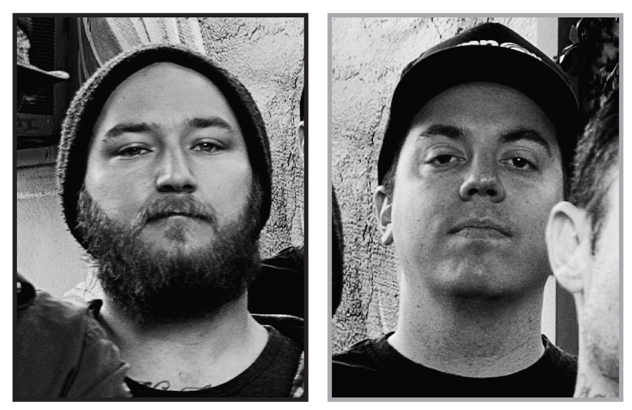
Shann Marriott & Justin Isaacks
What band(s) have you been in or are you in?
JI: I played guitar in a hardcore band called Turn It Around, and we split up in 2008. We did some Canadian and West Coast tours. Played a lot with DJ’s band, Killing the Dream.
How would you describe your sound?
SM: I’m in a slow metal/doom metal band called Church.
What’s the most embarrassing thing you’ve done on stage?
JI: Play guitar poorly—trick people into thinking I am an actual musician.
SM: I wore some denim short shorts at a festival in Tacoma, Wash., where my testicles were shown to the crowd.

Ben Dewey
What band(s) have you been in or are you in?
I play bass for Dcoi. It’s a punk band. We’ve toured the States, toured Europe, toured Canada.
What are European punkers like?
It’s better there. It’s fun. They care more. They care more about the music. They take better care of you. You get paid better. They put you up in hostels, there’s always beds.
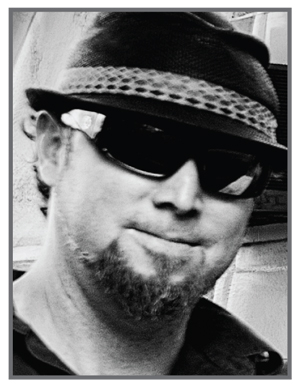
Mick Stevenson
What band(s) have you been in or are you in?
I moved here to play with Mynoc. I still currently play with Sans Sobriety and Nevada Backwards, and I did play in Blvd Park.
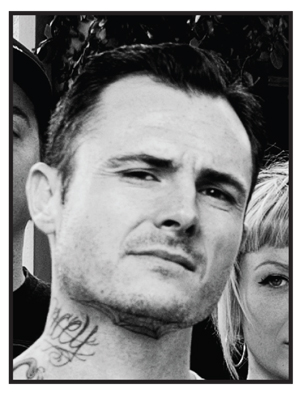
DJ Rogers
What band(s) have you been in or are you in?
I was in Secret Six, The Ballistics, The Romance of Crime, Five Minute Ride, The Roustabouts, Drugs of Youth and Killing the Dream.
What’s the craziest thing that’s happened to you on tour?
I got detained in a country, and I have no idea where I was. I threw a boulder in a lake, and they detained me. They were talking all about jail time and all these fines. I explained to him, “Man, I traveled all this way to tour this country because I think it’s the most beautiful place on Earth. I admire the culture.” And he let me go. To this day, I have no idea where I was.